Supercargo – Thornton McCamish

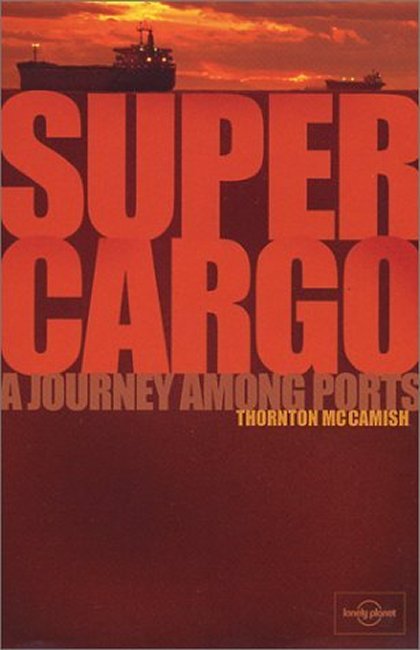
Supercargo is a penetrating and wickedly funny study of a way of life and travel that refuses to die.

That’s what it says on the back cover anyway, I can only assume that whichever marketing person wrote that had had a very generous liquid lunch beforehand and probably hadn’t read the book. There is very little that is actually very funny or even mildly amusing about this book, instead McCamish seems to spend most of his time moaning about how bad the journeys he makes are and the lack of the romance of foreign ports. I did make it to the end to see if it improved but it was a struggle where I abandoned the book several times, which is a pity as up until now I have loved the books from the now defunct Lonely Planet Journeys series.

There are actually three journeys described in the book, the first being a bit of a cheat bearing in mind the books subject as it starts with a flight from London and then uses normal passenger ferries on the western Mediterranean Sea to travel from the south of France to Tunisia and then onto Italy where he bounces around the coast, rather than the cargo vessels implied in the title. The second trip again starts with a flight but does at least use a cargo ship but is also in the Mediterranean although in its eastern side from Italy to Greece then Lebanon, Syria and Turkey before returning to Italy. Nowadays Lebanon and Syria suggest a little danger but this was the year 2000, four years after I visited both countries and they were perfectly safe if a little infuriating when trying to get documentation stamped for onward trips. It should be noted, for those people unfamiliar with the concept, that it used to be quite common for cargo ships to carry passengers and they had cabins of varying quality specifically to do this, with the passengers normally eating with the officers. I remember advertisements for travelling on the ‘banana boats’ across the Atlantic and was very tempted but these were fast ships with luxury offerings and were beyond my means. McCamish was therefore travelling on the very tail end of what was a ‘normal’ way to get around before widespread commercial air travel and the reduction in cargo crew sizes with the corresponding shrinking of superstructure meaning passenger cabins are rarely even included in a modern cargo ship.

I was therefore looking forward to a description of a now largely vanished means of travelling around the world, although it is still possible see here, and to find only the third trip to involve any sort of real distance and that one he missed two possible posts to catch, only eventually reaching the ship at the Canary Islands after flying from the bottom of Italy. This journey consisted of travel on two ships, one down the west coast of Africa to Cape Town with no stops, the second took him along the east African coast to India from Mauritius (which he got to by plane) via Madagascar, Tanzania, Zanzibar and Kenya. This last trip had a captain that really didn’t like the idea of passengers, or possibly this passenger in particular, and frankly I was pretty fed up of McCamish by now and his descriptions of miserable travelling conditions at sea interrupted by brothels and bars on land. I’m sure there is a great book out there about travelling on cargo vessels but this isn’t it. At the end McCamish admits whilst preparing to leave India “Then I would board my plane for the last leg of a sea journey which must have set the record for air miles covered by someone writing about the sea.”

Songs to an African Sunset – Sekai Nzenza-Shand

A fascinating journal of the time in the mid 1990’s when Nzemza-Shand returned to Zimbabwe with her Australian husband Adam Shand. She is a qualified nurse and gained a PhD in International relations whilst living in Melbourne which makes her almost effortless transition back to part time rural Zimbabwean village life all the more interesting. I say part time as Adam lived in the capital, Harare, working as a freelance journalist covering African affairs and obviously she spent time with him in the capital but she appears to have also spent a lot of time apart in the village where she was born and grew up. She only mentions Adam as being in the village during specific events and they clearly spend a lot of time living apart whilst she gets more involved in village life and it is those periods which are the most interesting in this book.

The tale starts with the impact of the AIDS epidemic in Africa and the loss of so many people including family friends and ultimately her brother Charles, indeed it was to attend funerals that first brought her back to Zimbabwe from a comfortable life in Australia. Her descriptions of the simple village life in a part of Africa largely denuded of its forests and wildlife even during her lifetime, of the coexistence of Christianity and ancestor worship, and the poverty of the villages especially compared to the greater affluence in the capital is powerful reading. Polygamy is also normal in rural Zimbabwe with men having many wives and lots of children with each of them which of course adds to the scarcity of food for such large families and the resultant hand to mouth existence for so many she describes.

AIDS rears its ugly head later in the book as well when she is travelling to Omay in the north west of the country to visit the Tonga people who had been displaced from their lands by the creation of Lake Kariba in a hydroelectric scheme. Whilst they had been promised support in transitioning to a new life as farmers as opposed to a semi-nomadic existence alongside the Zambezi River this had barely materialised so they relied on international support including the Australian aid corporation that paid her to go there to evaluate what they most needed. During an evening meal stop she started talking to some local prostitutes who assume that she is also there to work in that trade and they told her that the going rate was $30 for a night at a man’s house, $40 if they went to the woman’s place but they explain that if the man wants sex without a condom then she should insist on $60 because less than that “it’s not worth getting AIDS for”.

I was particularly interested in the rituals described such as the second funeral for her brother at which his wandering spirit is finally at peace and the description of the process surrounding the death of a local chief. There is also a chapter dealing with local law and another chief’s court with justice meted out far swifter than a formal court of law and in the presence of the local people so they could see that all was fair and just. There is so much that is done because it has always been done that way without involving the formal authorities and everything is accepted by the people as right and proper. Anyone who is interested in just how rural Africa continues to operate much as it always has done should read this book and by way of contrast there is a chapter dealing with Nzenza going to a baby shower in Harare, mainly because she had never been to one.

Nzenza left Zimbabwe for a career with an international development organisation based in the USA before returning to Zimbabwe in 2011 and later starting a weekly newspaper column for The Herald, a paper based in Harare, largely continuing her theme of rural life that she started with this book. That column ended in 2018 when she was elected as the Member of Parliament for Chikomba East although she no longer holds a parliamentary seat.

Full Circle – Luis Sepúlveda

Part biography part travelogue this is an interesting book in that it consists of notes that were taken at various times but which didn’t make it into a book, and Sepúlveda didn’t really know what to do with for a long time.

These notes, which I can’t think what to call, lay about on a shelf somewhere gathering dust. From time to time, looking for old photos or documents, I would come across them, and I confess that I read them with a mixture of tenderness and pride, because in these scribbled, or clumsily typed pages I had made an attempt to come to terms with two themes of capital importance, aptly defined by the Argentinian writer Julio Cortázar: understanding what it means to be human what it means to be an artist.

The book starts with memories of being a boy being taken round town by his grandfather, Sepúlveda was born in 1949 so this would be the mid to late 1950’s in Chile, being loaded up with soft drinks and ice-cream until he was desperate to empty his bladder and then taken to whatever church his grandfather had picked as that weeks target and made to urinate on the church door. This would of course be met with approbation by the priest of the church but his grandfather would defend his right to pee where he needed to and would get satisfaction from the insult to the church thus engendered. Eventually at the age of eleven he simply refused to do his grandfathers bidding and insisted on going to a proper toilet. Expecting to be punished for refusing to so his grandfathers bidding he is relieved, in more ways than one, to simply be taken to a bar and after finishing is given a book to read (one of the classics of social realism – Nikolay Ostrovsky’s How the Steel was Tempered) and made to promise to go on a journey inspired by the book and also to his grandfather’s birthplace of Martos in Spain.

After the comic start it was quite a shock to read the next chapter which deals with his time as a political prisoner in Chile as inspired by Ostrovsky he had joined the Young Communists so under the right wing dictatorship of General Pinochet he was regarded as a dangerous radical. The descriptions of the appalling conditions and the allusions to the electrical torture endured including the doctor who could tell how much electricity had been imposed when the victims were returned to the prison and could therefore judge what treatment each prisoner needed to recover are graphic yet needed to be told and I can see why Sepúlveda couldn’t think of what to do with his notes about these three years of his life.

After this the book becomes more of the travel book implied by it’s title with trips out of Chile and into various other South American countries with greater or lesser success in getting to his aimed for destination and the people he met on the way. Including a trip to Patagonia when he was finally allowed back into his home country after years of exile which was originally intended to have been with the British writer and explorer Bruce Chatwin, who had sadly died young and before Sepúlveda could go to Patagonia. This is one of the times the notes had actually been the basis of a book ‘Patagonia Express’ first published in 1995 in Spanish and then in 2004 in English translation. After reading this book I feel the need to get hold of this work and see what it ultimately became. There is a lot more travel writing beyond this trip in the book and I greatly enjoyed following Sepúlveda around the continent.

The penultimate chapter takes Sepúlveda to Spain and a fulfilment of a promise to his grandfather right at the start to visit Martos where he starts searching for anything his grandfather had told him about the place especially a drinking establishment called Hunter’s Bar. He goes to the pub in the central square to make enquiries but the landlord doesn’t recognise the name however older patrons point out that the bar he is in was known decades ago as Hunter’s Bar so he had inadvertently discovered where he was looking for within minutes of arrival. This then leads to him telling the tales as to why he was there only for the patrons to take him en masse to the local church to consult the priest for birth records. There they find not only his grandfather but also his grandfather’s brother who is still alive in the town. Taken to the man’s house he eventually overcomes his nervousness and we go full circle as he introduces himself to his great uncle, Don Angel.

It’s a good read, difficult at times with the description of his time in prison but uplifting so many times after this dark period and I’m glad I’ve read it. It is another of the short lived Lonely Planet Journeys series which as I’ve explained before I bought a lot of when it was clear the series was being discontinued and am only now sitting down to read.

Lonely Planet Unpacked – Various

This collection of twenty six stories of travel disasters by some of the Lonely Planet guidebook writers can be read as a series of useful precautionary tales or just as a very entertaining book where you keep thinking I’m glad I’ve never been there. It was published in 1999 as part of the regrettably short lived Lonely Planet Journeys series and was obviously popular as the follow up volume, imaginatively entitled, Lonely planet Unpacked Again came out in 2001 this time with thirty one travel disaster stories some of which are by the authors also featured in this volume, clearly people to avoid travelling with. The obvious exception to this list of people to avoid is Tony Wheeler, co-founder of Lonely Planet, and a man who has been everywhere so can definitely be excused the odd travel problem and in this book is merely faced by an extremely drunk Tibetan trying to get into the vehicle Tony was in by repeatedly headbutting the windscreen.

Some of the problems faced by the writers are relatively easily solved, such as with Bruce Cameron who uses a wheelchair so is rightly worried each time he arrives at a new location that he can access the bedroom and bathroom and in Tuscany this involves a very helpful landlord at the rented villa removing not only doors but the in one case the door frame and even part of a wall so that this could be achieved. Others are more concerning with Pat Yale travelling alone in Kenya who on her first day in Nairobi fell in a dark hotel corridor and broke her wrist so ending up with four weeks in plaster and heavily restricted as to what she could do. Precautionary tales include John Mock (another writer in both volumes) talking about the dangers of travelling in Pakistan and specifically the Karakoram Highway which takes you to Gilgit in the Hindukush and some amazing trekking routes. Unfortunately the KKH, as it is known, is one of the most dangerous roads in the world with regular rockfalls, an extremely narrow roadway with precipitous drops into the Indus river far below and armed locals who see closing the road as a way of getting what they want. The only alternative, at least when Mock is writing was Pakistan International Airways with their fleet of antique and barely functioning planes, he documents several trips between Gilgit and Islamabad, none of which I would be looking to be on. Amazing he never saw anyone actually crash off that road but Jennifer Brewer managed to go off the edge of a road in of all places Åland, an extremely flat island in the Baltic Sea belonging to Finland, possibly in the only part of the island such a feat could be achieved and with only 8km on her hire car tachometer.

The book bounces all over the world from China to India, various African countries but surprisingly only Brazil is representing South and Central America, a part of the world where I’ve had a couple of dodgy experiences and which I was expecting to be featured more. Sometimes the disaster is self inflicted, more often it’s encounters with other people or animals where the problems arise and for Randall Peffer who describes riding out a hurricane in Puerto Rico it just feels like the world is out to get you. The book is an easy read, I would pick it up go through a couple of the short stories and then put it back down again oh so glad that in my various out of the way journeys I’ve never had to put up with whatever I’ve just read about. Like all the Lonely Planet Journey’s books it is out of print but it, and it’s follow up, are readily available on the secondary market.

Black on Black: Iran Revisited – Ana M Briongos

Ana Maria Briongos is a Catalan writer from Barcelona who first went to Iran for the academic year of 1973-74 to study Persian but this book is mainly about a month long return journey she made in April 1994 where she catches up with old friends from twenty years ago. The book is interesting because of the contrast she is able to provide between life in the last days of the Shah against post revolutionary Iran and importantly it also gives a female perspective of the restrictions and some benefits of the strict Islamic life that she encounters on this revisiting. I chose to read the book as a modern follow up to ‘The Road to Oxiana‘ which I enjoyed so much last month and it gives a view that is much more familiar to me as it is set just four years before I was to visit Iran.

A woman travelling on her own has to know how to look after herself and be respected, which means dressing appropriately and using common sense. Travelling on her own a woman has access to places where a man could never go.

This is particularly true in the Middle East, especially Iran, and Briongos takes us to some of those places but particularly we visit friends and their families especially Bahman who hosted Briongos in Tehran and drove her to various places outside the capital during the thirteen day festival that coincided with her arrival, so getting to know Iranian family life, the jealously guarded recipes for specific foods which each Iranian housewife puts out to impress visitors and the tight knitted relationships across generations. In particular we are introduced to Rave and her grand-daughter with Down’s Syndrome Bubu, these two would be constant characters whenever Briongos was in Tehran during April 1994. Rave was one of the wives of Bahman’s father and had become a sort of mother hen for lots of his children regardless of which wife was actually their mother. She was very unwell and trying to get treatment in Europe which at the end of the book we find that she does succeed in doing before ultimately emigrating to Australia with Babu and Babu’s mother, whom we never actually meet because she was living in Hamburg. It is good that things worked out for Rave and Babu you really feel for both of them as the narrative progresses.

Interspersed with the account of the trip in 1994 are lots of memories of her first visit to the country both retelling of stories from then and also trips such as going back to the university where she studied two decades earlier only to find that she couldn’t go to the building where she lived then as it was now male only whereas before it was strictly a female domain, wanting to at least go somewhere familiar from that time she ventures into the library only to encounter a professor who had taught her all those years ago and who promptly whisks her off to the park over the road where they can chat and catch up more freely. It’s the personal touches that really make this book so enjoyable to read, you really feel as though you are with her on this trip back into her past.

This was Briongos’s first book, published in 1996, although she has written ten more since then about her times in Afghanistan, India and further trips to Iran. My copy is the first English translation published in 2000 as part of the Lonely Planet Journeys series, a now defunct series of travel books which I really enjoyed whilst they existed due to their eclectic range and focus on personal stories. When I discovered the series was being killed off I bought as many of the titles I didn’t already have as I could find and this book was one of them. Twenty years later I have finally opened it after it sat on the shelves waiting for me to get to it and I know there are still a couple of that batch of books I bought all in one go that are still waiting. I enjoyed this book so much that I suspect they will not have much longer before I finally get to read them.

Shopping for Buddhas – Jeff Greenwald

The book starts in October 1987 with Jeff and his girlfriend caught out by a violent snowstorm in the mountains at Gosainkund in the Langtang national park about 30 miles north of Kathmandu. They eventually make their way down through the deep snow that obscured all the paths along with a German couple and their guides and Jeff decides that to mark the escape he wants a Buddha statue, but not just any Buddha statue it must be the best he can get for a budget of up to $300. Kathmandu and the neighbouring city of Patan are covered in small shops selling Buddhas along with a vast range of Hindu and Buddhist gods of which there are thousands to choose from but the quality varies dramatically and the very best pieces are rarely on the shelves but secreted away for collectors in back rooms.

Ostensibly the book is about Jeff’s search for the perfect Buddha and his frustration with minor, and sometimes major, errors in the proportions or features. To positively identify a figure as Buddha it needs to pass the thirty two significant traits along with eighty less significant ones and he lists seventeen of these to give some idea as to the level of detail he was looking for, such as the wheels marked on the feet and the lotus blossom and conch shell trumpet on the palms. There should be a mole like mark between his eyes known as the urna and the eyes themselves should be centred and slightly downcast. The list goes on and made finding his perfect Buddha extremely difficult. I say ostensibly though because the book is a lot more than an extended shopping expedition over a period of about seven months, we also learn something about the lives of the Nepalese and the corruption, narcotic abuse and police brutality that they are subjected to.

A lot of the narcotic smuggling into the country and artwork and antique smuggling out is blamed on members of the royal family by Greenwald who at the time were untouchable as rulers of the only Hindu kingdom which they ran like medieval monarchs not subject to any aspect of the laws of the country. He speaks to many people to confirm this and is duly warned off by others including a smuggling boss. He also refers to an Amnesty International report of human rights abuses in the country where anyone can be locked up for months at a time without recourse to any legal process and when they are released can be arrested again the next day to be subject to more beatings and torture at the hands of the police and prison authorities. To the outsider Nepal is a paradise, to the locals it could often be a prison and a particularly awful prison at that.

The final chapter in the Lonely Planet edition was written six years after the book had first been published in America in 1990 and deals with the change of the political situation after the king was forced to move towards a more constitutional rather than absolute monarchy in 1990 but even then the power of the monarchy was still overbearing. This would be illustrated by the royal massacre of 2001 when Prince Dipendra used an automatic rifle to murder the King, Queen and seven other members of the royal family at a party before apparently shooting himself. During the three days he survived he was declared King and therefore immune from prosecution before dying and the monarchy passing to his brother Gyanendra. Dipendra and Gyanendra are named in Greenwald’s book as the heads of the smuggling operations in the country. In 2008 the monarchy was deposed and the worlds only Hindu kingdom became a federal republic.

Ten years after Greenwald’s marathon shopping trip, which did result in him buying a Buddha although for considerably more that his original $300 I was also in Kathmandu and whilst I didn’t have the budget that Jeff Greenwald had, after all I was there to go trekking in the Everest region and that cost enough, I was also captivated by the metal casting craftsmanship displayed all over the city. Although like Jeff I also found that there was a lot of dross to pick through before finding the perfect figures made of brass and bronze which are now on the mantelpiece in my bedroom.

The Buddhist gods and goddesses I purchased during my visit to Nepal in April 1997, from left to right;
Kharachheri – A form of Bodhisatwa Avalokiteswara, known as the six syllabled Lokeswara “Om Mani Padme Hum’ which is carved on rock faces and chanted all over Nepal.
Mayadevi – The mother of Siddhartha Gautam
Green Tara – The spiritual consort of the Dhyani Buddha and is incarnated in all good women

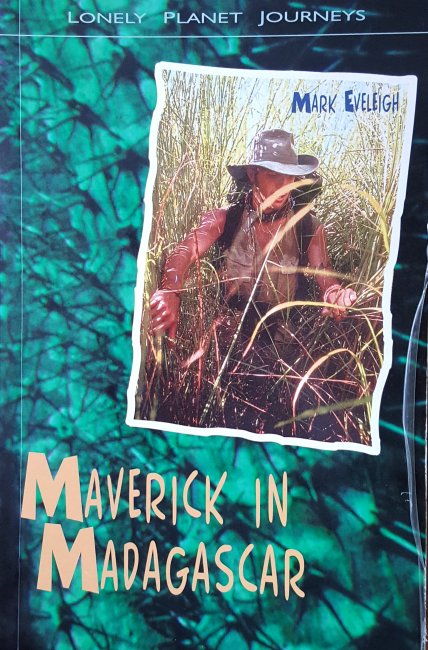
Maverick in Madagascar – Mark Eveleigh

This is not my own lie. This is a lie that the ancestors told me

Mark Eveleigh opens his book with this traditional start to any story being told in Madagascar as he describes his plan to walk from north to south along the western coastline of the fourth largest island in the world and before you even get to that original plan you know that he doesn’t succeed because the maps at the very beginning of the book only show less than a quarter to that route. Instead there is a second map relating to Part II of the book where he heads across the middle of the country in a search for the Vazimba tribe who are a group of white pygmies not seen for decades or even centuries and this may be because the various tales relating to them describe them as alternately not short and not white. This is going to be a difficult hunt.

That his original plan was doomed almost from the start was due in part to the late rainy season which made the going even more difficult that it should have been and the fact that, despite his intention to purchase a horse as a pack animal for his equipment, all the horses in the north of the country appeared to have succumbed to a mysterious disease and died in the few months before he got there. Instead he decides to buy Jobi the bull zebu (a local breed of humped cattle) and despite warnings that nobody could drive a zebu that far decides to set off in the company, at least initially, of a couple of locals who were taking two cows for slaughter part way down the route he would have to follow,

Mark is an entertaining writer, particularly when describing his own discomforts, and there are plenty of those especially in Part II where he gets poisoned by various plants that he is walking through and has recurrences of the malaria he first caught in Indonesia whilst trying to avoid being shot by bandits. He is also an excellent photographer so it is somewhat disappointing that despite frequent references to taking photographs the format of the Lonely Planet Journey’s books doesn’t allow for pictures apart from on the cover as you so want a few pages of images especially when he describes a breathtaking view. He also clearly bonded with Jobi during his aborted trek and is genuinely upset when the walk has to be abandoned partly due to Jobi getting unwell so he sells him for a significant loss to a family that will take care of him rather than the higher offers from others where his lifespan is likely to be considerably shorter.

What stands out through the whole book is the welcoming and friendly nature of almost all the Malagasy people he meets, apart from the bandits, and their determination to share what little they have despite Madagascar being one of the poorest countries on Earth. Their astonishment that a Vazaha (literally outsider) has made it to their isolated village, quite probably the first white man that the children at least have ever seen, is an ongoing theme. Madagascar does have its tourist traps but they are few and far between and due to the danger of travelling especially in the zone rouge in the middle of the country tourists tend to be restricted to these small areas and mainly to an island off the west coast which Mark visits in order to complete paperwork and send letters but gets away from as quickly as possible. It’s a really good read and I definitely recommend it.

Lonely Planet Journeys was a relatively short lived series of travellers tales published by Lonely Planet between 1996 and 2002, I really enjoyed the eclectic selection and when it became clear the series was coming to an end I bought up as many different ones as I could find in my local bookshop and in all have twenty five titles. There doesn’t appear to be a definitive list of all the book published under this imprint, the LibraryThing list has forty seven titles but includes several books that were not actually part of the series so I’m guessing that I’m missing no more than ten actual books from the set, probably quite a bit fewer than that. This one has been sitting unread on my shelves for twenty years so it was about time I finally got round to picking it up. I have read most of the ones I have now but whilst checking the shelves for the date range and the tally of books there are at least two that I have no memory of reading so they will probably appear sometime in the next few months.