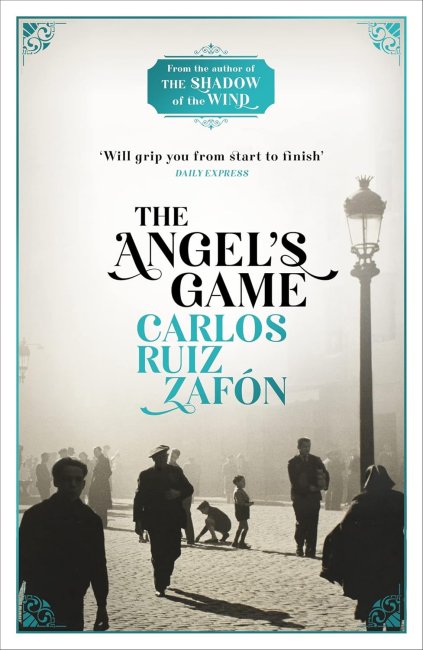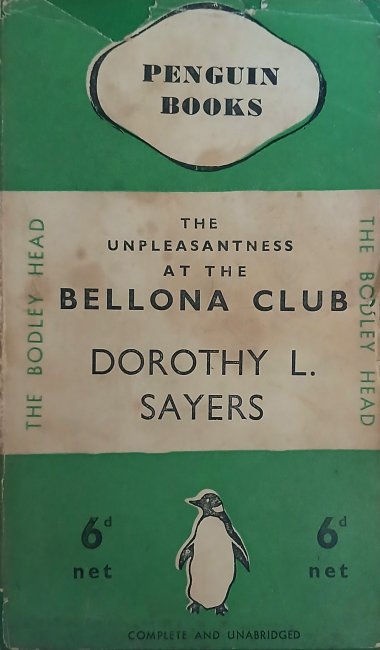
The Unpleasantness at the Bellona Club – Dorothy L Sayers

This post is going live on Remembrance Day 2025 so it is appropriate to feature this Lord Peter Wimsey crime novel as the body is discovered on the 11th November and the fact that it is Armistice Day, as it is called throughout the book, is vitally important to the plot. This is the fifth of the original ten Penguin books published on 30th July 1935 that were the start of the company and which I started reading in their first editions in August, the remaining five will be covered between now and July 2026. This book was originally published in 1928 and is the fourth title featuring Sayers’ amateur detective Lord Peter, I have previously written about her twelfth novel Busman’s Honeymoon and a collection of short stories, some of which feature Lord Peter, Hangman’s Holiday.

I’ve always liked the Lord Peter Wimsey books since watching as a child the television series featuring Ian Carmichael in the 1970’s and this, whilst not one of the best, is a really good read. As can be expected the initial unpleasantness at the Bellona Club is the discovery of the body of Colonel Fentiman in his customary chair by the fire in the club on the evening of the 11th November still clutching his newspaper which he was wont to doze under soon after arriving in the morning. He was after all in his nineties so the death, apparently of heart failure, was not entirely unexpected although unfortunate. To the club members however the unpleasantness was to continue for several more weeks due to the wording of both his and his sister’s wills, as she had also died on the morning of the 11th. The Colonel’s will left the majority of his estate, some £2,000 (roughly £110,000 today) to his youngest grandson George with the residual going to his other grandson Robert on the basis that George as a married man suffering from shell shock after WWI needed the money more than Robert who was still single and a Major in the army. His sister, Lady Dormer, however drafted her will so that her estate, which had come to her on the death of her wealthy husband, and was worth around £700,000 (about £38 million today) would mainly pass to the Colonel if he was still alive when she died but if he predeceased her the vast majority would go to Miss Dorland who had been her companion for many years. It was therefore vitally important to establish exactly when the Colonel had died as if it was before 10:37am, when Lady Dormer had passed, then Miss Dorland was now extremely wealthy and if it was after that time then Robert Fentiman, gaining the residual after George had his £2,000, would be the one to gain.

But that is somewhat leaping ahead, Lord Peter is a member of the club and a friend of George and was acquainted with the Colonel and Robert. A the book begins the club was busy as a lot of members had come to London for the Remembrance Day event, Lord Peter and all three of the Fentiman family were at the club, Robert was staying there as he didn’t live in London whilst George and Lord Peter met in the bar that evening, the Colonel, as previously mentioned, either dozed or had died but had not yet been discovered in his chair by the fire but was about to be. Fortunately when Colonel Marchbanks found he was addressing a body Dr. Penberthy, the old man’s physician was also at the club and he and Wimsey moved the body to one of the club bedrooms noticing one thing odd in that the left knee of the corpse moved freely indicating that rigor mortis had begun to pass off but strangely only that joint was free.

That should have been the end of the story for Lord Peter but Mr Murbles, Peter’s solicitor and also the representative of Colonel Fentiman called several days later to advise him of the conflicting wills and asked him to make some discrete enquiries to try to establish when the old man had died. But how to establish when a man’s heart had given out precisely enough to reconcile the issue and both Fentiman brothers were acting rather oddly. Peter begins to suspect foul play…

The sixth of the first ten Penguins is ‘The Mysterious Affair at Styles’ which I have already reviewed as The Strange Case of the Sixth Penguin Book where I explain why there are two books with that number so the next book to be covered of this group will be Twenty-Five, the autobiography of the young Beverley Nichols.

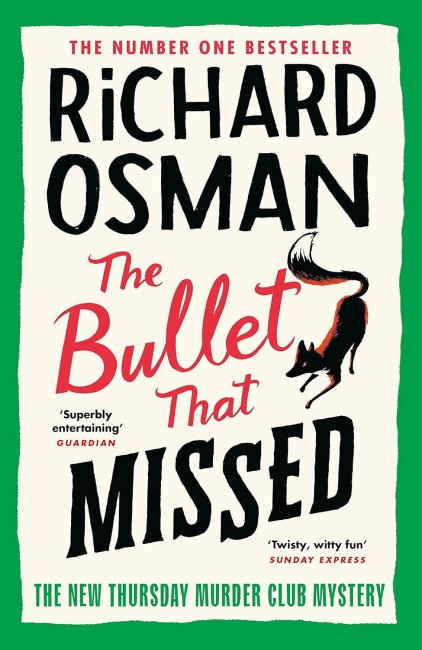
The Man Who Died Twice – Richard Osman

Earlier this year I read Richard Oman’s first novel and thoroughly enjoyed it, so it really was only a matter of time before I got to the second one. This continues the story of the four residents of a senior citizens residential village who originally got together to discuss unsolved murders and have now moved on to solving various current crimes, invariably including murder but not exclusively. One of the things I really liked about this book was the development of the characters from their first adventure, we gain quite a lot of new information on everyone, especially former spy Elizabeth who we now know as Dame Elizabeth Best, the title implying that she was even more senior in the service that previously suggested and from other comments that she had a reputation as one of the finest in her field. Fiery ex trade union leader Ron gets to show his gentle side as his grandson comes to stay, as well as becoming a highly effective ‘field operative’ for the Club and Joyce is braver and more intuitive than previously expected, although still so innocent that she chooses a combination of an old nickname and the year her daughter was born giving @GreatJoy69 as her Instagram user name, fortunately she can’t work out how to access her private messages. Her diary is again used as a mean of filling in story as she can review the days occurrences it’s a clever use of first person narrative in largely alternating chapters throughout the book. Ibrahim, the semi-retired psychiatrist, gets seriously mugged and kicked in the back of the head early on in the book and this puts him off leaving the retirement complex, or even his flat there, for a large part of the book. But it also drives the others to come up with a way of exacting revenge on his mugger in a way only they, and certainly not the police, could.

The remaining three have their work cut out dealing with £20 million worth of diamonds, the American mafia, an international crime go-between, a drug dealer, Elizabeth’s old employer MI6 or possibly MI5 it’s not made clear, and even Elizabeth’s ex husband whom he hadn’t seen for twenty years amongst others. Like the first book the plot is fast paced, full of twists and turns and the body count is surprisingly high for a book about four pensioners. We also find out more about the two local detectives who seem to have been seconded by the Club, Donna and Chris; along with the ever useful Polish builder Bogdan who has certainly gone up in the world since he killed off his main local rival in the first book and therefore got a lot more lucrative work. The book is full of humour as well, again not laugh out loud jokes, but humour nevertheless, it really is a fun read which is probably why less than twenty four hours after starting a 444 page book (I have the Waterstones edition with the extra chapter) I have finished it and am writing this blog.

The fifth book in the series came out last month and is of course already a bestseller, it seems that Osman can do no wrong with his septuagenarian detectives, although Ibrahim at least is now in his eighties and I hope to read many more books about them all. By the way I checked out the Instagram account and it is registered as belonging to Joyce Meadowcroft from the book, well done Richard Osman or possibly Penguin Books for not only having the account but posting pictures of her dog Alan and trips out exactly as I would expect Joyce to do. Much more sensible than Douglas Adams who used his own phone number in the first Hitch-hikers Guide to the Galaxy book and had to get his phone number changed when people started ringing it.

The Game-Players of Titan – Philip K Dick

The book is set sometime in the 22nd century, we know this as the year 2095 is mentioned as occurring in the past. Earth has been involved in a terrible war which has led to massive depopulation to between one and two million people over the entire globe, and due to radiation poisoning a significant reduction in fertility of the survivors. The planet is now administered by the Vugs, a race of telepathic beings from Saturn’s largest moon Titan who ended the conflict and whilst not seen as occupiers of Earth they are always around. Amongst the survivors are the maybe a couple of hundred thousand Bindmen, owners of huge swathes of cities and states and their non-B residents. The Bindmen play The Game putting title deeds to their properties and even their wives as stakes in the game which is encouraged by the Vugs who both love gambling and recognise that constant swapping of partners enhances the chances of a fertile couple meeting. The story starts with Pete Garden loosing not only his favourite property, the city of Berkeley in California, but also his wife Freya and to top it off has failed to throw a three which would allow him to take another wife. To make things more on edge Pete is already a drug addict and known suicide risk having attempted to take his own life on four previous occasions.

When Pete recovers from his latest low after losing the game he visits the winner and asks to buy back Berkeley only to find it has already been traded to an American East coast player called Jerome Luckman, a man who having won most of that side of the country was looking for a way in to play on the west coast and Berkeley was to be his opening stake. Pete meanwhile moves to another of his properties where he meets a telepathic non-B female resident who has been surprisingly lucky and has three offspring and he hopes to seduce her or possibly her prettier eighteen year old daughter. That evening though Pete throws a three and is immediately married to another partner just before Luckman arrives to play the game with Pretty Blue Fox as the game group in California is known and wins so consolidating his position.

But then there is a murder and The Game is going to completely change with everything you know, or think you know drastically altered…

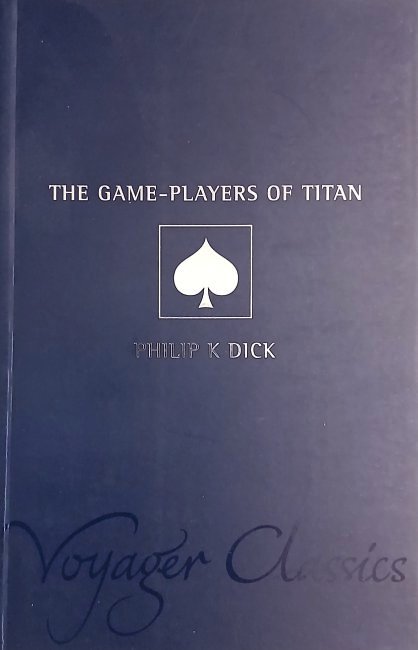
Voyager Classics was a relatively short lived series of science fiction and fantasy books from Harper Collins all with the same blue and silver cover design, with French flaps and a different small, but sort of appropriate, image in the box on the front along with the spine. In this case the ace of spades even though the game they play in the book, Bluff, is clearly a board game. At the time of writing Harper Collins still list two titles in this series on their website, however only one of these has this rather attractive cover design. The Game-Players of Titan is book ten of the thirty six listed titles at the start of the book and they must have all been released, or at least announced, simultaneously in 2001 as this is the first edition. The initial set includes the three Lord of the Rings novels along with The Silmarillion making Tolkien the most represented author, but Ray Bradbury, Stephen Donaldson, David Eddings and Kim Stanley Robinson each appear three times. Philip K Dick has one other titles in the first thirty six, ‘Counter-Clock World’.

As you can see from the title image the cover is rather glossy and difficult to photograph so I did a search on Google to see if I could find another image of the Voyager Classics edition. I did, but the title is subtly different, missing the ‘The’ and also the hyphen in Game-Players. I have no idea if this is a later erroneous edition or what but it is an interesting oddity.

The Stainless Steel Rat – Harry Harrison

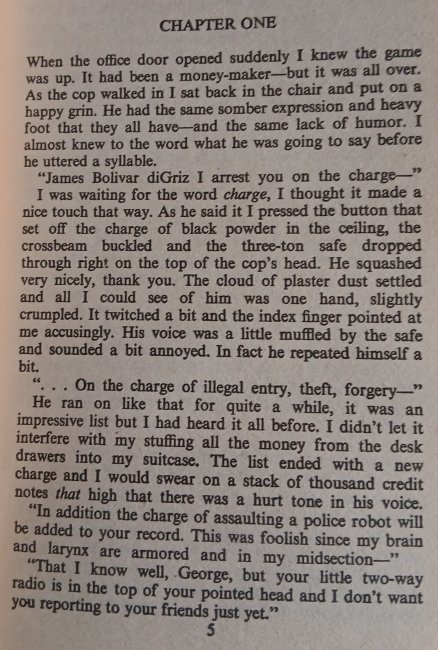
A few weeks back I featured a book written by Harry Harrison ghost writing as Leslie Charteris in the first ‘Saint’ book written by someone other than Charteris and that prompted me to look on the shelves for something where Harry Harrison was properly credited. That led me to a series of books I bought, and probably last read, back in the mid 1980’s and Harrison’s most famous creation The Stainless Steel Rat. There are a dozen books in the series and this was the first, it is based on a couple of short stories originally published in Astounding magazine in 1957 and 1960 which were linked and expanded to make the novel in 1961. The best way of introducing the character of Slippery Jim diGriz, alias The Stainless Steel Rat is to read the opening page of this book.

I like the way it is only revealed that the policeman is a robot after the safe is dropped on him, in fact The Stainless Steel Rat is proud of the fact that for all his criminal escapades he has never killed anyone. The stories are set in the distant future and on various planets far from our own, this is pure science fiction fantasy with a heavy dose of humour mixed in for good measure. As is stated in the page shown DiGriz is a career criminal, something of a rarity in this version of the future where children are scanned for any tendency to not be upright law abiding citizens and ‘corrected’ before adulthood. The crime he was committing at the beginning of the book was a simple one, rent a warehouse next to a government storage site, which is full of food but intended for emergencies so rarely visited, cut a hole in the wall and help himself to the goods, relabelling everything so it isn’t obvious it has come from the next door building. Using robots to do the work meant he could keep the money rolling in 24 hours a day without having to do any menial work himself.

Escaping from the police raid using a carefully planned route DiGriz soon starts another caper, this time the theft of an armoured car carrying the takings from a large department store, this is done in quite an ingenious way but this time someone was out thinking him every step of the way and he finds himself trapped. This is his first encounter with Special Corps, an interstellar police service headed by Harold Inskipp, who was a legendary criminal before DiGriz turned to crime and was assumed to be locked up somewhere as he hadn’t been heard of for years, instead he had been recruited to run Special Corps and now he wants DiGriz to add his special talents to the organisation.

I won’t go into too many details of the plot, it’s quite a short book, just over 150 pages, and can be read quite quickly, suffice to say that in the course of the novel DiGriz meets his future wife and mother of his twin sons although this won’t happen until the next book ‘The Stainless Steel Rat’s Revenge’, I have half of the Stainless Steel Rat books along with several other books by Harrison including one of his few books not to funny, Make Room! Make Room! which would be loosely adapted into the superb dystopian 1973 film Soylent Green, a very early warning on the dangers of the greenhouse effect and overpopulation. I have to admit that I prefer Harrison as a comedic writer with a strong streak of anti-authoritarianism thrown in.

The Thursday Murder Club – Richard Osman

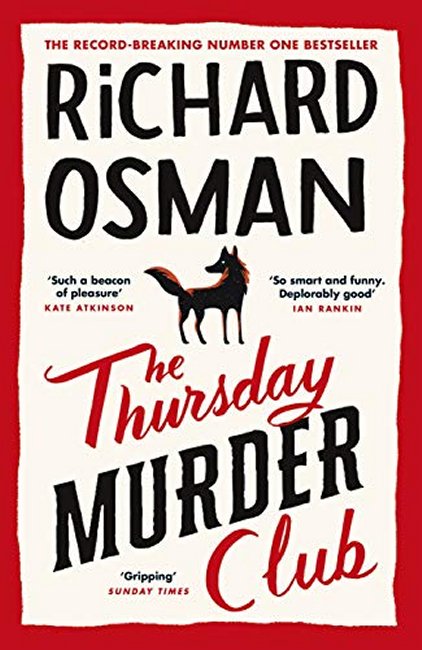
Whilst browsing the shelves of the local charity shop I spotted this book and picked it up immediately as I had been told several times that I would like it and the various people who recommended it were quite correct as I read the 377 pages over the space of two evenings. I probably would have read it in one go but there is a natural break point at page 172 and I decided to follow the structure of the book and reflect on what we had been told so far and the latest surprise murder that had just occurred.

Richard Osman himself helpfully summarised the four members of The Thursday Murder Club and what the club is all about in his notes for American reading clubs:

I am writing to you from England, home of Agatha Christie, Hugh Grant, and books about being murdered in quaint country villages.
Welcome to ‘The Thursday Murder Club,’ a group of very unlikely friends in their mid 70s. There is Joyce, a quiet but formidable former nurse; Ron, a retired Labour activist, still on the look out for trouble; Ibrahim, a psychiatrist and peacemaker, and Elizabeth, a . . . well no one is quite sure what Elizabeth used to do, but she seems to have contacts in very high places.
Once a week our four unlikely friends, all residents in a luxury retirement community, meet up to investigate old unsolved police cases—usually accompanied by friendly arguments and many bottles of wine.
One day the peace of their community is shattered by a real-life killing, and ‘The Thursday Murder Club’ decide they are just the people to solve the case.

For a murder mystery it’s quite funny with the interaction between the various characters being beautifully written as an example there is one murder where the victim was injected with Fentanyl whilst in close proximity to sixty odd residents of the retirement village and Joyce says ‘It would have to be someone with access to needles and drugs’ only to be told ‘That’s everyone here’ by Elizabeth, simply pointing out that due to age a lot of the residents are self medicating for diabetes amongst other conditions and what would normally be seen as a clue in this case definitely isn’t. But there is a lot of wisdom and experience in our team of self appointed detectives and with Elizabeth’s range of contacts all over the place they can do things the Police can’t either because they would be too obviously looking into things or because it would be either illegal or nearly so. Chris and Donna, the police officers assigned to the original murder gradually come to respect the Thursday Murder Club and their effective, if unorthodox, methods of getting information. The clues range from decades old gangland killings to links with Cypriot criminal families and always the club members are at least one step ahead of the police. I don’t want to say more in case I accidentally say too much but I heartily recommend The Thursday Murder Club and I suspect that recommendation would also apply to the subsequent novels that Osman has written about them.

This was Osman’s first novel, which he wrote over ten months whilst keeping the fact he was writing it a secret from most of the people who know him. But when he revealed its existence to publishers there was such a bidding war that he had a seven figure advance from Penguin Random House to get the book for their Viking imprint. Until the smash hit of his Thursday Murder Club series of books Osman was better known as a television producer, initially for Hat Trick Productions and then as Creative Director of Endemol. During which time he created the TV quiz Pointless for which he ended up the other side of the camera for the first time as the co-presenter after taking the role in the demonstration version for the B.B.C. and then worked with Alexander Armstrong on the programme for twenty seven series before quitting to concentrate on writing.

Vendetta for The Saint – Leslie Charteris

I reviewed the second ‘Saint’ book back in January 2019 and in that explained who Leslie Charteris really was, a Singaporean called Leslie Charles Bowyer-Yin, and said I’d keep reading the thirty books I had about The Saint and only review one if it strikes me as interesting and here it is. I explained six years ago that Charteris stopped writing the books after thirty six years, starting in 1928, and they were instead ghost written by various authors, well this is the first of these ghost written books from 1964, and as you can see by the cover it clearly claims that it is a work by Charteris indeed there is no mention that he didn’t produce it anywhere in the book and neither is there any mention of the real author, in this case American science fiction writer Harry Harrison. It may seem odd that Harrison wrote a Saint novel, and this is the only one he did, but he had been writing the American comic strip adaptation of The Saint for several years before he was let loose on a full blown work. In theory Charteris was now solely the editor of all the future Saint books and he said that he did a lot of work on them, but Harrison claimed he had minimal effect on this final work. I’m inclined to believe Harrison in this as the novel, despite being published by a UK company, Hodder & Stoughton Ltd, it is full of Americanisms which I’m sure Charteris would have replaced if he had actually done a proper editing job. The Saint is quintessentially English and certainly wouldn’t have referred to the fender or hood of a car or described driving down the pavement rather than the road as occurs in this book, just to give a few examples.

Quibbles regarding language aside this is actually a pretty good Saint story and the first one for many years that is a full length novel rather than a collection of shorter stories. The Saint is on holiday in Naples when he witnesses a violent altercation at a nearby table in a restaurant, stepping in to prevent further injury to the surprised English tourist, Mr Euston, who had simply greeted the person at the table as an old friend, although they claim he has made a mistake. The next morning he reads in the newspaper that Euston has been found dead and The Saint finds himself unwittingly caught up with the Mafia because the person Euston apparently recognised is a senior mafioso and they are determined to put him off following up Euston’s murder. Now The Saint isn’t about to be told what he can and cannot do and his holiday needed some excitement so this only increases his interest in trying to find out what is going on. and being a somewhat Robin Hood type character he isn’t above using criminal means to do so. I really enjoyed the story, which bowls along at quite a rapid pace with The Saint caught between the Mafia and the local Police Forces and it all comes to quite a satisfying end.

Incidentally when the book came to be filmed as part of the TV series starring Roger Moore it was made in Malta as the TV company thought filming a defeat of the Mafia story in Naples or Palermo wouldn’t have been a wise decision.

Artemis Fowl – Eoin Colfer

This is the first of an eleven book series written by Irish author Eoin Colfer, eight of which are about Artemis Fowl II and in the final three books, which are effectively a reboot, his twin younger brothers. My copy is a hardback from the first year of publication, 2001, and has a metallic, highly reflective dust jacket which made it very difficult to photograph. Later editions retain the gold colouring but are not metallic. At the start of this book is an introductory prologue which finishes as follows:

Artemis Fowl had devised a plan to restore his family’s fortune. A plan that could topple civilisations and plunge the planet into a cross-species war.
He was twelve years old at the time…

This last line, more than anything else in the prologue, establishes that we are in the literary genre known as young adult, which is not a area I have explored on this blog for a while so please be aware that this book is not aimed at me as a typical reader. Having said that I quite enjoyed this, and the next two books which I have also read, I have also discussed the series with other people who first read the books whilst they were within the target age range of roughly twelve to eighteen to obtain a more rounded viewpoint.

Artemis’s father is missing, presumed dead and his mother has become a barely functioning recluse in the attic triggered by her grief for her missing husband, this leaves Artemis without parental supervision in his parents large house in Ireland with only his mountainous bodyguard, deliberately confusingly called Butler and Butler’s younger sister Juliet. There are presumably servants but they don’t appear in the narrative. The family money was built upon criminal enterprises and Artemis is definitely a chip off the old block but he believes he has found a target for his genius beyond the jurisdiction of the Irish Gardaí or indeed any normal police force, his plan is to get money from the fairy world by obtaining their legendary supply of gold. And so we are entering the realm of fairies, elves, dwarfs, trolls and other magical creatures but not as imagined by Tolkein, Pratchett or others who have raided mythology for their characters modifying them to suit their plots. Here the changes are if anything more radical, dwarfs chew their way through the earth having first dislocated their jaws and expelling the residue via what can most delicately be called their opposite end having first dropped the flap in their trousers. That Butler at one point is in the way of a cataclysmic fart from Mulch Diggums. the kleptomaniac dwarf, is clearly there to appeal to the younger readers who by and large can never resist a fart joke. Elves are approximately a meter tall and one of the books major characters, Holly Short, is one of those, she is also part of LEPrecon, part of the police force for the fairy peoples who are now forced to live deep underground to avoid the Mud People as they refer to humans. Colfer explains that LEP stands for Lower Elements Police a somewhat tenuous forcing of the word Leprechaun into his plot line.

I’m not going to go into the plot of the book, suffice to say that Artemis has quite an ingenious plan to part the fairies from their gold which first involves deciphering their language, a sample of which is on the cover and which is also depicted on the base of each page of the novel, as far as I can tell differently on each page. The story moves on at quite a pace and I found myself at the end of the 280 pages far quicker than I expected. I mentioned at the beginning that I have read the first three Artemis Fowl books and talking to my friends who read them as teenagers I’m told I shouldn’t go much beyond about book five as they reckon that the plots get a bit similar as though Colfer was running out of stories to tell with these characters. One friend has read the first of the Artemis twins books but didn’t feel the urge to read the others, which I think says a lot, so by all means have a go at the early books as a bit of light reading between more weighty tomes but probably skip the later ones.

The Big Sleep – Raymond Chandler

Rightly regarded as one of the finest writers of prose in crime fiction Raymond Chandler was admired by other writers as diverse as W H Auden and Evelyn Waugh. It is his descriptive passages that mark him out and make reading Chandler’s works so much fun even if sometimes his completion of plot lines just isn’t there. In this, his first novel, we never do find out who killed the chauffeur but it doesn’t really matter as the rest of the story is compelling and there are plenty of other crimes that do get fully sorted out. The Big Sleep is a remarkably accomplished work for a first novel, but by the time he wrote it in 1939 he had had short stories published many times over the previous six years, this is also the first appearance of his most famous character Philip Marlowe who appears in the first person so we see everything from his perspective. An example of Chandler’s descriptive writing is shown below, taken from a paperback copy of the novel I also have as I didn’t want to possibly damage the spine of the lovely leather bound edition I was reading.

Chandler was clearly influenced by Dashiell Hammett and his hard-boiled detectives such as Sam Spade in ‘The Maltese Falcon’ . The ‘hard-boiled’ genre is a very specific category of crime fiction featuring a sole detective fighting organised crime, usually in the US prohibition era and whilst this novel isn’t set in prohibition times, definitely not based on the amount of whiskey Marlowe gets through in this book alone, these is definitely organised crime in the shape of casino owner Eddie Mars and his main hit-man Canino. The plot is complex, so I can forgive Chandler not sorting out the chauffeur’s murder, with lots of characters sometimes working together but often double crossing one another. But we start with the elderly General Sternwood, who appears to have only a short time left to live, setting Marlowe on a case to find out about a blackmailer and stop him. Sternwood has two wayward daughters who keep appearing across Marlowe’s tracks in unexpected ways and the final denouement involving the two women was a complete surprise to me. I’m not going to go into any more of the plot which rapidly heads off in all sorts of directions and makes the book one of the most enjoyable I’ve read for a long time as I simply didn’t know what was going to happen next.

In 2005 ‘The Big Sleep’ was included in Time Magazine’s top 100 novels (the list isn’t ranked) and it also came 96th in Le Monde’s 100 books of the century compiled in 1999.

The edition that I read is from a set of six Penguin Classics designed in 2008 by Bill Amberg, the London based leather work studio, each book comes in a sturdy box with a belly band indicating which book is inside. The book itself is fully bound in a soft brown leather with a hole punched right through the cover and all the pages in the top left corner where a leather book mark is attached with the title and author embossed in it. The only thing marking the cover itself is the Penguin Books logo at the base of the spine. It is also incredibly difficult to photograph accurately. The leather cover overlaps the pages by a significant amount making it a yapp binding where over time and repeated reading the leather will fold over to totally encase the book. Each book was published in a limited edition of 1000 and priced at £50 per volume.

The Kiss of Death – Eleazar Lipsky

A 100-page manuscript by Mr. Lipsky was the basis of the 1947 film “Kiss of Death,” starring Richard Widmark, and the full novel was published by Penguin that same year. 

New York Times obituary – Eleazar Lipsky – February 15, 1993

This is that first edition, published by the USA division of Penguin in August 1947, I also have the first UK Penguin edition, with a significantly less garish cover, from December 1949. see image at the end of this blog. Lipsky was by trade a lawyer and served as an assistant district attorney for Manhattan in the 1940’s, he later had a law practice in Manhattan and amongst other jobs served as legal counsel to the Mystery Writers of America. He was still practising law up to three weeks before his death at the age of eighty one from leukaemia. This solid background in law shows itself in his writing and you can be certain that the trial scenes and interactions with the Manhattan assistant district attorney in the book are procedurally accurate.

It’s an unusual crime novel as it is less concerned with the crime undertaken by Vanni Bianco and his mob then the repercussions of the act. Vanni is quickly captured and in the lead up to his trial D’Angelo, the assistant D.A. tries to persuade him to turn in the other members of his gang to avoid the mandatory thirty year jail sentence he faces for a fourth offence and this time involving a gun although it wasn’t fired during the robbery. Bianco refuses due to a code of honour and determines to do his time leaving his wife and children to be looked after by his gang. This however they fail to do and four years into his sentence word reached Bianco that his wife has died of tuberculosis brought on by cash shortages so she was looking after their daughters as well as she could to the detriment of her own health. The children were admitted into a home. This terrible situation strikes home at Bianco who determines to testify against his fellow criminals in an act of recrimination.

This is where the story totally changes tack as we follow Bianco into a new ‘career’ of stool pigeon being placed in prison cells with criminals where the D.A.’s office had insufficient evidence to see if he could get them to talk to him, an extremely dangerous role which could easily have got Bianco killed if he was suspected. It’s a very interesting aspect to the way of working of the District Attorney’s office and presumably is based on real life examples that Lipsky had during his professional career. I don’t remember reading a book dealing so specifically with the way the District Attorney would handle an informant of the type of Vanni Bianco. However I certainly didn’t see the final twist in the plot coming and it transforms the whole story in a completely believable but totally unexpected way.

As for the film mentioned in the obituary, it doesn’t really star Richard Widmark as claimed, as it was actually his debut. The film actually stars Victor Mature as Bianco and Brian Donlevy as D’Angelo with Widmark playing one of the criminals D’Angelo hopes Bianco will manage to get some more information on. I tried watching some of the movie and frankly wasn’t particularly impressed, unlike the book which was fast moving and a delight to read. It is nowadays sadly out of print but is pretty easy to track down on the second-hand market in either the USA or UK Penguin editions.

The Mystery of Orcival – Emile Gaboriau

Emile Gaboriau is largely forgotten now, especially in English translation, but he was a near contemporary of Sherlock Holmes creator Arthur Conan Doyle and his detective Monsieur Lecoq who appears in five novels and one short story by Gaboriau along with four novels by other writers all produced after Gaboriau’s untimely death at the age of just thirty six in 1873. Indeed Gaboriau was well enough known for Doyle to refer to him directly in the very first appearance of Holmes in the novel ‘A Study in Scarlet’ in 1887.

“Have you read Gaboriau’s works?” I asked. “Does Lecoq come up to your idea of a detective?”

Sherlock Holmes sniffed sardonically. “Lecoq was a miserable bungler,” he said, in an angry voice; “he had only one thing to recommend him, and that was his energy. That book made me positively ill. The question was how to identify an unknown prisoner. I could have done it in twenty-four hours. Lecoq took six months or so. It might be made a text-book for detectives to teach them what to avoid.”

A Study in Scarlet – Arthur Conan Doyle

Watson is upset at having two of his favourite detective writers dismissed as such amateurs, Gaboriau’s Lecoq along with Edgar Allen Poe’s Dupin

I felt rather indignant at having two characters whom I had admired treated in this cavalier style. I walked over to the window, and stood looking out into the busy street. “This fellow may be very clever,” I said to myself, “but he is certainly very conceited.”

A Study in Scarlet – Arthur Conan Doyle

To be fair to Holmes Lecoq is certainly an unusual character even wearing disguises at work so that his enemies, presumably people he has prosecuted and their associates, cannot find him to exact revenge “I have been a detective fifteen years, and no one at the prefecture knows either my true face or the colour of my hair.” He is clearly very intelligent and like Holmes sees inferences in the slightest clue which enables him to leap ahead of the other people on the case, what he lacks is a Watson where the conversations between the two keep the reader up to date with the plot. I enjoyed my first encounter with Lecoq in this his second novel although I also own a copy of his first appearance ‘L’Affaire Lerouge’ so I doubt it will be my only dalliance with this early policeman, and indeed the first time in fiction of a French detective. 

If I have one criticism of the novel it is the sudden appearance of a lot of back story, which in my copy starts on page 109 and runs until page 195, almost a third of the entire novel, and which kills the entertaining narrative up until then, effectively providing a pause in the story. This would probably have been better handled in an earlier part of the novel rather than pull the reader back to a time before the various crimes have been committed and deal with the relationships between the various characters, some of which are already dead by the time this extra information is provided. The sheer length of this section became frustrating as up until then the story had proceeded apace but suddenly we became bogged down in apparently irrelevant details, some of which do prove to be extremely relevant later. Yes we need this information to make full sense of the story but I don’t think it needed to be done in this way. This however is my only criticism of the novel, the various twists, that are revealed are very well done and whilst the reader can congratulate themselves in spotting the main suspect very early on the fact that this is confirmed just ninety pages in shows that you are probably supposed to work out the original protagonists according the provincial justice department were just red herrings.

The story when it eventually restarts at the case in hand is just as fast moving and ingenious as it was previously with Lecoq in control of chasing down the murderer whilst also willing to bend the law to protect the woman he is with, who would surely otherwise be dragged through the courts with her honour besmirched unnecessarily. Apart from the slow mid section of the novel I greatly enjoyed this early detective story from the 1860’s and Gaboriau was clearly an extremely capable pioneer of the genre who deserves to be far better known today than he is.