The Prose Edda – Snorri Sturluson

Snorri Sturluson (1179–1241) was born in western Iceland, the son of an upstart Icelandic chieftain. In the early thirteenth century Snorri rose to become Iceland’s richest and, for a time, its most powerful leader. Twice he was elected law-speaker at the Althing, Iceland’s national assembly, and twice he went abroad to visit Norwegian royalty. An ambitious and sometimes ruthless leader, Snorri was also a man of learning, with deep interests in the myth, poetry and history of the Viking Age. He has long been assumed to be the author of some of medieval Iceland’s greatest works, including the Prose Edda and Heimskringla, the latter a saga history of the kings of Norway.

This version of the Prose Edda is not complete. as although The Prologue is all there, as is Gylfaginning, only a selection of ten tales from Skáldskaparmál are included and the lists giving word definitions and origins at the end of this section are omitted entirely as is The Háttatal which is a discussion on the composition of traditional poetry, which is more of a technical handbook on this verse structure and is quite commonly left out of translations. This abridgement of the Prose Edda is therefore a more readable text than the full scholarly manuscripts believed to be composed by Sturluson. The name ‘The Prose Edda’ is used to distinguish this work from the earlier verse forms of similar material known as ‘The Poetic Edda’.

It is probably best to look at the three sections separately beginning with ‘The Prologue’. This was a real surprise to me as it initially reads like a variant of the Old Testament with Adam and Eve along with Noah’s ark referred to in the first page and there is a lot of naming of sons of sons of sons to illustrate how the generations have passed. We then suddenly leave the Old Testament in favour of Homer as Odin is named as coming from Troy and travelling north from that city and Asia or at least that part of the continent known at the time and specifically Turkey is seen as the origin point for the Norse gods and name of the Æsir, which is the main group of these that reside in Asgard, is implied to be derived from Asia which is a concept I have not come across before. ‘The Prologue’ is short but full of surprising elements like this.

On to the Gylfaginning (Old Icelandic for ‘The tricking of Gylfi’). This is in the style of a conversation between the Swedish King Gylfi and three men on thrones in Asgard called High, Just-As-High, and Third. Gylfi asks many questions of the three men on the history and future of the Æsir and from this we learn the names and attributes of the gods and goddesses with tales of their exploits, some of which I knew and others were new to me. The tales start with the creation of the Earth and all that live on it along with the rise of the gods and take us right through to Ragnarok, the great battle and the death of most of the Æsir along with those that had opposed them such as the world girdling Midgard serpent. The text quotes extensively from The Sybil’s Prophesy which I take to refer to Völuspá, a Norse poem which forms part of The Poetic Edda, and there are other poetic sections quoted in Gylfaginning which are also to be found in this ancient collection of verse.

Then finally the Skáldskaparmál (Old Icelandic for ‘The language of poetry’), The ten stories included in this selection are extremely bloodthirsty with barely a page between the death of one or more characters but it was interesting and unexpected to find the basis for Wagner’s retelling of the Ring of the Nibelung which I read recently. There is the Valkyrie Brunhilde, the fire surrounding her which could only be crossed by a hero and Sigurd who is clearly the basis of Siegfried. There is also Fafner, although here a serpent rather than a dragon although these are largely interchangeable in Norse sagas, the Rhinegold hoard and a ring which brings doom to all that possess it.

Anyone interested in the Icelandic Saga tradition should definitely read ‘The Prose Edda’ and I’m surprised it has taken me so long to get round to doing so. This book is from the Penguin Archive collection of ninety books to celebrate Penguin Books ninetieth birthday in 2025.

The Ring of the Nibelung – Richard Wagner

Back in March 2021 I reviewed a book about the trials and tribulations of staging the magnificent four opera series of the Ring Cycle by Richard Wagner, see here. Soon after that I purchased this magnificent cloth bound volume from The Folio Society, which is the full libretto in parallel text with Wagner’s original German alongside the superb translation by Stewart Spencer. This was first published by Thames and Hudson back in 1993 as ‘Wagner’s Ring of the Nibelung; A Companion’, but the Folio version, published in 2020, is much larger at 289 × 205 × 41 mm, and has added illustrations by John Vernon Lord. As can be imagined as the four operas in the 1991 Barenboim recording I have play for a grand total of 15 hours and 5 minutes the libretto runs for well over three hundred pages with an extra seventy pages of authoritative essays on the development of the opera cycle at the beginning along with extensive notes at the end making a total of over four hundred pages of text with seventeen unnumbered leaves of plates. All in all a comprehensive guide to this greatest of Wagner’s operatic works. It should be pointed out that whilst the words sung are all in both languages the stage directions are only in English, this didn’t bother me but if you were looking for a ‘full’ parallel text then bear in mind that these parts are missing.

Wagner is unusual in writing his own libretto, it is much more common to either set an existing work or work with a librettist. For the most part he combined Norse with Old German mythologies in developing his story, these are closely related anyway with much the same characters only with different names, Odin becomes Wotan and Thor becomes Donner for example, but there are also echoes of the ancient Greek especially Homer’s Iliad. Occasionally he merges two characters from different origins into one such as Freia (this is how Wagner spells her name, more usually Freya or Freyja) a Norse goddess of fertility and in this version also the one who looks after the golden apples that confer everlasting life to the gods; she is also referred to as Holde, a similar but different character from German folk tales. Wagner also adds to the mythology with his own concepts such as carving important contracts in runes on Wotan’s staff, the staff exists in the mythologies but not the binding contracts. This melding of the various myths and new ideas make the reading of the libretto so fascinating, especially if you have a reasonable knowledge of the original mythologies, and whilst I have picked up some of this whilst listening to the operas it was only when reading the text at my own pace rather than moving rapidly on as you do in a performance that I more deeply appreciated the complex weaving of stories that Wagner achieved. Certainly the librettos can be read as a long poem without any deeper knowledge of the operas but I found myself adding the music in my mind as I read the words especially in parts I knew well.

The book is really lovely to read, as can be seen above in this section of the third opera ‘Siegfried’ shown with an engraving of the sword Northung being repaired by Siegfried. The sword had belonged to his father Siegmund but was shattered by Wotan during Siegmund’s fight with Hunding in the previous opera ‘Die Walkure’ (The Valkyrie) as Wotan’s wife, Fricka, had demanded that he die as punishment for his incestuous relationship with his sister Sieglinde which had left her pregnant with Siegfried. The illustrations deliberately do not include any of the characters but are rather of important objects within the opera cycle, which I think is an interesting choice as John Vernon Lord explains in his note on the illustrations:

I thought that the words and music together would be best for conveying the ‘appearance’ of the various characters. At the outset, I felt that the inclusion of people would detract from the symbolic nature of what I wanted to express.

It is later in this opera, in fact in the final scene, that we get one of the few ‘humorous’ lines although this was not intended as such by Wagner but I always smile when we reach the ‘This is not a man’ line when Siegfried discovers and wakes the Valkyrie Brunnhilde from where she has been left in a magical trance by Wotan.

It should be realised that Siegfried has never seen a woman before, being brought up by Mime in a secluded location away from all others, but even so ‘Das ist kein Mann!’ is not Wagner’s finest hour.

I have really enjoyed having a deeper dive into the text of the operas and will have a much greater understanding the next time I listen to or watch them, being able to look back over previous sections to refresh my memory has proved to be well worth the cost of purchasing the book especially as it is such a fine edition.

Norse Mythology – Neil Gaiman

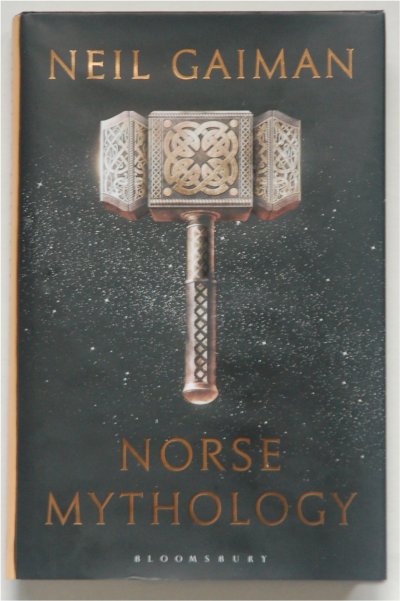
20170206 Norse mythology 1

Neil Gaiman’s Norse Mythology is a retelling of the Old Norse myths in a straightforward style aimed at the young adult market. He begins with a brief introduction to Odin, Thor and Loki and then the other characters that populate the myths are explained as we meet them.  The book has had a small number of poor reviews on Amazon, but mainly by people who were expecting a Neil Gaiman story rather than an introduction to the Norse mythology and were therefore disappointed not to find one. For me however it took me back to my childhood in the 1960’s and 70’s reading childrens’ magazines such as Look and Learn and World of Wonder, both of which regularly dipped into mythologies from around the world for features or retellings.

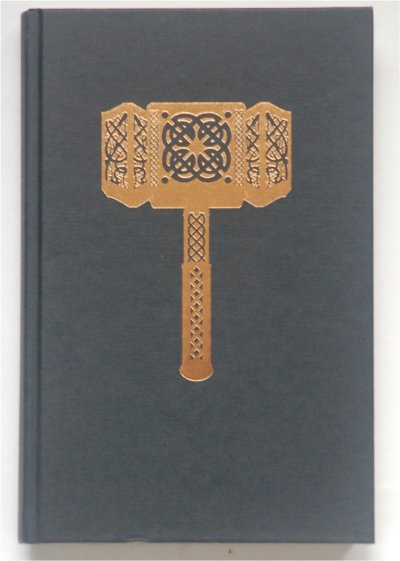
The dustwrapper is beautiful, featuring Thor’s hammer Mjollnir against a background of stars but how many people have taken this off to find the hammer again on the cover of the book

20170206 Norse mythology 2

There are 15 tales included, ranging in length from 3 to 23 pages, so this can be dipped into as a quick read over a period of a few days, but equally it doesn’t take long to read the whole thing. They are easily approachable, avoiding the temptation to explain everything with additional notes which can be a failing in editions aimed at adults which can fall into a scholastic tone. As Neil himself says in his introduction

As I retold these myths, I tried to imagine myself a long time ago, where the stories were first told, during the long winter nights perhaps, under the glow of the Northern Lights, or sitting outside in the small hours, awake in the unending daylight of midsummer, with an audience of people who wanted to know what else Thor did, and what the rainbow was, and how to live their lives, and where bad poetry comes from.

And that I think is the essence of Neil’s book, they feel like they are tales as told to an audience rather than pinned to the page like a specimen butterfly, they have a narrative flow and it doesn’t matter that Yggdrasil and the nine worlds is only 3 pages long, it tells you what you need to know and that information will illuminate later tales.

The book is of course just a brief introduction to the huge body of Norse tales and it would be nice to think that readers today will be inspired, as I was all those years ago with the magazines, to explore further and then maybe try some of the Icelandic sagas which I have enjoyed over the intervening years. More of those I think in a later blog. So thank you Neil for reminding me of the pleasure I got when I first encountered the Norse myths when I was 6 or 7 years old and the joy they still give me.

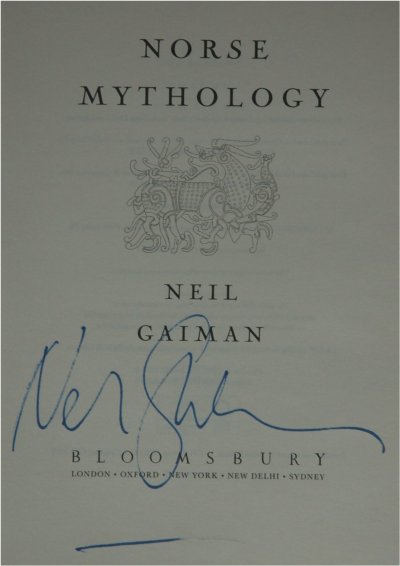
20170206 Norse mythology 3

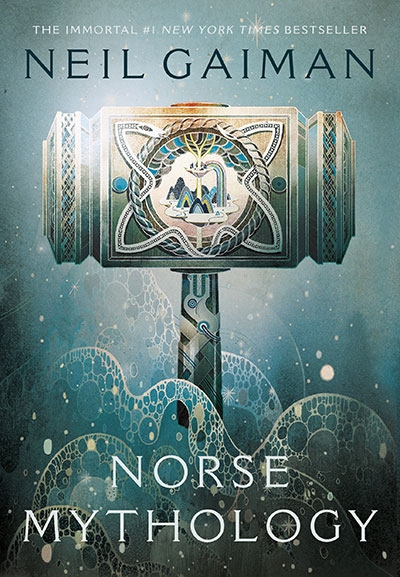
Footnote: I thought the UK hardback cover was beautiful and then saw the American paperback due out next month…

20170206 Norse mythology 4