Keepers of the House – Lisa St Aubin de Terán

Lisa St Aubin de Terán gained her exotic sounding name from a mix of her mothers maiden name (St Aubin) and her first husband’s surname (Terán) of which more later. Born in London she was just twenty nine in 1982 when she wrote this, her first novel, but had already by then amassed life events enough for any aspiring writer to draw on. The novel tells the story of Londoner Lydia Sinclair who at the age of seventeen marries thirty five year old Venezuelan Don Diego Beltrán and goes to South America to live with him on his vast but declining estate. The book starts with a prologue which is set in the present day and tells how Lydia ended up in Venezuela before diving back over the two centuries of the rise and fall of the Beltrán family and estate until Don Diego is virtually the last of the family, and even he has a stroke several years into the marriage and is paralysed.

But the story of the early years of the Beltrán’s is of strong and powerful men rising to senior political and military ranks backed by the wealth from their estate. It is only after a horrific massacre of the family a century ago, men, women and children gunned down by soldiers goaded by members of a rival dynasty and a plague of locusts that destroyed all the crops in the valley leaving the villagers starving and almost as importantly the sugar cane that was the source of the money. The years of drought during Lydia’s time was the final straw, nothing is left, it is time to go. It sounds like a depressing read and in places it is but there is still some lightness to provide succour to the reader and it is certainly well worth reading. I also have her second novel ‘The Slow Train to Milan’ which is also based on her life with Jaime from after their marriage but before they finally moved to Venezuela and were instead travelling around Europe with increasingly bizarre experiences

Keepers of the House gets its title from a quote in the bible, specifically Ecclesiastes 12, and won the British literary prize The Somerset Maugham Award in 1983, which ironically is “to enable young writers to enrich their work by gaining experience of foreign countries.” whilst St Aubin de Terán had already had seven years of experiences in Venezuela, which was used as the basis of the novel, and was now safely back in England. I have written about one of her other autobiographical books in another blog back in 2020 ‘A Valley in Italy‘ and up until now have largely read her non-fiction works but have recently purchased a couple of her novels, this one included. I was struck particularly by the similarities between the stories of fictional Lydia and real life Lisa when comparing this book to ‘The Hacienda’, her memoir of her time in Venezuela published in 1997. If you thought that the plot of the novel was somewhat far fetched then the real story of Lisa is definitely worth reading as in ‘The Hacienda’ she tell of how she married at the age of sixteen to an exiled Venezuelan man more than twice her age who is wanted in his home country for bank robbery but who nevertheless takes her back to South America to live on his estate. She eventually comes back to England with her daughter Iseult to avoid the planned suicide pact intended by her husband Jaime as he realises that the marriage is falling apart.

I Who Have Never Known Men – Jacqueline Harpman

This deeply disturbing novel has a group of women held in an underground bunker, none of whom knew one another before they arrived there and who don’t have any memory as to how they got there. Our narrator is the youngest, all the others were adult when put in the cage and have memories of life before, working, having children, living normal lives, but the unnamed narrator was a small child when incarcerated and this is all she knows.

There were forty of us living in that big underground room where no one could hide from the others. At five-metre intervals, columns supported the vaulted ceiling and bars separated our living area from the walls, leaving a wide passage all around for the guards’ relentless pacing up and down. No one ever escaped scrutiny and we were used to answering the call of nature in front of one another. At first – so they told me, my memories didn’t go back that far – the women were most put out, they thought of forming a human wall to screen the woman relieving herself, but the guards prohibited it, because no woman was to be shielded from view.

Other things were also forbidden such as physical contact, the women may not touch each other, suicide or self-harming were also banned, any attempt at escaping from the relentless monotony of their existence in the cage by killing or injuring themselves would instantly cause the guards to crack their whips close to the prisoners. The guards never entered the cage or spoke to the women even in the early days when they would cry out to try to find out what had happened to them and why they were there. Apart from constantly watching the women, the guards delivered the food, meat and vegetables with occasional pasta, which had to be boiled as that was the only means of cooking available. The knives the women needed to prepare the vegetables were blunted, they were not allowed to sharpen them in case they were used to injure and they had to be returned after use. The cage is large enough for the tables for food preparation, two toilets, a water supply and on the remaining floor just enough room to spread out forty mattresses for the women to sleep on, these would then be stacked to make something to sit on during the ‘day’. It is clearly costing somebody a lot of money to supply electricity and food and sometimes scraps of material to repair or fashion rudimentary tunics for clothing and pay for the constant guards over the dozen or so years the women have been held here but why?

Around a third of the way through the book everything changes. During the time of food serving a siren suddenly goes off and the guards simply run away leaving the keys in the serving hatch lock in their panic to get away. When the women realise they are alone the narrator, known only as ‘the child’ although by now she is probably fifteen years old, retrieves the keys and manages to unlock the main door to the cage. Exploring the rest of the bunker reveals a vast food store, enough for many years, but no guards or indeed much in the way of indication that they had ever been there. A staircase rises to a cabin and then to the outside. It has taken eleven minutes from the siren to the first women setting foot on the surface but there is no sign of the guards, where are they and how have they vanished from a vast open plain so quickly?

They decide to explore to find anyone else who might be there and eventually after four weeks they discover another cabin with stairs down. This also has the same layout as their prison with a cage but this time with forty corpses as these women had not been so fortunate when the guards left them. Eventually they come across hundreds of similar bunkers all with forty or maybe slightly fewer dead prisoners always unisex sometimes female sometimes male, a huge store of food and no guards. Just what was going on and where are they, is this even Earth?

The development of the relationships between the women is one of the driving themes of the book along with the increasing authority of ‘the child’ as she ages and develops useful skills. There is also the mystery as to what is going on. Jacqueline Harpman was born in Belgium in 1929 and as part of a Jewish family escaped to Morocco when the Nazis invaded at the start of WWII and the isolation of that time possibly influenced the isolation of the women. Returning to Belgium after the war she eventually trained as a psychoanalyst and this knowledge of how the mind works can be seen throughout the novel. ‘Moi qui n’ai pas connu les hommes’ published in 1995 was her tenth novel and the first to be translated into English, although it didn’t achieve major success in English until being reprinted in 2022 with a literal translation of its title rather than ‘Mistress of Silence’ which it was called in 1997. I loved this short book and cannot recommend it enough.

Madame Claire – Susan Ertz

Although the author is probably rarely read nowadays, this novel by Susan Ertz is still in print although I think only by Zinc Read, a publishing house that specialises in printing books that would otherwise be no longer available. Other than that example I can’t find any other books by Ertz that are still in print, which is a pity as I have enjoyed this quite charming novel, I do have a copy of her book ‘Now East, Now West’ and will definitely look for others. Madame Claire is the eighty year old widowed matriarch of three children and three adult grandchildren, all from her eldest daughter Millicent. Her two other children are Eric, the eldest, now a prominent Member of Parliament and unhappily married to Louise, and Constance who is referred to as Connie throughout the book and is definitely the black sheep of the family having run off with a Russian concert pianist and then being abandoned by him. Millicent is married to John who is a well to do barrister and their three children are Gordon who is dating Helen, the daughter of Lord Ottway, Noel, currently unemployed due to losing an arm during WWI and Judy who doesn’t really know what she wants to do but feels trapped into the cycle of marrying well and settling down which frankly she doesn’t want to do. It took me a couple of chapters to get everyone sorted out in my head along with Stephen de Lisle, ex Home Secretary who was deeply in love with Claire, so much so that he asked her to marry him a couple of decades ago when her husband Richard died. Refused he took off for the continent and hasn’t been heard from since. However the book starts with Claire receiving a letter from Stephen…

That letter from Stephen was the first of many in the book and I like this way of pushing the story forward, Ertz uses them for exposition of the various relationships which would otherwise involve many more pages of scene setting and dialogue, instead she can simply have one character explain things to another in their letters. There is no doubt that Claire runs the family but without obvious interventions, rather she suggests options that help push things along such as getting Judy sent to Cannes ostensibly to see how Stephen was recovering from his minor stroke which was stopping his return to London and the resumption of a sadly extended break in relations with Claire. Yes this was partly the reason but Claire also recognised that Judy needed a break from the suffocating situation at her family home to think through what she was going to do regarding Major Crosby aka Chip whom she had fallen for after the car she has a passenger in had hit him crossing a foggy road. Unfortunately Chip had no money, wasn’t from a ‘known family’ and didn’t have a job so Judy’s parents didn’t regard him as marriage material for their daughter, Claire however liked him so was keen to help. Beyond Madame Claire Noel is the most interactive of the other characters, always willing to help his sister and most like Claire in his ability to make the best of a situation such as being able to deal with Connie when she re-appears, again at the instigation of Claire.

The various interactions between the assorted characters are well done and whilst Ertz does go a little flowery with her prose occasionally that is probably more to do with a hundred year old writing style than any real issue with the book, which to my surprise I have greatly enjoyed. I am usually wary of works by authors who have vanished to the degree that Susan Ertz has but I think she is greatly in need of a rehabilitation of her literary reputation and I’m surprised that Persephone Books hasn’t reprinted her works as I think she would fit well with their house style.

As can be seen from the full list below with their original UK publishers and publishing years, the first ten Penguin Books were an eclectic mix of titles and whilst several authors are still well known and widely read today a few have largely fallen by the wayside. They had mainly first come out in hard back in the previous decade so were very much current material in 1935 and Penguin was for the most part their first appearance in paper back. After the first printing dates I have added a number in brackets which gives the number of UK printings each book had had before being printed by Penguin, as you can see most of these books were very much in demand. The relatively low reprint numbers for the two crime novels are probably more due to the larger numbers printed for each edition for these than other genres.

  • Maurois – Ariel – The Bodley Head Ltd. – 1924 (8)
  • Hemingway – A Farewell to Arms – Jonathan Cape Ltd. – 1929 (9)
  • Linklater – Poet’s Pub – Jonathan Cape Ltd. – 1929 (10)
  • Ertz – Madame Claire – Ernest Benn Ltd. – 1923 (14)
  • Sayers – The Unpleasantness at the Bellona Club – Victor Gollancz Ltd. – 1928 (3)
  • Christie – The Mysterious Affair at Styles – John Lane The Bodley Head Ltd. – 1920 (6)
  • Nichols – Twenty-five – Jonathan Cape Ltd. – 1926 (3)
  • Young – William – Jonathan Cape Ltd. – 1925 (2)
  • Webb – Gone to Earth – Constable and Co. – 1917 (21)
  • Mackenzie – Carnival – Macdonald and Co. – 1912 (11)

I’ve enjoyed reading the first four Penguin books over the last few weeks, and more books from the original ten will be featured on this blog over the coming months with the aim to have read them all by July 2026 so within their ninetieth birthday year. By the end of their first year Penguin had published fifty titles but were still an imprint of The Bodley Head and would not be a separate business until the beginning of 1937.

Poet’s Pub – Eric Linklater

Of the four books that I am reading to mark the ninetieth birthday of Penguin Books this was probably the one I was looking forward to most. Eric Linklater was an established novelist by 1935 when Penguin began, with six of his twenty three novels published by then and a seventh coming out that year. Poet’s Pub was his second work (1929) and would be adapted into a film in 1949 although that version bears little relation to the original novel. I was already familiar with Linklater’s work from probably his best known novel ‘Private Angelo’ a comic satire of war based in late WWII Italy and published in 1946, which I first read and enjoyed a decade or so ago and probably should get off the shelves and re-read at some point. However I wasn’t disappointed with this also comedic book which at times, such as the extended car chase from the fictional village of Downish, north west of London, to Scotland and the aftermath of the Elizabethan dinner which provides the opportunities for the two thefts that push the plot forward, descends into near farce.

Saturday Keith, named as such by his father as he was the seventh son and they had all been born on different days of the week is the eponymous poet and the Pelican Inn in Downish owned by the mother of Quentin, an old friend of his from university days, is the public house. Or more accurately the inn/hotel as the regular guests staying there along with the staff provide Linklater with his much varied cast of characters and few patrons of the public bar are even mentioned. It’s a setting that has attracted many authors over the decades from E M Forster’s ‘A Room with a View’ to Anita Brookner’s ‘Hotel du Lac’ and even Stephen King’s ‘The Shining’ along with numerous crime classics, where else could you believably have such a diverse group of people in one place with no need to explain who they are and why they are there?

Keith took the job as landlord with the hope that along with a regular income, something definitely lacking for the vast majority of poets, he would have a quiet space to work on his magnum opus, the poem that would finally mark his breakthrough onto the public consciousness. The work running a surprisingly successful inn once it become known it is run by a literary gentleman, and thereby attracts a more upmarket clientele, means he struggles to find time to work on his epic and the assorted distractions both from Quentin and Joan Benbow, the daughter of one of the guests whom Keith has fallen madly in love with add to the comic possibilities. Quentin has likewise fallen in love only he is smitten by Nelly Bly who is working there as a maid but in reality is a part time journalist for a national newspaper that is hoping to get some interesting stories. Amongst other guests there is an American by the name of Mr van Buren who has invented a new method for processing crude oil and if I say that his paper describing the technique is in an identical folder to that used by Keith for his poem I’m sure you can see where confusion lies later on in the book. Throw in some industrial espionage, a missing secret recipe for a blue cocktail available in light and dark shades to represent Oxford and Cambridge along with a few other quirks of the people staying there and the story positively bowls along dragged down only by the overlong car chase but even that has its redeeming and indeed ridiculous features.

Poet’s Pub is still in print by Penguin, although it now comes under Penguin Classics which I think is only fitting for this excellent novel that has stood the test of time remarkably well.

A Farewell to Arms – Ernest Hemingway

Book number two from Penguin Books’ first ten titles which I’m reading in the quite fragile first edition copies to mark their ninetieth anniversary is A Farewell to Arms. As mentioned in last week’s blog about Ariel all the original rear covers for these books refer to this book as Farewell to Arms but this was quickly noticed and corrected and after the initial distributed batch the ‘A’ was reinstated. I’ve never been a particular fan of Hemingway, but I have enjoyed this, his second novel, which is based quite heavily on his own experiences in Italy during WWI although with fictional military units and characters some of which are based on real people. It was first published in 1929 and was sandwiched between his first novel ‘The Sun Also Rises’ and a non fiction book ‘Death in the Afternoon’ both of which are concerned with bullfighting which was a passion of his and probably negatively coloured my original impression of Hemingway.

The book follows American volunteer Frederic Henry who is serving as a Lieutenant in an ambulance corps for the Italian army before the Americans actually joined WWI. He meets an English nurse named Catherine Barkley but is rebuffed when he tries to kiss her. Later Henry gets badly injured in one knee during a mortar attack on the front line, getting decorated for his bravery in assisting fellow soldiers and ends up being looked after for months in a hospital in Milan where he is treated by Catherine and a relationship develops. I don’t know why but I wasn’t expecting a romantic story from Hemingway and this it definitely is as the deepening love between Frank and Catherine during his recovery supersedes the war driven plot in the first section of the book. Only for the war to come back into the story as Frank recovers sufficiently to be posted back to the front just in time for the Italian army to retreat in the face of German onslaught. Later whilst hiding as a civilian he joins up again with the now pregnant Catherine and they make an escape to Switzerland.

Hemingway on the other hand arrived in Italy in June 1918, aged just eighteen, as a Second Lieutenant working as an ambulance driver. In July he was injured in a mortar attack and got decorated and promoted to Lieutenant for his bravery in assisting fellow soldiers and then ended up spending six months recuperating in a hospital in Milan where he met an American nurse named Agnes Von Kurowsky and fell in love with her. Rather than go to Switzerland to escape the war in reality the conflict finished whilst he was being treated and he went back to America in early 1919 expecting Agnes to join him later. Instead she got engaged to an Italian officer and the two never met again.

That Hemingway had first hand experiences of the scenarios depicted in the novel is obvious in the vivid descriptions both of the conflict and the life in Milan during Frank’s recuperation, which at times seems so far away from the realities at the end of the First World War. The book is written in the first person from the point of view of Frank and I was particularly drawn in by the later sections covering the retreat from the north where Frank and his crew were as likely to be shot by jumpy and trigger happy Italians as the advancing Germans. The text is accurate enough for me to follow their movements on a map of northern Italy and then his escape from actually being shot by a group of disaffected Italian lower ranks and Carabinieri because he is an officer leading to his abandonment of his uniform to avoid reprisals through to the ultimate night time row across the Swiss border.

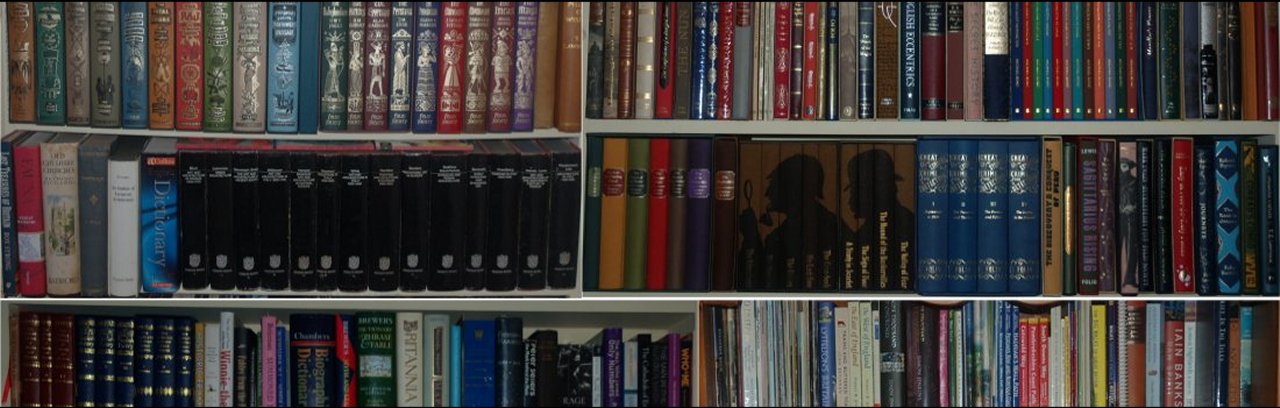
Below is a photo of my first edition copies of the first ten Penguin titles issued together on 30th July 1935.

Travels with Charley – John Steinbeck

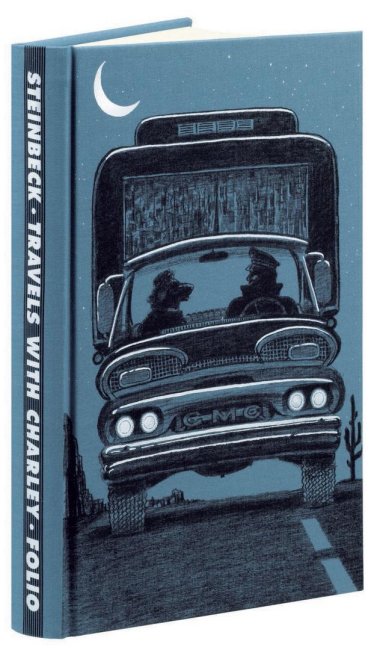
Towards the end of his life Steinbeck felt the need for one last adventure, this was 1960 and he would die of heart failure in 1968 aged just 66. His wife had long been concerned about his health and his heart condition, brought on by his heavy smoking had flared up several times in the preceding years and she was worried about his plans to travel right round the country in a converted camper van with his standard poodle, Charley, as theoretically his only companion. But Steinbeck wanted to reconnect with America, as he says at the beginning of the book:

The plan was to drive up from New York into Maine and explore the back roads of that sparsely populated state before heading along the Canadian border and into Canada by Niagara Falls, before coming back into the USA and travelling up through Illinois, Wisconsin and Minnesota then along the northernmost border to the coast, trying to stay off interstate freeways as much as possible. The first stumbling block was going into Canada with Charley, the Canadians were fine but, as is still the case, the USA border patrol were not, so Canada was dropped from the route. The less busy roads were also too slow so freeways appear more and more as the journey went on, but those kept him away from the people he wanted to talk to to see how their lives were changing so a sort of compromise was decided on where open countryside was driven through as often as practical.

The book when it came out in 1962 was a hit although it soon became clear that although Steinbeck had genuinely driven around the USA the text was less a travelogue than a carefully created artifice. That’s not to denigrate the book or the stories it tells, which are funny and at times distressing and provide considerable insights into how America had changed over the decades since Steinbeck had left his native California for the east coast and New York State. But it should be taken into consideration that Steinbeck was a great novelist, he was to win the Nobel prize for Literature just after this book came out, and probably couldn’t resist moving stories around and inventing dialogue to make his point. Also the actual trip was considerably more luxurious, and less lonely, than made out in the book, of the seventy five days he was away from home he spent forty five in hotels with his wife, Elaine, and on more than half of the remaining thirty days he either stayed in motels or trailer parks or parked the camper van at the home of friends. Steinbeck’s son, also called John, said that his father invented almost all of the dialogue whilst writing the book but frankly I don’t care, it’s a fun read and you do learn a lot about America on the turn of the 1950’s into the 1960’s.

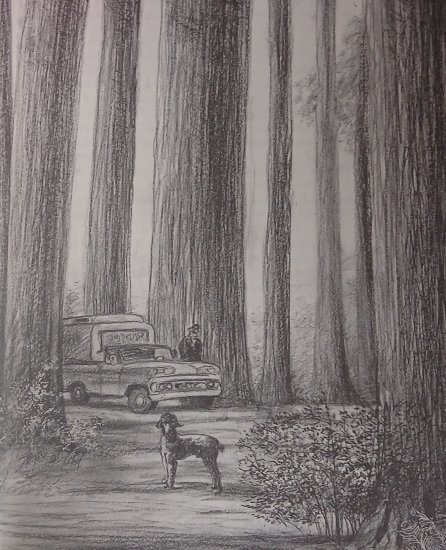
It is a very uneven travelogue anyway, by page 160 of the Folio Society edition I have we are in Seattle having left New York State and travelled along the US/Canadian border, so just one side of the rough rectangle planned for the journey. On that basis we should be looking at a four or five hundred page epic but instead it is only 241 pages in total, so over two thirds of the mileage is covered in a quarter of the pages and the detail in the first three quarters is lost in the remainder. That said I actually think the last quarter is the most important, as we have Steinbeck returning to search for his roots in California and finding that they are irretrievably lost. Cannery Row has been gentrified and he barely recognises the places of his childhood. Charley is also confused but that is mainly down to the visit to the giant redwoods which are so huge that he doesn’t seem to see them as trees and finds a small bush to mark instead.

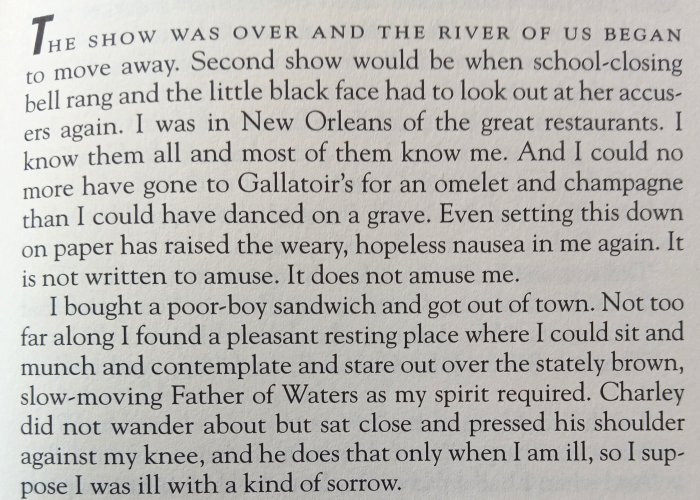
But it is pretty well the last section that is the most important of this ‘almost’ documentary and drives home Steinbeck’s dislike of some of what he found on his journey when he goes to New Orleans in search of ‘the Cheerleaders’. These frankly repellent middle aged white women gathered each day to scream abuse at six or seven year old children going or leaving school who just happened to be a different colour than they were. Steinbeck was appalled by them and the crowds they pulled together which meant the children needed police support just to go to school.

I’m going to leave it there.

The Good Soldier – Ford Madox Ford

This truly remarkable novel makes use of the ‘unreliable narrator’ literary style and is probably the best version of this particular method of slowly revealing the true aspects of the story I have read. Not for nothing did it come as high as thirteenth in the BBC poll of literary critics for the one hundred greatest English novels. But first let’s address the title, which is not the original given to it by Ford. The book was due to be first published by John Lane: The Bodley Head in 1915, in his later dedication appended to the book in 1927 Ford explains what happened:

The book was originally called by me The Saddest Story, but since it did not appear until the darkest days of the war were upon us Mr. Lane importuned me with letters and telegrams – I was by that time engaged in other pursuits! – to change the title which he said would at that date render the book unsaleable. One day, whilst I was on parade, I received a final wire of appeal from Mr. Lane and the telegraph being reply paid I seized the reply form and wrote in hasty irony ‘Dear Lane, why not The Good Soldier’… To my horror six months later the book appeared under that title.

That the new title was ironic certainly becomes obvious the more you read the book, although initially it appears to be highly suitable. The original title does make its appearance in a few places with Ford having his narrator say several times similar phrases to ‘I call this The Saddest Story’, which is actually the opening line of the final part or ‘THIS is the saddest story I have ever heard’ which is the books’ first sentence. When you start reading however there is no hint of the tragedies still to come as John Dowell, our unreliable narrator, starts off painting a happy friendship between the English couple Edward and Leonora Ashburnham and the Americans John and Florence Dowell set over nine years largely in the German spa resort of Bad Nauheim where the couples regularly meet. Captain Edward Ashburnham is the good soldier of the title and is apparently there for treatment of his heart condition that has effectively invalided him out of his regiment. Florence is also there for treatment of a heart condition, fear of which has prevented her from having sexual relations with John since their marriage began. Apart from that the couples seem ideal, independently wealthy so they can choose to live where they want and largely do what they want all is happiness in this small group of friends.

But that is what John initially wants you to think and it may be what he believes at least at the start of the narrative but gradually he reveals more, almost inadvertently, recalling details that turn the situation on its head and this is where reviewing this book becomes tricky because I really want to encourage you to read the book and discussing what happens is almost impossible without revealing too much. Suffice to say that almost nothing you are told in the first part of the book turns out to be true, instead there is a complex inter-relationship between the characters which is nothing like it first seems and even the reasons for them being in Germany at all is based on a tissue of lies.

The slow reveal of the various facts and of the other tragic characters associated with the ‘good’ Captain show a superb skill in the writing of the book as revelation after revelation come after the barest of hints that all is not right but remain believable and despite John’s bewildered insistence that he is the one steady rock in the narrative the fact that he keeps changing his story leaves the reader wondering just how much of what you come to understand by the end is really what happened and what is still John’s reinterpretation of the story. There is a good reason why this book has remained in print for almost 110 years so far so even if you have never heard of Ford Madox Ford I recommend that you get hold of a copy and read it.

Zulaikha – Niloufar-Lily Soltani

Canadian author Soltani’s first novel takes us to her Iranian heritage with a powerful story exploring the life of the fictional Zulaikha (pronounced Zuli-ka), born in 1945 and therefore exposed to the various changes that have overtaken Iran in the last seventy plus years including the suppression of female rights since the Islamic Revolution at the end of the 1970’s. Not that Zulaikha’s life had been particularly rosy even before the revolution and the subsequent Iran-Iraq war in the 1980’s. From being pulled out of school in 1958 at the age of thirteen because as her mother, Madineh, saw it “no man would marry a girl with an education”, her role was to get married and her wishes were seen as unimportant. The book however starts in December 2007 and in Amsterdam rather than Iran. Sixty two year old Zulaikha has been visiting her son, who now lives in The Netherlands and at Schiphol airport on the way back to Tehran she meets Kia, a man she hasn’t seen since the 1960’s. There is no hint as to the relationship between them other than he used to know her missing brother Hessam, in this opening chapter, we slowly find out more as the book progresses but the two of them meeting triggers a postponement of their flight and security take Zulaikha away for questioning. Who is this man and why should their chance meeting be seen as a cause of concern? We find out the who eventually but we are left in suspense as to what will happen to Zulaikha when she returns to Iran the next day as the book leaps backward to 1958 and begins a chronological narrative until we eventually get back to the plane landing.

Soltani gives her protagonist a difficult time, from being a child bride as the second wife of a merchant in Bahrain whom she only meets just before the wedding, to becoming a widow whilst still only seventeen and returning to Iran where she ends up having an abortion after a doomed illicit relationship. Zulaikha grows up in Abadan, home to what was at one time the largest oil refinery in the world and crucially close to the border with Iraq which made it a prime target in the 1980’s Iran-Iraq war, so much so that the population plummeted from around 300,000 in 1980 to just 6 in 1985 and Zulaikha along with her family and most of the population of the city became refugees in Tehran and it is in 1985 that Hessam vanishes, presumed killed on the front line. She also spends time in the notorious Evin prison but despite the hardships piled onto Zulaikha the narrative drive of the story keeps you reading, indeed it’s a difficult book to put down you just want to know more of her story. It is also a book that is clearly well researched with many real events explored, such as the Abadan Cinema Rex fire in 1978 which killed over four hundred people and became one of the turning points in the overthrow of the Shah with rumours blaming his secret police force despite the barring of the doors and subsequent arson actually being perpetrated by Islamic militants. I learnt so much more Iranian history through reading this novel.

The book first came out at the end of 2023 in Canada although it is now available more widely and it is definitely worth seeking out, it is beautifully written and the story of the ups and downs of Zulaikha’s life is engrossing with the various threads largely tied up by the end but you still want to know more about Zulaikha which is a good place to leave her story. This blog is being published on Tuesday 19th March and the Iranian new year is marked on the first day of Spring, this Thursday 21st March so Happy New Year to any of my readers whom are celebrating this, or in Farsi Nowruz Mobarak.

Around the World in Eighty Days – Jules Verne

I could have sworn I read this book as a child, but as I continued reading nothing came back to my memory, of course I knew the basic plot, but as it is a very well known work I could have picked that up at any time however the more I read the less I recognised and I loved the full story. So how come I have clearly never read this before?

The base story, as I think everybody knows, is that Phileas Fogg, a man who notoriously goes nowhere other than to his home or club and whom is so punctual and set in his habits that you could set a watch by his movements raises the subject of the possibility of travelling around the world in just eighty days. When other members of the Reform Club are incredulous he agrees to wager the massive sum of £20,000 (£1.8 million in today’s money) that he can make such a journey and whats more without any prior planning for he will leave from the card game they are playing immediately. I also knew that he arrives back in London having been delayed and believes he has taken eighty one days and is financially ruined but is rescued by having crossed the international date line in an easterly direction and therefore has gained a day’s grace so makes it back to the club just in time. That is all I knew when I started the book, I had assumed that some travel disaster had occurred to delay him and was surprised by the true reason and knew nothing of the policeman, Fix, who had dogged his trail around the world in the mistaken belief that Fogg was the man who stole £55,000 from the Bank of England a few days before he set out on his journey.

I also knew nothing of Aouda who accompanies Fogg from India as I believed that his sole companion was his newly employed valet, the Frenchman Passepartout, whose name is the French for a master key which will enable you to go through any door in an establishment. Jules Verne must have spent a considerable amount of time pre-planning the trip as it is exquisitely timetabled, just how long each trip would take and how much time the travellers would have to make the next connection and how long they would have to wait if they missed such a rendezvous is all set out and is completely believable. Having sat down with railway and ship timetables to work out long over land and sea journeys in the past for my own holidays I am very aware just how complicated this could be before the age of the internet.

I loved the story, the development of the characters and the ingenious ways that Verne managed to keep them hearing ever onwards. Yes it is possible now to get round the world in less than a handful of days by simply getting on a plane, a mode of transport unavailable to Fogg back in 1873 when the novel was written and back in 1988 Michael Palin proved it was still possible to get round the world in eighty days without the use of aircraft, taking roughly the same amount of time as Fogg did in the novel. I heartily recommend this wonderful tale and I’m simply amazed that this was the first time I read it.

About the only thing I didn’t like about this Folio Society edition is the fold out map tucked into a pocket in the rear cover. It is unfortunately extremely difficult to read, which is a shame as clearly a lot of work had gone into it and it could also have been considerably improved by including a line indicating the path that Fogg and his companions took, definitely a missed opportunity there. The images in this blog were taken from the Folio Society website which I downloaded before the edition sold out and the book was removed from the site. As can be seen it is copiously illustrated with headings and tailpieces to each of the thirty seven chapters by Kristjana S Williams who also drew the map and the front cover.

Guard Your Daughters – Diana Tutton

The second of the three Persephone books that I purchased from them at their own shop in Bath back in September this year. The first one I featured was ‘To Bed With Grand Music’ by Marghanita Laski which was also in their distinctive all grey binding and dust jacket. Persephone specialise in twentieth century female writers a large number of which have largely been forgotten nowadays, certainly I had never heard of Diana Tutton before buying this book. It turns out that this was Tutton’s second novel, but the first to be published, back in 1953 by Chatto and Windus, she would go on to write one more novel whilst living in Malaya in the early 1950’s before returning to the UK with her husband and apparently retiring from writing as I can find no other works by her other than these three novels. Guard your Daughters was easily her biggest hit and largely favourably reviewed at the time including by such literary luminaries as the future Poet Laureate John Betjeman who described it as ‘A really talented first novel’ in his review in the Daily Telegraph newspaper. Persephone Books have rather unusually included an afterword made up of contemporary reviews up to modern day blogs, I have to say that the more modern takes on the novel are nowhere near as complimentary as the reviews from the 1950’s and that I have to agree with them. Whatever ‘charm’ the book had when it first appeared has largely evaporated over the decades and I took weeks to read it despite it only being 250 pages long, picking up other books to read and review whenever I got totally fed up with the five Harvey sisters, their tedious father and their awful mother.

The father is apparently a famous mystery novelist although the pseudonym that he writes under is never mentioned and he spends most of his time in his study composing the books that have made him wealthy occasionally appearing to eat and in the evenings drink sherry before vanishing again to his room. The mother spends most of her time taking to her bed following whatever perceived slight she has objected to most recently and controlling her daughters to an obsessive degree so that none of them have ever been to school and are largely kept from any form of socialising, being effectively confined to the house except when needed to go on errands. As the book starts the eldest, Pandora, has escaped the oppressive atmosphere of the house by somehow getting married leaving behind her four sisters, in order of age, Thisbe, our narrator Morgan, Cressida and finally Teresa who is fifteen. The names are as pretentious as the girls are snobbish, seeing themselves as special because of their father and charmingly eccentric due to their odd existence cut off from the modern world without formal education, social life, telephone, or car rather than bizarre. The writing is all over the place as well with most things described in the present tense but then all of a sudden near the end of the book it’s Morgan looking back over the years at what had happened. Morgan is also not an interesting narrator which is another reason I kept putting the book down, frankly I didn’t care what these young women were doing in their extremely odd household where their mother did nothing other than flower arranging and having nervous collapses, leaving all the household duties to the girls, which are tediously described, and the one remaining servant who was mainly a cleaning lady as far as I could tell from her random appearances.

The girls attempts to add male company and presumably an escape from the house as Pandora managed are thwarted by the controlling interests of their parents but near the end of the book it looks like finally they may be set free. According to the Persephone Books website there was going to be a sequel where they did lead their own lives but this was unfinished. Frankly I’m happy Tutton never completed it, presumably she got as fed up with the Harvey sisters as I did.

Diana Tutton wrote a sequel in the late 1950s which, alas, was never published. It was called Unguarded Moments and its setting is London seven years after Mrs Harvey had a total breakdown and all the girls moved out: to freedom and their own lives. Morgan has married and had two children. In this novel, too, there is a dark side: one of her children disappears and is not found for a heart-stopping few hours.

Persephone Books website – see here

I will probably give this book away rather than find a home for it on the shelves as I’m unlikely to want to read it again, pity as I enjoyed Laski’s work and am really looking forward to the third book I bought in Bath which will be tackled sometime in the new year. As with the Laski there are patterned endpapers with a matching bookmark, this time it is taken from a 1953 printed cotton by Susie Cooper for Cavendish Textiles.