Until August – Gabriel García Márquez

In December 2019 I reviewed Gabriel García Márquez’s last collection of short stories ‘Strange Pilgrims‘. I love his work so was pleased to see that in March this year, on the 97th anniversary of his birth, his last novel was finally published in English, ten years after his death. According to the preface written by his children Márquez was not happy with what he had written and wanted it destroyed. Instead they simply put the manuscript on one side and almost ten years later read it again and decided that it was probable that the dementia he was suffering from, and which undoubtedly prevented him completing the novel, clouded his judgement as to the quality of the work.

At just 110 pages it is really more of a novella rather than a novel, especially when compared to his other far more weighty works, however I do agree with Rodrigo and Gonzalo that the book is definitely worth publishing even in this unfinished state. Originally planned as a set of five short (roughly 150 pages each) novels all of which would tell the story of Ana Magdalene Bach’s experiences during her annual visit to an unnamed island where her mother is buried. Instead we get six linked short stories all set around the 16th August, the anniversary of her mother’s death, where she travels to the island without her husband or children to tidy up and lay flowers on the grave.

We join Ana, at the start of the book, on her way to the grave having just got off the ferry, and this is clearly not the first time she has made the pilgrimage as she heads straight for a familiar taxi driver who by routine takes her to the flower stall where there is a pre-prepared bouquet of gladioli ready to be collected and then straight on to the cemetery returning later to the somewhat dilapidated hotel where she regularly stays the night before returning to the mainland the next day. But this is not to be the usual routine as she sips her gin in the bar after her evening meal she spots an intriguing stranger and invites him to join her. After a few more drinks she invites him to join her in her room and they make love. The next year on the ferry over to the island she is already looking forward to her night of passion with a stranger and by the time she is again sipping her gin is searching for the man she will choose, for this has already been added to her routine. The six visits detailed in the six chapters are sometimes successful in her hunt and sometimes not but the development of Ana and her relationship with her husband on her return to the mainland are fascinating as she becomes more and more convinced that he also has lovers and despite her own infidelity gets increasingly angry about it each year.

As well as the novella we get a translation of the original editor’s note from the Spanish edition written by Cristóbal Pera who had also edited Márquez’s autobiography. This is fascinating as it goes into the development of the novel, through the five main drafts along with a digital version maintained by his personal secretary Mónica Alonso and gives a glimpse as to how Márquez worked. The final published version is an amalgam of the fifth draft, heavily pen amended by Márquez, and the digital version which retained some of the earlier variants of the text, There are also four pages of the fifth draft manuscript showing hand written alterations both by Márquez and Alonso as she would read the pages to him and he would suggest changes as she read.

I’ll guarantee you won’t expect the highly original ending, I certainly didn’t, yet it perfectly rounded out Ana’s story. A final note of brilliance from the man described as “the greatest Colombian of all time” at the time of his death by the then president of Columbia, Juan Manuel Santos.

Lady into Fox & A Man in the Zoo – David Garnett

These two novellas by David Garnett include his first published work, Lady into Fox from 1923 with A Man in the Zoo coming out the following year. They are both fairly short, Lady into Fox being 24,514 words whilst A Man in the Zoo clocks in at 24,133 words. This undoubtedly explains why Penguin USA decided to combine the two in a book that is still only 135 pages long. Interestingly despite Garnett being English and several other later books by him being printed by Penguin UK I cannot find either of these stories in a UK released edition from Penguin Books. My copy is the Penguin USA first edition from December 1946 and it was later reprinted by Signet.

Garnett was a member of the Bloomsbury Group and indeed married Virginia Woolf’s niece Angelica Bell although she was then 23 years old and he was 50 which caused a considerable scandal. Although not as much as if it had been known at the time that in his twenties, and indeed during the time Angelica was born, he had had an, at that time illegal, homosexual relationship with her father, the artist Duncan Grant. As well as being a novelist he was heavily involved in the publishing scene in England being an original partner of the famous private press Nonesuch Press as well as being Literary Editor of the New Statesman for six years and a director of publishing house Rupert Hart-Davies. Along with his novels I have several of his factual works, of which he wrote many, including The Battle of Britain, written during WWII, and his edited collection of the letters of T.E. Lawrence, better known as Lawrence of Arabia. From what little I have read of his fiction though he tends to the surreal and this is especially the case in his best known work Lady into Fox. ‘Aspects of Love’ which he wrote in 1955 was subsequently turned into a hit musical by Andrew Lloyd-Webber with lyrics by Don Black and Charles Hart in 1989 although I doubt that many people know that David Garnett wrote the original work even though he is credited on the posters.

Lady into Fox

Right, this is definitely an odd story about a woman who spontaneously turns into a fox whilst out for a walk in the country with her husband. This happens within a few pages of the beginning and the tale concerns how she initially retains her personality and intelligence but that both of these gradually fade away as she spends more time as a vixen. Immediately after the transformation it is almost as if she doesn’t realise what has happened to her and when her husband takes her home she tries to dress herself and wants to sit at the table when eating, they even find a way for her to play cards together. He dismisses their servants so that they won’t find out what has happened and explains that she has had to go to London for some urgent reason, he even shoots their two dogs as they just howl and bark all the time as they are aware of a fox being in the house. The deterioration of her humanity is expressed most strongly by her sleeping arrangements, for the first few days she sleeps in the bed with her husband but gradually she moves to the foot of the bed and then to the floor, before refusing to go to the bedroom at all. It is quite clear that she is becoming wilder and that he cannot keep her even as a pet tame fox. She also starts trying to escape from the house and garden until realising that she cannot be happy in captivity he lets her loose into the countryside to exist as best she can. I won’t go into the rest of the story but suffice to say that although he eventually regains contact with her it doesn’t have a happy ending.

A Man in the Zoo

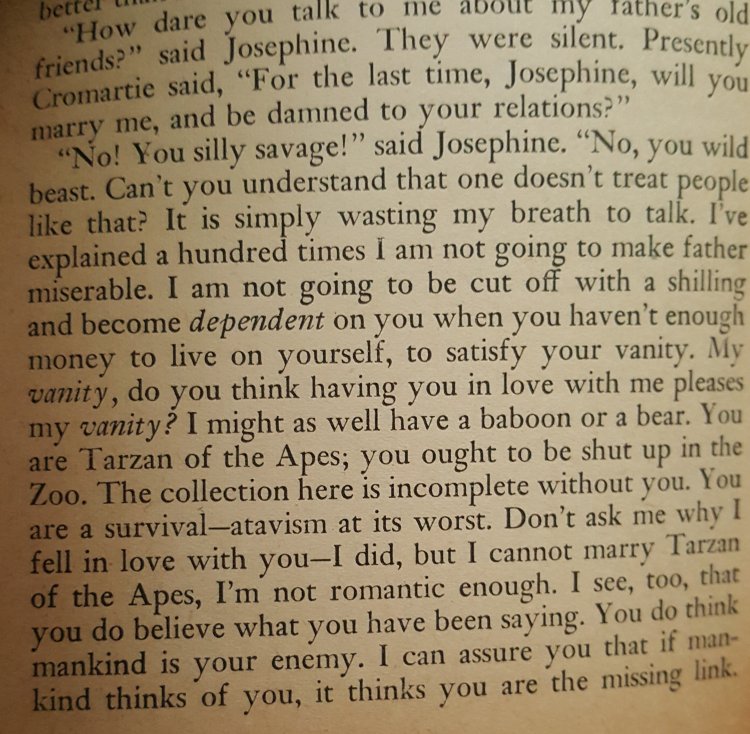
Another strange tale, but no metamorphosis is required this time. The story begins with Josephine Lackett and John Cromartie walking around London Zoo as they were wont to do on a pleasant weekend. The pair had been dating for some time and John was keen to marry Josephine but they are having a row about it as her father didn’t approve, presumably due to the lack of money on John’s behalf. I have selected below the salient part of this argument which becomes the turning point in the whole story.

The next morning John Cromartie wrote to the head of the zoo with the proposal that he should be exhibited in the great ape enclosure and thereby complete the collection. This suggestion was received by the committee running the zoo with considerable disagreement as to whether this would be appropriate but ultimately, because the main objector was disliked by a large part of the rest of the group, they agreed to the idea and a meeting was arranged with Cromartie. It was decided that he should be exhibited in ‘his natural state’ i.e. dressed in his own clothes and with a simply but well furnished living room with his books and a bedroom and bathroom both not on view to the public and that this should be laid out in the cage between an orangutan and the chimpanzee enclosure and so Cromartie moves in with the following written on the sign attached to his cage.

Homo Sapiens
MAN
This specimen, born in Scotland, was presented to
the Society by John Cromartie, Esq. Visitors are re-
quested not to irritate the Man by personal remarks.

The astonishment in the visitors later that day on finding a human displayed at the zoo was palpable and this started considerable debate not only amongst the public but in the newspapers as to the probity of the exhibit, which led to huge crowds coming to see him much to the irritation of the orangutan and chimpanzee on either side who suddenly found themselves largely ignored and without the extra titbits it was common to feed the animals at the time. The story progresses with Josephine coming to visit him several times, initially with fury in case she should be identified as his former girlfriend and determination that he had gone mad but gradually things develop and unlike Lady into Fox this does have a happy if somewhat unexpected ending.

Of the two novellas I definitely recommend ‘A Man in the Zoo’ as worth a read, less so ‘Lady into Fox’ although if you like tragedies that one might appeal. Both stories are now pretty well out of print (I have found some print on demand editions and they are also available on Kindle) however they can be read on Project Gutenberg. Lady into Fox is here, and A Man in the Zoo can be found here.