The Ring of the Nibelung – Richard Wagner

Back in March 2021 I reviewed a book about the trials and tribulations of staging the magnificent four opera series of the Ring Cycle by Richard Wagner, see here. Soon after that I purchased this magnificent cloth bound volume from The Folio Society, which is the full libretto in parallel text with Wagner’s original German alongside the superb translation by Stewart Spencer. This was first published by Thames and Hudson back in 1993 as ‘Wagner’s Ring of the Nibelung; A Companion’, but the Folio version, published in 2020, is much larger at 289 × 205 × 41 mm, and has added illustrations by John Vernon Lord. As can be imagined as the four operas in the 1991 Barenboim recording I have play for a grand total of 15 hours and 5 minutes the libretto runs for well over three hundred pages with an extra seventy pages of authoritative essays on the development of the opera cycle at the beginning along with extensive notes at the end making a total of over four hundred pages of text with seventeen unnumbered leaves of plates. All in all a comprehensive guide to this greatest of Wagner’s operatic works. It should be pointed out that whilst the words sung are all in both languages the stage directions are only in English, this didn’t bother me but if you were looking for a ‘full’ parallel text then bear in mind that these parts are missing.

Wagner is unusual in writing his own libretto, it is much more common to either set an existing work or work with a librettist. For the most part he combined Norse with Old German mythologies in developing his story, these are closely related anyway with much the same characters only with different names, Odin becomes Wotan and Thor becomes Donner for example, but there are also echoes of the ancient Greek especially Homer’s Iliad. Occasionally he merges two characters from different origins into one such as Freia (this is how Wagner spells her name, more usually Freya or Freyja) a Norse goddess of fertility and in this version also the one who looks after the golden apples that confer everlasting life to the gods; she is also referred to as Holde, a similar but different character from German folk tales. Wagner also adds to the mythology with his own concepts such as carving important contracts in runes on Wotan’s staff, the staff exists in the mythologies but not the binding contracts. This melding of the various myths and new ideas make the reading of the libretto so fascinating, especially if you have a reasonable knowledge of the original mythologies, and whilst I have picked up some of this whilst listening to the operas it was only when reading the text at my own pace rather than moving rapidly on as you do in a performance that I more deeply appreciated the complex weaving of stories that Wagner achieved. Certainly the librettos can be read as a long poem without any deeper knowledge of the operas but I found myself adding the music in my mind as I read the words especially in parts I knew well.

The book is really lovely to read, as can be seen above in this section of the third opera ‘Siegfried’ shown with an engraving of the sword Northung being repaired by Siegfried. The sword had belonged to his father Siegmund but was shattered by Wotan during Siegmund’s fight with Hunding in the previous opera ‘Die Walkure’ (The Valkyrie) as Wotan’s wife, Fricka, had demanded that he die as punishment for his incestuous relationship with his sister Sieglinde which had left her pregnant with Siegfried. The illustrations deliberately do not include any of the characters but are rather of important objects within the opera cycle, which I think is an interesting choice as John Vernon Lord explains in his note on the illustrations:

I thought that the words and music together would be best for conveying the ‘appearance’ of the various characters. At the outset, I felt that the inclusion of people would detract from the symbolic nature of what I wanted to express.

It is later in this opera, in fact in the final scene, that we get one of the few ‘humorous’ lines although this was not intended as such by Wagner but I always smile when we reach the ‘This is not a man’ line when Siegfried discovers and wakes the Valkyrie Brunnhilde from where she has been left in a magical trance by Wotan.

It should be realised that Siegfried has never seen a woman before, being brought up by Mime in a secluded location away from all others, but even so ‘Das ist kein Mann!’ is not Wagner’s finest hour.

I have really enjoyed having a deeper dive into the text of the operas and will have a much greater understanding the next time I listen to or watch them, being able to look back over previous sections to refresh my memory has proved to be well worth the cost of purchasing the book especially as it is such a fine edition.

The Ring – Stephen Fay & Roger Wood

Subtitled ‘Anatomy of an Opera’ this tells the story of the 1983 production of Wagner’s Ring Cycle at the theatre the composer had built for performances of his operas in Bayreuth in southern Germany and which is still run by his descendants. It starts with the 1980 announcement that Sir Peter Hall was to direct the four operas with Sir Georg Solti conducting, journalist Stephen Fay and photographer Roger Wood become involved right at the beginning and this gives a fascinating glimpse into how the production grew. The book isn’t the story of the Ring Cycle operas but rather a backstage look as to how they came to be performed in 1983, from initial meetings, through set and costume designs, rehearsals and ultimately the appearance on stage in front of an audience and it is lavishly illustrated with Woods excellent photographs. Frankly reading this book makes it amazing that start to finish it was managed in just three years. Bayreuth is unique amongst the worlds opera houses for many reasons but one particular feature is that whilst almost every other house starts with operas one and two in the first year and then introduces numbers three and four over the next one or two seasons Bayreuth always has all four from the start which is a massive undertaking.

Because this book is about the production effort you don’t need to know anything about The Ring Cycle to appreciate the book but it does help to understand the flow of the parts and the overall structure of what is going on. For anyone reading this who isn’t familiar with just how daunting a job this is I’ll just use this paragraph to summarise the task in hand. The cycle consists of four operas performed in sequence over four days/evenings and then repeated during the season, this would be a lot even with ‘normal’ operas but these are huge with large casts and long running times. Solti noted that a Beethoven symphony would have a score of roughly one hundred pages, his combined score for the four operas ran to well over two thousand pages, I have Solti’s famous recording of the cycle from 1958 on nineteen vinyl albums and the DVD recording I also have of Daniel Barenboim’s 1991 Bayreuth production has running times for the actual performances of Das Rheingold – 154 minutes, Die Walkure – 237 minutes, Siegfried – 244 minutes and Gotterdammerung – 270 minutes, a grand total of 15 hours and 5 minutes. Truly a musical marathon for all concerned, even the audience.

With so much needing to be done along with thirty six principal parts (several of which appear in more than one of the operas), a large chorus and numerous non-singing extras, a scratch orchestra put together for the season (the Festspeilehaus doesn’t have it’s own orchestra but draws players from various German orchestras who probably haven’t played together before) and limited time for rehearsals due to the need to do all of it in one go it is clear that this has lots of potential for disaster. Add in the conflicts between the various people involved along with all the back stage issues it’s remarkable it continues to happen and it’s this continuing rising tension that makes this book such a great read.

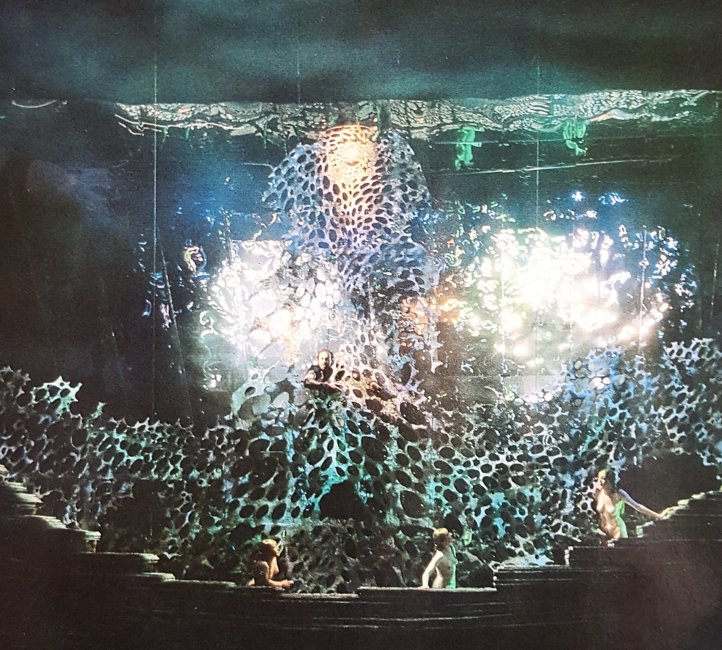
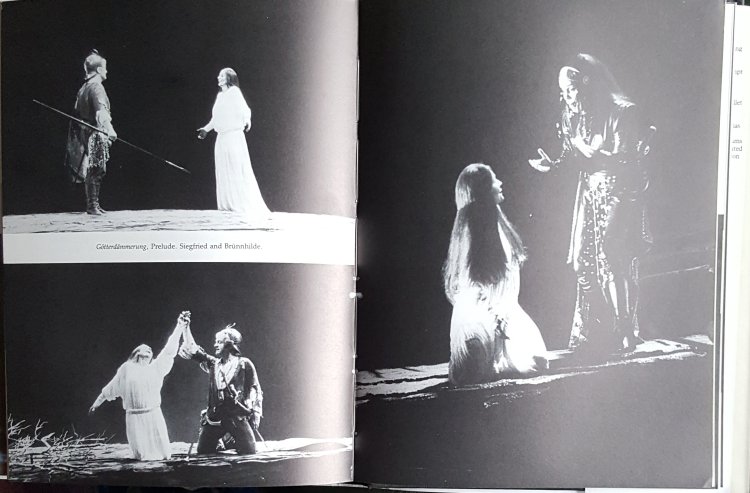
The spectacular set used for the start of Das Rheingold is depicted on the rear cover of the book as Alberich comes to steal the gold from the Rhinemaidens. Along with the writing of Stephen Fay the book is adorned with beautiful photographs by Roger Wood, probably one of the finest theatrical photographers of all time although my reproductions here don’t do justice to his work as they are quite glossy and difficult to re-photograph. To really appreciate them you need to read the book but as they make up such a significant part I felt I wanted to give some idea of what he did. There is a very good reason why the two men share the credits.

The fascination of the book comes from the quite often difficult relationships between the various protagonists, Solti had terrible problems with some members of the orchestra but also one principal singer in particular. Reiner Goldberg had been cast as Siegfried despite never having sung the role in the past and whilst he had promised to learn the part it rapidly became clear that on arrival for rehearsals he hadn’t done so, he also would not take stage direction and simply went off on his own way so causing tension with Hall as well. Nevertheless the two of them persevered with him far longer that they should have before eventually giving up when they had reached the dress rehearsals so just before the first proper performance. Manfred Jung was asked to replace him at almost no notice and could only do so because he had sung the part many times including the previous seasons of The Ring Cycle at Bayreuth. This however was only in the last few months before audiences would see what had been produced, the stressed relationship between Wolfgang Wagner, Richard Wagner’s grandson, who was running the theatre at the time and Sir Peter Hall had gone on for three years by now ever since Hall was chosen to direct. Hall was directing what would turn out to be easily the most expensive production of the cycle up to then and Wagner was having to pay for it. Wagner had also directed at least two complete cycles in his own right and had firm ideas as to how it should, and more importantly to him at least how it should not, be done. On top of this Wagner’s temper and Hall’s apparent calmness in face of it just wound Wagner up more exacerbated by the fact Wagner spoke no English and Hall hadn’t managed to learn any German so they had to use interpreters made the relationship particularly difficult altough highly entertaining to read about.

Solti did recognise that one of Hall’s particular troubles was Wagner. He took Hall aside one day in July nd asked if he could possibly say something pleasant to Wagner, to improve their relationship. Hall replied that he could think of nothing pleasant to say.

I was first properly introduced the The Ring via a TV version broadcast in May 1985 which was of the 1980 production which preceded the Solti/Hall version and was conducted by Pierre Boulez directed by Patrice Chereau, Introduced by Humphrey Burton broadcast on BBC 2 television and BBC Radio 3 over four consecutive Saturday evenings and I was amazed at the breadth of the concept. Reading this volume which gives just a hint of the three years work that goes into producing a cycle I am even more astonished by ‘the biggest work of art in the world’.