A series of essays inspired by books that I own, talking about their history, some reviews and also how they came to be on my shelves. With over 6,500 books here and several more arriving each week I doubt I'll ever be short of a topic.
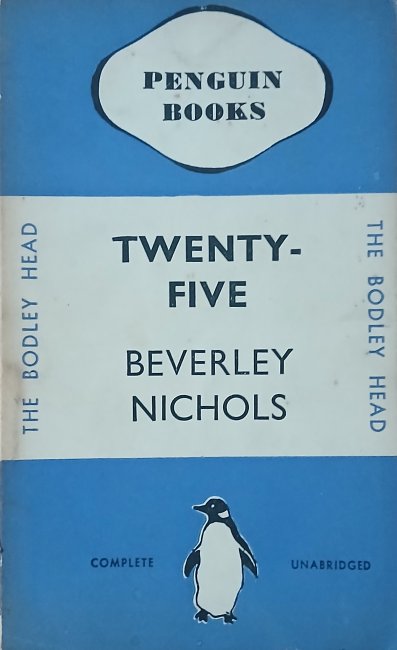
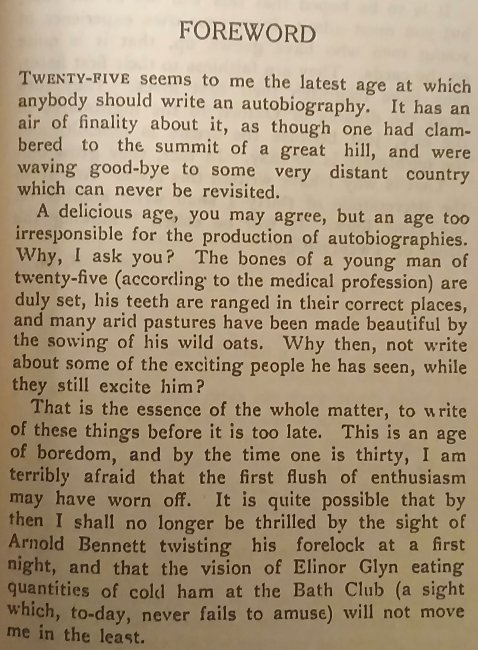
Continuing my plan to read the first ten Penguin Books during the twelve months after their ninetieth anniversary of when they were published, I have now reached book seven and the second one in the blue covers of biography in that initial set after book one ‘Ariel‘. We wouldn’t see a new colour until book thirty one in March 1936 when the purple of Essays and Belle Lettres first appeared on HG Wells’ ‘A Short History of the World’ and there wouldn’t be another book classified as Essays until number 444 ‘The Times Fourth Leaders’ in July 1945. However back to this book, and I have to admit I knew nothing of Beverley Nichols, to the point that I was surprised to discover that he was male despite the more usually female first name. I was also not inspired by the idea of a twenty-five year old writing their autobiography, so was not particularly looking forward to the book, but I’m so glad I read it. Nichols started to win me over even in the foreword:
And meet interesting people he certainly did, by page fifty we have encountered US Presidents Wilson and Taft, along with poets John Masefield, Robert Bridges and WB Yeats and are about to have conversations with both GK Chesterton and then Minister of War, Winston Churchill. Nichols was born in 1898 and the narrative runs up until 1924, he was therefore involved in World War I, but luckily was not called up to the front rather his Oxford University education was interrupted by working in the intelligence section of the War Office and then as Aide-de-camp to Arthur Shipley on the British University Mission to the United States, which is how he met the two Presidents. On return to the UK he resumed his delayed time at Oxford and became president of the Oxford Union, which is how he subsequently met so many other people of note at the time and as it was normal for the president to take people to dinner before the evening debates he would spend several hours in their company. He also ran a student magazine, which Masefield, for instance, contributed to, so even in his early twenties Nichols was remarkably well connected. This is the joy of the book, it is not so much an autobiography but a series of reminiscences regarding the various people he met, you learn far more aout them than you do Nichols himself.
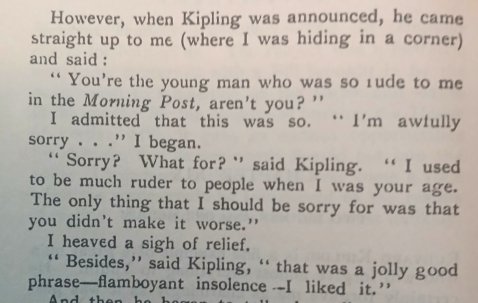
After leaving university Nichols eventually became a theatre critic giving him access to even more people but before that he spent some time as secretary to Australian opera star Dame Nellie Melba and there are numerous stories relating to those experiences included in the book, which like a lot of his anecdotes are really quite funny. One I particularly like has Melba taking a dislike to the position of some stone vases in a hotel and deciding to move them to a more ‘artistic’ formation which she duly did by strenuously pushing them up towards a wall much to the confusion of the staff. Typically for the lack of significant information about himself Nichols doesn’t mention that he was Melba’s secretary he just seems to spend quite a bit of time with her in Australia with no context given. Nichols also met Rudyard Kipling whom he had disparaged in a letter a couple of years earlier and then to his horror saw Kipling enter a room he was in:
The book is great fun and if I did have to look up a few people whose fame has somewhat died down in the intervening century there wasn’t many of them and it was worth the reference time but it is well written, amusing and far better than I expected it to be. Let’s leave the final words to Nichols, who did go on to have a long life as an author of over sixty books, using the final sentences of the book:
Again – I have done. Twelve o’clock strikes. There really should be slow music playing outside my window, so that I might work myself into a frenzy of pathos at the thought that another day has arrived to carry me on to middle-age. I should rather like to stay, just a little longer. But then – better not. Accept the joke of life for what it is worth. It is not such a very brilliant one, after all. And was there not a man called Browning, who wrote. “Grow old along with me, the best is yet to be.”
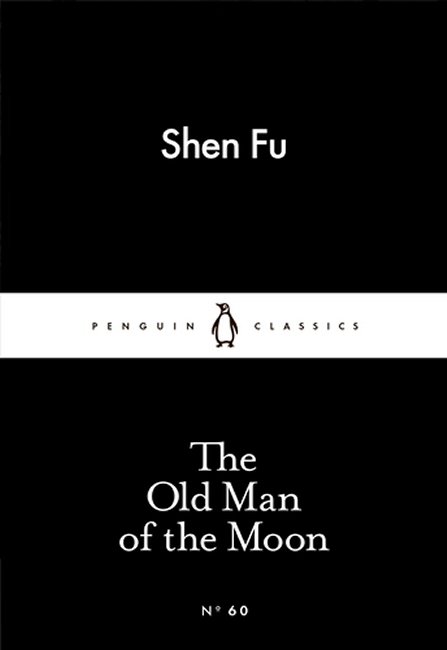
Very little is known about Shen Fu other than what he said in his book ‘Six Records of a Floating Life’ written in 1809 in China, of which only four sections were ever actually published in the 1870’s, the other two were either lost in the intervening decades or were never actually completed. Nothing definite is known of him after his book was written but he is believed to have died around 1825. What is known is that he was born in 1763 and married in 1780 to a cousin Chen Yun and earned his living as a governmental private secretary. The extract I have, entitled ‘The Old Man of the Moon’ by Penguin for this book, is largely from the first of the four surviving sections ‘Wedded Bliss’ and covers his life with Yun from their first meeting to her tragic death twenty three years later. The title of the complete book is presumed to come from the works of the Tang Dynasty poet Li Bai—“Ah, this floating life, like a dream…True happiness is so rare!” Whilst the title chosen by Penguin for this selection is a quote from about halfway through the book itself:
“People say that marriages are arranged by The Old Man of the Moon”, “said Yun. “He has already pulled us together in this life, and in the next we will have to depend on him too. Why don’t we have a picture of him painted so that we can worship him?”
What comes out most if the enduring love between the couple and his admiration for her skill in embroidery amongst other things. Initially their marriage was happy and they had two children and the book is full of simple pleasures that they enjoyed together such as sitting watching the moon at night whilst drinking wine and talking about poetry and art. But money worries overtook them especially after Shen Fu lost his job and resorted to opening up part of their house as a shop to sell his paintings and when that was not enough their possessions also were sold. Unfortunately Yun managed to get on the wrong side of her parents in law and they determined not to see her again, which along with the poverty the couple had been reduced to meant they had to move away leaving the children behind. Yun already had been ill, probably due to the stress she was in, and whilst she did make somewhat of a recovery in their exile in a better environment than they had living near Shen Fu’s parents she would relapse and die by the end of the book.
It’s a sad tale, lifted by the evident joy they had with each other before Shen Fu lost his job and difficulties engulfed them and I’m really glad I read it. Apparently the other surviving parts of ‘Six Records of a Floating Life’ are happier, and it is really good that the manuscript was discovered on a second hand book stall and recognised as a significant work by the brother in law of Wang Tao, who ran Shen Bao (a newspaper in Shanghai). Wang Tao published the manuscript in 1877 and it was an immediate hit.
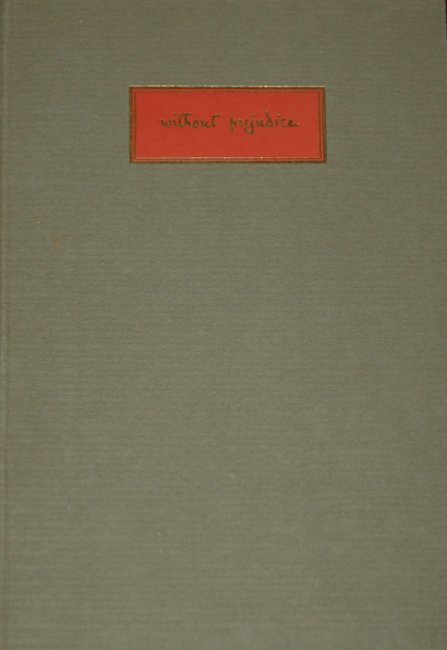
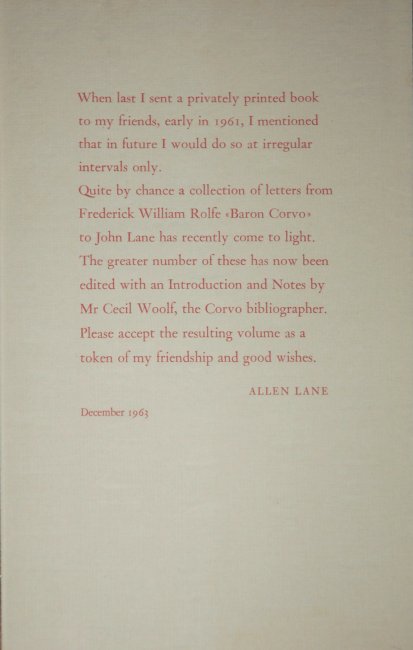
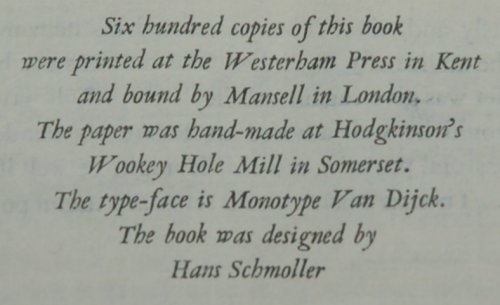
Another of the Allen Lane Christmas books is my featured work for Christmas week. This time the book consists of one hundred letters from the self styled Baron Corvo to John Lane, the founder of The Bodley Head Press. It was sent as a very limited gift of just six hundred privately printed copies in 1963 as can be seen from the enclosed sheet of paper from Allen Lane which is reproduced below.
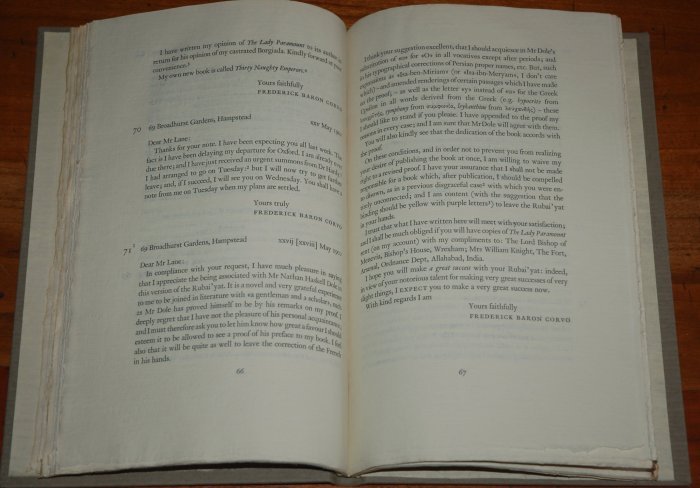
The paper for the book is hand-made with the distinctive ragged edges that such sheets often have if not trimmed which gives the book a lovely look and feel and it would be a pleasure to read is it wasn’t for one issue which I have mentioned before about another book. That is that the very helpful notes are all combined at the end so the reader is forced to use two bookmarks or repeatedly thumb through the pages looking for information. That these notes are necessary is due to the elusiveness of Corvo himself and the fact that what he did write about himself is not to be trusted, so you are regularly searching for context within the letters.
Frederick Rolfe aka ‘Baron Corvo’ was a strange and difficult to pin down person. He claimed the title from time he spent in Italy with an Italian nobleman who apparently granted him the name Baron Corvo but this is probably not true. That he had talent as a writer and artist is however undisputed but often his abrasive and wildly changing personality caused conflicts with those whom he most needed for support and he definitely endured considerable periods of hardship. Looking back over more than a century he is fascinating but not somebody I would have wanted to have anything to do with.
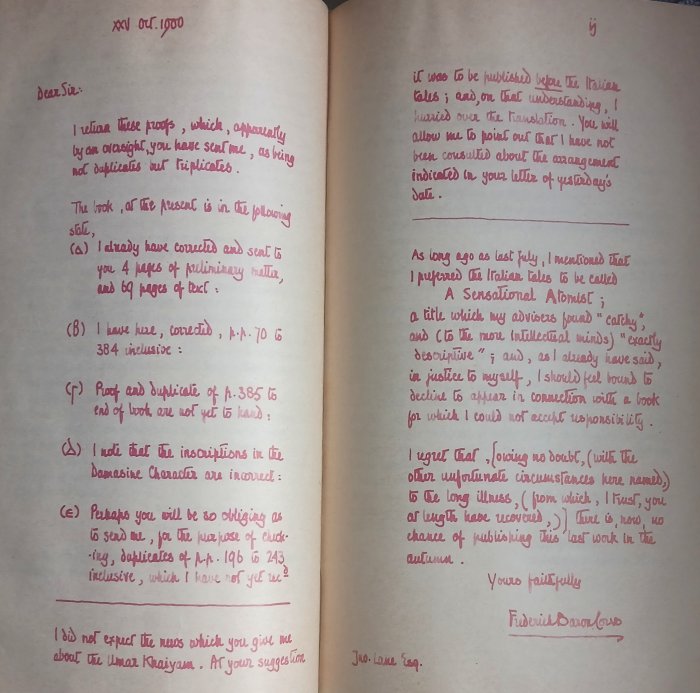
The book includes two of the letters as facsimiles, including the example below where you can see his bold handwriting but also his odd choice of red ink for correspondence. Indeed Corvo used a wide selection of coloured inks for his letters and if all the letters had been in facsimile the book would have been a positive rainbow.
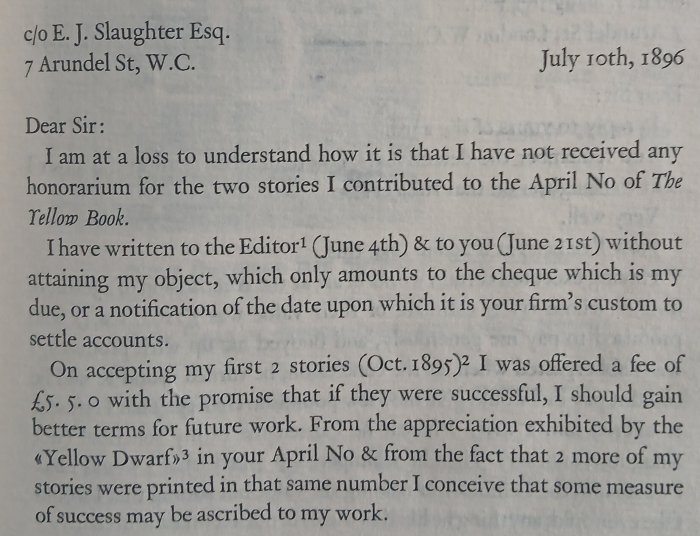
But let’s get to a proper selection of the letters which concern initially possible printing of more of Corvo’s ‘Stories Toto Told Me’ tales, several of which had been well received when published earlier in volumes seven and eleven of ‘The Yellow Book’, which was a Bodley Head i.e. John Lane publication. Over the years a possible illustrated edition of the Rubaiyat of Omar Khayyam was also mooted and the letters become more concerned with that. As the book is rare I have included a few letters so you can get to have a feel for the man, beginning with this letter chasing payment, and all too familiar theme in all of Corvo’s correspondence, from July 1896.
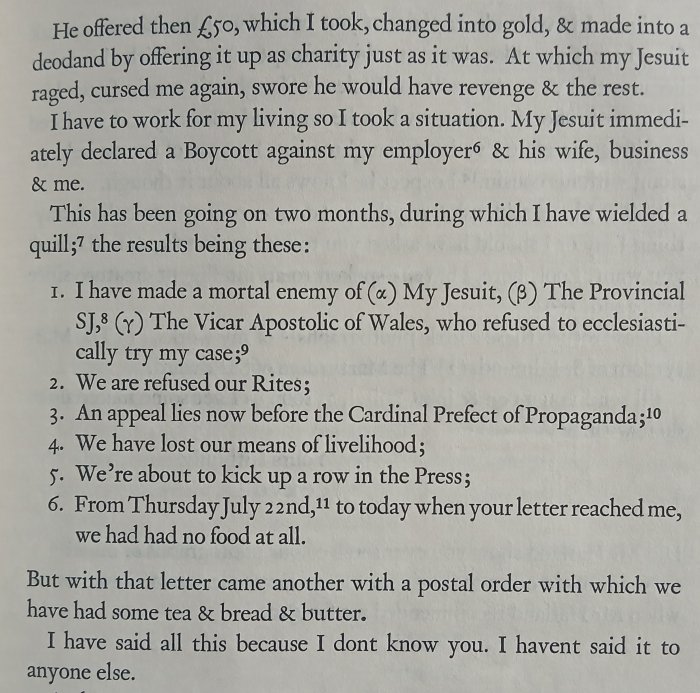
A year later, July 1897, and this is the second half of a letter which is happier in that he had received payment, which he had then given away principally in order to annoy the priest that gave him the money. I will go into more about what had happened here and some of the basis of his feuding with religious authorities next week when I dig more into the man behind these letters.
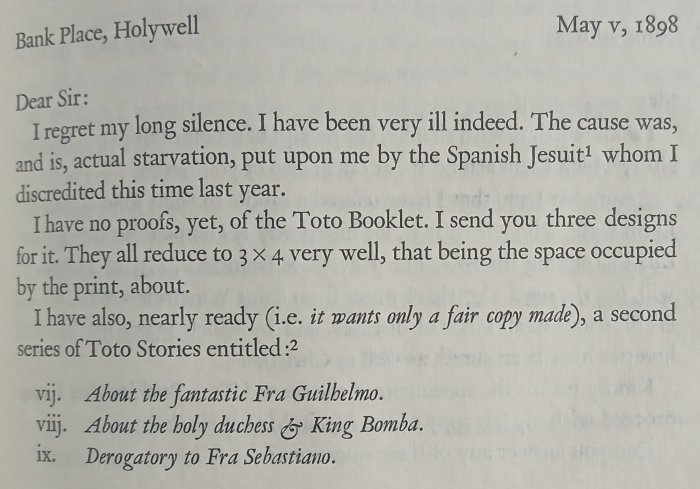
By May the following year Corvo was still in dispute with the church in Wales, but is also still trying to follow up what is happening with his Toto stories and is getting increasingly frustrated with Lane’s lack of replies to his numerous letters. It should be noted that a long silence from Corvo would only be a matter of weeks as he was a prolific sender of letters.
The next letters I have chosen from the hundred in the book are three years later, from 1901 where we see the first of numerous chases for what is happening with the Rubaiyat but also in the second one here a firm statement of his intention to remain private. It is this secrecy, and indeed the choice of different names he would use not just in print but whilst living in locations where he wasn’t already known, that makes tracking down Corvo and what he was actually doing from time to time so difficult.
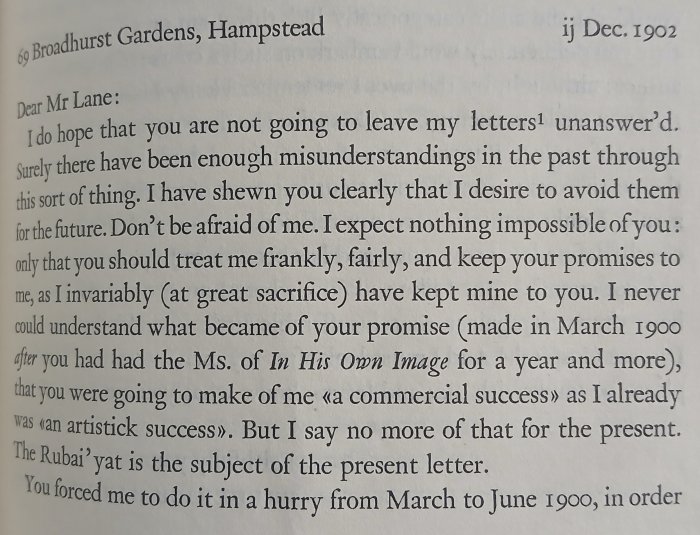
The start of the next letter, December 1902 has the familiar complaints of lack of response and more chasing of the Rubaiyat, I don’t think this was ever published however. In Lane’s defence he was known to be poor at replying to letters and the sheer number he was getting from Corvo was likely to make him even less prone to keep up a two way correspondence.
Finally I have chosen this letter from 1903 which is one of the sources of the title of this book, he uses the phrase ‘without prejudice’ several times whilst in disputes on various occasions.
So there it is, an unusual book for Christmas giving an insight into a distinctly unusual person published fifty years after his death. But who was Frederick Rolfe, aka Baron Corvo, aka Frank English, aka Frederick Austin, aka Fr Rolfe (giving the deliberate impression he was in the priesthood), aka ‘A Crab Maid’ etc. well more will be revealed next week when I review ‘A Quest for Corvo’ by AJA Symons.
As I’ve covered before, 2025 marks the ninetieth birthday of Penguin Books, and regular readers of this blog have no doubt realised I am a keen collector of this publisher. There are many different ways to collect Penguin books and one popular way is to collect the first five hundred, or first thousand, or if you really have the space then the first three thousand main series titles (those generally recognised as Penguins). This co-incidentally is pretty well all the main series books published by them from when they started in July 1935 up to the introduction of ISBN and the loss of the distinctive numbering system so it is a satisfying, if bulky, target to aim at. There are problems with this though as quite a few of the wartime titles, especially the crime fiction, are now very expensive, so I’ve been thinking about what I would do if I was starting now and one possibility is the Penguin Millions. These are a subset of the Penguin titles and importantly the first ‘million’ came out in 1946 so the scarce wartime crime titles can be avoided. But what is a Penguin Million and how many are there?
The first million has an explanation of the concept on the inside, in this case George Bernard Shaw had reached his ninetieth birthday in July 1946 and to mark the occasion Penguin simultaneously printed a hundred thousand copies of each of ten books. Nine of these were new to Penguin (books numbered 500 along with 560 to 567) and there was one reprint, Pygmalian (numbered 300 and originally printed in September 1941). Nowadays I doubt a million books by Shaw would sell very well but back then he was still a popular author and his works are regularly found in early Penguin lists and these titles were soon being reprinted again..
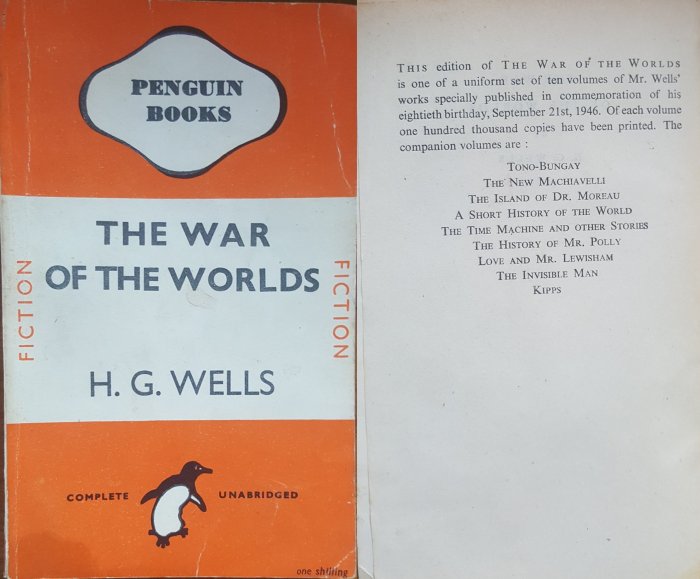
The idea obviously sold well enough for somebody at Penguin to decide that this was a good idea and the second million soon followed a couple of months later in September 1946 and this time the author featured was H.G. Wells
This time there were three titles reprinted as part of the set, A Short History of the World (Pelican A5 original May 1937), The Invisible Man (151 original August 1938), Kipps (335 original November 1941), with the remaining seven books being numbered 570 to 576 and coming out together in September 1946. Maybe these didn’t do as well as Penguin though they would as there was then a gap of a couple of years before they had another go and this time it was the sure fire winner Agatha Christie,
Published in August 1948, this time all ten books were new to Penguin so they had the consecutive numbers 682 to 691. Considering that a hundred thousand copies of each were printed Murder on the Orient Express as part of the Christie Million is surprising awkward to find and is probably the only book featured in this list that would be a real challenge to locate. Although tracking down some of the correct reprints for other titles can also be tricky, as they are rarely advertised as being part of their respective ‘millions’ when searching online but you can always tell if it is correct edition as it will have the page explaining about its part of the set.
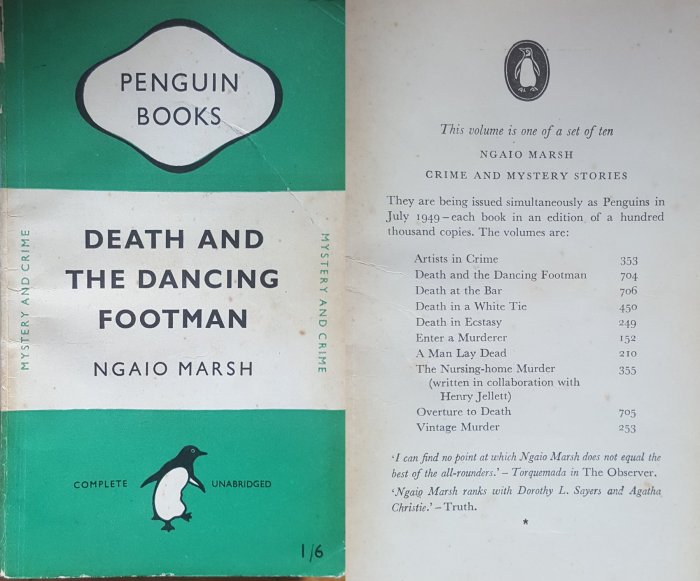
Another eleven months passed and it was time for another crime writer to be featured, this time New Zealander Ngaio Marsh.
This time Penguin have made it easy for me and given the respective numbers in the Penguin catalogue in the listing. As you can see only three titles were new to Penguin (numbers 704 to 706 published July 1949) with the others going back as far as Enter a Murderer (152 – August 1938). This is where the financial advantage of collecting the ‘millions’ editions comes into its own as Death in a White Tie would sell for well over £500 and possibly getting on for £1000 as the March 1945 Penguin first edition whilst the reprint for the ‘million’ is only a few pounds. This reprint is also a Penguin oddity as the floor plan of the house where the murder took place is missing from this edition and was incorrectly included in 704 Death and the Dancing Footman. Both books are therefore somewhat confusing for readers, one for the lack of the diagram which makes placing the action more tricky, and the other for an included plan of a house that bears no relation to the plot.
The next million was in March 1950 and we leave the world of crime in favour of a somewhat more challenging read, D.H. Lawrence to mark the twentieth anniversary of his death.
As can be seen five of the books chosen were ‘double volumes’ marked with an asterisk in the list above, i.e. books of significant length and were therefore more expensive than the standard paperback at the time, which retailed at one shilling and sixpence (7½ pence), these longer books were two shillings and sixpence (12½ pence). Kangaroo for example is 594 pages. All of the books were first printings by Penguin nine of which are 751 to 759. The original plan was for 760 The White Peacock to be included in the ten books but production issues meant that this wasn’t ready for publication until August 1950 so the collection of poems (D11) was issued instead, which, along with the separate volumes of letters and essays, I think gives a wider overview of D.H. Lawrence’s work as part of this collection.
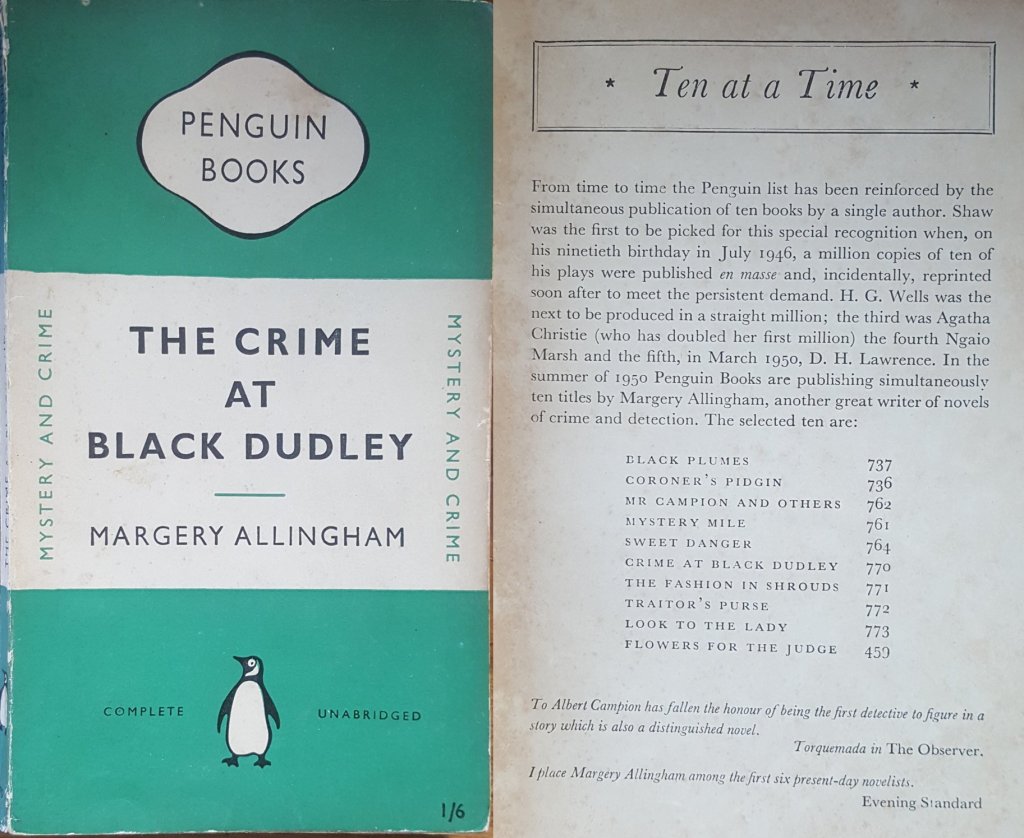
After the erudite literature of Lawrence it was back to crime for the next Penguin million. This time Margery Allingham in June 1950.
The only reprint is another wartime crime rarity 459 Flowers for the Judge (originally June 1944) all the others, despite the apparently random numbers, all first appeared as a UK Penguin in June 1950. The one oddity is 737 Black Plumes which had first been printed by Penguin USA Inc as number 534 in December 1943 and is another difficult to find wartime first Penguin printing, especially on this side of the Atlantic.
Next comes Evelyn Waugh whose ‘million’ came out in May 1951.
This time there are five titles new to Penguin (821 to 825) with five reprints Decline and Fall (January 1937), Vile Bodies (April 1938), Black Mischief (November 1938), Put out More Flags (October 1943) and Scoop (March 1944). There’s a nice potted bibliography along with the list of books in the listing. I’ve always quite liked Evelyn Waugh although he does seem to be a lot less well known nowadays. I also like the fact that his first wife, although only for one year as she had another relationship with John Heygate at the time, was also called Evelyn, just imagine the confusion when guests called.
We then start a run of three crime novelists before the ‘millions’ peter out and next comes Carter Dickson in June 1951.
Again we have ten new titles, consecutively numbered 811 to 820 and all by Carter Dickson, who also wrote under his real name John Dickson Carr as well as Carr Dickson and as a real wildcard once as Roger Fairbairn. Fortunately his ingenuity with plots is far better than his imagination with pseudonyms and the missing photograph on the back cover with it’s accompanying blurb regard anonymity fooled nobody. However regarding the use of the back cover here, I have had to do this as, due to a compilation error, all ten of the books actually have the Evelyn Waugh ‘millions’ description inside them instead of one for Carter Dickson. Almost all the books he wrote under the name Carter Dickson feature the elderly amateur detective and barrister Sir Henry Merrivale and that is certainly the case with the ten books in this collection. I personally prefer the Dr Gideon Fell stories he wrote under his actual name although that possibly because I came across him first. Each of these detectives have around a couple of dozen books dedicated to them and the Merrivale books certainly have much to recommend them.
The next million goes to Belgian George Simenon and his legendary detective Maigret and these were published in January 1952.
Simenon is invariably though of as French like his most famous creation Jules Maigret, as Penguin do so in the introduction above, and he did live for a lot of his life in France along with a decade or so in America after WWII. There are seventy five Maigret novels and numerous short stories but even the novels are quite short so Penguin tended to publish two per book. The collection came out as two blocks of numbers 826 to 830 and 855 to 858 which count for the nine new to UK Penguin Simenon titles in the ‘million’ there was also a reprint 739 A Battle of Nerves & At the ‘Gai-Moulin’ (originally January 1950). Yet again we have a book that was first printed in America as a Penguin Inc publication, Maigret Travels South which first appeared under the Penguin logo in New York as 564 (September 1945). The works of Simenon have a very chequered history with Penguin with many volumes being announced but never actually being published.
Where do you go after the classic Maigret novels well there can only be one choice and the only author to have multiple ‘millions’ it’s Agatha Christie again, this time in May 1953.
This time Agatha Christie chose the ten titles herself and oddly one of them had already appeared in the first Christie million so we have nine books (924 to 932) printed by arrangement with Collins which are first appearing in Penguin along with The Murder of Roger Ackroyd which had first been printed by Penguin as 684 in the first Christie million in August 1948. Technically all ten of these books are a first edition as each includes a new introduction written by Agatha Christie for this printing.
And that was it for the printing of ‘millions’ but there was one final addendum and that was for Arnold Bennett
This time there were only six books issued at the same time and no suggestion that a hundred thousand copies of each were being printed. Two were reprints Anna of the Five Towns (33, March 1936) and The Grand Babylon Hotel (176, November 1938) along with four that were new to Penguin (996 to 999) and as can be seen there were various issues with copyrights in Canada and the USA.
So where does that selection of eleven sets of publications within the first thousand bring us, well there are 106 (105 if you don’t want Roger Ackroyd twice) books to search for, eleven largely readable authors, both Bennett and Shaw I have to be in the mood for, and a pretty decent fiction library from the end of the 19th century through the first half of the 20th. Plenty of easy reading crime and other novels with some more taxing works but none that should put off a dedicated reader. It is also a manageable task to accumulate all of these without the bank account straining issues that can face a collector of a complete numeric run. I have been collecting Penguin for over thirty years, although I only really started taking the main series seriously in the last dozen or so as I mainly concentrated on the more obscure aspects of their output. But I’m still missing fourteen books out of the first six hundred even after twelve years and I’m only very very slowly filling in the gaps.
There are many more blocks of books by one author after number 1000, but as I don’t collect them I cannot pull them off the shelves to check to see if any of these are designated as ‘millions’. Examples include six books by Aldous Huxley numbered 1047 to 1052 published in April 1955, eight books by C.S. Forester numbered 1112 to 1119 published in January 1956 (1111 is also by Forester but came out two months earlier), and nine books by John Buchan numbered 1130 to 1138 which were published in May 1956. Maybe collecting the ‘millions’ is the way ahead.
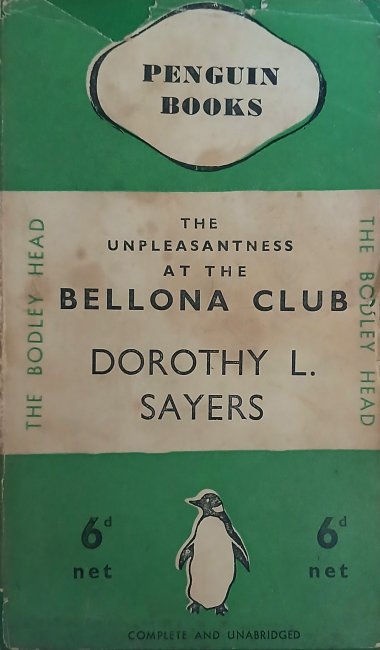
This post is going live on Remembrance Day 2025 so it is appropriate to feature this Lord Peter Wimsey crime novel as the body is discovered on the 11th November and the fact that it is Armistice Day, as it is called throughout the book, is vitally important to the plot. This is the fifth of the original ten Penguin books published on 30th July 1935 that were the start of the company and which I started reading in their first editions in August, the remaining five will be covered between now and July 2026. This book was originally published in 1928 and is the fourth title featuring Sayers’ amateur detective Lord Peter, I have previously written about her twelfth novel Busman’s Honeymoon and a collection of short stories, some of which feature Lord Peter, Hangman’s Holiday.
I’ve always liked the Lord Peter Wimsey books since watching as a child the television series featuring Ian Carmichael in the 1970’s and this, whilst not one of the best, is a really good read. As can be expected the initial unpleasantness at the Bellona Club is the discovery of the body of Colonel Fentiman in his customary chair by the fire in the club on the evening of the 11th November still clutching his newspaper which he was wont to doze under soon after arriving in the morning. He was after all in his nineties so the death, apparently of heart failure, was not entirely unexpected although unfortunate. To the club members however the unpleasantness was to continue for several more weeks due to the wording of both his and his sister’s wills, as she had also died on the morning of the 11th. The Colonel’s will left the majority of his estate, some £2,000 (roughly £110,000 today) to his youngest grandson George with the residual going to his other grandson Robert on the basis that George as a married man suffering from shell shock after WWI needed the money more than Robert who was still single and a Major in the army. His sister, Lady Dormer, however drafted her will so that her estate, which had come to her on the death of her wealthy husband, and was worth around £700,000 (about £38 million today) would mainly pass to the Colonel if he was still alive when she died but if he predeceased her the vast majority would go to Miss Dorland who had been her companion for many years. It was therefore vitally important to establish exactly when the Colonel had died as if it was before 10:37am, when Lady Dormer had passed, then Miss Dorland was now extremely wealthy and if it was after that time then Robert Fentiman, gaining the residual after George had his £2,000, would be the one to gain.
But that is somewhat leaping ahead, Lord Peter is a member of the club and a friend of George and was acquainted with the Colonel and Robert. A the book begins the club was busy as a lot of members had come to London for the Remembrance Day event, Lord Peter and all three of the Fentiman family were at the club, Robert was staying there as he didn’t live in London whilst George and Lord Peter met in the bar that evening, the Colonel, as previously mentioned, either dozed or had died but had not yet been discovered in his chair by the fire but was about to be. Fortunately when Colonel Marchbanks found he was addressing a body Dr. Penberthy, the old man’s physician was also at the club and he and Wimsey moved the body to one of the club bedrooms noticing one thing odd in that the left knee of the corpse moved freely indicating that rigor mortis had begun to pass off but strangely only that joint was free.
That should have been the end of the story for Lord Peter but Mr Murbles, Peter’s solicitor and also the representative of Colonel Fentiman called several days later to advise him of the conflicting wills and asked him to make some discrete enquiries to try to establish when the old man had died. But how to establish when a man’s heart had given out precisely enough to reconcile the issue and both Fentiman brothers were acting rather oddly. Peter begins to suspect foul play…
The sixth of the first ten Penguins is ‘The Mysterious Affair at Styles’ which I have already reviewed as The Strange Case of the Sixth Penguin Book where I explain why there are two books with that number so the next book to be covered of this group will be Twenty-Five, the autobiography of the young Beverley Nichols.
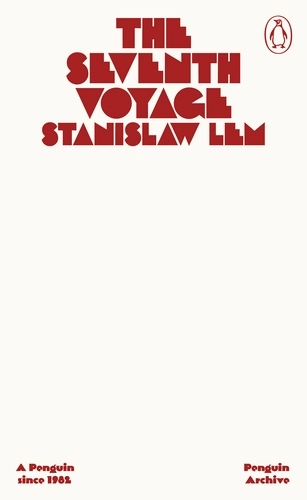
Polish author Stanislaw Lem is probably best known for his 1960’s science fiction masterpiece Solaris which has been adapted into a couple of films, in 1972 there was a Russian version and then fifty years later in 2002 James Cameron produced another in America. The Russian original is generally regarded as the better film although the latter is supposedly closer to the original book. This collection produced as part of Penguin Books 90th birthday celebrations consists of the short story ‘The Seventh Voyage’ (27 pages) along with a couple of short novellas, or longer short stories depending on how you define the categories, ‘Terminus’ (63 pages) and ‘The Mask’ (68 pages). I’ll review each one separately.
The Seventh Voyage
Well that was great fun, the story comes from a 1957 collection entitled The Star Diaries and despite being called The Seventh Voyage it is the first one in the collection which are different numbered journeys through space by Ijon Tichy as told by the equally fictional Professor Tarantoga. In this one Tichy encounters time loops after his spaceship is damaged and needing two people to effect the repairs decides to team up with one of his alternate selves to do the work. However all the various versions of himself seem to be a cross purposes and start fighting amongst themselves over who should have the one spacesuit to ensure that a future version can also have a suit on and also who can eat which bits of the limited rations.
Terminus
From Lem’s Book of Robots this story from 1961 is much more a ghost story rather than the humour of the first story although it is also clearly a work of science fiction. Pirx has just received command of an old spaceship and on first arrival at the spaceport was less than impressed with his ship with it’s visible rust internally and obvious patch jobs all over the place. Intrigued as to its history he searches for the ship’s log and finds out that the agent was not kidding when he said it was historic. In fact notorious would be closer to the mark as the ship was originally called Coriolanus and every space traveller knew that name and the disaster that befell it when it was caught in a meteor storm and so badly damaged that the crew were trapped in separate sections as the oxygen slowly ran out. All nineteen crew members died and the ship was assumed to be scrapped, but it was here, with its slapdash repairs to save money and barely capable of the run to Mars that Pirx had been assigned to do. Whilst exploring the ship after take-off Pirx notices that a pipe is vibrating and what is more it is doing so in Morse code and passing messages between the now dead crew calling for help as they slowly suffocate…
The Mask
This 1974 story can originally be found in the collection of Lem’s stories entitled Mortal Engines and we are this time in the realm of science fiction horror and it is a very strange but engaging tale. It is however very difficult to review without giving away the twists in the story, which is what the Wikipedia entry does within the first paragraph, you have been warned. The story starts with a nightmarish sequence where our first person narrator has no real idea what is going on or even who they are. This very quickly segues into what appears to be a regency royal ball, all crinolines and lace, but our narrator has no idea as to why she is there and still no clue as to their identity, is she recovering from amnesia, is she mad, or is there some other explanation? She is drawn to a mysterious stranger sitting alone in a window, but why and how can she know him better when she doesn’t even know herself? The explanation to these various questions is slowly revealed and the true horror of both their situations is a total surprise, unless that is you have sneaked a peek at Wikipedia, which I’m glad to say I only did to verify when this was first published after completing the story.
Although I knew the name Stanislaw Lem I have to admit that I hadn’t read any of his work before this book which was the main reason I bought a copy from this anniversary collection. I’m definitely going to read more, starting with Solaris of which I have seen the original Russian film version but never read the book.
Although the author is probably rarely read nowadays, this novel by Susan Ertz is still in print although I think only by Zinc Read, a publishing house that specialises in printing books that would otherwise be no longer available. Other than that example I can’t find any other books by Ertz that are still in print, which is a pity as I have enjoyed this quite charming novel, I do have a copy of her book ‘Now East, Now West’ and will definitely look for others. Madame Claire is the eighty year old widowed matriarch of three children and three adult grandchildren, all from her eldest daughter Millicent. Her two other children are Eric, the eldest, now a prominent Member of Parliament and unhappily married to Louise, and Constance who is referred to as Connie throughout the book and is definitely the black sheep of the family having run off with a Russian concert pianist and then being abandoned by him. Millicent is married to John who is a well to do barrister and their three children are Gordon who is dating Helen, the daughter of Lord Ottway, Noel, currently unemployed due to losing an arm during WWI and Judy who doesn’t really know what she wants to do but feels trapped into the cycle of marrying well and settling down which frankly she doesn’t want to do. It took me a couple of chapters to get everyone sorted out in my head along with Stephen de Lisle, ex Home Secretary who was deeply in love with Claire, so much so that he asked her to marry him a couple of decades ago when her husband Richard died. Refused he took off for the continent and hasn’t been heard from since. However the book starts with Claire receiving a letter from Stephen…
That letter from Stephen was the first of many in the book and I like this way of pushing the story forward, Ertz uses them for exposition of the various relationships which would otherwise involve many more pages of scene setting and dialogue, instead she can simply have one character explain things to another in their letters. There is no doubt that Claire runs the family but without obvious interventions, rather she suggests options that help push things along such as getting Judy sent to Cannes ostensibly to see how Stephen was recovering from his minor stroke which was stopping his return to London and the resumption of a sadly extended break in relations with Claire. Yes this was partly the reason but Claire also recognised that Judy needed a break from the suffocating situation at her family home to think through what she was going to do regarding Major Crosby aka Chip whom she had fallen for after the car she has a passenger in had hit him crossing a foggy road. Unfortunately Chip had no money, wasn’t from a ‘known family’ and didn’t have a job so Judy’s parents didn’t regard him as marriage material for their daughter, Claire however liked him so was keen to help. Beyond Madame Claire Noel is the most interactive of the other characters, always willing to help his sister and most like Claire in his ability to make the best of a situation such as being able to deal with Connie when she re-appears, again at the instigation of Claire.
The various interactions between the assorted characters are well done and whilst Ertz does go a little flowery with her prose occasionally that is probably more to do with a hundred year old writing style than any real issue with the book, which to my surprise I have greatly enjoyed. I am usually wary of works by authors who have vanished to the degree that Susan Ertz has but I think she is greatly in need of a rehabilitation of her literary reputation and I’m surprised that Persephone Books hasn’t reprinted her works as I think she would fit well with their house style.
As can be seen from the full list below with their original UK publishers and publishing years, the first ten Penguin Books were an eclectic mix of titles and whilst several authors are still well known and widely read today a few have largely fallen by the wayside. They had mainly first come out in hard back in the previous decade so were very much current material in 1935 and Penguin was for the most part their first appearance in paper back. After the first printing dates I have added a number in brackets which gives the number of UK printings each book had had before being printed by Penguin, as you can see most of these books were very much in demand. The relatively low reprint numbers for the two crime novels are probably more due to the larger numbers printed for each edition for these than other genres.
Maurois – Ariel – The Bodley Head Ltd. – 1924 (8)
Hemingway – A Farewell to Arms – Jonathan Cape Ltd. – 1929 (9)
Sayers – The Unpleasantness at the Bellona Club – Victor Gollancz Ltd. – 1928 (3)
Christie – The Mysterious Affair at Styles – John Lane The Bodley Head Ltd. – 1920 (6)
Nichols – Twenty-five – Jonathan Cape Ltd. – 1926 (3)
Young – William – Jonathan Cape Ltd. – 1925 (2)
Webb – Gone to Earth – Constable and Co. – 1917 (21)
Mackenzie – Carnival – Macdonald and Co. – 1912 (11)
I’ve enjoyed reading the first four Penguin books over the last few weeks, and more books from the original ten will be featured on this blog over the coming months with the aim to have read them all by July 2026 so within their ninetieth birthday year. By the end of their first year Penguin had published fifty titles but were still an imprint of The Bodley Head and would not be a separate business until the beginning of 1937.
Of the four books that I am reading to mark the ninetieth birthday of Penguin Books this was probably the one I was looking forward to most. Eric Linklater was an established novelist by 1935 when Penguin began, with six of his twenty three novels published by then and a seventh coming out that year. Poet’s Pub was his second work (1929) and would be adapted into a film in 1949 although that version bears little relation to the original novel. I was already familiar with Linklater’s work from probably his best known novel ‘Private Angelo’ a comic satire of war based in late WWII Italy and published in 1946, which I first read and enjoyed a decade or so ago and probably should get off the shelves and re-read at some point. However I wasn’t disappointed with this also comedic book which at times, such as the extended car chase from the fictional village of Downish, north west of London, to Scotland and the aftermath of the Elizabethan dinner which provides the opportunities for the two thefts that push the plot forward, descends into near farce.
Saturday Keith, named as such by his father as he was the seventh son and they had all been born on different days of the week is the eponymous poet and the Pelican Inn in Downish owned by the mother of Quentin, an old friend of his from university days, is the public house. Or more accurately the inn/hotel as the regular guests staying there along with the staff provide Linklater with his much varied cast of characters and few patrons of the public bar are even mentioned. It’s a setting that has attracted many authors over the decades from E M Forster’s ‘A Room with a View’ to Anita Brookner’s ‘Hotel du Lac’ and even Stephen King’s ‘The Shining’ along with numerous crime classics, where else could you believably have such a diverse group of people in one place with no need to explain who they are and why they are there?
Keith took the job as landlord with the hope that along with a regular income, something definitely lacking for the vast majority of poets, he would have a quiet space to work on his magnum opus, the poem that would finally mark his breakthrough onto the public consciousness. The work running a surprisingly successful inn once it become known it is run by a literary gentleman, and thereby attracts a more upmarket clientele, means he struggles to find time to work on his epic and the assorted distractions both from Quentin and Joan Benbow, the daughter of one of the guests whom Keith has fallen madly in love with add to the comic possibilities. Quentin has likewise fallen in love only he is smitten by Nelly Bly who is working there as a maid but in reality is a part time journalist for a national newspaper that is hoping to get some interesting stories. Amongst other guests there is an American by the name of Mr van Buren who has invented a new method for processing crude oil and if I say that his paper describing the technique is in an identical folder to that used by Keith for his poem I’m sure you can see where confusion lies later on in the book. Throw in some industrial espionage, a missing secret recipe for a blue cocktail available in light and dark shades to represent Oxford and Cambridge along with a few other quirks of the people staying there and the story positively bowls along dragged down only by the overlong car chase but even that has its redeeming and indeed ridiculous features.
Poet’s Pub is still in print by Penguin, although it now comes under Penguin Classics which I think is only fitting for this excellent novel that has stood the test of time remarkably well.
Book number two from Penguin Books’ first ten titles which I’m reading in the quite fragile first edition copies to mark their ninetieth anniversary is A Farewell to Arms. As mentioned in last week’s blog about Ariel all the original rear covers for these books refer to this book as Farewell to Arms but this was quickly noticed and corrected and after the initial distributed batch the ‘A’ was reinstated. I’ve never been a particular fan of Hemingway, but I have enjoyed this, his second novel, which is based quite heavily on his own experiences in Italy during WWI although with fictional military units and characters some of which are based on real people. It was first published in 1929 and was sandwiched between his first novel ‘The Sun Also Rises’ and a non fiction book ‘Death in the Afternoon’ both of which are concerned with bullfighting which was a passion of his and probably negatively coloured my original impression of Hemingway.
The book follows American volunteer Frederic Henry who is serving as a Lieutenant in an ambulance corps for the Italian army before the Americans actually joined WWI. He meets an English nurse named Catherine Barkley but is rebuffed when he tries to kiss her. Later Henry gets badly injured in one knee during a mortar attack on the front line, getting decorated for his bravery in assisting fellow soldiers and ends up being looked after for months in a hospital in Milan where he is treated by Catherine and a relationship develops. I don’t know why but I wasn’t expecting a romantic story from Hemingway and this it definitely is as the deepening love between Frank and Catherine during his recovery supersedes the war driven plot in the first section of the book. Only for the war to come back into the story as Frank recovers sufficiently to be posted back to the front just in time for the Italian army to retreat in the face of German onslaught. Later whilst hiding as a civilian he joins up again with the now pregnant Catherine and they make an escape to Switzerland.
Hemingway on the other hand arrived in Italy in June 1918, aged just eighteen, as a Second Lieutenant working as an ambulance driver. In July he was injured in a mortar attack and got decorated and promoted to Lieutenant for his bravery in assisting fellow soldiers and then ended up spending six months recuperating in a hospital in Milan where he met an American nurse named Agnes Von Kurowsky and fell in love with her. Rather than go to Switzerland to escape the war in reality the conflict finished whilst he was being treated and he went back to America in early 1919 expecting Agnes to join him later. Instead she got engaged to an Italian officer and the two never met again.
That Hemingway had first hand experiences of the scenarios depicted in the novel is obvious in the vivid descriptions both of the conflict and the life in Milan during Frank’s recuperation, which at times seems so far away from the realities at the end of the First World War. The book is written in the first person from the point of view of Frank and I was particularly drawn in by the later sections covering the retreat from the north where Frank and his crew were as likely to be shot by jumpy and trigger happy Italians as the advancing Germans. The text is accurate enough for me to follow their movements on a map of northern Italy and then his escape from actually being shot by a group of disaffected Italian lower ranks and Carabinieri because he is an officer leading to his abandonment of his uniform to avoid reprisals through to the ultimate night time row across the Swiss border.
Below is a photo of my first edition copies of the first ten Penguin titles issued together on 30th July 1935.
30th July 1935 was a very important date in the history of publishing, as that is when the first ten Penguin books made their appearance. Ninety years later these books in their first editions are somewhat fragile and definitely difficult to find, especially the crime titles. I do have all ten and seven of them still have their elusive dust wrappers as can be seen below, the wrappers have the 6d (six pence) price on the front cover. For August I’m going to be reading the first four, one a week, and the plan is to read five of the remaining six during the rest of the year, one has already been a subject of a blog so this will be linked to when its turn comes, I will probably re-read this one as well just to say I’ve read the set in a run. As the books are so delicate, and valuable, this is not something I have done before but it only seems appropriate as a means to celebrate Penguin’s 90th birthday. The books are colour coded with blue indicating biography, orange fiction and green crime, other colours would be introduced as time goes on. This was a concept started by Albatross Press in Germany, see my blog on those books for more details and the similarities between them and Penguin.
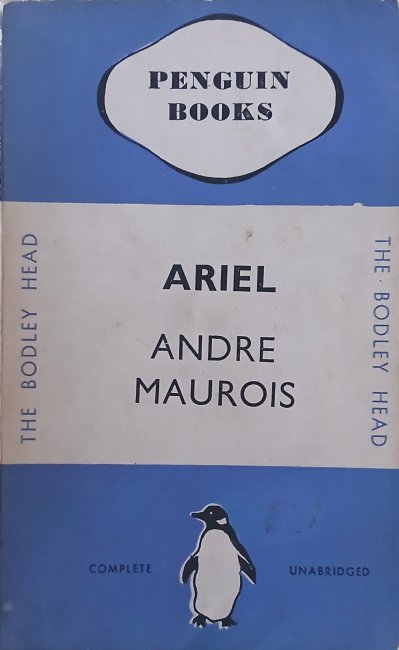
Before talking about ‘Ariel’ the book there is one other thing that needs to be mentioned regarding these first ten books and that is an error on the back of the very first versions of all of them. Book two, ‘A Farewell to Arms’, is missing its first word in the list of titles on the rear. This was noticed quite quickly but not in time to prevent the first batch of titles going out with this incorrect list. Subsequent batches of books from the first editions of all ten books were corrected and the full title appears, however another error happened with ‘Ariel’and this is clear on the front cover at the top of this log entry. The authors first name is André not Andre and this led to a third cover being produced for the remainder of the first edition run of this title, not a great start to a new publishing enterprise. The first edition is therefore available in three variants:
Farewell to Arms on the rear and Andre on the front
A Farewell to Arms on the rear and Andre on the front
A Farewell to Arms on the rear and André on the front
All three versions are shown below, the first book being the rear of the one used at the top of the page with the missing accent, the second book is also missing the accent on the front cover.
Another thing to add, as it is clearer at the base of the rear covers above, is that Penguin Books when it began was simply a paperback imprint of the publisher John Lane The Bodley Head which explains why all the books say THE BODLEY HEAD on their front covers. This would be the case for over a year with Penguin Books finally becoming a separate entity and references to The Bodley Head no longer appearing from the batch of books numbered 81 to 90 published in March 1937.
When reading ‘Ariel’ it becomes clear that its subtitle ‘A Shelley Romance’ is particularly appropriate, as whilst it reads as a biography of the poet Percy Bysshe Shelley it is at least partially a novel with a lot of clearly invented dialogue with no documentary evidence behind it, rather than what we would regard as a properly researched scholarly work today. That said the general thrust of the book and the sequence of events is accurate and it is impossible to examine the extent of Maurois’ actual research due to the lack of notes, citations or even an index in the book. Maurois is clearly more interested in getting a feel for his subject and portraying him in a way that gives an impression of what it would have been like to know him rather than providing a definitive biography, but it is very readable and still in print, both in this translation by Ella D’Arcy and other more modern versions.
We follow Shelley from his time being badly bullied at Eton, going on to Oxford where he lasted just a few months before being expelled from the university along with his friend and fellow student Thomas Jefferson Hogg over the authorship of a pamphlet entitled ‘The Necessity of Atheism’ which he had mailed to the bishops in the area and the heads of all the Colleges. Whilst at Oxford he had met Harriet Westbrook, a sixteen year old school friend of his sisters whom shortly after his nineteenth birthday he eloped to Edinburgh with. This led to their considerable financial difficulties as both sets of parents were outraged and stopped their allowances. Shelley had two children with Harriet, the second born after he had run away to France with the sixteen year old daughter of William Godwin and her sister whilst believing Harriet had begun an affair. Mary of course became famous as the author of Frankenstein which was published and went on to write several other novels after Shelley’s death but Maurois completely ignores this side of her portraying her as a dedicated wife, they married just days after after Harriet’s suicide, but also covering domestic arguments mainly between her and whichever other people (usually other women) were living with them at the time. The lack of acknowledgement of Mary’s literary talents is possibly the greatest failure of this biography. During the coverage of Shelley’s extended time in Italy, until his death there at just twenty nine, the quality of the biography improves markedly with letters included and far more evidence provided for what Maurois states happened.
Sadly Shelley never enjoyed the fruits of his poetic labours, as at his death he was still barely read and his life too coloured by his socialist and atheist reputation to make him acceptable reading for anyone likely to see his works in print, which is ironic bearing in mind his status as one of the great Romantic Poets nowadays. By all means read this book by Maurois as a general overview of the life of Shelley, but if you are really interested in the poet I have to recommend ‘Shelley: The Pursuit’ by Richard Holmes, first published in 1974 but still the definitive work.











 Ramblings on my bookshelves