The Prose Edda – Snorri Sturluson

Snorri Sturluson (1179–1241) was born in western Iceland, the son of an upstart Icelandic chieftain. In the early thirteenth century Snorri rose to become Iceland’s richest and, for a time, its most powerful leader. Twice he was elected law-speaker at the Althing, Iceland’s national assembly, and twice he went abroad to visit Norwegian royalty. An ambitious and sometimes ruthless leader, Snorri was also a man of learning, with deep interests in the myth, poetry and history of the Viking Age. He has long been assumed to be the author of some of medieval Iceland’s greatest works, including the Prose Edda and Heimskringla, the latter a saga history of the kings of Norway.

This version of the Prose Edda is not complete. as although The Prologue is all there, as is Gylfaginning, only a selection of ten tales from Skáldskaparmál are included and the lists giving word definitions and origins at the end of this section are omitted entirely as is The Háttatal which is a discussion on the composition of traditional poetry, which is more of a technical handbook on this verse structure and is quite commonly left out of translations. This abridgement of the Prose Edda is therefore a more readable text than the full scholarly manuscripts believed to be composed by Sturluson. The name ‘The Prose Edda’ is used to distinguish this work from the earlier verse forms of similar material known as ‘The Poetic Edda’.

It is probably best to look at the three sections separately beginning with ‘The Prologue’. This was a real surprise to me as it initially reads like a variant of the Old Testament with Adam and Eve along with Noah’s ark referred to in the first page and there is a lot of naming of sons of sons of sons to illustrate how the generations have passed. We then suddenly leave the Old Testament in favour of Homer as Odin is named as coming from Troy and travelling north from that city and Asia or at least that part of the continent known at the time and specifically Turkey is seen as the origin point for the Norse gods and name of the Æsir, which is the main group of these that reside in Asgard, is implied to be derived from Asia which is a concept I have not come across before. ‘The Prologue’ is short but full of surprising elements like this.

On to the Gylfaginning (Old Icelandic for ‘The tricking of Gylfi’). This is in the style of a conversation between the Swedish King Gylfi and three men on thrones in Asgard called High, Just-As-High, and Third. Gylfi asks many questions of the three men on the history and future of the Æsir and from this we learn the names and attributes of the gods and goddesses with tales of their exploits, some of which I knew and others were new to me. The tales start with the creation of the Earth and all that live on it along with the rise of the gods and take us right through to Ragnarok, the great battle and the death of most of the Æsir along with those that had opposed them such as the world girdling Midgard serpent. The text quotes extensively from The Sybil’s Prophesy which I take to refer to Völuspá, a Norse poem which forms part of The Poetic Edda, and there are other poetic sections quoted in Gylfaginning which are also to be found in this ancient collection of verse.

Then finally the Skáldskaparmál (Old Icelandic for ‘The language of poetry’), The ten stories included in this selection are extremely bloodthirsty with barely a page between the death of one or more characters but it was interesting and unexpected to find the basis for Wagner’s retelling of the Ring of the Nibelung which I read recently. There is the Valkyrie Brunhilde, the fire surrounding her which could only be crossed by a hero and Sigurd who is clearly the basis of Siegfried. There is also Fafner, although here a serpent rather than a dragon although these are largely interchangeable in Norse sagas, the Rhinegold hoard and a ring which brings doom to all that possess it.

Anyone interested in the Icelandic Saga tradition should definitely read ‘The Prose Edda’ and I’m surprised it has taken me so long to get round to doing so. This book is from the Penguin Archive collection of ninety books to celebrate Penguin Books ninetieth birthday in 2025.

Selected Works – Cicero

Cicero was a prominent statesman, lawyer and orator at a time of great turbulence in the Roman empire. Born in 106BC and elected one of the two consuls in 63BC, he was at his prime when Julius Caesar became dictator following his invasion on 49BC, and whilst not one of the group that ultimately assassinated Caesar in 44BC it was generally known that he supported them. He is one of the most prominent men of letters of his time with over eight hundred existing examples and many of his speeches were published. We don’t by any means have everything he wrote but what we have is still a substantial body of work. This book starts with his opening speech in the prosecution of Gaius Verres for mismanagement during his time as Governor of Sicily. the Roman legal system at the time expected a very long speech, normally over a day, in such matters but Cicero gave a ‘shortened’ version (still 23 pages long) as he was concerned that with various public holidays coming up the trial could be postponed for months. It’s a good introduction to Cicero’s style as are the selection of twenty three letters that follow which include one from Caesar.

It is in the third section that we really see Cicero in full flow in the second of his fourteen speeches mainly given in the Senate against Anthony, although this particular speech was never delivered there, being published instead. This massive fifty three page speech established Cicero as a major opponent to Anthony, who had seized control of Rome following the death of Caesar. The series of speeches were known as the Philippic’s after Demosthenes’s denunciations of Philip II of Macedon and were so powerful that Cicero eventually convinced the Senate to declare Anthony an enemy of the state as Cicero attempted to gather support for Anthony’s son, Octavian, to stand against his father. The section below is just a small part of the second Philippic against Antony but gives a feeling of the enmity between the two men:

For what was left of Rome, Antony, owed its final annihilation to yourself. In your home everything had a price; and a truly sordid series of deals it was. Laws you passed, laws you caused to be put through to your interests, had never even been formally proposed. You admit this yourself. You were an auger, yet you never took the auspices. You were a consul, yet you blocked the legal right of other officials to exercise the veto. Your armed escort was shocking. You are a drink-sodden, sex-ridden wreck. Never a day passes in that ill-reputed house of yours without orgies of the most repulsive kind.

The book concludes with two of Cicero’s best known works, the third part of ‘On Duties’ and all of ‘On Old Age’. ‘On Duties III’ consists of eleven sections where Cicero endeavours to explain the preference for actions seen as right as opposed to ones which are simply advantageous and why an action which may appear advantageous but cannot be seen as right is never the correct thing to do. This book, along with the first two parts is addressed to Cicero’s son Marcus who was then in Athens and is a guide to moral behaviour. ‘On Old Age’ is a lot more fun to read, it is written as an imagined conversation between Cato the Elder, who was 84 at the time it is set in 150BC, with Scipio Aemilianus, then 35, and Gaius Laelius, also in his thirties. Cato expounds on the advantages of old age and a reconciliation to the fact that death cannot be far away, in Cato’s case the following year.

Cicero was murdered in 43BC aged sixty three as he was attempting to escape the wrath of Anthony, now reconciled with Octavian, and his head and hands, specifically requested by Anthony as punishment for writing the Philippics, were nailed to the Rostra in the Forum Romanum.

The translation is by noted classicist Michael Grant, Professor of Humanity at the University of Edinburgh and was the first of several translations, mainly of Cicero, that he undertook for both Penguin Books and the Folio Society. This has been the first time that I’ve read Cicero although I can’t imagine it will be the last, there are several Penguin Classics that cover more of his writings and The Folio Society have recently published a massive single volume 664 page collection.

The Rule of Benedict

Another book on my shelves simply because I bought all 127 titles in the Little Black Classics series by Penguin Books and it is only now when I decided to take it off the shelf and have a look at what I had that I realised the importance of the work I had in my hands. Somewhat enigmatically entitled The Rule of Benedict this turns out to be the set of rules written down by St Benedict for the correct running of the monasteries in the order he founded, The Benedictines, and was originally written in Latin around 540AD. A book of rules doesn’t sound like a good read but surprisingly I really enjoyed it and the insights it gives into the life of what were for all their ‘simple’ lives actually the most educated of the populace in early medieval times. A monk after all was expected to be able to read the bible and give readings during the various services of the day and very few people at the time could read they were also expected to be able to perform various duties within the monastery which was intended to be as self sufficient as possible so there would be the obvious gardeners, cooks, herbalists for medicine but also tailors, carpenters and furniture makers to maintain the clothes for the monks along with the contents of the monastery. Each monk would be allowed a minimum of ‘personal’ items such as a knife, needle and thread for running repairs, and two habits and a pair of shoes from the communal stock, they were assigned underwear only if they were sent on a journey away from the monastery of more than a day.

The first example I have selected from this set of rules is part of the instructions on humility which actually run to twelve steps. This gives a good overview of the structure of the rules regularly quoting from scripture to back up the instructions:

There is also guidance as to the structure of the hierarchies within the monastery with suggestions on how deans, priors and even the abbot should be appointed and in the case of deans and priors how they should be regulated and punished if they stray from the righteous life expected of them. I hadn’t realised before reading this book that a dean was responsible for ten monks under them with a prior being considerably more senior as they would normally only be one although also under the abbot however Benedict warns specifically about priors becoming self important due to their seniority.

Other people mentioned specifically are monks that become priests, these again should be watched to make sure they don’t fall into the sin of pride and also the porter of the monastery who should be as follows ‘A wise old man should be placed at the monastery gate, who will know how to take a message and give a reply and whose age means they will not be tempted to wander about’.

The rules are very much of their time as can be seen below, particularly the final sentence, this punishment is several times stipulated for children, although not exclusively for the young depending on the severity of the offence, It is preferred to one of the various levels of excommunication that could be extended to the adults in the community as children as assumed to not be sufficiently conscious of their religious obligations to be able to understand the punishment of excommunication.

The book also includes instructions for the induction of a new monk into the community which explains that they should be initially turned away and if they persist then subjected to ‘harsh treatment’. If they continue to try to join then they may be admitted, but only into the guest house for a few days where they will be watched over by a senior monk to make sure they are really seeking God. If they continue in their wish to become a monk then they can then enter the novices centre and after two months they should have this full set of rules read to them and told if they will abide by all of it then they can stay otherwise they can leave. If they stay there is a further period of six months during which ‘their patience should be tested’ and then the rules read to them again to accept or not. There then follows another four months of effective probation after which the rules are read to them again and only after they accept the rules for the third time can they be finally admitted as a monk and from that day not permitted to leave the monastery for any reason unless instructed by the abbot. Frankly I’m amazed they had anyone join.

This serendipitous purchase has proved to be a fascinating read which I wouldn’t have had if I hadn’t bought the full set of books, along with other ones from this collection that I have reviewed earlier which you can find using the tag ‘Little Black Classics’ below.

Siddhartha – Hermann Hesse

At first sight this is an odd book for a German author, who as a young man had sufficiently strong callings to the priesthood that he briefly attended a seminary. But in 1911, in his mid 30’s, Hesse visited India and was introduced to Hindu mysticism and this has undoubtedly influenced this novel written in 1922. The story is set in ancient India, around 2500 years ago, it follows Siddhartha, and to a lesser extent his friend Govinda, in their quest for spiritual enlightenment. At first this leads them as young men to abandon their family homes and all their belongings and live in the forests as ascetic samanas, training their bodies to need nothing, using extended fasting and lack of clothes apart from a loincloth to preserve decency. This was a life of meditation and a severe deprivation of the body. A sample of the thoughts of Siddhartha are shown below and give a flavour of the sometimes difficult to follow text as Hesse can get caught up in the tautological expressions that he uses to try to explain Siddhartha thought processes for pages as a time.

Siddhartha and Govinda live with other samanas for a long time, occasionally begging for scraps of food as the bare minimum to stay alive but eventually they hear of a great teacher called Gautama (Buddha) and decide to travel to hear him teach. They eventually reach Gautama and hear him speak but whilst Govinda immediately resolves to follow the Buddha, Siddhartha instead explains that he feels that such enlightenment cannot be taught but must be individually gained through experiences and solitary meditation so the two friends part company. Leaving Govinda, Siddhartha travels until he reaches a river and there meets a ferryman who will become a significant character later in the book but for now he simply gets him to the other side whereupon he walks on to the next town. It is here that Hesse completely threw me as I thought I understood the path to enlightenment that Siddhartha was going to follow, but instead, on entering the town he sees a wealthy courtesan and is filled with desire. She however is not interested in the half starved gaunt and long haired ascetic standing in front of her and tells him that if he wants to know her better he has to be wealthy, clean and well dressed and he duly throws over his calling, gets his hair cut and body cleaned and perfumed, becomes a merchant and eventually earns a place in her bed. Definitely not what I had expected.

I admit I was somewhat daunted when beginning the book, not helped by Hesse’s undeserved reputation as a not very approachable writer, but as I read on I got more engrossed by the story and by the time of Siddhartha’s sudden change in direction I was highly intrigued as to where the novel was going and loved the ultimate resolution. It’s probably not a book for everyone, but I thoroughly enjoyed it. This is another of the Penguin Drop Caps series and eventually I will read all twenty six of these books, an explanation of the concept can be found on my my blog introducing the series here where I am also including links to each of the books as I review them.

Short Stories – Fyodor Dostoyevsky

I’ve been meaning to read Fyodor Dostoyevsky for a long time but in common with a lot of other Russian novelists his books are somewhat daunting for a blog which appears every week, just checking my shelves I find:

  • ‘Crime and Punishment’ – 559 pages
  • ‘The Devils’ – 669 pages
  • ‘The Idiot’ – 661 pages
  • ‘The Brothers Karamazov’ – 2 volumes totalling 913 pages
  • and a volume containing two short stories and a novella ‘The Cossacks’ – 334 pages

It was then I spotted that I had two volumes from the Penguin Little Black Classics series which would give me an entry point to Dostoyevsky to see if I like him as an author. The first one is number 44 from this series ‘The Meek One’ which only has this one short story in it. The title is more usually translated as ‘A Gentle Creature’, and it is just 57 pages, still quite long for a short story, but a lot more approachable. Warning there are spoilers in this review if you want to read the stories first I cannot find ‘The Meek One’ but ‘White Nights’ is on Project Gutenberg here and ‘Bobok’ can be found here.

‘The Meek One’ begins with the un-named narrator contemplating the body of his equally un-named young wife laid out on a table in their home waiting for the undertaker to arrive the next day and we then go back over the story of how the two met and the short and largely unhappy marriage that they had. They had originally come into contact with one another as she would often come and pawn items in his pawnbrokers to raise money to advertise her services as a governess or more latterly almost any job to enable her to leave her two aunts. At the time of their marriage he was forty one and she just sixteen, however he regarded himself as her saviour from a planned marriage arranged by these aunts to a shopkeeper in his fifties who had killed his two previous wives whilst drunk and was looking for a third. The relationship between the couple seems to have deteriorated very quickly after the wedding and it is a sad story he tells of long silences and barely communicating through the winter including a time when she places a loaded gun to his head whilst thinking he was asleep but doesn’t pull the trigger. In the spring he makes an unexpected move to rescue the marriage suggesting a journey to France but it is whilst out getting the passports that she commits suicide.

Russian writing has an often undeserved reputation for gloominess and this short story doesn’t go any way to repudiate that impression, maybe the next book will have something more uplifting.

The second and third of Dostoyevsky’s short stories in volume 118 of the Penguin Little Black Classics series has ‘White Nights’ paired with ‘Bobok’. ‘White Nights’ is 86 pages long, ‘Bobok’ is the shortest at just 27 pages.

‘White Nights’ tells the story of a twenty something recluse in St Petersburg and yet again we don’t have his name, this lack of a name seems to increase the isolation of Dostoyevsky’s characters and this time he is pretty well the only un-named person in the story. He spends his days wandering around the city imagining having conversations with the people and even the houses he sees but in fact the only person he communicates with is his maid Matrona who is supposed to look after his apartment but hasn’t even removed the cobweb on the ceiling, mind you neither has he. One day whilst out on one of his aimless walks he sees a pretty young girl crying on a bridge and this time builds up the courage to approach her, however she evades him only to be threatened by an older passerby and our narrator steps in the save her. So begins the four days of happiness that he is to enjoy as they get to know one another, he explains that he is a lonely dreamer whilst she tells of a unhappy time living with her blind grandmother who pins their clothes together so that she can be sure Nastenka is not wandering off. She also tells of a lodger they had a year ago whom she fell in love with but who had to return to Moscow but promised to return and marry her when he left. The narrator rapidly also falls in love with her but agrees to carry a letter to a family who know the ex-lodger to see if he has returned and is still planning on restarting their relationship whilst secretly hoping that he has found somebody else in Moscow. The story is well written with the narrator regarding himself as the hero almost of a book of his life, indeed Nastenka rebukes him for telling his story almost as if he was reading it out. Sadly the ex-lodger does return and the narrator returns to his apartment downcast looking to another fifteen years of loneliness but Matrona does at least remove the cobweb.

‘Bobok’ is easily the strangest of the three stories and to my mind the best due to its originality, although it starts out normally enough with our narrator, this time with a name, Ivan Ivanych, going to the funeral of a distant relative and avoiding the lunch afterwards, takes to lying down on one of the long stones in the graveyard for a rest. All of a sudden he hears voices, muffled but intelligible, and wonders where they may be coming from. Gradually he realises that they are coming from the graves around him and it appears that the dead have a second short life in the grave where they can communicate with each other for two or three months, possibly up to six before they decompose too far. I loved this story as I hadn’t read anything like it before, The various conversations start off reflecting the status of the characters as they were before they died but gradually they decide to throw off their previous lives and simply talk to one another until they suddenly fall silent when they become aware he is listening. Another possible reason for our narrator hearing them is given in the opening lines of the story:

The day before yesterday Semyon Ardalyonovich suddenly comes out with: ‘And would you kindly tell me Ivan Ivanych will the day come when you’ll be sober?’

All three tales are taken from the Penguin Classics volume ‘The Gambler and Other Stories’ translated by Ronald Meyer which also includes the short stories ‘The Dream of a Ridiculous Man’, ‘A Christmas Party and a Wedding’ and ‘A Nasty Story’ along with its title novella ‘The Gambler’ which was actually written by Dostoyevsky in order to pay off his debts from losses at roulette.

Fairy Tales – Charles Perrault

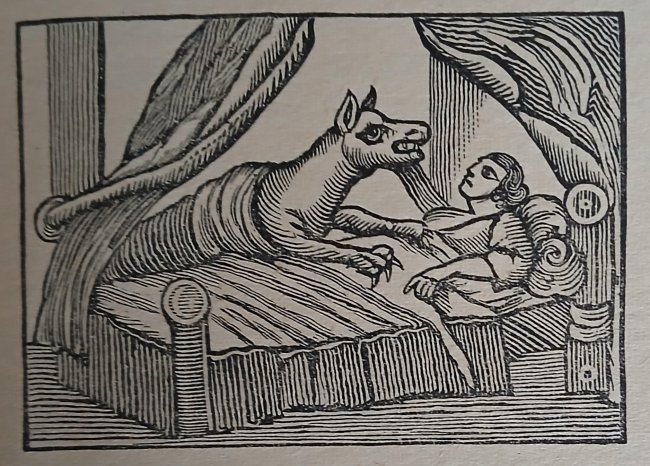
Frenchman Charles Perrault was one of the earliest collectors of fairy tales predating the German Brothers Grimm by over a century and these were well before the Danish Hans Christian Anderson and it is in this collection that we find some of the earliest published versions of such classics as Cinderella, The Sleeping Beauty, Little Red Riding Hood and Puss in Boots. Not that anyone brought up on the sanitised modern versions would recognise much of what they believe is in the story. A prime example of this is Little Red Riding Hood, which is much shorter than the tale I first read as a child, basically the wolf meets the young girl on her way to Grandmother’s house, establishes where she is going and gets there first. The wolf immediately eats the grandmother when he gets in the house and gets into the bed waiting for Little Red Riding Hood, when she arrives he tells her to undress and get into the bed at which point he eats her and the story ends just five pages after it starts with a moral that ‘plausible wolves are the most dangerous kind’ a clear warning to young ladies to beware of some men.

The most striking example of dangerous men preying on females is a story which I have never thought of as a fairy tale but it is included here and that is Bluebeard. I first came across this horror story in the opera by Hungarian composer Bela Bartok which is largely faithful to the Perrault version at least initially. A young woman visited one of the many fine homes of a wealthy man along with her family and they were all royally entertained for several days, so much so that she agreed to marriage. About a month after the wedding he has to go away on business but suggests she invites her family and friends round and gives her the keys to the house and the strong boxes, she can go and do anything but tells her never to enter the room at the end of a corridor. However she cannot resist and when she goes in finds dried blood on the floor and the bodies of his previous brides hanging on the walls, in her horror she drops the key which becomes coated with blood. Bluebeard unexpectedly returns that evening and finds blood on the key so knows she has been in the forbidden room and therefore determines that she has to die like the others. Fortunately for the young bride her brothers arrive and kill Bluebeard before he can kill her. Again there are morals to be learnt from the story at its conclusion the second of which says that the story is from long ago and nothing like this happens anymore indeed nowadays it is the wife to be afraid of not the husband.

Geoffrey Brereton as well as translating this book wrote a very interesting introduction going back to the even earlier Italian collections of fairy tales although they weren’t called that back then and taking the reader through the development of the stories such as Cinderella which in the Grimm version has the ugly sisters mutilating their feet to try to get the slipper on and having their eyes pecked out when they try to go to the castle after the wedding whilst Perrault has Cinderella forgive her sisters and invite them to live in the castle. Brereton was a freelance translator and writer specialising in French and to a lesser amount Spanish literature as such he was ideal for this 1957 translation and his erudition regarding the history of fairy tales is shown in his excellent introduction, which alone would make reading this book worthwhile. The book has reproductions of woodcuts from the first English edition of Perrault’s Fairy Tales dated 1719 before each story as in the example below for Little Red Riding Hood.

Protagoras and Meno – Plato

This volume consists of two of Plato’s dialogues, or reported conversations, featuring one of the leading sophists Protagoras and Meno, who was primarily a military leader although had also studied under several Sophists. The Sophists were a loose group of teachers on a wide range of moralistic as well as some practical subjects during the fifth century BC, teaching such things as philosophy, rhetoric and virtue along with mathematics and music. It is the teaching of virtue and whether this is even possible to be taught that most concerns these two dialogues and why they are commonly found together. Indeed Meno cuts straight to the question in the opening line of that dialogue.

Can you tell me Socrates – is virtue something that can be taught? Or does it come by practice? Or is it neither teaching nor practice that gives it to a man but natural aptitude or something else?

As can be seen from the above questions the other main character is Plato’s favourite subject, Socrates. In Protagoras the dialogue is reported by Socrates, whilst in Meno we are more directly involved as it is more like being there and listening in on the conversation. This is the second volume of Plato’s dialogues I have reviewed on this blog beginning about a year and a half ago with the most famous example The Symposium which also features Socrates. Socrates himself didn’t produce any writings so most of what we know of his teachings comes from two of his pupils, Plato and Xenophon, and it is believed that Plato didn’t start his works until after the death of Socrates even though they are all written as though contemporaneous with events although no dates are mentioned.

Protagoras

This meeting between Protagoras and Socrates covered by this piece can be fairly accurately dated to around 433 to 430BC when Protagoras would have been in his late fifties and very much the grand old statesman of the Sophists, highly respected and wealthy from his many years of speaking and lecturing whilst travelling round Greece. Socrates at this time would have been in his late thirties, The dating can be reasonably precise because Paralus and Xanthippus, the sons of Pericles are listed as present and they died of the plague in 429BC and Agathon (born around 448BC) is described as a youth. Whatever the precise date, it is before the birth of Plato (between 428 and 423BC)

The dialogue starts with Socrates visiting a friend and telling the story of the previous day when Hippocrates had called on him early in the morning very excited because he had found out that Protagoras was in Athens and demanding to go with him to hear him speak. Socrates, as ever, is doubtful of the wisdom of this and anyway it is far too early to go to the house where he knows Protagoras is staying. Instead he questions Hippocrates as to what he hopes to learn from the visit and discovers that he has no clear idea as to what would be gained, nevertheless he agrees to go. On seeing Protagoras with numerous people following him around the courtyard listening to his every word Socrates introduced himself and Hippocrates and asks Protagoras what Hippocrates could expect to learn if he became his pupil. At this Protagoras launches into a long speech broadly covering what he teaches, which is basically how to be a good and virtuous citizen. This speech is probably adapted by Plato from one of Protagoras’ books, now sadly lost apart from this fragment. Socrates then attempts to get Protagoras to define virtue, stating that he at least does not know what it is, this is typical Socrates where the admission of complete ignorance of a subject is key to the development of some sort of understanding through discussion.

Unfortunately this is where the dialogue largely runs out of steam as Socrates makes several attempts to get Protagoras to agree with a particular definition and when he cannot get him to the point he is aiming for drops that argument and picks up a different line of questioning. This makes for quite a ragged text which at times is difficult to follow as the reader cannot easily see what point Socrates is trying to make when he changes tack comparing one aspect of virtue with another such as wisdom and temperance or after that justice and temperance. The main sticking points between the two men seems to be the virtues of knowledge and courage. At the start of the dialogue Protagoras states that virtue can be taught and Socrates says it cannot at the end Socrates has come round to the idea that virtue is defined by knowledge, as after all it is in knowing the difference between good and bad that the virtuous can be determined and knowledge can definitely be taught. Protagoras however is unconvinced by this so the men seem to have swapped position during the discourse.

Meno

This occurs several decades after Protagoras in around 402BC. Again the people present allow for a pretty accurate date, Anytus is there and is described as having an important state position so it must be after 403BC and the restitution of the democracy, whilst Meno went to war in 401BC and never returned. Socrates is therefore in his late sixties and this time he is the respected thinker being consulted.

This is a much more satisfying dialogue as it is largely a discussion between the two men Socrates and Meno with Anytus only appearing near the end. Again the subject is the teaching of virtue and again Socrates starts by saying that unless virtue can be precisely defined then it cannot be taught whilst declaring himself ignorant as to what virtue may be. There is also an interesting discussion as to whether teaching is what it appears to be or rather it is the pupil being assisted to remember things that they were not aware that they already knew. This follows the concept that the soul is immortal and whilst between bodies it can explore and discover all things so it is merely a case of helping the soul within the body recover memories. This Socrates attempts to demonstrate using a slave of Meno’s who has had no mathematical training but who is brought to understand what happens to the length of each side of a square when doubling its area. Initially the slave says the side must also double but then realises that is a mistake. I think the argument that Socrates is not teaching as we understand the term during this exercise is highly debatable but Meno and by association Plato seem to agree with Socrates that the slave is simply being helped to remember.

The argument that virtue is knowledge is again raised and this time Socrates is not so sure although he goes back over some of the points in the previous dialogue. At this point Socrates and Meno are joined by the general Anytus and when he is asked his opinion of Sophists as teachers of virtue he professes considerable animosity towards the whole movement and the stupidity of the various people who had enriched Protagoras during his lifetime. During the brief time that he is with them Anytus gets angrier with Socrates in his apparent defence of the Sophists and perceived denigration of leading Athenians whom they agree were highly virtuous but which had according to Socrates distinctly opposite sons. Anytus would be one of the accusers of Socrates in the famous trial a few years later which led to his death by poison.

Ultimately Meno and Socrates agree that knowledge is not enough to be virtue and that virtue cannot be taught but is instead received via divine intervention and they separate with Socrates urging Meno to find Anytus and calm him down.

W K C Guthrie who translated the book was Laurence Professor of Ancient Philosophy at the University of Cambridge from 1952 to 1973 and master of Downing College, Cambridge from 1957 to 1972. He is best known for his six volume ‘History of Greek Philosophy’ the first volume of which was published in 1962. This Penguin Classics translation was first published in 1956.
Haiku & Lips too Chilled – Matsuo Bashō

A Japanese poem of seventeen syllables, in three lines of five, seven, and five, traditionally evoking images of the natural world.

Oxford reference

Almost certainly the master, and certainly the best known outside Japan, of the Japanese poetry style known as haiku is Bashō, a poet who lived from 1644 to 1694 and produced the most elegant works in this form. However as can be seen from the definition of haiku it is an extremely difficult poetic style to translate as in theory to do it properly the translator has not only to render the meaning of the poem but also to express it in the syllable limitations. Which between two such different languages as Japanese and English, or indeed any of the ‘western’ languages, adds an extra level of complexity to the task which frankly could destroy the meaning.

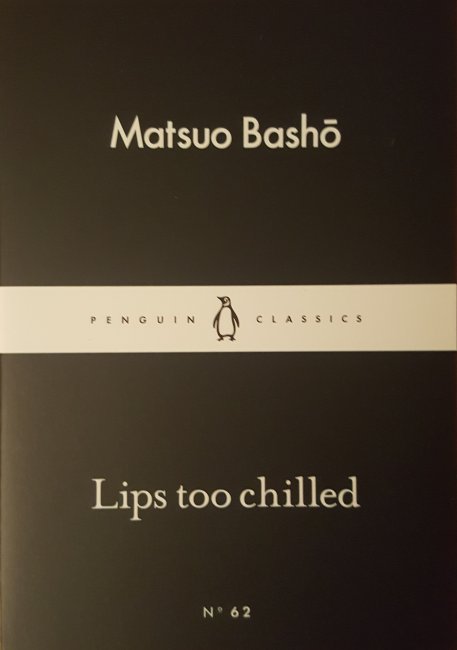
The two short volumes I have of Bashō’s poetry are both by Penguin although published twenty years apart, one to mark sixty years of Penguin Books (in 1995) and the other eighty (2015). They are both extracts from the Penguin Classics volume ‘On Love and Barley: Haiku of Bashō’ originally published in 1985 and translated by Lucian Stryk a Polish born American poet and professor of English at Northern Illinois University. This book has six haiku on each page and has sixty one pages of poetry so just over 360 poems in all. whilst ‘Haiku’ has a wonderful austerity of design with just one poem per page over sixty pages and ‘Lips too Chilled’ has two per page over fifty six pages. There is surprisingly little duplication between the two short books so I have somewhere around 150 haiku by Bashō which admittedly is still well short of half of his output but allows for an appreciation of his work. Stryk does sometimes attempt to stick to the rigid format of haiku but is quite happy to divert from this where the sense of the poem would be lost in translation, which I think is a perfectly fair way to approach the rendering between the two languages as I would much rather appreciate the meaning of the poets words than suffer the pedantic imposition of form. Let’s explore a little of the poets work in the title poem from the 2015 volume:

Lips too chilled
for prattle –
autumn wind

Not perhaps his finest work, I prefer:

Storming over
Lake Nio; whirlwinds
of cherry blossom

As with that I can picture the scene and the paucity of words adds a starkness to the image which would be lost with a longer form. So who was Matsuo Bashō? Well as I mentioned at the beginning he lived in the second half of the 15th century in Japan and as is common in the far east his first name (Matsuo) is his family name. Bashō is not even his real given name as he was born Matsuo Kinsaku, he took the name Bashō from the Japanese banana plant outside the hut built for him by his followers in the later part of 1675 as by then he was already a well known poet and this hut clearly inspired him.

New Year – the Bashō-Tosei
hermitage
a-buzz with haiku

Bashō is also well known in Japan as a traveller making many long walks, usually alone despite the dangers of bandits. But his best known walk, taking 150 days and covering roughly 2,400km (around 1,500 miles) was done in 1689 with one of his students and inspired his great travel book ‘The Narrow Road to the Deep North’, which when it was published posthumously further embellished the master’s fame.

Journey’s end –
still alive, this
autumn evening

I Hate and I Love – Catullus

A collection of forty three poems by Gāius Valerius Catullus, a Roman poet born in 84 BCE and who died in 54 BCE, but in his short life he wrote a number of poems, 116 of which have survived to the present day. Penguin published a complete volume translated by Peter Whigham which I don’t possess however this selection from that larger volume is part of the Penguin Little Black Classics all of which I purchased when they came out. Catullus’s poetry is normally categorised nowadays into three main subject types, those dealing with his friends, those about a woman he loves but refers to only as Lesbia rather than her real name which was probably Clodia Metelli and the rest are largely described as invective or works attacking other people, which was quite a popular style at the time. This volume is mainly poems in the ‘friends’ or ‘Lesbia’ categories with just seven of the ‘invective’ style represented although over fifty of the surviving works are categorised as ‘invective’. An example of the invective style is poem 43 which attacks the girlfriend of Formianus.

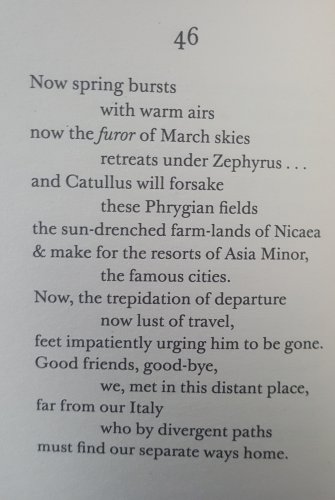
Apologies but photographing the poems without breaking the spine of the book has led to the distortions in the images. The next poem that I want to select to illustrate the tone of Catullus is one which describes his desire to travel now that the warmer weather is here. I have deliberately selected three of the shorter works although few are what we would regard as long, but the descriptions of personal experiences and desires is what marks Catullus as one of the writers known collectively as poetae nov or ‘new poets’ as poetry moved away from the epic heroic style favoured before then. The works of Catullus were almost lost to us completely as a single manuscript was found in the Chapter Library of Verona around seven hundred years ago. This document was copied twice before it was again mislaid and one of the copies was in its turn copied twice before being lost. So the 116 poems have come down the centuries due to these three surviving precious documents.

That one feels very modern with Catullus looking forward to a holiday in Turkey and hoping to meet up with friends there. For my third example it has to be one of the famous Lesbia poems although not the best known, which is poem 5, as that extends over a page in this edition so is difficult to include here. But poem 51 expresses his desire for Lesbia and how he feels when in her company although it is worth pointing out that poem 85 refers to her husband so Catullus was probably one of several men she had affairs with, including Rufus the subject of invective poem number 77 written after Catullus found out about their relationship.

A few others are quite ribald so I don’t feel I can put them on this blog. Although I have certainly enjoyed reading the collection it does nowadays probably need to come with a warning regarding adult themes, The title by the way is from the opening line of the very short poem 85, which is just two lines long:

I hate and I love. And if you ask me how.
I do not know. I only feel it, and I’m torn in two

Catallus 85 translated by Peter Whigham

À rebours – Joris-Karl Huysmans

It was the strangest book that he had ever read. It seemed to him that in exquisite raiment, and to the delicate sound of flutes, the sins of the world were passing in dumb show before him. Things that he had dimly dreamed of were suddenly made real to him. Things of which he had never dreamed were gradually revealed.

It was a novel without a plot and with only one character, being, indeed, simply a psychological study of a certain young Parisian who spent his life trying to realise in the nineteenth century all the passions and modes of thought that belonged to every century except his own, and to sum up, as it were, in himself the various moods through which the world-spirit had ever passed, loving for their mere artificiality those renunciations that men have unwisely called virtue, as much as those natural rebellions that wise men still call sin.

The Picture of Dorian Gray (chapter 10) – Oscar Wilde

When I recently read ‘The Picture of Dorian Gray‘ I assumed that the book referred to as the inspiration of Gray’s sensual explorations and obsessions was simply a device invented by Wilde, so I was surprised to discover that in fact the book actually existed. Wilde confirmed that À rebours by Huysmans was the book during his failed libel trial against the Marquess of Queensbury in 1895, and I found that not only did it exist but that a copy was already on my shelves, and had been for probably twenty years although sadly neglected, in form of the Penguin Books translation of 1959 with its title translated as ‘Against Nature’, it is also known as ‘Against the Grain’.

Charles-Marie-Georges Huysmans, who wrote as Joris-Karl in a tribute to his father, was a career civil servant, author and art critic living in Paris between 1848 and 1907 and was far from the character of the aesthete, Des Esseintes, who is the ‘hero’ of Against Nature. I put the word hero in quotes advisedly as the Duc Jean Des Esseintes is far from heroic being “a frail young man of thirty, who was anaemic, with hollow cheeks, cold eyes of steely blue, a nose that turned up, but straight, and thin papery hands”. This then is the subject of the book with other characters reduced to mere cyphers as he keeps himself away from all other human contact as far as possible. Even arranging that his two servants rarely see him and they live in a sound deadening apartment in a separate part of the house so that their existence doesn’t impinge on the solitude and quiet so desired by their master. Huysmans is clearly highly educated and very well read as demonstrated by the third chapter of the book, in this edition at least as translations vary between the chapter breaks, which is largely a harangue on the Latin writers from Virgil, just before the Christian era, to the eighth century Anglo-Saxon ecclesiastical authors whilst featuring the Des Esseintes library.

It is only fair to add that, if his admiration for Virgil was anything but excessive, and his enthusiasm for Ovid’s limpid effusions exceptionally discrete, the disgust he felt for the elephantine Horace’s vulgar twaddle, for the stupid patter he keeps up as he simpers at his audience like a painted old clown was absolutely limitless.

Sallust, who is at least no more insipid than the rest, Livy who is pompous and sentimental Seneca who is turgid and colourless, Suetonius who is larval and lymphatic, Tacitus who with his studied concision, is the most virile, the most virile, the most sinewy of them all. In poetry, Juvenal, despite a few vigorous lines, and Persius, for all his mysterious innuendos both left him cold. Leaving aside Tibullus and Propertius, Quintilian and the two Plinies, Statius, Martial of Bilbilous, Terence even and Plautus whose jargon with its plentiful neologisms, compounds and diminutives attracted him, but whose low wit and salty humour repelled hm.

Translation by Robert Baldick – Penguin 1959

Well that just about sums up most of the famous ancient Roman writers and presumably these are not just the supposed opinions of Des Esseintes but that of the author as well, the denigration of the Latin poets and later biblical scholars continues for several more pages as he moves through history. Two more chapters near the end of the book perform similar attacks on French literature but as these concentrate on liturgical authors and what Huysmans himself describes as minor writers I found these far more difficult to read as I wasn’t familiar with the works discussed. Another chapter represents the Des Esseintes art collection where Huysmans has him own Gustave Moreau’s ‘Salome Dancing Before Herod’ and ‘The Apparition’ both of which are described at length along with prints by Dutch artist Jan Luyken of medieval torture scenes along with other works. We are now roughly a third of the way through the book and I can see the fascination that this book must have had for Oscar Wilde, the descriptions are sumptuous, if at times macabre, but the book is so unlike anything else I have read apart from the work that it clearly inspired, that of Dorian Gray. Here we have a character determined to absorb all they can from the great art and literature to the exclusion of anything and anyone else, a man with a fine eye to colour and the effects that different lighting has upon it and a determination to appreciate all that he sees as good. A man who lives almost entirely in artificial light as he wakes in the evening and breakfasts then does as he pleases before dining in the early hours and going to bed as the sun rises so what looks good by candlelight is an essential consideration.

Later chapters cover, amongst many other things, his fascinating, although short lived collection of hot house flowers, deliberately chosen to look fake in texture and colours in contrast to his existing man-made floral displays that are masterpieces of realism. A detailed account of his bedroom also features where again artifice triumphs over nature with fine materials displayed to mimic the austerity of a monks cell such as the yellow silk on the walls to represent the paint on plaster of his original subject. All in all I loved this book and I’m glad I read it after ‘The Picture of Dorian Gray’, its very obscurity up until then had caused me to bypass in my shelves until I was truly ready to read it. I must admit I expected a difficult read and was pleasantly surprised as to how quickly I was absorbed in the work and apart from the previously noted French literature issues the 200+ pages largely flew past. Admittedly with several pauses where I looked up various things such as some of the paintings or flowers itemised by Huysmans which I was not familiar with, but that he had piqued my interest with to make sure I fully appreciated the points he was making and the exactitude of his representations of them,