Haroun and the Sea of Stories – Salman Rushdie

The start of the trial of Hadi Matar on the 10th February 2025 for the attempted murder of Salman Rushdie in August 2022 prompted me to go back to the shelf of Penguin Drop Caps volumes far earlier than I planned, as I knew that there I would find Haroun and the Sea of Stories. This novel for children was Rushdie’s first published work after ‘The Satanic Verses’, which had led to the fatwa declared against him by Ayatollah Khomeini of Iran for blasphemy and which almost certainly inspired Matar, a twenty seven year old American of Lebanese descent, to attack Rushdie almost killing him, stabbing him fifteen times, leaving him blind in his right eye, with a severely damaged hand and multiple other injuries. That the novel was published ten years before Matar was born and that Iran had said the fatwa would not be enforced also before he was born seems not to have affected Matar who admitted he had only read a few pages; and Rushdie had said that he was at last leading a relatively normal life without protection in an interview just two weeks before the attack. Still enough of the context as to why I picked the book up, let’s look at this wonderful fantastical story which I hadn’t read before.

Rushdie had me hooked from the opening lines of this novel:

There was once in the country of Alifbey, a sad city, the saddest of cities, a city so ruinously sad that it had forgotten its name. It stood by a mournful sea full of glumfish which were so miserable to eat that they made people belch with melancholy even though the skies were blue.
In the north of the city stood mighty factories in which (so I’m told) sadness was actually manufactured, packaged and sent all over the world, which never seemed to get enough of it. Black smoke poured out of the chimneys of the sadness factories and hung over the city like bad news.

It goes on to say that most places in Alifbey had just one letter as their name so there is the town of G and the nearby valley of K nestled in the mountains of M, this means that lots of places had the same name and therefore post was often delivered to the wrong place. In a helpful couple of pages at the back of the book Rushdie explains that the name Alifbey is based on the Hindustani for alphabet and that another destination on the journey of our heroes, for what sort of children’s book doesn’t have heroes even unlikely ones, is The Dull Lake “which doesn’t exist, gets its name from The Dal Lake in Kashmir, which does”. Rushdie was born in India and lived there until he was seventeen and takes a lot of inspiration in his writing from his youth. I have mentioned our heroes and they are Rashid Khalifa and his son Haroun, these are named after Haroun al-Rashid the legendary Caliph of Baghdad who appears in the Arabian Nights stories. Rashid is the happiest man in the very sad city and is renowned as a storyteller gaining the titles of The Ocean of Notions or the Shah of Blah because he could keep telling tales without repeating himself, weaving stories together without ever losing the intricate plots and therefore whenever he spoke he would draw huge crowds. This made his especially popular with politicians trying to get people to listen to them as elections approach as he could start the rally and pull people together from the surrounding area.

But one day disaster struck, the flow of stories just stopped, Rashid couldn’t string two words together and this was at the start of a tour arranged by politicians so it was vital that the reason was discovered. The second night of the trip saw Rashid and Haroun on a boat on The Dull Lake where Haroun encounters Iff the Water Genie who had come to disconnect the invisible tap that linked Rashid to the Sea of Stories, the source of all his tales. In vain Haroun argued that it was a mistake but finally he convinced Iff to take him to the Earth’s invisible second moon, Kahani, so that he could meet the leader of the Eggheads and appeal for Rashid’s tap to be reconnected. Travelling on a giant mechanical Hoopoe called Butt they arrive on Kahani and find the Ocean of Stories is heavily polluted with the stories dying off so Haroun then has to find out what is causing the pollution and stop it. Along the way he finds Rashid has also made his way to Kahani and has his own quest to undertake.

The book is a wonderful adventure story full of linguistic jokes, like the talking fish with lots of mouths which are called the Plentymaw fish in the Sea and the Pages, or soldiers, arranged into chapters and volumes instead of companies and battalions. It is split into twelve chapters, each no longer than fifteen pages so ideal to be read as to a child as a bedtime story over a couple of weeks. I loved the book and it was so different to the other book by Salman Rushdie I reviewed on this blog back in 2019, The Jaguar Smile. I also have his second novel, Midnight’s Children, which was his first best seller, hopefully I won’t wait another five and half years before reading that.

You can find more about the Penguin Drop Caps series in my overview here, which also includes links to the various books I have reviewed from this set of twenty six books.

Siddhartha – Hermann Hesse

At first sight this is an odd book for a German author, who as a young man had sufficiently strong callings to the priesthood that he briefly attended a seminary. But in 1911, in his mid 30’s, Hesse visited India and was introduced to Hindu mysticism and this has undoubtedly influenced this novel written in 1922. The story is set in ancient India, around 2500 years ago, it follows Siddhartha, and to a lesser extent his friend Govinda, in their quest for spiritual enlightenment. At first this leads them as young men to abandon their family homes and all their belongings and live in the forests as ascetic samanas, training their bodies to need nothing, using extended fasting and lack of clothes apart from a loincloth to preserve decency. This was a life of meditation and a severe deprivation of the body. A sample of the thoughts of Siddhartha are shown below and give a flavour of the sometimes difficult to follow text as Hesse can get caught up in the tautological expressions that he uses to try to explain Siddhartha thought processes for pages as a time.

Siddhartha and Govinda live with other samanas for a long time, occasionally begging for scraps of food as the bare minimum to stay alive but eventually they hear of a great teacher called Gautama (Buddha) and decide to travel to hear him teach. They eventually reach Gautama and hear him speak but whilst Govinda immediately resolves to follow the Buddha, Siddhartha instead explains that he feels that such enlightenment cannot be taught but must be individually gained through experiences and solitary meditation so the two friends part company. Leaving Govinda, Siddhartha travels until he reaches a river and there meets a ferryman who will become a significant character later in the book but for now he simply gets him to the other side whereupon he walks on to the next town. It is here that Hesse completely threw me as I thought I understood the path to enlightenment that Siddhartha was going to follow, but instead, on entering the town he sees a wealthy courtesan and is filled with desire. She however is not interested in the half starved gaunt and long haired ascetic standing in front of her and tells him that if he wants to know her better he has to be wealthy, clean and well dressed and he duly throws over his calling, gets his hair cut and body cleaned and perfumed, becomes a merchant and eventually earns a place in her bed. Definitely not what I had expected.

I admit I was somewhat daunted when beginning the book, not helped by Hesse’s undeserved reputation as a not very approachable writer, but as I read on I got more engrossed by the story and by the time of Siddhartha’s sudden change in direction I was highly intrigued as to where the novel was going and loved the ultimate resolution. It’s probably not a book for everyone, but I thoroughly enjoyed it. This is another of the Penguin Drop Caps series and eventually I will read all twenty six of these books, an explanation of the concept can be found on my my blog introducing the series here where I am also including links to each of the books as I review them.

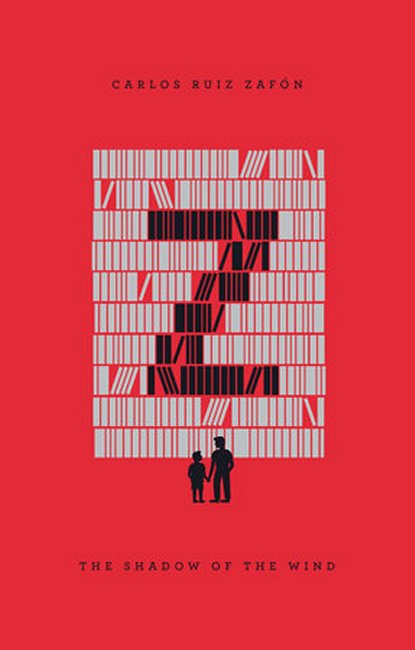
The Shadow of the Wind – Carlos Ruiz Zafón

Dawn is breaking in post-war Barcelona when Daniel’s bookseller father guides him through the mist to a mysterious building hidden in the heart of the old city. Here in the Cemetery of Forgotten Books, ten-year-old Daniel is allowed to choose one from the hundreds of thousands of abandoned volumes that line the labyrinthine corridors. Inexplicably drawn to ‘The Shadow of the Wind’ by Julian Carax, the boy clutches the book and he and his father leave. That night Daniel reads through the night totally captivated by the story and the quality of the writing and I know exactly how he felt as although my all night reading sessions are well behind me as I found it difficult to put this remarkable book by Zafón down. Perhaps a longer section than I would normally quote will give an insight into the wonderful descriptive prose and the building tension that is maintained throughout the 511 pages. This passage is very early in the book so doesn’t contain any spoilers and describes the night after Daniel took the book to Don Gustavo Barceló, another bookseller but one who knew more about the rarities of printing than Daniel’s father, for him to have a look at. There he discovered that he may well have the last remaining copy of Carax’s final novel and that all the other copies along with editions of all his other books had been systematically bought or stolen and mysteriously found burned over the years.

I turned off the light and sat in my father’s old armchair. The breeze from the street made the curtains flutter. I was not sleepy, nor did I feel like trying to sleep. I went over to the balcony and looked out far enough to see the hazy glow shed by the streetlamps in Puerta del Angel. A motionless figure stood in a patch of shadow on the cobbled street. The flickering amber glow of a cigarette was reflected in his eyes. He wore dark clothes, with one hand buried in the pocket of his jacket, the other holding the cigarette that wove a web of blue smoke around his profile. He observed me silently, his face obscured by the street lighting behind him. He remained there for almost a minute smoking nonchalantly, his eyes fixed on mine. Then, when the cathedral bells struck midnight, the figure gave a faint nod of the head, followed, I sensed, by a smile that I could not see. I wanted to return the greeting but was paralysed. The figure turned, and I saw the man walking away, with a slight limp. Any other night I would barely have noticed the presence of that stranger, but as soon as I’d lost sight of him in the mist, I felt a cold sweat on my forehead and found it hard to breathe. I had read an identical description of that scene in The Shadow of the Wind. In the story the protagonist would go out onto the balcony every night at midnight and discover that a stranger was watching him from the shadows, smoking nonchalantly. The stranger’s face was always veiled by darkness, and only his eyes could be guessed at in the night, burning like hot coals. The stranger would remain there, his right hand buried in the pocket of his black jacket, and then he would go away, limping. In the scene I had just witnessed, that stranger could have been any person of the night, a figure with no face and no name. In Carax’s novel, that figure was the devil.

The plot flies along at a breakneck speed with multiple clues as well as a few blind alleys as to what is going on as Daniel tries to find out what happened to Julian Carax and how he came to be found shot dead in Barcelona when he should have been safely in Paris and what the wartime thug, murderer and now Inspector of Police Fumero has to do with it, as we progress from 1945 when Daniel first visits the Cemetery of Forgotten Books to the end of 1955 when the story finally reaches its denouement. Along the way a cast of superbly drawn characters are introduced, some of which help but more than a few are there to hinder Daniel’s fascination with Carax and his slowly developing interest in women as he goes through his adolescence. At about two thirds through the book and three days after I started I still hasn’t worked out how everybody was linked and how the various plot strands were connected so took an evening off reading to think through what I knew so far without adding more detail. This proved to be a good idea as I finally realised where the story was going and who the man watching from the shadows was, just in time as Zafón was about to upend the story and make my guess a possibility. I read the remainder of the book the next evening as Zafón neatly tied up all the loose ends in an eminently satisfying way.

Sadly Carlos Ruiz Zafón died of cancer in 2020 aged just 55, robbing the world of a great author well before his time. This English language version of the book is translated by Lucia Graves, daughter of the poet and novelist Robert Graves. She was brought up in Mallorca from the age of three, and according to her memoir ‘A Woman Unknown’ she grew up speaking English at home, Catalan with locals, and Spanish at school and it is she who has translated into English all five of Zafón’s ‘Cemetery of Forgotten’ novels.

This is the fifth book from the Penguin Drop Caps series I have written about along with a general overview of the series. There are twenty six in total, one author per letter of the alphabet and previously I have covered Ellery QueenJohn SteinbeckXinran and W B Yeats.

When You are Old: Early Poems and Fairy Tales – W B Yeats

This collection of Yeats’ early works is split roughly 50/50 between his poems and other works including the play ‘The Land of Hearts Desire’ and selections from ‘Irish Folk Tales’, ‘The Celtic Twilight’, John Sherman and Dhota’ and ‘Stories of Red Hanrahan’. There are eighty eight poems split into four categories by subject including the work that gives this collection its title, ‘When You are Old’.

When you are old and grey and full of sleep,
And nodding by the fire, take down this book,
And slowly read, and dream of the soft look
Your eyes had once, and of their shadows deep;

How many loved your moments of glad grace,
And loved your beauty with love false or true,
But one man loved the pilgrim soul in you,
And loved the sorrows of your changing face;

And bending down beside the glowing bars,
Murmur, a little sadly, how Love fled
And paced upon the mountains overhead
And hid his face amid a crowd of stars.

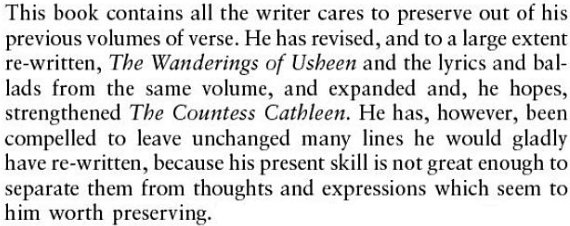
Yeats would come to look back on his early works with distaste as he regarded his more mature works as far superior and in the original preface of this collection he made clear that he thought the works that were cut were not worth retaining.

The first poem mentioned above ‘The Wanderings of Usheen’, more commonly titled ‘The Wanderings of Oisin’ is the longest poem included in the collection and takes up 35 of the 158 pages dedicated to poetry. I love the rhythm of this poem and despite its length it is actually quite an easy read and takes the form of a conversation between the legendary hero Usheen/Oisin and Saint Patrick, the patron saint of Ireland, although it is somewhat one sided with Saint Patrick barely managing to get a word in. It tells the story of Oisin’s journey into the land of Faerie and his wanderings with the fairy princess Niamh there for the last three hundred years. A small extract from the first section of the poem will give some idea of the work.

But now the moon like a white rose shone
In the pale west, and the sun’s rim sank,
And clouds arrayed their rank on rank
About his fading crimson ball:
The floor of Emen’s hosting hall
Was not more level than the sea,
As full of loving phantasy,
And with low murmurs we rode on,
Where many a trumpet-twisted shell
That in immortal silence sleeps
Dreaming of her own melting hues,
Her golds, her ambers, and her blues,
Pierced with soft light the shallowing deeps.
But now a wandering land breeze came
And a far sound of feathery quires;
It seemed to blow from the dying flame,
They seemed to sing in the smouldering fires.

One thing I didn’t realise until I read this collection and recognised the words, is that one of my favourite tracks by Irish band The Chieftains uses one of Yeats’ poems for the lyrics, beautifully read by Brenda Fricker, ‘Never give all the heart‘.

Leaving the poetry behind and delving into the second half of the book took me to totally unfamiliar territory as I had only read Yeats’ poetic works before. The one play included here has us yet again dealing with a character from the land of Faerie, this time the fairy is tempting a newly married woman to join her and leave the mortal realm. Following that is a very short and disappointing because of that, extract from the 1891 ‘Irish Fairy Tales’ which seems to just consist of an introduction and the enjoyable ‘Appendix: Classification of Irish Fairies’ this starts off with the largely friendly Sociable Fairies and then goes deeper into the mainly disagreeable Solitary Fairies. The brevity of this section makes me want to hunt out the complete book and read the actual folk tales told within it.

The next extract from a book, this time ‘The Celtic Twilight’ is at over forty pages quite a bit more representative than the handful of pages given to ‘Irish Fairy Tales’, it consists of a series of essays dealing with fairies, ghosts and other such supernatural characters and their encounters with humans. These essays are quite short, often just a single page but explore the myths of the Irish people with tales either told to Yeats or experienced by him. The selection from ‘John Sherman and Dhoya’ is again very short being just concerned with the story of Dhoya a giant mortal living alone who attracts the attention of a fairy lady who decides to become his companion until she is taken away by a male of her own folk leaving him alone again and inconsolable. Like ‘Irish Fairy Tales’ I’d like to read more of these stories as the taster is too brief. The final selection is actually complete and includes the six short stories concerning Red Hanrahan that were published together in 1897. These tell tales of Hanrahan’s, often ill-fated, encounters with women and supernatural beings.

If you want to get a representative overview of early works by William Butler Yeats then this collection would be a great place to start and like myself you will probably end up wanting more, especially of the prose works. This is the fourth book from the Penguin Drop Caps series I have written about along with a general overview of the series. There are twenty six in total, one author per letter of the alphabet and previously I have covered Ellery Queen, John Steinbeck and Xinran.

The Greek Coffin Mystery – Ellery Queen

As a lover of mystery and crime novels it is perhaps surprising that this was my first time reading Ellery Queen and the fact that I have started at the fourth book is due entirely to this being the only Ellery Queen that I possess. Let’s get the somewhat complicated back story of the authorship out of the way first and then dive into this surprisingly long (363 pages) crime novel. Ellery Queen is given as the author as well as the name of the private detective featuring in the book, in fact it is the work of two cousins, Frederic Dannay and Manfred Bennington Lee, who also individually wrote crime novels under those names. To add to the confusion both those names are also pseudonyms; Frederic Dannay’s real name was Daniel Nathan whilst his cousin Manfred Bennington Lee was really Emanuel Benjamin Lepofsky. Between them they wrote over thirty Ellery Queen novels and collections of short stories and there were also a few later books which were ghostwritten by various other authors and supervised by Lee.

What to make of this book though? It features Detective Inspector Richard Queen and his private detective son Ellery, who improbably gets to sit in on all meetings and interviews, along with visiting crime scenes just as if he was an actual member of the police force, he can even apparently make arrests. Indeed it took me some time to realise that Ellery Queen was, unlike his father, not actually an official part of the police. The story initially is simply the case of a missing will following the death of an elderly art dealer in New York. When it is worked out that the only place the will could have been put in the short time available from when it was last seen to when it was discovered to be missing is in Georg Khalkis’s coffin before the lid was screwed down an exhumation is ordered. The coffin being opened however is found to have two bodies in it, Khalkis and a mystery corpse and the case becomes murder and the problem is not just who killed the unknown victim but who are they… With thirty nine characters (including the police and Ellery) it can get complicated and I was glad of the list of people at the front of the book when trying to sort out the different relationships between them all.

The story is split up into two books, the first ending with the arrest of yet another incorrect suspect but with the police apparently satisfied that this time they have got their man. The second book details the collapse of the case against the arrested person and the slow discovery of the clues leading to the true murderer and thief. One thing I really liked was at the end of the thirtieth chapter where there is a break in the story for Ellery Queen to speak directly to the reader and make clear that at this point you have read all the clues needed to solve the case and that there is only one solution that fits everything you know. With almost sixty pages still to go it provided a break where I could go back in my mind over what has happened in the first three hundred pages and try to solve it. I have to admit that the actual solution was so surprising that I didn’t get it but yes everything fitted once you knew who did it.

This edition of The Greek Coffin Mystery was published as part of the Penguin Drop Caps series of twenty six books each with an author starting with a different letter and it is particularly appropriate for this to be Ellery Queen book chosen for Q as the chapters in this one are titled as an acrostic spelling out the titles and author. First published in 1932, the first Penguin Books edition came out in May 1957, this hardback was published in 2013 for the American and Canadian market only.

As I said at the start this was my first Ellery Queen mystery and whilst I enjoyed it I did find the character of Ellery Queen rather annoying. Reading about later books in the series he apparently does calm down a lot as the series progresses with far fewer irritating build ups to an incorrect accusation than occurs in this story. Maybe I ought to read one of the later books to see if I like him better.

Sky Burial – Xinran

This is one of those books that is only on my shelves because it completes a set, in this case the twenty six volumes of Penguin Drop Caps which I have covered as a series right back at the beginning of this blog in early 2018. This does mean that I came to read the book with no preconceptions at all knowing nothing about either it or the author and I have really enjoyed it. Having said that I have a suspicion that Xinran made it into this collection more due to her name beginning with X than for the literary merit of the book. This could be the fault of the translators from the original Chinese, Julia Lovell and Esther Tydesley, as the style is rather flat which considering the subject matter seems odd but as I cannot read the original I have no way of knowing if that is better. I don’t know why Xinran didn’t make the translation as she has lived and worked as a journalist and writer in London since 1997 and this translation was first published in 2004 so presumably she would be more than capable of producing an English version herself.

The conceit of the book is that it is based on the real life story of a Chinese doctor Shu Wen who in 1958 who in 1958 at the height of the Tibetan-Chinese conflict went to Tibet to try to find out what happened to her husband who was a military doctor and ends up stranded there for over thirty years living with the nomads and travelling from camp to camp. According to the introduction Xinran met Shu Wen in Suzhou and talked to her over a period of a couple of days whilst she related her story, Shu Wen then suddenly checked out of her hotel and disappeared. Wikipedia appears to have fallen for this and describes the book as a biography but it is clearly listed as a work of fiction on the publication data page and frankly the idea that an intelligent woman would make no attempt to either continue her search or head back to China and would stay with the nomadic family for three decades is desperately unlikely. The resolution of the novel also stretches credulity to breaking point as a real life case with too many unresolved plot points being sorted out in a relatively short space of time compared to the vast amount of time with no movement on them at all.

Treating it as the novel that it is becomes far more rewarding than looking at it as a dubious biography, the book is 220 pages long in this imprint and I read it at one sitting as you do get drawn into the story. The depiction of Tibetan nomadic life is fascinating and it appears that Xinran did a significant amount of research, so you slowly learn, along with Wen, how the dynamics of family life operate. The book also largely avoids discussing the Chinese takeover of Tibet which has existed since the 1950’s, this is done by completely ignoring the subject by putting Shu Wen away from all contact with other Chinese people and any news of the world outside of the nomadic family she is with for a couple of decades. The exception is at the start where the conflict is acknowledged because that is why Shu Wen’s husband, Kejun, was in Tibet in the first place and also the description of Wen’s journey into Tibet having enlisted in the military and the surprise that her fellow soldiers have that they were not being welcomed with open arms as liberators from the rule of the Dalai Lama. This is where another extremely unlikely event occurs as Wen discusses with a senior officer and gets agreement from him to desert her unit in her search for Kejun. In a novel this is fine, strange things happen in novels, but in real life deserting the Chinese army at the time would have been punished severely.

I have deliberately not written much about the time Wen spends with the nomadic family or how the various issues are resolved as this is the real meat of the novel and any coverage would just be spoilers. Suffice to say that even though there is much that is not as good as it could be the book is a pleasant way of spending a rainy afternoon, just sit back, suspend belief a little, and go with the flow.

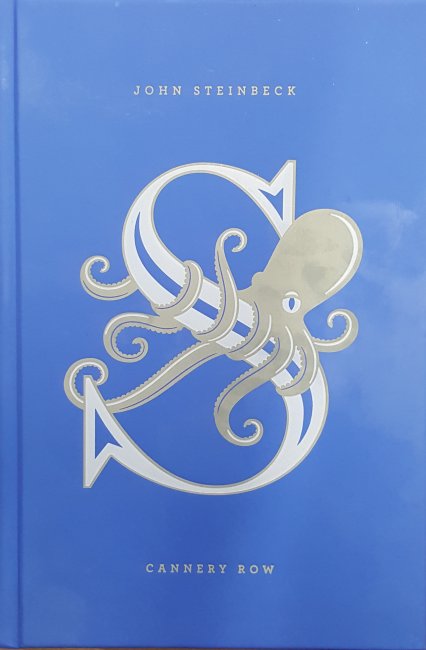
Cannery Row – John Steinbeck

Cannery Row in Monterey in California is a poem, a stink, a grating noise, a quality of light, a tone, a habit, a nostalgia, a dream.

20191112 Cannery Row

From the Penguin ‘Drop Caps’ series that I covered last year in a general review of all twenty six books, and I’m amazed that I had never read it before, the quote at the top is the opening line and immediately draws the reader in. What little Steinbeck I have read in the past I have thoroughly enjoyed, he really was a master wordsmith able to conjure totally believable characters with just a few sentences or even a handful of words and what characters he has populating Cannery Row and it was his “keen social perception” that he was awarded the Nobel Prize for Literature in 1962. There is a plot to the narrative but it is definitely secondary to the characterisations deployed. You really get to know marine biologist Doc and his lab/home, Mack and the boys at the Palace Flophouse and Grill (a rather grandly titled abandoned storage shed), Dora and her girls at the Bear Flag Restaurant (in reality a bordello), Lee Chong and his shop which seems to stock everything, albeit totally randomly, and the general human detritus living in whatever shelter they can find along the Row.

The people are poor but making the best of their situation, the time is the 1930’s during the Great Depression and times are hard. The main employers are the sardine canneries that give the area its name although the work depended on the arrival of the boats loaded with fish which also gives the area its distinctive odour. None of the characters are actually in employment at the canneries though, apart from when they need some money which they cannot get some other way. Lee Chong, Dora and Doc all have legitimate businesses in their own right. Lee’s grocery presumably would make money if his customers actually had any, what it mainly makes is debts which do mainly get paid off when he refuses to extend any more credit to somebody unless they actually part with some money to cover the backlog. Doc is the main character of the book, he owns Western Biological Laboratory, and if anyone in the US wanted a specimen of pretty well any sort of animal Doc would get it for them, eventually anyway. Dora as stated above owns the bordello and probably makes more money than any of the other characters but has to hand over large parts of it in ‘charity’ just to ensure that the authorities keep looking the other way. She is genuinely kind hearted though and looks after her staff who can’t work much due to age or infirmity, one breaks her leg during the book and there is no suggestion that because she can’t work she would lose her room or meals each day.

Mack and the boys at the flophouse, which they con Lee Chong out of at the start of the book, don’t work unless they have to, they have developed over the years a sense of contentment about their lives where they can get what little they need to survive somehow, even if it actually belongs to somebody else at the time. What they will do is get creatures for Doc at a fixed price that everybody knows because that’s more of an adventure than ‘working’ for a living. Despite their low grade criminality you can’t help but like them, they are more victims of their schemes than pretty well any one else and they are genuinely remorseful when things go badly wrong.

Even the bit parts are masterful, I particularly enjoyed the regular appearances of the old Chinaman as he wandered down to the sea and back each day; and like a minor character in a West End farce he always failed to interact with any of the major players whilst just walking through the narrative adding nothing to the plot apart from a comic interlude and a sense of wonder. Just what is it he is doing and why? It’s never explained.

The book revolves around Doc, his need for specimens and his love of classical music, his books and a quiet life. The plot, such as it is, involves Mack and the boys wanting to do ‘something nice for Doc’. They decide on a party so then need to raise some money to finance it, how they get the ‘money’ and the form it takes is really funny and the disaster of the party leads to real poignancy as the various characters reflect on how it went so horribly wrong and what to do to try to make it right. The book is brilliant and difficult to put down when you have started you just need to know more about the population of Cannery Row and apparently there is a sequel so I have to get a copy of that.

Penguin Drop Caps

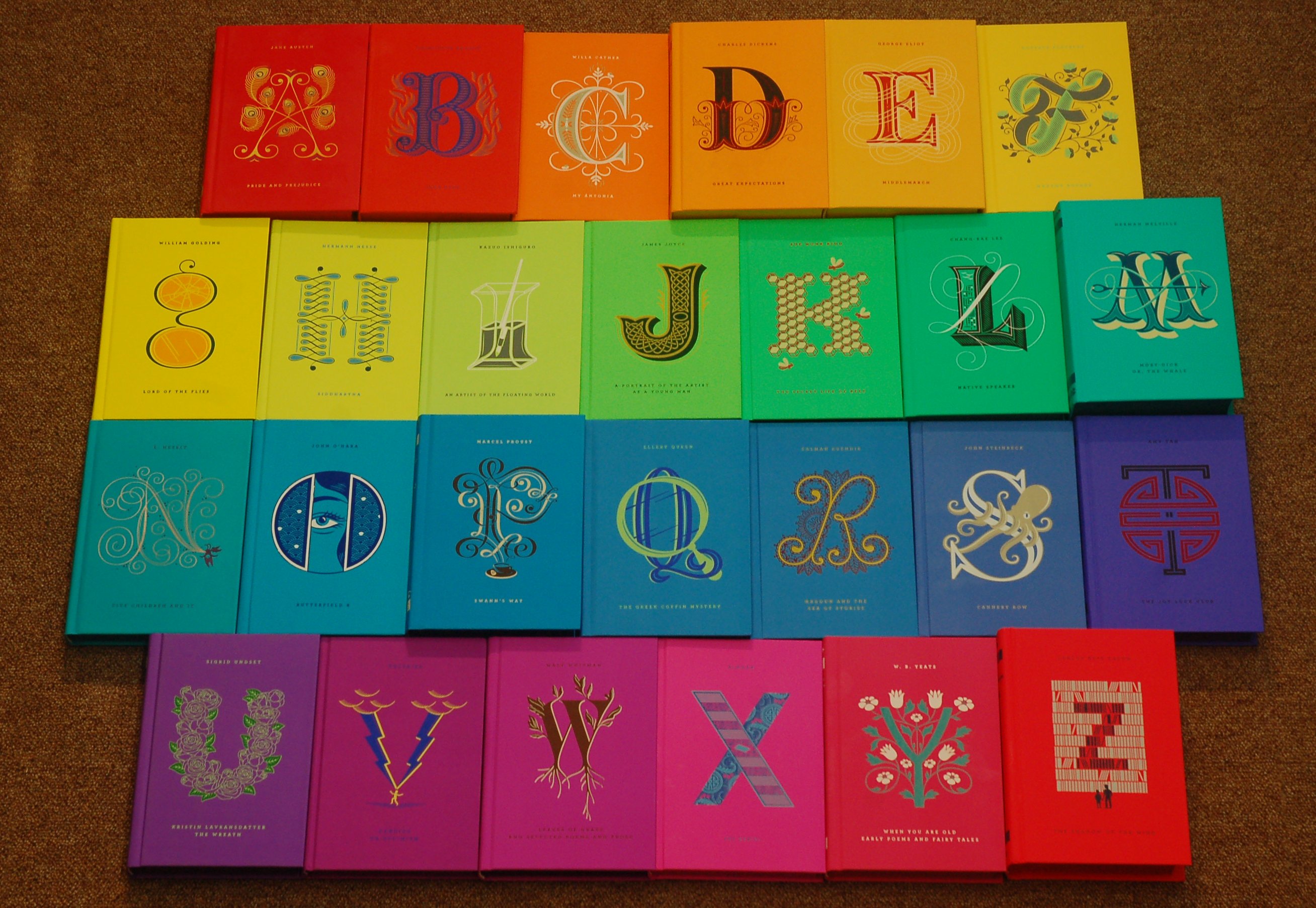
In 2012 Penguin Books started a series of books for sale in the USA and Canada and it made use of their extensive back catalogue along with some newer modern classics in a handsome new style hardback binding. The tagline of the set is

It all begins with a letter

and the concept was to produce 26 titles where each letter of the alphabet was represented by the surname of the author. An interesting idea especially over the choice of names for some of the more difficult letters. What made the set a cohesive whole was the decision to have all the letters on the covers designed by one person, Jessica Hische, and for her to create an evocative set of designs. Adding the input of Penguin Art Director Paul Buckley we ended up with a rainbow of classic books which call to you from the shelves and look totally different to anything else I have. Good design has been the hallmark of Penguin Books from their beginning in 1935 and it’s good to see that tradition being respected in a modern set.

20180213 Drop Caps 1

Of course a set like this appeals to the collector part of me, especially when they are not officially available in the UK as I like a challenge, but it also harks back to the very first Penguin Books I initially accumulated, then decided to collect, which was the early (first 125) Penguin Classics.  Buying a set of books forces you to purchase authors you may not have been intending to buy or even to have heard of and once the book is on the shelf it would be remiss not to at least give the book a go. The first title is a case in point; Pride and Prejudice by Jane Austen is not a title that has ever appealed but I have to say that much to my surprise I’m really enjoying it. I have also read Madame Bovary, A Portrait of the Artist as a Young Man, Five Children and It, and Cannery Row so far and I’m looking forward to tackling authors I don’t know at all such as Willa Cather and Sigrid Undset.

The full list is as follows, with links to books reviewed in this blog:

A to F came out in 2012, G to P in 2013 and Q to Z in 2014 although I only started to collect these books towards the end of last year (2017) so the last 5 have only recently arrived and I didn’t buy them in alphabetical order but rather which 4 or 5 a month I could find at a sensible price.  Their official retail price varies on the copies I have between US $23 and $30 although the Canadian prices fluctuate much more widely between $24 and $40. The cheapest I found one in the UK was around £10 and had to spend up to £17 to get the last few I was missing.

20180213 Drop Caps 2

The spines are also attractive and make a bold statement on the shelf next to me as I write this, as can be seen in the picture above the page edges are also coloured to complement the cover and the rear cover has a short quote from the book that Penguin have turned into a parlour game

Mine is from Great Expectations:

Suffering has been stronger than all the other teaching, and has taught me to understand what your heart used to be.

and then A Portrait of the Artist as a Young Man

to forge in the smithy of my soul the uncreated conscience of my race

Not the cheeriest of quotes but I’m not going to let them put me off reading all these as they are lovely books with a clear font (Archer) as you would hope from a series that takes lettering seriously and a pleasure to pull off the shelf and sit down with.