A series of essays inspired by books that I own, talking about their history, some reviews and also how they came to be on my shelves. With over 6,500 books here and several more arriving each week I doubt I'll ever be short of a topic.
For those not familiar with the name, Tom Maschler was the managing director and later chairman of the publishing firm Jonathan Cape for many decades. He died in 2020 aged 87 and this is the first and apparently only edition of his book published in 2005, interestingly by Picador which is a division of Pan Macmillan rather than Jonathan Cape which by 2005 was part of the Penguin Random House group. I can’t even find a paperback edition, suggesting the book rightly disappeared without trace. Having read it I doubt whether anyone from Cape, or indeed Penguin, would have been interested in this terrible example of vanity publishing so it’s hardly a revelation that it turned up under a different publishing house, the only surprise was that Picador actually picked it up. Oddly the photographer of the portrait on the front cover isn’t credited in the book.
I had hoped for some sort of insight into the world of publishing but all you get is an insight into an apparent egomaniac who considered that he knew best even when starting as a junior at the publishing house André Deutsch where he lasted a few months and by his own admission started selling ski tours whilst working for them, even running his operation from his office at André Deutsch. From there he moved to MacGibbon & Kee where he lasted somewhat longer but was reprimanded by the firms owner because even then he liked to give the impression that he ran the business and was not so lowly as to just be an employee. This two and a half years employment is dismissed in three pages of the book and is followed with the a year and a half at Penguin which is similarly summarily dealt with, this time with 4½ pages most of which is moaning that he is not treated as more senior than he actually was. This is all to get to his next job, this time at Jonathan Cape where he could let his ego fly.
There are some interesting short sections covering authors he dealt with but the overwhelming impression is that none of them could have succeeded without him, even the already famous ones before he published them. I really cannot recommend this book, even assuming you could find a copy to read and fortunately they are in short supply even on the secondary market which says a lot about how many were sold.. If ever a book was about me, me, me this is it, the only vaguely comparable experience would be Englebert Humperdink on the BBC radio programme Desert Island Discs where the the guest is supposed to choose eight records that would give them pleasure to listen to if stranded on a desert island and uniquely Humperdink chose eight records all sung by himself.
I’ll finish with an extract from his obituary in The Guardian newspaper which deals with the book and sums up my reaction to the overblown, self-aggrandising text I have just read, indeed I wish I had read this before wasting my time on this book. The obituary had just covered his first assignment for Cape, which was to help Mary Hemingway go through the trunk full of papers left by her husband Ernest after his suicide.
The episode provided Maschler with the opening line for Publisher (2005): “I was 27 when Hemingway killed himself, and I had just joined Cape.” It set the tone for a much-parodied memoir, in which his guiding mantra appeared to be “when in doubt claim credit”. Which he did, for books and authors with which he had little or nothing to do: Midnight’s Children, for example, even though Salman Rushdie had followed his editor, Liz Calder, from Gollancz. Calder was also responsible for acquiring the debuts of Julian Barnes (and his alter ego Dan Kavanagh), and Anita Brookner. In the London Review of Books, John Sutherland declared that Publisher was “dead on arrival”, but acknowledged Maschler’s effectiveness and the loyalty his authors had for him, as well as more widely held reservations.
As for the reference to ‘much parodied’ I refer you to a brilliant review of the book also in The Guardian from 21st March 2005. Read it here.
I’ve been fascinated by The Albatross Press and their huge selection of books solely issued in the English language although printed and circulated only in continental Europe for well over twenty years, possibly thirty, from when I first became aware of their existence and the obvious influence the press had on Allen Lane when he came to found Penguin Books back in 1935. However until this book was published in 2017 information about Albatross was patchy at best and for my 250th blog I’ve decided to look again at my small Albatross collection along with reviewing Michele Troy’s excellent book. The Albatross Press books are difficult to find here in the UK as due to copyright restrictions they were not available in the UK, British Empire or the USA and indeed were seized by customs officials if anyone tried to bring them in, but they can be found occasionally and when I see one at a reasonable price I normally pick it up to add to my library. I’m going to split this blog into two sections, firstly a review of Michele Troy’s superb and phenomenally well researched book and then a piece about my collection which will give an idea as to the sort of titles published by Albatross from its foundation in 1932 until closing down soon after 1947. In fact it survived as an entity until 1955 but didn’t produce any new books in the 1950’s merely trying to sell its back stocks as it faced competition from a wave of American and British new paperback publishers all able to undercut Albatross prices.
Strange Bird – Michele K. Troy
As implied by the subtitle of this impressive volume 1932 was not a good year to start a publishing venture in Germany as Hitler along with his followers burgeoning censorship of books, sometimes for little reason, made operating there extremely difficult from his rise to power in 1933. Alongside the issues of Nazi interference as to what may or may not be published there was a significant problem with the business model for The Albatross Press and that was that there was already a well established publishing company issuing English language books on the continent and the German firm Tauchnitz had been in that market for over ninety years. The Albatross Press was an extremely complicated company, initially printing books in Italy and then moving that part of the business to Germany to get round Nazi regulations. European distribution was also run from Germany but the editorial team were in Paris whilst the funding came from Britain via a holding company in Luxembourg. It’s founding partners were John Holroyd-Reece a German born naturalised Brit who was half Jewish and German Max Christian Wegner who had recently been fired as Managing Director of Tauchnitz. Running the distribution from his existing company was another German, Kurt Enoch, who was also Jewish. You can see the problems that will rapidly start to accumulate under the rise of the Nazis. Holroyd-Reece also started numerous other publishing companies some of which owned shares in the other ones and it is frankly amazing that not only does Michele Troy explain this dense web of businesses but does so in a highly readable way.
Part of the reason for the complexity was a desire to present the company as German to Germans, British to the British and sufficiently international to confuse everyone else but you may wonder why there was not only a market for English language books on the continent and how such a market got started. Troy does her best to cover this as well, initially created by Tauchnitz partly in order to allow British and later American authors to obtain copyright for their works in Europe decades before international copyright was available. Well educated Europeans could also normally read English perfectly and having books in the original language is always seen as preferable to translations. By the mid to late 1930’s though the main thing that was driving the existence of Albatross and Tauchnitz, which by then Albatross had succeeded in getting editorial control over, was the need for foreign currency by Hitler’s government. This is another complicating aspect ably covered by Michele Troy as she digs into Nazi files and reveals the various sides trying to decide if Albatross, as a British firm, should be trading in Germany at all, especially when it turned out that the main British backer was also a Jew. Amazingly even after war broke out Albatross continued to trade until 1944 although it was largely concerned in selling it’s stored books.
What starts off as the history of a now largely forgotten publishing house turns into almost a detective story as she pieces together the surviving documentation despite both Albatross and Tauchnitz archives being destroyed during the war. The notes and citations alone run to fifty seven pages and the selected bibliography a further twelve pages. This is a major academic research project from the professor of English at Hillyer College at the University of Hartford and is well worth a read even if you have never heard of Albatross because it is so well written the story draws you in.
My collection of Albatross Press books
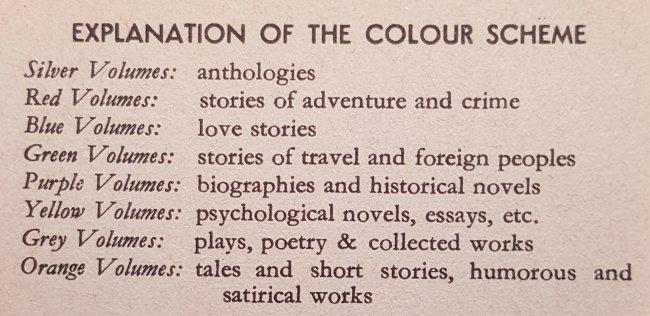
As has become clear to anyone reading my blog for a while I collect Penguin Books and have over 3,500 of them so Albatross are a logical side collection. The inspiration for Penguin Books was partly due to the press being named after a bird but mainly for the cheap but smart editions which are colour coded by subject matter, something that Allan Lane immediately adopted for his new enterprise. The chart shown below is from the dust wrapper of Memoirs of a Fox-hunting Man.
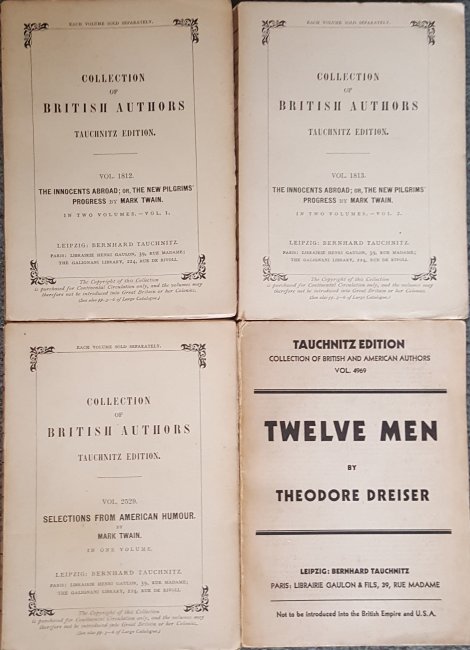
Troy explains the importance of Tauchnitz and if anything volumes from this publisher are even more difficult to find in the UK than Albatross, I just have four, three of which are from 1879 and 1880 and the final one, ‘Twelve Men’ is from 1930 so shows the plain typographical covers that the bright and colourful Albatross were going up against to attract customers.
I have managed to accumulate twenty three Albatross books, so roughly one a year since I started looking for them, and their immediate attraction is obvious even if the standardisation of colours is sometimes poor to say the least. Both ‘Journal’ and ‘The Arches of the Years’ are purple and ‘Journal’ isn’t faded as it is that shade on the spine and rear cover as well.
16 – The Brothers printed in Italy in 193?
19 – Ambrose Holt and Family printed in Germany in 1932
31 – Apocalypse printed in Germany in 1932
32 – The White Peacock printed in Germany in 1932
52 – Journal printed in Germany in 1933
203 – The Arches of the Years printed in Germany in 1934
216 (Extra Volume) – All Men are Enemies printed in Germany in 1934
236 – Pelican Walking printed in Germany in 1934
240 – Unfinished Cathedral printed in Germany in 1934
247 – Brief Candles printed in Germany in 1935
260 – Music at Night printed in Germany in 1935
310 – The Asiatics reprinted in Italy in 1947
317 (Special Volume) – The Weather in the Streets reprinted in Italy in 1947
326 (Extra Volume) – Aaron’s Rod printed in Germany in 1937
359 – The Bridge printed by Collins in Scotland in 1938 as Les Editions Albatros, Paris
377 – Juan in China printed in Germany in 1938
390 (Extra Volume) – The Letters of D.H. Lawrence printed in Germany in 1938
514 – Grandma Called it Carnal printed in Italy in 1947
551 (Special Volume) – Operation Neptune printed in Holland in 1947
556 (Special Volume) – English Saga printed in Holland in 1947
558 – Siegfried’s Journey printed in Holland in 1947
4802 – Lord Jim printed in Italy for Librairie Marcel Didier in 1947
4975 – Memories of a Fox-Hunting Man printed in Italy for Librairie Marcel Didier in 1947
The massive leap in the numbering scheme for the last two books should not be taken to show thousands of new titles suddenly being released. Rather I suspect that this is to keep the Librairie Marcel Didier volumes well out of the numbering scheme of the existing Albatross Press books. Penguin did something similar when launching Penguin Inc in America during the war and starting their book numbering at 500. Penguin Inc’s managing director was Kurt Enoch having escaped the Nazi’s so this was his second publishing venture. In 1948 following disagreements with Allen Lane back at Penguin headquarters in England Penguin Inc was dissolved and Enoch started again with his third publishing firm this time as Signet and Mentor. As for the Extra and Special Volumes these are normally significantly thicker than ‘normal’ volumes and presumably had a higher price although 558 Siegfried’s Journey is a normal size so maybe Special Volumes had a different rule.
But why Albatross? Holroyd-Reece had several explanations but the one I find most persuasive is because the word is similar in a lot of European languages: Albatros in Catalan, Czech, Danish, Dutch, French, German and Spanish amongst many others, Albatro in Italian, Albatrosz in Hungarian and surprisingly Albatross in Estonian and those last two languages I know from personal experience are normally miles away from English. I’m still on the lookout for more volumes from The Albatross Press and have even added a sideline of want to be Albatross books including the Italian Corvi press, which is undated but numbered 4 in the series and looks to be from the 1930’s. This is a true polyglot of a title as it is a biography of a British Prime Minister written by a French politician and translated into Italian. Alongside is a book I picked up earlier this year in Budapest which is much later, 1979, but is clearly inspired by Albatross design and in this case is written in Hungarian but published in Bucharest, Romania. Fabre was a French naturalist and this is a translation of one of his books about insects.
All in all The Albatross Press produced some very attractive books from a wide range of significant authors so are well worth looking for and are a pleasant surprise when you do find one on a shelf in a second hand bookshop. As Michelle Troy’s incredibly well researched book proves they also had a fascinating history behind them.
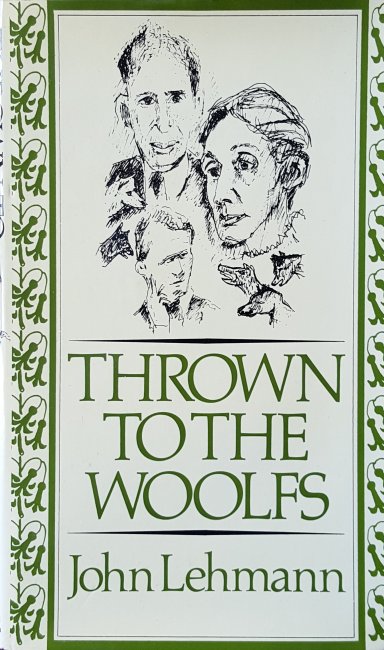
This book arrived in a box of mixed titles bought on Ebay for about £10 a couple of years ago, all of which were something to do with books or publishing. I must admit that I barely looked at it at the time as I had purchased the collection of fifteen or so books for a couple of autobiographies that I thought sounded interesting so this just sat on the shelf until last week. I wish now I had picked it up earlier as, for the most part, it was a thoroughly entertaining read. The book concerns Lehmann’s time either working for or later being a partner in The Hogarth Press, a small publishing house set up by Leonard and Virginia Woolf primarily to publish her books exactly as her and her husband wanted them. Now of course even an author of Woolf’s stature couldn’t keep a press going by her own work alone so they also published books by other writers as well and the company was quite successful from its foundation onwards.
John Lehmann knew Virginia’s nephew Julian Bell from their time at university and when he was deciding about working at the press as the manager Julian warned him that managers didn’t last long as Leonard was far too controlling over the tiniest detail, especially money, and he would have a difficult time. The first part of the book, it’s split into four sections, concerns this fairly disastrous first attempt at working at the press in 1931 and 1932. The descriptions not only of the cramped offices and working conditions in this section but also of Leonard and Virginia set up the tone of the whole book. Lehmann is clearly a great admirer of Virginia, not only of her work but as a person and when he isn’t actually arguing with Leonard he also gets on well with him but Julian was right, Leonard was impossible as a boss and ultimately the only way forward was for him to leave the business immediately at the end of his initial contract. This caused further ructions between him and Leonard and they barely contacted one another for several years.
The second section has Lehmann in Europe in the lead up to WWII, which is where he made a lot of contacts with up and coming writers across the continent which would serve him well in the coming years. He also started, in 1935, a bi-annual book called New Writing, initially published by The Bodley Head this was looking for a new publisher in 1938 and as things had calmed down by then he approached the Woolfs and this time would end up paying £3,000 (£205,000 in today’s money) for Virginia’s share of the business making him joint partner with Leonard in the Hogarth Press.
The third and fourth parts deal with the eight years from 1938 to 1946 whilst this partnership lasted and make up the significant part of the book not only in pages but also in detail regarding the running of the press and the interactions of the three of them. The sections are split at the suicide of Virginia in March 1941 with by far the happier times being whilst she was alive. Not only does Lehmann tell more about the Press but was also get details of Virginia’s working method and home life. Once Virginia was no longer there to provide arbitration between the two men however things started to go downhill and the one part of the book I found more difficult was a long section where Lehmann quotes verbatim letters between them arguing about which books should be printed or not. Apart from that the book was a very quick read I really wanted to know more so just kept going although you know that the final cataclysm cannot be far off.
In the end Lehmann felt he couldn’t continue as the animosity between the two men over the direction the press should take was just too much and he instigated a clause in the original agreement that either partner could ask the other to buy them out at three weeks notice. This was duly done far faster than Lehmann expected and yet another long period of bad blood between them opened up until oddly in the 1960’s they had yet another rapprochement and as this time they didn’t end up working together this seemed to go well until Leonard’s death at the end of that decade.
The book was published by Widenfield and Nicolson in 1978 in the UK and Holt, Rinehart, and Winston in 1979 in America. Neither edition appears to have been reprinted but both are easily available via abebooks and is definitely worth adding to the shelves of anyone interested in books.







 Ramblings on my bookshelves