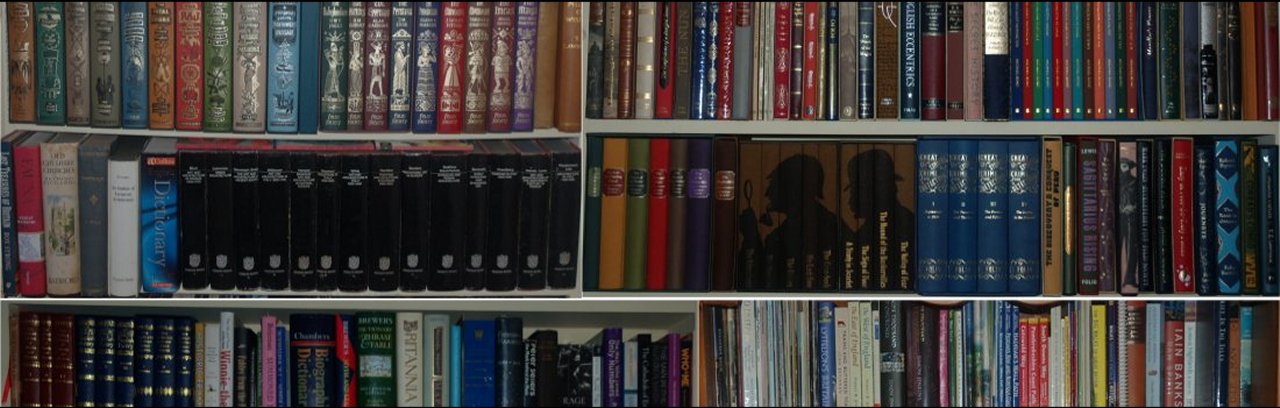
Collection du Vieux Chamois

I have recently managed to complete my collection of these sixteen children’s books, most of which were printed in 1947 in cooperation between Penguin Books in England and Fernand Nathan in France. The last two titles VC15 and VC16 are translations of books that originally came out in England in December 1947 and August 1948 respectively so presumably the French versions were later. After the war Penguin were keen to restart their international publications and came up with the plan of altering the text for a small number of Puffin Picture Books into French and printing them in England to avoid having to ship the lithographic plates abroad. This would still require a considerable amount of work to blank out the existing English text and replace it with a translation as the whole page is printed as one unit. This would therefore have been difficult enough but there were also some illustrations altered, some of which were done for obvious reasons others are more obscure.

The books were printed in editions of 20,000 copies per book and none appear to have been reprinted. In the intervening, almost eighty, years this relatively small production number along with the fragility of books consisting of eight folded sheets stapled down the centre making a thirty two page book meant that few have survived to the present day. Although they are a reasonably practical series of children’s books to collect and it has only taken me around five or six years to accumulate them all mainly from French second hand book dealers online. Interestingly none of the books mention who did the translation, presumably somebody at Fernand Nathan, or who made the alterations to the pictures, possibly the original artists. It is also somewhat ironic that the French translations were created, as one of the original inspirations for the Puffin Picture Book series was the French series ‘Albums du Pere Castor’.

I am indebted to the Penguin Collectors Society for their invaluable Checklist of Puffin Picture Books which includes a full listing of these books so that I could check each one as I obtained it, and the checklist is the source of a lot of the information in this blog. Whilst this book lists most of the differences between the English and French illustrations it doesn’t show the variations, so below I will do so as I think it is interesting to see just what cultural differences were picked up in the changes. Firstly let’s list the seven books where it is simply a text translation difference and as you will quickly spot there are several obvious title changes:

  • VC2 – Les Animaux de notre hémisphère – originally PP7 Animals of the Countryside
  • VC5 – Vacances a la Campagne – originally PP33 Country Holiday
  • VC7 – Les Abres de mon pays – originally PP31 Trees in Britain
  • VC9 – Merveilles de la Vie Animale – originally PP44 Wonders of Animal Life
  • VC10 – Comment Vivent les Plantes – originally PP58 The Story of Plant Life
  • VC13 – Les Chiens – originally PP56 Dogs
  • VC16 – La Péche et les Poissons – originally PP53 Fish and Fishing

Now let’s look at the ones with illustration changes which will also give you a chance to see how lovely this series of books are, either in the original 119 titles in English or these 16 in French:

VC1 – Les Oiseaux du village – originally PP20 Birds of the Village

This one is a mistake rather than a deliberate change, but page eight has a number of birds each identified in the adjacent text by a number. However in the French version the numbers within the illustration have been removed which makes the text meaningless. The alteration is omitted from the checklist which regards this book as a translation only.

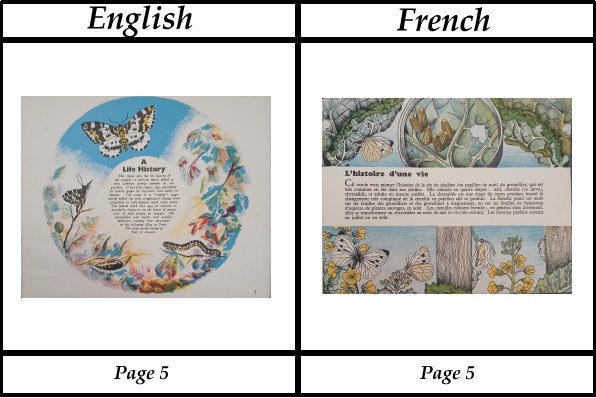
VC3 – Les Insectes – originally PP5 A Book of Insects

Two pages within this book are completely changed with totally new designs. The first one makes sense to change as the French text appears to be significantly longer than the English and therefore difficult to fit into the circular gap. The second one is less obvious why it was altered to a much more scientific form.
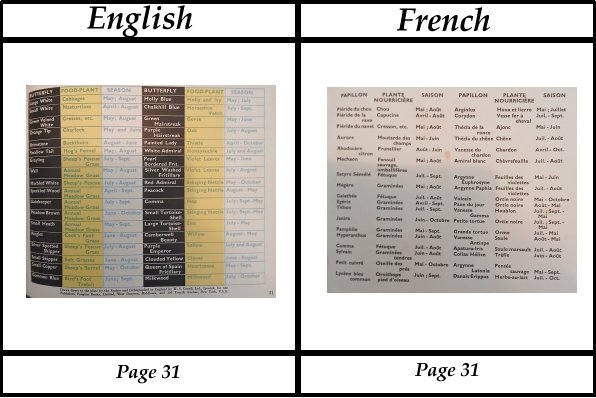
VC4 – Jolis Papillons – originally PP29 Butterflies in Britain

The change for this book is perfectly understandable as it is simply the table on the last page and changing all the text and replicating the original format is probably unnecessary. The deformation of the left hand side of the English text is simply because I didn’t want to force the page flat and possibly loosen the staples. This lack of formatting is not mentioned in the checklist which again regards this book as a translation only.
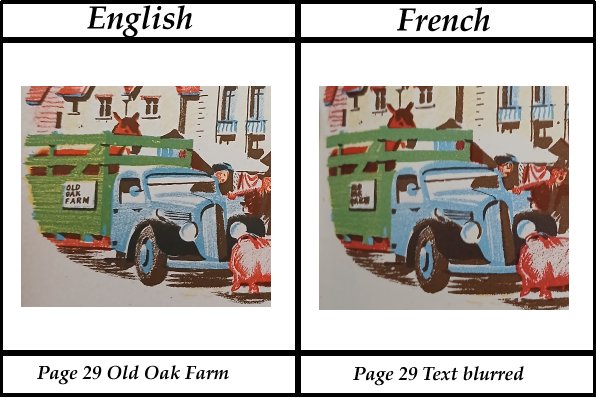
VC6 – A la Ferme – originally PP4 On the Farm

The biggest difference before the two versions is on the first page where the British farmer is replaced by a man more obviously at work.

The other change is not included in the checklist and it is the amendment to the sign on the side of the lorry on the page dealing with going to the market, where the English text has simply been blurred out.
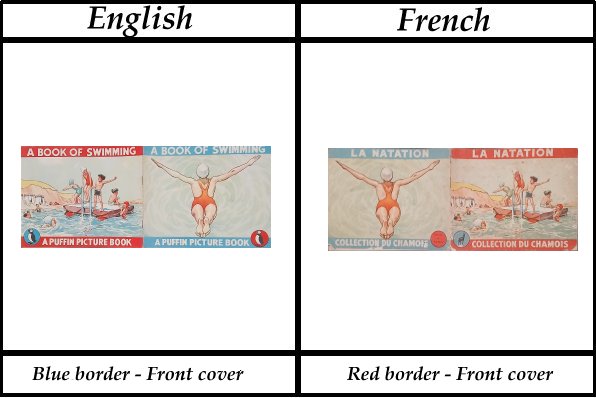
VC8 – La Natation – originally PP48 A Book of Swimming

Strangely this change isn’t in the checklist either although it is a pretty significant alteration, with the front and rear covers being transposed.
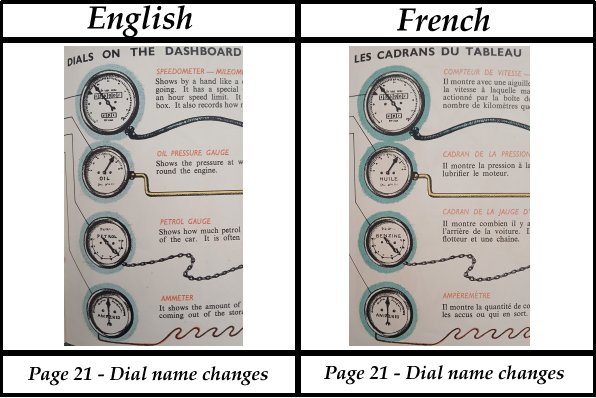
VC11 – L’Auto et son Moteur – originally PP38 About a Motor Car

The two small changes to this book are so small that they were ignored by the checklist, the first one is quite amusing and is a text alteration on the middle page spread where in the English version after the word chassis it points out that this is a French word, quite rightly the French edition doesn’t bother with this explanation. The other change is shown below and is an amendment to the text on the gauges.
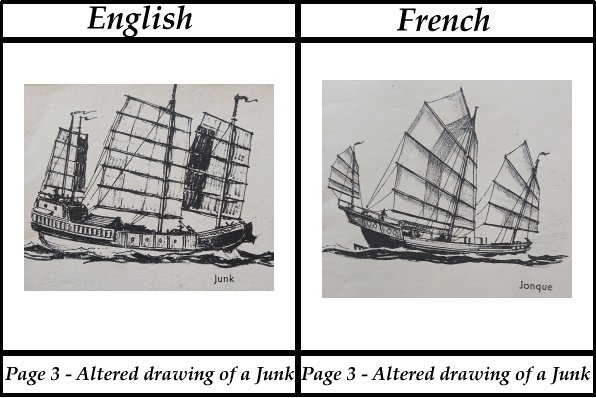
VC12 – Les Bateaux – originally PP11 A Book of Ships

Now we get to the book with the most changes between the two versions, all of which are included in the checklist and we start on page three with a new drawing of a Chinese Junk.
The very next page has the British naval flag, the Red Ensign, altered to be unrecognisable in the French version. This also occurs on page 24 but I’ve just included the one example here.

Next comes a change of headgear between two sailors

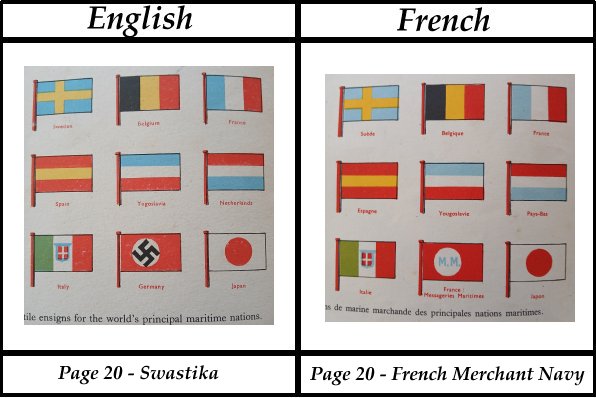
We then get a change that needed to be made from the original British edition, which was printed in June 1942, when the German flag would logically appear, to 1947 when it wouldn’t, or at least not in that form. The British book would be completely redesigned when it was reprinted in 1952 and no swastikas appear in that either.
Finally we come to page 27 where the illustration at the top of the page is reversed and indeed looks like it was completely redrawn.

VC14 – Les Merveilles du Charbon – originally PP49 The Magic of Coal

With this book only the front cover is amended to change both the helmet, the French version is more rounded and doesn’t have a lamp, and also the miner’s tattoo on his chest. This goes from St George and the dragon on the British miner to the symbol of France, the Gallic Rooster, in the French version. Whilst compiling this list I also realised for the first time that this book is slightly, but noticeably, larger than most of the other Puffin Picture Books or indeed the Vieux Chamois.

VC15 – Le Théatre – originally PP75 The Theatre at Work

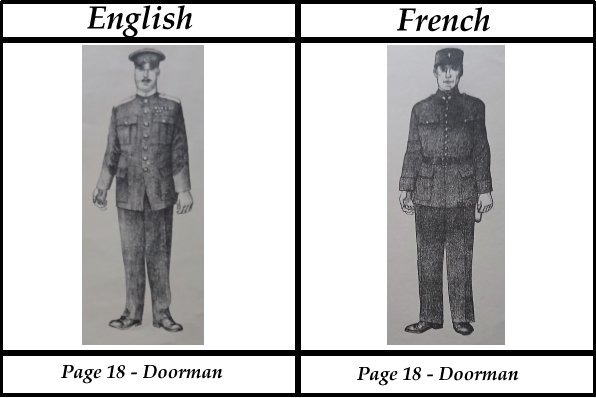
The final set of changes involve a couple of uniforms at the theatre both of which are in the checklist, firstly the doorman.
and finally the fireman who looks more prepared for disaster in the French version

That brings us to an end of this overview of the Vieux Chamois series, I’d love to know why they were called Old Chamois but I doubt that I’ll ever find out.

Puffin Picture Books illustrated by Paxton Chadwick

Paxton Chadwick was a well known artist who was born in Manchester in 1903 but after marrying his first wife he moved to Suffolk and took a post of art teacher at Neill’s Summerhill School in Leiston Suffolk which is where he lived for most of the rest of his life. His natural history artworks are justifiably celebrated and this blog looks at the four books he illustrated for Puffin Picture Books, three of which he also wrote. Sadly Chadwick died in 1961 before he completed his fourth title for Puffin Picture Books and so there was a gap in the series at number 116 out of the 120 volumes in the set. Number 116 was eventually published by The Penguin Collectors Society in 1995, see the end of this blog for more details as to how it came about.

Puffin Picture Books was an imprint of Penguin Books originally aimed at children of all ages with counting, spelling and story titles alongside works on shipping, agriculture, nature of all kinds and pastimes such as stamp collecting and building models. Gradually the fiction titles were phased out leaving the educational works, a lot of which would nowadays be categorised as Young Adult for their reading demographic. Starting in 1940 they were the first series of books published by Penguin that were aimed at children but are also excellent illustrated monographs to be read and enjoyed by all ages.

PP81 – Wild Flowers

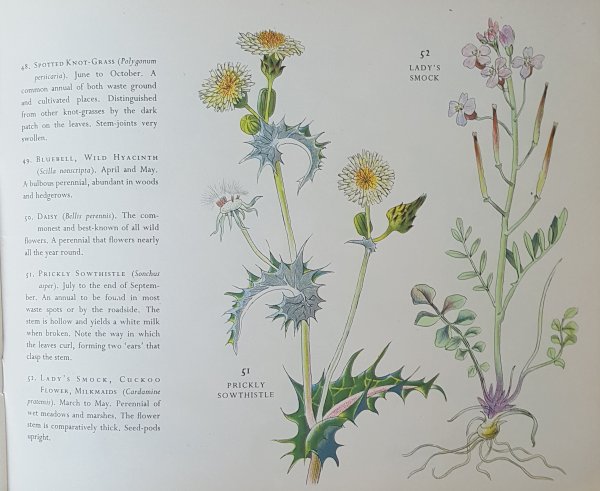
Written and illustrated by Chadwick this is the first edition printed April 1949 and it was reprinted a further four times making it the most reprinted of the four Paxton Chadwick Puffin Picture Books. As soon as you open the book it is clear why it was so popular, unlike any other Puffin Picture Book this one is almost full colour throughout (pages 2 and 3 which describe the structure of a flower are in black and white), normally half the illustrations would be in black and white and the pictures are beautiful. I particularly like the double page centre spread comparing a Great Mullein and a Foxglove see above. In total there are sixty one different plants illustrated and described giving their flowering season and if they are annual, biennial or perennial species. You also get the common English name along with the Latin and some more information as to how to identify the plant making it the best reference work on British wild flowers published by Penguin up to that point and not superseded until John Hutchinson and Edgar Hahnewald’s Wild Flowers in Colour was published by them in April 1958 which covered five hundred species.

The book won a National Book League (NBL) award for its quality of production.

PP93 – Pond Life

This is the only one of the four books just to be illustrated and not written by Paxton Chadwick, but rather by Jean Gorvett, about whom I can find nothing, this is the only book she appears to have written and I have been unable to find any biographical details on the internet. Regardless of the difficulty of finding information about the author the book was first printed in February 1952, going on to be reprinted twice by Penguin and then re-appeared as a hardback in 1971 under the title of Life in Ponds in the USA by McGraw-Hill with a completely different cover of male and female mallards, which was taken from page 25 of this original softback edition.

We are now back to the normal layout of Puffin Picture Books, after the anomaly of ‘Wild Flowers’, so colour only appears on alternate double page spreads. The text is the same chatty style that was familiar from the books written by Chadwick himself and is clearly aimed at a child from about nine to twelve years of age whom has access to a decent sized pond and is interested in what can be found there and is looking for a beginners guide. The first section ‘How to Enjoy Ponds’ discusses how to catch various creatures and suggests a suitable net, various jars for examining your catches and of course don’t forget your wellington boots. We then go on through plants, molluscs, insects, larger animals, fish and finally birds such as ducks and moorhens that you could expect to encounter. The final section discusses how to stock an aquarium so you can continue your pond life watching on rainy days.

Like Wild Flowers the book received an NBL award despite, in my opinion, the least inspiring cover of any of the Puffin Picture Books but the book itself is excellent.

PP105 – Wild Animals in Britain

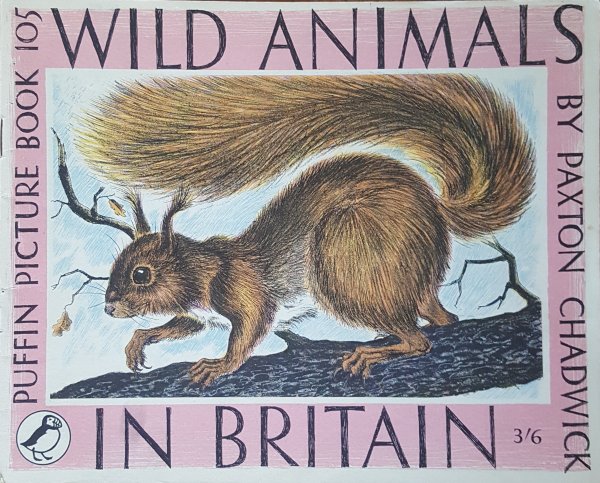
Again written and illustrated by Chadwick, Wild Animals in Britain was printed in April 1958 and was never reprinted. This was not uncommon with Puffin Picture books, indeed 66 of the 119 books issued in this series by Penguin were not reprinted, so the fact that his first two books went through multiple printings says a lot for how well received Chadwick’s books were. The title of this one is somewhat inaccurate as the only creatures included are mammals and reptiles but I suppose ‘Wild mammals and Reptiles in Britain’ is a bit wordy for a title. In all forty one species are illustrated, thirty five mammals and six reptiles ranging from the insectivores such as hedgehogs and shrews, through bats, rodents, hares and rabbits along with the bigger mammals such as badgers, foxes and various species of deer. Amongst the reptiles are the two snakes above, and there is a particularly fine painting of a grass snake on the rear cover. It’s a lovely book and the inclusion of brown on the pages that would normally be just black and white (as seen on the page with the snakes) just lifts the book above the normal format Puffin Picture Books.

PP116 – Life Histories

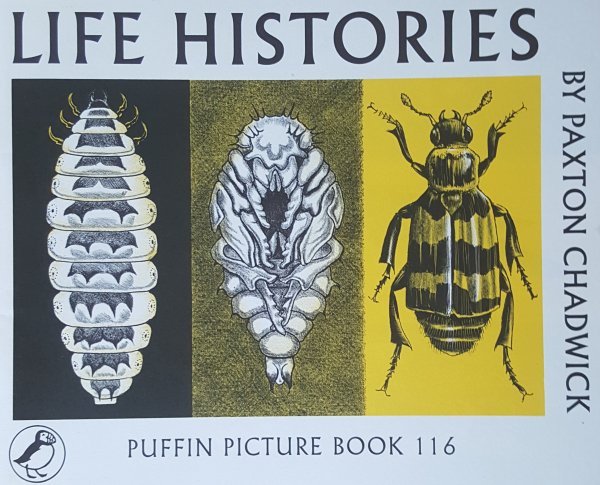
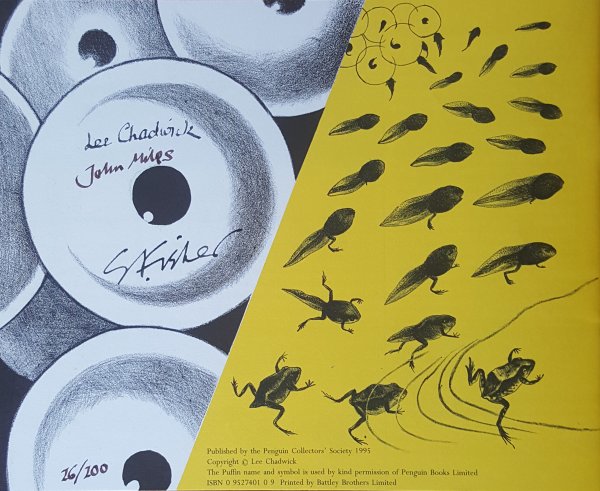
Written and illustrated by Chadwick this book was to be his final work as he died during its production which had started back in 1958 and was nearly complete by his death. Just how complete would become clear when the Penguin Collectors Society approached his widow, Lee Chadwick in the early 1990’s to see what, if anything, still survived. The final agreed text was known to exist in Bristol University archives and Lee confirmed that the plates were at The London College of Printing and when checked were found to be in excellent condition but needing some work before they could be used. This preparation of the plates was done by Sheila Fisher (nee Dorrell) who had been at the Manchester School of Art in the 1930’s when Chadwick had worked there and after the war became his assistant. However there was a further problem, the book needed to be properly designed and typeset in as sympathetic way as possible to the original 1960’s plans and here John Miles stepped in, he had been employed by Penguin back in the 1950’s as assistant to the head designer Hans Schmoller. By getting this remarkable group of people together, all of whom were in their seventies or eighties including Lee Chadwick to do some final editing the book was finally printed March 1996, some thirty five years after it had originally planned to be issued. There were just a thousand copies printed, the first one hundred of which were signed by Lee Chadwick, John Miles and Sheila Fisher. Penguin Books agreed to the edition having the original PP116 number assigned back in 1961. The book came with a twelve page booklet by Steve Hare entitled ‘The Life History of Life Histories’ which details the long gestation of this project and reprints sections of letters between Penguin Books and Paxton Chadwick regarding the work he was doing.

Conscious of the cost pressures that were signalling the end of Puffin Picture Books Chadwick designed the book to just use yellow and blue apart from the black text and line drawings but even so there would be just four more Puffin Picture Books produced after number 116. The creatures featured in this volume tend to be ones that undergo some sort of metamorphosis during their life cycle or have some elusive part of their existence such as eels and their trip to the Sargasso Sea so there is always something different about their entire life span. It makes it a very interesting read and such a pity that it never came out in the sixties for its target audience and that even now you are unlikely to find a copy due to its very limited print run.

The ultimate publication of Life Histories is a fitting tribute to Paxton Chadwick, an artist lost early at just fifty eight years old to an undiagnosed cancer.

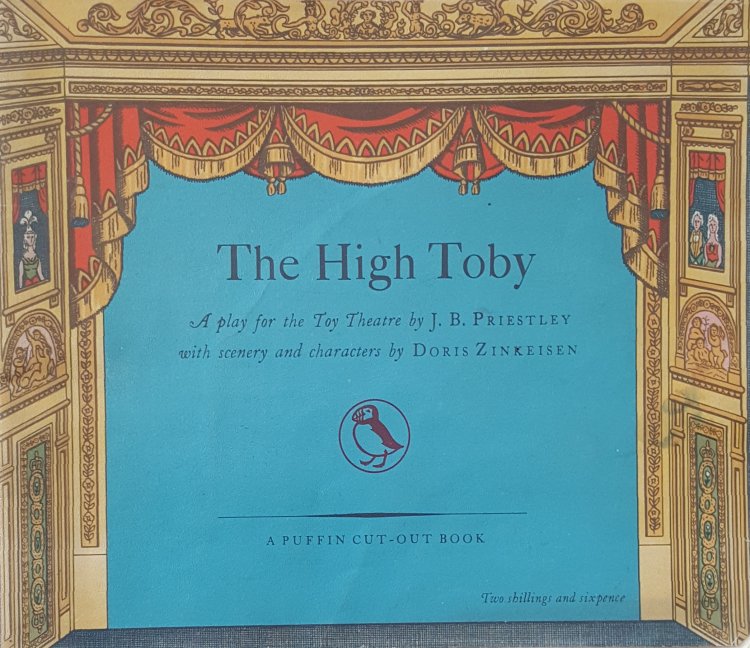
The High Toby – J B Priestley

This is less of a review of the High Toby than a brief look at the history of the toy theatre in Britain and more specifically the end of an era with the collapse into administration of the most famous, and by then the only significant, toy theatre company in the country, that run by Benjamin Pollock. For those readers unfamiliar with toy theatres I will also look in some detail at The High Toby and what you got when you purchased the book.

Benjamin Pollock didn’t set out to be a toy theatre maker and retailer, he married into the trade in 1877 when he took Eliza Redington as his wife and effectively inherited the family business of print making, especially sheets for toy theatres, before that he had been a furrier like his father. But his name was to become synonymous with toy theatres which was already a declining business when he started in the trade. However he was in for a considerable stroke of luck, with the reduction in the popularity of the toy theatre had gone a significant reduction in the number of competitors as they had slowly gone out of business and then in 1887 Robert Louis Stevenson wrote an essay called ‘A Penny Plain and Twopence Coloured’ about his love for toy theatres and specifically mentioning Pollock’s business, you can read it as chapter 13 of his later compilation of essays called Memories and Portraits available on Project Gutenberg. The title refers to the way the sheets were priced either a penny a sheet that you had to colour in yourself or two pence for pre-coloured, frankly half the fun of these was the colouring in as successfully performing a play on a toy theatre was actually quite difficult. This essay which originally appeared in The Magazine of Art drove interest in the subject and dramatically increased trade for Pollock’s.

Benjamin Pollock continued the business until he died in 1937, largely simply reprinting the sheets originally sold by John Redington with his name replacing Redington’s (just as Redington had done with his predecessor in the business) although he did introduce a handful of new plays in the six decades he was in charge. It was this careful use of the existing plates that kept his costs down and enabled the business to continue bringing in an income in the face of yet another downturn in demand for the products he was selling. Pollock’s daughters continued the shop for a short while but WWII intervened, the building was bombed and in 1944 they sold the plates and remaining stock to Alan Keen who ran an antiquarian bookshop. Keen may have understood book selling but the far more financially precarious world of toy theatres was all new to him and he set about expanding the new Benjamin Pollock Ltd company he created and that meant new plays and new designs of theatres to perform them in. Not content with new versions of classic pantomimes which didn’t require much or any royalties to be paid he commissioned completely new works including an adaption of the 1948 J Arthur Rank film of Hamlet starring Laurence Olivier.

As the film was in black and white the backgrounds and wing dressings for this production was also in black and white although the characters were reproduced in full colour using photographs of the actual cast. The licencing for this could not have been cheap but was almost certainly eclipsed by the cost of the other 1948 publication of The High Toby. There would be one more new production from Benjamin Pollock Ltd. which was a version of the nativity story published in 1950 but by 1952 the company had gone into receivership, probably pushed over the edge by the two 1948 new productions.

As indicated above The High Toby should really have been called The High Cost. In 1948 when this book was published Priestley was at the height of his powers, his most famous play ‘An Inspector Calls’ was written in 1945 and had reached the London stage the following year to excellent reviews so hiring him to write a play was a bold but extravagant choice for the Benjamin Pollock company. That they also got the well known artist and theatrical designer Doris Zinkeisen to design the sets and figures may well have been a step too far, although getting Penguin Books to publish the book unlike than their self published Hamlet may well have offset some of the cost as Priestley could at least expect more royalties that way but as this was a commission he would have received a significant advance. The book is intended for use with the Benjamin Pollock Regency Theatre which cost 38 shillings and sixpence (the equivalent of £69 in 2021) so not a cheap toy, especially so soon after WWII, so this was only an option to wealthier families. Along with the short play there are backdrops, dressings for the wings and characters in various poses to fit the performance all of which need to be cut out and mounted on cardboard before attaching to rods so they can be moved on the stage.

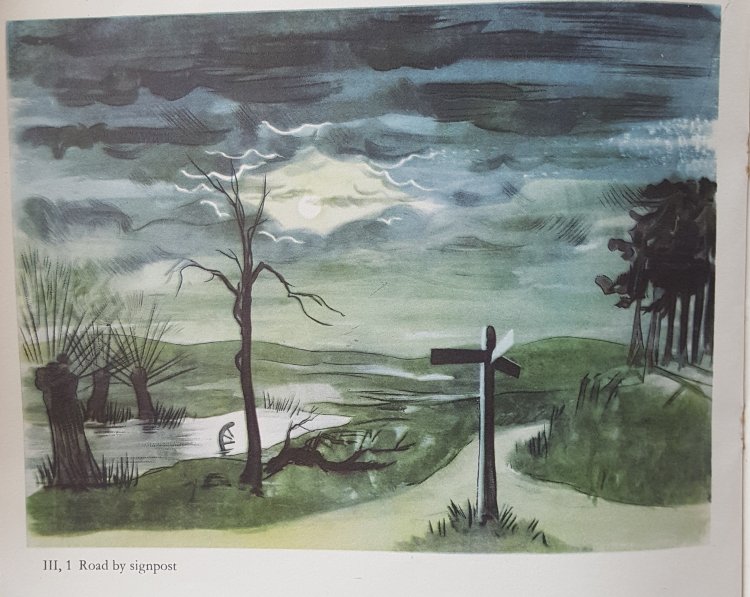
Some of the backdrops included in the book can be seen below, there are a total of nine pages of backdrops

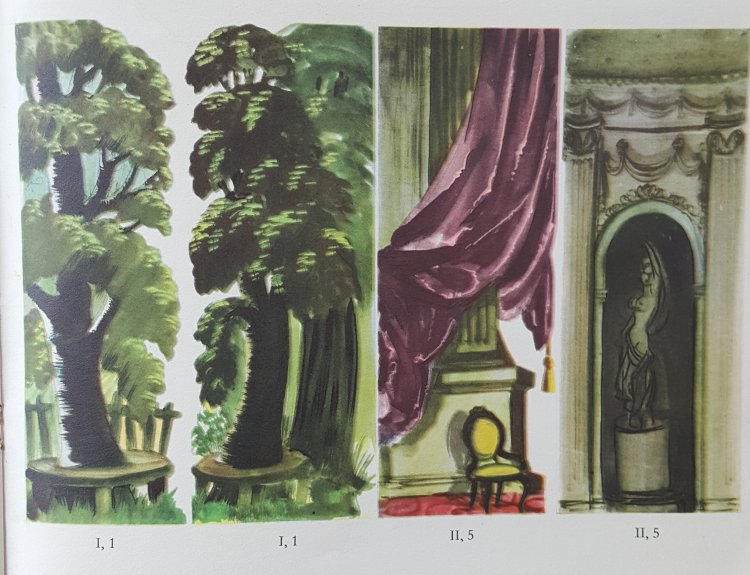
Wing dressings and a couple of carriages are on these pages again there are more wing dressings than I have included here.

and the designs for figures include these, there are two more pages of characters to be cut out. Not only did the lucky child with this toy need wealthy parents they also needed endless patience to cut out and mount all the various parts.

The text of the play indicates which version of each character is needed in that scene and as you can see this would have been a very colourful performance which is more than could be said for the largely black and white version of Hamlet printed by Benjamin Pollock at roughly the same time.

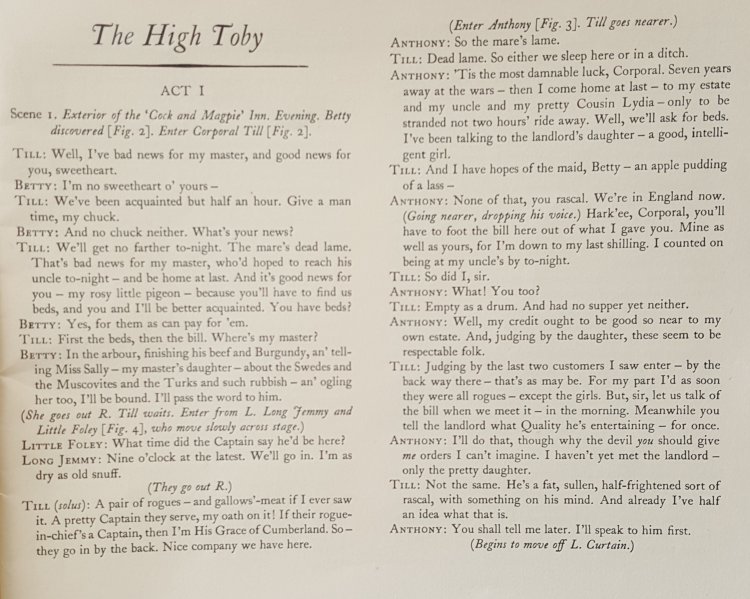
The play is actually quite good fun and the stage directions are clear and easy to follow there is even a section which indicates the type of voice to be used for each of the characters, but it would still need at least two children to perform it with any degree of success. There is a licencing note as well in the book that makes it clear that whilst toy theatre performances are royalty free, should anyone wish to perform the play on a real stage then there would be a licencing cost associated with it.

I’m glad to say that 1952 was not the final end of the Benjamin Pollock business, in the mid 1950’s Marguerite Fawdry needed some parts for the toy theatre that her children played with and tried to buy them from the receivers who refused. They did however suggest she could buy all the plates, printed sheets and theatres they held which she duly did and opened The Benjamin Pollock Toy Theatre museum, which also continued selling stock as the shop had. She even produced new plays but in a much more modest fashion than Alan Keen. The museum she created still exists and is still run by the Fawdry family in Fitzrovia, a district of London, and is now high on my list of places that I want to visit the next time I am in the city.

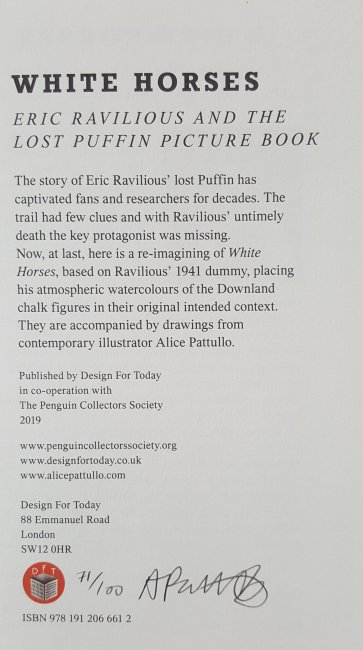
White Horses – Eric Ravilious

20190409 White Horses 1

Puffin Picture Books, an imprint of Penguin Books intended for children, started in December 1940 and ran until March 1965, although by then you were lucky to get one new title a year. In all 119 titles were published out of 120 that were given numbers, the missing title was 116 assigned to Life Histories by Paxton Chadwick and this was eventually printed by the Penguin Collectors Society in March 1996 under the guidance of Steve Hare. The story of the series appeared to be complete, but there were in the archives references to other titles that never even got as far down the path to publication that Life Histories had. One of these was Eric Ravilious’s White Horses. The beautiful watercolours of chalk figures and hills on the English chalk Downs intended for the book did exist but there appeared to be nothing more.

20190409 White Horses 4

Ravilious had been approached by Noel Carrington, editor of the Puffin Picture Book series to produce illustrations for a thirty two page landscape book of Downland figures back in 1939 and he was originally very enthusiastic about the project working of watercolours straight away. By the beginning of 1941 he had produced a dummy which showed the planned layout but by then commitments to the War Ministry left him no time to do more. Sadly on 28th August 1942 Ravilious was killed in an air crash whilst working as war artist in Iceland, the dummy of Downland Man (as Carrington referred to it)  disappeared and the planned book appeared to have died with him.

The story leaps to 2010 and the rediscovery of the dummy tucked away with other papers in the possession of Roland Collins. This critical evidence is now held at The Wiltshire Museum in Devizes and it is with their permission to make use of the document that the book I now have in front of me exists. Step forward Joe Pearson, owner of a small printing company in London, book and illustration collector and Penguin Books expert.

20190409 White Horses 2

Design For Today has, since its launch in 2015, already built up a reputation for producing fine examples of illustrated books based on Joe’s love of mid 20th century design, either reprints or more often using contemporary artists as inspired by the period as Joe is. As their website says…

Design For Today’s artists’ books are all designed, crafted and printed in the UK, using quality, sustainable materials and printed using the traditional processes of lithography, letterpress, screenprint, or linocut.  Editions are small, from 500 – 1500

Joe had been hinting throughout 2018 that White Horses (as Ravilious titled the dummy) was a project he was working on; with Alice Pattullo commissioned to produce the black and white illustrations needed to complete the artwork as Ravilious had only ever done the colour pictures and Puffin Picture Books are a mix of both. The text of the final book is by Joe himself.

On the 31st December 2018 disaster struck, as the warehouse holding all of DFT’s stock, along with part of Joe’s own book collection and personal items, was burnt to the ground and nothing could be saved. White Horses is the first book to be launched after that loss of all of the back stock from the first years of the business and members of the Penguin Collectors Society are to receive a copy of the standard edition with their June mailing.

My copy of the limited edition version, which also includes a signed A3 print of one of the pictures by Alice, arrived the other day and it is an excellent piece of work not just well printed as I expected having quite a few of DFT’s products already, but entirely in the spirit of the Puffin Picture Book series.

20190409 White Horses 3

The double page spread above shows the sort of village that the creators of the earliest chalk carvings would have lived in at about 1500BC and this is the illustration that comes as the print with the limited edition book. The limited edition appears to have sold out already but standard copies of this beautiful book are available for £15 plus postage from Design For Today, anyone who like me loves Puffin Picture Books and/or the works of Eric Ravilious is sure to want one.