Mathematical Games – Martin Gardner

This week I’m going to cover not one but five books, all of which started life as articles in Scientific American under the heading of Mathematical Games. This column was originated by Martin Gardner in 1956 and I first came across it in my school library in the early 1970’s and became hooked, looking forward to the next monthly issue, which fortunately the school subscribed to. Eventually Gardner compiled fourteen books based on the column, five of which I own.
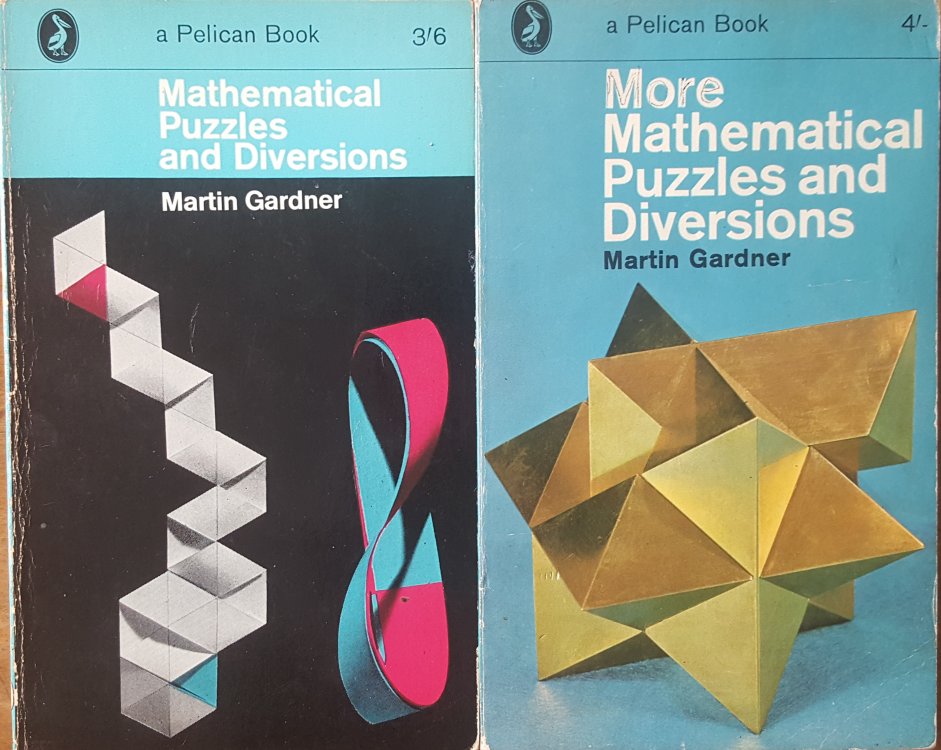
The first book has an unfolded flexagon alongside a mobius strip and immediately highlights the cover design issues with the Pelican editions in that although flexagons are the subject of the first chapter, the curious single-sided mobius strip is not referenced in this book. Flexagons were in fact the subject of the very first article Gardner wrote for Scientific American and are constructed by folding a strip of paper in a triangular pattern until you create a hexagon which when manipulated, or flexed, opens out and then returns to a hexagon shape but with different sides displayed. So if the user had coloured the original two visible sides these would disappear and new blank faces appear. It is possible to create flexagons with large numbers of faces but the number is always divisible by three. The book describes how to make a couple of different variations and I remember having great fun playing with them. Other chapters include the mathematical game of Hex, an overview of the puzzles created by American Sam Loyd, card tricks (Gardner was a keen magician as well as mathematics writer) and random collections of short puzzles which would be a staple of Mathematical Games columns and their successors in Scientific American.

The second book has a cover that is entirely from the imagination of the designer, in this case Denise York, as it has nothing to do with anything in the book which does however have an article about the five platonic solids one of which this definitely isn’t. Again we have an article about a great historical puzzle maker in this case the English near contemporary of Sam Loyd, Henry Ernest Dudeney, there are also discussions of three dimensional tangrams, magic squares, recreational topology and even origami. Like all the books I have each chapter is reprinted in the book and an addendum is added covering items that were raised after the publication of each column, sometimes pointing out things that were incorrect. Gardner surprisingly wasn’t a mathematician, or an academic, he was just fascinated by mathematical puzzles. Two of the people that continued the mathematics column in Scientific American after he retired in 1979 were professors Douglas Hafstadter and Ian Stewart.

The first two books were published by Pelican in the mid 1960’s but the next time they printed one of Gardner’s books was another pair, this time in 1977 and 1978. Again the the covers are not relevant to the text with the ancient puzzle of the Tower of Hanoi on the cover of Further Mathematical Diversions although this was in fact covered in the first book ‘Mathematical Puzzles and Diversions’ but this third Pelican title does have some of my favourite columns in it starting with the paradox of the unexpected hanging where the judge pronounces on the Saturday of the judgement that:

The hanging will take place at noon, on of of the seven days of next week but you will not know which day it is until you are informed on the morning of the day of the hanging.

The prisoner is despondent but his lawyer is pleased as he reasons that the sentence cannot be carried out because he cannot be executed on the Saturday as that is the last possible day and therefore he would know on the Friday that he was to be executed that day. Likewise it can’t be the Friday as Saturday is impossible so Friday is the last day and so on working back through the week. The logic is fine and worked right up until Thursday when the man was unexpectedly hung. The discussion on why the logic fails is quite entertaining.

Also in this book are articles on the transcendental number e, the properties of rotations and reflections, gambling, chessboard problems and numerous other subjects including the inevitable sets of nine short problems, but my favourite, because it prompted me to attempt to build one was about a ‘computer’ built of matchboxes and beads which could ‘play’ noughts and crosses (ticktacktoe) in fact the original article that this chapter was based on first appeared in Penguin Science Survey, a publication I was unaware of at the time I first read this article. The machine is more of a simple learning machine than a true computer but using three hundred matchboxes it is possible to have something that gradually optimises how to play the game and in the example described it was winning, or at least not losing the majority of games after just twenty goes.

The fourth book again doesn’t seem to have anything to do with the cover illustration but does have various articles including Pascal’s Triangle, infinities that are bigger than other infinities, the art of Dutch artist M.C. Escher, random numbers and a ‘simple’ proof that it is impossible to trisect an angle using just a compass and ruler although bisection is extremely easy. There are again many other subjects covered although unlike the other volumes there isn’t a chapter of nine short puzzles. I remember being fascinated by aleph-null and aleph-one infinities when I first read this piece as a teenager, the concept of ‘countable’ and ‘uncountable’ series resulting in differing ‘sizes’ of infinities was so different to what I was being taught in mathematics at the time that I needed to read it a couple of times to get my head around what was being explained and I have of course come to love the art of M.C. Escher.
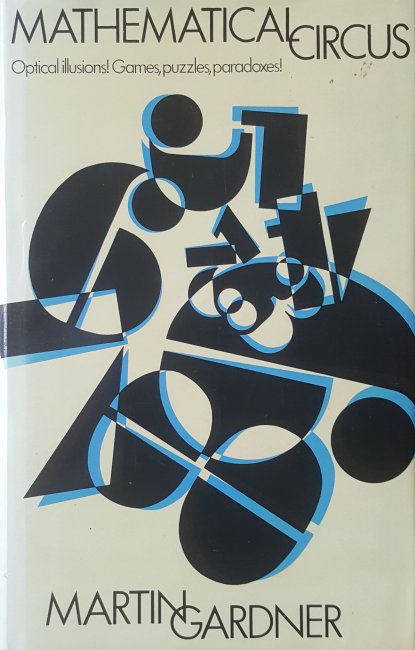
The final book I have by Gardner is a hardback published by Allen Lane rather than paperback Pelicans although both are imprints of Penguin Books. It follows much the same format as the other four with twenty chapters based on articles from Scientific American but this time I don’t remember reading many of these before but topics include such diverse subjects as Fibonacci and cyclic numbers, the Turing test, devised by Alan Turing to determine if a machine could fool a human into believing they were conversing with another human. The smallest cyclic number is one that I have always remembered and it is 142,857, what makes it cyclic well just multiply it by 1 to 6 and see that the digits remain in the same order just starting from a different place i.e.

  • 142857 x 1 = 142857
  • 142857 x 2 = 285714
  • 142857 x 3 = 428571
  • 142857 x 4 = 571428
  • 142857 x 5 = 714285
  • 142857 x 6 = 857142

I’ve thoroughly enjoyed the mental workout reading these books again this week and remembering oddities of mathematics that have stuck with me since my teenage years and if you have any liking for puzzles I heartily recommend searching out Martin Gardner’s extensive output.

Fermat’s Last Theorem – Simon Singh

Published in 1997 as a follow up to a BBC documentary about the discovery of a proof of Fermat’s last theorem in 1994/5 this 362 page book takes a deep dive into the history of the theorem and the various attempts at a solution over the 358 years that it remained a mathematical puzzle. The joy of Pierre de Fermat’s last theorem is that it is very simple to understand but turned out to be incredibly difficult to prove. Anyone who has had Pythagoras’s theorem relating to the sides of a right angled triangle drummed into them at school will understand the basic concept. That theorem states that the square on the hypotenuse equals the sum of the squares on the other two sides or put simply in a diagram with the best known whole number solution as an example:

Fermat stated that although this clearly works for squared numbers, and indeed there are infinitely more combinations of whole number solutions (such as x = 5, y=12 and z=13 as 25 + 144 = 169) there are no whole number solutions if the power that you raise x, y and z to is greater than 2. Fermat stated that he had a proof, although he wrote this in the margin of his copy of the ancient Greek mathematician Diophantus’s Arithmetica and stated that ‘the proof was too large to fit in the margin’. Fermat was a mathematical genius but also extremely annoying as he would often taunt fellow mathematicians by writing to them that he had discovered a proof to some mathematical conjecture and challenge them to also find the solution and would rarely write down his own proofs in a rigorous manner. Certainly no example of Fermat proving his last theorem has ever been found. Fermat of course didn’t refer to it as his last theorem, it gained the name as slowly all his other conjectures were proved correct leaving just this one which would become notorious and also the driver of other mathematical insights as people tried to prove, or disprove, it over more than three and half centuries.

Let’s come back to that date of 1994/5 for the final proof. English mathematician Andrew Wiles had worked for many years on attempting a proof, but without admitting to his fellow mathematicians that he was working on it as it was seen as a waste of time and as a professor at Princeton University, New Jersey, USA it wouldn’t be appropriate to be seen to have an interest in the subject. However all that changed in the mid 1980’s when it was shown that Fermat’s last theorem would be effectively proved if there was a proof discovered to the seemingly unrelated Taniyama-Shimura conjecture. This conjecture deals with two extremely complex areas of mathematics and indicated that they were inter-related and indeed one could be used to solve problems in the other. These two concepts were elliptic curves, which were Wiles’s Phd speciality and modular forms, a four dimensional topological ‘structure’. Now I sort of understand the basics of elliptic curves but the use of modular forms is beyond me even with the basic description provided by Simon Singh in this book. Wiles saw this as a legitimate use of his time and would give him a proof of Fermat, which had fascinated him since he was ten years old, whilst working on a ‘genuine’ mathematical problem, the proof of Taniyama-Shimura. The problem was that this, like Fermat’s last theorem, was considered impossible to prove. He still decided to work in secret though and for many years came up against brick walls preventing his proof from working until in 1994 he took three lecture slots at a convention in Cambridge, England and under the deliberately opaque title of “Modular Forms, Elliptic Curves and Galois Representations” endeavoured to present his proof. The mathematical world was astounded and Wiles was hailed for his outstanding achievement, problems however were found during the rigorous checking before the proof could be published and it took several more months before Wiles finally fixed the error in his proof hence 1994/5 being given as the date of the solution. The 1994 proof was so close to being correct, but relied on another conjecture which it turned out wasn’t proved so proving this other theorem was what took the extra time.

Now it may well be, if you are still reading this blog, that you are thinking no way am I going to read this book it sounds far to complex but you would be wrong. Singh has done a remarkable job in not only summarising Andrew Wiles’s work and still making it approachable, but the history of the various attempts to solve Fermat is fascinating. I first read this book back in 1997 when it came out and have picked it off the shelves two or three times in the intervening decades and each time I love descriptions of the failed attempts and the progress, or otherwise, that they led to, along with the various other puzzles included which help to get your brain engaged in the problem. Each time I get that little bit further in understanding just what Wiles actually proved with the specific part of the Taniyama-Shimura conjecture (named after the two Japanese mathematicians who came up with it in 1957). Taniyama-Shimura would finally be proved for all variants in 2001 by four of Andrew Wiles’s former students and renamed The Modularity Theorem. A note on terminology conjectures are unproved but seem to work, theorems are fully proved

Give your brain a workout, I definitely recommend giving it a go.

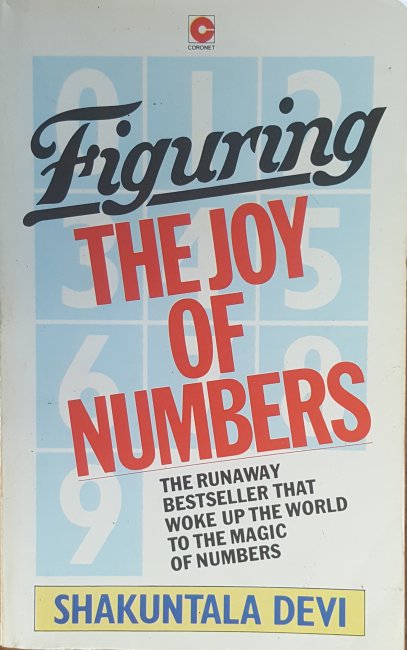
Figuring: The Joy of Numbers – Shakuntala Devi

As a child I was fascinated by mathematics, but especially by tricks and shortcuts that could be done. I started reading Martin Gardner’s section of Scientific American when I was eleven or twelve years old, I don’t claim to have understood all of it but each month my knowledge of recreational mathematics was stretched just that little bit more. I’ll cover one or more of his books in a later blog. However in 1977, when I was fifteen, this book was published and it was written by somebody who, at least partly, earned her living from amazing feats of mental arithmetic, I had to get a copy, and this book is still on my shelves today. Some of it I already knew but there were whole sections where she explained how to do tricks that I had seen done but which had baffled me such as calculating the day of the week for any date given to you or working out square and cube roots in your head. I remember practising these tricks for hours until I could do them too.

The book starts of simply by looking at each of the digits 0 to 9 in detail, explaining what is special about each of them and giving tips around multiplying and dividing by them, patterns in their multiplication tables etc. She then moves on to chapters about multiplication, addition, division and a very short chapter on subtraction. These chapters not only suggest shortcuts, which I still use today, to perform such calculations but ways to quickly check if the answer you get makes sense such as casting out nines. The book really caught my attention however when we reach calculating squares, cubes, square roots and cube roots. Amazingly cube roots which non mathematicians would assume to be much more difficult then square roots are actually very simple and fifth roots are even easier, square roots proved to be quite tricky. But just to see how easy extracting a cube root lets look at all you need to know, worryingly forty five years later I can still remember this:

  • 1 cubed = 1
  • 2 cubed = 8
  • 3 cubed = 27
  • 4 cubed = 64
  • 5 cubed = 125
  • 6 cubed = 216
  • 7 cubed = 343
  • 8 cubed = 512
  • 9 cubed = 729

Assuming that we are starting with 474,552 (which is 78 x 78 x 78) how do you get the right answer? Well first of all look at the thousands i.e. 474, this comes between 343 and 516 so the first digit is the cube root of the lower number which is 7. Next you will notice that all the cubes in the list above end with a different number and you just need to find the one that ends with the same digit as the number you are trying to extract the root of which in this case is 2 which matches 512 or 8 cubed and there we have the answer, the 7 from the thousands value along with the 8 from the final digit gives the required answer of 78. Notice that it was simply a case of knowing the first nine cubes and no actual calculation was performed on 474,552 in order to get the right answer.

Calculating the day of the week is a bit more tricky as you need to memorise four tables, admittedly the first of which is simply the first four values from the seven times table so this barely counts as a table and the working out is also more involved. I can’t do this in my head anymore and frankly with the all pervading computers or mobile phones with calendars on them what was once a occasionally handy ability is now of no use whatsoever as you are rarely that far from a device where you can look up the day for a specific date if you need it. When I was a teenager however this was quite impressive at least amongst the other maths fans at school and I got to be pretty quick at it.

The book finishes with chapters on special numbers and finally tricks and puzzles most of which, even then, I had already encountered but this book stretched still further my mathematical skills and I loved it. It has been great fun reading it again and finding out what I remembered and what I had forgotten. Shakuntala Devi died at the age of 83 in 2013 and wrote several books on mathematics along with astrology and oddly ‘The World of Homosexuals’ which she claimed was inspired by her marriage to a homosexual man but Figuring: The Joy of Numbers is probably her best known work, at least outside India although sadly it appears to now be out of print. If you know a child interested in mathematics I suggest trying to get a copy for them, it really is a joy.

Professor Stewart’s Cabinet of Mathematical Curiosities – Ian Stewart

After a series of novels, time for something factual and an exercise for the brain. Ian Stewart was Professor of Mathematics at The University of Warwick when he wrote this book in 2008 and still holds that title although now Emeritus since he retired. He has written numerous books on mathematics, several of which I own so this was chosen as the first one I picked off the shelf, he was also the third person to write the recreational mathematics column for the periodical Scientific American, taking the reins from 1991 to 2001. This column was started by Martin Gardner back in 1956 and he wrote it until the mid 1980’s and this was the true start of my love of mathematics so it has been a pleasure over the years to have sat in a few bars with Ian and discuss maths and also to enjoy his very readable books.

This book, along with it’s sequels Professor Stewart’s Hoard of Mathematical Treasures’ from 2009 and ‘Professor Stewart’s Casebook of Mathematical Mysteries’ from 2014, are an interesting mix of puzzles and mathematical history and are partly built upon notebooks that Ian started whilst still at school and more snippets that he has gathered over his long career of anything that looked fun or interesting in the field of mathematics. I had come across roughly half of the puzzles before and it’s surprising it was so few as I have lots of maths puzzle books but the 249 pages of puzzles and essays plus 60 pages of solutions and/or further further discussions on points raised contained a lot that was new to me. Of the essays I particularly liked his short summary of Fermat’s Last Theorem and how Andrew Wiles finally came to solve it centuries later. Ian demonstrates his skill as a good teacher in these essays, not simplistic, after all anyone picking this book up will have an interest in mathematics but not too complex either. The solution relies on a whole new branch of mathematics so he doesn’t try to explain how the solution works but instead explains why it is important and hints at the complexity involved. There are also essays on fractals, chaos theory, various famous mathematicians and numerous important conjectures and theorems spread throughout the book.

It is in the puzzles though that Ian allows his wit to shine through, even if sometimes that is just a series of bad puns as in ‘The Shaggy Dog Story’ which is a fun rewriting of a really old puzzle that would be familiar to almost all readers of the book so he dresses it up to still make it fun and then in the solutions section introduces a variant of the puzzle which I hadn’t come across before. The puzzle involves the terms of a will where the eldest son is to have a half of his fathers dogs, the middle son a third and the youngest a ninth. Unfortunately when the father dies he has seventeen dogs so the division looks like it could be quite messy if the will is to be executed exactly. The solution is actually quite easy and I first saw this puzzle over forty years ago but I’d never seen the follow up question which can also be solved where the legacy of the first two sons remains the same but the third son gets a seventh of the dogs and the puzzle is reversed because you have to work out how many dogs the father had in order for there to be a solution with no dogs harmed. If you haven’t seen the original puzzle before I’ll put the answer at the end of this blog.

I’d recommend this book to anyone with an interest in maths, the essays are fascinating, the puzzles fun and you’re guaranteed to learn something new.

I also have both the subsequent books in this style and there is an interesting part to the introduction of the second book, I’ll reproduce it here.

Cabinet was published in 2008, and, as Christmas loomed it began to defy the law of gravity. Or perhaps to obey the law of levity. Anyway, by Boxing Day it had risen to number 16 in a well known national best seller list, and by late January it had peaked at number 6. A mathematics book was sharing company with Stephanie Meyer, Barack Obama, Jamie Oliver and Paul McKenna.

This was, of course, completely impossible, everyone knows that there aren’t that many people interested in mathematics.

Ian therefore unexpectedly received an email from the publisher wanting a sequel which did well, but not as well as the first hence the longer delay before the third book. The Casebook is easily the weakest of the three as too many puzzles are dressed up in cod Sherlock Holmes stories which frankly only serve to pad out the puzzle and it appears to have been remaindered as I didn’t know it existed until planning to write about the first two and got a brand new still shrink wrapped first edition copy for a third the original price seven years after it originally came out.

Dogs problem solution – You just need to borrow a dog from somebody else. This will mean you have 18 dogs, half of that is 9, a third is 6 and a ninth is 2. As 9 + 6 + 2 = 17 you can then give the borrowed dog back, Now try the follow up question…

The Wanderer & other Old-English Poems

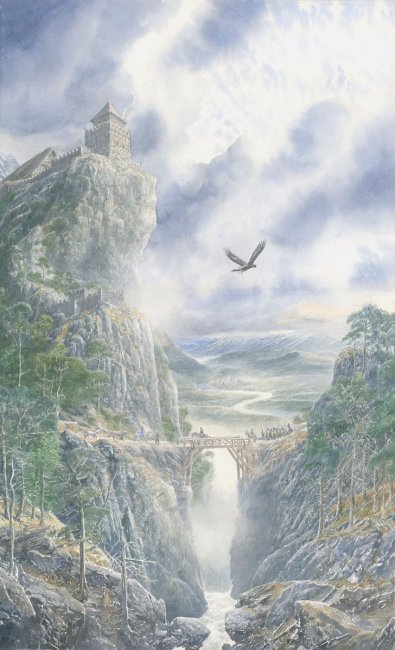
My latest limited edition book from The Folio Society is The Wanderer illustrated and signed by Alan Lee. An artist best known for his decades long association with works by Tolkien, both in illustrating his books and his many years in New Zealand working on the Lord of the Rings and Hobbit trilogies.

20200225 The Wanderer 1

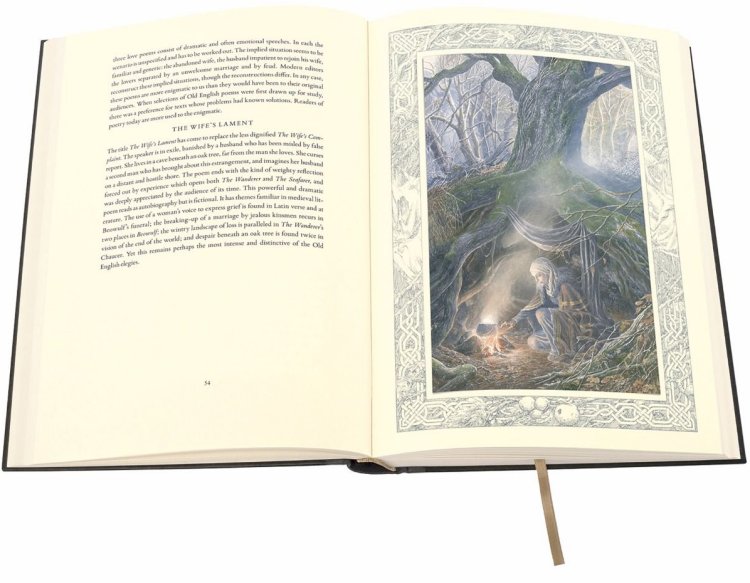
The text is largely from a 1966 Penguin Classic ‘The Earliest English Poems’, translated by Michael Alexander, which also included four pages of Beowulf. Over the years this has been revised until the 2008 edition which provides the entire text for this book, with some amendments, which by then was entitled ‘The First Poems in English’. Lee was approached by The Folio Society to see if he would like to illustrate something for them and between them chose this work as it takes him back to the source materials that so inspired Tolkien in his writings. This is by no means a typical way round, the society would normally choose a book that they wanted to publish and then approach an artist to illustrate it; but what it has produced is a book where you can see the love the artist has for the material and I suspect they eventually had to stop him from creating any more artwork so that the book could actually get published. As it is each poem has its own distinctive decorative borders along with the beautiful tipped in colour paintings and on page printed black and white illustrations.

20200225 The Wanderer 3

The poems and riddles themselves come from a very short window in time, between the reign of King Alfred the Great over the Anglo Saxons (886 to 899AD) where he started the process of moving the written word from Latin to Old-English and the Norman invasion of 1066 when all that was swept away with the imposition of Norman French. In truth there were probably just thirty or forty years where Old-English hit its peak before becoming almost extinct. The greatest source material for the work of this period is The Exeter Book which was regarded as largely worthless for centuries before becoming recognised as the treasure trove that it is.  The poems are much more powerful than might be expected from their great age, they clearly come from an oral tradition as they are directed at the reader as though being read to them, I am reminded of the Icelandic sagas in concept if not in size. Indeed as Bernard O’Donoghue writes in his especially commissioned foreword

There’s a vitality to these poems, written as they were at a time when life was so much more embattled, more desperate and fragile

Along with the general introduction and note on translation each poem has its own introduction setting the scene for the following work and providing mush needed context. The works are over a thousand years old and the people who wrote and read them were very different to ourselves.

20200225 The Wanderer 2

The original Penguin book its variants and companion volumes have sold over a million copies in the fifty years since they came out and the quality of the work shows exactly why Michael Alexander is such a respected translator and this edition makes reading them so much more of a joy than the original paperbacks. The text is presented with the original on the left hand side and the translation on the right as can be seen in one of my favourite works included the fragment of ‘The Battle of Maldon’ from the section of Heroic Poems. I suspect I like these more than the somewhat more introspective other poems is my fondness for the sagas and these have more of a feel of those. However this is an account of a real battle that can be also seen in The Anglo-Saxon Chronicle to such a level of detail that there is also an accompanying map included with the text so the reader can easily see how the fight progresses, which frankly is not well for the English side and a lot better for the attacking Vikings.

20200225 The Wanderer 4

The riddles are great fun and at the back are a set of proposed solutions, however the one that I have shown as an example also has drawings by Alan Lee which somewhat give away the answer. All the riddles are from The Exeter Book where presumably there are a lot more as these start at number seven and there are lots of numeric gaps.

20200225 The Wanderer 5

The answer is of course mead.

As only 750 copies were printed at £395 each and these are all sold out from the Folio Society it would be difficult to get a copy of this fine edition, but if I have whetted your appetite for Old-English poetry and riddles then the Penguin paperback is still in print and considerably cheaper.

There is a short video showing the book from the Folio Society

and a longer video of an interview with Alan Lee.