The Rule of Benedict

Another book on my shelves simply because I bought all 127 titles in the Little Black Classics series by Penguin Books and it is only now when I decided to take it off the shelf and have a look at what I had that I realised the importance of the work I had in my hands. Somewhat enigmatically entitled The Rule of Benedict this turns out to be the set of rules written down by St Benedict for the correct running of the monasteries in the order he founded, The Benedictines, and was originally written in Latin around 540AD. A book of rules doesn’t sound like a good read but surprisingly I really enjoyed it and the insights it gives into the life of what were for all their ‘simple’ lives actually the most educated of the populace in early medieval times. A monk after all was expected to be able to read the bible and give readings during the various services of the day and very few people at the time could read they were also expected to be able to perform various duties within the monastery which was intended to be as self sufficient as possible so there would be the obvious gardeners, cooks, herbalists for medicine but also tailors, carpenters and furniture makers to maintain the clothes for the monks along with the contents of the monastery. Each monk would be allowed a minimum of ‘personal’ items such as a knife, needle and thread for running repairs, and two habits and a pair of shoes from the communal stock, they were assigned underwear only if they were sent on a journey away from the monastery of more than a day.

The first example I have selected from this set of rules is part of the instructions on humility which actually run to twelve steps. This gives a good overview of the structure of the rules regularly quoting from scripture to back up the instructions:

There is also guidance as to the structure of the hierarchies within the monastery with suggestions on how deans, priors and even the abbot should be appointed and in the case of deans and priors how they should be regulated and punished if they stray from the righteous life expected of them. I hadn’t realised before reading this book that a dean was responsible for ten monks under them with a prior being considerably more senior as they would normally only be one although also under the abbot however Benedict warns specifically about priors becoming self important due to their seniority.

Other people mentioned specifically are monks that become priests, these again should be watched to make sure they don’t fall into the sin of pride and also the porter of the monastery who should be as follows ‘A wise old man should be placed at the monastery gate, who will know how to take a message and give a reply and whose age means they will not be tempted to wander about’.

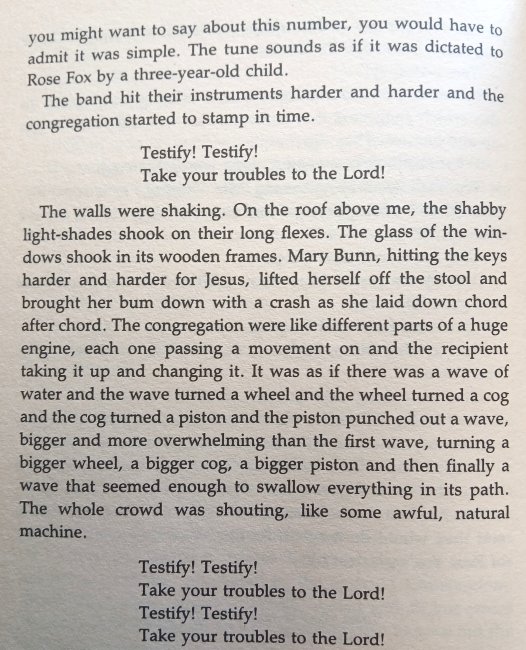
The rules are very much of their time as can be seen below, particularly the final sentence, this punishment is several times stipulated for children, although not exclusively for the young depending on the severity of the offence, It is preferred to one of the various levels of excommunication that could be extended to the adults in the community as children as assumed to not be sufficiently conscious of their religious obligations to be able to understand the punishment of excommunication.

The book also includes instructions for the induction of a new monk into the community which explains that they should be initially turned away and if they persist then subjected to ‘harsh treatment’. If they continue to try to join then they may be admitted, but only into the guest house for a few days where they will be watched over by a senior monk to make sure they are really seeking God. If they continue in their wish to become a monk then they can then enter the novices centre and after two months they should have this full set of rules read to them and told if they will abide by all of it then they can stay otherwise they can leave. If they stay there is a further period of six months during which ‘their patience should be tested’ and then the rules read to them again to accept or not. There then follows another four months of effective probation after which the rules are read to them again and only after they accept the rules for the third time can they be finally admitted as a monk and from that day not permitted to leave the monastery for any reason unless instructed by the abbot. Frankly I’m amazed they had anyone join.

This serendipitous purchase has proved to be a fascinating read which I wouldn’t have had if I hadn’t bought the full set of books, along with other ones from this collection that I have reviewed earlier which you can find using the tag ‘Little Black Classics’ below.

Siddhartha – Hermann Hesse

At first sight this is an odd book for a German author, who as a young man had sufficiently strong callings to the priesthood that he briefly attended a seminary. But in 1911, in his mid 30’s, Hesse visited India and was introduced to Hindu mysticism and this has undoubtedly influenced this novel written in 1922. The story is set in ancient India, around 2500 years ago, it follows Siddhartha, and to a lesser extent his friend Govinda, in their quest for spiritual enlightenment. At first this leads them as young men to abandon their family homes and all their belongings and live in the forests as ascetic samanas, training their bodies to need nothing, using extended fasting and lack of clothes apart from a loincloth to preserve decency. This was a life of meditation and a severe deprivation of the body. A sample of the thoughts of Siddhartha are shown below and give a flavour of the sometimes difficult to follow text as Hesse can get caught up in the tautological expressions that he uses to try to explain Siddhartha thought processes for pages as a time.

Siddhartha and Govinda live with other samanas for a long time, occasionally begging for scraps of food as the bare minimum to stay alive but eventually they hear of a great teacher called Gautama (Buddha) and decide to travel to hear him teach. They eventually reach Gautama and hear him speak but whilst Govinda immediately resolves to follow the Buddha, Siddhartha instead explains that he feels that such enlightenment cannot be taught but must be individually gained through experiences and solitary meditation so the two friends part company. Leaving Govinda, Siddhartha travels until he reaches a river and there meets a ferryman who will become a significant character later in the book but for now he simply gets him to the other side whereupon he walks on to the next town. It is here that Hesse completely threw me as I thought I understood the path to enlightenment that Siddhartha was going to follow, but instead, on entering the town he sees a wealthy courtesan and is filled with desire. She however is not interested in the half starved gaunt and long haired ascetic standing in front of her and tells him that if he wants to know her better he has to be wealthy, clean and well dressed and he duly throws over his calling, gets his hair cut and body cleaned and perfumed, becomes a merchant and eventually earns a place in her bed. Definitely not what I had expected.

I admit I was somewhat daunted when beginning the book, not helped by Hesse’s undeserved reputation as a not very approachable writer, but as I read on I got more engrossed by the story and by the time of Siddhartha’s sudden change in direction I was highly intrigued as to where the novel was going and loved the ultimate resolution. It’s probably not a book for everyone, but I thoroughly enjoyed it. This is another of the Penguin Drop Caps series and eventually I will read all twenty six of these books, an explanation of the concept can be found on my my blog introducing the series here where I am also including links to each of the books as I review them.

The Gospel As Recorded by St. Mark

As this blog is being published on Christmas eve, I have taken the opportunity to review another of the privately printed Christmas books given by Alan and Richard Lane as gifts, in this case the book for Christmas 1951. I’m not going to attempt to review the gospel itself, this blog is concerned with the new translation, this edition of the translation and this book in particular. Penguin were to publish a new translation of The Four Gospels by E V Rieu a year later in November 1952 so this was a first view of this very readable new translation. It was a little odd to select the gospel of Mark as a Christmas gift as only Matthew and Luke include the birth of Jesus, which you would have thought would have been a consideration, but as you can see below Mark starts with the adult Christ being baptised by John in the River Jordan.

Mark is one of the three synoptic gospels where the same stories are told in much the same sequence and in similar words, indeed three quarters of Mark’s gospel also appears in those of Matthew and Luke whilst the gospel of St John is quite different both in style and content. As I said earlier the big difference is the lack of a nativity story in Mark but you also don’t get the Sermon on the Mount or several parables amongst other items in Mark which is quite a bit shorter than the other three gospels.

Looking at the first page as translated by Dr. Rieu it is clear that it is written as much more of story than the classic King James translation which I grew up with, which for all its magnificent prose can be a little daunting to approach, particularly for a modern reader. By way of contrast this is the same passage in the King James version.

1:1 The beginning of the gospel of Jesus Christ, the Son of God;

1:2 As it is written in the prophets, Behold, I send my messenger before thy face, which shall prepare thy way before thee.

1:3 The voice of one crying in the wilderness, Prepare ye the way of the Lord, make his paths straight.

1:4 John did baptize in the wilderness, and preach the baptism of repentance for the remission of sins.

1:5 And there went out unto him all the land of Judaea, and they of Jerusalem, and were all baptized of him in the river of Jordan, confessing their sins.

1:6 And John was clothed with camel’s hair, and with a girdle of a skin about his loins; and he did eat locusts and wild honey;

1:7 And preached, saying, There cometh one mightier than I after me, the latchet of whose shoes I am not worthy to stoop down and unloose.

1:8 I indeed have baptised you with water: but he shall baptize you with the Holy Ghost.

1:9 And it came to pass in those days, that Jesus came from Nazareth of Galilee, and was baptized of John in Jordan.

1:10 And straightway coming up out of the water, he saw the heavens opened, and the Spirit like a dove descending upon him:

1:11 And there came a voice from heaven, saying, Thou art my beloved Son, in whom I am well pleased.

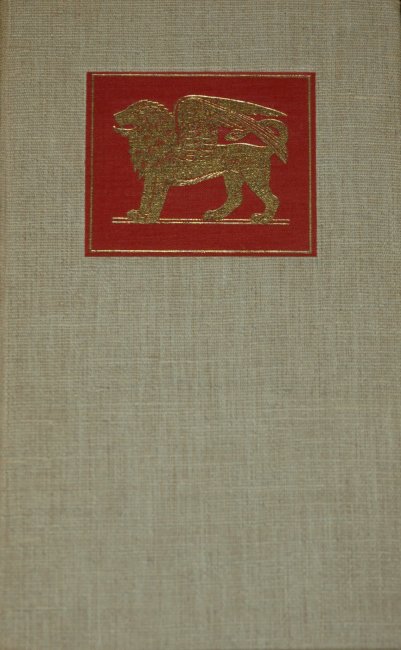
It is almost forty years since I first read E V Rieu’s translation of the four gospels. I took it, along with a couple of others from the Penguin Classics series, as my in flight reading for the first time I crossed the Atlantic in February 1986. I’m not remotely religious although I did go to a Church of England primary school for my education between the ages of four and eleven, but the way the gospels are presented in this translation means you can read them more like a collection of four novellas and enjoy the stories as they are told. This edition is really beautifully produced with canvas covered boards and terracotta cloth labels blocked in gold. The pages are a lovely grey and compliment the overall design by Hans Schmoller well. The lion design by Reynolds Stone is different to the one, also engraved by him, used for the Penguin Classic when it was finally published.

My copy was given to typographer Ruari McLean (it has his bookplate inside) who had joined Penguin Books in 1946 with specific responsibility for Puffin books and was instrumental in introducing Jan Tschichold to Penguin. By 1949 he had moved on and was working with Rev. Marcus Morris on the design of a new comic for boys he had devised called Eagle, which would go on to massive success in the 1950’s and 60’s. Tschichold would radically redesign Penguin books in the late 1940’s and came up with The Penguin Composition Rules.

Sacred Britain – Martin Palmer and Nigel Palmer

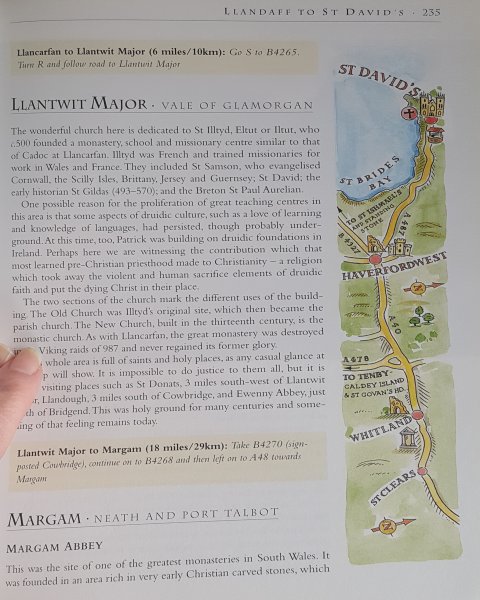
OK let’s start off by saying this book is a little odd and although I’m sure it could be used in the way it appears to have designed I have never done so in the twenty four years I have owned it. The book lives in my car rather than on a bookshelf and the times I have referred to it are when I am away from home and for some reason have some spare time to do a little exploring. But lets get back to why I think it’s odd. Firstly it is sponsored by the World Wildlife Fund for Nature. Now why, coming up to the millennium, this charity thought it appropriate to involve itself in a project regarding sacred spaces is beyond me as apart a small reference to trees and plants commonly found in a British churchyard there appears to be nothing linking nature to this book. Secondly although there are ancient pilgrimage routes in Britain these have been largely ignored by the authors, apart from one route to Canterbury cathedral, and instead they have created their own routes linking various sites which are usually associated with a varied selection of faiths, including pagan, all in one journey. Even the journey to Canterbury which was a major Christian pilgrimage in medieval times especially for those unable for financial or time reasons to make the trip to the Holy Land the suggested journey in this book goes via an iron age fort, the remains of a 1000 year old synagogue, a druids grove and some neolithic burial mounds, none of which fit in with a Christian pilgrimage. The inclusion of some excellent churches, cathedrals and ruined abbeys does not really get away from the trip being an odd mish mash of sites. The third oddity is to do with the panel maps within the text of the routes which are all narrow vertical pictures regardless of the true geography and to my mind are also upside down. Now there are ‘proper’ maps as well but these are the ones that you have to hand so to speak.

The example above shows what I mean, this is a journey TO St David’s and if you are going to ignore geographic orientation, north is to the right on this panel, then at least work down the picture to the destination not up. Also as you can see the text doesn’t actually refer to the map on the page, in fact that part of the journey is eight or nine pages further on, where there is no map but could easily have been one. The whole page layout throughout the book is as confusing as the selection of routes, you find yourself either inserting lots of bookmarks or constantly flipping between pages in an attempt to follow what is going on.

So why am I reading it this time, rather than dipping in for a specific locality which is my usual way of using the book? Well England is about to come out of what is the third and hopefully last lock down to prevent the spread of Covid 19 and I’m desperate to escape these four walls and go somewhere, in fact pretty well anywhere and I’m looking for inspiration. In all there are thirteen of these suggested journeys and they cover most of England, Scotland and Wales, the latter two will still be out of bounds next week but it should be possible to go somewhere in England if only for a day trip as overnight accommodation is still not easily available and won’t be for at least another month, probably longer. I’m not looking for a route but a destination preferably not too far away and if there is somewhere else interesting near to it then that would be a bonus. The one advantage of the route structure of the book is that places near one another are next to each other in the book so you can get happy accidents of two or three interesting places all in one go.

There are also sections that don’t stick to the routes but dot around by theme and one of these chapters on stone circles and tombs has probably inspired me to journey out on day trips more than any other and this is the only travel guide I own that specifically has a section on these ancient sites. So what to make of the book as a whole, well as I said at the beginning it’s odd and doesn’t really work in the way it was intended. It can also be infuriating due to the constant chopping and changing of pages to see what should be all together but it has earned its place in my car for when I have a spontaneous urge to go somewhere unplanned. It also has the advantage that it doesn’t matter that it is nearly a quarter of century old, which would be a serious handicap in most guide books as it is specifically pointing you to places that largely haven’t changed for centuries and will remain for years to come.

This book was originally published in 1997 by Piatkus in the UK and was reprinted in the USA in 2000 by Hidden Spring Books under the title ‘The Spiritual Traveller’. The sequence of some of the chapters are altered and suggestions of places to stay are added in the American edition but the books are to all intents and purposes the same.

Dialogue Concerning the Two Chief World Systems – Galileo Galilei

20200825 Galileo

The final, and longest, book in my August reading marathon of important scientific works is also definitely the oldest and arguably the most significant in the leap of understanding passed on to those members of the public able to read a copy. Published originally in 1632 in Italian so that it was more accessible to the general public than it would have been if written in Latin it was immediately seen as an attack on the Catholic church as it presented as valid the then heretical Copernican system of the Sun at the centre of the Solar System rather than everything rotating around the Earth as taught by Aristotle and Ptolemy and adopted as clearly correct by the church as Earth should be the centre of Gods handiwork. Galileo was duly tried by the Inquisition and sentenced to life imprisonment at home and the book remained on the Catholic church’s list of banned works for over 200 years until 1835.

It is styled as a conversation over four days between three characters, Salviati is the instigator of the meetings and is clearly a Copernican, Simplicio is an adherent to Aristotelian and Ptolemaic systems and Sagredo is there initially to play devils advocate putting questions to both of the others but towards the end is obviously swayed by Salviati. Both Salviati and Sagredo are based on real people with those names who had been friends of Galileo but had both died many years before publication so could not be implicated by their names being used, whilst Simplicio appears to have got his name from the Italian word semplice which means simple minded. The choice of this name for the character backing the Ptolemaic system was also not lost on the Inquisition. Galileo was well aware that he was pushing at boundaries and originally got permission from the church to write a book about tides which grew into the final work covering far more than his original proposal, but even the characters acknowledge that this is potentially dangerous territory.

We are arguing for our own amusement, and are not obligated to any such strictness as one would be who was methodically treating a subject for professional reasons, with the intention of publishing it … it should be almost as if we had met to tell stories, so that it is permitted for me to relate anything which hearing yours may call to mind.

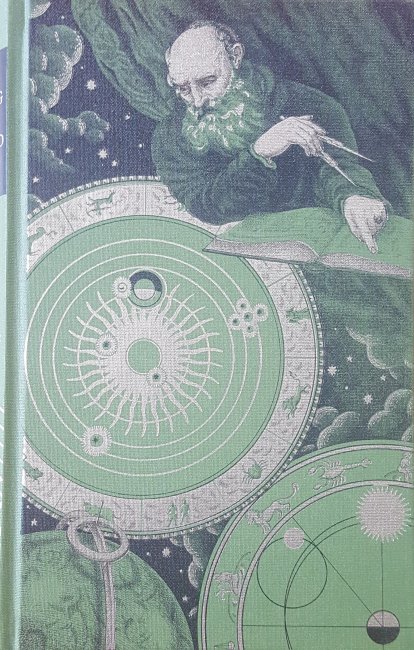
This edition was published by The Folio Society in 2013 using a translation originally done by Stillman Drake in 1953. It includes a modern introduction by Dava Sobel along with a foreword by Albert Einstein, which presumably dates back to the first publication of this translation. I did struggle a little with the verbose nature of the translation which whilst it may reflect Galileo’s original did also mean that I several times had to reread a sentence to make sure I followed the text correctly. This is not helpful when I was also trying to appreciate the leaps being made by Galileo whilst reminding myself that this was written decades before Newton formulated the Theory of Gravity so Galileo was truly groundbreaking in his explanations. His theoretically neutral but definitively pro-Copernican text starts from first principles with balls rolling down a slope to end up with not only the Earth rotating each 24 hours but also orbiting the Sun each year with the angle of the Earth’s axis also included to explain the equinoxes.

That is not to say that everything is correct as we would understand the cosmos now, Galileo has astronomical distances far too small, although much exceeding that of his contemporaries. A good example of this is the section of detailed calculations surrounding the two supernova that had been observed in the last few decades before he wrote the book. He is rightly dismissive of a book which aimed to prove that that these occurred within the orbit of the Moon so as to not disturb the changeless firmament which does so by carefully choosing between astronomical measurements of the period so as to find ones with sufficient error to support the authors position. However Galileo makes the same error in his selection by dismissing not only these examples but also any that would imply the nova occurred at an infinite distance from Earth which using the methods explained would actually have been the correct solution. Instead Galileo had decided that the stars were roughly six to eight times as far away as Saturn (then the furthest known planet) although some “could be two or three times further than that” to explain relative brightness and apparent size. He duly provides many pages of calculations regarding the sample set he has chosen, which are clearly there just to demolish the book and author he dislikes. Other ‘scientific’ books and papers from his time are likewise introduced and their methodology and reasoning torn apart. Galileo clearly wanted to leave no stone un-turned in his defence of Copernicus.

In the final section Galileo covers the subject that he originally stated was to be the main topic of the work, that is the tides and what causes them. Fortunately this makes up a tiny proportion of the whole book as sadly this is another area where he is in error by effectively ascribing them to the rotation of the Earth and the consequential ‘sloshing’ of the waters in the seas. The examples of mistakes given above are entirely understandable given the groundbreaking nature of the book and although I feel the translation could have been better this is still a book I thoroughly enjoyed as the insights presented by Galileo are not only good examples for today but give an understanding of the reasoning of the time and the turmoil between science and the Catholic church that would hold back scientific advances within its sphere of influence for decades if not centuries to come.

Galileo finally received an apology for his treatment at the hands of the church on the 31st October 1991 from Pope John Paul II over three hundred and fifty years too late.

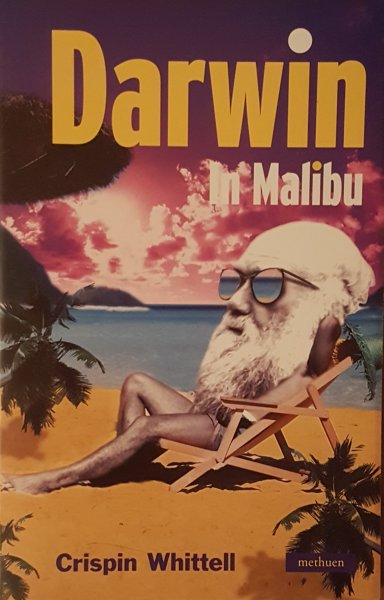
Darwin in Malibu – Crispin Whittall

20200128 Darwin in Malibu 1

This play by Crispin Whittell was premiered by The Birmingham Repertory theatre in Birmingham, England in May 2003, it opened on the 9th May and finished its scheduled run on the 31st, I attended the performance on the 21st. The copy of the book I possess was bought at the theatre and includes several pages relating to the performance including biographical details of the performers along with details regarding the theatre company and the theatre itself. Presumably these pages are not present in later versions of the book as it is replacing the need for a programme at this particular performance and is not relevant to any later production.

The entire play takes plays on the deck of a beach house in Malibu, California and is viewed as though the audience are sitting on the beach looking towards the house with the sea behind them. It is clearly the present day from the attire of the young woman who appears on the stage as the play opens. Already seated on the deck is an old man with a white beard wearing a Hawaiian shirt and reading a book, which turns out to be Malibu by Pat Booth. Already I was intrigued by the set-up, as presumably this was Charles Darwin, and nobody had said anything yet. Sarah and Darwin chat aimlessly for a while, she is clearly a little ditsy and missing her boyfriend whilst Darwin appears to have discovered a rather unlikely liking for horoscopes.

The two are joined by Thomas Huxley who was Darwin’s friend and public champion of his theory when it was published in 1859 whilst Darwin himself had stayed at his home in Kent most noticeably at an acrimonious  debate at the British Association’s Oxford meeting in 1860. It soon becomes clear that both men are well aware that over a century has passed and that they are both dead. They are also puzzled as to why in that case they are sitting in a beach house in Malibu and also why they are joined by Sarah who is clearly not a Victorian ghost. Nevertheless they chat about the Oxford debate and also technological discoveries since such as DNA which shows how Natural Selection (as Darwin called it) works.

Then suddenly from along the beach the bishop of Oxford from that same debate, Samuel Wilberforce, arrives. It was with the bishop that Huxley famously, and possibly apocryphally, disagreed most. Apparently back in 1860 Wilberforce facetiously asked Huxley whether his ape ancestors were on his grandfather or grandmother’s side. Huxley replied that he would rather have an ape for a grandfather than a man with an impressive brain and considerable influence who chose to employ those facilities in the ridicule of science. The three of them attempt to continue the debate on stage and although it is now 143 years later it is clear there will be no meeting of minds, just as we also slowly find out who Sarah is and why she is there.

Now if that all sounds a little dry and overly intellectual for an evenings entertainment I have to say that nothing could be further from the truth. Whilst not a laugh a minute it is very funny when it wants to be and poignant when appropriate. I still have the flyer for the show I saw which is tucked into the book as a bookmark and the quote from Darwin’s lines in the play printed on it sums up the effect of California on the great thinker. The play is seldom performed although it has had a few revivals not just in the UK but America as well, if it ever on near you I recommend it.

20200128 Darwin in Malibu 4