The Nutmeg Tree – Margery Sharp

If Margery Sharp is known at all nowadays it is of the creator of The Rescuers in a series of nine children’s books started in 1959, although a lot of people familiar with the two Disney animations of her stories about heroic mice may well not even know of the original books. The Nutmeg Tree precedes these by over twenty years, being first published in 1937 when Sharp was a well known author of novels for adults and this one is a romantic comedy. The story starts with the rather surreal position of Julia singing in her bath but without the usual reverberations, as it turns out that she is sharing the bathroom with most of her movable furniture, up to and including a grandfather clock, so she is somewhat disappointed with the acoustics. Now the reason she is in there with the furniture, and intends to be there for some time, is that bailiffs are in the living room, the other side of the door, and are looking for items to seize that could be sold to recover the money she owes as she is completely broke. Julia ultimately persuades the bailiffs to fetch the man running the pawnbrokers down the street and agrees to sell him the furniture in the bathroom sight unseen leaving her with a few pounds after clearing her debts. She needs the money as she has had a letter from her daughter, Susan, whom she hasn’t seen for years and is now living in France with her grandmother inviting her over in order to hopefully approve of her choice of husband.

Julia’s own first husband, and the father of Susan, had been killed during the first world war and after Susan was born they both lived with his parents for a while until the call of the stage and her old life drew Julia back to London and away from the frankly dull country life she was living. She left Susan with her grandparents as she would undoubtedly have a much better life with them as they were quite rich. They gave her the enormous sum of £7,000 in government stock (around £400,000 in today’s money) to set herself up as an independent woman and her first task on arriving in France is not to let on that she had frittered it away. Her various adventures in trying to hide the fact that she is now penniless and the interactions with Susan, Mrs Packett and Bryan (Susan’s intended) are where most of the comedic elements ensue as Julia recognises in Bryan a bit of herself and therefore is determined that he is not suitable for Susan. To add to the general confusion Julia had met a troupe of trapeze artists on the boat over to France and the senior brother had rather fallen for Julia and had asked her to marry him so was writing to her and then ultimately arriving at the house in France so she needed to explain him as well.

The book was adapted into a play in 1940 and then a film in 1948, which changed the title to Julia Misbehaves and altered the story quite a lot. The film starred Greer Garson as Julia and Walter Pidgeon as her now separated rather than dead husband and the young Elizabeth Taylor (aged 16) as Susan.

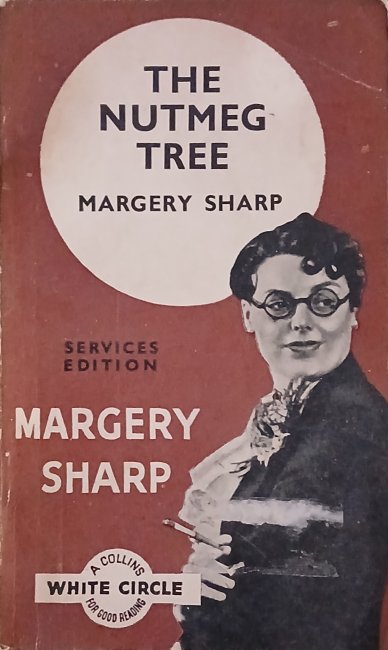
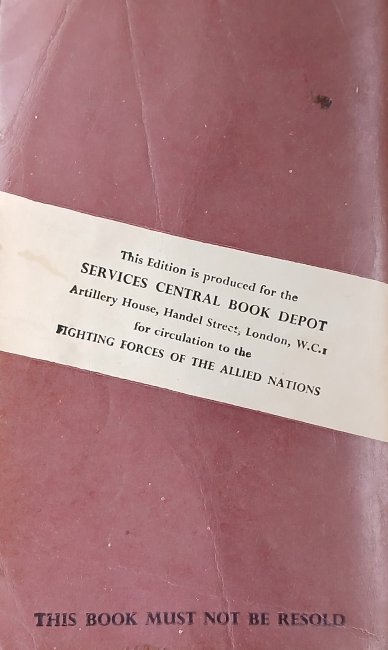
This edition was published by Collins in 1946 with a portrait of Margery Sharp on the cover as part of their short lived White Circle paperback range and is particularly notable as it is from the roughly 160 titles in this series also published as a Services Edition as explained on the rear cover, below. Most of the paperback printers during WWII printed Services Editions of books in their normal range, partly for patriotic reasons but also because doing so gave them access to more paper which was in short supply. None of them could be resold and should, in theory, be returned to the central book depot or passed on amongst the troops, as a consequence Services Editions are much sought after by collectors and when they are found are usually in fairly poor condition.
Something Borrowed Someone Dead – M C Beaton

Marion Chesney wrote 157 books between 1979 and her death in 2019, 72 of which were as M C Beaton which was the name she used mainly for her mystery romances featuring Hamish Macbeth (35 titles) and Agatha Raisin (33 titles plus a companion volume). She also wrote under the names of Ann Fairfax, Jennie Tremaine, Helen Crampton, Charlotte Ward, Sarah Chester and even 64 books (mainly historical romances) under her real name. Something Borrowed, Someone Dead was first published in 2013 as the 24th Agatha Raisin story. As can be seen from the sheer number of books published she is extremely popular but this is the first one of her books, and certainly the last, I have read, and I wouldn’t have picked up this one except that I spotted it in a charity shop for £2 and having heard the name decided to find out if she was any good. I knew the local secondhand bookshop sells out of her works almost as fast as they come in, so I thought they must have something to recommend them.

OK lets start with the positive point. The book is set in the fictional Cotswold village of Piddlebury and I can definitely believe that the Cotswolds (a region in south west central England) would have a place called Piddlebury after all they have Stow in the Wold, Moreton in the Marsh, Upper Slaughter and Lower Slaughter so why not Piddlebury. That however was the last thing I believed in throughout the book, the characters introduced for this novel are mere cyphers with no depth to them, the plot is so ridiculous as to be safely ignored and it frankly felt like a formulaic box ticking exercise on behalf of the author. Lots of random characters that have appeared before so readers recognise them even if they have nothing to do within the story – tick. No explanation as to who the hell these characters are for the benefit of anyone who hasn’t read their way through the previous 23 novels – tick. Doomed romance, in this case an odd romantic entanglement between the lead characters’ ex husband and her much younger member of staff who gets mistaken for his daughter when he takes her on holiday to Barcelona – tick. Lead character in constant desperate need for a romantic involvement with any apparently available male (a la the worst of Mills and Boon from the nineteen seventies and eighties) – tick.

I thought for a while that if I ignored the dreadful ‘romance’ part of the book the mystery would get my attention but as it became less and less believable as a possible real situation I frankly lost interest and only finished the book because I was writing this blog. Thank goodness it was only 198 pages long and at no point did I need to engage my brain in understanding what was going on as it was all so superficial. It’s quite possible, and indeed almost certain, that I am the wrong demographic for M C Beaton and I’m glad to say that the book has already been passed on the the secondhand bookshop that does have customers that want to read it.

The Hamish Macbeth and Agatha Raisin books are still being written, and are now credited to M C Beaton and R W Green who is Rod Green, husband of Chesney’s publisher Krystyna Green, see here for how he came to take on the mantle of these characters. Other fiction titles that have been continued after the authors death, such as the James Bond novels by various authors including Sebastian Faulks and Anthony Horowitz amongst others, The Hitch-hikers Guide to The Galaxy sixth book by Eoin Colfer, Peter Rabbit by Emma Thompson and many other examples have not continued the odd and somewhat creepy fiction of the original author being involved. It would be much more honest to simply give the author as R W Green as clearly M C Beaton has no input having been dead for almost four years, so equally clearly the publisher doesn’t feel the characters are strong enough to continue on their own without the Beaton tag.

A Room with a View – E M Forster

Originally published in 1908 this Edwardian romance and comedy of manners is nowadays regarded as one of the classics in English literature although probably not rated as highly as two of Forster’s other novels ‘Howards End’ and ‘A Passage to India’. I know I have read it before, probably around 1985 when the Merchant Ivory film adaptation came out, but to my genuine surprise I realised that I had completely forgotten the story line when I started reading it again this week. I chose this over the other two, that I also have on my shelves as a good friend of mine in Barcelona has just started reading a brand new Catalan translation along with two friends so I thought it would be fun to join in with the English original.

The novel is in two parts, the first of which is set entirely in Florence, Italy whilst the second part mainly takes place in England. We start with twenty year old Lucy Honeychurch and her much older cousin Charlotte Bartlett, who is acting as her chaperone, newly arrived at the Pensione Bertolini in Florence and bemoaning the fact that neither of them had been allocated a room with a view despite being assured when booking that they would each have a good view of the square and the river. We are then rapidly introduced to the other guests at the hotel as they discuss the situation leading up to Mr Emerson and his son George offering to swap rooms as they do have good views

“What I mean,” he continued, “is that you can have our rooms, and we’ll have yours. We’ll change.”

The better class of tourist was shocked at this, and sympathised with the new-comers. Miss Bartlett, in reply, opened her mouth as little as possible, and said “Thank you very much indeed; that is out of the question.”

“Why?” said the old man, with both fists on the table.

“Because it is quite out of the question, thank you.”

“You see, we don’t like to take—” began Lucy. Her cousin again repressed her.

“But why?” he persisted. “Women like looking at a view; men don’t.” And he thumped with his fists like a naughty child, and turned to his son, saying, “George, persuade them!”

And so within the first couple of pages we hit on the class difference between the Emerson’s and the other guests at the hotel as Lucy and Charlotte were shocked by the suggestion as it would leave the two women under a perceived obligation to two strange men, something that never occurs to either of the Emerson’s. It is this perceived total social unsuitability of these men to the rest of the group that provides the dynamic through the remainder of the book as various characters keep meeting them and recoil regarding their ‘common ways’. In fact a clergyman, Mr Beebe intercedes and convinces Charlotte that the exchange of rooms can be done without obligation so they both end up with a room with a view by the end of the first chapter. I don’t want to give away the plot but suffice to say that Lucy finds herself accidentally alone with George on more than one occasion whilst in Florence to the considerable embarrassment of her and the pleasure of him.

Part two has a sudden shift in location and time, clearly many weeks, if not months have passed and a new character is introduced, Cecil Vyse. We are also at the home of Mrs Honeychurch, Lucy’s mother in the fictional village of Summer Street in Surrey. Slowly various characters that made up the guests at the Pensione Bertolini also appear in the village either accidentally or deliberately and the tensions between the group are reproduced only this time with the added complication of Cecil who has become Lucy’s fiance or her ‘fiasco’ according to her brother Freddy and never a truer word was said in jest. The problems caused by various unseemly, at least to the mores of the time, acts or words by the assorted people and again unfortunate meetings and misunderstandings carry us through a thoroughly satisfying final chapter. I greatly enjoyed the book and the interplay between the characters and although many of the things they regard as shocking or unsuitable would not be so nowadays the fact that Forster is gently poking fun at them is always clear.

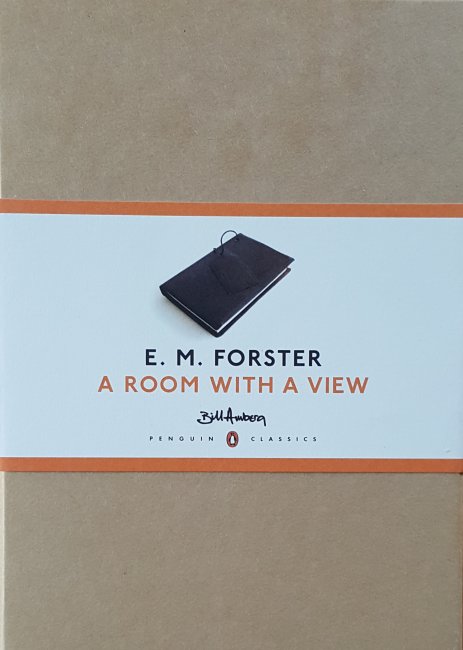
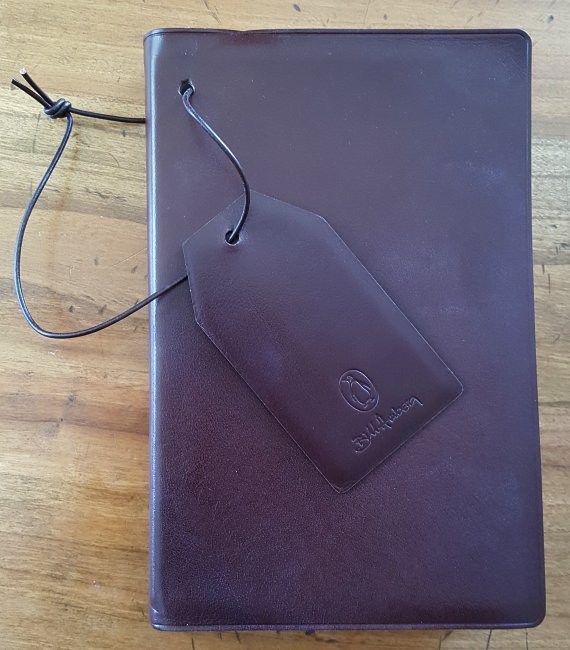
The edition that I currently own is from a set of six Penguin Classics designed in 2008 by Bill Amberg, the London based leather work studio, each book comes in a sturdy box with a belly band indicating which book is inside. The book itself is fully bound in a soft brown leather with a hole punched right through the cover and all the pages in the top left corner where a leather book mark is attached with the titles and author embossed in it. The only thing marking the cover itself is the Penguin Books logo at the base of the spine. It is also incredibly difficult to photograph accurately, the photos below are as close as I could get, with the bookmark being the closest to the actual colour of the leather. The leather cover overlaps the pages by a significant amount making it a yapp binding where over time and repeated reading the leather will fold over to totally encase the book. Each book was published in a limited edition of 1000 and priced at £50 per volume.

For the Penguin Classics leather binding I have chosen a vegetable tanned, buffalo calf. I should stress that all the skins were taken from ‘fallen animals’ – i.e. they died from natural causes – and were sourced from India’s premium calf tannery. They use traditional methods in a totally ecological process, where the water used is recycled after filtering through reed beds. This creates leather that improves with every use, the grain and sheen brightening continually over time.

Bill Amberg

Leaflet included with the book

Ethan Frome – Edith Wharton

I had the story, bit by bit, from various people, each time it was a different story. If you know Starkfield Massachusetts, you know the post-office.If you know the post-office you must have seen Ethan Frome drive up to it, drop the reins on his hollow-backed bay and drag himself across the brick pavement to the white colonnade: and you must have asked who he was.

The opening of Ethan Frome draws the reader in immediately, who is Ethan Frome? Nobody seems to know yet everybody ‘knows’ him and as a reader you to already want to know about this mysterious character. The narrator seems determined to find out so lets keep reading, further down the first page he is described as “but the ruin of a man” with “lameness checking each step like the jerk of a chain”, what on earth had happened to him? After the opening preface in which the anonymous narrator gets to know a little more about Ethan Frome whilst employing him to drive a sleigh each day to and from the railway station as it is winter and the snow is feet deep. He is about to enter Ethan’s home after finally being defeated by the snow one evening trying to get back to town when suddenly the preface ends and the first chapter leaps back in time. The book drops the narrator and continues in the present tense but this is clearly the present for Ethan of almost two and a half decades ago.

Back then the Frome farm is in a bad way, very little money coming in and what there is being spent on remedies for his ‘ill’ wife. I put the word ill in quotes because it’s fairly clear that a lot of what is wrong with Zeena is psychosomatic although she probably does have some underlying illness but not a severe as she believes. The other occupant of the farmhouse is Mattie, Zeena’s cousin, whom they took in a year ago when her parents died and is supposedly helping around the house although she isn’t very practical. Over the seven years since their marriage Zeena has become more and more sour tempered and nagging and the arrival of Mattie into their household had initially given Ethan some relief from her constant complaints. Over the intervening months however his feelings for her had changed to something far more and it transpires that Mattie’s feelings for Ethan had also grown but it is obvious that Zeena had noticed this and resolves to send Mattie away which leads to the tragedy which is foreshadowed several times during the book. The development of the entirely platonic romantic relationship between Ethan and Mattie in the shadow of the terrible atmosphere at the farm is beautifully written, neither character will admit to their feelings for the other with its implications for Ethan and Zeena’s marriage which frankly had fallen apart years ago and they were only still together due to the impossibility of doing anything else given the dire financial position of the farm.

The final chapter returns to the narrator and what he finds in the Frome household when he enters and all I’m going to say about that is that it isn’t what I expected from the start of the book.

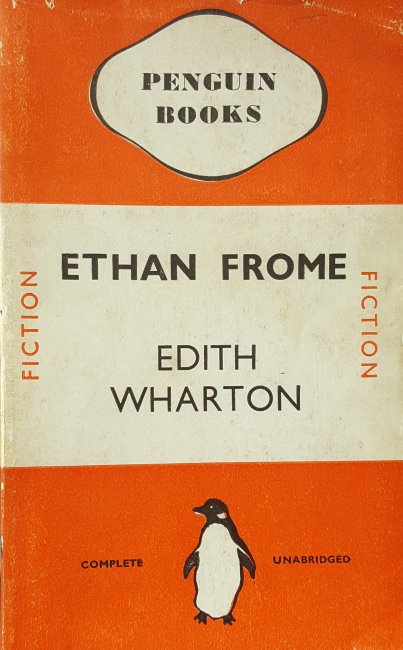
My copy is the first Penguin Books edition from November 1938, the book was first published in 1911 nine years before Wharton won the Pulitzer Prize for easily her best known work ‘The Age of Innocence” but by 1911 she had already published three full length novels, three shorter novellas, a couple of books of poetry, six volumes of short stories and even four non-fiction books, Wharton was clearly an experienced writer and this shows in her confident use of language and entirely believable dialogue in Ethan Frome. The book is now out of copyright and can be read or downloaded as an ebook from Project Gutenburg at this link.