Keepers of the House – Lisa St Aubin de Terán

Lisa St Aubin de Terán gained her exotic sounding name from a mix of her mothers maiden name (St Aubin) and her first husband’s surname (Terán) of which more later. Born in London she was just twenty nine in 1982 when she wrote this, her first novel, but had already by then amassed life events enough for any aspiring writer to draw on. The novel tells the story of Londoner Lydia Sinclair who at the age of seventeen marries thirty five year old Venezuelan Don Diego Beltrán and goes to South America to live with him on his vast but declining estate. The book starts with a prologue which is set in the present day and tells how Lydia ended up in Venezuela before diving back over the two centuries of the rise and fall of the Beltrán family and estate until Don Diego is virtually the last of the family, and even he has a stroke several years into the marriage and is paralysed.

But the story of the early years of the Beltrán’s is of strong and powerful men rising to senior political and military ranks backed by the wealth from their estate. It is only after a horrific massacre of the family a century ago, men, women and children gunned down by soldiers goaded by members of a rival dynasty and a plague of locusts that destroyed all the crops in the valley leaving the villagers starving and almost as importantly the sugar cane that was the source of the money. The years of drought during Lydia’s time was the final straw, nothing is left, it is time to go. It sounds like a depressing read and in places it is but there is still some lightness to provide succour to the reader and it is certainly well worth reading. I also have her second novel ‘The Slow Train to Milan’ which is also based on her life with Jaime from after their marriage but before they finally moved to Venezuela and were instead travelling around Europe with increasingly bizarre experiences

Keepers of the House gets its title from a quote in the bible, specifically Ecclesiastes 12, and won the British literary prize The Somerset Maugham Award in 1983, which ironically is “to enable young writers to enrich their work by gaining experience of foreign countries.” whilst St Aubin de Terán had already had seven years of experiences in Venezuela, which was used as the basis of the novel, and was now safely back in England. I have written about one of her other autobiographical books in another blog back in 2020 ‘A Valley in Italy‘ and up until now have largely read her non-fiction works but have recently purchased a couple of her novels, this one included. I was struck particularly by the similarities between the stories of fictional Lydia and real life Lisa when comparing this book to ‘The Hacienda’, her memoir of her time in Venezuela published in 1997. If you thought that the plot of the novel was somewhat far fetched then the real story of Lisa is definitely worth reading as in ‘The Hacienda’ she tell of how she married at the age of sixteen to an exiled Venezuelan man more than twice her age who is wanted in his home country for bank robbery but who nevertheless takes her back to South America to live on his estate. She eventually comes back to England with her daughter Iseult to avoid the planned suicide pact intended by her husband Jaime as he realises that the marriage is falling apart.

Guerrilla Warfare – Che Guevara

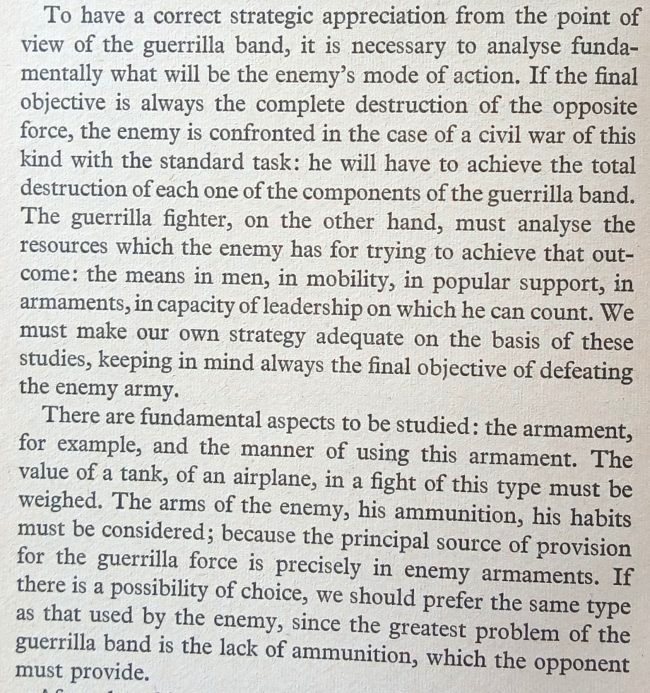
I have known of the existence of this book for many years and was somewhat confused that a book first published in the USA in 1961 and then in the UK by Pelican Books in 1969 was so elusive. I wanted it because I thought it would be a logical follow up of ‘The Motorcycle Diaries’ which I reviewed back in June 2022 and which very entertainingly covered a trip around South America by Guevara and his friend Alberto Granado whilst Guevara was studying to become a doctor. This book I assumed would cover his time as part of the Cuban revolution leading to his promotion as second in command below Fidel Castro and the ultimate overthrow of the Batista regime, But no I have since found out that a book I hadn’t previously heard of ‘Reminiscences of the Cuban Revolutionary War’, also written by Guevara and published in Pelican along with this book in 1969, performs that function. So what is ‘Guerrilla Warfare’ about? Well here we are probably coming to the reason it is so difficult to find, as it is basically a handbook on how to run a popular insurgency, from recruiting fighters to how to actually run a guerrilla band, feeding and clothing them, obtaining arms and proposed combat methodology. A look at the contents list gives an idea as to what to expect.

Despite not being what I expected the book is fascinating and gives an insight into the way a guerrilla band operates with some of the problems which come from operating in a secret way and some things that are different with a regular army. For example the chapters on warfare on favourable and unfavourable ground are diametrically opposite to a ‘normal’ army in that favourable ground for the guerrilla is the mountains and jungle where they can easily melt away or establish defensible positions whilst a regular army likes more open country where their heavy vehicles can move easily and this is precisely what a guerrilla army counts as unfavourable. Likewise armaments for a guerrilla fighter is largely restricted to rifles, preferably not fully automatic, and hand guns with homemade grenades or Molotov cocktails. The army on the other hand can utilise aircraft, tanks and tripod mounted machine guns which are too heavy to be easily moved by hand, which is usually how a guerrilla band would need to move them and quickly use far too much ammunition, which is always in short supply until they manage to capture more. Guevara explains that should a heavy machine gun be captured by all means use it but be prepared to abandon it if pressed as it is simply not worth the effort of carrying it away during combat. Guevara also says that a bazooka is an excellent guerrilla weapon let down by its size and the fact than a man can only just carry three shells any distance due to their weight and even then someone else has to carry the shoulder mounted launcher.

The need to capture ammunition also applies to most of the guns and rifles used by a guerrilla band, it is far easier to obtain these from the enemy than try to smuggle armaments in from outside, it also means that the ammunition is the same thus largely getting round the difficulties of supply. The section I have included below makes the distinction between a revolutionary and a terrorist in that a terrorist is indiscriminate in his targets unlike the more focused revolutionary. In another section Guevara also dismisses gangs of bandits as preying on the poor population whilst the revolutionary is there to support them, although he admits that the guerrillas will need food and clothing which the peasant agrarian economy must provide as they are the only practical source. But he explains that whenever possible this should be paid for either with cash or promissory notes which should be honoured as soon as possible. How likely this is to actually happen isn’t explained.

It should be pointed out that Guevara had a reputation as a ruthless fighter and unforgiving disciplinarian, executing deserters from his troops. But none of this is mentioned in this work which, whilst not glorifying Guevara as he isn’t mentioned by name, is more a guide on how to operate a revolutionary force at least in the context of 1950’s/60’s South American environment, which is almost certainly why it is no longer in print and copies are so difficult to come by. It was an unexpectedly interesting read and I have deliberately not included some of the more specific sections on armaments and tactics in this review.

Full Circle – Luis Sepúlveda

Part biography part travelogue this is an interesting book in that it consists of notes that were taken at various times but which didn’t make it into a book, and Sepúlveda didn’t really know what to do with for a long time.

These notes, which I can’t think what to call, lay about on a shelf somewhere gathering dust. From time to time, looking for old photos or documents, I would come across them, and I confess that I read them with a mixture of tenderness and pride, because in these scribbled, or clumsily typed pages I had made an attempt to come to terms with two themes of capital importance, aptly defined by the Argentinian writer Julio Cortázar: understanding what it means to be human what it means to be an artist.

The book starts with memories of being a boy being taken round town by his grandfather, Sepúlveda was born in 1949 so this would be the mid to late 1950’s in Chile, being loaded up with soft drinks and ice-cream until he was desperate to empty his bladder and then taken to whatever church his grandfather had picked as that weeks target and made to urinate on the church door. This would of course be met with approbation by the priest of the church but his grandfather would defend his right to pee where he needed to and would get satisfaction from the insult to the church thus engendered. Eventually at the age of eleven he simply refused to do his grandfathers bidding and insisted on going to a proper toilet. Expecting to be punished for refusing to so his grandfathers bidding he is relieved, in more ways than one, to simply be taken to a bar and after finishing is given a book to read (one of the classics of social realism – Nikolay Ostrovsky’s How the Steel was Tempered) and made to promise to go on a journey inspired by the book and also to his grandfather’s birthplace of Martos in Spain.

After the comic start it was quite a shock to read the next chapter which deals with his time as a political prisoner in Chile as inspired by Ostrovsky he had joined the Young Communists so under the right wing dictatorship of General Pinochet he was regarded as a dangerous radical. The descriptions of the appalling conditions and the allusions to the electrical torture endured including the doctor who could tell how much electricity had been imposed when the victims were returned to the prison and could therefore judge what treatment each prisoner needed to recover are graphic yet needed to be told and I can see why Sepúlveda couldn’t think of what to do with his notes about these three years of his life.

After this the book becomes more of the travel book implied by it’s title with trips out of Chile and into various other South American countries with greater or lesser success in getting to his aimed for destination and the people he met on the way. Including a trip to Patagonia when he was finally allowed back into his home country after years of exile which was originally intended to have been with the British writer and explorer Bruce Chatwin, who had sadly died young and before Sepúlveda could go to Patagonia. This is one of the times the notes had actually been the basis of a book ‘Patagonia Express’ first published in 1995 in Spanish and then in 2004 in English translation. After reading this book I feel the need to get hold of this work and see what it ultimately became. There is a lot more travel writing beyond this trip in the book and I greatly enjoyed following Sepúlveda around the continent.

The penultimate chapter takes Sepúlveda to Spain and a fulfilment of a promise to his grandfather right at the start to visit Martos where he starts searching for anything his grandfather had told him about the place especially a drinking establishment called Hunter’s Bar. He goes to the pub in the central square to make enquiries but the landlord doesn’t recognise the name however older patrons point out that the bar he is in was known decades ago as Hunter’s Bar so he had inadvertently discovered where he was looking for within minutes of arrival. This then leads to him telling the tales as to why he was there only for the patrons to take him en masse to the local church to consult the priest for birth records. There they find not only his grandfather but also his grandfather’s brother who is still alive in the town. Taken to the man’s house he eventually overcomes his nervousness and we go full circle as he introduces himself to his great uncle, Don Angel.

It’s a good read, difficult at times with the description of his time in prison but uplifting so many times after this dark period and I’m glad I’ve read it. It is another of the short lived Lonely Planet Journeys series which as I’ve explained before I bought a lot of when it was clear the series was being discontinued and am only now sitting down to read.

The Motorcycle Diaries – Che Guevara

The book tells the story of a journey made almost on a whim by Ernesto Guevara and Alberto Granado almost the full length of South America initially using Guevara’s 500cc Norton motorcycle which is what gives the book its title. However from when they leave Buenos Aires on 4th January 1952 to arriving in Caracas on 17th July almost all the trip is done via hitch-hiking on lorries as the bike broke completely between Lautaro and Los Angeles in southern Chile on the 21st February. At the time Guevara was a student doctor and Granado was a qualified biochemist and taking what was intended to be a year long break to explore South America was seen as madness but neither man could be persuaded to delay the trip. Ernesto would return to medical school and qualify as a doctor before becoming known the world over as Che Guevara the revolutionary who helped Fidel Castro overthrow Fulgencio Batista the then dictator in Cuba before going on to assist in various revolutionary movements across South America and even in Africa. Che simply means pal or mate in Argentinian Spanish but it was the name he would have as his own for most of his adult life and is still how he is best known today.

But this book precedes his fame, he was only 23 when they set out, Granado was 29, and this review is published on my blog on what would have been Ernesto Guevara’s 94th birthday (14th June) if he hadn’t been executed by Bolivian forces on the 9th October 1967 when he was just 39. It wasn’t Guevara’s first journey by motorbike, he had already done at least one very long trip but that was by himself, taking Granado as well just on the one bike was somewhat overloading its capacity and it really didn’t take long for the poor roads and the extra weight to take its toll. At first they just used wire to hold the bike together but then they started to get repeated punctures which proved tricky to fix especially when splits started happening due to multiple holes near one another and the bike finally broke its steering column which consigned it to the scrap heap. This was not a luxury trip, they were largely impoverished on the journey living from hand to mouth, cadging beds and food as well as they could and using a largely fake fame as famous Argentinian leprosy specialists to ingratiate themselves with anyone they could. To be fair Granado did know a lot about leprosy and Guevara was considering making it his speciality when he graduated and they did visit several leper colonies on the trip so they probably knew more than anyone else apart from the specialist doctors at the colonies. But even this appeal to peoples charity didn’t work very well so they were often cold and hungry.

Amongst other ‘cons’ they used to get looked after was to stare dreamily into space after asking what the date was and saying ‘Oh we have been on the road for a year as of today’ and people would help them celebrate by buying food and drink. Guevara was particularly good at when being offered a drink he would just sip at it and when asked why he would explain that Argentinians don’t just drink they would always have food with alcohol and it felt strange to just have a drink. This would invariably get some food on the table for them. The full journey was to head south from Buenos Aires into Chile, go north through that country and then onto Peru, where they visited Lake Titicaca and the Inca ruins of Machu Picchu. They continued from Peru into Colombia and Venezuela where Guevara and Granado split up so that Guevera could get back to university by plane. This final stage however didn’t go to plan, as so much of the entire journey hadn’t, as to get a cheap flight he agreed to help ship racehorses to Miami with the plane due to fly back to Caracas and then onto Buenos Aires the next day. Instead the plane broke down in Miami and he was stuck there for a month waiting for it to be fixed.

The book was first published in 1993, with the translation into English by Ann Wright published in 1995 by Verso, so well after Guevara’s death, and was put together from his manuscript notes written during the journey. There is also a preface and an epilogue, both written by Guevara’s father, the epilogue details the fraught long unwanted stay in America. I have to say that this particular copy of the book, the thirteenth impression by Fourth Estate, is very badly printed with considerable over inking on random pages making it quite difficult to read in places but it was well worth the effort to get a glimpse into the development of a future revolutionary. You can see in his writing a change as he glimpses the extreme poverty that a lot of the continent is stuck in and the largely despotic rulers that control the lives of the population. Definitely a recommended read.

Three Letters from The Andes – Patrick Leigh Fermor

In 1971 Patrick Leigh Fermor, already by then a respected travel writer, but still six years before he published his best known work ‘A Time of Gifts’, went with five friends to the Andes in Peru. This book consists of three long letters to his wife although he never actually posted the third one as he didn’t finish it until he was on his way home. The expedition was part of a trip organised by his fellow members of the Andean Society in London using privately chartered aircraft to get to and from Peru from London and Fermor’s friends were intent on exploring and scaling the peaks of a relatively unknown part of the Andes mountain range. If all this sounds expensive then it probably was but Fermor and his colleagues could certainly afford it, most of the party were highly experienced climbers:

  • Robin Fedden – Leader of this expedition, Deputy Director-General of Historic Buildings for The National Trust, a writer and diplomat
  • Renee Fedden – Robin’s wife and co leader of the expedition
  • Carl Natar – Ex world ski champion and London manager of famous jewellers Cartier for three decades
  • Andre Choremi – Lawyer and social anthropologist

Along with them were a couple of non climbers

  • Andrew Cavendish – 11th Duke of Devonshire and a keen amateur botanist looking for rare plants to grow at his stately home Chatsworth House in Derbyshire
  • Patrick Fermor – travel writer, just along to spend six weeks with his friends and explore the area with them.

The letters were not intended for publication, and it took twenty years before they were, after what Fermor describes as a general tidy up but not much. That these were originally just letters leads to the main criticism levelled at the book in that it is not as polished as his other works and it feels more like an old boys outing with irrelevant chit chat coming to the fore. Well yes, these are letters to his wife who knew most, if not all, the other people involved and recording the conversations between them is entirely right in that context. I quite like the chattiness of the style and I raced through the book, reading it in just two sessions, as I found it quite difficult to put down once I had started reading. It is full of beautiful descriptive passages as he tries to convey the beauty of the surroundings. To illustrate this I’m just going to open the book at random and quote whatever I find.

The mountains draw back of either side of an airy lift and fall of savannah. As our caravan picked its way over the edge and headed downhill, orange-flowered organ-cactus and myrtle and tamarisk rose up and the air began to smell of spice. There was a blazing sky of very pale blue.

From the second letter

You could almost be there, in just three short sentences Fermor has captured his environs perfectly and as I said this is literally a random sample, not a passage I had picked out in advance, opening the book anywhere will show his talent to take the reader with him which would be displayed fully in his masterpiece of travel writing, ‘A Time for Gifts’. After the climbing expedition the friends head off to Lake Titicaca where they end up in a terrible hotel and the sections covering their always exasperating dealings with the manager and the chef who appears to be incapable of even boiling an egg successfully are very funny. A sudden announcement that there is actually hot water for a change will have the group dive for the showers only for the water to turn icy cold just as they were starting to enjoy finally getting clean. You have to wonder if the manager was incompetent or simply didn’t care about the people staying there. It was only when Andrew in frustration at yet another rock hard egg for breakfast threw it across the dining room did conditions start to improve.

As usual with Fermor the book is thoroughly entertaining and I definitely recommend it.