The Importance of Being Interested – Robin Ince

A book about science written by a non scientist, but somebody who has proved over many years his determination to try to get his head round complex scientific concepts after being completely turned off science at school. This is the second book by Robin Ince I have reviewed, the first being a joint venture with his friend Professor Brian Cox ‘How to Build a Universe‘ which I covered almost a year ago now and which promised a review of this book as I already owned it “in a couple of months or so”. Oh well it sadly got buried in the To Be Read pile but has now resurfaced and I’m so glad it has as it was a joy to read. Unlike the first book which appears to be mainly written by Brian Cox with interjections from Ince this, far longer, book at 390 pages excluding Cox’s introduction, is entirely the work of Robin Ince and as he explains at the start it was largely written during the first covid lock down in the UK in 2020. The book is based around over a hundred interviews he conducted during lock down with scientists in many fields who like him were pretty bored being stuck at home so were quite happy to talk about their various specialisms. His contacts with them grew out of not only The Infinite Monkey Cage radio show he does with Brian Cox (see review on How to Build a Universe) but also ‘The Cosmic Shambles Network‘ a largely science based website co-founded by Ince and Trent Burton which helped me through lock down with Ince’s regular videos from his book filled attic study providing much needed mental stimulation.

The book has twelve chapters all of which have an individual theme, although like his radio show with Brian Cox staying entirely on topic is not something that really happens. There is also an afterword as Ince didn’t want to finish with a chapter on the heat death of the universe, although quite appropriate for a finale it is rather depressing Having recently lost my father, something that has also recently happened to Ince, the chapter on death was probably the most difficult to read although ultimately as it provided food for thought it was also somewhat uplifting. Scientifically the most difficult and yet also possibly the most interesting, at least for me, was the chapter on the brain. My background is physics not neuroscience so this was well off my topic knowledge. But the important thing is that at all times I was interested in what Ince had to say, there isn’t a single formula in the book but that is sort of the point, you don’t have to be able to understand the formulas to get a reasonable overview of the topic being covered and its importance in a general understanding of ideas in physics, biology, cosmology, chemistry, neuroscience or whatever and it is all beautifully written.
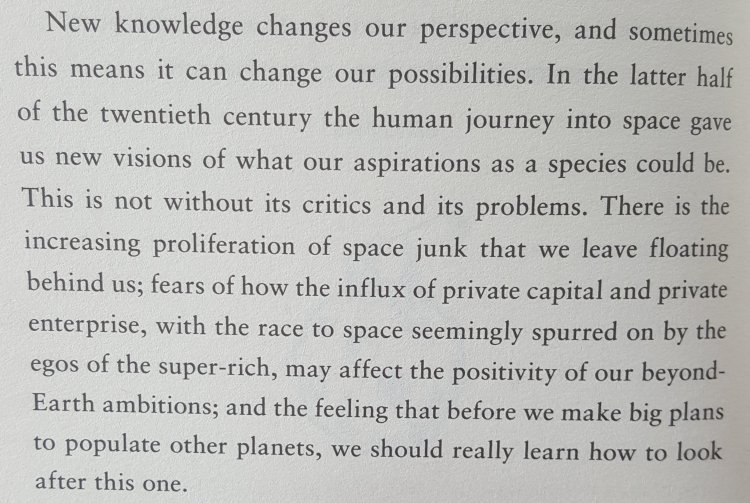
What Ince also provides, although indirectly, is a reading list of works that will take you further or just sound interesting. For example I’ve never read anything by Bertrand Russell but now need to get hold of a copy of ‘Sceptical Essays’ as featured in the first chapter which covers doubt and uncertainty and also the spread of conspiracy theories. I have read works by physicist Carlo Rovelli but not ‘The Order of Time’ so that also makes it to the list. At the other end of the scale when Ince asked physicist Jon Butterworth about time he responded by quoting an author whose work I do own but have not yet read i.e. The Venerable Bede, an English monk who lived around 1300 years ago and wrote ‘The Ecclesiastical History of the English People’. After saying a couple of months and then taking eleven months to get round to reading this book I’m making no promises regarding Bede, whose great work has been sitting on my shelves for something like twenty years but I do keep spotting it and thinking I must get round to reading that sometime.

Ince has had plenty of interactions with astronauts both in the infinite Monkey Cage and Cosmic Shambles so the chapter on space exploration is packed with interesting anecdotes from people who have actually been into space including Helen Sharman, Chris Hadfield and one of the few Apollo astronauts still alive Rusty Schweickart, who flew on Apollo 9 in 1969. Ince has always been interested in space and as he says in this book he had always wanted to be an astronaut but as he says “The only things in the way of pursuing such an ambition have been an uneven temperament, a fear of small spaces, a fear of heights, a lack of dexterity, my total lack of any necessary qualifications, frequent fits of existential anxiety, general non specific anxiety and a deep existential worry about ever being too far from an effective flushing toilet.”

As a professional stand up comedian Robin Ince has had years of experience in organising his thoughts to communicate an idea although he self-deferentially claims several times in the book that his performance style is more a stream of consciousness rather than a well planned set piece. Read this book and discover the importance of being interested in just about everything, it’s good for the brain.

From the Earth to the Moon & Round the Moon – Jules Verne

These two novels by that early master of science fiction Jules Verne mark the start of my annual August reading block of books with a link between them and this year I have decided on ‘translated from French’ as my theme. The plan is to top and tail the five essays with these two and an even earlier pair of French science fiction novels with some more ‘classic’ works in between.

The two books were published four years apart, ‘From the Earth to the Moon’ in 1865 with ‘Round the Moon’ being serialised in 1869 then coming out in book form in 1870 but they really have to be read together to get anything like a satisfying resolution. I will also refer to the second book as ‘Round the Moon’ as that is the title in this edition, ‘Autour de la Lune’ is more commonly translated as ‘Around the Moon’. Although my book is just entitled ‘From the Earth to the Moon’ on the spine it does actually include both novels.

From the Earth to the Moon

The story is set in a fictional Baltimore Gun Club whose members had been developing ever more powerful cannons and artillery pieces during the recently concluded American Civil War. Disappointed that there was no longer an outlet for their talents following the cessation of hostilities the mood in the club had been somewhat downbeat until the President, Impey Barbicane, decides on an audacious plan, they would build a gun that could fire a projectile to the moon. The book then follows a series of progressions as the projectile becomes modified to become a capsule following the arrival of a Frenchman whom is determined to ride within it after hearing the worldwide publicity. It is quite difficult to avoid giving away a lot of the plot, especially as I also need to cover the second novel, but what is interesting is that Verne did some surprisingly accurate calculations and there are also some remarkable coincidences between the fictional trip and the Apollo program a century later including taking his crew up to three as not only does Frenchman Micheal Ardan go but so does Barbicane and his rival Captain Nicholl who had bet Barbicane that the project couldn’t be done.

Verne to his considerable credit correctly worked out escape velocity and realised that the optimum launch site whilst still remaining within the USA mainland is Florida due to it being the closest to the equator. He also gets the time taken to get to the moon remarkably close and therefore where the moon should be at the time of the launch. The dimensions of his capsule for the three men travelling in it is amazingly not far from that of the Apollo command module. What wouldn’t work is his launch method of a huge cannon barrel sunk into the Earth as the massive forces applying on them would simply crush the occupants regardless of the sprung beds and the quite ingenious water cushion that he came up with to soften the acceleration.

Round the Moon

It is in his much requested follow up novel that science quite literally goes out of the window. Verne needed to write a sequel as he leaves his heroes apparently orbiting the moon having being diverted off their intended route by a large asteroid that they encounter soon after leaving the Earth. Their original plan was to have settled in valleys on the Moon as it was assumed at the time that there may be an atmosphere surviving in the lowlands. In fact at the end of the first book it is not even known if they are still alive as the entire narrative takes place from the viewpoint of people on Earth. This second book instead takes us with the astronauts, picking up their side of the story from just before the launch. Unfortunately despite Verne’s cleverness in getting the launch almost right he then has his astronauts sitting down to eat ordinary meals washed down with bottles of wine and disposes of the rubbish by simply opening a window and throwing it out. To those of us reading the book now this is clearly nonsense and detracts from an otherwise excellent tale but for his Victorian era readers this was presumably perfectly reasonable.

That they used the planned means of safe landing on the Moon to manage to get back to Earth is reminiscent of Apollo 13 although in a completely different way and again even assuming that it was possible to survive the launch as depicted by Verne there is no way they could have survived the return journey and splashdown.

I first read these two short novels as a child in a rather nice illustrated edition which I borrowed from the local library. My current copy is from the International Collectors Library and has no illustrations, no publication date and not even the name of the actual publisher. There were over four hundred titles published by Doubleday as a discount line in America as ICL editions, almost all of which have fake leather look bindings and are designed to look expensive whilst actually being quite cheap. The real giveaway as to the cheapness is the poor quality of the paper which in this edition has been rough cut to resemble handmade paper but clearly isn’t. Rereading them I enjoyed these so much I think I ought to invest in a nicer copy which will perhaps encourage me to read them more often because despite their scientific shortcomings it is a really fun story.