The Shadow of the Wind – Carlos Ruiz Zafón

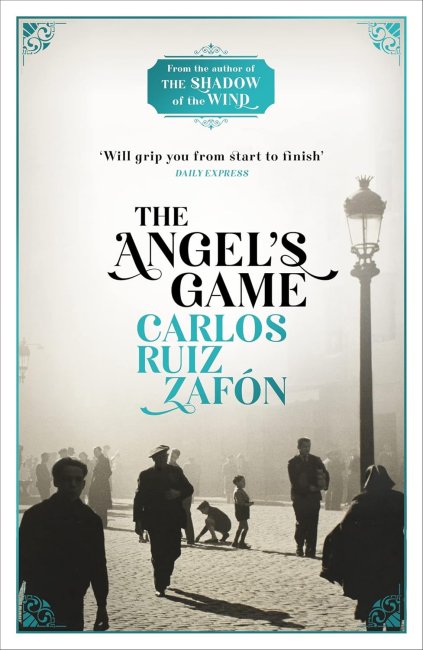
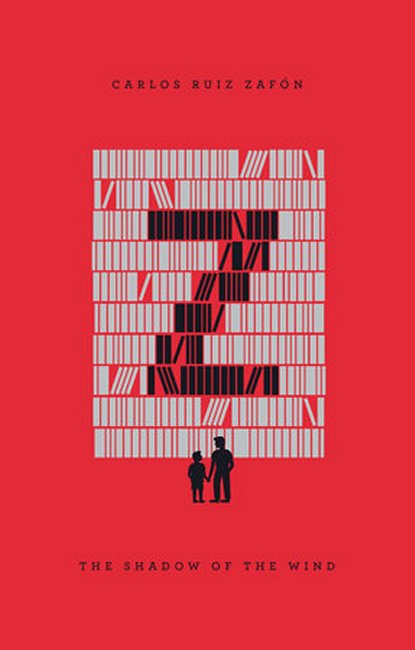
Dawn is breaking in post-war Barcelona when Daniel’s bookseller father guides him through the mist to a mysterious building hidden in the heart of the old city. Here in the Cemetery of Forgotten Books, ten-year-old Daniel is allowed to choose one from the hundreds of thousands of abandoned volumes that line the labyrinthine corridors. Inexplicably drawn to ‘The Shadow of the Wind’ by Julian Carax, the boy clutches the book and he and his father leave. That night Daniel reads through the night totally captivated by the story and the quality of the writing and I know exactly how he felt as although my all night reading sessions are well behind me as I found it difficult to put this remarkable book by Zafón down. Perhaps a longer section than I would normally quote will give an insight into the wonderful descriptive prose and the building tension that is maintained throughout the 511 pages. This passage is very early in the book so doesn’t contain any spoilers and describes the night after Daniel took the book to Don Gustavo Barceló, another bookseller but one who knew more about the rarities of printing than Daniel’s father, for him to have a look at. There he discovered that he may well have the last remaining copy of Carax’s final novel and that all the other copies along with editions of all his other books had been systematically bought or stolen and mysteriously found burned over the years.

I turned off the light and sat in my father’s old armchair. The breeze from the street made the curtains flutter. I was not sleepy, nor did I feel like trying to sleep. I went over to the balcony and looked out far enough to see the hazy glow shed by the streetlamps in Puerta del Angel. A motionless figure stood in a patch of shadow on the cobbled street. The flickering amber glow of a cigarette was reflected in his eyes. He wore dark clothes, with one hand buried in the pocket of his jacket, the other holding the cigarette that wove a web of blue smoke around his profile. He observed me silently, his face obscured by the street lighting behind him. He remained there for almost a minute smoking nonchalantly, his eyes fixed on mine. Then, when the cathedral bells struck midnight, the figure gave a faint nod of the head, followed, I sensed, by a smile that I could not see. I wanted to return the greeting but was paralysed. The figure turned, and I saw the man walking away, with a slight limp. Any other night I would barely have noticed the presence of that stranger, but as soon as I’d lost sight of him in the mist, I felt a cold sweat on my forehead and found it hard to breathe. I had read an identical description of that scene in The Shadow of the Wind. In the story the protagonist would go out onto the balcony every night at midnight and discover that a stranger was watching him from the shadows, smoking nonchalantly. The stranger’s face was always veiled by darkness, and only his eyes could be guessed at in the night, burning like hot coals. The stranger would remain there, his right hand buried in the pocket of his black jacket, and then he would go away, limping. In the scene I had just witnessed, that stranger could have been any person of the night, a figure with no face and no name. In Carax’s novel, that figure was the devil.

The plot flies along at a breakneck speed with multiple clues as well as a few blind alleys as to what is going on as Daniel tries to find out what happened to Julian Carax and how he came to be found shot dead in Barcelona when he should have been safely in Paris and what the wartime thug, murderer and now Inspector of Police Fumero has to do with it, as we progress from 1945 when Daniel first visits the Cemetery of Forgotten Books to the end of 1955 when the story finally reaches its denouement. Along the way a cast of superbly drawn characters are introduced, some of which help but more than a few are there to hinder Daniel’s fascination with Carax and his slowly developing interest in women as he goes through his adolescence. At about two thirds through the book and three days after I started I still hasn’t worked out how everybody was linked and how the various plot strands were connected so took an evening off reading to think through what I knew so far without adding more detail. This proved to be a good idea as I finally realised where the story was going and who the man watching from the shadows was, just in time as Zafón was about to upend the story and make my guess a possibility. I read the remainder of the book the next evening as Zafón neatly tied up all the loose ends in an eminently satisfying way.

Sadly Carlos Ruiz Zafón died of cancer in 2020 aged just 55, robbing the world of a great author well before his time. This English language version of the book is translated by Lucia Graves, daughter of the poet and novelist Robert Graves. She was brought up in Mallorca from the age of three, and according to her memoir ‘A Woman Unknown’ she grew up speaking English at home, Catalan with locals, and Spanish at school and it is she who has translated into English all five of Zafón’s ‘Cemetery of Forgotten’ novels.

This is the fifth book from the Penguin Drop Caps series I have written about along with a general overview of the series. There are twenty six in total, one author per letter of the alphabet and previously I have covered Ellery QueenJohn SteinbeckXinran and W B Yeats.

Until August – Gabriel García Márquez

In December 2019 I reviewed Gabriel García Márquez’s last collection of short stories ‘Strange Pilgrims‘. I love his work so was pleased to see that in March this year, on the 97th anniversary of his birth, his last novel was finally published in English, ten years after his death. According to the preface written by his children Márquez was not happy with what he had written and wanted it destroyed. Instead they simply put the manuscript on one side and almost ten years later read it again and decided that it was probable that the dementia he was suffering from, and which undoubtedly prevented him completing the novel, clouded his judgement as to the quality of the work.

At just 110 pages it is really more of a novella rather than a novel, especially when compared to his other far more weighty works, however I do agree with Rodrigo and Gonzalo that the book is definitely worth publishing even in this unfinished state. Originally planned as a set of five short (roughly 150 pages each) novels all of which would tell the story of Ana Magdalene Bach’s experiences during her annual visit to an unnamed island where her mother is buried. Instead we get six linked short stories all set around the 16th August, the anniversary of her mother’s death, where she travels to the island without her husband or children to tidy up and lay flowers on the grave.

We join Ana, at the start of the book, on her way to the grave having just got off the ferry, and this is clearly not the first time she has made the pilgrimage as she heads straight for a familiar taxi driver who by routine takes her to the flower stall where there is a pre-prepared bouquet of gladioli ready to be collected and then straight on to the cemetery returning later to the somewhat dilapidated hotel where she regularly stays the night before returning to the mainland the next day. But this is not to be the usual routine as she sips her gin in the bar after her evening meal she spots an intriguing stranger and invites him to join her. After a few more drinks she invites him to join her in her room and they make love. The next year on the ferry over to the island she is already looking forward to her night of passion with a stranger and by the time she is again sipping her gin is searching for the man she will choose, for this has already been added to her routine. The six visits detailed in the six chapters are sometimes successful in her hunt and sometimes not but the development of Ana and her relationship with her husband on her return to the mainland are fascinating as she becomes more and more convinced that he also has lovers and despite her own infidelity gets increasingly angry about it each year.

As well as the novella we get a translation of the original editor’s note from the Spanish edition written by Cristóbal Pera who had also edited Márquez’s autobiography. This is fascinating as it goes into the development of the novel, through the five main drafts along with a digital version maintained by his personal secretary Mónica Alonso and gives a glimpse as to how Márquez worked. The final published version is an amalgam of the fifth draft, heavily pen amended by Márquez, and the digital version which retained some of the earlier variants of the text, There are also four pages of the fifth draft manuscript showing hand written alterations both by Márquez and Alonso as she would read the pages to him and he would suggest changes as she read.

I’ll guarantee you won’t expect the highly original ending, I certainly didn’t, yet it perfectly rounded out Ana’s story. A final note of brilliance from the man described as “the greatest Colombian of all time” at the time of his death by the then president of Columbia, Juan Manuel Santos.

Poems – St John of the Cross

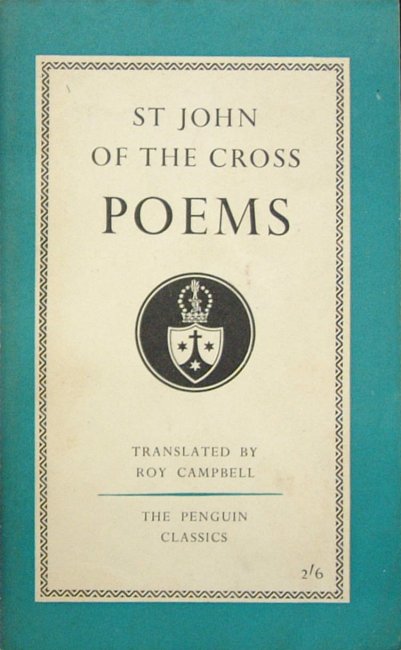
For this, the 200th post in this blog, I have chosen a Penguin Classic translation of the poetry of St. John of the Cross, the 16th century Spanish mystic christian and follower of Teresa of Ávila whose writings have also appeared in the Penguin Classics catalogue. The book is actually rather more than a translation as it is a parallel text edition with the original Spanish text on the left hand pages and the English on the right. Saint John (Juan de la Cruz in Spanish) was a Catholic priest and Carmelite friar involved in setting up religious houses in northern Spain but was also the greatest of the mystic poets in Spanish literature and indeed one of the giants of Spanish literature regardless of style or theme.

However, before discussing the poems, I would like to take a little time over the translator, much as the book does with a preface by his widow Mary Campbell. Roy Campbell was born in South Africa in 1901 and first came to England in 1919 where he met and married Mary in 1922 and they moved back to South Africa in 1925. He worked as an editor on a literary magazine whilst writing poetry but disagreed with the apartheid regime so moved back to London in 1927. On their return to England they fell in with the Bloomsbury Group and Mary started a lesbian affair with Vita Sackville-West at the same time as Virginia Woolf was also having an affair with Vita. Roy strongly, and reasonably, disapproved of his wife’s affair and to separate Mary and Vita the Campbell’s moved first to Provence and then to Toledo in Spain where Roy Campbell discovered the works of St John of the Cross and the couple converted to Roman Catholicism. It was in Toledo that St John had been imprisoned by rival Carmelite monks opposed to the very strict variant of the calling espoused by Teresa and John, he wrote most of his poems during his confinement. Roy Campbell, by the 1930’s, was becoming a well known poet in his own right and was fascinated by the poems of St John and whats more his heroic poetic style seemed ideally suited to the extant works of St John so he began work on a translation that was finally published by Harvill in 1951 and won the 1952 Foyle Prize. It is this verse translation that is reprinted in the 1960 Penguin first edition that I have, Roy Campbell having died in 1957 hence his widow penning the preface where she completely fails to mention the lesbian affair that took them to Spain in the first place.

The Spanish text is by Padre Silverio de Santa Teresa CD, and first appeared in an UK book in 1933 published by the Liverpool Institute of Hispanic Studies.Roy Campbell has done an excellent job of translating the poems as not only has he translated the text but found English words which allow the lines to largely scan and always rhyme as the originals do. A moments thought would tell you how difficult this is and why many poetry translations don’t attempt this.The longest work is ‘Songs between the soul and the bridegroom’ where the poem is in the form of a conversation between the two parts where God is gradually revealed to be the bridegroom that the soul or bride is conversing with. I really enjoyed this one as there is more time for development of the story within the poem as it goes on for seven pages, most are less than a page and a half and some are simply one verse.

Several of the poems use repetition of the last line of each verse such as ‘Song of the Soul that is Glad to Know God by Faith’ where each verse, apart from the eleventh, ends “Aunque es de noche” (Although it is night) although with this particular poem Campbell varies the last line between “Although by night” and “Though it be night” and I’m not sure why he made the change as reading it with “Although by night” seems to scan perfectly well with each verse. My favourite poem of the collection though is ‘Verses about the soul that suffers with impatience to see God’ and this is another where repetition of the last line of each verse is utilised although this time it is the sense of the last line that is repeated as the words vary between “Am dying that I do not die”, “And die because I do not die”, “The more I live the more must die” etc. culminating in the more hopeful “I live because I’ve ceased to die”.

I was surprised by how much I enjoyed this volume of poetry as I’m not remotely religious, let alone Catholic, so am clearly not the target audience. I suspect this is partly down to the way religion is handled in English schools where is is taught as a ‘normal’ subject and after all nobody asks you to believe in geography.

Strange Pilgrims – Gabriel García Márquez

For my 100th post on this blog I have chosen one of the lesser known works by Gabriel García Márquez, in fact it is his last published collection of short stories. They were started during the 1970’s and 80’s but were not actually published until 1992 with an English translation appearing a year later. My copy is the Penguin books edition translated by Edith Grossman and published in 1994 with a bizarre cover by Matthew Richardson of Eastwing Design. The twelve tales are linked by being all about Latin American characters travelling or living in Europe, this was a familiar position for Márquez at the time as he lived in Barcelona for seven years in the 1970’s, going there after the success of his novel “One Hundred Years of Solitude”.

Born in Columbia, Márquez spent a lot of his life in Mexico, although his time in Europe clearly had a significant influence on these works. Awarded the Nobel Prize for Literature in 1982 he is probably best known for his novels, three of which are also on my shelves along with three more books of short stories. However because there are so many reviews of his novels such as “Love in the Time of Cholera”and “One Hundred Years of Solitude”  and also as I have a soft spot for well crafted short stories this collection had to be the one to read this week.

20191203 Strange Pilgrims

In the preface Márquez explains the long gestation of these stories, beginning with an exercise book in which he wrote sixty four tales none of which he was quite happy with, the dates each story was started is given after each one in the book and I have added this information as a date in brackets after each title below. He had several goes at rewriting but was never satisfied and the book was added to his papers to be looked at again when he might have a better idea how to work with the material. Unfortunately the exercise book got lost, presumably thrown out by accident, so he had a go at recreating them from memory. This reduced the total to about thirty and he is sanguine about this regarding the other half as clearly not good enough if he couldn’t remember how they went. The stories were still not right though and it was not until a final eight months of solid work finished the last ten included in this collection, which were all worked on simultaneously, that he finally had a book that he was happy to publish in the early 1990’s.

The twelve stories are each briefly reviewed below:-

Bon Voyage, Mr President (June 1979)

The first story concerns a familiar subject for Latin America, that of a deposed and exiled president finding treatment for illness in a foreign country, in this case Geneva in Switzerland. He is recognised by one of the ambulance drivers who comes from his original country and the driver plans along with his wife to get money from him by selling a fake insurance and funeral plan. The plot does not go as they intended and the development of the three characters makes an interesting twist.

The Saint (August 1981)

The Saint in the story is the incorruptible body of a seven year old girl from Columbia being taken round Rome by her father in an attempt to have her recognised as a saint. Well that is the initial premise anyway. In truth the story is more about the various characters staying in the hostel near the Vatican and their inter-reactions not only with each other, the saint and oddly the lion in the nearby zoo. The final two sentences of the tale though switch the meaning of the title in an unexpected way.

Sleeping Beauty and the Airplane (June 1982)

I’m not sure what to make of this story, it has a distinct voyeuristic tone that can be a little uncomfortable. The narrator sees a beautiful woman in Charles de Gaulle airport, Paris and then is pleased to see that he has the seat next to her on the plane to New York. The descriptions of watching her sleep next to him throughout the flight without any communication taking part between them throughout the journey makes odd reading.

I Sell My Dreams (March 1980)

Another tale regarding sleep, although this time the prophetic dreams of a Colombian woman who had come to Europe as a child and is first encountered by Márquez in Vienna. He sees her again many years later in Barcelona when he meets the Chilean poet Pablo Naruda and she is in the same restaurant and she is still making money from her dreams.

“I Only Came to Use the Phone” (April 1978)

The most disturbing story in the collection. A woman is driving on the way to Barcelona in a storm when her car breaks down. She is eventually picked up by a bus which drops her off at its destination so that she can use the phone. However the rest of the passengers are female mental patients and it is assumed at the asylum that she must also be a patient and she is prevented from calling her husband, sedated and admitted. The story describes her ultimate mental collapse as she tries and fails to explain her true situation.

The Ghosts of August (October 1980)

At less than four full pages this is the shortest work in the collection and is a really good ghost story, this time set in Tuscany and again involving a real person, in this case Venezuelan writer Miguel Otero Silva.

María dos Prazeres (May 1979)

Maria is a semi-retired prostitute in her seventies, originally from Manaus in Brazil but living for most of her life in the Gracia district of Barcelona. She now has only one client who has come to her weekly for decades and it is more a relationship than a business proposition. Convinced she is soon to die the story concerns her elaborate plans for her funeral and what is to happen with her belongings including her little dog afterwards. You really get to know her as the story unfolds and just as with other stories in this collection things suddenly change at the end.

Seventeen Poisoned Englishmen (April 1980)

The eponymous Englishmen are simply bit players in this tale of a Colombian widow who has travelled to Italy planning to see the Pope soon after the end of WWII. What it is more about is her reactions to post war Naples and her fears when she has to make her own way rather than the planned help she was expecting.

Tramontana (January 1982)

The Tramontana of the title is a persistent and powerful wind that the narrator of the tale experienced for three long days whilst staying in Cadaqués in Catalonia. He describes it as oppressive presence taking a personal affront to the presence of him and his family. It also clearly has a strong effect on all those who experience it.

Miss Forbes’s Summer of Happiness (1976)

Two young boys from Alta Guajira on the Colombian Caribbean coast are on the island of Pantelleria at the southern end of Sicily for a long summer holiday. For the first month they were with their parents and all was wonderful but they had left them in the care of a German governess called Miss Forbes whilst they went on a writers retreat elsewhere in the Mediterranean. She is very strict and the holiday had become intolerable to the boys, so much so that they resolve to kill her but the plot does not go as they intended…

Light is Like Water (December 1978)

This very short tale (around five pages) is positively surreal and again features two young boys around the ages that Márquez’s children would have been when he started to write it. As the narrator explains, he was asked how the light came on at a touch of the switch and replied “Light is like water, you turn the tap and out it comes”. Taking this seriously the boys break a bulb and sail a boat on the pool of light that cascades out of it despite being in an apartment on the fifth floor of a building in Madrid. But you should never play with liquid light.

The Trail of Your Blood in the Snow (1976)

Like the boys in ‘Light is Like Water’ the protagonists of this final tale are originally from Cartegena de Indias on the Colombian Caribbean coast but this time they are wealthy young adults recently married and travelling from Madrid to Paris overnight in a Bentley convertible that had been a wedding present. But Nena has cut her finger on a rose thorn and the bleeding will not stop.

A very enjoyable collection and if you have never read any Márquez it’s a good place to start. The stories do all feel that they belong together, possibly due to the simultaneous final rewriting yet are sufficiently different to highlight alternate aspects of his style. Highly recommended.