Strata – Terry Pratchett

I have done several blogs about Pratchett but always tried to emphasise some of the less well known aspects of his work and this time I’m going back to his third novel, and the last before he created Discworld, which was to make him rightly famous. My copy is a signed first edition published by Colin Smythe Limited on the 15th June 1981 in a print run of just 1,001 copies, 850 of which were sold to Reader’s Union, and it is in this book that Terry first explored the concept of a flat world although not in this case borne on the back of a giant turtle; as he wrote at the time:

I am also working on another ‘discworld’ theme, since I don’t think I’ve exhausted all the possibilities in one book! 

That theme would result in ‘The Colour of Magic’ first published on 24th November 1983 and it, along with the subsequent forty plus books, proved that he definitely hadn’t exhausted all the possibilities. But back to Strata which I must admit I hadn’t reread for at least thirty years, the story starts with a fake quote from an equally fake book that sets up the premise for the beginning of the plot:
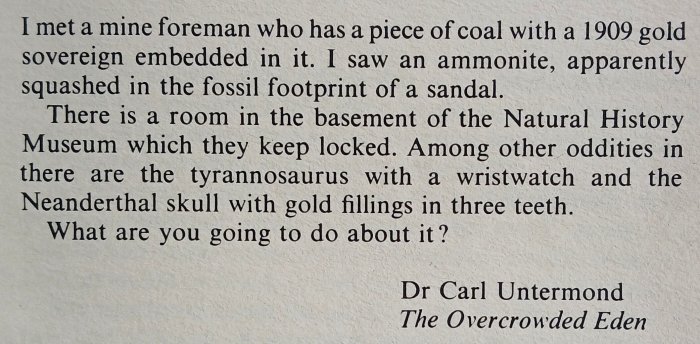
Whilst it would undoubtedly fun to have developed more on this idea, instead Pratchett abandons the dubious fossil record concept quite quickly after explaining it was done via a huge device called a strata machine. This was invented to form fake sedimentary layers and their accompanying embedded fossils on newly created planets by a race known as the Spindle Kings who predated mankind by several million years and had also built Earth. A small number of these machines had been found buried on other planets and humans were now using them to terraform new planets for ongoing colonisation. There has been other galaxy wide races before the Spindle Kings such as The Wheelers and these had died out in turn leaving the present day to Humanity along with a few other sentient and space travelling races, specifically for this book, Kung and Shand. The main human character in the story is Kin Arad who had written a book called ‘Continuous Creation’ giving the history of the various galaxy creating races and this had made her famous so that she was approached by a man who claimed to have found a flat Earth out in a largely unvisited part of the galaxy and wanted to put together a small crew to explore it, this crew would consist of Kin Arad, Marco a representative of the Kung along with Silver a Shand. I can explain all this because it is dealt with in the first forty pages of the book and gives away nothing of the main story.

Anyone who has read Pratchett’s Discworld books will keep seeing references throughout the book, for example our three protagonists first meet in a bar called The Broken Drum and when we get to the flat world there is a rimfall, a continuous flow of the oceans off the edge, amongst other similarities. However the flat planet is recognisably the Earth with much the same continental pattern unlike Discworld and it works using technology, such as matter transference to replenish the seas, rather than magic which drives The Disc in the later books. Anyone who has read Discworld and wants to get an inkling of Pratchett’s ideas in creating it should probably read Strata, it is by no means as an accomplished work as certainly the Discworld novels from the fourth one onwards where Pratchett had more fully developed his skill as a storyteller but it is definitely worth a go and the twist at the end is a good one. It is definitely a science fiction story rather than a fantasy and is probably closer to Larry Niven’s Ringworld than to Pratchett’s Discworld series.

Designing Terry Pratchett’s Discworld – Paul Kidby

Well I was halfway through the book that will now be the subject of next weeks blog when this arrived and was begging to be read. As regular readers of this blog will know I have been a reader of Terry Pratchett’s work since the very beginning of Discworld back in 1983 and have numerous pictures by Paul Kidby on my walls that attest to that interest, some signed by Paul, some by Terry. For Terry the art of Paul Kidby came the closest to what was in his mind of anyone who has illustrated his works so I was fascinated to read this book, indeed I had ordered it from Paul many months ago and whilst knowing it was to be published in November 2024 had lost track of the actual publication date so when this signed copy dropped through my door on Friday then it just leapt to the top of the to be read list and frankly I haven’t been remotely disappointed. The pages have a high gloss finish, entirely appropriate for the art book that this is, but making them extremely difficult to photograph.

The above picture is of Kidby in his surprisingly bare, and quite small, studio with his dog asleep under his desk. This is from a chapter where we look at the materials he uses to create his art, specific boards, brushes, pencils and paints that he prefers and this is interesting as he explains why he picks particular art supplies. But the vast majority of the book looks at the development of the various characters. All the major characters have at least a page discussing how Kidby came up with the their look and how they have changed over the years, so I’ll feature Lady Sybil Ramkin.

As you can see there is an original sketch which frankly looks more like the Clarecraft version of Lady Sybil than the later iterations by Kidby and there are often handwritten notes like the one featured above adding more details of the artistic influences to the illustrations. One thing I particularly liked was the inclusion of the original art when Kidby does one of his numerous parodies of famous paintings so that you can clearly see where his inspiration came from.

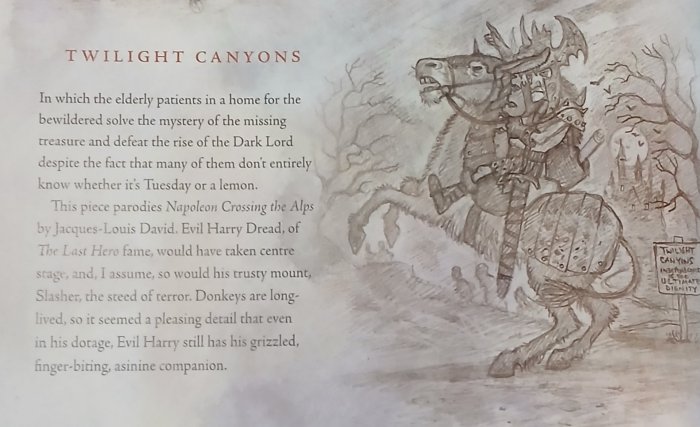
One of the joys of the book however is right at the end in a chapter called ‘The Road Not Taken’ where Kidby has produced a brief sketch for books that never were, Pratchett’s work in progress at the point of which he could no longer write and one of these is Twilight Canyons.

I was in the audience for ‘Bedtime Stories’ at the 2016 UK Discworld Convention, this section had always featured a reading from a book that hadn’t been published yet, initially read by Terry and latterly by his Personal Assistant Rob Wilkins. This was the first convention after Terry’s untimely death and seeing this on the programme had raised a definite buzz of anticipation, what would Rob do? Maybe just tell stories about how he and Terry had worked together and that indeed is how he started but suddenly he reached over for a sheaf of paper and started reading Twilight Canyons, a book that was clearly well in progress but which we would never get to read, the room fell even quieter as we all knew this was our only chance to experience this book.

Right after he finished the quite long extract he removed the On Air sign and the coat to reveal that the ‘table’ beside him was a shredder and he duly dropped the manuscript into the slot of the now working machine, continuing Terry’s wishes that all his unfinished work was to be destroyed. A sad but fitting end.

Rob wrote the afterword to this book where he explains that it is hoped that this will simply be the first in a series of volumes looking at various aspects of Pratchett’s work and I do hope there is more as this was a fascinating book.

Going Postal – Terry Pratchett

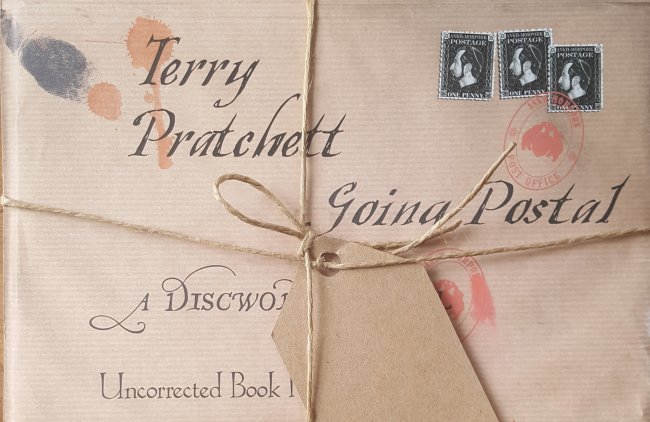
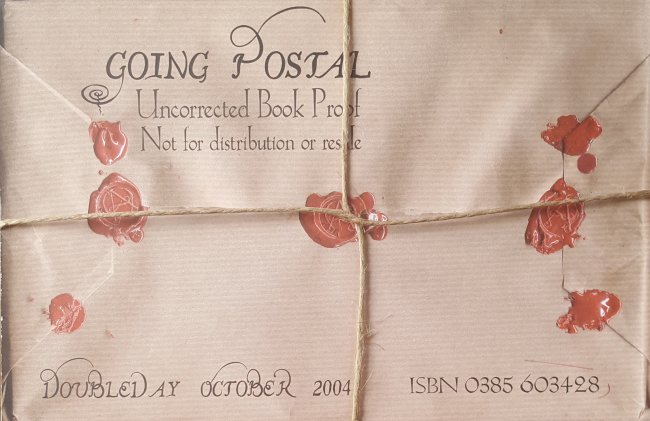
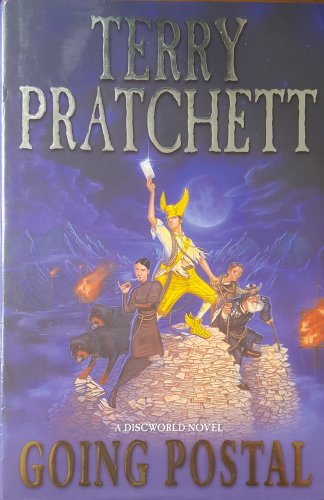
The 9th July 2004 saw the first appearance of stamps purportedly from Terry Pratchett’s Discworld and as I posted an entry on my Instagram account to mark the 20th anniversary of this and the book ‘Going Postal’ which had inspired them I got out my copies of the book of which I have three, the uncorrected book proof, and the first hardback and paperback editions. The cover of the book proof was designed by Bernard Pearson and made to look like a brown paper parcel tied up with string, just 727 copies were printed and sent to book reviewers on the 28th June 2004 with the instruction that they were not to be distributed or sold, the hardback was released on 1st October 2004 and the paperback followed on the 26th September 2005. I’ve never untied the string around my proof copy so had to read the first commercially available edition, see cover further down the blog. As you can see the front cover of the proof includes ‘stamps’ clearly based on the worlds first stamp, the penny black from 1840, but with Queen Victoria’s head replaced by that of Stephen Briggs in his guise as Lord Vetinari, the Patrician of Ankh Morpork, the largest city on the Disc. As I had got them off the shelves, probably for the first time in almost twenty years it seemed logical to read the book again.

Going Postal is the first appearance of a character who would play a major role in most of the remaining Discworld books , well those set in Ankh Morpork anyway, that Pratchett would write before his untimely death in 2015, i.e. Moist von Lipwig, who at the start is facing being hanged for forgery and embezzlement amongst other crimes. To his surprise, and undoubted relief, after being hanged he comes round in the office of Lord Vetinari who reveals that the hangman is an expert in almost hanging somebody such that those observing the event would believe that the prisoner had indeed been executed and instead his lordship wants to offer him a job. Recognising von Lipwig’s abilities and importantly expendability if it doesn’t work out, he wants him to resurrect the moribund Post Office, a branch of government which had failed and no longer delivered anything. The populace instead relying on ‘the clacks’, a primitive form of telegraph system in a world yet to discover electricity, which is increasingly expensive and prone to failure as the new money men who had taken it over fail to understand the importance of daily maintenance to fix small problems before they become much bigger ones.

Without giving the plot away von Lipwig succeeds in re-invigorating the Post Office but in the meantime what initially reads as a comedy fantasy also dissects the world of crooked finance where men just interested in making more money for themselves fiddle the books to project a business doing much better than it really is. The company is therefore able to take on large loans at preferential rates which will be used to enrich the directors whilst loading the company with debts they have no intention of paying back, simply waiting for it to collapse at which point they will buy what is left at a knockdown rate and do it all over again. Pratchett would have another go at the murky world of finance in the next Moist von Lipwig book ‘Making Money’ in 2007.

‘Going Postal’ is a highly entertaining book both for the ruses Moist von Lipwig makes use of in reinventing the Post Office and making it work again, demonstrating time and again the wisdom of Lord Vetinari in putting a conman and most significantly a showman in charge who along the way invents stamps as a means of getting money further up front for delivery of letters and parcels even though he doesn’t understand people who collect them and therefore simply hand over the money for a service they are never going to use. The climactic way he ultimately destroys the money men running the clacks is beautifully written and I highly recommend both this book and ‘Making Money’, something I probably wouldn’t have said at the time they were written when Moist von Lipwig simply didn’t appeal to me as a character but I have to say he has grown on me over the years as I better understood what Pratchett was trying to do with the books.

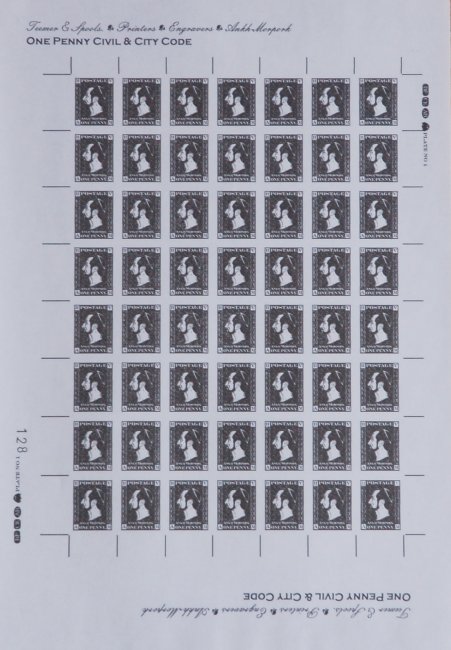
The sheet of stamps shown above replicates the original sheet described as being printed in the book by Teemer & Spools and just 250 sheets were produced by letterpress to be sold to lucky collectors who managed to get one in the couple of days before they sold out. Mine is number 128 as can be seen in the left hand margin. Discworld stamps have become a highly collectable product over the couple of decades they have existed and numerous examples have been produced with new designs coming out every year. For a brief history of the stamps and other postal artefacts see here.

Below is the cover of the first hardback edition this time designed by Paul Kidby.

A Stroke of the Pen – Terry Pratchett

The first of the books I received for Christmas to be reviewed is this collection of stories written by Terry Pratchett whilst he was still learning his trade as a writer and working as a journalist for the Bucks Free Prres in Beaconsfield. These stories however were mainly written for the Bristol based Western Daily Press so Pratchett wrote under the pseudonym of Patrick Kearns, Kearns being his mothers maiden name. The stories were rediscovered by Pat and Jan Harkin during a massive trawl through the British Library newspaper archive in search of a story they knew existed ‘The Quest for the Keys’ and in doings o they came across the other works by an unknown writer Patrick Kearns that sounded and felt familiar as they used places and characters from the tales written by Pratchett for the Bucks Free Press under the name of Uncle Jim which have now been collected in four volumes, the fourth coming out after I wrote my original review of those books. Apparently the fourth book is to be the last but ‘A Stroke of the Pen’ adds another twenty short stories by the young Terry Pratchett for us to enjoy and yes they do feel like the Uncle Jim stories and indeed one of them, ‘Mr Brown’s Holiday Accident’ did originally appear in the Bucks Free Press as by Uncle Jim.

The scale of the archive work done by the Harkin’s can only be appreciated when you know that despite being very short each of the stories were published in multiple parts with the longest, and the only one to be credited to Terry Pratchett in the Western Daily Press, being ‘The Quest for the Keys’ which appeared in thirty six individual sections from 30th July to the 13th October 1984. Also nobody knew about Patrick Kearns as a pseudonym so it was only the style and content that tipped them off that here was an until then unknown source of Terry Pratchett works. Also although ‘The Quest for the Keys’ was known to exist, because of the way it was clipped from the newspaper and saved the dates and indeed the newspaper which printed it were lost so they had to go through four possible newspapers archives from the earliest probable date (1972) up until 1984, when Terry’s first Discworld novel, ‘The Colour of Magic’, was printed, in their search. Fortunately they decided to work forwards rather than back or they would have found ‘The Quest of the Keys’ a lot quicker and probably not stumbled on the works of Patrick Kearns.

Enough of the history, what of the stories themselves? Well I love the Uncle Jim stories and these are more of the same, indeed there are a couple of reworked Uncle Jim tales under the name of Patrick Kearns which provides confirmation, if any was needed, that this is indeed the same author. The first story included is clearly inspired by Roy Lewis’s ‘The Evolution Man’ with its stone age man main character discovering major advances such as fire. My personal favourite of the ones in this book however is ‘The Fossil Beach’ in which the curator of Blackbury museum is taken to the beach by a local geology student where they find a fossilised deckchair, radio and a copy of today’s newspaper in the mouth of a small dinosaur. How these all got there is a mystery they are determined to solve. Pratchett is clearly already a very competent fantasy writer by the time he wrote as Patrick Kearns, not as good as he would become but definitely worth reading.

Sadly I cannot recommend this hardback book as it currently exists, as it has been announced that there is a story missing from it which Colin Smythe, who had commissioned the Harkin’s to undertake their quest, accidentally omitted when he sent the text to the printers which means that the paperback, due out in April this year will be the complete book and anyone who has the hardback first edition, like mine, will have to buy the paperback as well in order to read the missing tale.

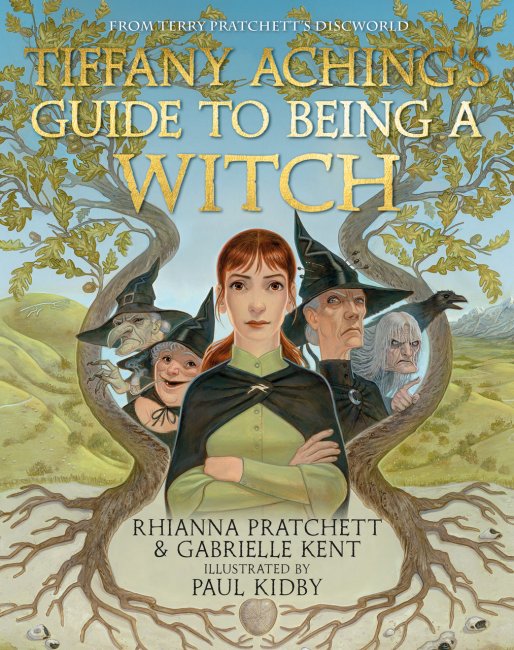
Tiffany Aching’s Guide to Being a Witch – Rhianna Pratchett & Gabrielle Kent

I’m writing this on Friday 10th November having received my copy of this book on the morning of its publication day, yesterday, and spent several happy hours reading it, finishing around 2:30pm yesterday afternoon. I think that tells you how much I enjoyed this first foray into her father’s literary world made by Rhianna and I hope that there will be more to come. When Sir Terry died Rhianna said that she would definitely not be continuing her father’s Discworld novels, and despite initial appearances this book does indeed stick to that line as it is another of the ancillary Discworld books such as Mrs Bradshaw’s Handbook, The World of Poo, the various atlases, or even the assorted diaries, maps, plays and guides all of which were written by people other than Terry Pratchett but based on his works with his approval and undoubted tinkering. Sadly Terry is no longer with us to give his blessings to this book but I’m sure he would have done so as Rhianna has stepped carefully into her father’s legacy with the assistance of Gabrielle Kent, whom I admit not knowing anything about other than she writes the Alfie Bloom series of childrens books, and the wonderful artwork of Paul Kidby who has signed my copy.

Based on the five ‘young adult’ Tiffany Aching books written by Terry , which include his final novel ‘The Shepherd’s Crown’, the book is beautifully designed as a guide to witchcraft by Tiffany but with apparently hand-written notes by other characters from these books such as witches Esme Weatherwax, Nanny Ogg, Miss Tick and the Feegle Rob Anybody along with additional notes from the witch Mrs Letice Earwig inserted so she can complain. Do you need to have read the books before reading this one? Frankly yes. Not only will you understand better what is being covered in the two hundred pages of this work but it basically consists of a huge number of spoilers for the other five books so you definitely don’t want to start here. Below is one of the pages from the main text (carefully chosen so as not to include any spoilers), all of which are full colour and covered in illustrations by Paul Kidby, it really is a pleasure to read the book and admire the artwork.

If you are intrigued by the illustration of the carved chalk figure behind the Feegle it is an accurate depiction of the 180 feet high (55 metres) Cerne Abbas Giant carefully censored by the appearance of the Feegle head to hide his most obvious feature and keep the book child friendly.

The text does contain a lot of original content but also consists of retelling, from Tiffany’s viewpoint, stories from the five Tiffany novels and also other tales from the Witches series of books going all the way back to the third Discworld title, ‘Equal Rites’ in 1987. Equal Rites told the story of Eskarina Smith, the only female wizard, whilst the forty first and final Discworld novel, ‘The Shepherds Crown’ in 2015, in a neat closing of a vast circle includes Geoffrey Swivel the only male witch, both of these characters feature in the new book. The pictures also go back over the decades with old illustrations intermingled with brand new work, some of the older depictions of the characters come from the now difficult to find calendars and diaries so it is good to see them re-used in a book where they can be appreciated by more people, Paul Kidby first started working with Terry back in 1993 doing artwork for the calendars and diaries and various other books but not the novel covers as these were the work of Josh Kirby, sadly Kirby died in 2001 and Kidby took over as the artist of choice by Terry for the novel covers and almost everything else and it is his depictions of the characters and places that are now most familiar to people.

I hope you enjoy the book as much as I did but make sure to read the five Tiffany Aching books first. These are, in order, ‘The Wee Free Men’ (2003) ‘A Hat Full of Sky’ (2004) ‘Wintersmith’ (2006), ‘I Shall Wear Midnight’ (2010) and ‘The Shepherd’s Crown’ (2015). You don’t need to have read any of the earlier Witches series of books before tackling these but they are good so why not? There is a final joke that I almost missed as it is on the back of the dust wrapper. Feegles will steal anything and here they are making off with the barcode block.

Terry Pratchett: A Life With Footnotes – Rob Wilkins

I was given this book for Christmas and picked it up to read a few chapters at 4pm that day, ten and a half hours, and most of a bottle of wine, later at 2:30am on Boxing Day I finished the last of the 429 pages. I just kept thinking I’ll read another chapter and then by one o’clock in the morning it was a case of, well I may as well finish it then. Yes I knew a lot of the story already but Rob’s writing draws you in, he is surprisingly good with a turn of phrase although I suppose he was taught by a master. Rob Wilkins, for those who don’t know, was Terry’s PA and later business manager from December 2000 until his death. He now runs Narrativia (a production company looking after Terry’s works) and Terry’s literary estate alongside Rhianna Pratchett, Terry’s daughter. It is this that gives him a unique oversight of Terry’s life and works.

Terry had started to compile notes for an autobiography before he died in 2015 but by then had only produced around 24,000 words and reached 1979, still way before he wrote his first Discworld novel. At that point he had had only two novels published, ‘The Carpet People’ and ‘Dark Side of the Sun’ along with a handful of short stories. Rob has used these notes extensively but there needed to be a lot more research, not just to fill in gaps but also to do some fact checking. Not everything was, or even could, be checked and some of these fell into the category, referred to several times in the book as Too Good To Check, invariably abbreviated as TGTC. Terry was diagnosed with Posterior cortical atrophy, a variety of Alzheimer’s disease in 2007 and as Rob points out, just how reliable were his memories especially near the end so a lot of checking was needed, fortunately Lyn (Terry’s wife for more that forty years) and Rhianna were always available along with numerous other people so the book has to be described as pretty accurate, except possibly where it is TGTC.

The book does indeed cover Terry’s life, rather unlike a lot of biographies which tend to rush to the point at which the person being written about has done something significant that brought them to the public’s attention. As I said at the beginning there are 429 pages and it is only as we approach page 200 that the first book in the Discworld series is being written. Before that we have his schooldays and his initial somewhat ambivalent attitude to reading. His first job, in a library, and leaving school before his A levels to become an apprentice journalist on his local newspaper. Journalism was where Terry learnt to write and love words and especially books. One paragraph in the book really spoke to me and my love of books.

You know how it goes. You start out just borrowing a few books from the library, or your grandmother, and thinking you’ve got it under control and that you can handle it – they’re just loans, after all, so what’s the fuss about? And the next thing you know you’re moving on to the harder stuff -second-hand books from second-hand bookshops, and actually paying for them with your own money and taking them home with you to own, putting them on a shelf in your bedroom, even. And at that point, most likely, it’s all over and you’ll be on to brand new books before you realise it, and almost certainly an addict for the rest of your life.

Chapter three

In June 2011 Terry and Rob appeared in their second TV documentary ‘Terry Pratchett: Choosing to Die’, an incredibly difficult programme to watch about assisted suicide which was something Terry was considering for himself as his condition worsened and was actively campaigning for a change in the law in the UK so that people wouldn’t have to go to Switzerland which was the only place in Europe where it was legal. Throughout the programme you can see Terry getting more enthusiastic and Rob getting more and more distressed as the reality of what they were talking about hit hard. The next day after the broadcast I happened to be talking to Rob on the phone about something else and he asked me what I had thought of the programme and I told him that I had cried at times, much as I did nearing the end of this book eleven years later, and that it was his reactions that I had most been drawn to. I wish he had mentioned something that appears in this book as he sat watching the programme himself and was scrolling through the twitter feed to try to gauge peoples reactions to the documentary when he randomly paused his scrolling to read “Terry Pratchett’s Assistant is a Right Knob”. Years later at the 2016 Discworld convention, the first one after Terry’s death, he had clearly embraced this sentiment.

Rob Wilkins on stage at the 2016 Discworld Convention at Kenilworth near Warwick, England on 26th August, photo taken by me.

It was a great read Rob, and no you’re not a Right Knob.

The Shakespeare Codex – Stephen Briggs

Based loosely on The Science of Discworld II: The Globe, Lords and Ladies and A Midsummer Night’s Dream, The Shakespeare Codex is a new Discworld stage adaptation written to commemorate Terry Pratchett’s life and works.

Pratchett and Shakespeare fans may also spot snippets from Maskerade, Wyrd Sisters, Richard II, Henry V, Hamlet and others as two worlds collide.

From the rear cover of the book

First published in 2021, but initially performed on 6th April 2016, this is Stephen Brigg’s first adaptation since Terry Pratchett’s death on 12th March 2015 and unusually takes as it’s base not one of Pratchett’s novels but the short novella written as part of the second Science of Discworld series which is used as the links between the science sections written by professors Ian Stewart and Jack Cohen. In the Science of Discworld series of four books the wizards of Unseen University accidentally create what they call Roundworld, but which is clearly our home planet of Earth, and then get involved in various adventures trying to keep it safe. In the case of book II this is to prevent Discworld elves taking over and involves Shakespeare as the man to write them eternally into fantasy and figures of fun and therefore no longer a danger, which he does in A Midsummer Night’s Dream. Briggs quotes extensively from Shakespeare’s plays with instructions to the actors taking the roles that these should be “played straight. Not hammy”.

As said in the quote from the rear cover Briggs has extended the source material beyond the Science of Discworld II and produced a play that works well even for non Discworld fans and which sold out through its first performances at the Unicorn Theatre in Abingdon, Oxfordshire where Briggs is part of an amateur dramatic company. He has been adapting Pratchett’s material since 1991 and these have been performed all over the world to apparently equally happy audiences. Despite this being the twentieth ‘Discworld’ play by him this is the first I have actually owned and read and it was very enjoyable with the mix of Shakespeare and Pratchett handled really well and plenty of the Bard’s own words to set it firmly in Elizabethan England.

The wizards are able to travel through time and ‘fix’ things that have gone wrong and which would prevent Shakespeare being born but they remain largely puzzled by this place where magic doesn’t work but despite which everybody there seems to believe it does work. They are also the only people able to see the elves as they spread their malevolent influence over the population although the Countess of Shrewsbury says to Queen Elizabeth at the end of the play that she could have sworn there was another Queen on the stage at some point so she clearly had seen, or at least sensed, the Queen of the Elves. Of course, all’s well that ends well, so to say and all does end well for the wizards and indeed for William Shakespeare whose new play making fun of the elves as silly fairies that try to interfere with mortal men but are ultimately defeated is a big hit with his audience.

As a final thought the Discworld librarian of the Unseen University is an orangutan (it’s complicated) and throughout the original book and this play is apparently successfully disguised as a Spaniard. I’m intrigued as to what nationality he is assigned in Spanish translations of the two books.

Dodger – Terry Pratchett

Having had my annual read of Charles Dickens’ classic ‘A Christmas Carol‘ I thought I would follow it with a book not written by Dickens but one where he appears as a character. Set in the early years of Victorian London various real people interact with the fictional Dodger and his compatriots including not only Dickens but Disraeli, Gladstone, Robert Peel, Joseph Bazalgette and Henry Mayhew to name but a few. Of these probably the least well known nowadays is Henry Mayhew whose monumental book ‘London Labour and the London Poor’ sits on my shelves just as it did on Terry Pratchett’s. Without this exhaustive, but surprisingly readable, study of the poor in Victorian London which did so much to raise awareness of the problems that beset them and ultimately helped to improve their lot I doubt if Pratchett would have produced such a leap from his ever popular Discworld series. The book is unusually dedicated not just to Terry’s wife Lyn but also to Henry Mayhew.
Dodger, the star of the book is the nickname of a tosher, a person who scours the sewers of London for things that have fallen or been washed down the drains and got caught up in the detritus down there. It was a step up from being a mudlark, someone who similarly looked for lost items or money but along the tidal banks of the Thames, mudlarks still exist but as a hobby rather than a career but toshing stopped after Bazalgette designed the new, more capable, sewer system for London. Right at the beginning of the story Dodger rescues an unknown woman from two men and his adventure, and rapid rise up the social tree begins as his heroism is recognised by Henry Mayhew and Charles Dickens who come along just afterwards. Dodger is an interesting character, clearly based on descriptions in Mayhew’s book but fleshed out by Pratchett in quite a believable way even if his subsequent adventures do stretch the imagination somewhat especially after his encounter with another fictional character from the period Sweeney Todd, the demon barber. It says a lot for Pratchett’s ability as an author that you are quite willing to allow for the speed of the plot and the people he gets to meet so quickly, and improbably for his social class.

The story fairly races along with Dodger and the young woman he rescued being dragged into an international crisis due to her unfortunate background and the reason she was trying to get away. Because of this however it is almost impossible to discuss more of the plot in this review as it would give too much away for future readers but it is a really fun read which I managed in one, fairly long, sitting but I didn’t want to put the book down until I finished. At the end Pratchett provides a short section on his use of actual and fantasy Victorian London

I have to confess ahead of the game that certain tweaks were needed to get people in the right place at the right time … but they are not particularly big tweaks, and besides, Dodger is a fantasy based on a reality. … This is a historical fantasy, and certainly not a historical novel. Simply for the fun of it, and also too, if possible, to get people interested in that era so wonderfully catalogued by Henry Mayhew and his fellows.

Because although I may have tweaked the positions of people and possibly how they might have reacted in certain situations, the grime, squalor and hopelessness of an underclass which nevertheless survived, often by a means of self-help, I have not changed at all. It was also, however, a time without such things as education for all, health and safety, and most of the other rules and impediments that we take for granted today. And there was always room for the sharp and clever Dodgers, male and female.

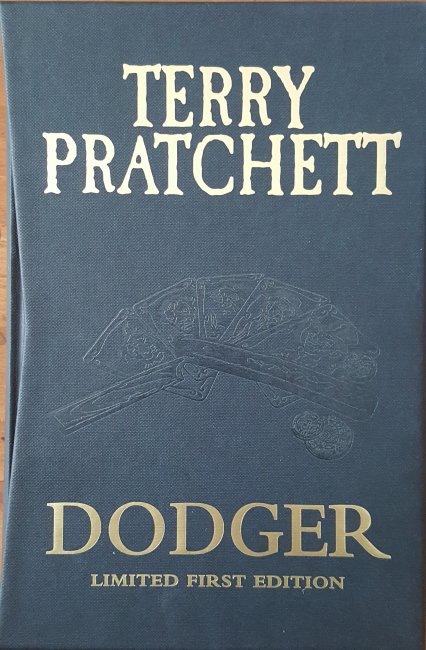
My copy is one of several ‘special editions’ produced when the book was first published on the 13th September 2012, this is the specially bound, stamped & numbered, slipcased edition limited to 3000 and sold exclusively by Waterstones, there was also various un-numbered ‘specials’:

  • 20000 copies exclusive to Waterstones with 500 for Australia with a special jacket and an extra section ‘The Wise Words of Solomon Cohen’ at the end.
  • 30000 copies for W.H. Smith along with 3000 for Easons with a bonus scene at end, Dodger goes to Bedlam to see Sweeney Todd. Both are the same except for different stickers on jacket.
  • 25000 copies exclusive to Tesco with post cards inside the front cover.
  • 6000 copies exclusive to Asda with a map of Dodger’s London at end.

This means that the ‘special editions’ outnumbered the ‘normal editions’ at publication in the UK of which there were 77000 copies. The ‘exclusive’ extra chapter in the edition for W.H. Smith and Easons was subsequently included in the UK paperback when this was published by Corgi on 26th September 2013. The Wise Words of Solomon Cohen do not appear to have been available in any other edition than the Waterstones special, they are not in my copy despite that also being a Waterstones exclusive. Bibliographic details are taken from the website of Terry Pratchett’s long time agent Colin Smythe which is a fount of knowledge on the subject of Terry’s works and is a fascinating read.

The Unadulterated Cat – Terry Pratchett

20190903 The unadulterated cat 1

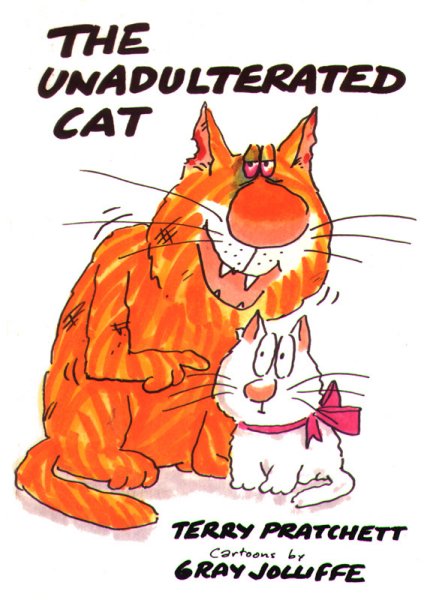
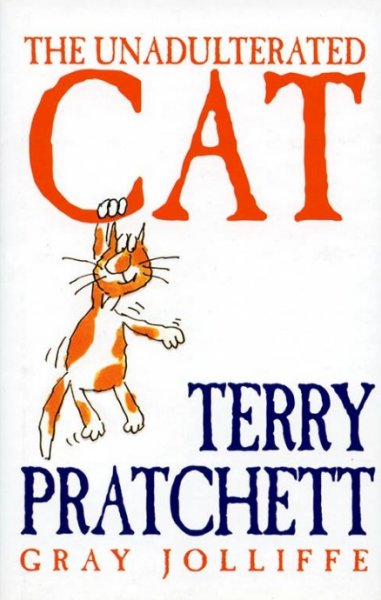
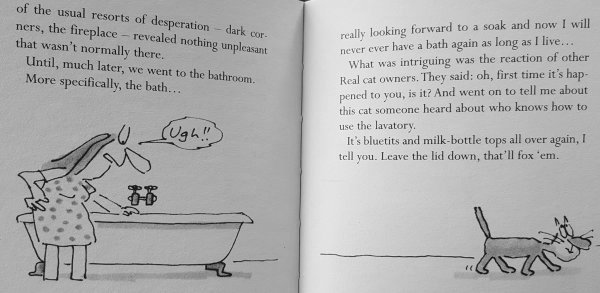
One of Terry Pratchett’s least well known books, The Unadulterated Cat is an odd mix of cat lovers companion, a parody of the Campaign for Real Ale, and a heavy dose humour about the joys (or otherwise) of owning a cat. It is illustrated by Gray Jolliffe whose style completely fits in with the text and as discussed below is one of the reasons why I would recommend the later editions over the first. So what is it all about then? Well the opening lines give a pretty good guide.

Far too many people these days have grown used to boring mass-produced cats which may bounce with health and nourishing vitamins but aren’t a patch on the good old cats you used to get. The Campaign for Real Cats wants to change all that by helping people recognise Real Cats when they see one.

Hence this book.

The Campaign for Real Cats is against fizzy keg cats

That last line is a definite reference to CAMRA which as an organisation prefers ‘proper’ cask conditioned ales over anything in a pressurised keg. That used to a reasonable position but nowadays a lot of craft brewers are producing some wonderful keg beers. However on with the review, or at least Pratchett’s idea as to what a Real Cat is…

For example: real cats have ears that look like they’ve been trimmed with pinking shears; real cats never wear flea collars… or appear on Christmas cards… or chase anything with a bell in it; real cats do eat quiche. And giblets. And butter. And anything else left on the table, if they think they can get away with it. Real cats can hear a fridge door opening two rooms away…

Anyone who has ever owned a cat, or gained a cat they didn’t intend to, or indeed have been owned by a cat will recognise most, if not all, of the situations described in the book. Just a selection of chapter titles will give a feel for what is covered.

  • How to get a cat
  • Types of cat
  • Naming cats
  • Illnesses
  • Feeding cats
  • Training and disciplining the Real Cat
  • Games cats play
  • Schrodinger cats
  • The cat in history

etc.

That types of cat includes ‘Black cats with white paws’ and ‘Boot faced cats’ is a hint that this is not a book that regards pedigree highly. Training cats is also not something that can be done well apart from using a litter tray anyway as Pratchett points out

You think it’s the cat turning up obediently at the back door at ten o’clock obediently for its dinner. From the cats point, a blob on legs has been trained to take a tin out of the fridge every night.

If you have a sense of humour and own a cat, or frankly even if you don’t then read this book, it will definitely give you a laugh.

20190903 The unadulterated cat 2

Note of variations between editions

I have two distinct versions of this book. The original first edition was a paperback published by Victor Gollancz in 1989 and is shown at the top of this review. I also have the first hardback edition, also published by Victor Gollancz, but not until 2002, pictured above, and this, along with two intermediate paperback editions, Gollancz in 1992 and Vista in 1997 are all described as ‘revised editions’ so what is different?

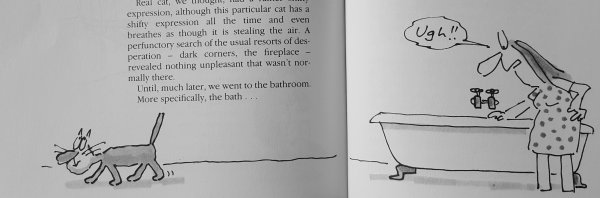
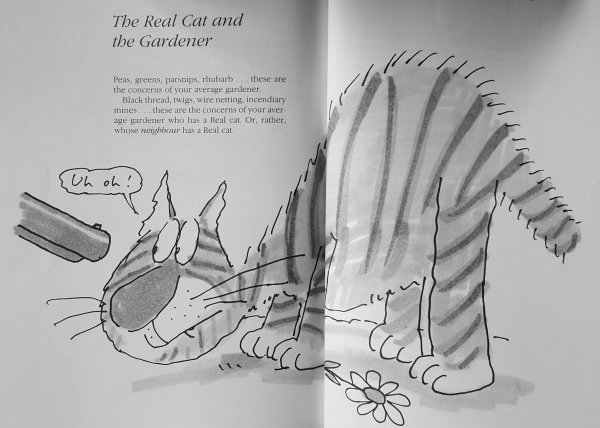
Well the initial obvious difference is the covers and the sizes of the two books I have, the first edition is 242mm tall by 172mm wide and the revised hardback is 185mm by 120mm. Partly due to this size differential the first edition is 96 pages as opposed to the 159 pages in the hardback. It appears the text is unchanged, unless there are minor corrections that I haven’t spotted, but the illustrations are significantly different between my two editions. There are a lot more of them in the later edition, which also adds to the page count, and those carried over from the original are sometimes in different places in relation to the text. There is one example of a mirrored version being used. Original version of what can happen if you accidentally leave your real cat in the house when you think it is outside is first.

20190903 The unadulterated cat 3

20190903 The unadulterated cat 4

Another where the text is amended, apparently to clarify a joke that I think was already quite clear, original to the left

And two illustrations are dropped altogether, along with the front cover of the original which didn’t make it into the revised edition. In the first case the mink coat cartoon was replaced

In the second example there is no illustration at this point in the text in the revised edition.

20190903 The unadulterated cat 9

My Name Escapes Me – Alec Guinness

20190528 My Name Escapes Me

Subtitled “The diary of a retiring actor” this book takes us from the 1st January 1995 to the 6th June 1996. 1995 is treated rather episodically with large gaps in the diary but there are much more frequent entries for 1996 at least as far as that year goes. The book is quite a gentle read, ideal for a quiet afternoon where you just want something to entertain rather than educate. Guinness is in his eighties by the time he wrote this and effectively has retired although he does do a couple of very small parts for films and a short voice-over during the 18 months of the diary.

There are the expected reminiscences scattered through, not just of stage and screen but also of his conversion to Roman Catholicism forty years earlier. Through most of the book his wife Merula is having problems getting about leading to hip surgery and a long slow recovery and he clearly dotes on her, with various changes of plan wrapped around her current health. He is an inveterate name dropper and chides himself several times in the diary for long convoluted stories he tells at dinner parties probably boring everyone else in the process, a habit Merula sometimes curtails by commenting, with the punchline that he is slowly working up to, during the story. People expect actors, especially ones of his seniority, to be able to talk in public but Guinness is quite clear several times that having him give a speech is doomed to failure from the start, it always has been and age has not improved his ability.

One running commentary relates to the Star Wars films and the fan mail, usually with photographs they want signing that he gets all the time.  As in this entry from 16th December 1995 which gives a good flavour of the style of the book.

Today I have felt querulous. Behaviour has been spiky; largely due, I think, to our affable postman dutiful pushing piles of junk mail through the letterbox daily. It gets worse near Christmas. The rubbish, the charity appeals (often in duplicate) and worst of all, the photographs from Star Wars demanding autographs. They mostly come from America and as often as not enclose a stamped addressed envelope – the stamps being US stamps are useless her. The English usually make their demand without photograph, envelope, stamp or money. The nation has got acclimatized to asking something for nothing. Bills in the post are welcome in comparison. It’s mean and hard of me but from 1 January 1996 I am resolved to throw it all in the waste bin unopened (bills excepted, of course); I no longer have the energy to assist teenagers in their idiotic, albeit lucrative, hobby.

He makes a good point here, that a lot of the signed pictures are probably destined for Ebay or some such autograph trading site, where they would make a significant profit for the person who sent them and that is the reason for the contact in the first place. This is something that Sir Terry Pratchett was also somewhat wary of, threatening to sign any book where no dedication was requested “To Ebay purchaser”. Terry does actually make a slight appearance in the book in the 13th June 1995 entry where Guinness praises the Jungle Quest episode from the previous night which featured Terry and his PA Rob in Borneo with Orang Utans.

The diary ends on the 56th birthday of their son Matthew (also an actor) soon after a much needed holiday at Lake Como, not just to mark his birthday but also the anniversary of the Normandy invasion in 1945. Guinness was in the opposite side of Europe, in Italy, at the time having taken part in the attacks on Sicily and Italy several days before, designed not only to take that area but also to divert German military forces away from Dunkirk.

It’s a good read, if a little light, and has an excellent index which reveals that Alan Bennett is mentioned twelve times, The National Theatre four times whilst the National Lottery gets five. Shakespeare or his plays are name checked forty five times whilst the second highest is his wife Merula at twenty nine (although much longer entries) and third comes dogs at twenty one times. I think this says a lot for his priorities. Sir Alec Guinness died in August 2000 and Merula only lived another couple of months afterwards.