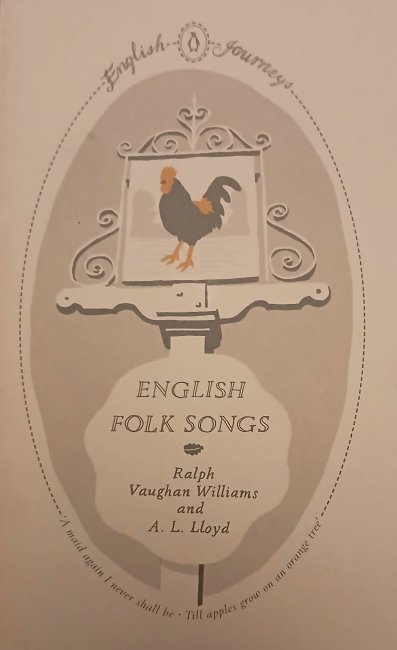
Continuing the bucolic countryside and doomed love themes from last week’s ‘Far From the Madding Crowd’ I was drawn to this book of English folk songs, which was Vaughan Williams’ last book as sadly he died just before it was published. Ralph Vaughan Williams was of course one of the great English composers of the first half of the twentieth century, he died in 1958, and was heavily inspired by English folk songs although he also wrote nine symphonies and four concertos along with his numerous song cycles and choral works. He qualified as a Doctor of Music from Cambridge University and it is as Doctor Vaughan Williams that A L Lloyd refers to him in his ‘Note on the Presentation of the Tunes’ at the start of this book. The selection of songs is quite widespread, although biased toward tunes gathered in the south of England as that was where Vaughan Williams lived so it was easier for him to travel round collecting material in that part of the country although there are a small number from the north. Vaughan Williams was inspired to start collecting English folk songs by contemporaries such as Cecil Sharp and the collections he made helped to preserve a rapidly dying art form as well as influencing his own work.
If I have one criticism of this book it is not in the choice of songs, which provide a spectrum of styles but in the structure of the book itself with the songs in the first part and the accompanying text in the second half which means that you need two bookmarks to keep track of where you are as you continually skip to and fro to read the context and history of the song you have just read. I would have much preferred the descriptions to be interleaved with the music as that would have been far simpler to read.
Before the couple of examples I have chosen, I must explain that the copy I have has a very tight spine and to avoid splitting it I have been forced to hold it open as much as I dared but that has led to somewhat distorted photos of the pages.

Although listed as collected from Somerset, the earliest versions of this song are known from Newcastle Upon Tyne, so the opposite end of the country, and these date back to the late seventeenth century. The lyrics included are a mix of at least three versions into a harmonious whole presumably by Vaughan Williams when collating this book.

The Green Bed follows a theme common with other songs of the period of a sailor who arriving at lodging he has used before claims to have lost all his money in a disaster and is turned away but when he shows that actually he has plenty of money all of a sudden beer and bed are available and the landlady is quite happy to include her daughter in the bed. However the sailor spurns the offer as it is clear that both of them are only interested in the money he has. Again the example comes from the south of England but versions of this song are also known from Warwickshire, in the English Midlands and therefore a long way from the sea.
I really enjoyed this exploration of English folk song and I have various other collections of traditional music which would also be worth exploring at a later date.
 Ramblings on my bookshelves