The Ring of the Nibelung – Richard Wagner

Back in March 2021 I reviewed a book about the trials and tribulations of staging the magnificent four opera series of the Ring Cycle by Richard Wagner, see here. Soon after that I purchased this magnificent cloth bound volume from The Folio Society, which is the full libretto in parallel text with Wagner’s original German alongside the superb translation by Stewart Spencer. This was first published by Thames and Hudson back in 1993 as ‘Wagner’s Ring of the Nibelung; A Companion’, but the Folio version, published in 2020, is much larger at 289 × 205 × 41 mm, and has added illustrations by John Vernon Lord. As can be imagined as the four operas in the 1991 Barenboim recording I have play for a grand total of 15 hours and 5 minutes the libretto runs for well over three hundred pages with an extra seventy pages of authoritative essays on the development of the opera cycle at the beginning along with extensive notes at the end making a total of over four hundred pages of text with seventeen unnumbered leaves of plates. All in all a comprehensive guide to this greatest of Wagner’s operatic works. It should be pointed out that whilst the words sung are all in both languages the stage directions are only in English, this didn’t bother me but if you were looking for a ‘full’ parallel text then bear in mind that these parts are missing.

Wagner is unusual in writing his own libretto, it is much more common to either set an existing work or work with a librettist. For the most part he combined Norse with Old German mythologies in developing his story, these are closely related anyway with much the same characters only with different names, Odin becomes Wotan and Thor becomes Donner for example, but there are also echoes of the ancient Greek especially Homer’s Iliad. Occasionally he merges two characters from different origins into one such as Freia (this is how Wagner spells her name, more usually Freya or Freyja) a Norse goddess of fertility and in this version also the one who looks after the golden apples that confer everlasting life to the gods; she is also referred to as Holde, a similar but different character from German folk tales. Wagner also adds to the mythology with his own concepts such as carving important contracts in runes on Wotan’s staff, the staff exists in the mythologies but not the binding contracts. This melding of the various myths and new ideas make the reading of the libretto so fascinating, especially if you have a reasonable knowledge of the original mythologies, and whilst I have picked up some of this whilst listening to the operas it was only when reading the text at my own pace rather than moving rapidly on as you do in a performance that I more deeply appreciated the complex weaving of stories that Wagner achieved. Certainly the librettos can be read as a long poem without any deeper knowledge of the operas but I found myself adding the music in my mind as I read the words especially in parts I knew well.

The book is really lovely to read, as can be seen above in this section of the third opera ‘Siegfried’ shown with an engraving of the sword Northung being repaired by Siegfried. The sword had belonged to his father Siegmund but was shattered by Wotan during Siegmund’s fight with Hunding in the previous opera ‘Die Walkure’ (The Valkyrie) as Wotan’s wife, Fricka, had demanded that he die as punishment for his incestuous relationship with his sister Sieglinde which had left her pregnant with Siegfried. The illustrations deliberately do not include any of the characters but are rather of important objects within the opera cycle, which I think is an interesting choice as John Vernon Lord explains in his note on the illustrations:

I thought that the words and music together would be best for conveying the ‘appearance’ of the various characters. At the outset, I felt that the inclusion of people would detract from the symbolic nature of what I wanted to express.

It is later in this opera, in fact in the final scene, that we get one of the few ‘humorous’ lines although this was not intended as such by Wagner but I always smile when we reach the ‘This is not a man’ line when Siegfried discovers and wakes the Valkyrie Brunnhilde from where she has been left in a magical trance by Wotan.

It should be realised that Siegfried has never seen a woman before, being brought up by Mime in a secluded location away from all others, but even so ‘Das ist kein Mann!’ is not Wagner’s finest hour.

I have really enjoyed having a deeper dive into the text of the operas and will have a much greater understanding the next time I listen to or watch them, being able to look back over previous sections to refresh my memory has proved to be well worth the cost of purchasing the book especially as it is such a fine edition.

Closely Watched Trains – Bohumil Hrabal

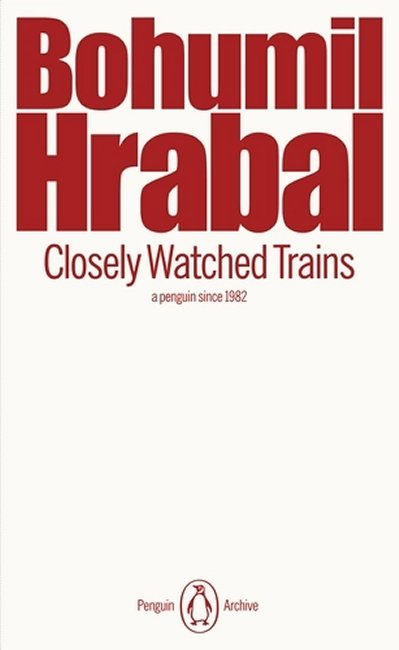
The first book to be featured on my blog of the ninety volumes published as Penguin Archive to mark the ninetieth birthday of Penguin Books on 30th July 2025 and oddly I have chosen this one because of the translator rather than the author. The book was translated into English from the original Czech by Edith Pargeter, better known by her pen name Ellis Peters and the author of the medieval mystery books featuring the monk from Shrewsbury Abbey called Brother Cadfael. Pargeter was born and brought up within a few miles of where I live now and died just a couple of miles away so I’m always intrigued when I come across anything different she worked on and until reading this book I didn’t know that Pargeter became fluent in Czech following her time in the country in 1947. The original Czech title is ‘Ostře sledované vlaky’ and in some English translations is given as ‘Closely Observed Trains’. The 1966 film that was based on the novella also seems to switch titles between the two options depending on where it was released. The film won the 1968 Oscar for best foreign film and was nominated for the 1969 BAFTAs in the best film and best soundtrack categories. The line on the cover ‘A Penguin since 1982’ refers to the first year one of Hrabal’s works was published by Penguin Books.

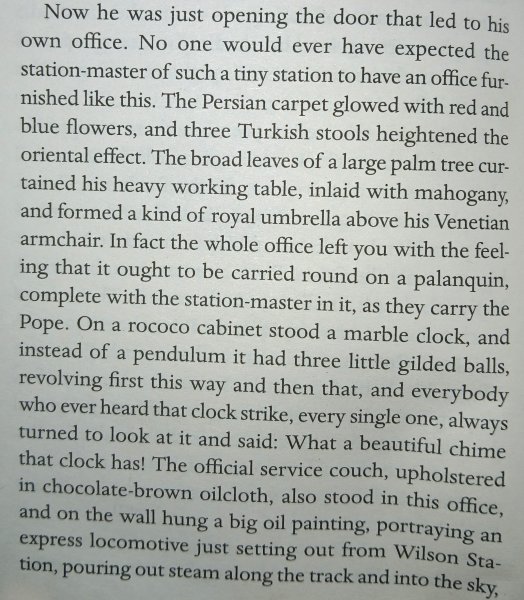
Hrabal worked as a railway labourer and train dispatcher during WWII, whilst waiting to complete his law degree in Prague as the university was shut down during the German occupation. The knowledge he gained from this experience is fully used in this 1965 novella which is set at a somewhat eccentrically run small railway station during 1945 as the Nazi troops were being forced back across Czechoslovakia. The main protagonist of the book is twenty two year old apprentice dispatcher Miloš Hrma, who at the beginning is about to start his first shift back at the station after attempting suicide by slitting his wrists three months previously. The eccentricity of the station can best be emphasised by the description of the Station Masters office:

The station master is as unconventional as his office, keeping his pigeons, which he exchanged from a German to a Polish breed at the start of hostilities, in the roof of the station and when upset shouting profanities into the ventilation ducts in his office. Miloš may be the apprentice dispatcher and his suicide attempt after failing to perform in his first foray into lovemaking with his girlfriend does mark him out but his senior dispatcher is also a man to be reckoned with. During Miloš’s time recovering Výpravcí Hubicka had had a bet with the telegraph operator and when she lost had used all the station’s ink rubber stamps to decorate her naked behind. Something that she simply finds as funny but has greatly upset not only the station master but the railway inspector who unexpectedly arrives to perform a disciplinary. As you can imagine the operation of the station is somewhat chaotic and that’s without the interaction with the occupying German troops.

The fighting on the Eastern Front and the subsequent traffic with trains containing fresh troops going east and injured and dead troops going west along with ammunition and equipment heading into the conflict seems to provide most of the movements through the station. These are presented as stark contrasts to the craziness at the station which flips between the wildly funny and the tragic, especially in the brilliant and unexpected denouement. I greatly enjoyed this book and will now try to search out the film.

Selected Works – Cicero

Cicero was a prominent statesman, lawyer and orator at a time of great turbulence in the Roman empire. Born in 106BC and elected one of the two consuls in 63BC, he was at his prime when Julius Caesar became dictator following his invasion on 49BC, and whilst not one of the group that ultimately assassinated Caesar in 44BC it was generally known that he supported them. He is one of the most prominent men of letters of his time with over eight hundred existing examples and many of his speeches were published. We don’t by any means have everything he wrote but what we have is still a substantial body of work. This book starts with his opening speech in the prosecution of Gaius Verres for mismanagement during his time as Governor of Sicily. the Roman legal system at the time expected a very long speech, normally over a day, in such matters but Cicero gave a ‘shortened’ version (still 23 pages long) as he was concerned that with various public holidays coming up the trial could be postponed for months. It’s a good introduction to Cicero’s style as are the selection of twenty three letters that follow which include one from Caesar.

It is in the third section that we really see Cicero in full flow in the second of his fourteen speeches mainly given in the Senate against Anthony, although this particular speech was never delivered there, being published instead. This massive fifty three page speech established Cicero as a major opponent to Anthony, who had seized control of Rome following the death of Caesar. The series of speeches were known as the Philippic’s after Demosthenes’s denunciations of Philip II of Macedon and were so powerful that Cicero eventually convinced the Senate to declare Anthony an enemy of the state as Cicero attempted to gather support for Anthony’s son, Octavian, to stand against his father. The section below is just a small part of the second Philippic against Antony but gives a feeling of the enmity between the two men:

For what was left of Rome, Antony, owed its final annihilation to yourself. In your home everything had a price; and a truly sordid series of deals it was. Laws you passed, laws you caused to be put through to your interests, had never even been formally proposed. You admit this yourself. You were an auger, yet you never took the auspices. You were a consul, yet you blocked the legal right of other officials to exercise the veto. Your armed escort was shocking. You are a drink-sodden, sex-ridden wreck. Never a day passes in that ill-reputed house of yours without orgies of the most repulsive kind.

The book concludes with two of Cicero’s best known works, the third part of ‘On Duties’ and all of ‘On Old Age’. ‘On Duties III’ consists of eleven sections where Cicero endeavours to explain the preference for actions seen as right as opposed to ones which are simply advantageous and why an action which may appear advantageous but cannot be seen as right is never the correct thing to do. This book, along with the first two parts is addressed to Cicero’s son Marcus who was then in Athens and is a guide to moral behaviour. ‘On Old Age’ is a lot more fun to read, it is written as an imagined conversation between Cato the Elder, who was 84 at the time it is set in 150BC, with Scipio Aemilianus, then 35, and Gaius Laelius, also in his thirties. Cato expounds on the advantages of old age and a reconciliation to the fact that death cannot be far away, in Cato’s case the following year.

Cicero was murdered in 43BC aged sixty three as he was attempting to escape the wrath of Anthony, now reconciled with Octavian, and his head and hands, specifically requested by Anthony as punishment for writing the Philippics, were nailed to the Rostra in the Forum Romanum.

The translation is by noted classicist Michael Grant, Professor of Humanity at the University of Edinburgh and was the first of several translations, mainly of Cicero, that he undertook for both Penguin Books and the Folio Society. This has been the first time that I’ve read Cicero although I can’t imagine it will be the last, there are several Penguin Classics that cover more of his writings and The Folio Society have recently published a massive single volume 664 page collection.

Collection du Vieux Chamois

I have recently managed to complete my collection of these sixteen children’s books, most of which were printed in 1947 in cooperation between Penguin Books in England and Fernand Nathan in France. The last two titles VC15 and VC16 are translations of books that originally came out in England in December 1947 and August 1948 respectively so presumably the French versions were later. After the war Penguin were keen to restart their international publications and came up with the plan of altering the text for a small number of Puffin Picture Books into French and printing them in England to avoid having to ship the lithographic plates abroad. This would still require a considerable amount of work to blank out the existing English text and replace it with a translation as the whole page is printed as one unit. This would therefore have been difficult enough but there were also some illustrations altered, some of which were done for obvious reasons others are more obscure.

The books were printed in editions of 20,000 copies per book and none appear to have been reprinted. In the intervening, almost eighty, years this relatively small production number along with the fragility of books consisting of eight folded sheets stapled down the centre making a thirty two page book meant that few have survived to the present day. Although they are a reasonably practical series of children’s books to collect and it has only taken me around five or six years to accumulate them all mainly from French second hand book dealers online. Interestingly none of the books mention who did the translation, presumably somebody at Fernand Nathan, or who made the alterations to the pictures, possibly the original artists. It is also somewhat ironic that the French translations were created, as one of the original inspirations for the Puffin Picture Book series was the French series ‘Albums du Pere Castor’.

I am indebted to the Penguin Collectors Society for their invaluable Checklist of Puffin Picture Books which includes a full listing of these books so that I could check each one as I obtained it, and the checklist is the source of a lot of the information in this blog. Whilst this book lists most of the differences between the English and French illustrations it doesn’t show the variations, so below I will do so as I think it is interesting to see just what cultural differences were picked up in the changes. Firstly let’s list the seven books where it is simply a text translation difference and as you will quickly spot there are several obvious title changes:

  • VC2 – Les Animaux de notre hémisphère – originally PP7 Animals of the Countryside
  • VC5 – Vacances a la Campagne – originally PP33 Country Holiday
  • VC7 – Les Abres de mon pays – originally PP31 Trees in Britain
  • VC9 – Merveilles de la Vie Animale – originally PP44 Wonders of Animal Life
  • VC10 – Comment Vivent les Plantes – originally PP58 The Story of Plant Life
  • VC13 – Les Chiens – originally PP56 Dogs
  • VC16 – La Péche et les Poissons – originally PP53 Fish and Fishing

Now let’s look at the ones with illustration changes which will also give you a chance to see how lovely this series of books are, either in the original 119 titles in English or these 16 in French:

VC1 – Les Oiseaux du village – originally PP20 Birds of the Village

This one is a mistake rather than a deliberate change, but page eight has a number of birds each identified in the adjacent text by a number. However in the French version the numbers within the illustration have been removed which makes the text meaningless. The alteration is omitted from the checklist which regards this book as a translation only.

VC3 – Les Insectes – originally PP5 A Book of Insects

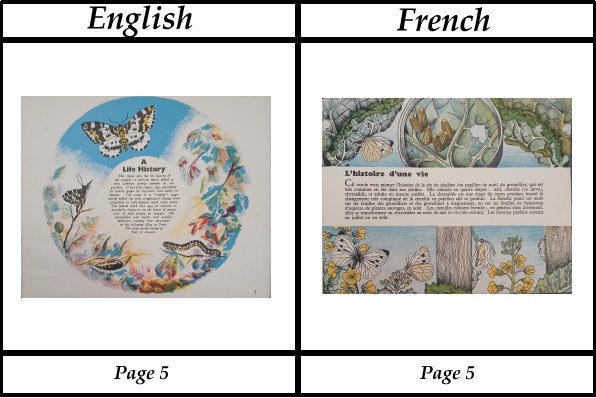
Two pages within this book are completely changed with totally new designs. The first one makes sense to change as the French text appears to be significantly longer than the English and therefore difficult to fit into the circular gap. The second one is less obvious why it was altered to a much more scientific form.

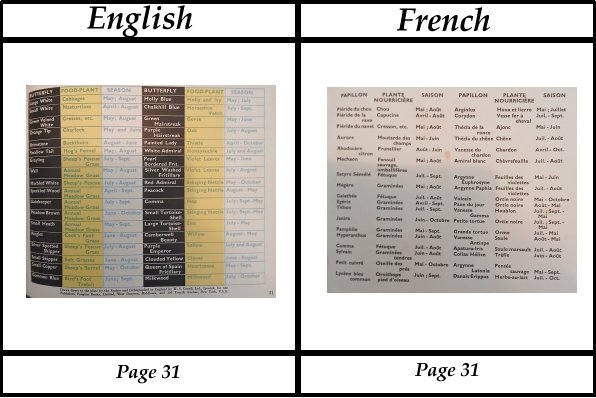
VC4 – Jolis Papillons – originally PP29 Butterflies in Britain

The change for this book is perfectly understandable as it is simply the table on the last page and changing all the text and replicating the original format is probably unnecessary. The deformation of the left hand side of the English text is simply because I didn’t want to force the page flat and possibly loosen the staples. This lack of formatting is not mentioned in the checklist which again regards this book as a translation only.

VC6 – A la Ferme – originally PP4 On the Farm

The biggest difference before the two versions is on the first page where the British farmer is replaced by a man more obviously at work.

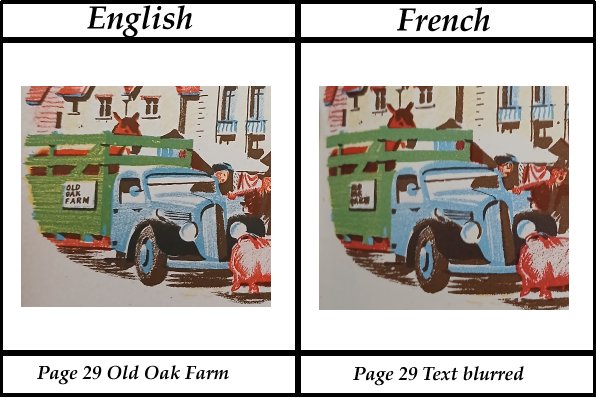
The other change is not included in the checklist and it is the amendment to the sign on the side of the lorry on the page dealing with going to the market, where the English text has simply been blurred out.

VC8 – La Natation – originally PP48 A Book of Swimming

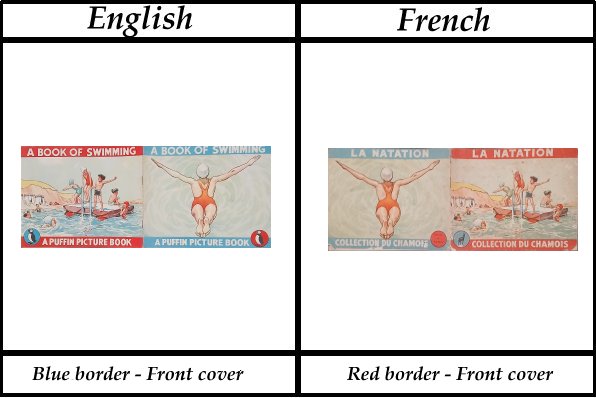
Strangely this change isn’t in the checklist either although it is a pretty significant alteration, with the front and rear covers being transposed.

VC11 – L’Auto et son Moteur – originally PP38 About a Motor Car

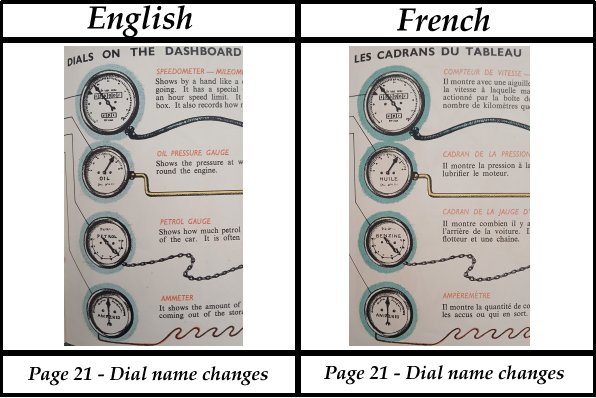
The two small changes to this book are so small that they were ignored by the checklist, the first one is quite amusing and is a text alteration on the middle page spread where in the English version after the word chassis it points out that this is a French word, quite rightly the French edition doesn’t bother with this explanation. The other change is shown below and is an amendment to the text on the gauges.

VC12 – Les Bateaux – originally PP11 A Book of Ships

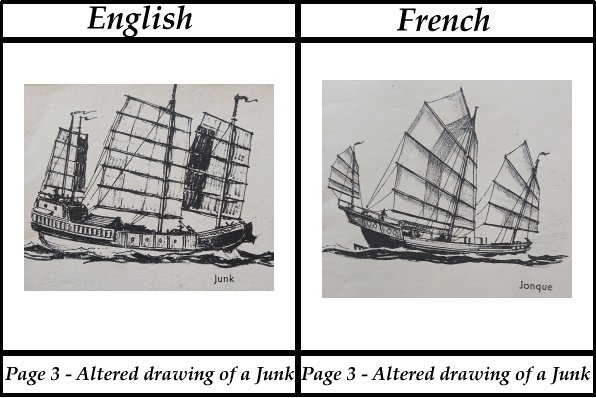
Now we get to the book with the most changes between the two versions, all of which are included in the checklist and we start on page three with a new drawing of a Chinese Junk.

The very next page has the British naval flag, the Red Ensign, altered to be unrecognisable in the French version. This also occurs on page 24 but I’ve just included the one example here.

Next comes a change of headgear between two sailors

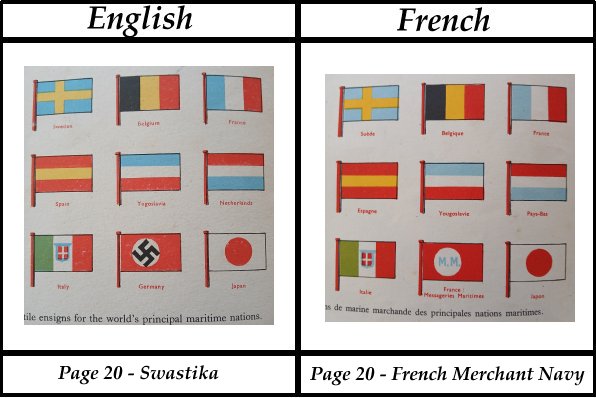
We then get a change that needed to be made from the original British edition, which was printed in June 1942, when the German flag would logically appear, to 1947 when it wouldn’t, or at least not in that form. The British book would be completely redesigned when it was reprinted in 1952 and no swastikas appear in that either.

Finally we come to page 27 where the illustration at the top of the page is reversed and indeed looks like it was completely redrawn.

VC14 – Les Merveilles du Charbon – originally PP49 The Magic of Coal

With this book only the front cover is amended to change both the helmet, the French version is more rounded and doesn’t have a lamp, and also the miner’s tattoo on his chest. This goes from St George and the dragon on the British miner to the symbol of France, the Gallic Rooster, in the French version. Whilst compiling this list I also realised for the first time that this book is slightly, but noticeably, larger than most of the other Puffin Picture Books or indeed the Vieux Chamois.

VC15 – Le Théatre – originally PP75 The Theatre at Work

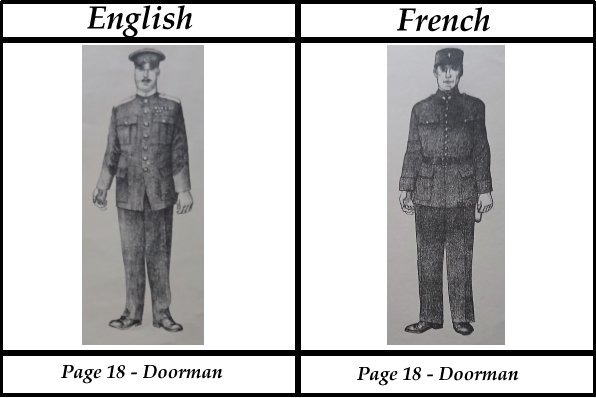
The final set of changes involve a couple of uniforms at the theatre both of which are in the checklist, firstly the doorman.

and finally the fireman who looks more prepared for disaster in the French version

That brings us to an end of this overview of the Vieux Chamois series, I’d love to know why they were called Old Chamois but I doubt that I’ll ever find out.
Siddhartha – Hermann Hesse

At first sight this is an odd book for a German author, who as a young man had sufficiently strong callings to the priesthood that he briefly attended a seminary. But in 1911, in his mid 30’s, Hesse visited India and was introduced to Hindu mysticism and this has undoubtedly influenced this novel written in 1922. The story is set in ancient India, around 2500 years ago, it follows Siddhartha, and to a lesser extent his friend Govinda, in their quest for spiritual enlightenment. At first this leads them as young men to abandon their family homes and all their belongings and live in the forests as ascetic samanas, training their bodies to need nothing, using extended fasting and lack of clothes apart from a loincloth to preserve decency. This was a life of meditation and a severe deprivation of the body. A sample of the thoughts of Siddhartha are shown below and give a flavour of the sometimes difficult to follow text as Hesse can get caught up in the tautological expressions that he uses to try to explain Siddhartha thought processes for pages as a time.

Siddhartha and Govinda live with other samanas for a long time, occasionally begging for scraps of food as the bare minimum to stay alive but eventually they hear of a great teacher called Gautama (Buddha) and decide to travel to hear him teach. They eventually reach Gautama and hear him speak but whilst Govinda immediately resolves to follow the Buddha, Siddhartha instead explains that he feels that such enlightenment cannot be taught but must be individually gained through experiences and solitary meditation so the two friends part company. Leaving Govinda, Siddhartha travels until he reaches a river and there meets a ferryman who will become a significant character later in the book but for now he simply gets him to the other side whereupon he walks on to the next town. It is here that Hesse completely threw me as I thought I understood the path to enlightenment that Siddhartha was going to follow, but instead, on entering the town he sees a wealthy courtesan and is filled with desire. She however is not interested in the half starved gaunt and long haired ascetic standing in front of her and tells him that if he wants to know her better he has to be wealthy, clean and well dressed and he duly throws over his calling, gets his hair cut and body cleaned and perfumed, becomes a merchant and eventually earns a place in her bed. Definitely not what I had expected.

I admit I was somewhat daunted when beginning the book, not helped by Hesse’s undeserved reputation as a not very approachable writer, but as I read on I got more engrossed by the story and by the time of Siddhartha’s sudden change in direction I was highly intrigued as to where the novel was going and loved the ultimate resolution. It’s probably not a book for everyone, but I thoroughly enjoyed it. This is another of the Penguin Drop Caps series and eventually I will read all twenty six of these books, an explanation of the concept can be found on my my blog introducing the series here where I am also including links to each of the books as I review them.

The Shadow of the Wind – Carlos Ruiz Zafón

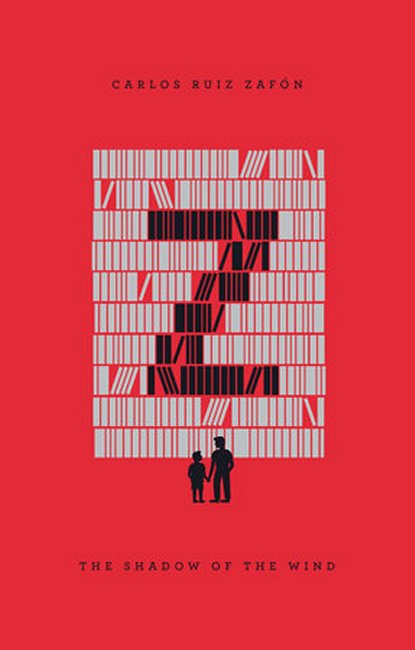
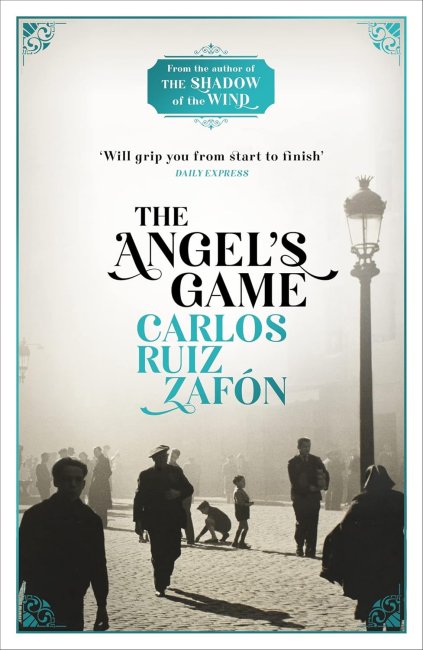
Dawn is breaking in post-war Barcelona when Daniel’s bookseller father guides him through the mist to a mysterious building hidden in the heart of the old city. Here in the Cemetery of Forgotten Books, ten-year-old Daniel is allowed to choose one from the hundreds of thousands of abandoned volumes that line the labyrinthine corridors. Inexplicably drawn to ‘The Shadow of the Wind’ by Julian Carax, the boy clutches the book and he and his father leave. That night Daniel reads through the night totally captivated by the story and the quality of the writing and I know exactly how he felt as although my all night reading sessions are well behind me as I found it difficult to put this remarkable book by Zafón down. Perhaps a longer section than I would normally quote will give an insight into the wonderful descriptive prose and the building tension that is maintained throughout the 511 pages. This passage is very early in the book so doesn’t contain any spoilers and describes the night after Daniel took the book to Don Gustavo Barceló, another bookseller but one who knew more about the rarities of printing than Daniel’s father, for him to have a look at. There he discovered that he may well have the last remaining copy of Carax’s final novel and that all the other copies along with editions of all his other books had been systematically bought or stolen and mysteriously found burned over the years.

I turned off the light and sat in my father’s old armchair. The breeze from the street made the curtains flutter. I was not sleepy, nor did I feel like trying to sleep. I went over to the balcony and looked out far enough to see the hazy glow shed by the streetlamps in Puerta del Angel. A motionless figure stood in a patch of shadow on the cobbled street. The flickering amber glow of a cigarette was reflected in his eyes. He wore dark clothes, with one hand buried in the pocket of his jacket, the other holding the cigarette that wove a web of blue smoke around his profile. He observed me silently, his face obscured by the street lighting behind him. He remained there for almost a minute smoking nonchalantly, his eyes fixed on mine. Then, when the cathedral bells struck midnight, the figure gave a faint nod of the head, followed, I sensed, by a smile that I could not see. I wanted to return the greeting but was paralysed. The figure turned, and I saw the man walking away, with a slight limp. Any other night I would barely have noticed the presence of that stranger, but as soon as I’d lost sight of him in the mist, I felt a cold sweat on my forehead and found it hard to breathe. I had read an identical description of that scene in The Shadow of the Wind. In the story the protagonist would go out onto the balcony every night at midnight and discover that a stranger was watching him from the shadows, smoking nonchalantly. The stranger’s face was always veiled by darkness, and only his eyes could be guessed at in the night, burning like hot coals. The stranger would remain there, his right hand buried in the pocket of his black jacket, and then he would go away, limping. In the scene I had just witnessed, that stranger could have been any person of the night, a figure with no face and no name. In Carax’s novel, that figure was the devil.

The plot flies along at a breakneck speed with multiple clues as well as a few blind alleys as to what is going on as Daniel tries to find out what happened to Julian Carax and how he came to be found shot dead in Barcelona when he should have been safely in Paris and what the wartime thug, murderer and now Inspector of Police Fumero has to do with it, as we progress from 1945 when Daniel first visits the Cemetery of Forgotten Books to the end of 1955 when the story finally reaches its denouement. Along the way a cast of superbly drawn characters are introduced, some of which help but more than a few are there to hinder Daniel’s fascination with Carax and his slowly developing interest in women as he goes through his adolescence. At about two thirds through the book and three days after I started I still hasn’t worked out how everybody was linked and how the various plot strands were connected so took an evening off reading to think through what I knew so far without adding more detail. This proved to be a good idea as I finally realised where the story was going and who the man watching from the shadows was, just in time as Zafón was about to upend the story and make my guess a possibility. I read the remainder of the book the next evening as Zafón neatly tied up all the loose ends in an eminently satisfying way.

Sadly Carlos Ruiz Zafón died of cancer in 2020 aged just 55, robbing the world of a great author well before his time. This English language version of the book is translated by Lucia Graves, daughter of the poet and novelist Robert Graves. She was brought up in Mallorca from the age of three, and according to her memoir ‘A Woman Unknown’ she grew up speaking English at home, Catalan with locals, and Spanish at school and it is she who has translated into English all five of Zafón’s ‘Cemetery of Forgotten’ novels.

This is the fifth book from the Penguin Drop Caps series I have written about along with a general overview of the series. There are twenty six in total, one author per letter of the alphabet and previously I have covered Ellery QueenJohn SteinbeckXinran and W B Yeats.

Short Stories – Fyodor Dostoyevsky

I’ve been meaning to read Fyodor Dostoyevsky for a long time but in common with a lot of other Russian novelists his books are somewhat daunting for a blog which appears every week, just checking my shelves I find:

  • ‘Crime and Punishment’ – 559 pages
  • ‘The Devils’ – 669 pages
  • ‘The Idiot’ – 661 pages
  • ‘The Brothers Karamazov’ – 2 volumes totalling 913 pages
  • and a volume containing two short stories and a novella ‘The Cossacks’ – 334 pages

It was then I spotted that I had two volumes from the Penguin Little Black Classics series which would give me an entry point to Dostoyevsky to see if I like him as an author. The first one is number 44 from this series ‘The Meek One’ which only has this one short story in it. The title is more usually translated as ‘A Gentle Creature’, and it is just 57 pages, still quite long for a short story, but a lot more approachable. Warning there are spoilers in this review if you want to read the stories first I cannot find ‘The Meek One’ but ‘White Nights’ is on Project Gutenberg here and ‘Bobok’ can be found here.

‘The Meek One’ begins with the un-named narrator contemplating the body of his equally un-named young wife laid out on a table in their home waiting for the undertaker to arrive the next day and we then go back over the story of how the two met and the short and largely unhappy marriage that they had. They had originally come into contact with one another as she would often come and pawn items in his pawnbrokers to raise money to advertise her services as a governess or more latterly almost any job to enable her to leave her two aunts. At the time of their marriage he was forty one and she just sixteen, however he regarded himself as her saviour from a planned marriage arranged by these aunts to a shopkeeper in his fifties who had killed his two previous wives whilst drunk and was looking for a third. The relationship between the couple seems to have deteriorated very quickly after the wedding and it is a sad story he tells of long silences and barely communicating through the winter including a time when she places a loaded gun to his head whilst thinking he was asleep but doesn’t pull the trigger. In the spring he makes an unexpected move to rescue the marriage suggesting a journey to France but it is whilst out getting the passports that she commits suicide.

Russian writing has an often undeserved reputation for gloominess and this short story doesn’t go any way to repudiate that impression, maybe the next book will have something more uplifting.

The second and third of Dostoyevsky’s short stories in volume 118 of the Penguin Little Black Classics series has ‘White Nights’ paired with ‘Bobok’. ‘White Nights’ is 86 pages long, ‘Bobok’ is the shortest at just 27 pages.

‘White Nights’ tells the story of a twenty something recluse in St Petersburg and yet again we don’t have his name, this lack of a name seems to increase the isolation of Dostoyevsky’s characters and this time he is pretty well the only un-named person in the story. He spends his days wandering around the city imagining having conversations with the people and even the houses he sees but in fact the only person he communicates with is his maid Matrona who is supposed to look after his apartment but hasn’t even removed the cobweb on the ceiling, mind you neither has he. One day whilst out on one of his aimless walks he sees a pretty young girl crying on a bridge and this time builds up the courage to approach her, however she evades him only to be threatened by an older passerby and our narrator steps in the save her. So begins the four days of happiness that he is to enjoy as they get to know one another, he explains that he is a lonely dreamer whilst she tells of a unhappy time living with her blind grandmother who pins their clothes together so that she can be sure Nastenka is not wandering off. She also tells of a lodger they had a year ago whom she fell in love with but who had to return to Moscow but promised to return and marry her when he left. The narrator rapidly also falls in love with her but agrees to carry a letter to a family who know the ex-lodger to see if he has returned and is still planning on restarting their relationship whilst secretly hoping that he has found somebody else in Moscow. The story is well written with the narrator regarding himself as the hero almost of a book of his life, indeed Nastenka rebukes him for telling his story almost as if he was reading it out. Sadly the ex-lodger does return and the narrator returns to his apartment downcast looking to another fifteen years of loneliness but Matrona does at least remove the cobweb.

‘Bobok’ is easily the strangest of the three stories and to my mind the best due to its originality, although it starts out normally enough with our narrator, this time with a name, Ivan Ivanych, going to the funeral of a distant relative and avoiding the lunch afterwards, takes to lying down on one of the long stones in the graveyard for a rest. All of a sudden he hears voices, muffled but intelligible, and wonders where they may be coming from. Gradually he realises that they are coming from the graves around him and it appears that the dead have a second short life in the grave where they can communicate with each other for two or three months, possibly up to six before they decompose too far. I loved this story as I hadn’t read anything like it before, The various conversations start off reflecting the status of the characters as they were before they died but gradually they decide to throw off their previous lives and simply talk to one another until they suddenly fall silent when they become aware he is listening. Another possible reason for our narrator hearing them is given in the opening lines of the story:

The day before yesterday Semyon Ardalyonovich suddenly comes out with: ‘And would you kindly tell me Ivan Ivanych will the day come when you’ll be sober?’

All three tales are taken from the Penguin Classics volume ‘The Gambler and Other Stories’ translated by Ronald Meyer which also includes the short stories ‘The Dream of a Ridiculous Man’, ‘A Christmas Party and a Wedding’ and ‘A Nasty Story’ along with its title novella ‘The Gambler’ which was actually written by Dostoyevsky in order to pay off his debts from losses at roulette.

Fairy Tales – Charles Perrault

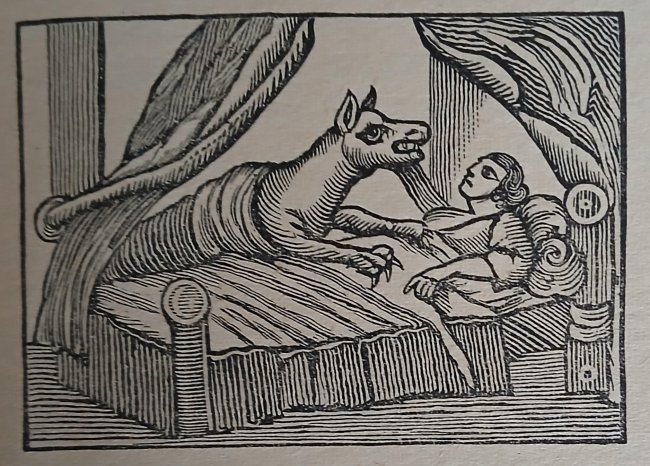
Frenchman Charles Perrault was one of the earliest collectors of fairy tales predating the German Brothers Grimm by over a century and these were well before the Danish Hans Christian Anderson and it is in this collection that we find some of the earliest published versions of such classics as Cinderella, The Sleeping Beauty, Little Red Riding Hood and Puss in Boots. Not that anyone brought up on the sanitised modern versions would recognise much of what they believe is in the story. A prime example of this is Little Red Riding Hood, which is much shorter than the tale I first read as a child, basically the wolf meets the young girl on her way to Grandmother’s house, establishes where she is going and gets there first. The wolf immediately eats the grandmother when he gets in the house and gets into the bed waiting for Little Red Riding Hood, when she arrives he tells her to undress and get into the bed at which point he eats her and the story ends just five pages after it starts with a moral that ‘plausible wolves are the most dangerous kind’ a clear warning to young ladies to beware of some men.

The most striking example of dangerous men preying on females is a story which I have never thought of as a fairy tale but it is included here and that is Bluebeard. I first came across this horror story in the opera by Hungarian composer Bela Bartok which is largely faithful to the Perrault version at least initially. A young woman visited one of the many fine homes of a wealthy man along with her family and they were all royally entertained for several days, so much so that she agreed to marriage. About a month after the wedding he has to go away on business but suggests she invites her family and friends round and gives her the keys to the house and the strong boxes, she can go and do anything but tells her never to enter the room at the end of a corridor. However she cannot resist and when she goes in finds dried blood on the floor and the bodies of his previous brides hanging on the walls, in her horror she drops the key which becomes coated with blood. Bluebeard unexpectedly returns that evening and finds blood on the key so knows she has been in the forbidden room and therefore determines that she has to die like the others. Fortunately for the young bride her brothers arrive and kill Bluebeard before he can kill her. Again there are morals to be learnt from the story at its conclusion the second of which says that the story is from long ago and nothing like this happens anymore indeed nowadays it is the wife to be afraid of not the husband.

Geoffrey Brereton as well as translating this book wrote a very interesting introduction going back to the even earlier Italian collections of fairy tales although they weren’t called that back then and taking the reader through the development of the stories such as Cinderella which in the Grimm version has the ugly sisters mutilating their feet to try to get the slipper on and having their eyes pecked out when they try to go to the castle after the wedding whilst Perrault has Cinderella forgive her sisters and invite them to live in the castle. Brereton was a freelance translator and writer specialising in French and to a lesser amount Spanish literature as such he was ideal for this 1957 translation and his erudition regarding the history of fairy tales is shown in his excellent introduction, which alone would make reading this book worthwhile. The book has reproductions of woodcuts from the first English edition of Perrault’s Fairy Tales dated 1719 before each story as in the example below for Little Red Riding Hood.

Until August – Gabriel García Márquez

In December 2019 I reviewed Gabriel García Márquez’s last collection of short stories ‘Strange Pilgrims‘. I love his work so was pleased to see that in March this year, on the 97th anniversary of his birth, his last novel was finally published in English, ten years after his death. According to the preface written by his children Márquez was not happy with what he had written and wanted it destroyed. Instead they simply put the manuscript on one side and almost ten years later read it again and decided that it was probable that the dementia he was suffering from, and which undoubtedly prevented him completing the novel, clouded his judgement as to the quality of the work.

At just 110 pages it is really more of a novella rather than a novel, especially when compared to his other far more weighty works, however I do agree with Rodrigo and Gonzalo that the book is definitely worth publishing even in this unfinished state. Originally planned as a set of five short (roughly 150 pages each) novels all of which would tell the story of Ana Magdalene Bach’s experiences during her annual visit to an unnamed island where her mother is buried. Instead we get six linked short stories all set around the 16th August, the anniversary of her mother’s death, where she travels to the island without her husband or children to tidy up and lay flowers on the grave.

We join Ana, at the start of the book, on her way to the grave having just got off the ferry, and this is clearly not the first time she has made the pilgrimage as she heads straight for a familiar taxi driver who by routine takes her to the flower stall where there is a pre-prepared bouquet of gladioli ready to be collected and then straight on to the cemetery returning later to the somewhat dilapidated hotel where she regularly stays the night before returning to the mainland the next day. But this is not to be the usual routine as she sips her gin in the bar after her evening meal she spots an intriguing stranger and invites him to join her. After a few more drinks she invites him to join her in her room and they make love. The next year on the ferry over to the island she is already looking forward to her night of passion with a stranger and by the time she is again sipping her gin is searching for the man she will choose, for this has already been added to her routine. The six visits detailed in the six chapters are sometimes successful in her hunt and sometimes not but the development of Ana and her relationship with her husband on her return to the mainland are fascinating as she becomes more and more convinced that he also has lovers and despite her own infidelity gets increasingly angry about it each year.

As well as the novella we get a translation of the original editor’s note from the Spanish edition written by Cristóbal Pera who had also edited Márquez’s autobiography. This is fascinating as it goes into the development of the novel, through the five main drafts along with a digital version maintained by his personal secretary Mónica Alonso and gives a glimpse as to how Márquez worked. The final published version is an amalgam of the fifth draft, heavily pen amended by Márquez, and the digital version which retained some of the earlier variants of the text, There are also four pages of the fifth draft manuscript showing hand written alterations both by Márquez and Alonso as she would read the pages to him and he would suggest changes as she read.

I’ll guarantee you won’t expect the highly original ending, I certainly didn’t, yet it perfectly rounded out Ana’s story. A final note of brilliance from the man described as “the greatest Colombian of all time” at the time of his death by the then president of Columbia, Juan Manuel Santos.

Protagoras and Meno – Plato

This volume consists of two of Plato’s dialogues, or reported conversations, featuring one of the leading sophists Protagoras and Meno, who was primarily a military leader although had also studied under several Sophists. The Sophists were a loose group of teachers on a wide range of moralistic as well as some practical subjects during the fifth century BC, teaching such things as philosophy, rhetoric and virtue along with mathematics and music. It is the teaching of virtue and whether this is even possible to be taught that most concerns these two dialogues and why they are commonly found together. Indeed Meno cuts straight to the question in the opening line of that dialogue.

Can you tell me Socrates – is virtue something that can be taught? Or does it come by practice? Or is it neither teaching nor practice that gives it to a man but natural aptitude or something else?

As can be seen from the above questions the other main character is Plato’s favourite subject, Socrates. In Protagoras the dialogue is reported by Socrates, whilst in Meno we are more directly involved as it is more like being there and listening in on the conversation. This is the second volume of Plato’s dialogues I have reviewed on this blog beginning about a year and a half ago with the most famous example The Symposium which also features Socrates. Socrates himself didn’t produce any writings so most of what we know of his teachings comes from two of his pupils, Plato and Xenophon, and it is believed that Plato didn’t start his works until after the death of Socrates even though they are all written as though contemporaneous with events although no dates are mentioned.

Protagoras

This meeting between Protagoras and Socrates covered by this piece can be fairly accurately dated to around 433 to 430BC when Protagoras would have been in his late fifties and very much the grand old statesman of the Sophists, highly respected and wealthy from his many years of speaking and lecturing whilst travelling round Greece. Socrates at this time would have been in his late thirties, The dating can be reasonably precise because Paralus and Xanthippus, the sons of Pericles are listed as present and they died of the plague in 429BC and Agathon (born around 448BC) is described as a youth. Whatever the precise date, it is before the birth of Plato (between 428 and 423BC)

The dialogue starts with Socrates visiting a friend and telling the story of the previous day when Hippocrates had called on him early in the morning very excited because he had found out that Protagoras was in Athens and demanding to go with him to hear him speak. Socrates, as ever, is doubtful of the wisdom of this and anyway it is far too early to go to the house where he knows Protagoras is staying. Instead he questions Hippocrates as to what he hopes to learn from the visit and discovers that he has no clear idea as to what would be gained, nevertheless he agrees to go. On seeing Protagoras with numerous people following him around the courtyard listening to his every word Socrates introduced himself and Hippocrates and asks Protagoras what Hippocrates could expect to learn if he became his pupil. At this Protagoras launches into a long speech broadly covering what he teaches, which is basically how to be a good and virtuous citizen. This speech is probably adapted by Plato from one of Protagoras’ books, now sadly lost apart from this fragment. Socrates then attempts to get Protagoras to define virtue, stating that he at least does not know what it is, this is typical Socrates where the admission of complete ignorance of a subject is key to the development of some sort of understanding through discussion.

Unfortunately this is where the dialogue largely runs out of steam as Socrates makes several attempts to get Protagoras to agree with a particular definition and when he cannot get him to the point he is aiming for drops that argument and picks up a different line of questioning. This makes for quite a ragged text which at times is difficult to follow as the reader cannot easily see what point Socrates is trying to make when he changes tack comparing one aspect of virtue with another such as wisdom and temperance or after that justice and temperance. The main sticking points between the two men seems to be the virtues of knowledge and courage. At the start of the dialogue Protagoras states that virtue can be taught and Socrates says it cannot at the end Socrates has come round to the idea that virtue is defined by knowledge, as after all it is in knowing the difference between good and bad that the virtuous can be determined and knowledge can definitely be taught. Protagoras however is unconvinced by this so the men seem to have swapped position during the discourse.

Meno

This occurs several decades after Protagoras in around 402BC. Again the people present allow for a pretty accurate date, Anytus is there and is described as having an important state position so it must be after 403BC and the restitution of the democracy, whilst Meno went to war in 401BC and never returned. Socrates is therefore in his late sixties and this time he is the respected thinker being consulted.

This is a much more satisfying dialogue as it is largely a discussion between the two men Socrates and Meno with Anytus only appearing near the end. Again the subject is the teaching of virtue and again Socrates starts by saying that unless virtue can be precisely defined then it cannot be taught whilst declaring himself ignorant as to what virtue may be. There is also an interesting discussion as to whether teaching is what it appears to be or rather it is the pupil being assisted to remember things that they were not aware that they already knew. This follows the concept that the soul is immortal and whilst between bodies it can explore and discover all things so it is merely a case of helping the soul within the body recover memories. This Socrates attempts to demonstrate using a slave of Meno’s who has had no mathematical training but who is brought to understand what happens to the length of each side of a square when doubling its area. Initially the slave says the side must also double but then realises that is a mistake. I think the argument that Socrates is not teaching as we understand the term during this exercise is highly debatable but Meno and by association Plato seem to agree with Socrates that the slave is simply being helped to remember.

The argument that virtue is knowledge is again raised and this time Socrates is not so sure although he goes back over some of the points in the previous dialogue. At this point Socrates and Meno are joined by the general Anytus and when he is asked his opinion of Sophists as teachers of virtue he professes considerable animosity towards the whole movement and the stupidity of the various people who had enriched Protagoras during his lifetime. During the brief time that he is with them Anytus gets angrier with Socrates in his apparent defence of the Sophists and perceived denigration of leading Athenians whom they agree were highly virtuous but which had according to Socrates distinctly opposite sons. Anytus would be one of the accusers of Socrates in the famous trial a few years later which led to his death by poison.

Ultimately Meno and Socrates agree that knowledge is not enough to be virtue and that virtue cannot be taught but is instead received via divine intervention and they separate with Socrates urging Meno to find Anytus and calm him down.

W K C Guthrie who translated the book was Laurence Professor of Ancient Philosophy at the University of Cambridge from 1952 to 1973 and master of Downing College, Cambridge from 1957 to 1972. He is best known for his six volume ‘History of Greek Philosophy’ the first volume of which was published in 1962. This Penguin Classics translation was first published in 1956.