Supercargo – Thornton McCamish

Supercargo is a penetrating and wickedly funny study of a way of life and travel that refuses to die.

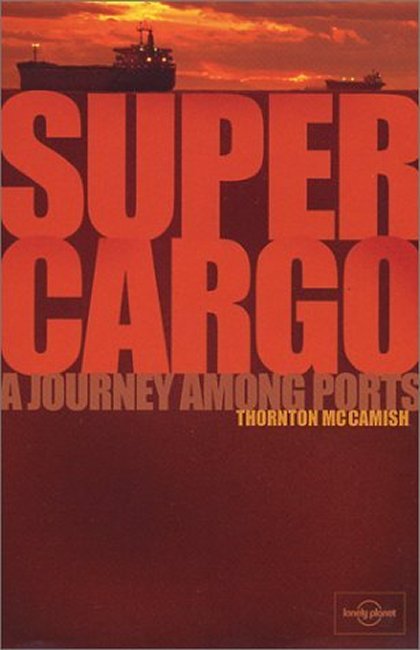
That’s what it says on the back cover anyway, I can only assume that whichever marketing person wrote that had had a very generous liquid lunch beforehand and probably hadn’t read the book. There is very little that is actually very funny or even mildly amusing about this book, instead McCamish seems to spend most of his time moaning about how bad the journeys he makes are and the lack of the romance of foreign ports. I did make it to the end to see if it improved but it was a struggle where I abandoned the book several times, which is a pity as up until now I have loved the books from the now defunct Lonely Planet Journeys series.

There are actually three journeys described in the book, the first being a bit of a cheat bearing in mind the books subject as it starts with a flight from London and then uses normal passenger ferries on the western Mediterranean Sea to travel from the south of France to Tunisia and then onto Italy where he bounces around the coast, rather than the cargo vessels implied in the title. The second trip again starts with a flight but does at least use a cargo ship but is also in the Mediterranean although in its eastern side from Italy to Greece then Lebanon, Syria and Turkey before returning to Italy. Nowadays Lebanon and Syria suggest a little danger but this was the year 2000, four years after I visited both countries and they were perfectly safe if a little infuriating when trying to get documentation stamped for onward trips. It should be noted, for those people unfamiliar with the concept, that it used to be quite common for cargo ships to carry passengers and they had cabins of varying quality specifically to do this, with the passengers normally eating with the officers. I remember advertisements for travelling on the ‘banana boats’ across the Atlantic and was very tempted but these were fast ships with luxury offerings and were beyond my means. McCamish was therefore travelling on the very tail end of what was a ‘normal’ way to get around before widespread commercial air travel and the reduction in cargo crew sizes with the corresponding shrinking of superstructure meaning passenger cabins are rarely even included in a modern cargo ship.

I was therefore looking forward to a description of a now largely vanished means of travelling around the world, although it is still possible see here, and to find only the third trip to involve any sort of real distance and that one he missed two possible posts to catch, only eventually reaching the ship at the Canary Islands after flying from the bottom of Italy. This journey consisted of travel on two ships, one down the west coast of Africa to Cape Town with no stops, the second took him along the east African coast to India from Mauritius (which he got to by plane) via Madagascar, Tanzania, Zanzibar and Kenya. This last trip had a captain that really didn’t like the idea of passengers, or possibly this passenger in particular, and frankly I was pretty fed up of McCamish by now and his descriptions of miserable travelling conditions at sea interrupted by brothels and bars on land. I’m sure there is a great book out there about travelling on cargo vessels but this isn’t it. At the end McCamish admits whilst preparing to leave India “Then I would board my plane for the last leg of a sea journey which must have set the record for air miles covered by someone writing about the sea.”

Travels with Charley – John Steinbeck

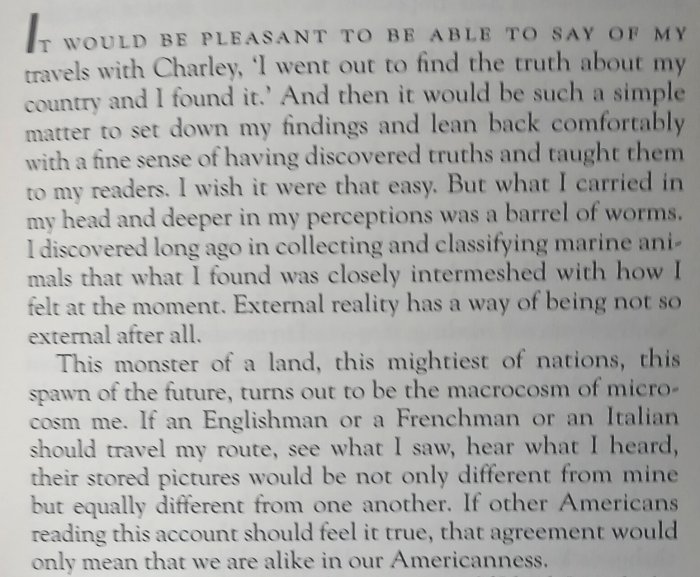
Towards the end of his life Steinbeck felt the need for one last adventure, this was 1960 and he would die of heart failure in 1968 aged just 66. His wife had long been concerned about his health and his heart condition, brought on by his heavy smoking had flared up several times in the preceding years and she was worried about his plans to travel right round the country in a converted camper van with his standard poodle, Charley, as theoretically his only companion. But Steinbeck wanted to reconnect with America, as he says at the beginning of the book:

The plan was to drive up from New York into Maine and explore the back roads of that sparsely populated state before heading along the Canadian border and into Canada by Niagara Falls, before coming back into the USA and travelling up through Illinois, Wisconsin and Minnesota then along the northernmost border to the coast, trying to stay off interstate freeways as much as possible. The first stumbling block was going into Canada with Charley, the Canadians were fine but, as is still the case, the USA border patrol were not, so Canada was dropped from the route. The less busy roads were also too slow so freeways appear more and more as the journey went on, but those kept him away from the people he wanted to talk to to see how their lives were changing so a sort of compromise was decided on where open countryside was driven through as often as practical.

The book when it came out in 1962 was a hit although it soon became clear that although Steinbeck had genuinely driven around the USA the text was less a travelogue than a carefully created artifice. That’s not to denigrate the book or the stories it tells, which are funny and at times distressing and provide considerable insights into how America had changed over the decades since Steinbeck had left his native California for the east coast and New York State. But it should be taken into consideration that Steinbeck was a great novelist, he was to win the Nobel prize for Literature just after this book came out, and probably couldn’t resist moving stories around and inventing dialogue to make his point. Also the actual trip was considerably more luxurious, and less lonely, than made out in the book, of the seventy five days he was away from home he spent forty five in hotels with his wife, Elaine, and on more than half of the remaining thirty days he either stayed in motels or trailer parks or parked the camper van at the home of friends. Steinbeck’s son, also called John, said that his father invented almost all of the dialogue whilst writing the book but frankly I don’t care, it’s a fun read and you do learn a lot about America on the turn of the 1950’s into the 1960’s.

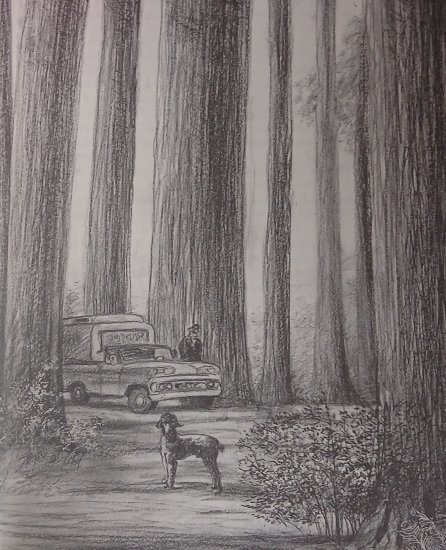
It is a very uneven travelogue anyway, by page 160 of the Folio Society edition I have we are in Seattle having left New York State and travelled along the US/Canadian border, so just one side of the rough rectangle planned for the journey. On that basis we should be looking at a four or five hundred page epic but instead it is only 241 pages in total, so over two thirds of the mileage is covered in a quarter of the pages and the detail in the first three quarters is lost in the remainder. That said I actually think the last quarter is the most important, as we have Steinbeck returning to search for his roots in California and finding that they are irretrievably lost. Cannery Row has been gentrified and he barely recognises the places of his childhood. Charley is also confused but that is mainly down to the visit to the giant redwoods which are so huge that he doesn’t seem to see them as trees and finds a small bush to mark instead.

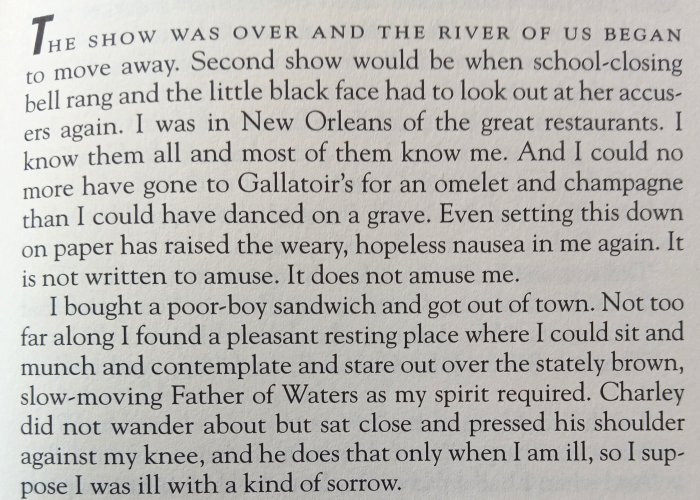
But it is pretty well the last section that is the most important of this ‘almost’ documentary and drives home Steinbeck’s dislike of some of what he found on his journey when he goes to New Orleans in search of ‘the Cheerleaders’. These frankly repellent middle aged white women gathered each day to scream abuse at six or seven year old children going or leaving school who just happened to be a different colour than they were. Steinbeck was appalled by them and the crowds they pulled together which meant the children needed police support just to go to school.

I’m going to leave it there.

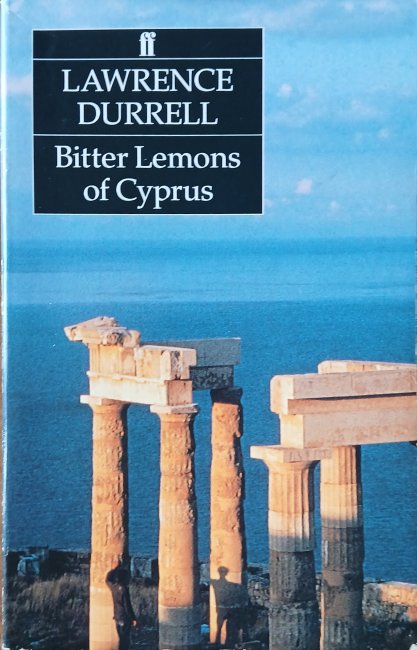
Bitter Lemons of Cyprus – Lawrence Durrell

Following on from his brother Gerald’s book last week, this is one of Lawrence Durrell’s travelogues and covers the years he spent in Cyprus from 1952 to 1956 after he left the British Council in Belgrade and planned to restart his novel writing, hopefully inspired by returning to a Greek island. Although he was there with his very young second daughter Sappho, born 1951, and without his wife who had been hospitalised back in England with post-natal depression you wouldn’t really know it as he largely avoids his family problems in the book. Indeed apart from a brief mention of Gerald, whom he claims had died in Thermopylae fighting alongside the Greeks in order to calm down a somewhat drunk Greek in a bar there are very few family references.

Sappho makes her first (and unnamed) fleeting appearance on page 102 and then only to note that she could see Turkey from an upstairs window of the house Lawrence is having renovated. Lawrence’s mother even makes an appearance, mainly I suspect to look after Sappho whilst Lawrence is working away to support the renovations, and Gerald threatens to appear, which as Lawrence points out would be awkward due to his apparent death at Thermopylae. One odd thing did occur to me at this point, why could the brother who died fighting not be thought of as Leslie, anyone who has read Gerald’s accounts of growing up in Corfu knows that there is another brother but Lawrence seems determined to ignore his existence, much as Gerald left out Lawrence’s first wife Nancy whom he lived with throughout the time the family were in Corfu and not with the rest of the Durrell family as stated in the books, and with whom he had his first daughter, Penelope.

Back however to this book, chapters vary wildly from good humour and even hints of farce when considering the purchase of the house and the crazy driving from person to person to get the legal process complete before they are caught up with by the rest of the sellers family who don’t think she is getting enough money for the property; to extremely serious such as the chapter entitled ‘A Telling of Omens’ which deals with the issue of Enosis, or the proposed union of Crete with mainland Greece and thereby ending the British rule, which was still in place whilst Lawrence was there. You can tell when reading this chapter that Lawrence initially didn’t believe that this would such an issue and neither did the Cypriots he lived amongst. It is only from the older students he started teaching English to in order to raise money to complete the house that he starts to see the first flickering of the violent unrest that is less than a few months away. But from this point onwards the tone of the book changes, turning from gentle humour to deadly serious as the situation on Cyprus quite literally explodes.

Lawrence was also a poet and the book ends with his poem Bitter Lemons, as does this review, but the beauty of his text can be seen in this extract describing a beach at dawn.

In the fragile membranes of light that separate like yolks upon the cold meniscus of the sea when the first rays of the sun come through, the bay looked haunted by the desolate and meaningless centuries which had passed over it since the first foam-born miracle had occurred. With the same obsessive rhythms it beat and beat again on that soft eroded point with its charred looking sand: it had gone on from the beginning, never losing momentum, never hurrying, reaching out and subsiding with a sigh.

When Gerald and his wife arrive Lawrence is about to take on a new role as press adviser for the colonial government which would mean living in the capital rather than his out of the way village so he basically left the house in Gerald’s care during the week, only returning at weekends. This role also gives him an insight into the ramshackle government operation which is totally ill prepared for what is to come and it is this summary of the failings of the British administration that makes the book so important as a document of the times. The book changes tone roughly halfway through as Durrell leaves the realm of good natured village life and instead describes the slow disintegration of all that he had come to love about Cyprus and the introduction of thousands of British troops to try to put a lid on the bombings and shootings which would eventually lead to independence in 1960, long after Durrell had left the island.

The Third Voyage – Captain James Cook

Before his third, and final, voyage Cook was formally given the rank of Captain and was officially retired, assigned to Greenwich Hospital at the age of just forty seven. He accepted this transfer off active duty on the basis that he would be allowed to come back and this he duly did, taking command of the apparently refurbished HMS Resolution in 1776. This time he was tasked to head north in search of the fabled North-West Passage which would give a route above the top of Canada between the Atlantic and the Pacific oceans. This had been sought for many years starting from the north Atlantic, Cook’s instructions was to start off Alaska and see if the route could be discovered coming in the opposite direction. Charts at the time for this part of the world were poor to say the least with one of the maps showing Alaska as a giant island off the coast of Canada although the Danish explorer Vitus Bering had discovered the Strait that bears his name many decades earlier whilst in the employ of the Russian navy.

In the absence of any alternative route Cook headed south to go north as he first had to enter the Pacific. The first thing that strikes the reader as we head back to familiar territory of New Zealand, Tonga and Tahiti is that the book is written in a very different style compared to the first two voyages. Instead of the formal naval journal with each day detailed with position, wind speed, heading etc. we get a manuscript that is far more aimed at the lay reader where a lot of the technical information is dispensed with and it reads much more like a diary. I have checked this with the full 1784 first edition to make sure that this style is not just a creation of the abridgement and that book is also in this more readable style so Cook was clearly aiming at publication from the start. Sadly he was never to see the book come out as he was to die on this voyage and never return to England but the manuscript that was to be published was just 17 days behind when he died so he must have been constantly working on it whilst at sea.

Cook had another reason to go to the South Pacific and that was to return Omai, a native of one of the islands with Tahiti who had travelled back on HMS Adventure as part of Cook’s second voyage. Omai was the first Polynesian to visit Europe and had achieved celebrity status whilst he was there and his return was the publicly stated reason for the trip as the search for the North West Passage was kept secret. It took longer to get to the South Pacific than intended so Cook decided that by the time he headed north it would be too late to attempt the search so stayed in the southern summer before heading north the next year and on his way became the first European to encounter Hawaii, or the Sandwich Isles as he named them after the then First Lord of the Navy, Lord Sandwich. Cook’s two ships HMS Resolution and HMS Discovery, commanded by Captain Charles Clarke, arrived at an opportune time as the islanders believed that their god was due to arrive at pretty well the same time as Cook did so they were treated royally and the elaborate ceremonies are described in the journals. When he finally left to continue north he was somewhat later than the predicted date for the god’s departure and the islanders were getting a little annoyed that he had not gone according the the plan.

Cook then headed north sighting Oregon and then following the coast of Canada, all the way to the Bering Strait producing the first accurate maps he then went east across the top of Canada before being stopped by ice bu which time he had gone past 70 degrees north. Turning round he headed west and continued on that heading, mapping the Siberian coast of Russia before again being stopped and having to go back to the Bering Strait. By then it was September and nothing more could be done so far north so he decided to return to Hawaii where they had been so welcome. The ships stayed for a month and were again welcome but soon after leaving a mast broke and knowing nowhere else he could go to effect repairs Cook went back to Hawaii and this time he was definitely not expected, Lomo was supposed to appear then leave and not come back again so soon and relations between the islanders and the ship’s crew rapidly deteriorated leading to the killing of Cook.

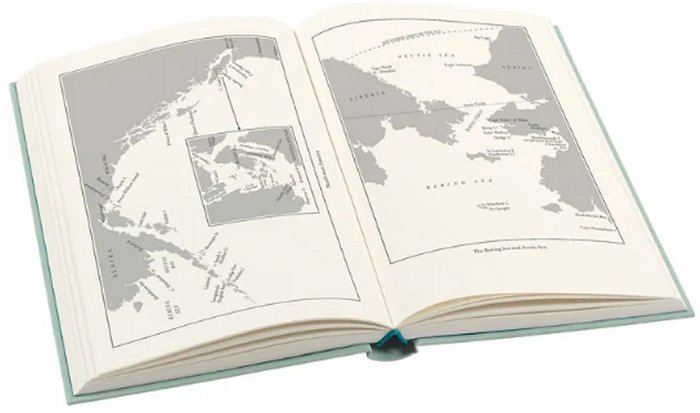
Now at this point the two versions of the book I have separate as the first edition is just two volumes in to a three volume set, the third volume being written by Captain King, whilst the Folio edition pretty well stops here presumably as the set is called the Journals of Captain Cook and he is now dead. The three books that make up the Folio set are however an excellent summary of what should in fact be a much larger nine volume set if you had the full version but it is no less good for that. Anyone interested in voyages of exploration should definitely read Cook and this is one of the most approachable editions being beautifully typeset and therefore a pleasure to read. One oddity of the images that I have used from the Folio Society web site is seen below as the picture of the included maps appears to show them in the middle of the book whilst they are in fact at the front of each volume.

The Second Voyage – Captain James Cook

Continuing with the voyages of Captain James Cook, the second trip had much greater funding than the first and Cook had charge of two vessels, Resolution and Adventure with Cook leading from HMS Resolution and HMS Adventure captained by Tobias Furneaux. They were charged with trying to discover the supposed great southern continent then known as Terra Australis, modern day Antarctica as opposed to Australia which was called New Holland at the time. It was believed by many scientists that such a mass of land must exist, if only as the source of the icebergs. The other thing that Cook and Furneaux were to study was on behalf of the Board of Longitude. Calculating latitude, how far up or down you are in the world was relatively easy however longitude, how far round the world you are, was much more difficult and ideally needed accurate knowledge of the time back where you started and clocks and watches were highly susceptible to temperature and climate variations. Cook therefore had a watch made by Larcum Kendall which was a copy of that designed by John Harrison and alongside this a watch made by John Arnold, Ferneaux had two watches made by Arnold, these were to be tested at sea and their accuracy determined, Cook and Ferneaux duly set off in May 1772. I’ll be reading more about the search for accurate longitude in the fourth book of this months theme ‘Longitude’ by Dava Sobel.

Cook duly sailed south and spent months skirting ice fields, with the two ships becoming on the 17th January 1773 the first from Europe to cross the Antarctic Circle and the following day getting to seventy five miles from the continent itself but without spotting land due to the amount of ice between them and Antarctica. Cook describes himself as surprised that the ice they recovered from the ocean in order to replenish the ships water stocks was fresh with only a small salty coating which would soon melt off and wonders how sea water freezes without retaining salt without realising that this is proof of fresh water glaciers further south that have broken off and are simply floating past the ships. One interesting quote a few days earlier gives an idea as to how the crew were faring in the extreme cold again featuring Cook’s idiosyncratic approach to spelling.

Monday 4th January 1773: First and middle parts strong gales attended with a thick fogg, sleet and snow, all the rigging covered with ice and the air excessive cold, the crew however stand it tolerably well, each being clothed with a Fearnaught jacket, a pair of trowsers of the same, and a large cap made of canvas and baize, these together with an additional glass of brandy every morning enables them to bear the cold without flinshing.

Cook would make another trip south in December 1773 after spending time in New Zealand along with Tahiti and Tonga amongst others repairing and re-equipping his vessels, and indeed getting back with HMS Adventure as the two ships had lost one another in thick fog in February 1773. Fortunately anticipating such an occurrence there had agreed to meet at New Zealand if they parted in the Antarctic ice. This trip round the South Pacific islands enabled Cook to also reacquaint himself with people he had met on his first voyage and pass on the bad news that the islander who had accompanied Cook on that voyage had sadly died on his way from Indonesia to South Africa and had therefore never seen Europe.

The second trip in search of Antarctica was no more successful than the first and Cook became convinced that there was no great southern continent, what he did however prove was that none of the lands known and partly mapped reached down through the ice to the far south. Indeed there would be no confirmed landing on Antarctica until the Norwegians got there in 1895 but to my surprise Cook is definitely a pioneer of Antarctic exploration getting far further south than anyone else in his time, something I hadn’t realised until I read this book. I had always though of Cook sailing in warmer climes so to read the battles with ice in this volume was fascinating but by February 1774 he finally turned north again eventually arriving at Easter Island in the hope of trading for more supplies. However Easter Island was to be a disappointment, the rich fertile land described by the first European visitors, the Dutch, in 1720 had gone and the people were reduced to a subsistence existence, the population also appeared to be greatly reduced, clearly something had happened here but Cook didn’t have the time, or the inclination, to find out what as he needed supplies so headed back to Tahiti.

Cook would make a further attempt to head south in 1775, this time in the South Atlantic having passed the southern tip of South America and would briefly visit South Georgia. By this time although he still hadn’t seen land to the far south he was convinced there was something as he had realised that it was needed to be a source of the ice. He wrote on 6th February 1775:

We continued to steer to the south and SE till noon at which time we were at the Latitude of 58 degrees, 15 minutes South, Longitude 21 degrees 34 minutes West and seeing neither land nor signs of any. I concluded that what we had seen. which I named Sandwich Land was either a group of islands or else a point of the continent, for I firmly believe that there is a tract of land near the Pole, which is a source of most of the ice which is spread over this vast Southern Ocean.

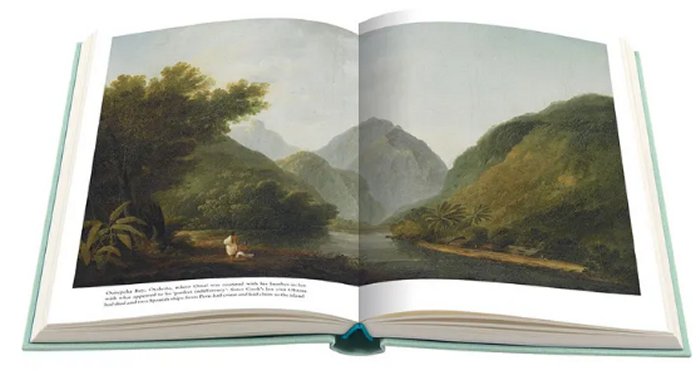
From the South Atlantic Cook finally turned north and sailed back to England, arriving in July 1775. The illustrations shown above are from Tanna, in the New Hebrides, now Vanuatu including a portrait of a native islander whilst below is the map that comes with this set which folds out to quite a good size.

The First Voyage – Captain James Cook

August is the month I read a theme and this year I have decided to tackle the journals written by James Cook describing his various voyages round the world. To do this I am starting off with the excellent abridged collection published by The Folio Society which is based on the JC Beaglehole version first published by The Hakluyt Society between 1955 and 1967. Beaglehole went back to Cook’s original manuscripts and ships logs and especially for the first voyage removed a lot of the extraneous material added by the Admiralty’s appointed editor which so annoyed Cook when he first saw the published work when he returned from his second voyage.

The barque HMS Endeavour set sail in August 1768 with 94 people aboard on what would be an almost three year voyage of exploration, both geographic and scientific as amongst the ships passengers were the eminent naturalist and Fellow of the Royal Society, Joseph Banks, and astronomer Charles Green specifically there to observe the transit of Venus from Tahiti. There were also other scientists to assist in the collection of specimens and a couple of artists, Sydney Parkinson and Alexander Buchan, sadly neither of which survived the trip. First port of call after leaving England was the island of Madeira for further provisions and where amongst other things they took on 3,032 gallons of wine (presumably the local fortified variety), twenty pounds of onions per man, 270 pounds of beef and amazingly a live bullock. I dread to think how killing the beast and its subsequent butchery were accomplished whilst crossing the Atlantic to Brazil on a crowded ship which was less than 100 feet (30 metres) long.

The first target destination was Tahiti for the observation of the transit of Venus due on Saturday 3rd June 1769 this was, as far as the Royal Society was concerned, the primary reason for the voyage because from this observation along with ones made in England and seven other locations around the Earth, it would be possible to accurately calculate for the first time the distance from the Earth to the Sun. Tahiti was chosen as one of the main points due to its distance from Europe, being the other side of the world therefore improved the accuracy of the calculation. By the time all the calculations were done the value was 93,726,900 miles, the modern value is 92,955,000 miles so remarkably close and within the variation of distance due to the fact the Earth does not orbit the Sun in a circle. Cook and his crew spent three months in Tahiti establishing a fortified base to make the observations from, this was necessary due to large amount of thefts that occurred from the natives who seemed to take things regardless of whether they were any use to them.

Leaving Tahiti the expedition was to search for the the legendary southern continent, but what they instead encountered was New Zealand, which had already been discovered by Abel Tasman the Dutch explorer. However over the next six months Cook would circumnavigate both the North and South Islands establishing that they were islands and mapping the coasts of them for the first time. Cook’s encounters with the Maori were fraught with disaster from the start with numerous native people being killed as they were deemed to pose a threat to either the ship or crew that landed in search of water, wood and fresh food. It is worth saying at this point that the quite small ship had by this time also taken on board some sheep as there are numerous mentions of grass being cut to feed them so it was not just the crew that needed sustenance. Cook’s interactions with the Maori people also seem to improve over the months there and there are far fewer documented fatal encounters beyond the initial landings.

After New Zealand Cook held a meeting to determine where they should go next and it was decided to sail west still looking for the southern continent. After sixteen days at sea they arrived at Australia, then called New Holland, and sailed up the north east coast of New South Wales and it is from Botany Bay that the animals shown in the plates above were seen. However whilst travelling up the coast disaster struck when on the 11th June 1770 the ship struck the Great Barrier Reef, which in this part of Australia comes very close to the shore, and was holed. After a few days they managed to get loose from the coral by dumping 40 or 50 tonnes of stores and the larger guns overboard. There then follows an interesting passage of around a month where Cook managed to beach the ship so that repairs could be undertaken and at least the large hole was repaired but the sheathing to protect the timbers was irreparable they also had considerable difficulty refloating the ship and getting back out of the trap they had found themselves in as the winds were against attempts to sail back south. Whilst trying to free themselves from a stretch of water deemed ‘The Labyrinth’ by Cook they finally managed, on 14th July 1770, to shoot one of the strange creatures spotted several times at a distance and therefore unidentifiable to find a odd animal.

The head, neck and shoulders was very small in proportion to the other parts; the tail was nearly as long as the body, thick near the rump and tapering towards the end; the fore legs were 8 inch long and the hind 22, its progression is by hopping or jumping 7 or 8 feet at each hop upon its hind legs only, for in this it makes no use of the fore, which seem to be only design’d for scratching in the ground etc. Its skin is cover’d with a short hairy fur of a dark mouse or grey colour. Excepting the head and ears which I thought was something like a hare’s it bears no sort of resemblance to any European animal I ever saw.

The entry for the 15th July includes the following observation “Today we din’d of the animal shott yesterday & thought it was excellent food”. So ended the first kangaroo examined by Europeans. The odd spelling is by the way directly from Cook’s journal, although a great seaman he was not highly educated and the spelling throughout the books is eccentric to say the least.

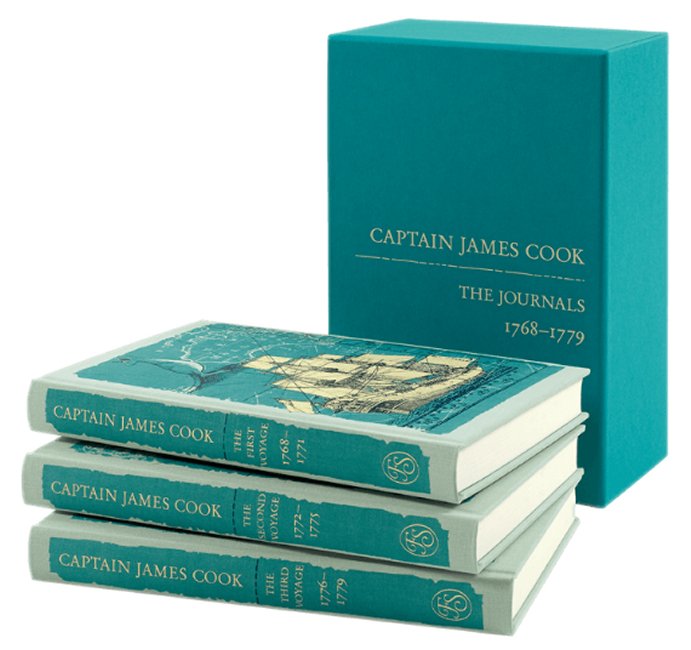
Above can be seen the Folio Society boxed set of the three voyages I am reading this month, I have the second printing from 2002.

Full Circle – Luis Sepúlveda

Part biography part travelogue this is an interesting book in that it consists of notes that were taken at various times but which didn’t make it into a book, and Sepúlveda didn’t really know what to do with for a long time.

These notes, which I can’t think what to call, lay about on a shelf somewhere gathering dust. From time to time, looking for old photos or documents, I would come across them, and I confess that I read them with a mixture of tenderness and pride, because in these scribbled, or clumsily typed pages I had made an attempt to come to terms with two themes of capital importance, aptly defined by the Argentinian writer Julio Cortázar: understanding what it means to be human what it means to be an artist.

The book starts with memories of being a boy being taken round town by his grandfather, Sepúlveda was born in 1949 so this would be the mid to late 1950’s in Chile, being loaded up with soft drinks and ice-cream until he was desperate to empty his bladder and then taken to whatever church his grandfather had picked as that weeks target and made to urinate on the church door. This would of course be met with approbation by the priest of the church but his grandfather would defend his right to pee where he needed to and would get satisfaction from the insult to the church thus engendered. Eventually at the age of eleven he simply refused to do his grandfathers bidding and insisted on going to a proper toilet. Expecting to be punished for refusing to so his grandfathers bidding he is relieved, in more ways than one, to simply be taken to a bar and after finishing is given a book to read (one of the classics of social realism – Nikolay Ostrovsky’s How the Steel was Tempered) and made to promise to go on a journey inspired by the book and also to his grandfather’s birthplace of Martos in Spain.

After the comic start it was quite a shock to read the next chapter which deals with his time as a political prisoner in Chile as inspired by Ostrovsky he had joined the Young Communists so under the right wing dictatorship of General Pinochet he was regarded as a dangerous radical. The descriptions of the appalling conditions and the allusions to the electrical torture endured including the doctor who could tell how much electricity had been imposed when the victims were returned to the prison and could therefore judge what treatment each prisoner needed to recover are graphic yet needed to be told and I can see why Sepúlveda couldn’t think of what to do with his notes about these three years of his life.

After this the book becomes more of the travel book implied by it’s title with trips out of Chile and into various other South American countries with greater or lesser success in getting to his aimed for destination and the people he met on the way. Including a trip to Patagonia when he was finally allowed back into his home country after years of exile which was originally intended to have been with the British writer and explorer Bruce Chatwin, who had sadly died young and before Sepúlveda could go to Patagonia. This is one of the times the notes had actually been the basis of a book ‘Patagonia Express’ first published in 1995 in Spanish and then in 2004 in English translation. After reading this book I feel the need to get hold of this work and see what it ultimately became. There is a lot more travel writing beyond this trip in the book and I greatly enjoyed following Sepúlveda around the continent.

The penultimate chapter takes Sepúlveda to Spain and a fulfilment of a promise to his grandfather right at the start to visit Martos where he starts searching for anything his grandfather had told him about the place especially a drinking establishment called Hunter’s Bar. He goes to the pub in the central square to make enquiries but the landlord doesn’t recognise the name however older patrons point out that the bar he is in was known decades ago as Hunter’s Bar so he had inadvertently discovered where he was looking for within minutes of arrival. This then leads to him telling the tales as to why he was there only for the patrons to take him en masse to the local church to consult the priest for birth records. There they find not only his grandfather but also his grandfather’s brother who is still alive in the town. Taken to the man’s house he eventually overcomes his nervousness and we go full circle as he introduces himself to his great uncle, Don Angel.

It’s a good read, difficult at times with the description of his time in prison but uplifting so many times after this dark period and I’m glad I’ve read it. It is another of the short lived Lonely Planet Journeys series which as I’ve explained before I bought a lot of when it was clear the series was being discontinued and am only now sitting down to read.

Cranes Flying South – Nikolay Karazin

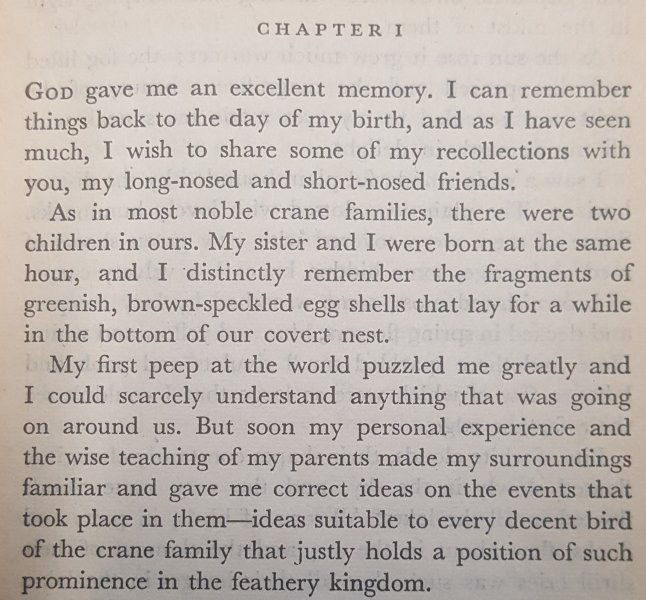
I knew nothing of this book or indeed its author before I picked up this copy a few days ago and there are no biographical details within the book either so onto the internet. Nikolay Karazin was a Russian soldier, artist and author of several books who was born in 1842 and died in 1908, he wrote and painted after retiring from the army and it is for his artwork that he is probably best known nowadays. I suspect the cover illustration is by him although no artist is credited. The English translation, by M.Pokrovsky, of his children’s book Cranes Flying South was first published in 1936 and this is the 1948 Puffin first edition. The book tells the story of the crane’s migration from the Ostashkovo marshes in north western Russia about halfway between Moscow and St Petersburg all the way over eastern Europe and Egypt following the Blue Nile to beyond Khartoum in Sudan, told from the point of view of a bird making his first long distance flight, as the book starts with him and his sister hatching.

His father, Clarion Trumpeter, is quite senior in the military like hierarchy supposed by Karazin to be normal in a colony of cranes especially during the migrations and in this he imposes his background. The story has them flying in structured triangles, which indeed they do, but regarding the stops on the way as camps with posted sentries and the discussions between senior cranes as to the best way to advance is rather more fanciful but does make for a good story. Amongst the other major characters is the Trifler, a crane known for his outrageously tall tales of his adventures and the leader of the colony Longnose the Wise. We never learn the name of our narrator or his sister, or indeed their mother but we are introduced to some of the cranes from another colony based in the Urals who join up as part of the massive flock taking part in the migration. On the way they also meet herons and storks both of which are regarded as inferior to the cranes, herons for their appetite as they will eat pretty well anything unlike the largely vegetarian cranes and storks for their relationship with man whilst cranes regard men as dangerous.

The journey south is full of incidents both with men hunting and also with bad weather which causes the loss of several cranes over open water when they get so exhausted by the buffeting winds but can find nowhere to safely land as cranes cannot swim. The descriptions of the route are also fascinating both the long slow journey over Russia and Ukraine then onto the mouth of the Danube before deciding to either cross the Mediterranean via a rest stop on Cyprus or skirting the coast from Turkey, Syria and Lebanon on their way to the Nile delta. Karazin had clearly read up on the ornithological knowledge at the time regarding the routes taken by cranes which seems to be largely correct according to the data I can find online. One particularly fun bit is near the end:

There are unimaginative persons unable to rise above the commonplace, who are generally very fond of ‘investigating’ things.
I am quite certain that several such persons, on reading of my travels will say: ‘How could he write it, when cranes have no ink and no paper?’
Such a remark will show, to say the least, a total lack of humour.

The book follows the full migration both to and from Sudan back to the breeding grounds in the Ostashkovo marshes and we get the full circle of life with our narrator pairing up with Blackneck, a crane originally from the Ural colony, and them having their own chicks. Sadly the book appears to be out of print but is quite easy to find second hand, it’s a lovely children’s story and worth seeking out.

Around the World in Eighty Days – Jules Verne

I could have sworn I read this book as a child, but as I continued reading nothing came back to my memory, of course I knew the basic plot, but as it is a very well known work I could have picked that up at any time however the more I read the less I recognised and I loved the full story. So how come I have clearly never read this before?

The base story, as I think everybody knows, is that Phileas Fogg, a man who notoriously goes nowhere other than to his home or club and whom is so punctual and set in his habits that you could set a watch by his movements raises the subject of the possibility of travelling around the world in just eighty days. When other members of the Reform Club are incredulous he agrees to wager the massive sum of £20,000 (£1.8 million in today’s money) that he can make such a journey and whats more without any prior planning for he will leave from the card game they are playing immediately. I also knew that he arrives back in London having been delayed and believes he has taken eighty one days and is financially ruined but is rescued by having crossed the international date line in an easterly direction and therefore has gained a day’s grace so makes it back to the club just in time. That is all I knew when I started the book, I had assumed that some travel disaster had occurred to delay him and was surprised by the true reason and knew nothing of the policeman, Fix, who had dogged his trail around the world in the mistaken belief that Fogg was the man who stole £55,000 from the Bank of England a few days before he set out on his journey.

I also knew nothing of Aouda who accompanies Fogg from India as I believed that his sole companion was his newly employed valet, the Frenchman Passepartout, whose name is the French for a master key which will enable you to go through any door in an establishment. Jules Verne must have spent a considerable amount of time pre-planning the trip as it is exquisitely timetabled, just how long each trip would take and how much time the travellers would have to make the next connection and how long they would have to wait if they missed such a rendezvous is all set out and is completely believable. Having sat down with railway and ship timetables to work out long over land and sea journeys in the past for my own holidays I am very aware just how complicated this could be before the age of the internet.

I loved the story, the development of the characters and the ingenious ways that Verne managed to keep them hearing ever onwards. Yes it is possible now to get round the world in less than a handful of days by simply getting on a plane, a mode of transport unavailable to Fogg back in 1873 when the novel was written and back in 1988 Michael Palin proved it was still possible to get round the world in eighty days without the use of aircraft, taking roughly the same amount of time as Fogg did in the novel. I heartily recommend this wonderful tale and I’m simply amazed that this was the first time I read it.

About the only thing I didn’t like about this Folio Society edition is the fold out map tucked into a pocket in the rear cover. It is unfortunately extremely difficult to read, which is a shame as clearly a lot of work had gone into it and it could also have been considerably improved by including a line indicating the path that Fogg and his companions took, definitely a missed opportunity there. The images in this blog were taken from the Folio Society website which I downloaded before the edition sold out and the book was removed from the site. As can be seen it is copiously illustrated with headings and tailpieces to each of the thirty seven chapters by Kristjana S Williams who also drew the map and the front cover.

The Hills of Adonis – Colin Thubron

First published in 1968, Colin Thubron’s second book finds him still in the Middle East, his first book from the previous year ‘Mirror to Damascus’ covered his travels in Syria and for his third which came out in 1969 he stayed in the same geographical region with a book set in Israel entitled ‘Jerusalem’. None of these early works are particularly well known today, especially compared to his more recent travelogues, indeed the most recent publication of ‘The Hills of Adonis’ I can find is from fifteen years ago, whilst my copy was published in 1987 during the last few years of the Lebanese Civil War. Thubron spent four months walking around Lebanon, a country of just 4,036 square miles (10,452 square km) so slightly less than half the size of Wales or for Americans roughly the size of the two smallest states combined (Delaware and Rhode Island) so it was possible to cover most of the sights in the country on foot in this time frame.

Thubron weaves his way up the country from the southern border with Israel, which even in the mid 1960’s was already a dangerous place to be, up to the northern border with Syria visiting most of the significant places on the way. The first part of the book however is also concerned with a breakdown of the mythology prevailing ancient Lebanon and for me this was convoluted and unnecessary in the amount of detail and number of pages dedicated to it. Fortunately after the first few chapters Thubron largely drops the subject and proceeds to describe the history, geography and most importantly the people of this tiny but extremely culturally diverse country. This is where the book really gets into its stride although it can be difficult at times to determine if he is writing about the near or ancient history of a place, he does rather bounce around a lot. But the people he meets are fascinating and because he includes tiny villages as well as the metropolitan centres you start to get a feel for the various peoples, the Maronites and Druze, the remains of ancient and isolated monastic orders, the agricultural people of the mountains and the largely more prosperous people of the coastal regions especially as he moves further north.

In the late 1960’s, at the time Thubron was travelling in Lebanon, it was a place largely at peace. This was before the civil war which would destroy large parts of the country and kill around 150,000 people in the fifteen years from 1975 and Lebanon was still seen as a significant tourist destination in the region. This is what initially drew me to the book, a snapshot of a now long vanished time and place and whilst I was in Lebanon just six years after the civil war ended, the destruction of its once beautiful capital was all too evident when I was there and it would have been impossible to replicate Thubron’s journey as the south of the country was still occupied by Israel and would be until the year 2000. Reading the book and seeing what Lebanon was like, and unfortunately has no obvious way of getting back to, is depressing but at least here is a record of what has been lost.

The cover picture, by Mark Entwhistle, is of the ruins of the palace in Anjar in the Bekaa region of Lebanon, which I photographed in September 1996, although from the opposite side of this particular surviving section. When Thubron got there the people were clutching radios tuned to Radio Cairo and waiting for war and he was deeply troubled by his experience there far from the peaceful scene depicted on the cover. Far from ‘driving the Israelis into the sea’ which is what everyone told him would happen the conflict that actually occurred turned out to be Six Days War where Israel defeated most of its neighbours in a series of decisive air strikes largely destroying the air forces of Egypt, Jordan and Syria in one day. But before then Thubron had left Lebanon and was presumably working on this book, which with all its faults is still an interesting read. Below are a couple of my pictures from Anjar.

a closer view of the arches