Jorrocks’ Jaunts & Jollities – RS Surtees

In 1949 The Folio Society decided to have a go at resurrecting the works of Robert Smith Surtees who had sadly dropped out of fashion since his heyday in the Victorian period with an edition of his first book, indeed his books used to be so well known that Virginia Woolf referred to this very title in the 1925 novel ‘Mrs Dalloway’ as her eponymous character was searching for a book suitable to take to a nursing home.

This late age of the world’s experience had bred in them all, all men and women, a well of tears. Tears and sorrows; courage and endurance; a perfectly upright and stoical bearing. Think, for example, of the woman she admired most, Lady Bexborough, opening the bazaar.

There were Jorrocks’ Jaunts and Jollities; there were Soapy Sponge and Mrs. Asquith’s Memoirs and Big Game Shooting in Nigeria, all spread open. Ever so many books there were; but none that seemed exactly right to take to Evelyn Whitbread in her nursing home.

Frankly if I was in a nursing home then Surtees may well be just the right author for my convalescence as the books are well written, with excellent observations on country life and Jorrocks is one of the great comic characters of the early Victorian age. This book was printed in only the third year of The Folio Society’s existence and was intended as a one off from this author in companion with a similarly designed edition of The Compleat Angler by Izaac Walton. However it was so popular that they subsequently published the remaining seven books by Surtees at the rate of one a year, making Surtees the first author to have their complete works published by the society.
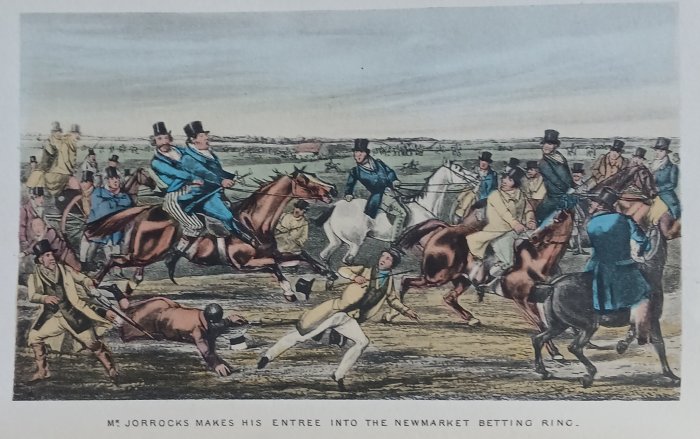
John Jorrocks is described as a grocer in the book but as he operates out of his own warehouse rather than a shop he is probably a fairly wealthy wholesaler based in London. He is a keen fox hunter, riding with the Surrey hounds based at the small country town of Croydon about ten miles from central London. Anyone who knows Croydon nowadays, it has a population of around two hundred thousand and has been largely subsumed by Greater London, will find the rural descriptions of the place in the 1830’s difficult to imagine but this really was the case back then. Jorrocks’ regular companion is Mr Stubbs who is normally simply referred to as The Yorkshireman and one of the funniest passages in this book describes a ride from the middle of London by both of these gentlemen to join the hunt on a particularly foggy day in the city with the chaos they cause or get involved in. As Surtees is not well known nowadays I’m going to include a couple of examples of his style. The Yorkshireman never seems to have any money but is quite happy to live off Jorrocks as in this plan for a weekend trip.

“Now to business—Mrs. J—— is away at Tooting, as you perhaps knows, and I’m all alone in Great Coram Street, with the key of the cellar, larder, and all that sort of thing, and I’ve a werry great mind to be off on a jaunt—what say you?” “Not the slightest objection,” replied the Yorkshireman, “on the old principle of you finding cash, and me finding company.” “Why, now I’ll tell you, werry honestly, that I should greatly prefer your paying your own shot; but, however, if you’ve a mind to do as I do, I’ll let you stand in the half of a five-pound note and whatever silver I have in my pocket,” pulling out a great handful as he spoke, and counting up thirty-two and sixpence. “Very good,” replied the Yorkshireman when he had finished, “I’m your man;—and not to be behindhand in point of liberality, I’ve got threepence that I received in change at the cigar divan just now, which I will add to the common stock, so that we shall have six pounds twelve and ninepence between us.” “Between us!” exclaimed Mr. Jorrocks, “now that’s so like a Yorkshireman. I declare you Northerns seem to think all the world are asleep except yourselves;

Jorrocks also loves his food and drink and there are long descriptions of meals and consuming numerous bottles of wine and port in one sitting. I particularly enjoyed the contrast between the eating manners of the English and French when Jorrocks takes The Yorkshireman with him on a trip to Paris and the slow appearance of course after course in France confuses him rather than the everything on the table to start with which was then the preference in England and he assumes he is going to starve due to the lack of visible food. Early on in the book he invites The Yorkshireman round for breakfast before heading out to the hunt.

About a yard and a half from the fire was placed the breakfast table; in the centre stood a magnificent uncut ham, with a great quartern loaf on one side and a huge Bologna sausage on the other; besides these there were nine eggs, two pyramids of muffins, a great deal of toast, a dozen ship-biscuits, and half a pork-pie, while a dozen kidneys were spluttering on a spit before the fire, and Betsy held a gridiron covered with mutton-chops on the top; altogether there was as much as would have served ten people. “Now, sit down,” said Jorrocks, “and let us be doing, for I am as hungry as a hunter. Hope you are peckish too; what shall I give you? tea or coffee?—but take both—coffee first and tea after a bit. If I can’t give you them good, don’t know who can. You must pay your devours, as we say in France, to the ‘am, for it is an especial fine one, and do take a few eggs with it; there, I’ve not given you above a pound of ‘am, but you can come again, you know—waste not want not. Now take some muffins, do, pray. Batsey, bring some more cream, and set the kidneys on the table, the Yorkshireman is getting nothing to eat. Have a chop with your kidney, werry luxterous—I could eat an elephant stuffed with grenadiers, and wash them down with a ocean of tea; but pray lay in to the breakfast, or I shall think you don’t like it. There, now take some tea and toast or one of those biscuits, or whatever you like; would a little more ‘am be agreeable? Batsey, run into the larder and see if your Missis left any of that cold chine of pork last night—and hear, bring the cold goose, and any cold flesh you can lay hands on, there are really no wittles on the table.

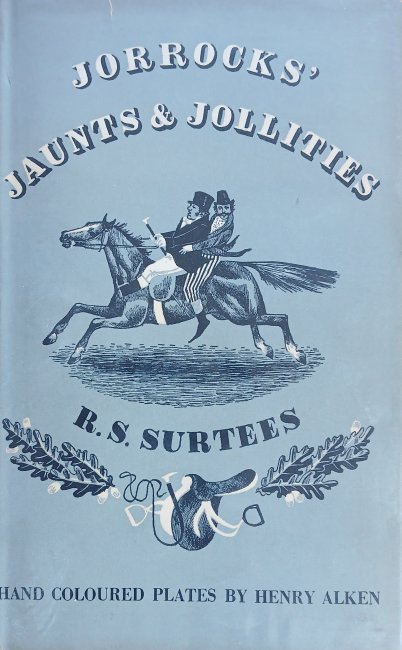
A note should be made regarding the fifteen colour plates included in the book as they were done by a technique that had largely disappeared by 1949. The plates, which are those by Henry Alken originally included in the book back in 1838, were in fact printed in monochrome and individually hand coloured by Maud Johnson who went on the do the same for the further seven volumes Folio printed of Surtees’ works. The Folio Society doesn’t include printing numbers for their books in the various bibliographies they have published but it can be imagined what a huge amount of work this involved for one person, but the effort was worth it as these illustrations really stand out. The pages for the prints are noticeably thicker and stiffer than the pages of text presumably to allow for Johnson’s use of watercolours to do the colouring without distorting the paper. Other than special very limited editions these eight volumes are the last books with hand coloured plates printed in England that I am aware of although I’d love to know of any others. The Folio Society continued to use the original plates throughout the series of reprints which was finally complete in 1956 with this being the only one illustrated by Alken, most of the others are done by John Leech.

Far From the Madding Crowd – Thomas Hardy

I have to admit that in the over three decades I have owned this book, as part of a set of six novels by Hardy from The Folio Society, I have attempted to read it at least three times. Initially when I bought it back in 1993 and then again probably ten years later, where according to the bookmark I found inside I made it to page 84 out of 413, this time I read and thoroughly enjoyed the book in just four days during the last week. I don’t know why I failed the first two times, some books you just have to be in the right frame of mind to appreciate them.

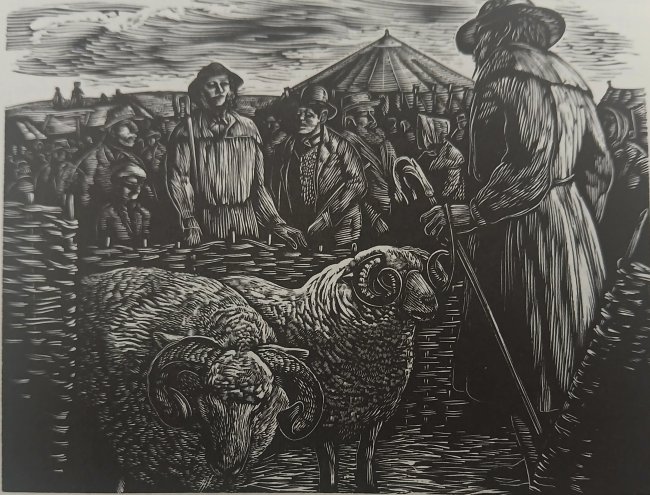
There are five main characters, I’ll tell as much of the start of the novel to set out how they stand with each other. Gabriel Oak who starts the novel as a farmer in good standing with two hundred sheep and a couple of sheepdogs, the younger of which would lead to his ruin by one night driving his entire flock over a cliff edge to their deaths, The sheep were not insured but by selling everything he owned he managed to cover his debts. Also appearing at the start of the book is Bethsheba Everdene, a young woman whom Oak falls in love with, pretty well at first sight, but she does not return his affection. She however soon leaves the vicinity, before Oak’s disaster with the sheep, and he knows not where she has gone. Oak, now penniless takes himself off to a hiring fair hoping to get a job as a bailiff (farm manager), failing to do so he reverts to his skill as a shepherd but still doesn’t get a job so decides to try the next fair in a nearby town. On his way he sees a hayrick on fire and endeavours to put it out, his bravery is soon noticed by the labourers on the farm as they race to his assistance and on the back of this he is offered the job as shepherd by Mistress Everdene who it turns out had inherited this very farm which is why she left the area where Oak was living. Still very much in love with Bethsheba but now so reduced in fortune as opposed to her meteoric rise he realises that he can never hope to gain her hand in marriage.

On coming into the village after the fire is extinguished he encounters the young Fanny Robin who it turns out has that night left the house where she was employed as a servant without telling anyone and is running away to her love, a Sergeant Troy in one of the local regiments who has promised to marry her. Troy however is an out and out cad as will become obvious as the book progresses. This leaves one more major character, the owner of the farm adjacent to Bethsheba Everdene’s, Mr Boldwood, I don’t think we ever find out his first name. In a moment of fecklessness Bethsheba sends Boldwood a valentine one year even though she doesn’t love him and this prompts the bachelor to look again at his neighbour and consider marriage for the first time in his life and this will lead to all sorts of problems as the book progresses. These five characters with their interrelationships drive the whole plot but around them the description of rural life and its nearness to poverty is brilliantly told by Hardy, take the following example, which also shows the expression of the local dialect which pervades the novel, this is just after Oak has been retained as shepherd after his heroics with the fire.

The book, like all Folio Society editions, is beautifully illustrated, this time with thirty one wood engravings by Peter Reddick who worked on all of their Thomas Hardy volumes, around twenty of them, making him the first artist to completely illustrate Hardy.

It was only at the end of the book that it dawned on me how young the major characters are, Gabriel Oak is one who is given a definite age, that of twenty eight at the start of the novel which covers the span of around four or possibly five years so he is thirty two or thirty three at the end of the story. There then becomes the slight problem of the age of Bethsheba Everdene caused by two statements by Gabriel which disagree. In chapter twenty nine – Particulars of a Twilight Walk he says he is six years older:

But in chapter fifty one – Bathsheba Talks with Her Outrider he says there is eight years between them and Bethsheba agrees:

As she agrees and she knows him better by now, as it is near the end of the book, I’m inclined to the eight year gap meaning she was twenty at the start of the novel and twenty four or twenty five at the end. Suddenly it dawned on me just how young she was when she inherited the farm and started running it by herself and that brings a new perspective to her fearlessness and possibly recklessness in deciding to do that. Mr Boldwood is described as ten years older than Oak so allowing for Oak’s approximations in the earlier passage we can say he is in his early forties by the end, which fits with his position as a confirmed bachelor early on in the narrative as he would hardly be described as such if much younger than his late thirties. Sergeant Troy is stated as twenty six at the end of the book and Fanny Robin is twenty, so she was just fifteen or sixteen when she started her relationship with Troy. However I can’t include a picture of where these ages come from without giving away a large part of the end of the book, which I don’t want to do.

I’m so glad I had another go at reading this book and I’m now not sure why it has taken me so long to finish it as I have greatly enjoyed this tale of Victorian life in south west England, so much so that I’m considering which one of the other six Hardy novels I own to tackle next.

The Mystery of Orcival – Emile Gaboriau

Emile Gaboriau is largely forgotten now, especially in English translation, but he was a near contemporary of Sherlock Holmes creator Arthur Conan Doyle and his detective Monsieur Lecoq who appears in five novels and one short story by Gaboriau along with four novels by other writers all produced after Gaboriau’s untimely death at the age of just thirty six in 1873. Indeed Gaboriau was well enough known for Doyle to refer to him directly in the very first appearance of Holmes in the novel ‘A Study in Scarlet’ in 1887.

“Have you read Gaboriau’s works?” I asked. “Does Lecoq come up to your idea of a detective?”

Sherlock Holmes sniffed sardonically. “Lecoq was a miserable bungler,” he said, in an angry voice; “he had only one thing to recommend him, and that was his energy. That book made me positively ill. The question was how to identify an unknown prisoner. I could have done it in twenty-four hours. Lecoq took six months or so. It might be made a text-book for detectives to teach them what to avoid.”

A Study in Scarlet – Arthur Conan Doyle

Watson is upset at having two of his favourite detective writers dismissed as such amateurs, Gaboriau’s Lecoq along with Edgar Allen Poe’s Dupin

I felt rather indignant at having two characters whom I had admired treated in this cavalier style. I walked over to the window, and stood looking out into the busy street. “This fellow may be very clever,” I said to myself, “but he is certainly very conceited.”

A Study in Scarlet – Arthur Conan Doyle

To be fair to Holmes Lecoq is certainly an unusual character even wearing disguises at work so that his enemies, presumably people he has prosecuted and their associates, cannot find him to exact revenge “I have been a detective fifteen years, and no one at the prefecture knows either my true face or the colour of my hair.” He is clearly very intelligent and like Holmes sees inferences in the slightest clue which enables him to leap ahead of the other people on the case, what he lacks is a Watson where the conversations between the two keep the reader up to date with the plot. I enjoyed my first encounter with Lecoq in this his second novel although I also own a copy of his first appearance ‘L’Affaire Lerouge’ so I doubt it will be my only dalliance with this early policeman, and indeed the first time in fiction of a French detective. 

If I have one criticism of the novel it is the sudden appearance of a lot of back story, which in my copy starts on page 109 and runs until page 195, almost a third of the entire novel, and which kills the entertaining narrative up until then, effectively providing a pause in the story. This would probably have been better handled in an earlier part of the novel rather than pull the reader back to a time before the various crimes have been committed and deal with the relationships between the various characters, some of which are already dead by the time this extra information is provided. The sheer length of this section became frustrating as up until then the story had proceeded apace but suddenly we became bogged down in apparently irrelevant details, some of which do prove to be extremely relevant later. Yes we need this information to make full sense of the story but I don’t think it needed to be done in this way. This however is my only criticism of the novel, the various twists, that are revealed are very well done and whilst the reader can congratulate themselves in spotting the main suspect very early on the fact that this is confirmed just ninety pages in shows that you are probably supposed to work out the original protagonists according the provincial justice department were just red herrings.

The story when it eventually restarts at the case in hand is just as fast moving and ingenious as it was previously with Lecoq in control of chasing down the murderer whilst also willing to bend the law to protect the woman he is with, who would surely otherwise be dragged through the courts with her honour besmirched unnecessarily. Apart from the slow mid section of the novel I greatly enjoyed this early detective story from the 1860’s and Gaboriau was clearly an extremely capable pioneer of the genre who deserves to be far better known today than he is.

The Time Machine – H G Wells

First published in 1895 The Time Machine largely created a whole new genre of fiction, for this was the first use of the phrase ‘time machine’ applied to a device to enable time travel and the first time such a machine was described. I bought my edition new in 1975 and because the title story is basically a novella, being just under one hundred pages long, the book also includes another of Wells’ short stories ‘The Man Who Could Work Miracles’, more of which later on in this review.

Throughout the book the main protagonist and inventor of the machine, is simply referred to as ‘The Time Traveller’, no other name is given and indeed only one of the characters we meet at the start and end of the story, which is set in what was then the present day, i.e. late Victorian London, is named, if we get anything for the others it is simply their professions. The story starts with ‘The Time Traveller’ hosting his weekly dinner club of friends and producing an intricate model of what he claims, to pretty well universal disbelief, is a time machine, placing it on a table he adjusts a lever and it vanishes. He then leads the incredulous small party into his laboratory and shows them the almost complete full size version. He explains that he will complete it in the next few days and will tell them all about his adventures at the following weekly gathering. He arrives late for this meal and is clearly dirty, injured and limping so he apologises, goes to wash and change and then after ravenously eating his fill heads off to the smoking room to tell his tale.

The story he tells of a journey into the far future to the year 802701 where he meets a race of small people called the Eloi who appear to have an idyllic lifestyle, eating the abundant fruit growing all around them, living in huge partially ruined buildings and having no need to work or otherwise stress themselves. It soon becomes clear however that they are terribly afraid of the dark. The Time Traveller however has a very specific and different fear, which is that in the morning when he goes back to his machine he finds that it has disappeared and he is therefore trapped in the future. The descriptions of how The Time Traveller gradually works out what the true and terrifying situation that the Eloi are in and the dangers posed by the subterranean Morlocks who had taken his machine is wonderfully done. You can see him slowly working out the real relationship, after several false starts, between the two races that have descended from man as he knew it and the disgust he feels at his conclusions until eventually he manages to retrieve his machine and escape.

The various radio, TV and film dramatisations of the book have varied wildly in their use of the original material so I recommend reading the story as Wells intended. It’s an extremely good tale and as I wrote at the start of this review it gave birth to a whole genre of travellers in time using a machine of some sort to do so.

The illustration on the cover is by Alan Lee now best known for his work as conceptual designer, with John Howe, on the Lord of the Rings and Hobbit films but is a book illustrator par excellence see the Folio Society limited edition of The Wanderer I reviewed back in early 2020. As I would expect from an artist with his attention to detail the machine and indeed the attacking Morlocks are exactly as described in the book.

The Man Who Could Work Miracles

Also set in late Victorian England, this story was first published in 1898, we have if anything a more amazing tale than ‘The Time Machine’ as we follow the misadventures of a man who unexpectedly finds he has developed miraculous powers. Mr Fotheringay starts the tale in a bar where an argument was unfolding regarding the impossibility of miracles to demonstrate his point he gets agreement that the oil lamp in front of them would not be able to continue functioning normally if it was upside down and then says “Turn upsy-down without breaking, and go on burning steady”. To everyone’s amazement, including his own, the lamp does exactly that, but he finds that he has to expend considerable mental effort to hold it like that so it soon crashes to the ground. This was his first miracle but would definitely not be his last.

Fotheringay experiments with his power when he returns home and in the morning continues outside with ever wilder attempts which he sometimes gets wrong by not wording exactly what he wants to happen precisely. Until when surprised by a policeman whom he had accidentally hit with his stick he sends him to Hades and then repents and decides to move him to San Francisco presumably because it is far away and marginally better than Hell. Ultimately, again whilst not considering his words fully, he causes massive death and destruction and realising his mistake for his last miracle returns everyone and everything back to the bar just before he upturned the lamp and also removes his ability to perform miracles. It’s a really fun story and again Wells is experimental in his style with a fantasy story set in his present day,

I always associate Wells with late Victorian times, possibly because of books like The Time Machine and War of the Worlds both of which were written in the 1890’s but he wrote throughout most of the first half of the twentieth century, dying in 1946 at the age of 79. Until writing earned him enough money to give up he mainly worked as a teacher, indeed he was A A Milne’s first science teacher. The Time Machine was his first novel but he had been writing short stories and journalistic articles for several years before that honing his skills that would make him a world famous author.

The Turn of the Screw – Henry James

Probably Henry James’s best known novel, The Turn of the Screw, is a ghost story and although I’m not a particular fan of this genre I have to admit that the suspense builds superbly and that I thoroughly enjoyed this rare wander into the supernatural. Although born in New York in 1843 James moved to Europe in 1869 and finally settled in England in 1876 where he lived until his death in 1915 a year after gaining British citizenship. The book, written in 1898, reflects this and reads much more like a Victorian English novel rather than one from his homeland, indeed if I hadn’t known the author was an American I would never have guessed it from the style. The initial premise that it is a story read out to a group of friends from an old manuscript seems similar to so many British mystery and crime novels from the golden age of the 1920’s and 30’s although predating them by at least twenty years that the structure of the work felt so familiar. A group of friends are gathered at Christmas and are telling tales of supernatural events when Douglas stands up and referring to the previous tale starts to introduce his own story…

“I quite agree – in regard to Griffin’s ghost, or whatever it was – that its appearing first to the little boy, at so tender an age, adds a particular touch. But it’s not the first occurrence of its charming kind that I know to have been concerned with a child. If the child gives the effect another turn of the screw, what do you say to two children?…”
“We say, of course,” somebody exclaimed, “that two children give two turns! Also that we want to hear about them.”
I can see Douglas there before the fire, to which he had got up to present his back, looking down at this converser with his hands in his pockets. “Nobody but me, till now, has ever heard. It’s quite too horrible.” This was naturally declared by several voices to give the thing the utmost price, and our friend, with quiet art, prepared his triumph by turning his eyes over the rest of us and going on:
“It’s beyond everything. Nothing at all that I know touches it.”
“For sheer terror?” I remember asking.
He seemed to say it wasn’t so simple as that – to be really at a loss how to qualify it. He passed his hand over his eyes, made a little wincing grimace. “For dreadful— dreadfulness!”
“Oh, how delicious!” cried one of the women

As you can see this passage from the preface to the novel introduces the title which is then not referred to. The two children are brother and sister Miles, aged ten, and Flora, aged eight, who start off being simply strange but rapidly become more than a little creepy. The story is told by their governess who was appointed to this position at the beginning of the book and the gradual loss of her composure as she discovers that the country house where she is working is haunted by two ghosts, the masters late valet Peter Quint and the children’s previous governess Miss Jessel. Only other servants live at the country house as the children’s parents are both dead and the house belongs to their uncle who never comes there, but lives in London, and as part of the condition of employing the new governess required her not to communicate with him. Her only support in dealing with the increasingly odd behaviour of the children, as they clearly seem not only to be able to see the ghosts but actively pretend not to and also appear to encourage manifestations is Mrs Grose the housekeeper who slowly reveals the history of the two characters. To add to the mystery Miles attended just one term at school before being expelled with no reason given by the headmaster and refuses to talk about his time there. When he was alive Quint apparently spent far too much time with Miles according to Mrs Grose and had an undue influence over the boy whilst Flora appears to have been rather too close to Miss Jessel.

The story is engrossing and was originally serialised in an American weekly magazine over a period of twelve weeks, so two chapters at a time. This probably explains the regular cliffhanger revelations at the end of the chapters thereby ensuring that the next section would be looked forward to by a presumably growing band of avid readers. I’m certainly glad to have finally got round to reading what Stephen King in his 1983 book Danse Macabre described as one of only two great supernatural works of horror in a century, the other being The Haunting of Hill House and I heartily recommend giving it a go.

This copy is from the Alma Classics Evergreens series which at the time of writing has an excellent deal available of ten books for just £30 with free UK shipping.

Silas Marner – George Eliot

I’ve made a few attempts at reading Middlemarch and have failed miserably each time but do feel there must be something to George Eliot to explain her popularity so when on lithub.com I came across the following ‘recommendation’

George Eliot, Silas Marner (1861) : Like MiddlemarchSilas Marner is exquisitely written and ecstatically boring. Unlike Middlemarch, it is quite short.

I felt I had to make a go of it and I have a 1944 first Penguin Books edition on the shelves, so Silas Marner here we come…

Like several of her contemporaries Mary Anne Evans used a male pseudonym for her novels although unlike the Bronte sisters for example this was not how she was first published as she used her own name for her earlier translations, nevertheless it is as George Eliot that she is best known. She took the male name to avoid being pigeonholed as a romantic writer which would have undoubtedly have been the case in mid Victorian England and she wanted to write far more serious novels. Having finished, and enjoyed Silas Marner I have to say that the above quote that prompted me to pick up the book is extremely unfair. Yes there are some dull parts, especially when the ladies are getting ready for the new years party and seem to spend far too long discussing, and admiring each others dresses but even that had some interest in how they would prepare for a social gathering with outfits sent on in advance so they didn’t have to carry them in the carriage or on horseback.

Whilst the book is specifically split into two parts in reality it more properly falls into three each fifteen to sixteen years apart. The first short section deals with Marner as a young man brought up in a strict religious community in an un-named norther city, where he is falsely accused of stealing the church funds and expelled from chapel. He also loses the love of his life due to his apparent crime to the man that framed him and Marner duly leaves the city to start a new life on the edge of the fictional small village of Raveloe in Warwickshire. All this happens in a flashback during the first chapter of the book to provide some background to his character and why he is such a loner as the rest of Part One deals with his life fifteen years after he came to Raveloe. This is a part of the country well known to George Eliot as she was born in Nuneaton, Warwickshire and whilst the book is set in the early years of the nineteenth century and she was born in 1819 this would still be a familiar territory for her to set the novel in and one of the features of the book is the descriptions of the lives of the various social strata within the village. Marner earns his living as a weaver, in fact the full title of the book is Silas Marner: The Weaver of Raveloe and from this skill he is able to amass quite a substantial sum over the fifteen years he had lived there and was respected for his skill but took no part in village life other than that which was necessary for his trade working at his loom all available hours day in day out. This solitude coupled with his bulging eyes which were rather short sighted, his bent back from hours at the loom and his occasional cataleptic fits which left him motionless for up to an hour at a time when they struck him made him an object of fear amongst the village children and his non-appearance at church a concern for the adults.

There is a parallel tale to that of Marner within the book and that is of the local squire, or more specifically his dissolute sons, the eldest of which had made an unwise secret marriage to an opium addicted poor woman and fathered a daughter whilst the other was of generally bad character thinking nothing of bullying his way around the local populace and wasting money of drink and gambling. Initially it seems that there is no link between the two tales but the two are destined to become entangled with both tragic and happy results. Part two is set sixteen years after part one but the various loose story strands have got no nearer to resolution but everything is about to change and oddly it is the improved draining of the fields that is going to be the catalyst. It is the clever interleaving of the two facets of social life in the village that make the book so enjoyable even whilst I sometimes struggled with the written out dialect when the poorer people are talking amongst themselves. The characters are all believable and the interplay between the gentry (such as they are in such a backwater), the poor and those who see themselves as in between such as the parson, the doctor, the innkeeper and the farrier is very well done.

I felt drawn in to this portrait of rustic middle English life from two centuries ago, maybe it’s time to have another go at Middlemarch…

An Old Man’s Love – Anthony Trollope

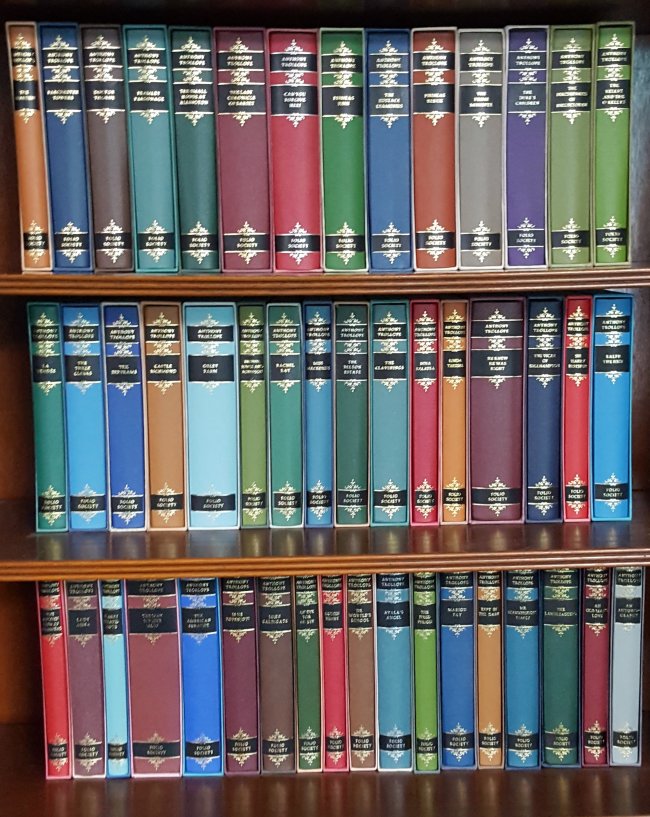
Twenty years or so ago I collected all forty seven novels plus the autobiography of Anthony Trollope in the lovely edition printed by the Folio Society which was the first ever complete edition to be illustrated. These are now long out of print but can still be obtained easily on the second hand market. I admit to having bought them far faster than I have ended up reading them in order to complete the set at the time. I have now read over half but have decided for the purpose of this blog to tackle his final work of fiction, completed before he died in 1882. He was still working on The Landleaguers which was published as an unfinished work in 1893 oddly before An Old Man’s Love which didn’t actually get published until 1894. Both of these are amongst his less well known works, indeed I cannot find an edition of An Old Man’s Love currently in print. Trollope suffered a decline in popularity towards the end of his life and it took sixty or seventy years before his reputation as a great Victorian novelist was restored but even so only about half of his novels are read to any extent today.

20190611 An Old Man's Love

The vast majority of An Old Man’s Love is written as as you would expect although there are passages where the author is talking directly to the reader and Trollope can get quite chatty as in the opening paragraph to the third chapter when we are properly introduced to The Old Man’s love interest.

There is nothing more difficult in the writing of a story than to describe adequately the person of a hero or a heroine, so as to place before the mind of the reader any clear picture of him or her who is described. A courtship is harder still—so hard that we may say generally that it is impossible. Southey’s Lodore is supposed to have been effective; but let any one with the words in his memory stand beside the waterfall and say whether it is such as the words have painted it. It rushes and it foams, as described by the poet, much more violently than does the real water; and so does everything described, unless in the hands of a wonderful master. But I have clear images on my brain of the characters of the persons introduced. I know with fair accuracy what was intended by the character as given of Amelia Booth, of Clarissa, of Di Vernon, and of Maggie Tulliver. But as their persons have not been drawn with the pencil for me by the artists who themselves created them, I have no conception how they looked. Of Thackeray’s Beatrix I have a vivid idea, because she was drawn for him by an artist under his own eye. I have now to describe Mary Lawrie, but have no artist who will take the trouble to learn my thoughts and to reproduce them. Consequently I fear that no true idea of the young lady can be conveyed to the reader; and that I must leave him to entertain such a notion of her carriage and demeanour as must come to him at the end from the reading of the whole book.

But the attempt must be made, if only for fashion sake, so that no adventitious help may be wanting to him, or more probably to her, who may care to form for herself a personification of Mary Lawrie.

And so he continues to give a basic description of the young lady who finds herself an orphan and is taken in to the home of Mr Whittlestaff, initially as an act of kindness because he was a friend of the family and she had nowhere else to go. At the start of the book Mr Whittlestaff is fifty and Miss Lawrie is twenty five although we quickly leap about a year and a half to two years so that she is well settled in the house and Mr Whittlestaff decides to ask her to marry him. Now this she is willing to do, although in truth she loves another, a certain John Gordon who vanished from her life three years earlier without actually declaring his love for her but promising to one day return. Then, on the very day that she agrees to her engagement to William Whittlestaff, John Gordon does come back and arrives at Croker’s Hall intending now that he has made money in South Africa to ask her to marry him.

All this has occurred in the first forty or so pages of the book and so the stage is set for the rivalry between the two men for the hand of Miss Mary Lawrie which is to be played out in the grounds of Victorian manners. Some of the characters favour her becoming Mrs Whittlestaff and yet more favour Mrs Gordon and none are shy about coming forward with their opinion even in front of the three main characters. There are numerous twists and turns before the final conclusion and there is also a sub-plot concerning the housekeeper at Croker’s Hall and her drunken husband which also needs to be resolved in the 172 pages so there is a lot going on considering the relative shortness of this book in the grand scheme of Victorian novels.

Romance is not normally a genre that I would choose to read but I definitely enjoyed this story and whilst Trollope is clearly not at the height of his powers as he was in The Chronicles of Barchester books or the Palliser series, both of which consist of six novels each, it is well written and draws you into the tale of the love triangle.