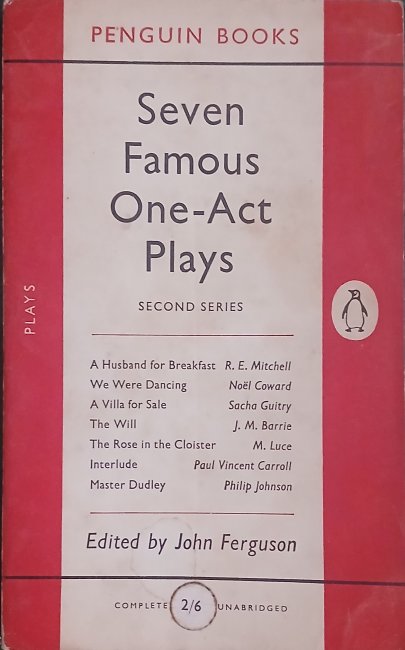
It was a long time between the first collection of one-act plays published by Penguin and this second selection, the first volume was published in November 1937 whilst this one came out in November 1953. Part of the sixteen year gap can of course be explained by the onset of WWII but Penguin wouldn’t publish any more collections of one-act plays until 1965 and the establishment of Penguin Plays as a series of its own. Which is odd if the blurb on the rear of the book is true as this suggests that one-act plays are particularly popular with amateur dramatic associations. Popular or not I’ve largely enjoyed this collection even if, just over seventy years after it came out, I recognise the names of just two of the playwrights of the seven ‘famous’ plays and there are three I would really like to see performed. Taking them in the order they appear in the book, rather than the front cover:
Villa For Sale – Sacha Guitry
A noted French actor, playwright and film maker, Guitry was prolific in both his production of plays and films, often acting, producing and directing in the same film where he also wrote the script and in 1936 he performed all four roles in four separate films. Villa for Sale is translated from the original French, although no translator is given in the book, and it was quite enjoyable as an entree to the collection. However it isn’t really satisfying as a story as the characters are quite lightly painted possibly due to the restrictions of the length of the play but as my favourite of this set is only a little longer I’m less inclined to give Guitry the benefit of the doubt with this. The story concerns a French lady who is trying to sell her villa for 250,000 Francs but would take 200,000 at a pinch, the villa is in an up and coming neighbourhood for the French film industry so should be in demand but has been on the market for a while, however she has a viewer this afternoon. A couple arrive and are welcomed but the husband is clearly bored of looking at villas and doesn’t really want to buy anything. Whilst his wife is upstairs being shown around it becomes clear that this couple are not the expected buyers but have turned up on spec when the real potential purchaser arrives, mistaking the man as the seller of the property she offers 300,000 Francs and provides a cheque straight away as she wants the place immediately ready to start working on a film. She leaves just before the real owners comes back downstairs and the husband writes a cheque for 200,000 Francs to buy the villa. All in all a rather tawdry story and not one I would rush to see performed.
We Were Dancing – Noel Coward
The play that for me has aged least well in the book, this comedy of manners based around a woman who feels that she has suddenly fallen in love with the man she was dancing with despite being married for many years to another man she loved once but over time it has become more habit to be together rather than love. I had high hopes for this as I had never read a play by Noel Coward, and at times the interactions between her husband and her new infatuation did work but frankly for the most part it left me bored and the clip I found of Coward performing the song included in the play does little to improve my opinion of the play.
Master Dudley – Philip Johnson
In third place of the plays I would like to see performed is this one, although the chance of any company even hearing of the play never mind putting it on are very low. Over fifty of Philip Johnson’s one-act plays appeared in the Samuel French catalogue of published plays of 1951 – more than any other author. In the comparable catalogue of 2005, his plays had disappeared without trace. At the start of the play Dudley’s aunt Stella had just arrived from America to provide support to her sister’s family as Dudley was on trial for murder, however as she arrives he is sensationally acquitted, It becomes clear as the play progresses that there has been a grave miscarriage of justice…
Interlude – Paul Vincent Carroll
Irish playwright Paul Carroll was well known in Ireland and wrote many works including for the National Theatre and this almost makes it into my list of plays I would like to see performed as I suspect that done well it would make great entertainment. The play is set in the office of a money lender in a small market town in Northern Ireland, Judy Tippin and her husband have come to Farrelly’s office to try to get an extension on their loan which was actually due to be settled the day before. Judy and Farrelly have history and she is hoping to use this to soften the heart of the famously stern money lender. The use of ‘defective’ electrics in the office which cause the lights to flicker occasionally and then ultimately go out leaving the performance by candlelight for a short-while has Judy almost convincing Farrelly to forget the debt in lieu of happy memories but then the lights come back on and in the harsh light the hard-hearted Farrelly takes her money leaving her and her husband with nothing.
Although Carroll was lauded in both Dublin and New York as a major new theatrical voice, virtually none of his work has been in print since his death in 1968 until Colin Smythe published a significant collection in 2014 as the sixteenth volume in his series of Irish dramatists, with six complete plays (although not including this one) and overviews of many of his other works.
A Husband for Breakfast – Ronald Elwy Mitchell
Top of my list for plays I would like to see performed from this collection is this one, yet annoyingly Mitchell is the author I can find least about on the internet, other than born in Camberwell, Surrey in 1905 and died in Dane County, Wisconsin, USA in 1986. Nothing he wrote appears to still be in print yet from this short play he was clearly an excellent writer. The play, set in a small Welsh village, is full of humour. It starts early morning as Aholibah is starting to prepare breakfast for her and her husband Isiah, who is still asleep, but is surprised by the arrival of a neighbour who is clearly expecting some sort of show. It becomes clear that Isiah had been in the pub the previous night and when it came to his turn to pay for the drinks he hadn’t any money. Trying to think of anything he could sell or barter for his round he was constantly thwarted by people pointing out the items he came up with belonged to Aholibah. Eventually he struck a deal with Moses Roberts to sell Aholibah herself to him for the price of the drinks. Various villagers were therefore descending on Aholibah’s cottage to see how she reacts. Eventually Moses Roberts himself arrives seeking the return of the half a crown he had paid Isiah but Aholibah sensing a way to profit from this instead sets him to work around the house as her new ‘husband’ much to the amusement of the other villagers there. Moses Roberts is then desperate to get out of the bargain as can be seen below and a trade is proposed for Roberts to buy himself out of the ‘contract’ which starts with two bushels of wheat but quickly escalates:

The Rose in the Cloister – Margaret Luce
Later Lady Margaret Luce as her husband was knighted when he became Governor of Aden in 1956 she is also one of the grandmothers of English actress Miranda Hart and wrote a book about her experiences in the Middle East ‘From Aden to Gulf: personal diaries’, which covers 1956 to 1966 and is a book I will definitely be looking out for. The play is well written and is also by far the shortest work in this collection being just nine pages long yet it manages to tell a complete story and even deliver a moral. It starts with a monk just concluding his sermon in the cloister of the monastery during which he points out a rose bush with a single flower and warns that “Only he whose heart is true as steel and without sin may pluck that rose from its stem: if any other dare to make the attempt his hands as they touch the stem will be burned”. This greatly excites his listeners but one resolves to take the rose and give it to his true love in place of the rose he has already brought for her.
The Will – J M Barrie
Second in my list of plays I want to see is this one. Barrie is probably most famous as the creator of Peter Pan and this is beautifully written as we see the effect of the years passing with the simple expedient of altering the set dressing, and presumably some quick changes on behalf of the cast. It is set in a solicitors office and a young couple arrive to set out his will in favour of his new wife. Once this is done the curtain falls ut rises again just ten seconds later to reveal subtle changes such as the portrait of the monarch going from Queen Victoria to King Edward VIII. The couple return, a little older, and revise the will, he is obviously doing much better than anticipated yet the beneficiaries other than his wife are getting less. The curtain falls and rises ten seconds later again, the portrait of the monarch has altered to King George V along with other small changes. The couple return and again revise the will, he is now wealthy but again the changes show even less regard for others. The curtain comes down and back up for a third time and this time just the man arrives as his wife has died, this time he wants to revise to will to pay back those people he had taken advantage of on his way up in society. The play is really well done as not only are the changes in the couple elegantly drawn but the father and son pair of solicitors also evolve over time.
One thing I would have liked included in the book is a brief biography of the various writers, I assume it is missing as they would have been well known at the time, but only Coward and Barrie have lasted the decades as names I recognised so I’ve had to do a little research to identify the authors.
 Ramblings on my bookshelves