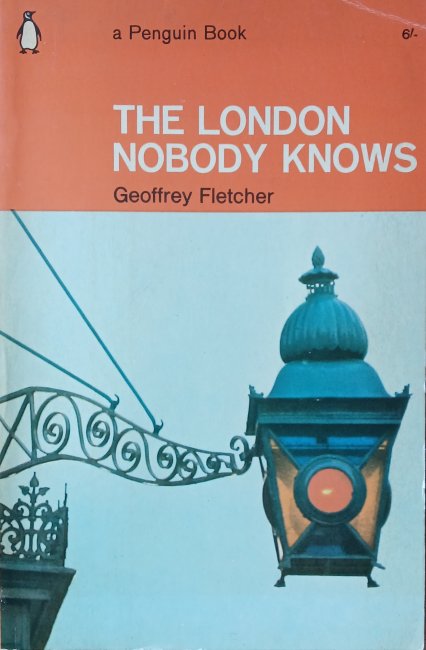
The London Nobody Knows – Geoffrey Fletcher

Originally published by Hutchinson in 1962 and reprinted as a paperback by Penguin in 1965 this is now really more of a historical document a a lot of ‘The London Nobody Knows’ could really be retitled ‘The London Nobody Knew’ if reprinted today as quite a lot of what is featured no longer exists or has changed so dramatically as to be unrecognisable. For example the chapter dedicated to Islington refers to bomb damaged buildings and shops still in need on preservation, definitely not the case nowadays where in 2024 the average price for a terraced house there was £1,600,000 and a semi detached home getting on for 2 million pounds. I love the fact that Islington could be regarded as part of London nobody knows.

The book marks the beginning of the over thirty years Fletcher wrote and illustrated a diary column for the Daily Telegraph newspaper. As a young man in 1945 at the end of WWII he came to London to study at the famous Slade School of Fine Art and later at the Bartlett School of Architecture and brought his knowledge and art ability to the fore in his columns and his books. He died in 2004 at the age of eighty one back in his birthplace of Bolton and wrote, along with his newspaper work, at least thirty books of which this was the second. Of the books I have found listed two thirds are about London and almost all the rest are about how to paint and draw so he was dedicated to his subject and it shows in this delightful volume. There are two very different styles to the forty two drawings included, three of which are of the cast iron gents toilets in Star Yard, Holborn which I’m pleased to say is still there as a remnant of Victorian plumbing although no longer functional. I have chosen two illustrations to show both the finished drawings and what must really be regarded as sketches, the first being St Anne’s church in Limehouse, one of three churches he describes in that locality, another being Christ Church, in Spitalfields which he comments is in danger of demolition but is definitely still standing today and in regular use.

The title of the book has had a few dissenters over the years as ‘The London Nobody Knows’ is somewhat condescending to the many hundreds of thousands of people that live in the parts of London featured and know all too well in some cases. Whilst researching this article I found one comment that it should have been called ‘The London Nobody Who Reads The Telegraph Knows’ as it mainly covers parts of London that the more wealthy readers of that newspaper would have frequented although now of course a lot of it has been gentrified over the years.

Sadly the building I chose to demonstrate the more sketch like drawings, the Grand Palais Yiddish Theatre on Commercial Road, Whitechapel, was a bingo hall by 1962 when the book was written and was demolished in 1970. Whilst admiring the artistry of the more finished drawings I love the sketches as he captures the life of the people around the featured properties and you feel more drawn in. The suggested perambulations to find the buildings, or even lampposts and signs covered in the text are also a joy to read.

Annoyingly much as I would love to know where that multicoloured lamp is on the front cover, neither the photographer nor their subject is credited in the book, something at the time that Penguin Books were all to prone to do. Two years after my copy was published there was a documentary film of the same name based on the book where actor James Mason wanders round some of the places featured and parts of this are available on youtube including this bit about The Roundhouse, now a major music venue,and illustrated in the Camden Town chapter of the book.
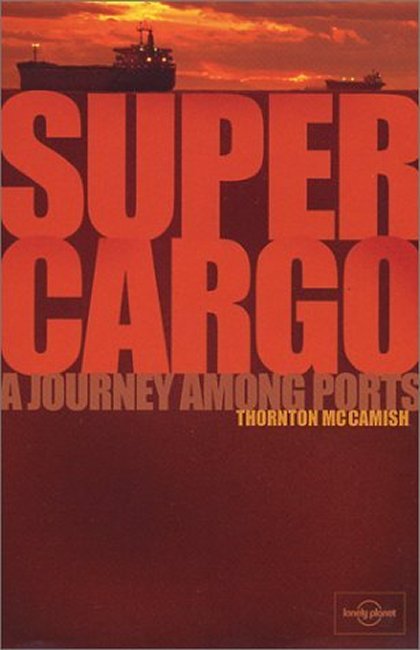
Supercargo – Thornton McCamish

Supercargo is a penetrating and wickedly funny study of a way of life and travel that refuses to die.

That’s what it says on the back cover anyway, I can only assume that whichever marketing person wrote that had had a very generous liquid lunch beforehand and probably hadn’t read the book. There is very little that is actually very funny or even mildly amusing about this book, instead McCamish seems to spend most of his time moaning about how bad the journeys he makes are and the lack of the romance of foreign ports. I did make it to the end to see if it improved but it was a struggle where I abandoned the book several times, which is a pity as up until now I have loved the books from the now defunct Lonely Planet Journeys series.

There are actually three journeys described in the book, the first being a bit of a cheat bearing in mind the books subject as it starts with a flight from London and then uses normal passenger ferries on the western Mediterranean Sea to travel from the south of France to Tunisia and then onto Italy where he bounces around the coast, rather than the cargo vessels implied in the title. The second trip again starts with a flight but does at least use a cargo ship but is also in the Mediterranean although in its eastern side from Italy to Greece then Lebanon, Syria and Turkey before returning to Italy. Nowadays Lebanon and Syria suggest a little danger but this was the year 2000, four years after I visited both countries and they were perfectly safe if a little infuriating when trying to get documentation stamped for onward trips. It should be noted, for those people unfamiliar with the concept, that it used to be quite common for cargo ships to carry passengers and they had cabins of varying quality specifically to do this, with the passengers normally eating with the officers. I remember advertisements for travelling on the ‘banana boats’ across the Atlantic and was very tempted but these were fast ships with luxury offerings and were beyond my means. McCamish was therefore travelling on the very tail end of what was a ‘normal’ way to get around before widespread commercial air travel and the reduction in cargo crew sizes with the corresponding shrinking of superstructure meaning passenger cabins are rarely even included in a modern cargo ship.

I was therefore looking forward to a description of a now largely vanished means of travelling around the world, although it is still possible see here, and to find only the third trip to involve any sort of real distance and that one he missed two possible posts to catch, only eventually reaching the ship at the Canary Islands after flying from the bottom of Italy. This journey consisted of travel on two ships, one down the west coast of Africa to Cape Town with no stops, the second took him along the east African coast to India from Mauritius (which he got to by plane) via Madagascar, Tanzania, Zanzibar and Kenya. This last trip had a captain that really didn’t like the idea of passengers, or possibly this passenger in particular, and frankly I was pretty fed up of McCamish by now and his descriptions of miserable travelling conditions at sea interrupted by brothels and bars on land. I’m sure there is a great book out there about travelling on cargo vessels but this isn’t it. At the end McCamish admits whilst preparing to leave India “Then I would board my plane for the last leg of a sea journey which must have set the record for air miles covered by someone writing about the sea.”

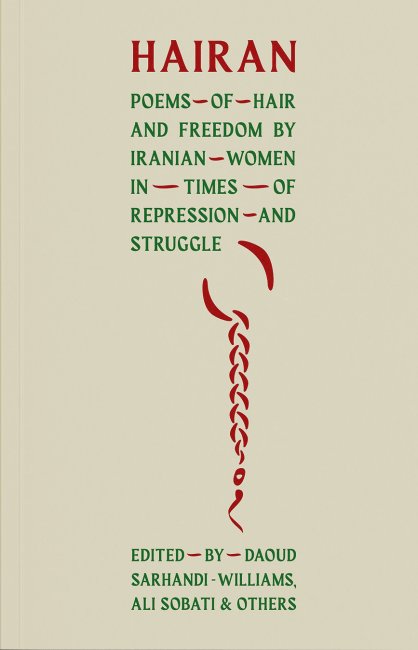
Hairan – Daoid Sarhandi-Williams, Ali Sobati and others (Ed)

This book was inspired by the killing of Mahsa Amini by the Morality Police in Iran apparently for not having her hair properly covered by her hijab. This murder in 2022 added further outrage to a movement that was already existing in the country known as Woman Life Freedom which opposes the oppression of women not only in Iran but neighbouring countries such as Afghanistan. I have featured works both from and about Iran several times in the past and when I spotted this book in a shop last month I was inevitably drawn to it, I especially like the title combining the provocative word hair, which for women must at all times be hidden in public, with the name of the country.

The book is much more than simply a collection of poems, most of which were especially written for this collection, as there is also a very informative introduction which covers the history of female poets in Iran going back to the days of the Persian empire. This introduction also includes brief remarks about several of the poems in the collection, setting them in context. There are also thirteen black and white photographs of Iranian women from the back showing their hair, with clearly no identifying information in order to protect them from the regime and several political posters supporting the Woman Life Freedom movement. One thing the editors were surprised by was the refusal by any of the poets included to use a pseudonym or be credited anonymously especially bearing in mind the topics covered.

The poems are powerful in their imagery and in sorrow and outrage at the treatment of women and sometimes men who support them. If a poem needs more explanation for those of us that don’t live in Iran and therefore haven’t been exposed to names, places or events referred to there are useful notes after the poem. Several poems refer to Ferdosi’s epic Shahnameh, which I briefly covered in 2018 as the story is a classic in Persian culture and familiar to most Iranians. Whilst reading I was noting any poems that I thought I could pick out in this review as I particularly enjoyed them and ended up with twelve of the seventy six which is clearly too many to list but emphasises how strong this collection is. However I particularly want to mention “This Place” written by Atefeh Chararmahalian during her 71 days incarcerated in the infamous Evin prison in Tehran along with “You’d Said” by Fanous Bahadorvand and “freedominance” by Leila Sadeghi which are both explicit tributes to Mahsa Amini as is the poem I have chosen to represent all the others:

The three young women included in the dedication are Mahsa Amini (aged 22 when killed in police custody), Nika Shakarami (aged just 16 when abducted by the security forces and killed sometime during the next ten days, who know what happened to her during that time) and Hananeh Kia (aged 23 when shot by the Iranian Revolutionary Guard near a protest whilst walking back from the dentist, she was due to get married just two weeks later). Nika’s body was never returned to her family and she was instead secretly buried by the security forces forty kilometres away presumably to avoid her funeral becoming a flash point for more protests.

The book is published by Scotland Street Press, who I must admit I hadn’t heard of before purchasing this collection, but looking at their online catalogue they seem to have quite a few titles that are very interesting, so I don’t think this will be the last book of theirs to make it to my library. I’ll finish with a couple of the images of Iranian women’s hair from the book including one very bravely out in the street without a hijab.

The Mirror of Ink – Jorge Luis Borges

2005 was Penguin Books seventieth anniversary and to mark the occasion they published seventy books at £1.50 each which were largely extracts from other works in their vast back catalogue as is this one although this is collated from several collections of short stories. With Borges though, as he is mainly a writer of short stories, you ended up with seven complete works in the book and as an introduction to his literary output this book is excellent. The art of writing a short story is extremely difficult as in a short space you must not only have a beginning, a middle, and an end but also express an idea or indeed several which will leave the reader satisfied and in all seven of these Borges has proved himself well able to meet those aims. Knowing that he was Argentinian I was expecting South American themes but instead the first two ‘The Mirror of Ink’ and ‘The Lottery in Babylon’ are set in the Middle East, the third ‘The Library of Babel’ could frankly be anywhere and everywhere. The fourth ‘The Theme of the Traitor and the Hero’ is in Ireland, ‘The Witness’ is probably medieval England, ‘Ragnarok’ could also be anywhere, whilst the final story ‘Blue Tigers’ is based in rural India. A linking theme, if there is one, is the somewhat mystical and fantastic ideas behind all of these stories, that and the definite quality of the prose. I hadn’t read any of Jorge Luis Borges before this slim volume and indeed this is the only book of his work that I possess but I definitely need to read more.

Sadly Borges suffered from fading eyesight for many years and became blind at the end of the 1950’s however he continued to write, dictating stories initially to his mother who took on the role of his secretary until her death. The last two stories in this book were written after his blindness and there is certainly no diminution of the power of his writing. I just want to pick out a couple of the stories that I particularly enjoyed:

‘The Library of Babel’ is an exploration of the concepts of infinity in that the library described contains all possible books that are exactly 410 pages long with a fixed format of forty lines per page and eighty characters per line where a character is one of twenty two letters of the alphabet, a full stop, a comma or a space and all combinations of these appear at least once in one of the infinite series of books stored in the apparently infinite number of replicating hexagonal galleries that make up the library. The concept of a library that because it has all combinations of the twenty five characters and therefore contains books of apparently complete nonsense but must also due to randomness have every book that could possibly exist expressing every theme and also arguing both for and against every idea is beguiling. The impossibility of ever finding a specific work is also clearly spelled out along with some of the oddities of infinite series in that a revolution in the past had destroyed countless volumes but that this didn’t matter because books survived elsewhere in the library which differed from the vandalised editions by as little as a punctuation mark somewhere within them.

‘Blue Tigers’ also drew me in with a weird mathematical theme, the tigers are not flesh and blood but a collection of odd blue disks that the narrator finds on top of the plateau of a sacred hill. These discs are uncountable, initially he thought he had around ten of them but when examining them found far more. Sometimes there would be as little as three but holding these few and then letting them fall could reveal hundreds. The narrator spends nights trying to find a pattern to the ever increasing, and decreasing, quantities without any success and eventually, to save his sanity, he gives them to a blind beggar who seems to understand in someway that he is the fitting custodian.

Naturally the four mathematical operations – adding, subtracting, multiplying and dividing – were impossible. The stones resisted arithmetic as they did the calculation of probability. Forty disks, divided, might become nine, those nine in turn divided might yield three hundred. I do not know how much they weighed, I did not has recourse to a scale, but I’m sure their weight was constant, and light. Their colour was always the same blue.

As 2005 was the seventieth anniversary it is clear that this year (2025) is the ninetieth and again Penguin have marked their birthday with a set of books, this time ninety of them at £5.99 each, some of which will be featured in this blog as the year goes on. The actual anniversary is the end of July so I am dedicating my August theme this year to the first four Penguin titles, which I will be reading in their first Penguin editions something I don’t do often due to the fragility of these ninety year old paperbacks.