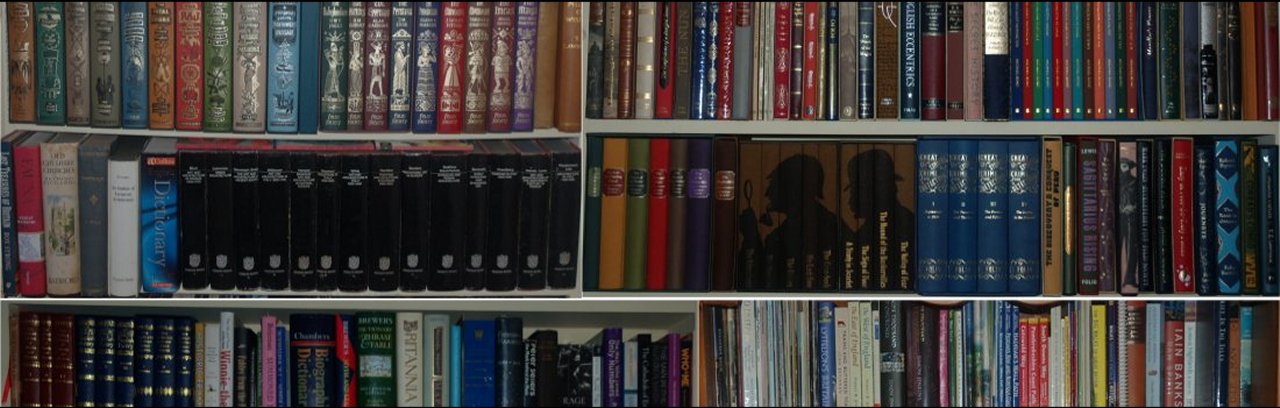
A series of essays inspired by books that I own, talking about their history, some reviews and also how they came to be on my shelves. With over 6,500 books here and several more arriving each week I doubt I'll ever be short of a topic.
Shaun Bythell’s first book, ‘The Diary of a Bookseller‘, was one of the very first books I reviewed on this blog back in January 2018. Since then he has written three more books, two of which continue his diary of owning the largest secondhand book shop in Scotland, which is in Wigtown and it is these two books I have read this week. The diaries cover the following periods:
The Diary of a Bookseller – Published 2017 – covers Wednesday 5th February 2014 to Wednesday 4th February 2015.
Confessions of a Bookseller – Published 2019 – covers Thursday 1st January 2015 to Thursday 31st December 2015
Remainders of the Day – Published 2022 – covers Friday 5th February 2016 to Saturday 4th February 2017
It was only as I typed the list above that I realised that there is a five week overlap between the first two books so had to get ‘The Diary of a Bookseller’ off the shelf to compare the entries. They are completely different even down to the number of orders, customers and shop takings.
Wednesday 21st January – Diary of a Bookseller
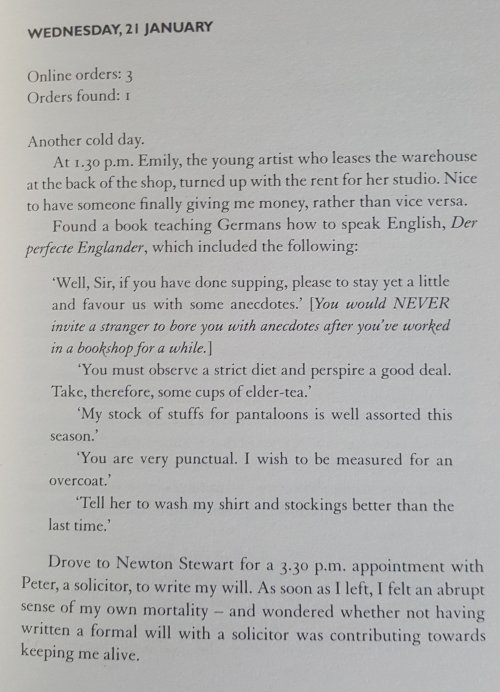
Wednesday 21st January – Confessions of a Bookseller
As the third book, like the first, starts on the 5th of February I’m left wondering if the 1st January to 4th February in Confessions and which are clearly labelled 2015 are actually entries for 2016 transposed to the start by an overzealous editor who assumed that a diary should be for a calendar year.
The books are quite long, 328 pages for Confessions and 377 for Remainders but reading them just flies by and I finished both books inside four days. As I mentioned in my review of his first book I also own and run an independent specialist shop so the interactions with customers he details are frighteningly familiar and all the funnier for that. He has also noticed that anyone who comes through the door and says out loud “Oh I’m in heaven, this is just the sort of shop I love”, or words to that effect never buy anything, but will inevitably spend a lot a lot of time wandering round the shop and moving stock from shelf to shelf whilst not doing so. This means that you then have to spend even more time putting things back where they should be so that actual customers have a chance of finding them. I’m going to lend the books to my staff as I’m sure they will appreciate them as well and I’m thankful I don’t have staff as mad as Shaun seems to.
A few months after writing my review of The Diary of a Bookseller in 2018 I met Shaun in Hay on Wye, the Welsh book town that Wigtown has modelled itself on, lots of book shops all in one small place may sound like overkill but it really works by making the town a specific destination for collectors and there are few things I love more than wandering round book shops. Shaun was being interviewed by Jasper Fforde as part of a book collectors Instagram event which the owner of my local secondhand bookshop and I had also given a talk at a couple of days earlier on the subject of collecting Penguin books. Shaun came over as a really nice person but then again I wasn’t trying to buy a book off him at the time, I still haven’t made it to Wigtown but I’m determined to get there, in fact I just checked and it’s 285 miles from where I live and would take just over five hours to get there, the Google maps picture of the shop is from this month and shows a copy of Remainders of the Day in the right hand window along with the inevitable large number of boxes of more stock just inside the door and by the other window.
I was introduced to Orwell in my first year at Grammar School, so aged eleven, when we studied Animal Farm and I’ve read a lot of his works since but somehow not included Down and Out in Paris and London which was his first book. I have no idea how I missed it especially as reading it now I loved the detailed descriptive narrative of his times in poverty in Paris and living amongst tramps around London. The writing is totally immersive and you feel with him as he lives hand to mouth, sometimes not eating for days at a time because he simply has no money left especially after all his meagre savings were stolen leaving him with just the few francs in his pocket. It is after this financial disaster that he seeks out an old friend Boris, who is a Russian émigré, and had often told him of the easy money to be made in tips as a waiter, but Boris had also fallen on hard times and together they scour the city looking for work and not finding it until after many days surviving by pawning their dwindling clothes supply they drop ‘lucky’ and get jobs in the hell of a kitchen of a hotel that Orwell leaves unnamed, just calling it X.
I was at work from seven in the morning till a quarter past nine at night; first at washing crockery, then at scrubbing the tables and floors of the employees’ dining-room, then at polishing glasses and knives, then at fetching meals, then at washing crockery again, then at fetching more meals and washing more crockery. It was easy work, and I got on well with it except when I went to the kitchen to fetch meals. The kitchen was like nothing I had ever seen or imagined—a stifling, low-ceilinged inferno of a cellar, red-lit from the fires, and deafening with oaths and the clanging of pots and pans. It was so hot that all the metal-work except the stoves had to be covered with cloth. In the middle were furnaces, where twelve cooks skipped to and fro, their faces dripping sweat in spite of their white caps. Round that were counters where a mob of waiters and plongeurs clamoured with trays. Scullions, naked to the waist, were stoking the fires and scouring huge copper saucepans with sand. Everyone seemed to be in a hurry and a rage. The head cook, a fine, scarlet man with big moustachios, stood in the middle booming continuously, ‘Ça marche deux oeufs brouillés! Ça marche un Chateaubriand aux pommes sautées!‘
Chapter X – Orwell was a plongeur, the lowest of the low in the kitchen hierarchy
Orwell was initially amazed at the squalor behind the baize doors that separated the patrons of the hotel from the kitchen staff, what absolutely had to be cleaned was but if it didn’t then rubbish and scraps simply built up in corners or hard to clean places. But this was nothing to the hideous conditions in the new start restaurant that Boris persuaded him to leave hotel X and join. Raw food was simply left on the bare floor as they had no larder and wiped down and cooked as needed. Cats and rats helped themselves to whatever they wanted and again what was left was served to the customers. He also went from working fourteen hours a day for six days to seventeen hours a day every day. Plates weren’t cleaned as they had no hot water just wiped down either with newspaper or on the clothes of the staff and yet the restaurant drew in customers and succeeded despite the filth in the kitchen. Orwell gives the impression that this was perfectly normal in Parisian restaurants, and it quite probably was, but he couldn’t cope with the excessive hours and after a couple of weeks quit and headed back to London after being told by a friend that there was a job for him looking after a congenital imbecile.
The second part of the book dealing with life in and around London was added after Orwell initially tried and failed to get a publisher for the Parisian part on its own under the title of “A Scullion’s Diary”. Adding the English section took the work from around 38,700 words to 66,400, which in this edition is 180 pages and a much more normal size for a book.
Needless to say the job when he got there didn’t exist, both the potential employers and the patient having gone abroad so Orwell is back to no money, nowhere to live and no job, so Orwell took to the streets living hand to mouth as a tramp. This section is very different to the first sixty percent of the book as it is less like a journal of his experiences, although you certainly get his experiences of homelessness in the London area, and more a diatribe against the Vagrancy Act of 1824 and the strict interpretations imposed which meant that not only was homelessness effectively criminalised but all forms of begging were not permitted and rough hostels introduced across the country known as spikes. These, mainly unsanitary, hostels did not allow anyone to stay for more than one night and you couldn’t return inside a month, in London you couldn’t go to more than two spikes inside a month. These rules meant that vagrancy was effectively enforced as the men, and it was nearly always men Orwell met only one female tramp in his time on the road, had to keep moving ten to twenty miles a day in search of a bed if they couldn’t afford even the worst bunkhouses to sleep in and it was a criminal offence to sleep in the open air. Astonishingly whilst looking up this act to write the blog I discovered that parts of the Act are still in force in England and Wales almost two hundred years after it was first passed, I feel every Member of Parliament should be made to read this book.
The book is notable for being the first appearance of the name George Orwell in print, up until then he had used his real name, Eric Blair, for the small number of articles he had published but he wanted to be ‘anonymous’ due to the poor conditions that he had endured in both Paris and outer London and didn’t want his family linked to this book. From then on however he wrote as Orwell, rarely using Eric Blair again. As for the veracity of the stories he tells here, he wrote in the introduction for the 1935 French edition “I think I can say that I have exaggerated nothing except in so far as all writers exaggerate by selecting. I did not feel that I had to describe events in the exact order in which they happened, but everything I have described did take place at one time or another.” The most obvious time distortion is that the times as a tramp around London occur after returning from France in the book whereas in reality this time was before he went to Paris in Spring 1928, as when he returned to London from Paris in December 1929 he went to live at his parents house.
My copy is the first Penguin Books edition from December 1940 and is in remarkably good condition for a wartime paperback printed on very poor quality paper yet it is still perfectly intact. This was the edition that really started interest in the book, as before then it was not a great seller. However despite 55,000 copies being printed in this edition it is a very scarce book and at the time of writing I cannot find any examples for sale on abebooks or biblio which are the two main international websites for secondhand books. Down and Out in Paris and London is of course easy to obtain, it is this first edition, possibly the first time it came out in paperback, that is so rare.
Michael Palin’s latest travel adventure took place March 2022 and consisted of a short (two week) trip to Iraq, he was after all seventy eight when he made the journey and the epic trips from the 1980’s and 90’s are probably behind him now but this was still a fascinating read. This was his first documentary travelogue since visiting North Korea in 2018 which was equally short and it is now eleven years since his last trip lasting multiple months which saw him explore Brasil. The book is beautifully illustrated and written in Palin’s easy to read diary format which he has honed over decades of doing such series for television although now they are for ITN and Channel 5 here in the UK rather than the earlier, and higher budget, trips for the BBC.
The book covers eighteen days travelling, although days one to four are in Turkey as he travels down to the Iraq border finally crossing over on the evening of the fourth day and day eighteen has him getting up at 5am to dash to the airport to leave so that doesn’t really count. On the way through Iraq following the River Tigris he gets to places I read about as a child, the ancient city of Ur and its famous ziggurat, Babylon and the astonishing minaret in Samarra which can be seen top right on the cover of the book. Like Palin I have wanted to visit these places for decades, and nearly went soon after returning from Iran in 1997 but various other destinations called to me more urgently and later it became too dangerous to go. From the descriptions in this book it looks like it may be becoming possible to be a relatively safe tourist in Iraq again, however he explains that major destinations such as Ur’s ziggurat and the site of Babylon were largely reconstructed over their original ruins during the time of Saddam Hussain. That doesn’t make them less impressive and the lower parts, certainly of the ziggurat, are genuinely thousands of years old so still worth a visit. It would be the endless waits at random checkpoints that they endured for seemingly little point other than to justify the existence of the checkpoint and the guards manning it, I doubt I have the patience for nowadays.
The book is quite short, just 171 pages and a lot of those have half and half text and photographs of the trip, I therefore read it in about two and a half hours. I would have liked more details especially on the life of the people coming out of decades of conflict. Palin was always good interacting with locals in previous documentaries and whilst I haven’t yet seen the TV series that this book accompanies, that is only three sixty minute episodes and those include adverts so I doubt you get much more insight. Having said that I really enjoyed the book and when I started it was difficult to put down, the urge to just read another chapter was always there and as each chapter was a days journey it felt even more like a diary and you felt you were progressing down Iraq along with the small team making the films.
Unlike his previous expeditions where he planned a lot of the journey himself and was very much an independent traveller, albeit with a TV crew in tow, this time Palin travelled with a company called Untamed Borders which means that a large part of his itinerary can be booked direct with them if you too fancy a trip to Iraq.
I first came across McGough in the late 1960’s as part of The Scaffold, a ‘band’ which was made up of him, John Gorman and Mike McGear and the first record I ever bought with my own money was their 1968 number one hit ‘Lily The Pink’. Only McGear was a musician having taken up the guitar at a young age like his brother Paul McCartney who was also in a bit of a band in the 1960’s. This meant that they usually appeared with session musicians, such as Reg Dwight (aka Elton John), Keith Moon, Paul McCartney and Jimi Hendrix making up the numbers for the recorded and occasional live performances, whilst Roger McGough read his poems and comedian John Gorman did various comic sketches as well as playing the piano. I wonder what happened to those various session musicians? McGough wrote almost all the lyrics for The Scaffold with McGear (who changed his name so as not to be seen to be riding on the coat tails of his elder brother) writing the music. Although the band broke up in 1977 they occasionally appear together, although all the members are well past retirement age. At 85 years old McGough is still the presenter of BBC Radio 4’s programme Poetry Please and is very much active on the British poetry scene.
This collection of some of McGough’s short poems, some of which are very short indeed, is part of a huge body of his works published in well over thirty volumes, with one, a collaboration with two other Liverpool poets entitled ‘The Mersey Sound’ not being out of print since it first appeared in 1967. Whilst he writes poems on all sorts of subjects it is probably for his comic verse that he is most known.
Writer’s Block
The excitement I felt as I started the poem. Disappeared on reaching the end of the fourth line.
McGough’s poetry is invariable upbeat and his distinctive accent makes his live performances a real pleasure, this is one of my favourites from his 2016 collection Poetry Pie just so that if you haven’t come across McGough before you can hear him in full flow. But I’m here to review this short book so back to the poems in here and one that starts off dark but still manages to have a happy ending.
Another Mid-Life Crisis
3am. Feeling like death and wanting to end it all I reach for the paracetamol will there be enough?
One by one I count them out. 72? Need more to be on the safe side. Rummaging around I add another 30. That should do it.
Take the first two with a glass of water. Feel better. Go back to bed. Fall asleep.
McGough has been a fixture on British TV and radio ever since the days of The Scaffold so I’ve grown up, and started growing old, with his poetry and I find myself hearing his voice as I read the book. It was a real joy to read the 79 short works in this volume and I love the cover illustration with famous poets as geographical features. I feel the need to end this review the same way as the book ends with a simple one liner based on President Truman’s famous desktop sign.
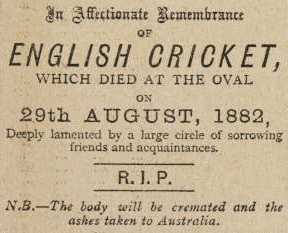
The 2023 Ashes Series is starting on Friday 16th June, for those of you who don’t follow cricket this is one of the oldest bilateral sports tournaments in the world, starting in 1877 and pits Australia versus England at cricket in a series of five day matches. It’s worth noting that it didn’t gain the name of ‘The Ashes’ until the ninth test match between the two sides, which took place in England in 1882 and which England somehow managed to lose from what should have been a winning position. This led to a mock obituary appearing in The Sporting Times on 2nd September 1882.
The urn containing ‘the ashes’ was presented to the captain of the touring England team in Australia that Christmas and is now kept at Lord’s Cricket Ground in London as it is extremely fragile, only rarely being removed from its glass display case for ceremonial occasions, and has only actually travelled to Australia twice in the intervening years. It isn’t the official trophy for the tournament but symbolises the rivalry between the two countries but replicas and images of this tiny, 6 inch (15cm), vase are to be seen whenever the two teams play each other and its silhouette can be seen on the front cover of this book between the words ‘The’ and ‘Ashes’.
This year there are five games to be played in June and July at various venues across England, five games is the most common number of matches but it does sometimes alter. Phil Tufnell played in five of these series and both his first and last test matches for England were against Australia. It should be noted that at the time the England team were pretty weak and the Australians very good so he never got near to being on the winning side in an Ashes series. Tufnell retired from playing serious cricket in 2003 and gained a job as a summariser on The BBC Test Match Special which he still does and he continued to play cricket for celebrity teams for many years after his official retirement.
I didn’t know what to expect from this book, but thought it would probably be descriptions of his experiences and whilst those do appear, the book is a whole lot more than that. In fact it is a highly entertaining look over the entire existence of the tournament from the first matches and includes the origin story of the Ashes urn but also lots of stories of players and games over the entire, almost 150 years, that England and Australia have faced each other on the cricket grounds in both countries. These range from when in 1903, back before aeroplanes existed and it would take three weeks by boat each way to get to the tour, the England team on their way out managed to lose a game of deck cricket against a team of female passengers. In 2001 The Australians hosted a charity function in Manchester and the first auction item was a chance to train with the team, bidding was slow as the room hadn’t really got going when they started this so a couple of Australian players decided to bounce the bids on a bit, which was fine until Steve Waugh ended up winning the auction and paying £500 to train with his own team-mates.
Scattered through the book are lists of ten players in various categories including, ten fast bowlers Tuffers was happy to have never faced, ten Ashes blockers and ten Ashes bashers amongst other selections. These are fun as it’s not just a list but reasons why. Chris Tavare is probably the best of the blockers that I have seen and he once spent ninety minutes at the crease without scoring anything at all and had on a different occasion taken two hours to score nine, not entertaining but incredibly frustrating for the Australian bowlers and winding them up led to mistakes.
My copy is the first edition hardback from 2013 published by Headline and I have to wonder why it has languished on my shelves for ten years its been a really fun read and here’s hoping for an equally fun summer of cricket.
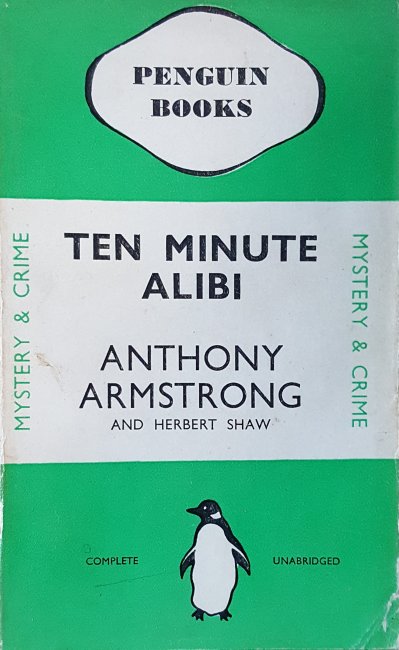
First published as a novel in 1934 ‘Ten Minute Alibi’ is based on the play of the same name by Anthony Armstrong and has presumably been adapted as a novel some time during its run in London by Herbert Shaw. I have to say presumably because there is nothing in the book to say what role Herbert Shaw had in writing it, or indeed any biographical details for him. The play was very successful playing across America and on Broadway it had 89 performances (from 17th October 1933 to January 1934) whilst in London’s West End, it had 857 performances (from 2nd January 1933 to 23rd February 1935) but having read it I can definitely say that the novel is less than riveting so not a good transformation by Shaw, I think I would have preferred to read the original play.
The plot however is interesting, Philip Sevilla appears to be a well to do club owner in London but he has a much more lucrative sideline in people trafficking, specifically innocent English women with few remaining family members whom he seduces before packing them off to South America to be forced to work as prostitutes. The way his operation works is spelled out with an example at the start of the book where we witness the downfall of Muriel Cartney. Having established that she has only a small number of people that would be particularly concerned if she disappeared Sevilla works his charms on her telling her that he is married but that his wife is in an insane asylum so he is desperately lonely and would marry her if he could get a divorce but that is unlikely due to his wife’s medical condition. Finally he persuades her to give up her job and rented apartment to join him in Paris where they can live, apparently as man and wife, without any of their London acquaintances being around to spot the lie and ruin her reputation.
Once in Paris he then appears to ‘accidentally’ run into his ‘friend’, in reality his business partner in the trafficking operation Jose Garcia, and starts to arrange the handover of Muriel. At first all is well and they stay in a lovely hotel in Paris apparently whilst he looks for something more permanent, this he would normally do for two to four weeks enjoying the nights with his victim before claiming that pressing business issues with the club means that he has to return to London to sort these out, Assuring Muriel that he would be back in a few days and that Garcia would look after her whilst he was away he would leave and never return just sending increasing worrying, and false, messages that the people he had put in charge of the club had ruined him and she was on her own but he had no money left to support her. Unwilling to return to England as a woman who had been living in sin Garcia then suggests that he has contacts in Buenos Aires where Muriel could get a new career on the stage and effectively start again and he would willingly accompany her there to see her settled in. Once in Argentina she would be handed over to the gangsters and pimps that would then keep her prisoner and force her into sex work. Sevilla meanwhile would pocket at least a thousand pounds for delivery of another victim.
This sounds all too modern, although nowadays it is women from poorer nations falsely promised legitimate work in the West only to arrive and be told that they need to pay back the enormously inflated cost of transporting them by working in the sex industry. I was surprised to see roughly the same process in a book written in the 1930’s, I’ve never seen it as a plot line in any other contemporary work and I can see why the shocking nature of the story would have generated publicity for the original play. Having spent the first twenty or so pages detailing the story of Muriel and through that Sevilla’s real means of earning big money we then move on to his planned next victim, Betty Findon and this is where the book really starts as Betty has a man who secretly loves her, trainee barrister Colin Derwent, and he will do anything to thwart Sevilla’s plans.
However this is also where the book started to lose my interest, the ongoing scenes between Betty and Sevilla, Sevilla and Colin, Sevilla and his manservant and other two handers would clearly work well on a stage but it’s all too bitty for a book. The dream sequence after Sevilla drugs Colin to prevent him seeing Betty to try to warn her again feels odd, and the means of how to kill Sevilla and still have an alibi by altering clocks so that he could be seen to be elsewhere at the same time revealed to Colin in his dream is all too complicated to work as it needs split second timing involving people who don’t know it involves split second timing. The plan involves Colin catching Sevilla at home and alone before taking Betty to Paris to replicate his previous modus operandi. However when Sevilla needs to be home for the first part of Colin’s alibi to work he’s out and when he does return it’s with Betty and the manservant is also there, both of which are not visible when Colin finally arrives to carry out his plan which involves claiming to have £1,500 to pay off Sevilla but in reality shooting him and staging it as a suicide.
I’m not going to go further into what happens in this review in case anyone fancies braving the rather clunky text for what is actually quite an unusual plotted story especially for the period. Maybe however see if you can find the play script rather than the novel. My copy is the 1938 Penguin first edition and whilst there may have been a reprint in the 1940’s this appears to be the last time the novel was published in English, which I think speaks volumes for its popularity. The play is actually easier, and cheaper, to find in various 1930’s anthologies.
This collection of three of Albert Camus’ essays was published by Penguin Books as part of their seventieth anniversary in 2005 and is a fascinating description of two cities and a town in Algeria, the country which was the birthplace of Camus. It is always interesting to read a locals perspective on places that you really want to visit especially if it is by a writer of the quality of Camus, and Algeria is the only country on the north African coast that I haven’t yet been to and this book moved it higher up the list of places to visit. This is the second book I have reviewed that is set in Algeria though, after Tartarin of Tarascon by Alphonse Daudet so clearly I need to go there sooner rather than later. As mentioned this has descriptions of a couple of cities, Algiers and Oran along with the archaeologically important town of Tipasa with its wonderful Roman ruins, the first essay concerns Algiers.
Summer in Algiers
Unlike the other two essays in this book, this is not a description of the place but the people of Algiers and especially the youth. He explains that here people start work and marry young and raise their children so that by their thirties men have largely done all that they have to do and it is a steady decline of their vigour that is all they have to look forward to. Summer in Algiers is a time of unrelenting heat so only the poor are left there, the rich decamp to more salubrious climes until the September rains bring relief. The young poor however gather on the beaches, for it is the culture of the body that reigns supreme and as Camus explains “Here intelligence has no place as in Italy” instead the men display their muscles and the girls their shapely legs in one fast summer before work, drudgery and motherhood claim them all far too early. It’s not a happy essay.
The Minotaur, or a stop in Oran
The longest, at 31 pages, of the three essays is possibly the most interesting, partly as I’d never heard of Oran despite it being the second largest city in Algeria, but mainly for the wonderful description of not just the town but also the people and what they do for work and fun, Camus worked here as a teacher for a while before ill health (tuberculosis) forced him to leave. The title’s reference to the Minotaur is an allusion to the labyrinthine network of streets in the city where it is easy to get lost and the walls of the old city which cut the centre off from both the desert behind but also the sea to the front. But everywhere there is the dust which seems to be the defining element for Camus whenever he thinks of Oran along with the odd collections of merchandise in the shops.
Here, presented in a casket of dust, is the contents of a shop window: frightful plaster models of deformed feet: a group of Rembrandt drawings ‘sacrificed at 150 francs each’, practical jokes, tricoloured wallets, an eighteenth century pastel, a mechanical donkey made of plush, bottles of Provence water for preserving green olives, and a wretched wooden virgin with an indecent smile. (So that no one can go away ignorant the ‘management’ has propped at its base a card saying ‘wooden virgin’).
There is also a detailed description of a boxing tournament, not just of the boxers but the crowd and building as well and a section on the construction of the new harbour walls which will eventually pull the city to face the sea, if not embrace it. It’s s great piece of closely observed travel writing although unlike the next essay it doesn’t make me want to go there.
Return to Tipasa
Tipasa is about seventy km from Algiers and had clearly been a regular destination when Camus was a child. He doesn’t care much for the modern town, it is the ancient Roman ruins that call to him and having looked up the town online I can see why, just follow the link here to Atlas Obscura. To his dismay on returning to the ruins as an adult decades later he finds them surrounded by barbed wire with a small number of designated entry points rather than the open site he remembered as a youth but once inside the magic returned and he revels in walking through the ‘bread-coloured stones’ feeling peace again and escape from the modern world as he does so.
I’d always been a bit wary of Camus, mainly because of his reputation as an existentialist writer, and having studied the works of his friend Jean Paul Satre at school that put me off that particular group of authors, but this short collection has made me want to read more Camus. He has a real gift for a phrase and an ability to take the reader to where he is writing about. I’ve explored several of the ruined Roman cities along the north African coast in both Tunisia and Libya and Return to Tipasa took me right back to those magical trips. There is a monument to Camus in amongst the ruins of ancient Tipasa which includes a quote from another of his essays set there ‘Wedding in Tipasa’
Je comprends ici ce qu’on appelle gloire : le droit d’aimer sans mesure.
I understand here what is called glory: the right to love without measure.
A long time ago I read Ulysses by James Joyce and for decades considered that was enough Joyce to last a lifetime; but I also had this book, and at 199 pages it was a lot shorter, maybe it was time for another go? Well I finished it this morning and if anything it was the tougher read of the two books. A series of disjointed episodes with several characters appearing seemingly at random but treated as though they had been there all the time however lacking context to place them within the tale, such as it is. It was also, to my considerable surprise, a book about Stephen Dedalus, the main character for the first third of Ulysses and here more clearly as a fictional representative of James Joyce himself. The book starts with the earliest memories of Stephen as a very small child and finishes with him deciding to leave Ireland just as Joyce did, and on the way Stephen attends the same schools and university as the author and his family has the money problems not helped by his father’s alcoholism. So is it a work of fiction or is it a disguised autobiography? It’s a bit of both, a fictionalised autobiography and with no way to separate the two parts, it also has several issues which made it a more difficult read even than the famously difficult Ulysses; the biggest of which is the twenty odd pages in the middle of the book that is basically a religious screed on life, death, heaven and hell which in places reads like a sermon from the more hellfire branch of the Catholic church and in others like an interminable list of confusing arguments, see below for a random sample of this section.
What you eventually get from this huge section is Stephen Dedalus’s slow retreat from the Catholic doctrine that he has been immersed in from childhood, first at home and then at the Jesuit boarding school of Clongowes Wood College and after a year there, when his father ran out of money to pay the fees for that place, on to the Christian Brothers O’Connell School in Dublin. This was exactly as Joyce himself did. By the end of the book as he is graduating from university Dedalus admits to his friend that he doesn’t want to take holy communion as his mother wishes because he has largely lost his faith “I will not serve that which I no longer believe”. Joyce himself had a somewhat more complicated relationship with Catholicism, certainly by the time he left Ireland he was not a practising Catholic but he attended church services during his self imposed exile on the continent, largely in Paris and Trieste, which lasted from 1904 until his death in 1941.
My other problem with the book is the regular use of Latin in the text, which I have never studied, and in this version of the book is not translated in footnotes which I suspect more modern editions do. My copy is from May 1948 during the crossover from Penguin Books in America to them going independent as Signet which explains the somewhat confusing references to Penguin, Signet and even New American Library (NAL) on the front cover. There is also Irish slang and several words that I didn’t recognise so that much like the Dean in the passage below I found myself putting the book down to look up a word.
A tundish by the way is nowadays a plumbing term for a device placed close to the pressure release valve that allows people to see if water has escaped the system due to excessive water pressure rather than a means of getting liquid into something but a century ago when ‘A Portrait of the Artist as a Young Man’ was written it was more usually a funnel used in the brewing industry.
All in all you are left with the impression that Joyce was more concerned with showing off his own perceived brilliance than telling a coherent story and at times I was tempted to give up but by then I was half way through so kept on going. Fortunately the final chapter, of the five, did read more like the book I was expecting so it was worth ploughing on. Will I read more Joyce? Probably not; but then again I said that after finishing Ulysses. I don’t have any more of his works on the shelves though so it would have to be a new purchase.
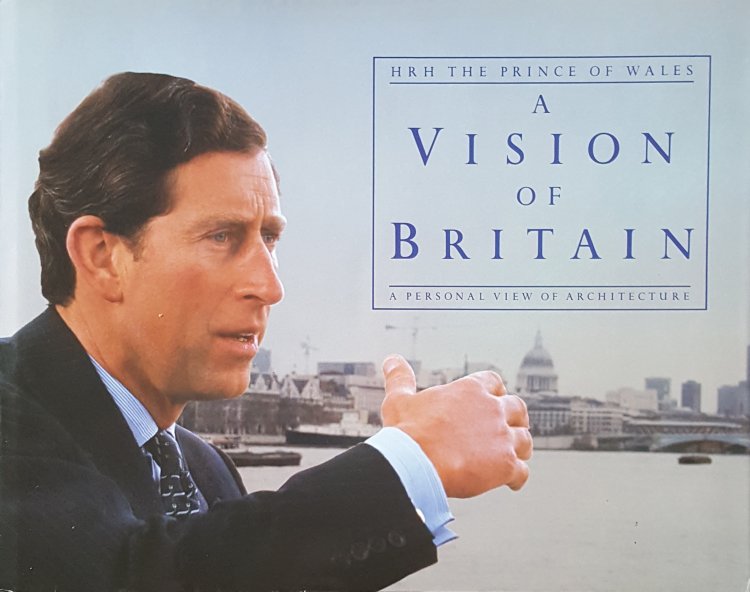
No prizes for guessing what put Prince Charles on my mind this week of his coronation as King Charles III and I knew I had a copy of this book on the shelves where it has been since I bought it new in 1989. The original version of this was a television programme broadcast by the BBC on the 28th October 1988 as part of the a documentary series called Omnibus, the script for this was then expanded and somewhat re-arranged to make the book. The main theme of the book is what Prince Charles sees as the destruction of the built landscape with modernist construction replacing beautiful old buildings especially in London although he does occasionally step outside the capital memorably describing the brutalist central library in Birmingham as
It looks to me like a place books are incinerated, not kept!
Page 32
I must admit that I tend to agree with Charles on that one and it wasn’t much loved by most people in the city which meant that although it was only built in 1973 it has since been demolished, although quite what Prince Charles thinks of the replacement I have no idea. It’s definitely an improvement and I really like the inside which is light and airy rather than the gloomy previous building.
Charles is often regarded as having a rather twee view of architecture, a classic example of which is Poundbury which as it says on the town website.
Poundbury is an urban extension to the Dorset county town of Dorchester, designed in accordance with the principles of architecture and urban planning as advocated by His Majesty, King Charles III, in his book ‘A Vision of Britain’.
Not many books can claim to have been the basis for an entire town of 4,600 people, planned to rise to 6,000 when development is completed in a couple of years. And whilst it is rather fake looking in places it is a viable community with businesses, schools and other civic amenities created within it rather than thought about afterwards which seems to be the current process for new built large developments. Charles is still involved in the overall design plan for Poundbury and whilst I don’t think I would want to live there I can see what he tried to do.
The book is particularly scathing about architectural developments in the UK since WWII and whilst he does find much to praise this is invariably where the architect has looked backwards in history for inspiration. The book is heavily illustrated both of buildings he likes and those derided and you quickly get the feeling for his ten principals for good buildings and design. In summary these are:
The Place – respect for the existing landscape
Hierarchy – the importance of a building should be obvious
Scale – size of buildings in relation to the buildings surrounding them
Harmony – buildings should not be jarringly different from their neighbours
Enclosure – public squares and enclosed spaces rather than row upon row of similar houses
Materials – use local materials where possible, the beauty of our ancient towns and cities constructed of local stone and brick
Decoration – there should be some, not the all too common featureless brick walls
Art – again have some
Signs and Lights – these are necessary but need not be overwhelming and should be well designed
Community – building a community with spaces for people to gather is essential
All in all the book definitely expresses a vision for the future even if a lot of it is deeply rooted in the past. Thirty five years after he made the documentary Charles still very much believes in what he said then. There are buildings he hates in the book which I quite like and as I said I wouldn’t want to live in Poundbury but there is a lot to agree with him. There have been some truly awful buildings created and a lot of really lovely ones lost in the last eighty years.
This book contains all eighteen short stories Arthur C. Clarke wrote in the 1960’s, including one set in his beloved Sri Lanka where he had moved to from England in 1956 and resided there until his death at the grand old age of ninety in 2008. Although all the stories were written in the 1960’s the last two didn’t actually get published until the early 1970’s including probably the strongest of the works in the book ‘A Meeting With Medusa’. The title story ‘The Wind From the Sun’ is also one of my favourites from this, the sixth collection of short stories by Clarke, it’s original title was ‘Sunjammer’ and it is still occasionally published under that name but Clarke explains in the preface that he changed its title as fellow SciFi author Poul Anderson used the same title, and indeed the same concept of sailing the solar wind, almost simultaneously in early 1963. To add to the confusion, and this time not mentioned by Clarke, another SciFi writer, Jack Vance, also had the same idea and published a similar story ‘Gateway to Strangeness’ also known as ‘Sail 25’ although that came out in late 1962. All three men had come up with the same idea independently and had no idea of each others work and the time taken to get things into print more than allows for the disparate publishing dates.
Perhaps inspired by the co-incidences around ‘Sunjammer’ there is another short essay included in this book entitled ‘Herbert George Morley Roberts Wells Esq.’ which describes Clarke’s absolute conviction that a story called ‘The Anticipator’ was written by H.G. Wells and he had written as such in his single page short story ‘The Longest Science-Fiction Story Ever Told’ which precedes the Roberts/Wells essay in the collection. In fact ‘The Anticipator’ was written by Well’s contemporary Morley Roberts and in the essay he explains that the story is about a high quality writer who keeps having the plots of his stories hijacked by a hack writer and published just before his version comes out so that the general public assume that he is constantly plagiarising the less good author so it is somewhat appropriate that Clarke didn’t get the true authors name right. It happened again to Clarke in 1979 when his book ‘The Fountains of Paradise’ was published at the same time as Charles Sheffield’s ‘The Web Between The Worlds’ both of which are about the construction of a giant tower all the way up to geostationary orbit which would operate as a space elevator therefore removing the need for rockets to reach space. Both novels have a similar construction method using a robot called Spider, both towers are built by a engineer who had previously constructed the longest bridge in the world and there are several other identical, or near identical features including the engineers name beginning with M. Again neither author knew about the others work it was simply an idea whose time had come.
All but two of the stories in this collection take place within the Solar System, the exceptions being ‘Crusade’ and ‘Neutron Tide’ and most occur on the Earth or Moon. This is another feature of Clarke’s science fiction writing, not for him universe wide adventures or galaxies at war which a lot of his contemporaries wrote about. Clarke, for the most part, is a more grounded writer. That doesn’t mean they are less fantastical just less space opera and more extensions of the readers understanding. ‘Maelstrom II’ for example has a man on his way home from the Moon when the, normally freight carrying, railgun that he is using as a cheaper way to get back malfunctions so he doesn’t have enough speed to achieve escape velocity. Yes it’s science fiction but everything in the story is valid science.
Arthur C. Clarke had a first class degree in mathematics and physics from King’s College London and used his scientific training in his writing, always making sure, as much as possible, that any concepts he came up with had a valid scientific basis. This makes him one of the strongest writers of science fiction as opposed to fantasy, when Clarke describes the fall into the atmosphere of Jupiter in ‘A Meeting With Medusa’ or the astronomical observations in ‘Transit of Earth’, which has an astronaut on Mars watching Earth cross The Sun you can be sure that the figures used are as accurate as 1960’s science allowed. Clarke didn’t come up with the idea of geostationary orbit but he did write the first scientific paper describing how satellites placed there would be perfect for telecommunications.
It’s a fun set of short stories and I was surprised how well I remembered several of them from when I first read the book in the mid to late 1970’s.










 Ramblings on my bookshelves