Surely You’re Joking, Mr Feynman! – Richard Feynman

Well this book was a complete surprise when I finally pulled it off the shelf where it has sat, largely undisturbed, for over ten years. The year before buying it I had read Six Easy Pieces and Six Not so Easy Pieces which were sections lifted from the Feynman Lectures on Physics and whilst I had enjoyed them I never felt in the mood to see which topics were included in this volume. In fact this isn’t a physics textbook but a stab at autobiography based on taped conversations between Feynman and Ralph Leighton largely done over a seven year period whilst they were drumming together, Feynman was a keen bongo player. The short pieces that make up the book are arranged in a rough chronological order from his childhood to getting his degree in physics at MIT in the first section, his time getting his PhD at Princeton University in the second. Part three covers his time at Los Alamos working on the Manhattan Project which developed the first atomic bomb during WWII whilst part four has him working as professor of physics at Caltech and Cornell universities and the final section has some fairly random stories in it. This potentially sounds rather dry but it is far from it, what we actually get is a total of forty anecdotes a lot of which have nothing to do with physics at all. As well as being one of the outstanding physicists of the twentieth century Feynman loved an anecdote and also stretching his brain doing things that had nothing to do with his career such as learning to do safe-cracking and taking it upon himself to translate Mayan pictographs relating to mathematical problems, both of which are covered in this book.

The stories are often humorous such as the first one concerning his Princeton years, which is also where the title of the book comes from. On arrival to start work on his doctorate he was invited to the rooms of the head of college for tea and being a young man from a Jewish background in New York he hadn’t come across this decidedly English concept which was popular amongst the academic elite at Princeton so didn’t really know what to expect. On being asked if he wanted lemon or milk in his tea he replied ‘both’ leading the lady pouring the tea to exclaim ‘Surely you’re joking, Mr Feynman!’ One of the funniest stories is his battle with the censors working at Los Alamos, now technically they weren’t allowed to censor mail within America but clearly they were going to because of the nature of the work on the Manhattan Project, However Feynman liked to keep his mind sharp so had already started having his correspondence with his father and his wife include codes without giving him a hint as to the key so that he had to crack the codes and the censors really didn’t like that aspect of his letters. Eventually they settled on having the letter writer include on a separate piece of paper how to crack the code and the censors would remove the solution before passing it onto Feynman. All I can say is he must have been a tricky person to work with and indeed his long time collaborator, Freeman Dyson, described him as ‘half genius, half buffoon’ which he later updated as ‘all genius, all buffoon’.

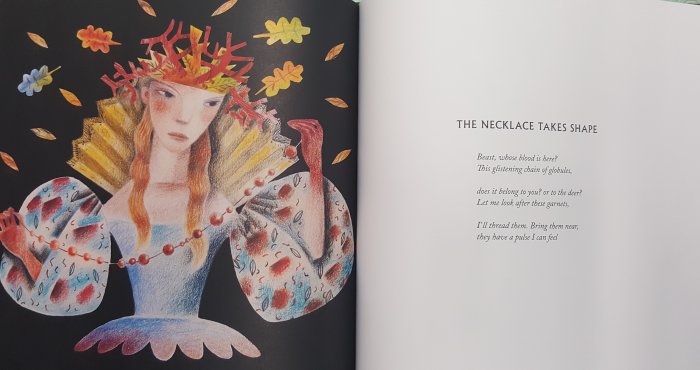
By its very nature the book is somewhat bitty, there are little, if any, links between the various stories included and you quite often want to know more and it leaves out large chunks of his life including his work on the report into the space shuttle Challenger disaster which helped bring him to wider public recognition outside of the world of physicists and academia. However the fact that it is forty largely self contained tales means it can be just dropped into wherever you feel making it ideal for reading when you just have short periods of time available and it is definitely worth reading, even if Feynman does come over as a pain in the ass at times. My copy was published by The Folio Society in 2012, twenty seven years after it first came out and is beautifully illustrated with numerous photographs along with drawings by Aude van Ryn.

Round Ireland with a Fridge – Tony Hawks

British comedian Tony Hawks was first in Ireland back in 1989 as the writer of a song entered for an ill fated attempt at an international song contest, but whilst he was there he saw something odd on his way to the contest; a man hitch-hiking with a fridge. What was even odder, at least to Tony was the complete way that this was regarded as normal by his Irish companions. Over the years this became a favourite tale for Tony to bring up at parties until late in the nineteen nineties he got particularly drunk at a friends house and…

Now both men knew in their heart of hearts that a bet made when neither of them could remember it being set because they were both too drunk does not have to be honoured, but this one niggled at Hawks for a while until he decided to go for it and I’m very glad he did because the trip and the subsequent book are very funny. I first read the book soon after it came out in 1999 and loved it then so it was with a little trepidation that I got it off the shelf for a reread, would I still think it as good as I did then? I needn’t have worried the tale is still as brilliantly daft as I remembered it to be.

Hawks arrived in Dublin having done minimal preparation other than badly packing a rucksack and arranging with a friend in Ireland to be met at the airport by a friend of this friend along with his travelling companion for the next month. It was whilst explaining to this person, that he had never before, what he was planning on doing that the economic idiocy of the adventure starts to come clear. As he pays him the £130 for the fridge it is obvious that even if he succeeds he is already £30 down not counting the flights, accommodation costs, food etc that he will have to pay for on his journey but he had not counted on the friendliness of the Irish. At a suggestion of his friend he drops a note round at RTE, the national broadcaster, for Gerry Ryan who is the host of the popular breakfast radio show on the basis that breakfast radio is a perfect place to talk about hitch-hiking round Ireland with a fridge as this sort of programme is always looking for offbeat stories to fill up some time. Instead of just a short chat with Ryan on his show it turns into a regular feature with the radio programme regularly calling to find out where he had got to since they last spoke and before he had even got half way round Hawks was mildly famous as ‘Fridge Man’ throughout Ireland and people were waiting to see him turn up in their town and he was being covered by local papers across the country.

The book is not just funny though, in his tale Hawks introduces people who helped and the stories of their lives that he briefly touches on, people start signing the fridge and by the time he gets back to Dublin there is no room left of the two foot cube that had made it all the way round. On the way, the pair of them did all sorts of things including going surfing, fortunately there is photographic evidence of this to prove it, the fridge also got christened and became a folk hero, they even spent a night in a dog kennel when there was no room anywhere else. The book is a joy to read and I’m so glad I picked it back up again after more than twenty years. Hawks has written several books since this one, often with a theme of travelling with a specific purpose such as ‘Playing the Moldovans at Tennis’ where he tries to persuade all eleven members of the national football team to play him at tennis. Or ‘One Hit Wonderland’ where he travels around the world trying to have a second hit record, he had his first, and only previous success back in 1988 with ‘Stutter Rap’ which made the British top ten back in 1988. If you like your travelogues with an eccentric edge Tony Hawks is the man for you.

Change of Use – Candia McWilliam

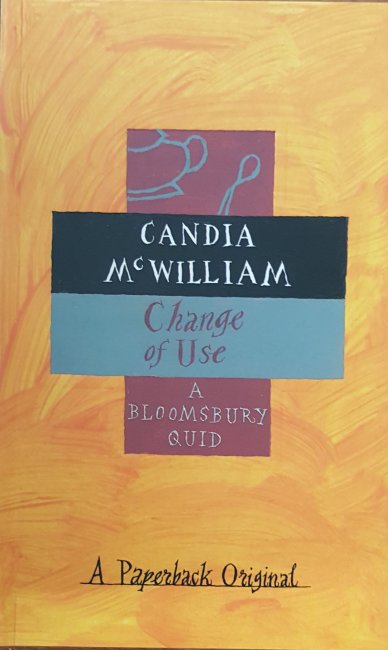
As a response to Penguin Books and Pheonix producing small cheap editions in the mid 1990’s Bloomsbury decided to have a go as well and so the Bloomsbury Quid was born, and almost immediately died. The initial ten books, which came out in 1996, were never followed by any more. Priced, as implied by the series name, at a quid, or one pound, they are probably the nicest designed and best produced, being on much higher quality paper than others of these cheap editions so it is a great pity that Bloomsbury never saw fit to produce any more, perhaps they didn’t sell, perhaps there simply wasn’t enough money in it, who knows after almost thirty years? The titles chosen were certainly interesting:

  • Change of Use by Candia McWilliam
  • The Drowned Son by David Guterson
  • Faith by Joanna Trollope
  • Harald, Claudia, and Their Son Duncan by Nadine Gordimer
  • The Queen and I by Jay McInerney
  • She Wasn’t Soft by T. Coraghessan Boyle
  • A Story for Europe by Will Self
  • Three Stories and a Reflection by Patrick Süskind
  • Two Boys and a Girl by Tobias Wolff
  • The Labrador Fiasco by Margaret Atwood

From the page dedicated to this series on Library Thing you can see that the series was bright and colourful and even that these are suggested as a collectors item of the future; and whilst that hasn’t proved to be the case so far, I’m glad I picked up the full set when they came out.

So enough of the publishing history, what is the book itself like?

On the back of the book is the opening line of the story and it’s certainly intriguing, Why is Mary sitting on the edge of a sink and what sort of rituals? It slowly comes clear that most of the story is set in a retirement home and the rituals are literally that, things that are done ritually by the people being cared for. Mary is one of the nurses at the establishment and she is overseeing one of the residents as he polishes some silver spoons whilst reliving his time as a butler, interestingly enough at the same property that is now his nursing home. Interleaved with his story is that of the grandmother of the person who drives the laundry van that calls at the home. She is getting increasingly fed up with the research work that she does for various authors and dreams of a life away from it and like Mr Charteris, the ex butler, she longs for the memories of her younger life and is scheming to reclaim them.

The story is interesting as you get into the minds of the various characters very well for such a short work and I loved the twist at the end. I’m definitely going to have to read another of McWilliam’s surprisingly few books. She stopped writing in 1997 and then had a medical condition in 2006 which left her blind for two years and which inspired her to take up writing again although this time a memoir which was published in 2010 which was her last published work. Interestingly this story has never been reprinted, even though McWilliam published a collection of short stories in 1997 so this small volume remains the only place you can read it.

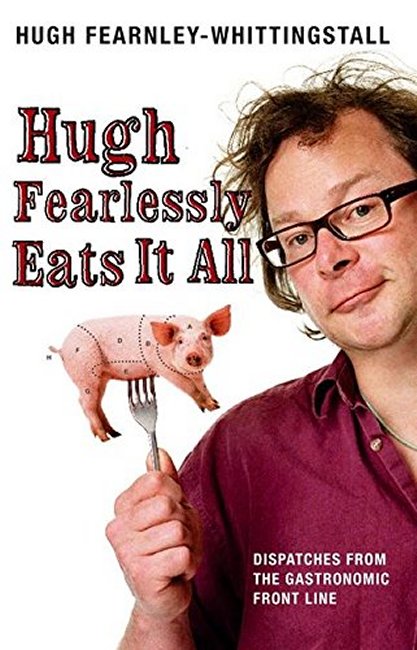
Hugh Fearlessly Eats It All – Hugh Fearnley-Whittingstall

It has been said that I will eat anything. This is, of course, nonsense. Medium Density Fibreboard soaked in paraffin served between two discs of foam rubber has never got me salivating (which is why I steer clear of McDonalds).

Start of chapter two

Hugh gained the sobriquet of Hugh Fearlessly Eats It All from a review of one of his books where he advocated eating as much of an animal as possible, no discarding of offal, if a pig has been killed to provide the diner with pork chops the least people can do is eat the rest of it with as little waste as can be managed. I am very much in agreement with him and regard most offal as a treat due to the flavours and textures that you would otherwise miss. I haven’t gone as far as Hugh’s keenness for brains and frankly his descriptions of the texture, which for him makes the dish, are quite off-putting to me.

This book, unlike the others I have by Hugh, is a collection of his journalism and whilst some of the articles are campaigning for various issues, especially regarding ‘nose to tail’ eating, others are very funny and even self deprecating. His own personal food business ‘River Cottage‘ barely gets a mention and whilst there are some recipes in the book they appear only rarely and always to illustrate a point in the article they are attached to. This is worth pointing out as most of his books are cookbooks, and one is my favourite which is his Meat book, nothing I have ever cooked from that book has failed to work or indeed been so complicated that I was immediately put off trying it. Having said that the journalism is a delight and being short articles it makes this a great book to dip into pretty well at random. Hugh started out as a sous chef in the kitchen of the famous River Island restaurant in Hammersmith, London but didn’t last long as a need to cut costs led to him being fired about eight months after joining them, he has never looked back, or indeed worked seriously in a professional kitchen since that date in August 1989. He moved to River Cottage in 1997 and presented his first TV series from there two years later and nowadays it is River Cottage rather than his journalism that most people think of, which is a pity because as I said earlier it’s very good.

The book is split into six sections with articles gathered thematically so for example the first part ‘Hard to Swallow’ includes pieces about McDonalds and Kentucky Fried Chicken, bemoaning the quality of their products and the Atkins diet pointing out the dangerous side effects of that regime. There are also articles about the poor standard of food in first class on Eurostar and other other similar topics. These sound like they could be hard work to read but rather they are quite entertaining, especially when he tries to replicate a Big Mac at home. Later sections dwell on travelling to try new foods and also his home life from childhood to his current family life at River Cottage, he is a very good writer, short articles are notoriously difficult to do especially if you are also raising an important point such as intensive farming without just banging on about it. No everybody can’t live the way he does and eat fresh home produced vegetables and meat but we can try to do the best we can afford’ Hugh has the advantage of coming from a wealthy family and sometimes he can be somewhat divorced from the realities of how most people live but having said that he comes over as a very likeable person and at some point I will get down to River Cottage to do one of his cookery courses.

One thing I think that is missing is which publication the articles originally appeared in, you get the month and year but not where. He had regular columns in Punch magazine and the Evening Standard and Sunday Times newspapers so I guess most are from those but it seems a strange omission.

Penguin Marvel Classics collection

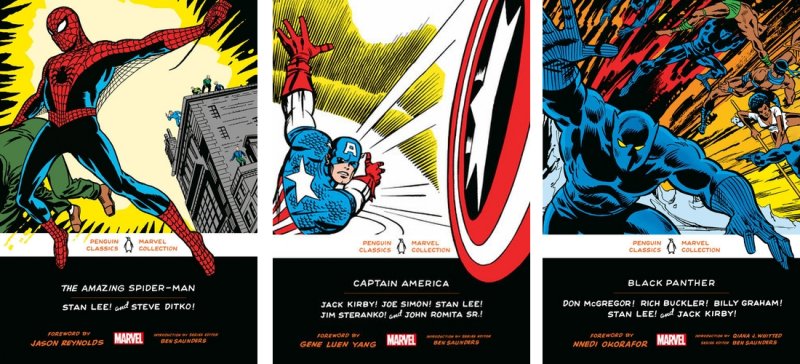
On the 14th June 2022 Penguin Books embarked on a new series of titles with three books each simultaneously printed in hardback and paperback. The paperbacks, as can be seen above, were designed to look like the current iteration of Penguin Classics but noticeably larger at 252mm tall and 180mm wide as opposed to the ‘normal’ size of Penguin Classics which are 198mm tall and 129mm wide. This larger size makes the reproduced comic books in each volume far more legible. The hardbacks are larger still at 272mm tall by 198mm wide, their covers are very different and have gold page edges on all three sides. The hardback covers are illustrated below as each book is discussed in this blog. It isn’t the size of the books that strikes the reader as different when you pick them up though, it’s the weight. At getting on for a kilo each for the paperbacks and even closer to two kilos for the hardbacks, this is due to the high quality paper used in order to do justice to the full colour pages throughout the almost four hundred pages making up each book, these are clearly not books for reading in bed.

All the books have the same introduction to the new collection as shown below:

It’s an interesting idea to class early Marvel comics as Penguin Classics, after all that series concept began in 1946 and 1947 with translations of Homer’s Odyssey, Guy de Maupassant’s short stories, Sophocles’ The Theban plays and Voltaire’s Candide in the first two years, quite what E V Rieu (the original series editor) would have made of these comic books appearing in Penguin Classics can only be surmised but it probably wouldn’t have been positive. Having said that, the introductory essays do indeed set the comic art in it’s historical and cultural context so at least some attempt to hold to Rieu’s principles for the series has been made.

The Amazing Spider-man

I was interested to see how these editions differed from the Folio Society curated volumes currently being produced, see their Spider-Man launch video here. Penguin have gone for a very different approach to their selection of comics to the Folio Society as with Penguin you get an almost contiguous run of early comics rather than a selection over the years by former Marvel editor Roy Thomas which is Folio’s take on the subject. So in this volume you get Spider-Man’s first appearance in Amazing Fantasy number 15 (August 1962) followed by the first four comics from The Amazing Spider-Man (March to September 1963). There then follows an essay about the characters development which also discusses comics five to eight and then the reproductions of the full comics continues with The Amazing Spider-Man comics nine and ten before another essay replacing issues then more reproductions and so on until the last comic included which is number nineteen from December 1964 by which time there have been twelve full reproductions. I actually really liked this way of doing it because at least you can follow story development rather than the more bitty Folio treatment and the three appendixes dealing with further aspects were really interesting as was the volume introduction by Ben Saunders. What you miss with the Penguin version rather than the Folio edition is a feel for where the character is going over the subsequent years however these are Penguin Classics after all so we should be looking at the early version of the character and even the hardbacks, at £40 are less than half the £95 of the Folio Society version.

Captain America

Captain America takes a similar way of selecting comics but with one major difference to the Spider-Man volume as although we get a reproduction of Captain America number one (March 1941) the rest of his largely propaganda driven World War II comic book stories are skipped. Because we get number one though we do at least get the famous cover illustration of Captain America punching Adolf Hitler. Instead we leap to Tales of Suspense number fifty nine (November 1964) and take the Captain from his relaunch including Tales of Suspense number sixty three (March 1965) which tells the origin story of Captain America. This had to be done as an entire generation had grown up without the character so who was this guy in the stars and stripes outfit? There are in total twenty two partial or complete reproductions of the comics, all but the first being Tales of Suspense which tended to have two, or more, separate stories in each edition and only the Captain America parts are reproduced here and he also didn’t appear in every edition so the last one included is number 113 (May 1969). Again unlike the Folio Society version we are focusing on one period of the characters existence rather than a more rounded overview and we also get essays that cover comics not included and provide more developmental background.

Black Panther

Unlike the other two, Black Panther originally appeared in another series entirely and has The Fantastic Four visiting Wakanda, home of The Black Panther, at his invitation only for him to launch an unexpected attack on them. This takes place in Fantastic Four numbers fifty two and fifty three (July and August 1966 respectively) both of which are in this volume. Despite the initially unfriendly approach, Black Panther and the Fantastic Four end up joining forces to attack an enemy of Wakanda and them ultimately encouraging him to continue fighting for good as Black Panther. We then leap to his next appearance, which is Jungle Action number six (September 1973) and have an uninterrupted series of comics from there to Jungle Action number twenty one (May 1976) this time with no explanatory essays replacing the comics. The appendices are very different as well, this time we get the essay written by Don McGregor as his introduction to Marvel Masterworks: Black Panther volume one and the typewritten plot synopsis originally created for Jungle Action number seven also by McGregor. This is a very interesting document as it shows how stories were developed before any artwork had been started.

The first three volumes of the Penguin Marvel Classics collection are excellent and anyone interested in comic books or the booming graphic novel market should seek them out.

The Prince – Niccolò Machiavelli

Everyone has heard the name Machiavelli, but how many have actually read the book he is most famous for? Well until this week I hadn’t got round to it despite owning a copy for many years. It’s an interesting book, originally written in Italian at around 1513 and ultimately dedicated to Lorenzo de Medici after the original proposed dedicatee died before the work was finished; it has given its author a reputation for ruthlessness and scheming which is partly but not entirely justified. Machiavelli was above all else a patriot to his city state of Florence and having lived through turbulent times when the various Italian states had been repeatedly fighting each other along with invasions from both France and Spain he wanted to set down some advice based on his experiences. Florence was seriously weakened during his lifetime and he wanted it to rise again so sets out in the first half of the book some arguments as to how a state rises, is maintained, and can ultimately fall with numerous historical examples to back up his propositions.

It is probably the second half of the book which has been historically so troubling but frankly despite the directness of the language, you can still read it and see where he is coming from even if you don’t agree with his arguments, see the following passage for how a prince should behave

he should learn from the fox and the lion; because the lion is defenceless against traps, and the fox is defenceless against wolves. Therefore one must be a fox in order to recognise traps, and a lion to frighten off wolves. Those who simply act like lions are stupid. So it follows that a prudent ruler cannot, and should not, honour his word when it places him at a disadvantage and when the reasons for which he made his promise no longer exist. If all men were good this precept would not be good; but because men are wretched creatures who would not keep their word to you, you need not keep your word to them.

Chapter XVIII – How princes should honour their word

He further looks to whether a prince should be generous or parsimonious and concludes that whilst generosity can possibly rise a new ruler to princedom it cannot keep him there as it ultimately will be ruinous and any attempt to raise further funds will be resented by the majority who have to supply the money either by taxes or seizures of property and merely appreciated by the minority who gain by them. This will lead to uprisings against the prince and the loss of his state or more likely his life. The decision is then that a prince should be seen as miserly by preference especially if they use the garnered wealth to maintain sufficient soldiers to make the state safer from possible attacks from its neighbours. He also has much to say about armies and why mercenaries are a bad thing as they just draw on the state funds when not in use and can simply move to another state willing to pay them more money if things start to look as if they are going against them. Even a professional army is a problem that needs to be carefully looked after to avoid officers rising to a point where they could see themselves as possible rulers and therefore mutiny and there is a balancing act needed to ensure loyalty without engendering resentment from the populace who ultimately have to pay for them.

He is even more troublesome when it comes to cruelty or compassion to your subjects

So a prince should not worry if he incurs reproach for his cruelty as long as he keeps his subjects united and loyal. By making an example or two he will prove more compassionate than those who, being too compassionate, allow disorders which lead to murder and rapine, These nearly always harm the whole community, whereas executions ordered by the prince only affect individuals.

Chapter XVII – Cruelty and compassion, and whether it is better to be loved than feared, or the reverse.

Well that last sentence is certainly true, especially for the individual being executed, but I’ve never come across such an argument so brutally put and it is probably such sentiments that have given Machiavelli his reputation today, and indeed pretty well ever since the book was published in the early sixteenth century.That is not to say that the book is not worth reading, because it definitely should be read today especially when considering the current state of world politics and conflicts. Machiavelli is blunt in his opinions but that only makes them easier to read and understand, I’m certainly not recommending the book as a guide to how to exist nowadays but it can give valuable pointers as to the possible mindsets of various rulers today who whilst not embracing Machiavelli in his entirety definitely give the impression of being in general agreement with him.

Terry Pratchett: A Life With Footnotes – Rob Wilkins

I was given this book for Christmas and picked it up to read a few chapters at 4pm that day, ten and a half hours, and most of a bottle of wine, later at 2:30am on Boxing Day I finished the last of the 429 pages. I just kept thinking I’ll read another chapter and then by one o’clock in the morning it was a case of, well I may as well finish it then. Yes I knew a lot of the story already but Rob’s writing draws you in, he is surprisingly good with a turn of phrase although I suppose he was taught by a master. Rob Wilkins, for those who don’t know, was Terry’s PA and later business manager from December 2000 until his death. He now runs Narrativia (a production company looking after Terry’s works) and Terry’s literary estate alongside Rhianna Pratchett, Terry’s daughter. It is this that gives him a unique oversight of Terry’s life and works.

Terry had started to compile notes for an autobiography before he died in 2015 but by then had only produced around 24,000 words and reached 1979, still way before he wrote his first Discworld novel. At that point he had had only two novels published, ‘The Carpet People’ and ‘Dark Side of the Sun’ along with a handful of short stories. Rob has used these notes extensively but there needed to be a lot more research, not just to fill in gaps but also to do some fact checking. Not everything was, or even could, be checked and some of these fell into the category, referred to several times in the book as Too Good To Check, invariably abbreviated as TGTC. Terry was diagnosed with Posterior cortical atrophy, a variety of Alzheimer’s disease in 2007 and as Rob points out, just how reliable were his memories especially near the end so a lot of checking was needed, fortunately Lyn (Terry’s wife for more that forty years) and Rhianna were always available along with numerous other people so the book has to be described as pretty accurate, except possibly where it is TGTC.

The book does indeed cover Terry’s life, rather unlike a lot of biographies which tend to rush to the point at which the person being written about has done something significant that brought them to the public’s attention. As I said at the beginning there are 429 pages and it is only as we approach page 200 that the first book in the Discworld series is being written. Before that we have his schooldays and his initial somewhat ambivalent attitude to reading. His first job, in a library, and leaving school before his A levels to become an apprentice journalist on his local newspaper. Journalism was where Terry learnt to write and love words and especially books. One paragraph in the book really spoke to me and my love of books.

You know how it goes. You start out just borrowing a few books from the library, or your grandmother, and thinking you’ve got it under control and that you can handle it – they’re just loans, after all, so what’s the fuss about? And the next thing you know you’re moving on to the harder stuff -second-hand books from second-hand bookshops, and actually paying for them with your own money and taking them home with you to own, putting them on a shelf in your bedroom, even. And at that point, most likely, it’s all over and you’ll be on to brand new books before you realise it, and almost certainly an addict for the rest of your life.

Chapter three

In June 2011 Terry and Rob appeared in their second TV documentary ‘Terry Pratchett: Choosing to Die’, an incredibly difficult programme to watch about assisted suicide which was something Terry was considering for himself as his condition worsened and was actively campaigning for a change in the law in the UK so that people wouldn’t have to go to Switzerland which was the only place in Europe where it was legal. Throughout the programme you can see Terry getting more enthusiastic and Rob getting more and more distressed as the reality of what they were talking about hit hard. The next day after the broadcast I happened to be talking to Rob on the phone about something else and he asked me what I had thought of the programme and I told him that I had cried at times, much as I did nearing the end of this book eleven years later, and that it was his reactions that I had most been drawn to. I wish he had mentioned something that appears in this book as he sat watching the programme himself and was scrolling through the twitter feed to try to gauge peoples reactions to the documentary when he randomly paused his scrolling to read “Terry Pratchett’s Assistant is a Right Knob”. Years later at the 2016 Discworld convention, the first one after Terry’s death, he had clearly embraced this sentiment.

Rob Wilkins on stage at the 2016 Discworld Convention at Kenilworth near Warwick, England on 26th August, photo taken by me.

It was a great read Rob, and no you’re not a Right Knob.

A Very Early Victorian Christmas – Hector Bolitho

Not so much a book as a pamphlet, this sewn spine publication was privately printed in an edition of just three hundred copies in 1929 as a Christmas gift from Alan, Dick and John Lane. It is the second such Christmas book from the brothers after the previous years Elegy Written in a Country Churchyard by Thomas Gray which I wrote about in a blog two years ago. The story appears to have been specially written by Bolitho for this edition and I cannot find any other time that it has been published, indeed it is so obscure that it wasn’t included in the Hector Bolitho bibliography on Wikipedia until I added it this morning.The book is attractively bound with quite large french flaps and a paper label stuck onto the cover giving the title and author. The first thing you see on opening the book is the gift dedication from the Lane brothers.

Surprisingly what you don’t see is any indication as to who printed the book and for hints as to which company it is I have turned to the Autumn 1984 edition of ‘The Private Library’, which is the quarterly journal of The Private Libraries Association. In this edition Jonathan Gili wrote an excellent article dealing with all the Lane Christmas books and in it he suggests that The Curwen Press, which had suddenly closed down in January of 1984, printed it as the paper cover was definitely from one of their patterns and the Koch Kursive typeface used for the above dedication panel was introduced by them in 1926. The sudden collapse of the business and the subsequent rapid sale and dispersal by auction of their effects would however preclude a more detailed examination.

Born in New Zealand in 1897 Bolitho came to England in the mid 1920’s and settled there, initially working as a freelance journalist. He went on to write over fifty books, a large number of which are biographies and a significant number of those are of British monarchs but is now largely unknown and this is the only book by him that I possess. Indeed as I said at the beginning this is barely a book, finishing as it does on page fifteen. The frontispiece shown above features a portrait of Princess Victoria at the age of eleven which would mean it is from 1830 which is roughly when the book is set and is seven years before she would become queen so the title is not really accurate as her father King William IV was monarch at the time and the Victorian era was still a few years away. However the little princess features in this short tale if only in allusion.

The stories lead character is Michael Stranger, born on Christmas Day early in the nineteenth century, and at the start he is living with his older sister near Reading, Berkshire and she is wonderfully described by Bolitho as

a gaunt, hard woman, with a face like a horse. She moved within her clothes as if she were made of laths of wood

Michael is to go to stay with his uncle, Abraham Trotter, from Christmas Day and he had a fine house in the Edgware Road, London, he was apparently

a dealer in tea and spices and cloves and ginger. His wife had died of pneumonia and the spittings and he lived alone

However we never meet him as Michael is to stay overnight on Christmas Eve at an inn in Kensington and on the coach to there he chats with a fellow passenger who tells him of Princess Victoria and that night after his meal, where there is more discussion regarding Victoria, he wanders down the road until he comes to Kensington Palace where a watchman tells him that the lights he can see on are from the windows of the young princess’s rooms. Amazingly that is the end of the book, it has barely got going when it stops.

Brother Bear – H Clark Wakabayashi

Brother Bear was the 44th animated feature film by Disney and this book tells the story of how the film was made rather than telling the story in the film. I must admit that I have never seen the film, which was released in 2003, but that was not really important as I was interested in the creative development involved in making an animated feature and a quick flick through suggested that buying this book would give me the insight I was looking for. In fact the book told me much more about the somewhat odd personal development methods at Disney and their willingness to throw staff in at the deep end to see how they get on.

The book is an unusual landscape format is the 2003 first edition and is part of the Welcome Book series from Disney Editions. These books are dedicated to the making of various animated films from Disney and after reading this one I’m tempted to see if I can find more titles. The landscape format allows for the format of the images to be shown better although it does make the book somewhat unwieldy and also produces extra stress on the binding which has already resulted in the pages dropping at the far end so that they rest on the shelf rather than being held straight as originally bound.

The book starts with the determination of one animator, Aaron Blaise, to work on this movie from when it had been just a suggestion of a project that might go ahead. At that time it was to be loosely based on Shakespeare’s play King Lear, so an old bear with three daughters and it would be anthropomorphic like the much earlier Robin Hood with the animals dressed up like humans. Blaise didn’t like this idea and kept pushing, whenever he got a chance, for a more realistic treatment and for him to be involved as one of the animators. Eventually he was called to a meeting with a senior executive and rather than being offered an animators job he was asked to direct the film despite having no experience of directing. At this point there was no script and no real idea as to what the film would look like it was up to Blaise to come up with potential plot summaries and designs and put them in front of the executives who could agree to fund the production. After floundering for several months he was eventually assigned a co director, Bob Walker, to help although Walker hadn’t directed before either. The more you read the more you wonder how Disney ever come to make any movies at all. Eventually they gained a producer, Chuck Williams, who did know what he was doing and progress started to be made although they still didn’t have a script.

Gradually though the film starts to come together and the idea of transformation of a human into a bear, although how and why remained unclear and that human having to learn to live as a bear. For probably three quarters of the films development he is assisted in this by an old bear named Grizz and this got as far as being animated and even the voice of this bear being recorded and a song written by Phil Collins about the growing friendship between our hero and Grizz. All of this was scrapped very near the end of scheduled production and the old bear was replaced by a young cub named Koda who would be much more appealing to the potential audience. The cub idea came from the much more experienced team of animators in Los Angeles whilst Blaise and his team were in Florida and they held out for Grizz mainly due to the huge amount of work that had already gone into him and they felt tied to this way of the story. The two teams communicated via regular video conferences which were getting more and more fractious to the point that the cartoon below by one of the team of animators, Nathan Greno, was drawn to sum up how the conferences were going.

Eventually Blaise, Walker and Williams were convinced that the cub idea solved a lot of the story problems and a story editor was finally assigned to the movie years after they started making it and this turned the whole production around. The book is fascinating for the details of the conflicts and issues that occurred during the six years the film took to make and just how late in the process the whole project could be totally revised. I’ll have to watch the film now and see if I can spot areas where the whole plot changed direction from the numerous failed attempts to come up with a viable story.

The Strange Case of the Sixth Penguin Book

The first ten Penguin books were all published together in July 1935 with an edition size of 20,000 books per title and launched a publishing phenomena. being a fraction of the cost of any other books available at the time, but there was to be a problem with book number six. It soon became clear that Penguin Books might not have the rights to publish a paperback version of ‘The Mysterious Affair at Styles’ by Agatha Christie so despite it’s popularity, it was reprinted twice in 1935, the book was pulled from the list of available titles leaving a gap in the neat numbering system. What to do? Well by early 1936 Penguin definitely had the rights to another book by Agatha Christie, ‘The Murder on the Links’ and in March that year this replaced ‘The Mysterious Affair at Styles’ but numbered 6A, see below.

Using an A to differentiate between the two books looked odd so in September 1936 the A was quietly dropped and ‘The Murder on the Links’ became number six. In the meantime however Penguin had sorted out the rights over ‘The Mysterious Affair at Styles’ but this couldn’t go back to being book six without renumbering ‘The Murder on the Links’ and causing even more confusion so in June 1936 ‘The Mysterious Affair at Styles’ was published again, this time as number sixty one. ‘The Mysterious Affair at Styles’ as number sixty one is relatively easy to find but the book as number six is extremely rare despite the original print run. I have collected Penguin Books for over thirty years and only obtained a copy of this version in the last few days and fortunately didn’t have to pay the £750 that a similar condition copy apparently recently sold for. All of Christie’s first five books were published by The Bodley Head which at the time of publication was the home of Penguin Books whilst its Managing Director, Allen Lane, got Penguin started before leaving to run Penguin as a separate entity at the start of 1937. This interconnection between the two businesses is probably the cause of the confusion over rights.

So let’s look at the two books:

The Mysterious Affair at Styles

Originally published in 1920 this was Agatha Christie’s first book and introduced her most famous creation Hercule Poirot to the world. It was only when flicking through the book when it arrived that I realised that I hadn’t actually read it before, which was a considerable surprise. When we first meet Poirot he is with a group of other Belgian refugees from the First World War living in a house in Styles St Mary, a small village near the grand house of Styles Court. The man who would be Poirot’s chronicler and friend, Arthur Hastings, was staying at Styles Court whilst recuperating from being invalided out of the war. He is greatly surprised to find Poirot, whom he had met in Belgium before the war living so close and when Emily Inglethorp, the elderly owner of the manor house, dies, apparently of strychnine poisoning, he suggests getting Poirot involved in solving the case. The plot is surprising well constructed for a first novel and numerous family members and other guests at the house are suspected before Poirot explains the true solution in the final chapter. According to the rear flap of the dust wrapper the book was a result of a bet that Christie couldn’t write a detective story where the reader only discovered the true murderer in the last chapter. I have to say the final twist is most ingenious and yet the reader cannot say that any clues were not available to them in trying to solve the case themselves.

Poirot and Hastings would return to Styles Court in his last appearance, ‘Curtain’, only this time the house is no longer a family home but has been turned into a guest house.

And now for the second number six, this is one of only two times two completely different Penguin books shared the same catalogue number that I have been able to find in the almost ninety years Penguin Books have been publishing, the other being number 305 which was allocated to the first two volumes of Penguin New Writing before that was spun off into its own series. There are however several examples of books by that publisher being re-issued under a different number to that originally assigned so six becoming sixty one, whilst it is unusual and is the first such renumbering at Penguin is certainly not unique.

The Murder on the Links

Agatha Christie’s third book and the second to feature Hercule Poirot must presumably have been already planned for publication by Penguin before it suddenly appeared as 6A, the book had been first published in 1923 and like ‘The Mysterious Affair at Styles’ had gone through numerous editions before appearing in Penguin. This time Poirot and Hastings are trying to solve a murder in northern France, in the imaginary small coastal town of Merlinville-sur-Mer which is apparently an up and coming destination and is constructing a golf course and casino in order to attract more wealthy visitors. Poirot had received a letter from Paul Renauld at his home in London, showing a considerable step up from his shared refugee home in Styles St Mary, which requested his urgent assistance in France so off they both go only to discover when they arrive that Paul Renauld was murdered the previous night. The plot has the addition of humour with Inspector Giraud, a modern detective from the Sûreté in Paris, whose methods amuse Poirot and the obvious resentment Giraud has for Poirot leads to a rivalry in which a five hundred franc bet is made between the two detectives as to who will solve the case. The case is more complicated than Poirot’s first appearance showing a growth in confidence by Christie after the very positive reception of her first two novels and I enjoyed this book more than the first.

Poirot and Hastings are so often seen as a double act, clearly based on Holmes and Watson, that it is perhaps surprising that of the further twenty Poirot novels Christie would write Hastings is only in five of them and she would later rewrite two of those removing Hastings as she did so. Indeed she is clearly trying to get rid of him in this book as he meets his future wife during this case and subsequently moves to Argentina to run a ranch with her. I like Hastings, although he can be a bit irritating but I have definitely enjoyed reading the two number sixes from Penguins catalogue.