Uncle Jim

20180227 Uncle Jim 1

Back in 1965 a teenage apprentice journalist started work at the Bucks Free Press, then as now, the local newspaper covering the Buckinghamshire area, places such as High Wycombe, Beaconsfield, Marlow, Gerrards Cross etc. The newspaper had started over 100 years earlier and there was nothing really to suggest that this new trainee was much different to the many that had gone before him except that 2 years earlier at the age of 15 he had had his first story printed in Science Fantasy magazine (volume 20, number 60), more of that particular magazine in a later blog because that is also on my shelves.

The Bucks Free Press had a section called Children’s Circle (the image at the top is scanned from a 1966 copy) which had stories and birthday wishes aimed at younger readers all of which were apparently written by Uncle Jim, the general nom de plume of whoever was tasked to write them and it seemed logical to give the job to the new starter who had already proved he liked to write stories. In the coming years he would write over 80 tales as Uncle Jim nearly all of which were split over several weeks to keep the kids coming back for more, whilst also working as a journalist covering all the things that a local paper needs to do, he saw his first dead body within a week of starting.

The name of this young chap – Terence David John Pratchett, later to become Sir Terence, knighted for services to literature in 2009, or just Terry for those of us lucky enough to have met or indeed spent time in bars late at night with him. Because Terry always had time for his fans and we loved him for it.

Dsc_0558

Now trying to find local newspapers from over 50 years ago is largely a fruitless task so the first time I saw some of these stories from Terry’s early days was on a website started by the Bucks Free Press in association with the Friends of High Wycombe Libraries in June 2010, which posted 2 of them and the first 4 parts of what would become Terry’s first novel The Carpet People. They indicated that they intended to make them all available before they were told to stop quite quickly after the site was started as Terry owned the copyright. The site never actually added any more work and was eventually taken down by the end of 2012. What they did have on the site though was a partially useful list that showed the first time Terry wrote as Uncle Jim was published on the 8th October 1965 and the last they listed was 20th December 1968, in total there were 167 parts listed making up 47 distinct stories. The earliest was a 12 part story that eventually led to The Carpet People, the next longest were 2 stories, one in 1966 and one in 1968 which needed 8 parts and there were 7 stories that were completed in just one part.

These figures are however known to be incomplete as even the article on the Bucks Free Press website announcing the launch of the site in 2010 states that his last appearance as Uncle Jim was in 1970 and there were some 250 episodes, however they do provide an insight into the first 3 years of Terry’s work on this column and the way the stories were split. In fact there were 247 parts written by Terry between 8th October 1965 and 17th July 1970 making up the 80+ stories but apart from going to Beaconsfield library and reading their newspaper archive that seemed to be the end of being able to access these stories far less being able to have Uncle Jim wish you a happy birthday.

20180227 Uncle Jim 2

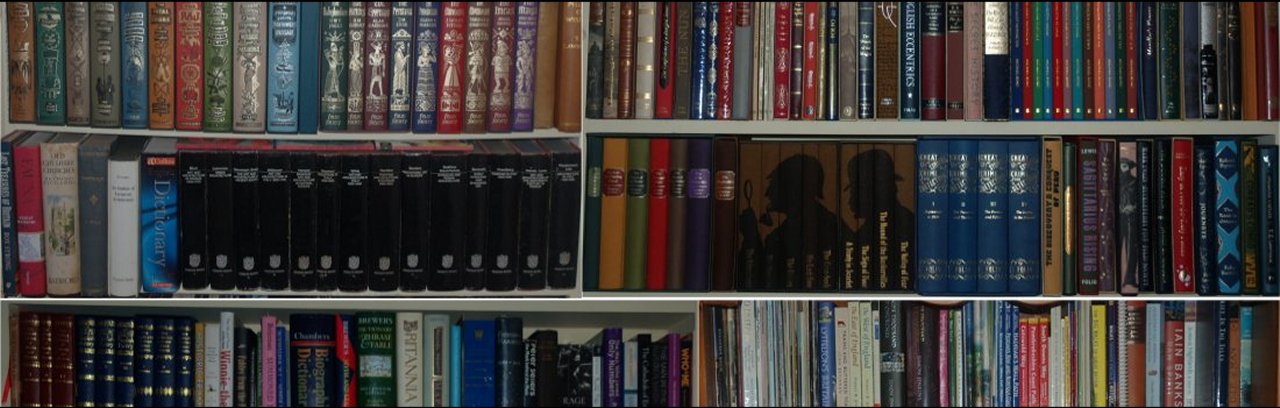
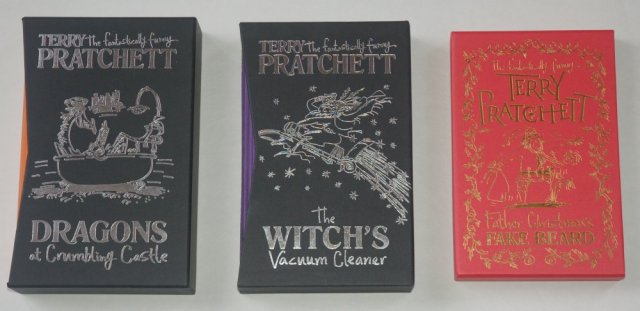
However as can be seen from the image of the books above there have now been 3 collected volumes and I have all 6 of them. Yes you read that right, each one has come out as a standard edition alongside a collectors version.

Dsc_0560

Dsc_0559

So lets make a comparison of the available volumes:

Dragons at Crumbling Castle – published 2014

  • Standard edition – Dust wrapper – 14 stories, two of which went to make up The Carpet People but are here presented as 2 separate works and an introduction.
  • Collectors edition – Slipcase – 16 stories, the two extras being ‘The Wergs Invasion of Earth’ and ‘Bason and the Hugonauts’. There is also a different, significantly longer, introduction; commentaries after each story written by Terry and a colour print tucked inside.

The Witch’s Vacuum Cleaner – published 2016

  • Standard edition – Dust wrapper – 14 stories and an introduction
  • Collectors edition – Slipcase – 16 stories, the two extras being ‘Johnno, the Talking Horse’ and ‘The Wild Knight’. Commentaries after the stories were written by Terry’s assistant Rob Wilkins as Terry had sadly passed away in March 2015 and there was also a postscript added by Rob by way of a eulogy to his boss and friend. Again a colour print was included as a loose insert.

Father Christmas’s Fake Beard – published 2017

  • Standard edition – Dust Wrapper – 11 stories, including one of the stories from The Dragons at Crumbling Castle, ‘Father Christmas goes to Work at the Zoo’.
  • Collectors edition – Slipcase – Identical text to the standard edition but on better paper and all the illustrations are in colour. No other extras

This means that 42 (or 41 if you regard the two parts of The Carpet People as 1 piece) have now been published which is roughly half of what appeared in the newspaper all those years ago.

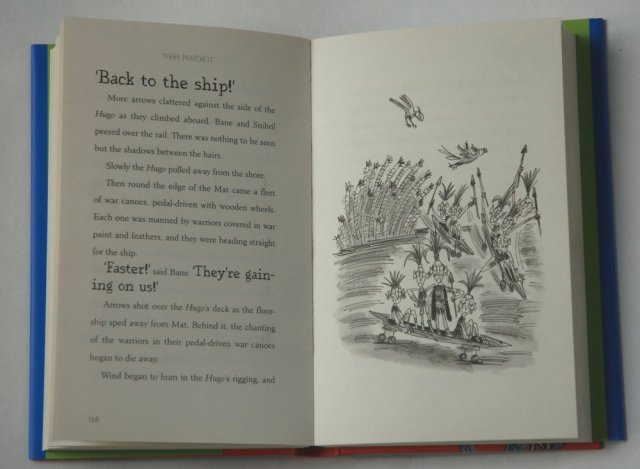
The books are great fun, the pages are covered in typographical games, at one point when the lights go out in a story the next two pages are white text on black, and there are numerous uses of other fonts and text sizes to emphasise the action.
Dsc_0562

The colour edition of Father Christmas’s Fake Beard is also a joy to own, the original looks great but the colour just looks fantastic.

Dsc_0564

During Terry’s tenure as Uncle Jim a lot of the stories are centred on the fictional county of Gritshire, its county town of Blackbury with surrounding towns like East Slate and Umbridge (on the river Um) and the notorious Even Moor where strange things happen in the wild places. The characters gradually develop over the stories so you really feel that there is such a community where odd events occur almost every day and almost feel sorry for the largely incompetent county councillors who just seem to invite disaster with their every plan for improvement. I suspect that this was Terry letting his main job. which included reporting on local government decisions. drift into his fantastical imagination.

I shall finish with the two prints from the collectors editions. The one on the right of Sir Terry as a knight in armour includes his actual coat of arms as ably described in this Wikipedia entry. Let’s hope to see more of these wonderful stories from Terry aka Uncle Jim being published in the future, after all there is still 50% of the work unavailable apart from in frustratingly difficult to obtain old newspapers.

Dsc_0565

Persian Poets

In 1997 I was in Iran and in the Tehran museum saw fabulous hand painted pages from the great classics of Persian literature some of which were 1000 years old, so were contemporary with the great early medieval illuminated manuscripts produced by the monks in Western Europe that I was already familiar with. However these pages were on a different level being more miniature paintings surrounded by text rather than marginal images, a complete book would be a wonder of any age but few have survived intact.

The great epic poem Shahnameh by Ferdosi (also Ferdowsi, Firdusi etc. Persian to English isn’t a precise transliteration) was one of the stars of the exhibition with several wonderful pages on display and at over 100,000 lines it is the longest poem ever written by one author. Written and revised between 997 and 1010AD the 1000 year old poem tells the tale of Persia from a mythological start and the creation of the world, through a time of legendary heroes to historical accounts up to around 750AD and the fall of the Sassanid rulers of Persia. Despite the age of the text it is still perfectly readable to modern Iranians whereas Geoffrey Chaucer (who lived roughly 400 years later) is about as far back in English that you can go and  have a reasonable chance of being able to understand the meaning. Regrettably I don’t read Persian so the text is beyond me but the illustrations made me yearn for a copy for myself. So along with a couple of rugs my souvenirs of Iran included a book in tribute to this great work and the ancient illustrations that so fascinated me on first seeing them.

20180220 Ferdosi 01

20180220 Ferdosi 10

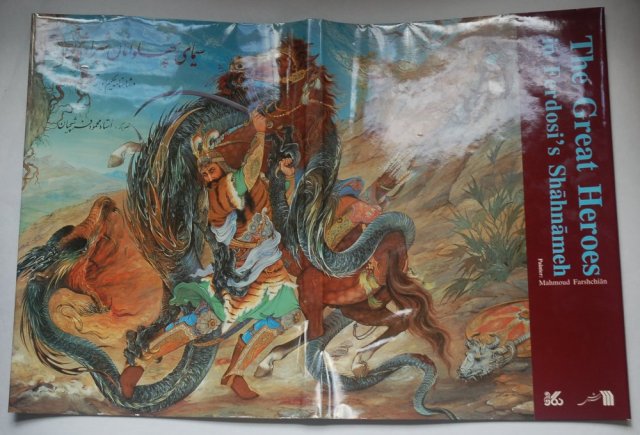
The book was printed in 1991 and describes itself as a commemoration of the millennium of composing Shahnameh by Ferdosi. It was a few years early but the 1000 years have now passed and I’m glad it was early or I may not have been able to obtain this lovely, if somewhat large (42cm x 30cm), volume. The basic premise of the book is that 22 paintings by Mahmoud Farshchian done in the old style of Persian miniature art that I so admired would be used to illustrate sections from the heroic phase of the poem, it is written mainly in Persian with some English to explain the paintings.  The introductory pages are truly beautiful

and then we get into the main work which is the 22 modern interpretations of pages from the ancient works, I love the way that the pictures reach out beyond the frame. Click on the pictures to access full screen versions.

I have chosen 5 pages from the book to illustrate it and these are:

  • In his third labour, Rostam slays the dragon
  • Sohrab launches an offensive against Persia
  • Siavosh undergoes the ordeal by fire which Keykavus has arranged
  • Rostam sets Bijan free from the well where he has been imprisoned by order of the Turanian ruler
  • View of the Hunting Ground, with Bahram Gur talking to the harpist maiden

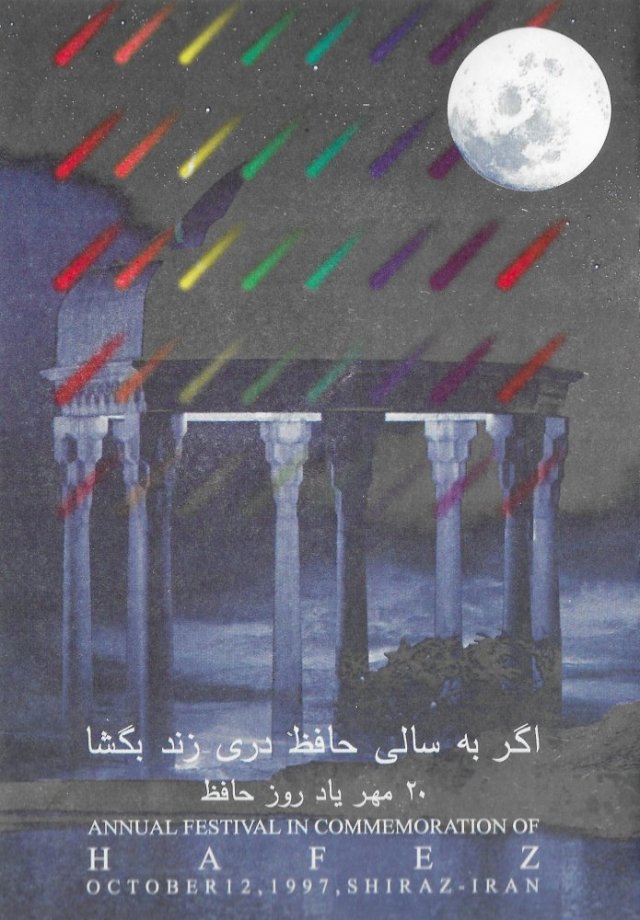
Ferdosi is not by any means the most famous of the Persian poets, that honour probably goes to Hafez and the annual Hafez festival was on when I arrived in his birthplace of Shiraz. He lived from 1315 to 1390 and like Ferdosi his name is more of an honorific, the difference is that we don’t know the real name of Ferdosi but Hafez was Khwāja Shams-ud-Dīn Muḥammad. Being called Hafez indicates somebody who has memorised the Koran, which apparently he did at a remarkably early age and that is the name with which he has gone down in posterity. Also on my bookshelves is the programme for the event.

20180220 Hafez 6

and I took several photographs at his mausoleum which is where recitals and singing of his poems were taking place. He is a much loved poet in Iran which is odd when you consider that most of his poems involve wine, love or the beauty of women; hardly the subjects that are approved of in conservative Iran.

There are fortunately several good English translations including Penguin paperbacks of Hafez’s works, and now Ferdosi has also been included in Penguin Classics so let us leave this blog post with some words by Hafez from The Penguin Little Black Classic “The nightingales are drunk”

With wine beside a gently flowing brook – this is best;

Withdrawn from sorrow in some quiet nook – this is best;

Our life is like a flower’s that blooms for ten short days

Bright laughing lips, a friendly fresh-faced look – this is best.


The Original Alice

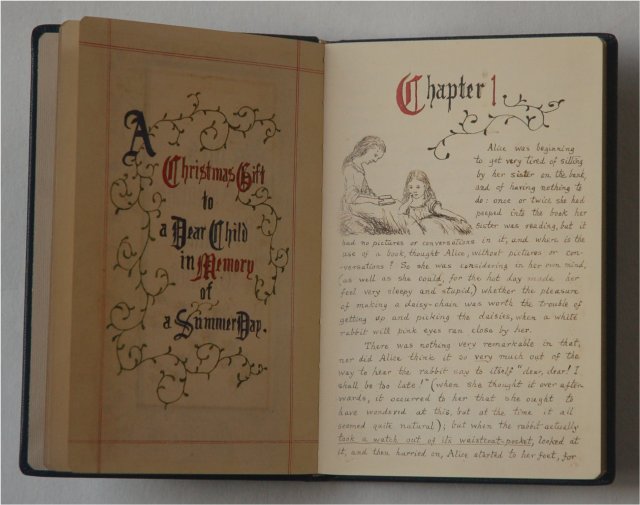
Almost everyone knows the children’s tale Alice in Wonderland by Lewis Carroll either having read the book, or seen or heard, one of the many adaptations over the years.  Most readers will know that Alice was a real person, one of the daughters of Henry Liddell, dean of Christ Church college at Oxford and the stories were told to entertain her and her sisters.  They will also know that Lewis Carroll was really the reverend Charles Lutwidge Dodgson, a 24 year old mathematics lecturer at Christ Church when he first met the Liddell’s. But what is less well known is that when the stories were first written down they were intended to just be a one off book as a gift to Alice and the title was Alice’s Adventures Under Ground.

20170116 The Original Alice 4

The book was handwritten and illustrated by Dodgson and was given to Alice for Christmas in 1864 when she was 12 years old, although he originally came up with most of the story when she was 10 on a trip up the river for a picnic. Alice treasured the little book for decades but eventually in 1928 at the age of 75 and now a widow needing money she sold it at auction for £15,000 (approximately £860,000 today). The book was bought by Dr Rosenbach, who was an American book dealer, and he subsequently sold it in the US.   The private collector who owned it died in 1948 and the book was again put up for auction this time making $50,000 (roughly $508,000 or £363,000 nowadays) and Dr Rosenbach was the top bidder at this auction as well.

20170116 The Original Alice 5

This time however was to be the last time it will ever come to the market. Several American benefactors led by book collector Lessing Rosenwald obtained the book in order to give it to Britain in thanks for the gallantry of the British people during the Second World War.  In November 1948 the book was brought on the liner The Queen Elizabeth across the Atlantic and presented to the British Museum with the Archbishop of Canterbury representing the country by receiving it.  The book is now part of the national collection (catalogue ref MS 45700).

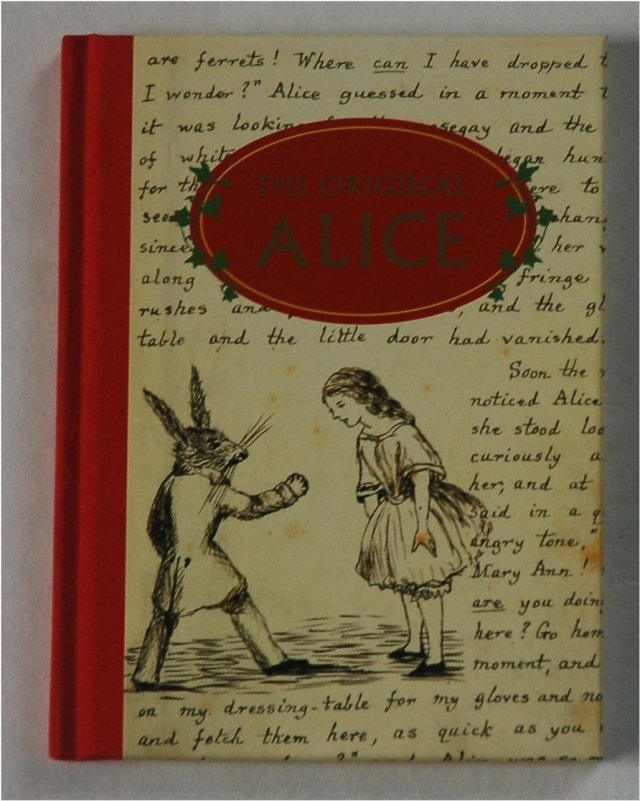
In 1997 The British Library published a book by Sally Brown entitled The Original Alice, which now sadly out of print but fairly easy to find on the second hand market.  This tells the story of how Alice came to be written and compares Alice’s Adventures Under Ground to Alice in Wonderland with examples as to how the books differ.

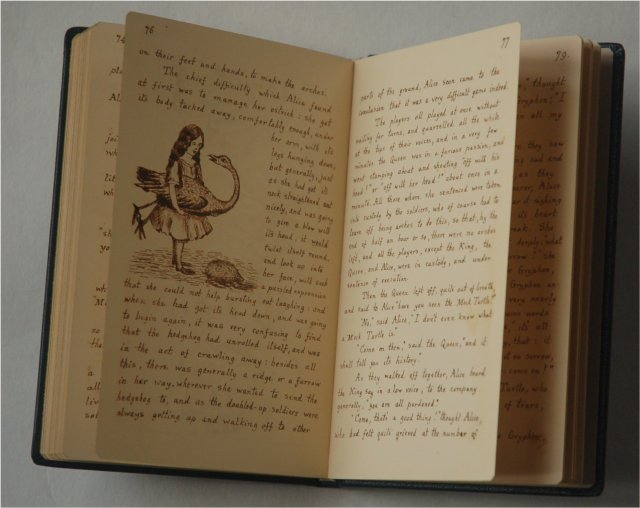
20170116 The Original Alice 1 The illustrations of the original book included here are from another out of print edition, a beautiful leather bound facsimile of the original produced in a limited edition run of just 3750 copies by the Folio Society in 2008, this is somewhat more tricky to track down but it is a beautiful thing to own and read.  It comes in a lovely box with a ribbon to lift the book out with.


Although he never intended publication Dodgson did pass the book to his friend, the children’s novelist George MacDonald, to cast his professional eye over, before giving it to Alice. MacDonald’s children so enjoyed the book that Dodgson was eventually persuaded to publish.  He significantly rewrote the tales, removing a lot of references that only really made sense to the Liddell family and adding Pig and Pepper along with The Mad Tea Party. These additions and revisions to the original text almost doubled the length and took the book up from 18000 to 35000 words.

Alice’s Adventures in Wonderland was finally published in November 1865 in an edition of 2000 copies but in a final twist these were withdrawn as the illustrator, John Tenniel, was unhappy with the quality of the reproductions of his pictures.  This makes the handful of copies that still exist one of the rarest of all children’s books.  The book was finally available to the public in 1866 and was an immediate success.  Alice’s Adventures Under Ground has been printed several times in the intervening 150 years but only the Folio Society have produced a true facsimile of the book with the leather binding and colour illustrations where appropriate, however it is worth searching out a copy of the text as first written as it gives a view of the story that Alice herself first heard and it is quite different to the text that we all know.

Welcome

1894 - Lane Christmas Book- The Life of Sir Thomas Bodley- 2 title pageWelcome to my book shelves, home to some 6500 volumes dating back to the mid 1700’s right up to the present day. I’m going to use these as the basis for short essays or reviews not just of these books but where ever they wish to take me.  The aim is to pick a book, or group of books each week and look at its significance, or just tell a tale as to why it has found itself here.

The Life of Sir Thomas Bodley featured with this first article is a good entry point as the Bodliean Library in Oxford takes its name from Sir Thomas who came to its rescue in the 1590’s and put it finally in the secure position it now holds as one of the worlds greatest libraries. So immediately we have a book leading to more books

When John Lane founded his publishing company in 1887 he chose to call it The Bodley Head in honour of Sir Thomas and for Christmas 1894 printed a very small number of copies of Bodley’s autobiography as gifts to friends and people who had helped set up the business.  Very few of these books have survived the intervening 123 years but it’s an interesting work that should perhaps be better known.

I have two copies of ‘The Life’ one still in the original card covers and one rebound in boards and this also includes the original compliments slip from John Lane.

My main interest in The Bodley Head however is in one of his employees in the 1930’s, Allen Lane, who went on to found a far more famous publishing company namely Penguin Books, which now owns The Bodley Head imprint and uses it for non-fiction titles.

Well over 2000 of my books are Penguins and I specialise in the first 10 years of the company 1935 to 1945 which led to some fascinating books and stories about how they came about as the firm struggled with wartime restrictions but also the greater need amongst the population at home and also servicemen/women for something to read.  More to come about those in future entries to this blog…