A series of essays inspired by books that I own, talking about their history, some reviews and also how they came to be on my shelves. With over 6,500 books here and several more arriving each week I doubt I'll ever be short of a topic.
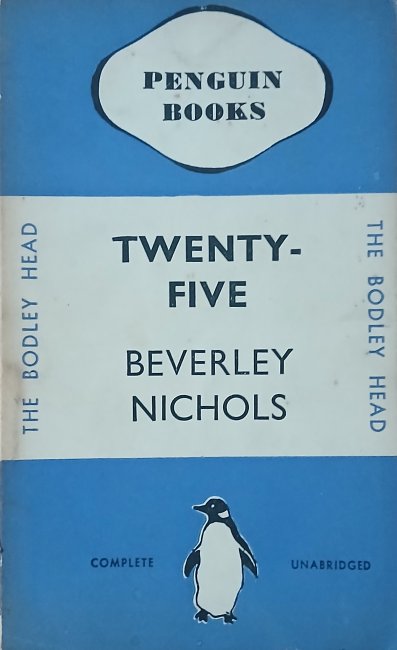
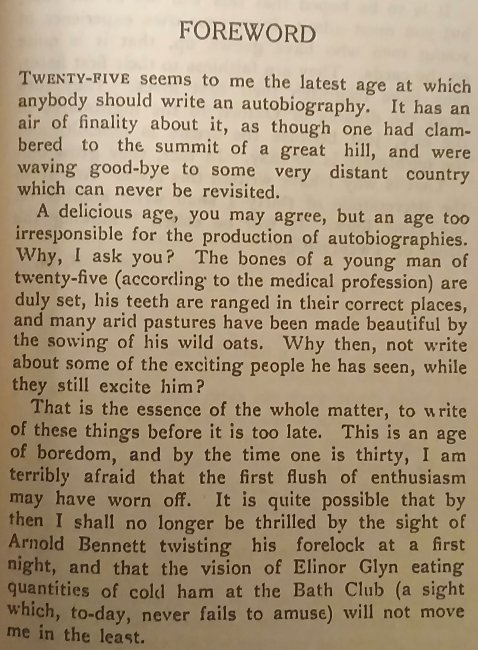
Continuing my plan to read the first ten Penguin Books during the twelve months after their ninetieth anniversary of when they were published, I have now reached book seven and the second one in the blue covers of biography in that initial set after book one ‘Ariel‘. We wouldn’t see a new colour until book thirty one in March 1936 when the purple of Essays and Belle Lettres first appeared on HG Wells’ ‘A Short History of the World’ and there wouldn’t be another book classified as Essays until number 444 ‘The Times Fourth Leaders’ in July 1945. However back to this book, and I have to admit I knew nothing of Beverley Nichols, to the point that I was surprised to discover that he was male despite the more usually female first name. I was also not inspired by the idea of a twenty-five year old writing their autobiography, so was not particularly looking forward to the book, but I’m so glad I read it. Nichols started to win me over even in the foreword:
And meet interesting people he certainly did, by page fifty we have encountered US Presidents Wilson and Taft, along with poets John Masefield, Robert Bridges and WB Yeats and are about to have conversations with both GK Chesterton and then Minister of War, Winston Churchill. Nichols was born in 1898 and the narrative runs up until 1924, he was therefore involved in World War I, but luckily was not called up to the front rather his Oxford University education was interrupted by working in the intelligence section of the War Office and then as Aide-de-camp to Arthur Shipley on the British University Mission to the United States, which is how he met the two Presidents. On return to the UK he resumed his delayed time at Oxford and became president of the Oxford Union, which is how he subsequently met so many other people of note at the time and as it was normal for the president to take people to dinner before the evening debates he would spend several hours in their company. He also ran a student magazine, which Masefield, for instance, contributed to, so even in his early twenties Nichols was remarkably well connected. This is the joy of the book, it is not so much an autobiography but a series of reminiscences regarding the various people he met, you learn far more aout them than you do Nichols himself.
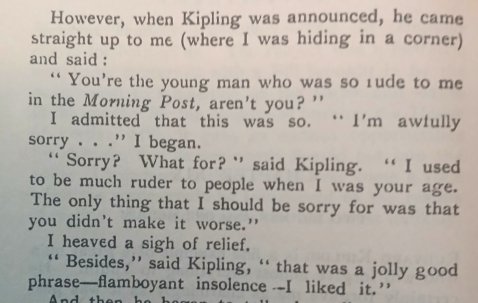
After leaving university Nichols eventually became a theatre critic giving him access to even more people but before that he spent some time as secretary to Australian opera star Dame Nellie Melba and there are numerous stories relating to those experiences included in the book, which like a lot of his anecdotes are really quite funny. One I particularly like has Melba taking a dislike to the position of some stone vases in a hotel and deciding to move them to a more ‘artistic’ formation which she duly did by strenuously pushing them up towards a wall much to the confusion of the staff. Typically for the lack of significant information about himself Nichols doesn’t mention that he was Melba’s secretary he just seems to spend quite a bit of time with her in Australia with no context given. Nichols also met Rudyard Kipling whom he had disparaged in a letter a couple of years earlier and then to his horror saw Kipling enter a room he was in:
The book is great fun and if I did have to look up a few people whose fame has somewhat died down in the intervening century there wasn’t many of them and it was worth the reference time but it is well written, amusing and far better than I expected it to be. Let’s leave the final words to Nichols, who did go on to have a long life as an author of over sixty books, using the final sentences of the book:
Again – I have done. Twelve o’clock strikes. There really should be slow music playing outside my window, so that I might work myself into a frenzy of pathos at the thought that another day has arrived to carry me on to middle-age. I should rather like to stay, just a little longer. But then – better not. Accept the joke of life for what it is worth. It is not such a very brilliant one, after all. And was there not a man called Browning, who wrote. “Grow old along with me, the best is yet to be.”
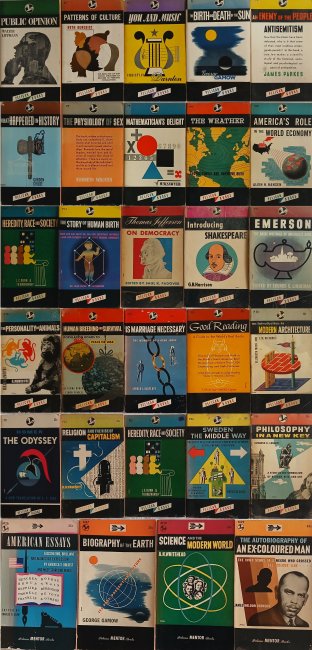
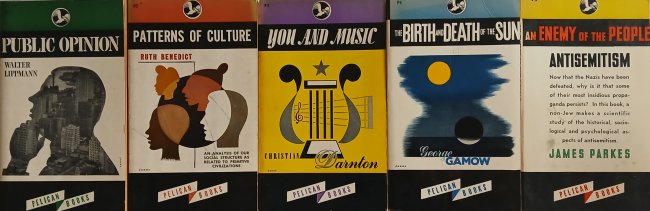
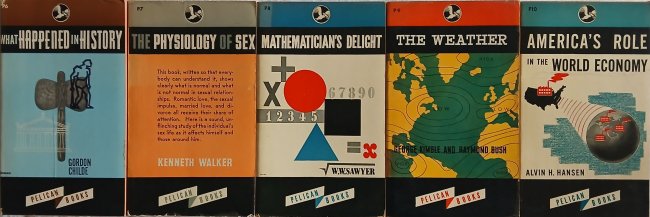
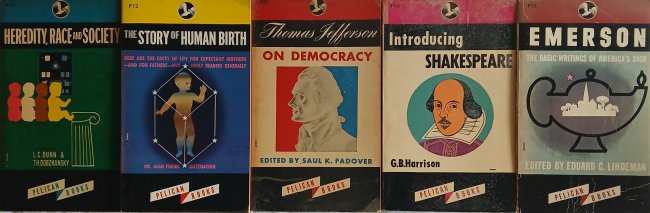
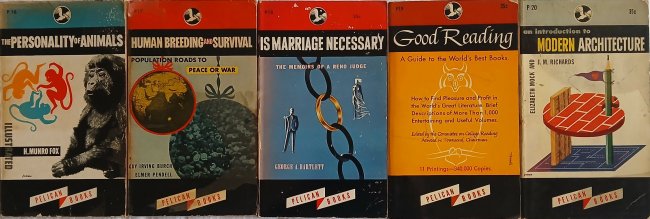
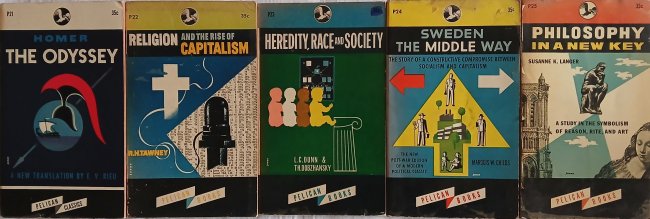
This month marks the eightieth anniversary of the first books that became the Mentor imprint, which would grow to be a major factual book publisher in America. Stepping forward a couple of years we see in 1948 two new paperback imprints first appear in the USA, Signet and Mentor, at first sight these series closely resemble the UK Penguin main series and Pelicans with Signet largely being fiction and Mentor for the most part factual. This is due to them both growing out of the wartime Penguin books printed in America to avoid shipping across an increasingly dangerous Atlantic Ocean. In 1948 Penguin decided to pull out of American publishing and their assets were purchased by Victor Weybright and Kurt Enoch both of whom had been running Penguin Books Inc based in New York since 1942 when the American Penguins were launched . Enoch had previously been head of Albatross Books, so knew how to run a publishing business, and was already in New York, having escaped Nazi Germany in 1940, whilst Weybright had been recruited by the owner of Penguin Books, Allen Lane, from the US Office of War Information back in London and returned to America to help Enoch. The two men formed New American Library of World Literature (NAL) in 1948 when they bought the American Penguin operation, but crucially not the name, and gained, at least in theory, 164 titles to start Signet and 24 to get Mentor going. I’d like to concentrate on Mentor as this grew out of a far less well known series in America which had taken the name of its UK equivalent, Pelican and which began eighty years ago this month in January 1946. The full list of titles, with their first published dates, as at the time of the takeover were:
P1 Public Opinion by Walter Lippmann – January 1946
P2 Patterns of Culture by Ruth Benedict – January 1946
P3 You and Music by Christian Darnton – January 1946
P4 The Birth and the Death of the Sun by George Gamow – January 1946
P5 An Enemy of the People: Anti Semitism by James Parkes – March 1946
P6 What Happened in History by Gordon V Childe – March 1946
P7 The Physiology of Sex by Kenneth Walker – March 1946
P8 Mathematician’s Delight by W.W. Sawyer – March 1946
P9 The Weather by George Kimble and Raymond Bush – May 1946
P10 America’s Role on the World Economy by Alvin H Hansen – April 1946
P11 Heredity, Race and Society by Theodosius Dobzhansky and L.C. Dunn – November 1946
P12 The Story of Human Birth by Alan F Guttmacher – January 1947
P13 Thomas Jefferson on Democracy edited by Edward C Linderman – January 1947
P14 Introducing Shakespeare by G.B. Harrison – February 1947
P15 Emerson – The Basic Writings of America’s Sage edited by Eduard C Lindeman – March 1947
P16 The Personality of Animals by H Munro Fox – April 1947
P17 Human Breeding and Survival by Gut I Burch and Elmer Pendell – June 1947
P18 Is Marriage Necessary? By George H Bartlett – July 1947
P19 Good Reading edited by The Committee On College Reading – September 1947
P20 An Introduction to Modern Architecture by E.B. Mock and J.M. Richards – September 1947
P21 The Odyssey by Homer – trans E.V. Rieu – October 1947
P22 Religion and the Rise of Capitalism by R.H. Tawney – November 1947
P23 Heredity, Race and Society by Theodosius Dobzhansky and L.C. Dunn – November 1947
P24 Sweden: The Middle Way by Marquis W Childs – January 1948
P25 Philosophy in a New Key by Susanne K Langer, – February 1948
It’s an interesting mix of subjects, much like the UK originals. I said earlier that there were 24 titles to form the basis of Mentor yet the list above has 25 books, however careful checking will reveal that P11 and P23 are in fact the same book issued a year apart, yet inside both claim to be the first time this title was published. It is almost as if the publishers had forgotten they had already printed this book in 1946 so simply did it again exactly a year later in 1947. Of the twenty four titles ten had been originally printed in the UK, mainly as Pelicans, whilst the remaining fourteen were originals to the American Pelican imprint, the ten reissues are as follows:
P3 – Originally UK Pelican A68 – July 1940
P5 – Originally UK main series 521 – August 1945
P6 – Originally UK Forces Book Club – November 1942 then Pelican A108 – December 1942
P7 – Originally UK Pelican A71 – July 1942
P8 – Originally UK Forces Book Club – April 1943 then Pelican A121 – August 1943
P9 – Originally UK Forces Book Club – September 1943 then Pelican A124 – November 1943
P14 – Originally UK Pelican A43 – May 1939
P16 – Originally UK Pelican A78 – December 1940
P21 – Originally UK Services Edition SE18 – 1945 then Classic L1 – January 1946
P22 – Originally UK Pelican A23 – February 1938
Bizarrely two of the above had also passed through the American Penguin numbering before reappearing as American Pelicans, P7 had already been 507 (1942) but this change seems highly sensible as it is not a work of fiction, whilst P21 had first appeared in the USA as 613 (November 1946). Quite why The Odyssey moved from the fiction main series to the factual Pelicans, becoming by the way the only American Pelican Classic almost twenty years before the UK business came up with this series name is a mystery as it seems to make no sense. After 1948 the rights to the EV Rieu translation of The Odyssey were not part of the transfer of intellectual property so when Mentor came to reprint the now renumbered M21 they used a different translator, W H D Rouse, where it became the first Mentor Classic and went through 47 reprints by 1976 including at least one renumbering ending up as ME2519. All the other P series Pelicans were simply reprinted unchanged apart from the P becoming an M for Mentor although later on Mentor introduced sub categories so for example P13 ‘Thomas Jefferson on Democracy’ became M13 when first reprinted and then this was later changed to MD13.
The first four books published as Mentor from March 1948 were actually initially indicated on the cover as Pelican Mentor to help inform the general public regarding the change of name before dropping the Pelican part when they came to be reprinted. Enoch and Waybright also did this with the much more prolific main series as it morphed into Signet only in this case seventeen new books and a small number of reprints bore the imprint of Penguin Signet for a few months. I haven’t yet found any evidence of reprinted American Pelican titles being listed as Pelican Mentor, only the four new books appear to have had that designation. It is worth noting that the few books originally published as Penguin but reprinted as Penguin Signet and then later simply as Signet, which include 615 Lady into Fox, command far higher prices as the Penguin Signet reprint version than as either the Penguin or Signet versions alone. The four Pelican Mentor titles are:
M26 American Essays by Charles B Shaw – March 1948
M27 Biography of the Earth by George Gamow – April 1948
M28 Science and the Modern World by A.N. Whitehead – May 1948
M29 The Autobiography of an Ex-Coloured Man by J.W. Johnson – June 1948
As can be seen the covers feature bold designs, so much more enticing to their target American audience than the simple blue and white that would be the trademark of the UK Pelicans for decades. It was the use of full colour laminated covers, especially on the main series, that would be one of the primary falling out points between Penguin Books Inc in the USA and Allen Lane back in the UK, where typographic covers would reign supreme as the Penguin identity for many years to come. Although it was almost certainly tax difficulties between the two countries that ultimately prompted the split in the end.
Interestingly New American Library was bought out and became part of Penguin Publishing Company in 1987 neatly bringing the whole enterprise full circle. But confusingly there is also an Irish publishing company that calls itself Mentor Books which started in 1979 and specialises in educational works but has nothing to do with the American company which predates them by thirty one years and was well established by the time the Irish firm started
As I’ve covered before, 2025 marks the ninetieth birthday of Penguin Books, and regular readers of this blog have no doubt realised I am a keen collector of this publisher. There are many different ways to collect Penguin books and one popular way is to collect the first five hundred, or first thousand, or if you really have the space then the first three thousand main series titles (those generally recognised as Penguins). This co-incidentally is pretty well all the main series books published by them from when they started in July 1935 up to the introduction of ISBN and the loss of the distinctive numbering system so it is a satisfying, if bulky, target to aim at. There are problems with this though as quite a few of the wartime titles, especially the crime fiction, are now very expensive, so I’ve been thinking about what I would do if I was starting now and one possibility is the Penguin Millions. These are a subset of the Penguin titles and importantly the first ‘million’ came out in 1946 so the scarce wartime crime titles can be avoided. But what is a Penguin Million and how many are there?
The first million has an explanation of the concept on the inside, in this case George Bernard Shaw had reached his ninetieth birthday in July 1946 and to mark the occasion Penguin simultaneously printed a hundred thousand copies of each of ten books. Nine of these were new to Penguin (books numbered 500 along with 560 to 567) and there was one reprint, Pygmalian (numbered 300 and originally printed in September 1941). Nowadays I doubt a million books by Shaw would sell very well but back then he was still a popular author and his works are regularly found in early Penguin lists and these titles were soon being reprinted again..
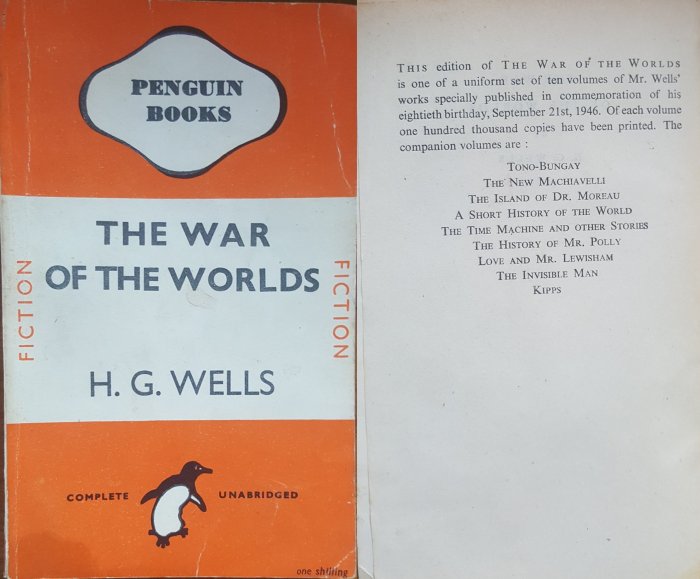
The idea obviously sold well enough for somebody at Penguin to decide that this was a good idea and the second million soon followed a couple of months later in September 1946 and this time the author featured was H.G. Wells
This time there were three titles reprinted as part of the set, A Short History of the World (Pelican A5 original May 1937), The Invisible Man (151 original August 1938), Kipps (335 original November 1941), with the remaining seven books being numbered 570 to 576 and coming out together in September 1946. Maybe these didn’t do as well as Penguin though they would as there was then a gap of a couple of years before they had another go and this time it was the sure fire winner Agatha Christie,
Published in August 1948, this time all ten books were new to Penguin so they had the consecutive numbers 682 to 691. Considering that a hundred thousand copies of each were printed Murder on the Orient Express as part of the Christie Million is surprising awkward to find and is probably the only book featured in this list that would be a real challenge to locate. Although tracking down some of the correct reprints for other titles can also be tricky, as they are rarely advertised as being part of their respective ‘millions’ when searching online but you can always tell if it is correct edition as it will have the page explaining about its part of the set.
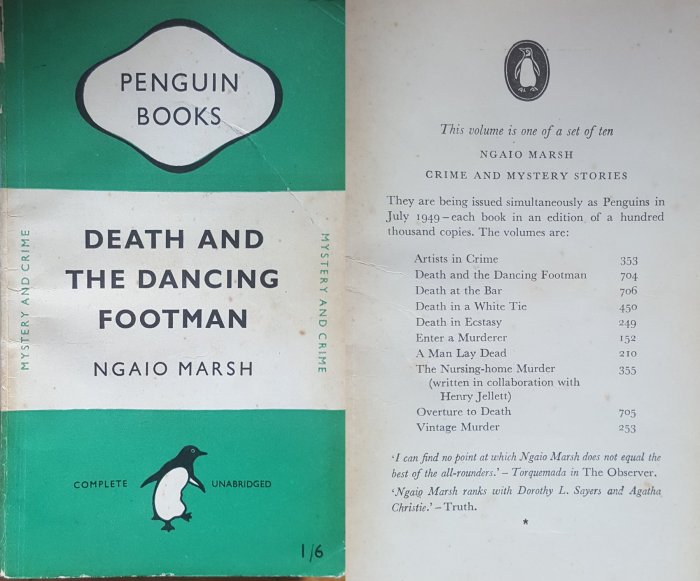
Another eleven months passed and it was time for another crime writer to be featured, this time New Zealander Ngaio Marsh.
This time Penguin have made it easy for me and given the respective numbers in the Penguin catalogue in the listing. As you can see only three titles were new to Penguin (numbers 704 to 706 published July 1949) with the others going back as far as Enter a Murderer (152 – August 1938). This is where the financial advantage of collecting the ‘millions’ editions comes into its own as Death in a White Tie would sell for well over £500 and possibly getting on for £1000 as the March 1945 Penguin first edition whilst the reprint for the ‘million’ is only a few pounds. This reprint is also a Penguin oddity as the floor plan of the house where the murder took place is missing from this edition and was incorrectly included in 704 Death and the Dancing Footman. Both books are therefore somewhat confusing for readers, one for the lack of the diagram which makes placing the action more tricky, and the other for an included plan of a house that bears no relation to the plot.
The next million was in March 1950 and we leave the world of crime in favour of a somewhat more challenging read, D.H. Lawrence to mark the twentieth anniversary of his death.
As can be seen five of the books chosen were ‘double volumes’ marked with an asterisk in the list above, i.e. books of significant length and were therefore more expensive than the standard paperback at the time, which retailed at one shilling and sixpence (7½ pence), these longer books were two shillings and sixpence (12½ pence). Kangaroo for example is 594 pages. All of the books were first printings by Penguin nine of which are 751 to 759. The original plan was for 760 The White Peacock to be included in the ten books but production issues meant that this wasn’t ready for publication until August 1950 so the collection of poems (D11) was issued instead, which, along with the separate volumes of letters and essays, I think gives a wider overview of D.H. Lawrence’s work as part of this collection.
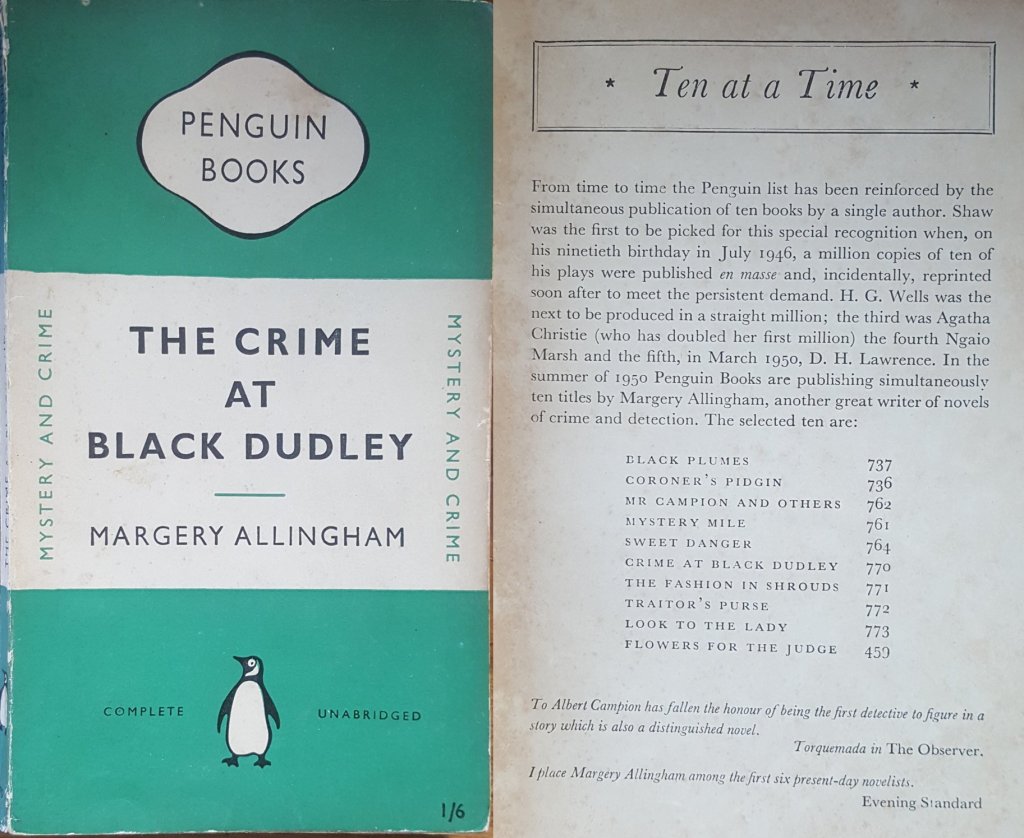
After the erudite literature of Lawrence it was back to crime for the next Penguin million. This time Margery Allingham in June 1950.
The only reprint is another wartime crime rarity 459 Flowers for the Judge (originally June 1944) all the others, despite the apparently random numbers, all first appeared as a UK Penguin in June 1950. The one oddity is 737 Black Plumes which had first been printed by Penguin USA Inc as number 534 in December 1943 and is another difficult to find wartime first Penguin printing, especially on this side of the Atlantic.
Next comes Evelyn Waugh whose ‘million’ came out in May 1951.
This time there are five titles new to Penguin (821 to 825) with five reprints Decline and Fall (January 1937), Vile Bodies (April 1938), Black Mischief (November 1938), Put out More Flags (October 1943) and Scoop (March 1944). There’s a nice potted bibliography along with the list of books in the listing. I’ve always quite liked Evelyn Waugh although he does seem to be a lot less well known nowadays. I also like the fact that his first wife, although only for one year as she had another relationship with John Heygate at the time, was also called Evelyn, just imagine the confusion when guests called.
We then start a run of three crime novelists before the ‘millions’ peter out and next comes Carter Dickson in June 1951.
Again we have ten new titles, consecutively numbered 811 to 820 and all by Carter Dickson, who also wrote under his real name John Dickson Carr as well as Carr Dickson and as a real wildcard once as Roger Fairbairn. Fortunately his ingenuity with plots is far better than his imagination with pseudonyms and the missing photograph on the back cover with it’s accompanying blurb regard anonymity fooled nobody. However regarding the use of the back cover here, I have had to do this as, due to a compilation error, all ten of the books actually have the Evelyn Waugh ‘millions’ description inside them instead of one for Carter Dickson. Almost all the books he wrote under the name Carter Dickson feature the elderly amateur detective and barrister Sir Henry Merrivale and that is certainly the case with the ten books in this collection. I personally prefer the Dr Gideon Fell stories he wrote under his actual name although that possibly because I came across him first. Each of these detectives have around a couple of dozen books dedicated to them and the Merrivale books certainly have much to recommend them.
The next million goes to Belgian George Simenon and his legendary detective Maigret and these were published in January 1952.
Simenon is invariably though of as French like his most famous creation Jules Maigret, as Penguin do so in the introduction above, and he did live for a lot of his life in France along with a decade or so in America after WWII. There are seventy five Maigret novels and numerous short stories but even the novels are quite short so Penguin tended to publish two per book. The collection came out as two blocks of numbers 826 to 830 and 855 to 858 which count for the nine new to UK Penguin Simenon titles in the ‘million’ there was also a reprint 739 A Battle of Nerves & At the ‘Gai-Moulin’ (originally January 1950). Yet again we have a book that was first printed in America as a Penguin Inc publication, Maigret Travels South which first appeared under the Penguin logo in New York as 564 (September 1945). The works of Simenon have a very chequered history with Penguin with many volumes being announced but never actually being published.
Where do you go after the classic Maigret novels well there can only be one choice and the only author to have multiple ‘millions’ it’s Agatha Christie again, this time in May 1953.
This time Agatha Christie chose the ten titles herself and oddly one of them had already appeared in the first Christie million so we have nine books (924 to 932) printed by arrangement with Collins which are first appearing in Penguin along with The Murder of Roger Ackroyd which had first been printed by Penguin as 684 in the first Christie million in August 1948. Technically all ten of these books are a first edition as each includes a new introduction written by Agatha Christie for this printing.
And that was it for the printing of ‘millions’ but there was one final addendum and that was for Arnold Bennett
This time there were only six books issued at the same time and no suggestion that a hundred thousand copies of each were being printed. Two were reprints Anna of the Five Towns (33, March 1936) and The Grand Babylon Hotel (176, November 1938) along with four that were new to Penguin (996 to 999) and as can be seen there were various issues with copyrights in Canada and the USA.
So where does that selection of eleven sets of publications within the first thousand bring us, well there are 106 (105 if you don’t want Roger Ackroyd twice) books to search for, eleven largely readable authors, both Bennett and Shaw I have to be in the mood for, and a pretty decent fiction library from the end of the 19th century through the first half of the 20th. Plenty of easy reading crime and other novels with some more taxing works but none that should put off a dedicated reader. It is also a manageable task to accumulate all of these without the bank account straining issues that can face a collector of a complete numeric run. I have been collecting Penguin for over thirty years, although I only really started taking the main series seriously in the last dozen or so as I mainly concentrated on the more obscure aspects of their output. But I’m still missing fourteen books out of the first six hundred even after twelve years and I’m only very very slowly filling in the gaps.
There are many more blocks of books by one author after number 1000, but as I don’t collect them I cannot pull them off the shelves to check to see if any of these are designated as ‘millions’. Examples include six books by Aldous Huxley numbered 1047 to 1052 published in April 1955, eight books by C.S. Forester numbered 1112 to 1119 published in January 1956 (1111 is also by Forester but came out two months earlier), and nine books by John Buchan numbered 1130 to 1138 which were published in May 1956. Maybe collecting the ‘millions’ is the way ahead.
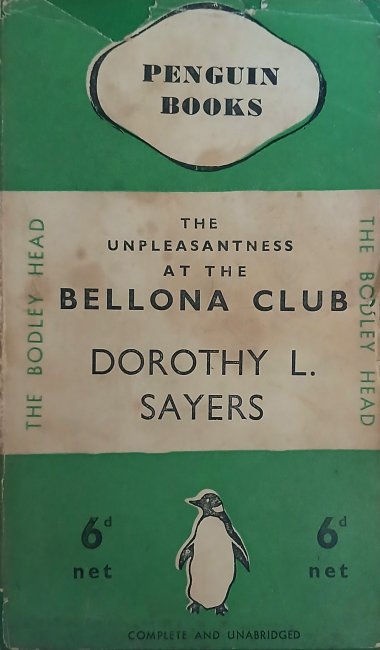
This post is going live on Remembrance Day 2025 so it is appropriate to feature this Lord Peter Wimsey crime novel as the body is discovered on the 11th November and the fact that it is Armistice Day, as it is called throughout the book, is vitally important to the plot. This is the fifth of the original ten Penguin books published on 30th July 1935 that were the start of the company and which I started reading in their first editions in August, the remaining five will be covered between now and July 2026. This book was originally published in 1928 and is the fourth title featuring Sayers’ amateur detective Lord Peter, I have previously written about her twelfth novel Busman’s Honeymoon and a collection of short stories, some of which feature Lord Peter, Hangman’s Holiday.
I’ve always liked the Lord Peter Wimsey books since watching as a child the television series featuring Ian Carmichael in the 1970’s and this, whilst not one of the best, is a really good read. As can be expected the initial unpleasantness at the Bellona Club is the discovery of the body of Colonel Fentiman in his customary chair by the fire in the club on the evening of the 11th November still clutching his newspaper which he was wont to doze under soon after arriving in the morning. He was after all in his nineties so the death, apparently of heart failure, was not entirely unexpected although unfortunate. To the club members however the unpleasantness was to continue for several more weeks due to the wording of both his and his sister’s wills, as she had also died on the morning of the 11th. The Colonel’s will left the majority of his estate, some £2,000 (roughly £110,000 today) to his youngest grandson George with the residual going to his other grandson Robert on the basis that George as a married man suffering from shell shock after WWI needed the money more than Robert who was still single and a Major in the army. His sister, Lady Dormer, however drafted her will so that her estate, which had come to her on the death of her wealthy husband, and was worth around £700,000 (about £38 million today) would mainly pass to the Colonel if he was still alive when she died but if he predeceased her the vast majority would go to Miss Dorland who had been her companion for many years. It was therefore vitally important to establish exactly when the Colonel had died as if it was before 10:37am, when Lady Dormer had passed, then Miss Dorland was now extremely wealthy and if it was after that time then Robert Fentiman, gaining the residual after George had his £2,000, would be the one to gain.
But that is somewhat leaping ahead, Lord Peter is a member of the club and a friend of George and was acquainted with the Colonel and Robert. A the book begins the club was busy as a lot of members had come to London for the Remembrance Day event, Lord Peter and all three of the Fentiman family were at the club, Robert was staying there as he didn’t live in London whilst George and Lord Peter met in the bar that evening, the Colonel, as previously mentioned, either dozed or had died but had not yet been discovered in his chair by the fire but was about to be. Fortunately when Colonel Marchbanks found he was addressing a body Dr. Penberthy, the old man’s physician was also at the club and he and Wimsey moved the body to one of the club bedrooms noticing one thing odd in that the left knee of the corpse moved freely indicating that rigor mortis had begun to pass off but strangely only that joint was free.
That should have been the end of the story for Lord Peter but Mr Murbles, Peter’s solicitor and also the representative of Colonel Fentiman called several days later to advise him of the conflicting wills and asked him to make some discrete enquiries to try to establish when the old man had died. But how to establish when a man’s heart had given out precisely enough to reconcile the issue and both Fentiman brothers were acting rather oddly. Peter begins to suspect foul play…
The sixth of the first ten Penguins is ‘The Mysterious Affair at Styles’ which I have already reviewed as The Strange Case of the Sixth Penguin Book where I explain why there are two books with that number so the next book to be covered of this group will be Twenty-Five, the autobiography of the young Beverley Nichols.
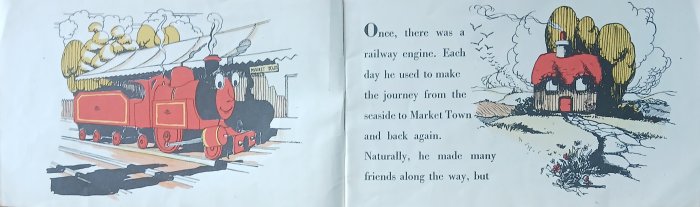
These three charming books were printed by Puffin Books in the 1940’s. They don’t seem to have been reprinted, not just by Puffin but by anyone, which bearing in mind that they are for very young readers, or more likely parents reading to young children, and their inherently fragile nature consisting of just eight sheets of paper, including the covers, folded and stapled in their centre makes finding them in good condition extremely difficult. Due to their rarity I have decided to include several double page spreads so that you can appreciate what a delight these little books (182mm x 110mm or 7.16 x 4.33 inches but so thin they are almost pamphlets) are. As implied the three books feature an anthropomorphic railway engine similar to the slightly later, and much more famous Railway Series by Wilbert Awdry and later his son Christopher which feature, amongst others, Thomas the Tank Engine, although that particular character isn’t in the first book which first appeared in May 1945.
The Holiday Train
Published in November 1944 as Baby Puffin number five, this introduces The Holiday Train as a character along with the love of his life The Little House which he passed every day whilst travelling up and down the line. Like the Puffin Picture Books, which were well established by then, the books were produced from plates normally cut direct by the artist, But Heaton was not a lithographer and didn’t know the technique so his drawings were converted in house by staff at the printers W.S. Cowell Ltd of Ipswich.
The story actually starts with the older engines, including The Holiday Train, being retired and going off to rest which he was happy about although he was really going to miss The Little House. But the seaside town where he had worked grew in popularity and population so the new engines couldn’t cope and it was decided to bring back the old locomotives.
As you can see above his return didn’t get off to a great start but soon all was well and The Holiday Train could renew his friendship with The Little House until…
The dreadful thing is a violent storm where a lightening strike hits The Little House and destroys it which sends The Holiday Train into depression at the loss of his friend. Trying to work out what to do to bring him back to normal the managers of the railway decide to get him to pull a special train, I love the expressions of the people on this next double page spread.
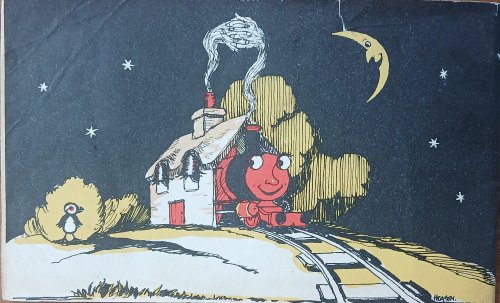
Of course The Holiday Train not only manages but sets a new record for the journey and as a reward it is decided to rebuild The Little House. I particularly like the puffin, the logo of the imprint, hiding behind a bush on the rear cover of the book as the Holiday Train settles down for the night in his new engine shed built from the ruins of The Little House.
The Holiday Train Goes to America
Published in June 1946 as Baby Puffin number six this takes the form of an international competition held in America between five locomotives from England against five from the USA which means of course crossing the Atlantic by ship. Which is a step up from the branch line antics of the first book, even if The Holiday Train is by far the smallest locomotive and is rather looked down on by the others. This book is very different to the other two, not only because of the use of four colour printing which allows for a full colour palate but also due to the much greater amount of text needed to tell a more complex story. This means a significantly smaller font is used, which along with the more literate style makes this definitely a book to be read to a small child rather than one they would read themselves.
Heaton makes full use of his extended colour range, it would have been difficult to do this book without the inclusion of blue. Speaking of which I’m sure the large blue loco called Blue Racer at the back of the left hand image above is a version of Mallard which at had broken the world speed record for a steam train in July 1938 by pulling seven coaches at a peak of 126 miles per hour, a record that still stands today. This can be better appreciated in a later picture where the streamlining of the LNER class A4 is shown, see below.
I love this picture of a seasick train, not a sentence I thought I would ever type, but Heaton manages to capture the abject misery of this condition so well on the face of the engine.
At last they arrive in New York and after being unloaded were welcomed to America and it appears that The Holiday Train runs on a narrower gauge that the mainline locomotives alongside him, which would somewhat explain his size difference. The two locos either side of him above are definitely giving him side-eye.
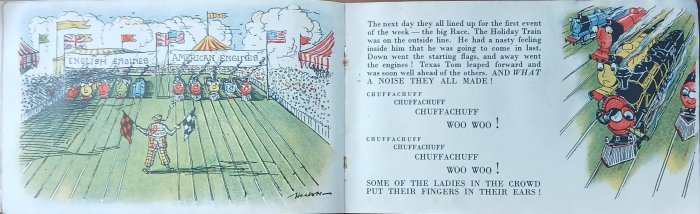
The three competitions are explained, a race, a beauty competition and a prize for the biggest engine which was almost certainly going to go to an American entrant as they are so much bigger than the locomotives from England. It didn’t look like The Holiday Train stood a chance in any of them. But there was a problem with the huge American engine Texas Tom who suddenly let out a lot of smoke obscuring the view for the other engines, but The Holiday Train is so small that he could see clearly under the dark cloud
and went on to win the race. I haven’t included the picture of the race itself but it does feature one of the errors Heaton made in his artwork as the green English train has vanished along with any tracks for him to run on. Another error is seen above as there is only one blue engine out of the ten and that is the Mallard lookalike but the loco shown above is missing the streamlining clearly depicted a few pages earlier. At the beauty contest there are again only nine tracks and no sign of the English green loco.
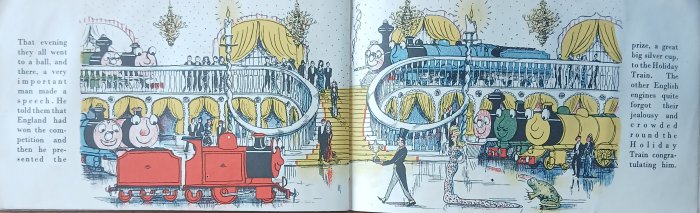
At the ball, where The Holiday Train is presented with the cup there are ten locos depicted but yet again Heaton has forgotten that one of the English locos is streamlined. It’s a fun story somewhat let down by the artistic faults, it is possible however that due to the age of the intended readership that this wasn’t noticed at the time by them, however it was spotted by Penguin management.
The Holiday Train Goes to the Moon
The last book in the series, not just of the Holiday Train but of Baby Puffins themselves as an imprint was published in April 1948 as the ninth Baby Puffin. Frankly this is the least interesting of the three titles, having a fairly simplistic story and a return to just red, yellow and black illustrations. It is noticeable that the scale between The Holiday Train and his engine shed formally The Little House has changed somewhat from the first book. In that the loco only just fitted in the picture on the back cover in the original title but now he is inside quite a roomy place with highly impractical curtains and a rug on the floor, see below.
The book tells the story of The Holiday Train being surprised by Carrumpus, a magical character who introduces himself saying “I come to visit trains when they get tired or overworked and cheer them up.” He does this by granting them a wish.
As you can see above The Holiday Train wishes he could fly and soon he has wonderful golden wings so he could fly around rather than running on rails.
Soon he decides to travel to the moon where he finds a railway, but not one like at home as here the carriages pull the locomotive rather than the other way round. But nevertheless The Holiday Train sets off to explore.
Arriving over the town of Lubbelium he sees some strange birds but suddenly Carrumpus notices the time, it’s almost midnight and the wish expires in a few minutes. Quickly The Holiday Train flies back to Earth and his home in The Little House.
It’s a pity that only nine different Baby Puffins were printed but I’m guessing that they were quite difficult for booksellers to display and sell them as they were so thin with no spine and usually were a horizontal format. With regard to the finishing of The Holiday Train books, by April 1948 the first book featuring Thomas the Tank Engine had appeared and he would go on to become enormously popular so did the world really need another anthropomorphic locomotive especially as Thomas and friends were somewhat more realistically drawn although not as delightfully whimsical. The rear cover of this last book has an appeal from Peter Heaton,
Dear Children,
As you know from reading my little books. I like having adventures. If you can tell me of any exciting places I could go to, write to me, care of Penguin Books, West Drayton, Middlesex, England
So clearly Heaton had no idea either that this would be the last anyone would see of The Holiday Train. Although he also wrote and illustrated the eighth Baby Puffin ‘Dobbish the Paper Horse’ Peter Heaton is probably best known to collectors of Penguin books for his Pelican titles dealing with a very different mode of transport, Sailing (first published June 1949) and Cruising (first published April 1952). He served in the Royal Navy during WWII on armed Merchant Navy vessels, corvettes and Motor Torpedo Boats ending up at the Admiralty and after the cancellation of the Baby Puffin series became friends with Penguin Books’ Managing Director, Allen Lane, regularly accompanying him on journeys on his boat. These trips led to the two factual books which made his name and which would be in print for several decades.
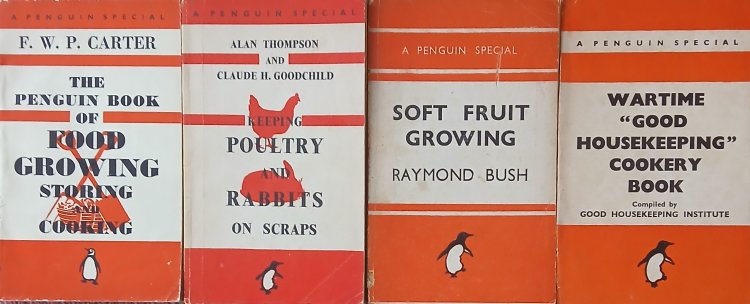
Last week saw the fiftieth anniversary of the end of the Vietnam War and this week sees the eightieth anniversary of VE Day, the end of the Second World War in Europe, as this post goes live on the 6th May 2025 two days before VE Day itself. Whilst last week I read Felix Greene’s excellent summary of the first half of the Vietnam War, this week I’m looking at eight books produced as part of the Penguin Specials series which were designed to help the population feed themselves during a time of food shortages and rationing. Penguin Specials were intended to be books dealing with issues of the day and they had rapidly multiplied during WWII with such titles as ‘Aircraft Recognition’, ‘Nazis in Norway’, ‘How Russia Prepared’, ‘Signalling for the Home Guard’ etc. The books were produced far quicker than titles in the other Penguin Series so that they were relevant to the issues of the day, but before the designation of some of them as handbooks there had also been some concerned with making best use of the food supplies however these were in the more usual red covers for Specials. These included ‘S90 The Penguin Book of Food Growing, Storing and Cooking’ (May 1941), ‘S101 Keeping Poultry and Rabbits on Scraps’ (January 1942), ‘S119 Soft Fruit Growing’ (December 1942) and ‘S127 Wartime Good Housekeeping Cookery Book’ (February 1943).
The dates shown below for most of these handbooks may seem quite late in the war for those of us born after the end of shortages and rationing, but it should be noted that general rationing in the UK continued until July 1954 although some items such as bread (1948) did come off rationing before then.
S132 Tree Fruit Growing – Apples – December 1943
Raymond Bush had already written one book for Penguin, as can be seen above, but the two handbooks detailing tree fruit growing took us to his main speciality which he had adopted following a bad accident in 1914 and being advised that an outdoor life would be better for his health than the poster design his company had been doing prior to the First World War. He was a commercial grower from 1915 up until 1935 when he started advisory work on the subject for various scientific committees. The book is a wide ranging guide to growing apple trees with notes where similar methods are appropriate for other fruits such as pears and almost a third of the book is dedicated to pests and how to get rid of them, but it is based on Bush’s determination that the wartime population should not be derived of wholesome fruit. As he says in his introduction “Well my amateur friends, once again you must sit back and watch the Ministry of Food collect most of the fruit to make jam go several times as far as it has any rights to go by the judicious addition of apple pulp, swedes, mangolds and what not. That is unless you grow your own fruit and make your own jam.”
S137 Preserves for all Occasions – April 1944
This book admits that it will soon become out of date as ingredients become more available after the war ut nevertheless it provide a lot of useful information on the varying ways of preserving food. Not just the expected jams and chutneys but syrups, bottling means of drying fruit, vegetables and herbs and how to store fresh produce for the longest time. Unlike other books on preserving that I own it doesn’t include recipes but instead concentrates on good techniques and means of avoiding common mistakes.
S138 Tree Fruit Growing – Pears, Quinces and Stone Fruits – December 1943
Volume 2 of Tree Fruit Growing concentrates much more on the individual varieties of a wider range of crops than I was expecting. I hadn’t realised that almonds were not true nuts but were in fact relative of the plum and peach where we eat the seed and discard the rest as a direct opposite to the two fruits. Bush admits to not having grown them himself and struggled to find any information but put together what he could. There is also a section on laying out an orchard and a substantial chapter on bees at the end along with the inevitable chapter on spraying for pests, a subject clearly on Bush’s mind a lot.
S140 Rabbit Farming – June 1944
Inspired by the success of ‘S101 Keeping Poultry and Rabbits on Scraps’ which as Goodchild explains in the introduction to this book was “giving all the practical hints I knew on rabbit keeping under wartime conditions in order that many newcomers could make a success of rabbit meat production”. This book on rabbit farming is however a very different work as it is aimed at a larger scale operation and includes use of the fur in coats and other clothes necessary to make a living from the business. Goodchild himself came from a long line of farmers and along with his partner ran the largest rabbit farm in England producing not just meat but from it’s manufacturing division coats, gloves and other assorted fur products. The photographs, presumably taken at his site near Crawley in south east England, show an extensive operation which must have been very useful to wartime food and clothing supplies.
S144 Poultry Farming – May 1945
The second of the books split off from ‘S101 Keeping Poultry and Rabbits on Scraps’ took almost a year longer to write than the first. Alan Thompson was amongst other things the editor of the monthly magazine ‘The Poultry Farmer’ which had started in 1874 as ‘The Fanciers Gazette’ and was eventually bought by the publishers of ‘Poultry World’ in 1968, so he was ideally suited to write the book. The book is not aimed at people wanting to keep a handful of chickens in their garden or allotment which was the point of S101 but instead those planning to run a commercial operation and early on mentions a figure of £2,000 (£73,500 in today’s money) for initial outlay if you want to have a hope of making a success of such a venture. The book goes into considerable detail not only on housing and selecting your chickens but also the finances of such an operation with several pages of photographs along with many line drawings to illustrate various points. My copy has clearly been well used.
S145 Trees, Shrubs and How to Grow Them – January 1945
Uniquely in this collection of eight books we have a title not covering food preparation or production and it is also, for me anyway, the least interesting of the titles. It goes into considerable detail about the various trees and shrubs in the UK, with guides as to what to plant and where, such as hedgerows and because Rowe is trying to impart so much information in a book just short of two hundred pages it is not particularly readable. That’s not to say it isn’t useful but just not for the general reader.
S146 The Vegetable Growers Handbook – Volume 1 – May 1945
All the other handbooks were commissioned by Penguin especially for this series and my copies are therefore true first editions whilst S146 and S147 are first editions in Penguin. The Vegetable Growers Handbook by civil servant Arthur J Simons however had first appeared in 1941 published by Bakers Nurseries Ltd of Codsall, Wolverhampton. Simons had written it during a period of quarantine he had undergone after contracting “a succession of childish but contagious diseases during the air raids”. In it you learn the basics of preparing the ground, improving the soil, using manure, compost and chemical fertilisers and this takes up the first third of the book. You then progress on what to grow, how to sow the seeds and raise the plants successfully initially in open ground and then a short section on using greenhouses and frames before a final chapter on pests and diseases and what to do about them. All in all a pretty comprehensive guide and I’m sure customers of Bakers Nurseries found it very useful.
S147 The Vegetable Growers Handbook – Volume 2 – May 1945
The second volume doesn’t have a first published date, but it doesn’t appear to be a Penguin original so I’m guessing this also first appeared from Bakers Nurseries. This volume deals specifically with the various crops you can grow, when to sow them and how to ensure a long cropping season with various vegetables ripening throughout many months. Like the first volume there are suggested plans for gardens or allotments to make maximum use of the space without wastage from gluts in certain weeks. Simons refers to letters he received after the first volume with suggestions which prompted this second book and despite the focus on wartime household needs these two books would even now be useful for a keen vegetable grower.
After the war it was decided to create a series of its own called Penguin Handbooks, the first new title of which was The Penguin Handyman which came out in November 1945 and was assigned the number PH9 with the obvious intention to move the existing eight books into this new series, however it all became more complicated than that, as it often does with Penguin Books. In fact PH1 is a 1945 reprint of ‘S119 Soft Fruit Growing’ but in the green cover of Penguin Handbooks rather than its original red. PH2 was assigned to the reprinted ‘S132 Tree Fruit Growing – Apples’ and PH3 became the reprint of ‘S138 Tree Fruit Growing – Pears, Quinces and Stone Fruits’, both of which are covered above and these would ultimately be combined into a single volume ‘PH83 Tree Fruit Growing’ in September 1962.
Despite the assumed plan of simply renumbering the existing handbooks into the gap left at the beginning of the new series we already have one book which hadn’t previously been issued as a handbook and just two of the originals occupying the first three numbers and this gets worse as numbers PH4 and PH5 were not in the end used and neither was PH8. This leaves just two numbers PH6 which became a reprint of ‘S145 Trees and Shrubs and How to Grow Them’ in 1951 and PH7 which combined S146 and S147 as the ‘Vegetable Grower’s Handbook’ in 1948.
Oddly ‘S137 Preserves for all Occasions’ did get reprinted as a ‘proper’ handbook as PH12 in July 1946, why they didn’t use one of the abandoned numbers I have no idea. ‘S140 Rabbit Farming’ and ‘S144 Poultry Farming’ were both discontinued in favour of their original base work ‘S101 Keeping Poultry and Rabbits on Scraps’ which came out as handbook PH14 in June 1949 making these two some of the most difficult to find Penguin Handbooks.
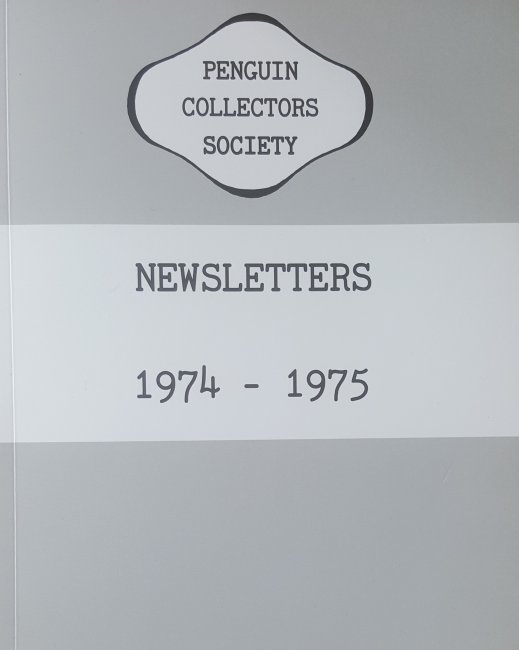
Although founded towards the end of 1973 the Penguin Collectors Society didn’t really get going until 1974 with the first meeting of like minded collectors being in the spring of that year and the first newsletter coming soon afterwards in May by which time there were 38 members. Member number one was Tanya Schmoller who had been personal assistant to the founder of Penguin Books, Sir Allen Lane, and number two was her husband Hans Schmoller who was at the time still Head of Typography and Design at Penguin Books. Sadly I never met Hans as he died in 1985 before I joined the society but I remember Tanya fondly for the encouragement she gave to a then relatively new collector when I discovered the society in 1990. By then the newsletters had become professionally printed rather than the typed onto a waxed paper and Gestetner reproduced early examples. There were also some three hundred members including several institutions including The Library of Congress in America, Canterbury College of Art, Manchester Polytechnic and the State Library of Victoria in Melbourne Australia to name just four.
The first page of newsletter number one is reproduced above, taken from the book and possibly the most striking sentence in this age of data protection regulations is “whose names and addresses are included in this issue”, it is difficult to imagine such a thing being done nowadays. The last directory of members was in 1988 and that not only had names and addresses but phone numbers and in many cases their collecting interests and approximate size of collection. Reading through these early issues, which I’d never seen before, was fascinating and I thank whoever came up with the idea of collating them. The society has only ever produced an appropriate number of copies for the members it has plus a small number for new members who want to purchase old editions and with just thirty eight members for issue one and just over a hundred by the time of the fifth and last 1975 edition finding these early newsletters is pretty well impossible.
So what was covered in the first newsletters? Well even the first issue at just thirteen pages, two of which were the directory of members and another two a series of adverts where members were searching for specific titles managed to cover wartime advertisements in Penguin Books, a couple of printing variations on “The Penguin Herodotus” along with “Russian Campaigns”, other early paperback printers and how many titles were printed in various Penguin periodicals. By the time we reach issue five, confusingly called volume 2, number 2, from December 1975 we get an interesting short article regarding the book on the Spanish Civil War entitled “Searchlight on Spain” by the Duchess of Atholl which may be unique in Penguin history as it prompted a second book, published by Hutchinson aimed squarely at refuting the original Penguin and entitled ” Daylight on Spain: The Answer to the Duchess of Atholl”. I had never heard of this second book however the review is not exactly complimentary as it seems solely intent on attacking the original book rather than establishing a cognitive argument so I won’t be searching for a copy. There is also an attempt to sort out the various publications of the early Penguin Handbooks along with a breakdown of the wartime Penguins issued in French. All very interesting.
This collection of early newsletters came with the latest example, June 2024’s number 101
This, as you can see is a very different beast to the early examples, now 112 pages long and illustrated in full colour, with articles as diverse as early days of the society, the development of the railway bookstall, various articles of designing particular books, two of the Allan Lane Christmas books and a couple of articles on translation amongst others. Following an appeal for more material there are also three articles based on entries from this blog:
I was surprised to see all three included as I just sent versions expecting the editor to use one or possibly two and hold the remainder over to a future newsletter. The articles were largely rewritten with new illustrations but you can get a feel for what appeared in this newsletter from myself.
The society can be contacted via its website and if you are remotely interested in Penguin Books or their various offshoots I heartily recommend membership, which by the way now stands at 470 according to the accounts dated December 2023. You don’t just get the newsletter but normally a special volume dedicated to a specific topic or reproducing hard to find items such as: A.S.B. Glover by Tim Graham and White Horses by Eric Ravilious.
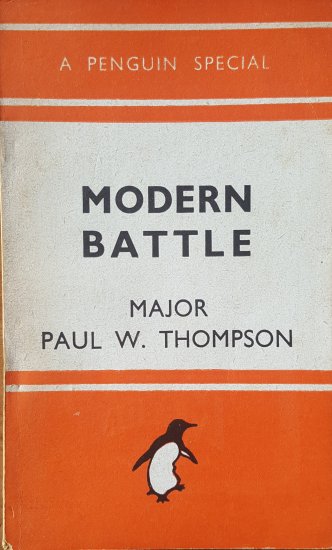
Inspired by the eightieth anniversary of the D-Day landings which was marked earlier this month I thought I’d look back on a book covering the start of the war. This is not a review of Modern Battle by Major Paul W Thompson, although it is a surprisingly interesting book which studies actual engagements between German and Allied troops in the early years of World War II so I will talk about it later in this blog. Rather I am looking at the various editions I have of the book and what these tell us about the war. Starting with The Forces Book Club edition published in October 1942, which is the second most difficult of the four versions to find as it as not sold to the public but rather only as packs supplied under subscription to military units, as described below on the inside front cover of this book. This explains why my copy has “C” Mess handwritten on the cover, sadly there is no further indication as to which battalion the mess (a place where military staff would eat and socialise) was associated with. Several of the other books I have from The Forces Book Club are ink stamped with the battalion or ship which had subscribed.
The rear cover gives a list of the first twenty books to make up, what was intended to be a substantial library for isolated units who otherwise would have little to read. The project however was a failure, partly down to the poor information regarding the existence of The Forces Book Club disseminated by the Ministry of Defence and partly due to the overly worthy choice of titles. The mystery and crime editions such as ‘Panic Party’ or ‘The Murders in Praed Street’ would undoubtably have been voraciously read but I can’t imagine Thomas Sharp’s volume on ‘Town Planning’ would have been as popular. Penguin did produce the 120 books needed to fulfil original subscriptions taken out, but in far lower numbers than expected and a lot of the books were subsequently rebound, initially as books to go to prisoner of war camps in Germany and later in the ‘normal’ covers these books would have had for general sale to the public.
The POW versions have the normal front cover but on the inside of this there is a replacement of the description of The Forces Book Club with some information regarding The Prisoner of War Book Service. Again the overall cost is three pounds for 120 books but this time even the more esoteric titles would probably have been read due to serious shortage of other reading material in the camps. All the remaining FBC titles appear to have been rebound as POW editions but they are all incredibly rare, I have a couple that, whilst popular as reading for the forces would definitely not been acceptable to the Germans i.e. ‘The Escaping Club’ and ‘The Tunnellers of Holzminden’ both of which deal with escapes from POW camps in the First World War and would therefore not pass the censors which probably explains why they have survived. I suspect that the company doing the rebinding simply did all the books without consideration as to the material they contained.
Books that didn’t make it out as FBC or POW editions were potentially rebound again as the main production run, so it is relatively common to find books that inside say they were printed for the Forces Book Club but in the ‘normal’ covers, rather than the one shown at the top of this blog. Speaking of which the first UK edition of the book in the Penguin Special cover from July 1942 can be seen below. All of the editions described so far have identical text inside with a foreword by Tom Wintringham, who had already written a couple of books published by Penguin including ‘English Captain’ and ‘New Ways of War’.
But we now come to a variant text as the book was also printed as a Penguin Special in America in association with The Infantry Journal, a company that already had distribution within the USA military and this has a new introduction by the editors of The Infantry Journal giving some background for their readership. This book was also published in July 1942, so just a few months after the Japanese attack on Pearl Harbour and the direct involvement of USA in the Second World War in December 1941. The original hardback first edition was published by W W Norton’s and Co. of New York earlier during 1941. A brief quote from the introduction to this Penguin American edition.
Modern Battle is based on a variety of source materials mainly from the professional military journals. Some of the accounts come from interviews with actual participants in the engagements described. Much of the background material is German, since the Nazi methods of warfare are those that have been most successful, and those that we need to know best as we work to find methods still better.
The copy I have is the third US edition from November 1942 by which time Paul Thompson had been promoted to Lieutenant Colonel. In the introduction there is an acknowledgement that the numerous included maps are drawn by Captain William H Brown of the US Army, who had also apparently been promoted, as in the July editions he is given as a Warrant Officer for the U.S. Coast Artillery Corps.
Now to the actual book. As alluded to above Thompson had access to German sources, presumably because America was not a combatant in WWII at the time he wrote the book, and these enable him to provide a comprehensive review of the various actions beyond anything available to a UK author. Of particular interest is the account of the aerial attack on Crete in May 1941 which is covered in the final chapter, which has a lot of information from German sources explaining how they went about the invasion which took just eleven days to complete despite the island being around 160 miles long. These alternative sources are evident throughout the book whether it be the German 10th army in Poland or the 1st Panzer division advancing on Aachen in 1940 and it makes the book a fascinating read as I have rarely come across information from outside Allied write ups.
I’ve been fascinated by The Albatross Press and their huge selection of books solely issued in the English language although printed and circulated only in continental Europe for well over twenty years, possibly thirty, from when I first became aware of their existence and the obvious influence the press had on Allen Lane when he came to found Penguin Books back in 1935. However until this book was published in 2017 information about Albatross was patchy at best and for my 250th blog I’ve decided to look again at my small Albatross collection along with reviewing Michele Troy’s excellent book. The Albatross Press books are difficult to find here in the UK as due to copyright restrictions they were not available in the UK, British Empire or the USA and indeed were seized by customs officials if anyone tried to bring them in, but they can be found occasionally and when I see one at a reasonable price I normally pick it up to add to my library. I’m going to split this blog into two sections, firstly a review of Michele Troy’s superb and phenomenally well researched book and then a piece about my collection which will give an idea as to the sort of titles published by Albatross from its foundation in 1932 until closing down soon after 1947. In fact it survived as an entity until 1955 but didn’t produce any new books in the 1950’s merely trying to sell its back stocks as it faced competition from a wave of American and British new paperback publishers all able to undercut Albatross prices.
Strange Bird – Michele K. Troy
As implied by the subtitle of this impressive volume 1932 was not a good year to start a publishing venture in Germany as Hitler along with his followers burgeoning censorship of books, sometimes for little reason, made operating there extremely difficult from his rise to power in 1933. Alongside the issues of Nazi interference as to what may or may not be published there was a significant problem with the business model for The Albatross Press and that was that there was already a well established publishing company issuing English language books on the continent and the German firm Tauchnitz had been in that market for over ninety years. The Albatross Press was an extremely complicated company, initially printing books in Italy and then moving that part of the business to Germany to get round Nazi regulations. European distribution was also run from Germany but the editorial team were in Paris whilst the funding came from Britain via a holding company in Luxembourg. It’s founding partners were John Holroyd-Reece a German born naturalised Brit who was half Jewish and German Max Christian Wegner who had recently been fired as Managing Director of Tauchnitz. Running the distribution from his existing company was another German, Kurt Enoch, who was also Jewish. You can see the problems that will rapidly start to accumulate under the rise of the Nazis. Holroyd-Reece also started numerous other publishing companies some of which owned shares in the other ones and it is frankly amazing that not only does Michele Troy explain this dense web of businesses but does so in a highly readable way.
Part of the reason for the complexity was a desire to present the company as German to Germans, British to the British and sufficiently international to confuse everyone else but you may wonder why there was not only a market for English language books on the continent and how such a market got started. Troy does her best to cover this as well, initially created by Tauchnitz partly in order to allow British and later American authors to obtain copyright for their works in Europe decades before international copyright was available. Well educated Europeans could also normally read English perfectly and having books in the original language is always seen as preferable to translations. By the mid to late 1930’s though the main thing that was driving the existence of Albatross and Tauchnitz, which by then Albatross had succeeded in getting editorial control over, was the need for foreign currency by Hitler’s government. This is another complicating aspect ably covered by Michele Troy as she digs into Nazi files and reveals the various sides trying to decide if Albatross, as a British firm, should be trading in Germany at all, especially when it turned out that the main British backer was also a Jew. Amazingly even after war broke out Albatross continued to trade until 1944 although it was largely concerned in selling it’s stored books.
What starts off as the history of a now largely forgotten publishing house turns into almost a detective story as she pieces together the surviving documentation despite both Albatross and Tauchnitz archives being destroyed during the war. The notes and citations alone run to fifty seven pages and the selected bibliography a further twelve pages. This is a major academic research project from the professor of English at Hillyer College at the University of Hartford and is well worth a read even if you have never heard of Albatross because it is so well written the story draws you in.
My collection of Albatross Press books
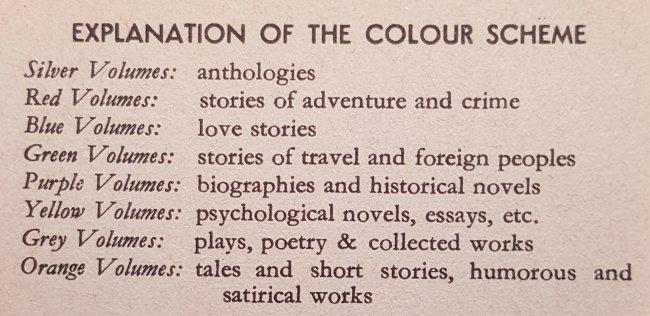
As has become clear to anyone reading my blog for a while I collect Penguin Books and have over 3,500 of them so Albatross are a logical side collection. The inspiration for Penguin Books was partly due to the press being named after a bird but mainly for the cheap but smart editions which are colour coded by subject matter, something that Allan Lane immediately adopted for his new enterprise. The chart shown below is from the dust wrapper of Memoirs of a Fox-hunting Man.
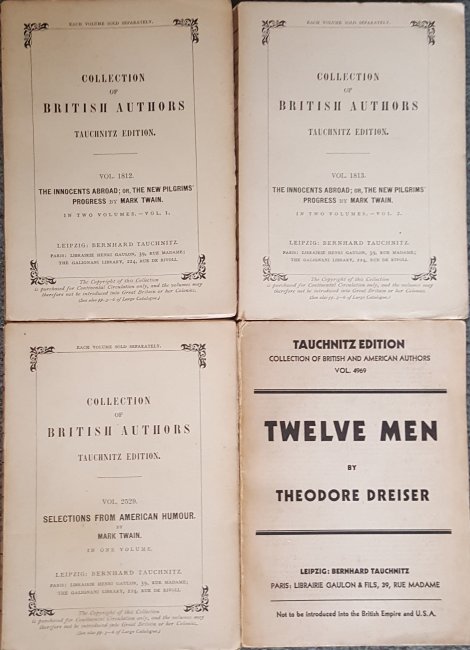
Troy explains the importance of Tauchnitz and if anything volumes from this publisher are even more difficult to find in the UK than Albatross, I just have four, three of which are from 1879 and 1880 and the final one, ‘Twelve Men’ is from 1930 so shows the plain typographical covers that the bright and colourful Albatross were going up against to attract customers.
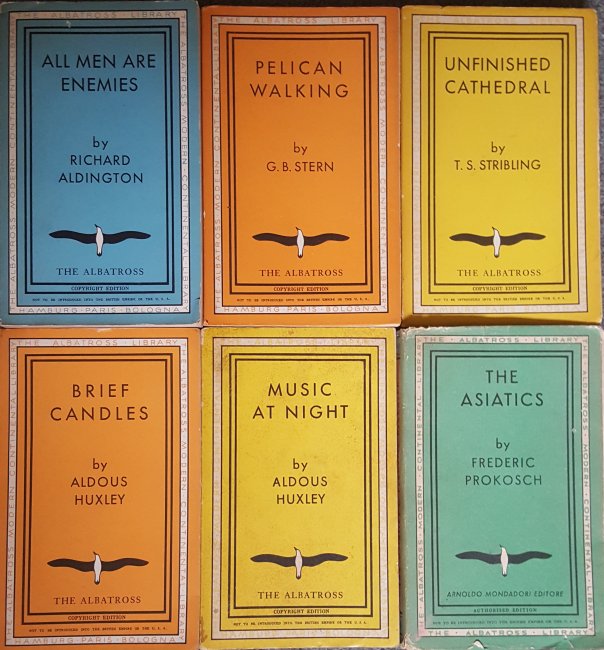
I have managed to accumulate twenty three Albatross books, so roughly one a year since I started looking for them, and their immediate attraction is obvious even if the standardisation of colours is sometimes poor to say the least. Both ‘Journal’ and ‘The Arches of the Years’ are purple and ‘Journal’ isn’t faded as it is that shade on the spine and rear cover as well.
16 – The Brothers printed in Italy in 193?
19 – Ambrose Holt and Family printed in Germany in 1932
31 – Apocalypse printed in Germany in 1932
32 – The White Peacock printed in Germany in 1932
52 – Journal printed in Germany in 1933
203 – The Arches of the Years printed in Germany in 1934
216 (Extra Volume) – All Men are Enemies printed in Germany in 1934
236 – Pelican Walking printed in Germany in 1934
240 – Unfinished Cathedral printed in Germany in 1934
247 – Brief Candles printed in Germany in 1935
260 – Music at Night printed in Germany in 1935
310 – The Asiatics reprinted in Italy in 1947
317 (Special Volume) – The Weather in the Streets reprinted in Italy in 1947
326 (Extra Volume) – Aaron’s Rod printed in Germany in 1937
359 – The Bridge printed by Collins in Scotland in 1938 as Les Editions Albatros, Paris
377 – Juan in China printed in Germany in 1938
390 (Extra Volume) – The Letters of D.H. Lawrence printed in Germany in 1938
514 – Grandma Called it Carnal printed in Italy in 1947
551 (Special Volume) – Operation Neptune printed in Holland in 1947
556 (Special Volume) – English Saga printed in Holland in 1947
558 – Siegfried’s Journey printed in Holland in 1947
4802 – Lord Jim printed in Italy for Librairie Marcel Didier in 1947
4975 – Memories of a Fox-Hunting Man printed in Italy for Librairie Marcel Didier in 1947
The massive leap in the numbering scheme for the last two books should not be taken to show thousands of new titles suddenly being released. Rather I suspect that this is to keep the Librairie Marcel Didier volumes well out of the numbering scheme of the existing Albatross Press books. Penguin did something similar when launching Penguin Inc in America during the war and starting their book numbering at 500. Penguin Inc’s managing director was Kurt Enoch having escaped the Nazi’s so this was his second publishing venture. In 1948 following disagreements with Allen Lane back at Penguin headquarters in England Penguin Inc was dissolved and Enoch started again with his third publishing firm this time as Signet and Mentor. As for the Extra and Special Volumes these are normally significantly thicker than ‘normal’ volumes and presumably had a higher price although 558 Siegfried’s Journey is a normal size so maybe Special Volumes had a different rule.
But why Albatross? Holroyd-Reece had several explanations but the one I find most persuasive is because the word is similar in a lot of European languages: Albatros in Catalan, Czech, Danish, Dutch, French, German and Spanish amongst many others, Albatro in Italian, Albatrosz in Hungarian and surprisingly Albatross in Estonian and those last two languages I know from personal experience are normally miles away from English. I’m still on the lookout for more volumes from The Albatross Press and have even added a sideline of want to be Albatross books including the Italian Corvi press, which is undated but numbered 4 in the series and looks to be from the 1930’s. This is a true polyglot of a title as it is a biography of a British Prime Minister written by a French politician and translated into Italian. Alongside is a book I picked up earlier this year in Budapest which is much later, 1979, but is clearly inspired by Albatross design and in this case is written in Hungarian but published in Bucharest, Romania. Fabre was a French naturalist and this is a translation of one of his books about insects.
All in all The Albatross Press produced some very attractive books from a wide range of significant authors so are well worth looking for and are a pleasant surprise when you do find one on a shelf in a second hand bookshop. As Michelle Troy’s incredibly well researched book proves they also had a fascinating history behind them.
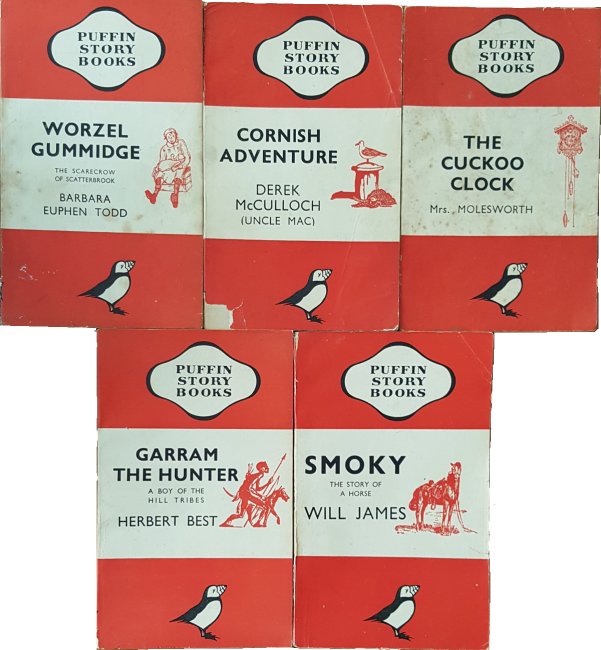
I somehow missed the eightieth anniversary of the start of Puffin Books last month as they launched in December 1941 but let’s somewhat belatedly look at how this massively important children’s imprint from Penguin Books started with five books, Worzel Gummidge, Cornish Adventure, The Cuckoo Clock, Garram the Hunter and Smoky and I have to say that the only one of these to have stood the test of time is Worzel Gummidge by Barbara Euphan Todd. I do have first editions of the Puffin books for all five so let’s take them in turn, starting each description with a quote from the title page where there is a brief introduction to the book.
Worzel Gummidge – Barbara Euphan Todd
This clever, fantastic story of the mysterious scarecrow who – when the mood took him – came to life and engaged in the funniest, and most alarming adventures, has become universally popular since the B.B.C. gave it to a wide and enthusiastic public.
The reference to the B.B.C. adaptation was a serialisation of the radio during Children’s Hour before the start of WWII and this was to just be the first of many adaptations that the book and its sequels have had over the years. I clearly remember the television version from 1979 to 1981 starring Jon Pertwee on ITV and there is a new TV adaptation running on the B.B.C. which started in 2019 starring Mackenzie Crook, which although I haven’t seen is introducing the character to a whole new generation. In the book two children, John and Susan, come to stay at the farm where Worzel is one of the scarecrows and start getting into all sorts of trouble as they are the only ones who see him move around and do things so they keep getting blamed for what he does. It’s a good story and you can see why Barbara Euphan Todd wrote nine sequels as Worzel Gummidge grew into a much loved character.
The book was first printed in 1936 and the Puffin edition is the first paperback, it is illustrated by Elizabeth Alldridge
Cornish Adventure – Derek McCulloch (Uncle Mac)
The setting, of small village, rocky cove and smuggler’s cave, is ideal for the plot that develops. The mystery breaks into the peaceful picture as the boy sails home on August morning with his fisherman friends
Derek McCulloch was best known as Uncle Mac on BBC radio where he presented Children’s Hour for seventeen years from 1933 but was also head of children’s broadcasting for the corporation throughout that time so would have been extremely familiar to his readers. It’s a classic children’s adventure yarn along the lines of Enid Blyton’s Secret Seven or Famous Five stories although these appeared much later than Cornish Adventure. ‘The boy’ referred to in the introduction is Clem and he is fifteen and has been coming to Cornwall through the summer holidays for the last five years and has got to know the local people over that time. He was out with a couple of fishermen collecting the crab pots when he spotted a dinghy going into a cave in the cliffs where they had never seen anyone before, what were the people doing there? Clem is determined to find out especially after swimming into the cave and finding it went back quite a way in the dark but he didn’t see the dinghy or the men.
The book is illustrated with drawings based on McCulloch’s own photographs but the artist who turned them into simple line drawings is not identified, it was first published in 1937.
The Cuckoo Clock – Mrs Molesworth
Griselda was only a little girl when her mother died, and she went to live in a big house with two great-aunts… She might have been lonely but for the cuckoo in the clock.
First published in 1877 and to my surprise still in print although no longer with Puffin, this book is definitely aimed at the younger reader; Griselda’s age isn’t given in the book but I’d guess at six or seven and Phil, the boy she meets near the end, is even younger and it is reasonable to assume that the target audience is around the same age as the protagonist in this case. Despite that it was a fun read with Griselda making friends with the cuckoo in the clock in scenes that could be interpreted as dreams except for the small invasions into real life afterwards such as finding the shoe from the land of the nodding mandarins in her bed (a large oriental cabinet in the room by the cuckoo clock turns out to be a gateway to where the carved figure live) or getting a message to Phil that she won’t be able to meet him the next day. The book is illustrated with several charming drawings by C E Brock.
Garram the Hunter – Herbert Best
Garram the boy is a fine vigorous character, cool-headed, bold and resolute, a skilful hunter, calculating his chances well and leaping swiftly into action. His adventures are lively and sometimes terrifying.
I probably enjoyed this book the most of the five I have read this week so it’s a disappointment to find that unlike the others it is long out of print with the Puffin version being the last I can find. Garram is the son of the chief of his tribe and is falsely accused of stealing and selling goats from one of the village elders by a rival for his fathers position. He manages to prove that the goats were in fact taken by a huge leopard but although this saves him at the time his enemy Sura continues to plot against both his father and him. Ultimately he is persuaded by The Rainmaker of the tribe to leave in order to protect his father as Sura would then fear his return as an adult to avenge any attack and so begins his adventures in lands beyond his tribes domain heading for the famous walled town of Yelwa, which is a real place, and where Garram would make his career before returning to his tribe and defeating his fathers rivals years later.
Despite being an American Herbert Best worked as an administrative officer for the British Civil Service in Nigeria and published several children’s books. First published in 1930, Garram the Hunter was shortlisted for the Newbery prize in 1931, the Puffin edition is illustrated with lino-cuts by Erick Berry which were ‘made on the spot’ so presumably in Nigeria and are the same as those in the hardback first edition rather than new illustrations for the Puffin book.
Smoky – Will James
Smoky is the story of a wild horse, told with exceptional vividness. It is also a real hot cowboy yarn, a grand adventure story told by a man who had lived in the saddle almost since infancy.
Well with an introduction like that who could fail to be intrigued? It is at many times a sad and yet ultimately fulfilling tale as Clint, who first trains Smoky after capturing him as a wild horse loses him to a horse thief. Smoky however, whilst perfectly obedient to Clint, will not allow the thief to ride him and is beaten repeatedly until eventually he lashes out and kills the thief. So begins his next life as an un-rideable bronco horse under the name of Cougar which eventually leads to career ending injuries. Sold off, this time as Cloudy he end up with yet another abusive owner who neglects and starves him before being spotted and recognised by Clint who eventually gets him back and nurses him back to health and a quiet retirement. Yeesh it was a hard read for a lot of the time.
Smoky is illustrated by the author although he isn’t credited in the book and it is easily the longest of the books in this set of five at 192 pages. Smoky won the Newbery medal for American children’s literature in 1927, a year after the book was first published, much to the surprise of Will James who considered it a book for adults, probably assuming the hard life Smoky has to be too upsetting for a younger readership.
Eleanor Graham was the series editor for Puffin Books from 1941, when they started, through to 1961 when she retired and was replaced by Kaye Webb. She did a remarkable job, especially dealing with paper rationing during the war and then building the imprint once paper started to become more available in the early 1950’s and adding titles such as Heidi, The Borrowers stories by Mary Norton and the first Moomin book. Webb inherited a series which by then ran to 150 titles which she was to vastly expand during her time in control including creating the Puffin Club and its associated annuals.























 Ramblings on my bookshelves