The Greek Coffin Mystery – Ellery Queen

As a lover of mystery and crime novels it is perhaps surprising that this was my first time reading Ellery Queen and the fact that I have started at the fourth book is due entirely to this being the only Ellery Queen that I possess. Let’s get the somewhat complicated back story of the authorship out of the way first and then dive into this surprisingly long (363 pages) crime novel. Ellery Queen is given as the author as well as the name of the private detective featuring in the book, in fact it is the work of two cousins, Frederic Dannay and Manfred Bennington Lee, who also individually wrote crime novels under those names. To add to the confusion both those names are also pseudonyms; Frederic Dannay’s real name was Daniel Nathan whilst his cousin Manfred Bennington Lee was really Emanuel Benjamin Lepofsky. Between them they wrote over thirty Ellery Queen novels and collections of short stories and there were also a few later books which were ghostwritten by various other authors and supervised by Lee.

What to make of this book though? It features Detective Inspector Richard Queen and his private detective son Ellery, who improbably gets to sit in on all meetings and interviews, along with visiting crime scenes just as if he was an actual member of the police force, he can even apparently make arrests. Indeed it took me some time to realise that Ellery Queen was, unlike his father, not actually an official part of the police. The story initially is simply the case of a missing will following the death of an elderly art dealer in New York. When it is worked out that the only place the will could have been put in the short time available from when it was last seen to when it was discovered to be missing is in Georg Khalkis’s coffin before the lid was screwed down an exhumation is ordered. The coffin being opened however is found to have two bodies in it, Khalkis and a mystery corpse and the case becomes murder and the problem is not just who killed the unknown victim but who are they… With thirty nine characters (including the police and Ellery) it can get complicated and I was glad of the list of people at the front of the book when trying to sort out the different relationships between them all.

The story is split up into two books, the first ending with the arrest of yet another incorrect suspect but with the police apparently satisfied that this time they have got their man. The second book details the collapse of the case against the arrested person and the slow discovery of the clues leading to the true murderer and thief. One thing I really liked was at the end of the thirtieth chapter where there is a break in the story for Ellery Queen to speak directly to the reader and make clear that at this point you have read all the clues needed to solve the case and that there is only one solution that fits everything you know. With almost sixty pages still to go it provided a break where I could go back in my mind over what has happened in the first three hundred pages and try to solve it. I have to admit that the actual solution was so surprising that I didn’t get it but yes everything fitted once you knew who did it.

This edition of The Greek Coffin Mystery was published as part of the Penguin Drop Caps series of twenty six books each with an author starting with a different letter and it is particularly appropriate for this to be Ellery Queen book chosen for Q as the chapters in this one are titled as an acrostic spelling out the titles and author. First published in 1932, the first Penguin Books edition came out in May 1957, this hardback was published in 2013 for the American and Canadian market only.

As I said at the start this was my first Ellery Queen mystery and whilst I enjoyed it I did find the character of Ellery Queen rather annoying. Reading about later books in the series he apparently does calm down a lot as the series progresses with far fewer irritating build ups to an incorrect accusation than occurs in this story. Maybe I ought to read one of the later books to see if I like him better.
How to Build a Universe – Professor Brian Cox & Robin Ince

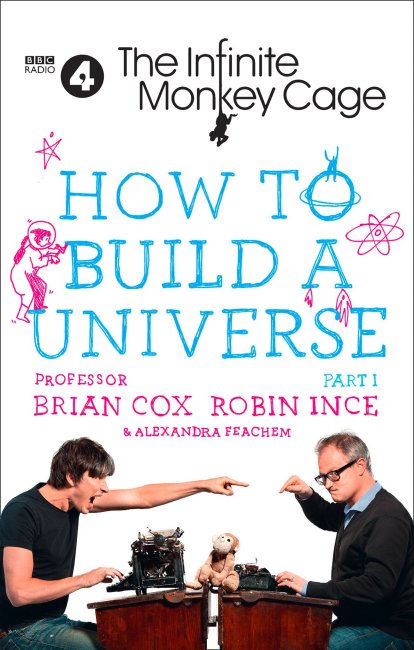
Based on the highly successful BBC Radio 4 series ‘The Infinite Monkey Cage’ this is science book like no other I have read. The radio show is also difficult to explain to people that haven’t listened to it, and you definitely should listen to it (link at the end of this blog) because it is co-hosted by on the one hand a Professor of Particle Physics at Manchester University and on the other a stand up comedian which is an extremely unlikely combination but works brilliantly. The look of the book matches the slightly anarchic structure of the radio show which in an early episode whilst discussing something completely different wandered onto the subject of “is a strawberry alive or dead?” They have come back to this subject on other occasions and I was pleased to see this being treated in the book as shown below:

The science for the most part is not overly challenging and the only really complex section is the largest, an eighty page chapter entitled ‘Recipe to Build a Universe’ which is almost entirely written by Brian Cox and as Robin writes:

This is the hard bit of the book. You may need a pencil to underline sections or just to occasionally jab into your leg or skull as you ask “but what does it all mean?” Don’t let this put you off

Page 80

In truth I have read so many books on this topic that it was relatively easy to follow and I largely sailed through this bit as it is so well written. Although a background of nuclear physics, coincidentally at Manchester University although six years before Brian went there to do his degree, possibly also helped. It also helped that the book is actually very funny especially during interplay between Cox and Ince, I laughed out loud at several sections and particularly a part written by Robin with increasingly irritated footnotes correcting him by Brian.

Other topics covered include the concept of infinity, space travel, the ultimate death of the universe and lots of things in between. In this way it is very similar to the radio show in that the main subject of a chapter, or indeed an episode, can be lost briefly if something interesting comes up as an aside. ‘Schrödinger’s strawberry’ (is it alive or is it dead) alluded to in the first chapter of this review is a prime case in point. You will learn a lot from this book but it won’t feel like it at the time unlike tackling something like Relativity by Albert Einstein or any of the four important science books I read one after another in August 2020. The style is easily approachable and the need for Brian to make sure that Robin is following the points as he makes them keeps the text grounded, although Robin Ince has now written his own science book ‘The Importance of Being Interested’ which I have a copy of so expect a review of that in a couple of months or so.

The radio show is just embarking on its twenty fourth series, some of the earlier ones only had four episodes but it now seems to have settled on six and all of them are available on the BBC website via this link. The shows on the site are usually the extended podcast versions rather than the original thirty (now forty five) minute broadcast. The usual format is that Brian Cox and Robin Ince are joined by two scientists who specialise in the subject selected for that episode and also another comedian who may have a science background but more often does not. A notable exception to this format, and an episode that is well worth listening to, was the astronaut special from series 22 where they were joined by astronauts Helen Sharman, Chris Hadfield, Nicole Stott and Apollo 9’s Rusty Schweickart. The book is great fun, the radio show even more so.

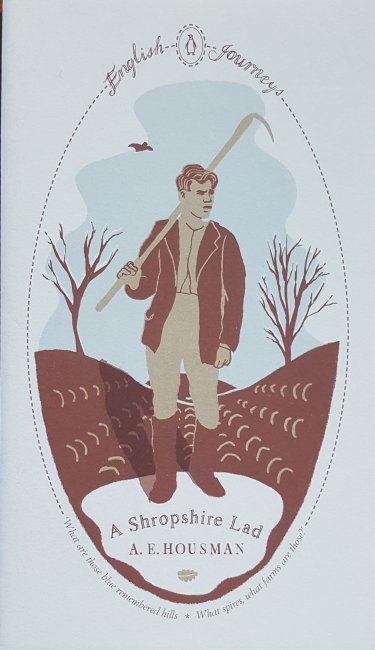
A Shropshire Lad – A E Housman

I have lived in Shropshire for the past eleven years and have seen copies of A Shropshire Lad numerous times in various bookshops across the county but never bought it. I think mainly because I knew that Housman never visited Shropshire before writing this collection of poems celebrating the county and he only came here briefly after becoming permanently associated in the public’s mind with Shropshire so doubted that he would have much insight into this extremely beautiful part of England. Sure enough whilst reading it became clear that even geographic details, which he gleaned from a tourist guidebook whilst writing the poems in London, were incorrect but the poems are not really about Shropshire anyway but about war and the untimely death of youths both in conflict and otherwise, including suicide. It cannot be described as a cheery read.

Let’s tackle a couple of the poems with more glaring geographic issues first just to get these out of the way, starting with one of the few poems to have a title rather than just a number, XXVIII The Welsh Marches which starts

          High the vanes of Shrewsbury gleam
          Islanded in Severn stream;

Well Shrewsbury may be built in a loop of the river Severn but it certainly isn’t on an island, indeed Shrewsbury castle stands guard on the northern side of the river defending the land entrance to the town. The poem continues in it’s fourth verse with

          When Severn down to Buildwas ran
          Coloured with the death of man,

Buildwas is roughly seventeen miles (27½ km) from Shrewsbury and the river has a significant volume by then so there is no way that blood from a Saxon battle, which would have involved hundreds rather than tens of thousands of combatants at that period of history, would still be visible in the water by the time it got there. The most obvious error though is in poem LXI Hughley Steeple, I don’t even need to quote the poem as Hughley church has a timber framed belfry but it certainly doesn’t have a steeple. But that doesn’t stop Housman giving it one with a prominent weather vane on top, which it also doesn’t have.

Ludlow gets mentioned in five of the sixty three poems and Wenlock Edge, which is a nineteen mile (30 km) long escarpment appears twice. Although even in, probably the most famous poem from the set, known as ‘On Wenlock Edge’ although not actually titled, geography isn’t Housman’s strong point as it mentions the Roman city of Uriconium, the ruins of which are fifteen miles (24 km) from Wenlock Edge. But the poem is a really good example of the style of the collection and has been set numerous times to music, most notably by Ralph Vaughan Williams who included other poems from the set as well in his song cycle On Wenlock Edge.

          XXXI

          On Wenlock Edge the wood's in trouble;
           His forest fleece the Wrekin heaves;
          The gale, it plies the saplings double,
           And thick on Severn snow the leaves.

          'Twould blow like this through holt and hanger
           When Uricon the city stood:
          'Tis the old wind in the old anger,
           But then it threshed another wood.

          Then, 'twas before my time, the Roman
           At yonder heaving hill would stare:
          The blood that warms an English yeoman,
           The thoughts that hurt him, they were there.

          There, like the wind through woods in riot,
           Through him the gale of life blew high;
          The tree of man was never quiet:
           Then 'twas the Roman, now 'tis I.

          The gale, it plies the saplings double,
           It blows so hard, 'twill soon be gone:
          To-day the Roman and his trouble
           Are ashes under Uricon.

As said above most of the poems don’t concern Shropshire in particular but rather the perils of war and death. The collection was first published in 1896 but didn’t really start to sell in significant numbers until the start of the Second Boer War and massively rose again during the First World War when the death of young soldiers was so keenly felt across the country. The overall body count across the series of poems is surprisingly high and it is nearly always young men who are speaking from the grave (a common theme of the poems) to those yet to die. I don’t really know what I expected from the poems as I genuinely didn’t know anything about them apart from the title before I came to read the book but I can’t say they particularly appealed to me. There is however a brief glimpse or two of albeit grim humour amongst the largely unrelenting gloom.

          XXVII

          "Is my team ploughing,
           That I was used to drive
          And hear the harness jingle
           When I was man alive?"

          Ay, the horses trample,
           The harness jingles now;
          No change though you lie under
           The land you used to plough.

          "Is football playing
           Along the river shore,
          With lads to chase the leather,
           Now I stand up no more?"

          Ay, the ball is flying,
           The lads play heart and soul;
          The goal stands up, the keeper
           Stands up to keep the goal.

          "Is my girl happy,
           That I thought hard to leave,
          And has she tired of weeping
           As she lies down at eve?"

          Ay, she lies down lightly,
           She lies not down to weep:
          Your girl is well contented.
           Be still, my lad, and sleep.

          "Is my friend hearty,
           Now I am thin and pine,
          And has he found to sleep in
           A better bed than mine?"

          Yes, lad, I lie easy,
           I lie as lads would choose;
          I cheer a dead man's sweetheart,
           Never ask me whose.

My copy is from the 2009 series of twenty books by Penguin called ‘English Journeys’ and I do have the complete set, all of which have very attractive covers. If there is any of these that you would like me to cover in a future blog entry then please send me a comment.

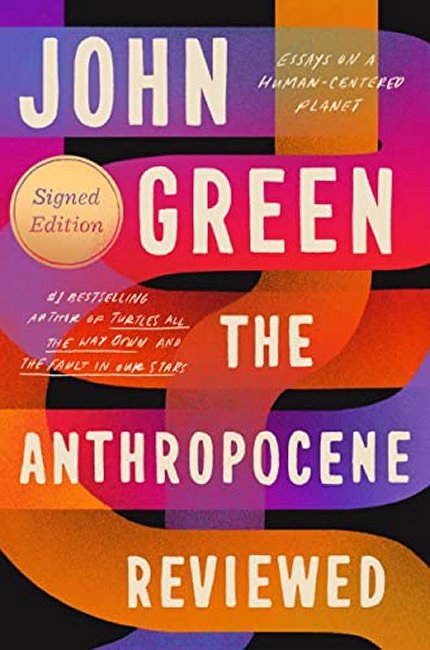
The Anthropocene Reviewed – John Green

John Green wrote this book as the coronavirus pandemic took hold in 2020 and from his first review, the song You’ll Never Walk Alone which gets four and a half stars, through predictions of the end of humanity which he originally gives just one star to but adjusts as the pandemic spreads but humanity persists to four stars we can see how this series of essays is going to progress. The Anthropocene is an as yet short period of Earth history just two hundred and fifty thousand years where man has been, if not the dominant species, at least initially, a significant impact on the world. As this is a tiny temporal range compared to most other species, the elephant has been around for two and a half million years so ten times more, whilst the tuatara (a New Zealand reptile) has existed for a thousand times longer being found in archaeological remains two hundred and fifty million years old our dominance is unique. The book started out as a series of podcasts which can be found here and the audio book is read by John Green so appears similar to the podcast but in the book each topic is dealt with separately whilst the podcast almost always links two subjects in each broadcast. There are forty four separate essays included along with an introduction and a postscript so it comes in at a reasonably chunky 304 pages but because it is a series of disconnected essays it is an easy read.

I wrote that initial paragraph whilst starting to read the book but I quickly switched to the ten hour audio book in order to get the feel of the original podcast and discovered that there are three more entries on the audio book giving a total of forty seven. This is presumably a later edition of the book as the audio book came out in 2021, a year later than the original hardback but as one of the extras includes an audio file which clearly cannot be done in the book then maybe not. After originally deciding that nothing would get the perfect five stars in fact nine entries do receive that accolade, including one of the extra entries, the full list of these gives some indication of the randomness of the essays:

  • Sunsets – A quote from the review is “nothing is five stars because nothing is perfect but this is perfect”. From here on he feels more able to award five stars
  • Jerzy Dudek – Polish goalkeeper who played for Liverpool including the final of the UEFA Champions League in 2005
  • Harvey – The 1950 film staring James Stewart and a six and a half foot tall invisible white rabbit
  • Auld Lang Syne
  • The Hot Dogs of Baejarins Beztu Plysur – A famous Reykjavik hot dog stand
  • The Mountain Goats – A band that is easily the favourite of Green’s
  • Sycamore trees
  • “New Partner” – A song by Palace Music (Will Oldham)
  • The Smallpox vaccine (extra entry)

A few of these need a little explaining as to why he rated them with the maximum score because they are so personal to him. John Green is a supporter of the Liverpool football team and watched the 2005 final on television where his team were 3-0 down to A.C. Milan at the end of the first half only to score three goals of their own in the second half. This led to a penalty shootout where Dudek saved Andriy Shevchenko’s penalty and Liverpool won one of the most amazing comebacks. Fellow Pole, Pope John Paul II is quoted in the review for saying “Of all the unimportant things football is the most important” and Green concurs. Harvey was a film Green was recommended to watch by his then boss as he quit the firm to deal with his nervous breakdown which had left him unable to do anything, strangely enough the film actually helped Green on his way to recovery. Baejarins Beztu Plysur is a small chain of hot dog stands in Reykjavik, the name literally translates as The Town’s Best Hot Dogs and these were enjoyed during a short visit to the city with his wife and another couple, where he tried one on the day Iceland won their first Olympic team gold medal for men’s handball. Green really got into the Icelandic mood of celebration and loved the hot dog. The Mountain Goats is easily the shortest review where he basically just says this is his favourite band and has been for over twenty years with a quote he particularly likes “I’m going to make it through this year if it kills me”. With sycamore trees it is less clear quite why he rated them at five stars apart from talking about walking through a wood with his children and being especially struck by the beauty of the sycamore although this is preceded by a long section about his depression so it may be just he really needed something beautiful to focus on. “New Partner” is Green’s favourite song not by The Mountain Goats and has been for over twenty years, as part of the review he gives episodic stories about listening to the song over the years. The extra entry, smallpox vaccine, leads to a short history of the vaccine and also the covid vaccine that he had recently been to have. In 1796 Edward Jenner infected a young boy with cow pox as a protection against smallpox, as it was known that farmers with cows and especially people dairy maids were immune to smallpox, and gave the world the first vaccination (from vacca the Latin for cow).

At the other end of the scale only three entries get only one star and those are Staphylococcus Aureus, The Plague, or Black Death as it is probably better known and viral meningitis. Staphylococcus aureus is a bacteria John Green has been treated for and this section also features the development of antiseptics. In 2014 Green suffered from viral meningitis and had a headache worse than anything else he has had, extreme pain for a couple of weeks and a week in hospital, he recovered slowly but it kept returning in a less and less serious way for several years. I think it’s quite clear why all three of these only rate one star.

The weird variety of topics is both a positive and a negative to the book, you never know what is coming next, especially when listening to the audio book version as clearly you don’t have a list of contents and some of the essays appear to have only a passing relevance to the topic being discussed, for instance Our Capacity for Wonder is told via a review of The Great Gatsby. Some of the pieces are touching, others just odd, some tell stories that I already knew such as the discovery of the Lascaux cave paintings and the history of Monopoly giving The story of the theft of the game from its original inventor Elizabeth McGee by Charles Darrow, the person who patented it, sold it to Parker Brothers and became a millionaire. Some are new to me, such as the rise of Piggly Wiggly, an American supermarket chain operating in the American Southern and Midwestern regions and Hiroyuki Doi’s circle drawings which use thousands upon thousands of hand drawn circles to make up a complex design.

As mentioned there are three extra entries in the audio book version one of which is The Smallpox Vaccine which I have covered earler. The second one is Mortification where he describes his embarrassment after giving a talk in a high school when he gets to the end and ‘any questions?’ only for the first response to be ‘Are you aware your fly is open?’ After fixing this and going for another question there is just silence where before there were lots of hands in the air. The third is Kauaʻi ʻōʻō, a Hawaiian bird now believed to be extinct along with the other four species of ōʻō. By 1981 only one nesting pair was known to exist but female went missing after a hurricane in 1982. Includes final known recording of the single male pausing in his song for a female reply which never comes, this plaintive call is played three times in audio book.

I give The Anthropocene Reviewed four stars.

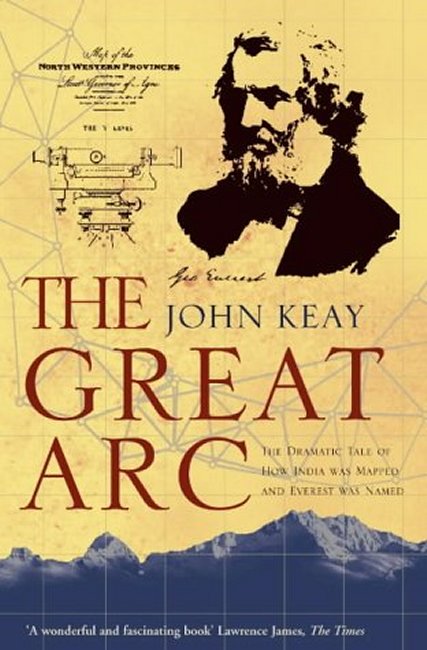
The Great Arc – John Keay

I’ve seen many a ‘trig point’ whilst walking the hills of Britain, these mainly concrete structures on top of high points were used for accurate mapping, specifically to get the correct height of hills and mountains, but quite how they were used was not something I particularly thought about before reading this book. The story John Keay tells is of an epic fifty year project to both start the accurate mapping of India but more importantly to create the longest ‘Great Arc of the Meridian’ a accurate calculation of the curvature of the Earth and it’s variation as you move from the equator to the north pole, one of the most outstanding scientific endeavours of the first half of the 19th century. Started in 1800 by a team led by William Lambton and ultimately completed by George Everest (pronounced ‘eve rest’ not ‘ever rest’ as he and his descendants would repeatedly tell people) the sheer scale of the project can be seen on the map below as a series of phenomenally precise triangles stretch all the way from the southern tip to India right up to the foothills of the Himalayas.

The basic concept is quite simple, first establish a baseline whose length is exactly known but is also long enough to mean that a high point visible from both ends will form a significantly different angle when this is measured by a theodolite from these two points. Using trigonometry you can then calculate the position of this third point and the length of the two inferred sides of the triangle formed. One of these ‘new’ sides can then become the base of another triangle, a new high point selected, measured and so on. It had already been established that the Earth wasn’t round like a ball but more like a grapefruit so flatter at the poles than at the equator but by just how much was it flatter. Measurements had been taken of the length of a degree (1/360 of the circumference of the Earth) and it had been found that in Ecuador (on the equator) it was approximately 111km whilst in Lapland it was around 110km so a whole kilometre shorter.

The problem lies in accurate measurement of a long enough distance, nowadays it is relatively easy but over two hundred years ago the equipment was a lot more primitive and Lambton had to use what was called a chain but was a lot more sophisticated than that. His was made up of forty bars of blistered steel each two and a half feet long and each attached to the next one using a brass hinge, using this he had a measure of one hundred feet (30.48 metres) that he knew to be correct, the problem comes when he needed a long enough base to his first triangle which he decided was a seven and a half mile long (12.07 km) flat stretch of land that needed to be cleared and levelled as much as possible near Madras. Which means that he had to use his chain four hundred times, precisely starting where the previous measure had finished, in a perfect straight line and allow for the expansion of the steel as its temperature rose under the Indian sun even though he only took measurements in the early part of the day. It would take fifty seven days to complete the seven and a half miles and the markers for the two end points can still be seen. From this line he could head north.

Now you have probably seen surveyors with theodolites at building sites but nothing like the giant piece of equipment Lambton used. It needed to be this size not only for stability but to allow for the large brass dials which would make the scale large enough to read extremely accurate measurements of the angles and even then the dials were fitted with microscopes so that the precise figure could be attained. Lugging this massive instrument across India, through jungles, deserts, up mountains and all sorts of other terrain never mind crossing rivers along with all the other equipment, food and tented accommodation for the entire vast team for months at a time was a stupendous achievement with people falling ill or dying both of sickness and animal attacks throughout the fifty years of the survey. Each time it was set up it had to be on a high point with other members of the team at another high point with a marker, initially flags and then later on lights and sometimes it would take weeks for the marker team to reach the next point, it was very slow progress with trees and in some cases houses or parts of whole villages having to be cut down or purchased and then flattened to provide clear sight lines from one point to the next. Six years after starting out a new base line was measured to check the calculated length with reality and amazingly over the six miles (9.66 km) checked the error was just 7.6 inches (19.3 cm) or to put it another way he was out by just 0.0000002%.

William Lambton eventually retired and was replaced by George Everest who carried the survey up to the foothills of the Himalayas but not into Nepal as that kingdom was going through one of its reclusive periods and they were not allowed in even to do scientific work. Besides it was known that the theodolite could see vast distances, possibly even into women’s quarters, and even worse the image seen was inverted and no man wanted his wife, or wives, seen upside down so they were often attacked by villagers or blocked by local rulers from coming through certain parts of India. This added to the geographic, animal and disease problems really slowed progress but Everest was not a man to put up with resistance to his survey and he pressed on regardless. He never saw the mountain that was to be named after him when it was determined to be the world’s highest peak; but nowadays whilst everyone has heard of Mount Everest, who has heard of George Everest? Tragically especially ignored is the brilliant William Lambton who started this magnificent survey so this book is important to raise their profile again. It is also a fascinating description of the hardships endured by the teams who did this amazing project. John Keay has produced a highly readable account of the survey which whilst including details as to how the work was done never gets bogged down in the mathematics which is a trap that would have been so easy to fall into. It was first published in 2000, mine is the 2001 paperback published by Harper Collins and is still easily available and I highly recommend it.

The Yellow Wall-Paper – Charlotte Perkins Gilman

The story that provides the title of this collection of three short stories is easily Charlotte Perkins Gilman’s best known work, it is beautifully written and is also a very difficult read. It deals with the descent into madness of a woman who suffered from a severe bout of postpartum psychosis, a range of mental illnesses which occur soon after childbirth. Gilman was perfectly aware of how this could be as she suffered from very bad attack of some form of postpartum psychosis after the birth of her first child so the story can be seen as semi-autobiographical. Unfortunately for Gilman this collapse of her mental health wasn’t recognised by the medical profession back in 1885 when she had her daughter and she was largely seen as simply needing to pull herself together and rest and recuperate physically after the birth, but in fact she didn’t really start to recover her mental well being until 1888 by which time she had separated from her first husband and was resting in Rhode Island with a female friend.

It was in 1890 that she wrote The Yellow Wall-Paper and the story is told first person from the point of view of the unnamed female narrator as she gradually becomes more and more obsessed with the wallpaper in the bedroom she is in. At first all seems well, her husband, who is also a doctor ‘treating’ her condition has taken a large house in the country for three months to see if the air would help her recover from the psychosis she is suffering from but slowly she reveals to the reader, if not herself, the true position she is in. The room that he puts her in is a large one in the attic that has a bed screwed to the floor and initially no other furniture so some random pieces are brought up from the rooms below. There is also a gate at the top of the stairs up to this room so initially she assumes that the room had been for the children of a previous resident but it gradually becomes clear to the reader that she is a prisoner in this room, with its terrible, faded and partly pulled off the walls wallpaper. Oh the wallpaper, the pattern is odd, not quite matching and making a satisfying design but maddeningly elusive and the missing pieces along with the faded patches make finding the pattern even more difficult. The colour is also coming away from the paper, brushing up against it leaves yellow stains on your clothing and that blurring makes it even more difficult to interpret.

The colour is hideous enough, and unreliable enough, and infuriating enough, but the pattern is torturing.

She is also told to rest after meals and not to do any work, even writing is forbidden so she hides her notes on the changes of the wallpaper that she perceives in different lighting conditions. This was also the fate of Gilman herself, a writer told not to write and this greatly prolonged her own mental collapse. Gradually, as the weeks progress, our narrator starts to see movement behind the wallpaper and is convinced that some malevolent creature is behind the paper, small at first but the creature grows as the nights pass until she sees a woman loping behind the paper and determines to release her. This has to be one of the most disturbing short stories I have ever read, you are drawn totally into this woman’s world and you can feel the paranoia rising. The Yellow Wall-Paper is rightly regarded as a classic of feminist literature and a few years later Gilman sent a copy to her own doctor to try to persuade him away from the stifling treatment she had received at his hands.

The other two stories in the book are also interesting, ‘The Rocking Chair’ is another beautifully written story where two friends take rooms in an old property having been drawn to it by the sight of a beautiful young woman rocking in a chair by the window, but all is not as it seems. The girl is almost never seen by either of the two men although one catches a glimpse of her one day but both of them are convinced that the other has been talking to her, indeed they have each seen the other standing by her at the window when approaching the house. Both are disturbed at night by the incessant rocking of the chair which is in one of their rooms but both deny having been in the chair at night. What is going on and what will be the ultimate result of their gradual loss of friendship for each other as they refuse to believe the others story of not seeing the girl?

The final story is for me the weakest of the three, ‘Old Water’ is another story of obsession this time of a young poet for the daughter of an acquaintance. The daughter is however not in the least interested in him as she likes sports and the outdoor life and his attempts to join in with her simply highlights his inadequacies in her eyes. You know it isn’t going to end well but the final twist is unexpected but strangely satisfying as a conclusion.

I hadn’t heard of Charlotte Perkins Gilman before but I’ll definitely be reading more of her work.

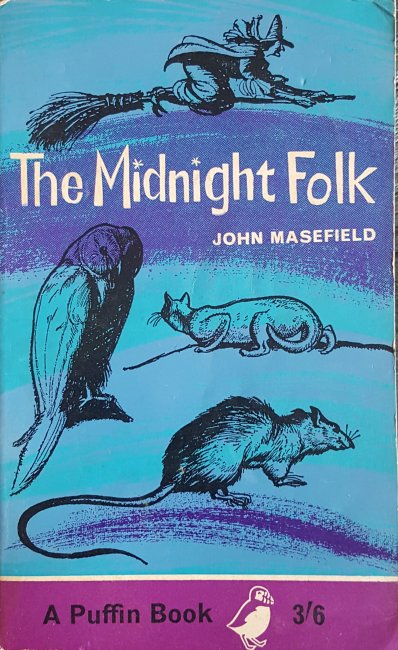
The Midnight Folk – John Masefield

John Masefield was the UK Poet Laureate from 1930 to 1967 the second longest period of time of any of the holders of this office since its creation in 1668, he is only exceeded by Alfred, Lord Tennyson. However this book is not a collection of poems, but is instead a wonderfully imaginative work for children written in 1927 and still in print to this day. My copy was published in this Puffin edition in March 1963 and is beautifully illustrated by Rowland Hilder with not only large pictures but smaller images within the text. Masefield packs in the characters in this story from pirates, witches and wizards, talking animals, mermaids, King Arthur and his knights, moving and talking paintings, hidden treasure, a flying horse and even a crooked gamekeeper and his henchmen to name just a few. But so to our hero, nine year old Kay Harker who is trying to solve the mystery of the lost treasure with the help of some and the major hindrance of the others in this huge cast. He is apparently an orphan, no parents are mentioned except his mother in passing right at the end, and the large house he is living in is equally not very clear, did it belong to his parents or is it the property of his guardian who doesn’t live there? The only residents of the house other than Kay are the servants and his unpleasant governess, who turns out to be one of the coven of witches casting spells and causing mischief as they also search for the treasure.

The story positively races on as we alternate from Kay’s dreary schoolwork set by the governess and tedious meetings with her friends and his guardian to exciting overnight chases both on the ground and in the air on broomsticks or the flying horse which always find him fast asleep back in his bed just before the maid comes round to wake him up; but the mud on his slippers or other traces of the previous nights activities prove that this is not dreams. In many ways this reminded me of ‘The Cuckoo Clock’ which I included a few months ago as part of my look at the early days of Puffin Books, but the stories are far more fantastical than those by Mrs Moleworth in her Victorian adventure. The choice of words and the wide vocabulary used betray this book as the work of a significant poet who was to receive the highest honour for poetry in the country just three years later and the hunt for Kay’s great grandfather’s wrecked ship and the lost treasure he was trying to protect from a South American uprising is carried on in beautifully crafted adventure stories. Will Kay work out where it is before the wizard Abner Brown and the witches get to it and what will happen to the evil governess once Kay has worked out that she is one of the witches and therefore his enemy? Maybe a peek into the past will give the final clues.

Masefield wrote a sequel to this book in 1935 entitled ‘The Box of Delights’ which if anything is better known than this original story and has been adapted for radio, television, theatre and even as an opera by Robert Steadman with a libretto by Masefield. It was also available in Puffin Books in the 1960’s so I may see if I can track down a copy to match this edition, it’s been a really fun read.

Fahrenheit 451 – Ray Bradbury

This is the 225th blog entry on Book Ramblings and I have chosen a dystopian classic, Fahrenheit 451 named after the temperature at which paper starts to spontaneously combust and a book that brings terror to all lovers of books. I first read it in my mid teens and amazingly haven’t read it since, presumably the original book I read back then was from the local library, as although I believed I had a copy somewhere I couldn’t find it so had to buy a new paperback to do the review. The back page of this edition gives a brief, although slightly inaccurate (see later), summary of the book’s plot.

Rear cover of Harper Voyager edition

Guy Montag was a fireman, there was a rumour that firemen had once followed alarms to burning houses and put them out, but that couldn’t be true as houses were all fireproof weren’t they? So firemen followed alarms on reports of houses where books could be found and turned up in their great salamander engines full of kerosene and burnt everything inside. Then one day as Montag is walking home he meets sixteen year old Clarisse McClellan and unusually for a time and place where social interactions are far from the norm she starts to talk to him. Her family had recently moved in and unlike all the other houses which shut out the outside world this one had lights on in all the rooms, the windows were open and the sound of people talking could be heard as you passed, such a strange place and by implication a strange family. The reader starts to expect these encounters on the way home as the first ten percent of the novel is built around them as she introduces him to other experiences such as savouring the rain on your face or brushing a dandelion under his chin to see if he is in love and then just as suddenly as she is introduced she is gone. In the introduction to the 50th anniversary edition Bradbury states that killing her off was a mistake and in the play and opera versions he had written she survives and reappears near the end. In this he was inspired by François Truffaut, whose film adaptation in 1966 retained Clarisse, but in the novel we now focus on the fire station and Montag’s home and wife Mildred.

It is at the station that things start getting nasty for Montag, it is clear that the fire chief Beatty suspects Montag of saving books but Beatty himself is clearly well read, he quotes from lots of books during his conversations with Montag for instance, but he will be the driver that pushes Montag into his rebellion against the system. At the station there is also ‘The Hound’ an eight legged robotic killing machine which destroys pests at the station but can also be programmed to seek out humans that don’t ‘fit in’. As Montag gets more nervous regarding his safety, especially as The Hound’ starts reacting in his presence and intrigued about what may be in the books he has been systematically destroying he seeks out a man he met in a park a year ago. Faber is a retired English professor who quite rightly is initially nervous of Montag but will ultimately guide him to safety. From here the book takes a significantly more violent tone as Montag is forced to burn his own home and takes his revenge before making his televised escape.

There is a slow running subplot in the book and that is the regular mention of bombers flying high over the city at night. Is there a war on? There is no mention of it through the soporific TV channels broadcast twenty four hours a day onto wall sized screens but something is clearly building up and when it does it will be totally devastating.

This is Ray Bradbury’s first complete rather than fix-up novel and took for its inspiration five short stories he had written over the previous few years, specifically ‘The Fireman’ which was quite long at twenty five thousand words and starts the premise of books being burnt because they could lead to dissent or at least present alternate views to those in power. He had published ‘The Martian Chronicles’ three years earlier in 1950 but that was a fix-up consisting of several already published short stories with added bridging material and a minor rewrite to make them consistent. The short stories that inspired Fahrenheit 451 didn’t survive into the final novel but between them provided context for the final work. The reason for the rewrite was an approach from Ian Ballantine’s publishing company which was interested in ‘The Fireman’, which had been struggling to sell, but needed it to be fifty thousand words so it could be published as a book. At this point Bradbury realised that the other four short stories provided further structure to allow him to continue the story. It was a brave choice by Ballantines, 1953 was the peak of Senator John McCarthy’s purging of perceived anti-American activities and by now almost anyone could be accused and their works suppressed so a book about the evils of censorship was either well or really badly timed depending on your view.

There is another publishing milestone that should be mentioned here, to help get the book known parts of it were put out for magazine serialisation but nobody would touch it until a new publisher trying to launch a magazine was willing to take the risk. So in editions two, three and four of Playboy you will find extracts from Fahrenheit 451.

Oh, and for the slightly inaccurate piece on the back, clearly this is a reference to Montag’s brief chats with Clarisse at the beginning of the novel and also his chance meeting with Faber a year earlier. It is however with Clarisse that his world view starts to change, but crucially he had already started hiding books in the ventilation shaft of his home well before that as he refers to his guilty secret hidden there right after his first meeting with her. The rear cover summary implies that the book saving starts after both meetings but actually it probably started after his encounter with Faber.

The Knight in Panther Skin – Shota Rustaveli

This prose translation of Rustaveli’s Georgian epic poem from the twelfth century by Katharine Vivian was praised by The Director of the Institute of the History of Georgian Literature in Tibilisi, A G Baramidze, as

an interesting attempt to render Rustaveli’s poem in prose – not to give a literal word by word translation, but rather a free rendering which may bring to the reader the contents of the poem and thus contribute greatly to Rustaveli’s popularity throughout the English-speaking world.

Prefatory note

The poem is seen as one of the greats of Georgian literature and Rustaveli is regarded there in much the same way as Shakespeare is here so it was a surprise on reading it that it doesn’t appear to have any action take place in Georgia. Instead Avtandil and his great love Tinatin are portrayed as coming from Arabia whilst Tariel and his love Nestan-Darejan are Indian. The story concerns how Avtandil and Tariel are separated from the loves of their lives and ultimately win their hands in marriage although in two very different ways. But let us start at the beginning because that is where the story is closest to Georgian history. The first chapters deal with Tinatin being raised to be Queen of Arabia by her father as he steps aside and this mirrors the ascension of Queen Thamar in Georgia who was monarch during Rustaveli’s lifetime and this is still seen as a golden age for Georgia. Avtandil is commander of Tinatin’s army and a favourite of her father Rostevan whilst Queen Thamar’s second husband was a highly successful military commander. From here onwards though the poem leads off on a mythical path.

One day whilst Rostevan and Avtandil were out hunting they see in the distance a knight on a black charger clad in a panther skin and when they get nearer it can be seen that he is weeping. Rostevan dispatches some of the soldiers with them to bring the knight to him but he seeing soldiers approach kills them assuming that they meant him harm. When the king attempts to get near the knight turns his horse and vanishes. Greatly intrigued by this mysterious knight and saddened by the loss of his men Rostevan sends Avtandil on a three year quest to find the knight in the panther skin. Now this is where the tale could have been padded out considerably in describing Avtandil’s journey, and the poem is already 200 pages long, but within a page we find ourselves near the end of the three years and all we are told is that he hadn’t found him, Rustaveli is clearly keen to get to the action.

Finally about to turn back and report failure Avtandil spies his quarry but remembering what happened to the last soldiers he saw approach the knight decides to track him rather than approach directly. He discovers his home in some caves and finally manages to talk to the woman who lives with him and persuades her to get the knight to talk to him. This knight turns out to be Tariel and king of one of the seven kingdoms of India and prospective heir to other six who are all held by one man, he is also maddened by grief. It turns out that he is desperately in love with Nestan-Darejan who is the daughter of the other king and she is in love with him but that he had killed the man who had been arranged to be her husband and fled the country to avoid the repercussions. Nestan-Darejan, once it was discovered that she was in on the plot was exiled in secret and Tariel had been looking for her ever since and this is where the story really begins to pick up.

The tale of how Avtandil returns to Arabia to report finding the knight and then heads back to him against the wishes of Rostevan, thereby making himself an outcast, but he does so in order to aid Tariel find Nestan-Darejan. The great quest he makes in this search (which this time is covered by the poem) and the ultimate success not only in defeating the many enemies he comes up against but also in rescuing her and into the arms of Tariel is the main part of the story. That all ends well for our heroes, including the other characters that assist them greatly is happily the result and the way the story builds in excitement is really well done. Avtandil and Tariel are endowed with mythical abilities in war and either singly or with a few hundred men are capable of taking on foes with considerably greater numbers whilst emerging with at worst a minor injury to themselves. This truly is a tale of the Heroic Age and what would probably have been a daunting read, a 200 hundred page poem is something to take care with, was transformed in Katharine Vivian’s prose to be a romp through a great story. Georgian literature is poorly represented in English translation so I am glad I finally took this book off the shelves.

The book was published by The Folio Society in 1977, unusually by using letterpress, and is bound in Princess Satin cloth with a very attractive device on the cover by Levan Tsutskiridze. Sadly for A G Baramidze’s hopes that this would spread the word about their great epic it was never reprinted and I cannot find Katharine Vivian’s translation being subsequently published by anyone else. In fact this appears to be the only English translation of Rustaveli’s masterwork ever printed in the UK.

The Shakespeare Codex – Stephen Briggs

Based loosely on The Science of Discworld II: The Globe, Lords and Ladies and A Midsummer Night’s Dream, The Shakespeare Codex is a new Discworld stage adaptation written to commemorate Terry Pratchett’s life and works.

Pratchett and Shakespeare fans may also spot snippets from Maskerade, Wyrd Sisters, Richard II, Henry V, Hamlet and others as two worlds collide.

From the rear cover of the book

First published in 2021, but initially performed on 6th April 2016, this is Stephen Brigg’s first adaptation since Terry Pratchett’s death on 12th March 2015 and unusually takes as it’s base not one of Pratchett’s novels but the short novella written as part of the second Science of Discworld series which is used as the links between the science sections written by professors Ian Stewart and Jack Cohen. In the Science of Discworld series of four books the wizards of Unseen University accidentally create what they call Roundworld, but which is clearly our home planet of Earth, and then get involved in various adventures trying to keep it safe. In the case of book II this is to prevent Discworld elves taking over and involves Shakespeare as the man to write them eternally into fantasy and figures of fun and therefore no longer a danger, which he does in A Midsummer Night’s Dream. Briggs quotes extensively from Shakespeare’s plays with instructions to the actors taking the roles that these should be “played straight. Not hammy”.

As said in the quote from the rear cover Briggs has extended the source material beyond the Science of Discworld II and produced a play that works well even for non Discworld fans and which sold out through its first performances at the Unicorn Theatre in Abingdon, Oxfordshire where Briggs is part of an amateur dramatic company. He has been adapting Pratchett’s material since 1991 and these have been performed all over the world to apparently equally happy audiences. Despite this being the twentieth ‘Discworld’ play by him this is the first I have actually owned and read and it was very enjoyable with the mix of Shakespeare and Pratchett handled really well and plenty of the Bard’s own words to set it firmly in Elizabethan England.

The wizards are able to travel through time and ‘fix’ things that have gone wrong and which would prevent Shakespeare being born but they remain largely puzzled by this place where magic doesn’t work but despite which everybody there seems to believe it does work. They are also the only people able to see the elves as they spread their malevolent influence over the population although the Countess of Shrewsbury says to Queen Elizabeth at the end of the play that she could have sworn there was another Queen on the stage at some point so she clearly had seen, or at least sensed, the Queen of the Elves. Of course, all’s well that ends well, so to say and all does end well for the wizards and indeed for William Shakespeare whose new play making fun of the elves as silly fairies that try to interfere with mortal men but are ultimately defeated is a big hit with his audience.

As a final thought the Discworld librarian of the Unseen University is an orangutan (it’s complicated) and throughout the original book and this play is apparently successfully disguised as a Spaniard. I’m intrigued as to what nationality he is assigned in Spanish translations of the two books.