Penguin Millions

As I’ve covered before, 2025 marks the ninetieth birthday of Penguin Books, and regular readers of this blog have no doubt realised I am a keen collector of this publisher. There are many different ways to collect Penguin books and one popular way is to collect the first five hundred, or first thousand, or if you really have the space then the first three thousand main series titles (those generally recognised as Penguins). This co-incidentally is pretty well all the main series books published by them from when they started in July 1935 up to the introduction of ISBN and the loss of the distinctive numbering system so it is a satisfying, if bulky, target to aim at. There are problems with this though as quite a few of the wartime titles, especially the crime fiction, are now very expensive, so I’ve been thinking about what I would do if I was starting now and one possibility is the Penguin Millions. These are a subset of the Penguin titles and importantly the first ‘million’ came out in 1946 so the scarce wartime crime titles can be avoided. But what is a Penguin Million and how many are there?

The first million has an explanation of the concept on the inside, in this case George Bernard Shaw had reached his ninetieth birthday in July 1946 and to mark the occasion Penguin simultaneously printed a hundred thousand copies of each of ten books. Nine of these were new to Penguin (books numbered 500 along with 560 to 567) and there was one reprint, Pygmalian (numbered 300 and originally printed in September 1941). Nowadays I doubt a million books by Shaw would sell very well but back then he was still a popular author and his works are regularly found in early Penguin lists and these titles were soon being reprinted again..

The idea obviously sold well enough for somebody at Penguin to decide that this was a good idea and the second million soon followed a couple of months later in September 1946 and this time the author featured was H.G. Wells
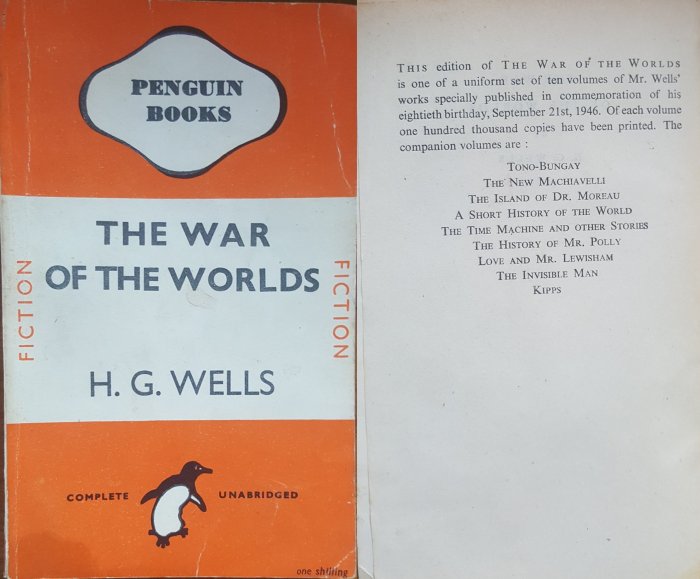
This time there were three titles reprinted as part of the set, A Short History of the World (Pelican A5 original May 1937), The Invisible Man (151 original August 1938), Kipps (335 original November 1941), with the remaining seven books being numbered 570 to 576 and coming out together in September 1946. Maybe these didn’t do as well as Penguin though they would as there was then a gap of a couple of years before they had another go and this time it was the sure fire winner Agatha Christie,

Published in August 1948, this time all ten books were new to Penguin so they had the consecutive numbers 682 to 691. Considering that a hundred thousand copies of each were printed Murder on the Orient Express as part of the Christie Million is surprising awkward to find and is probably the only book featured in this list that would be a real challenge to locate. Although tracking down some of the correct reprints for other titles can also be tricky, as they are rarely advertised as being part of their respective ‘millions’ when searching online but you can always tell if it is correct edition as it will have the page explaining about its part of the set.

Another eleven months passed and it was time for another crime writer to be featured, this time New Zealander Ngaio Marsh.
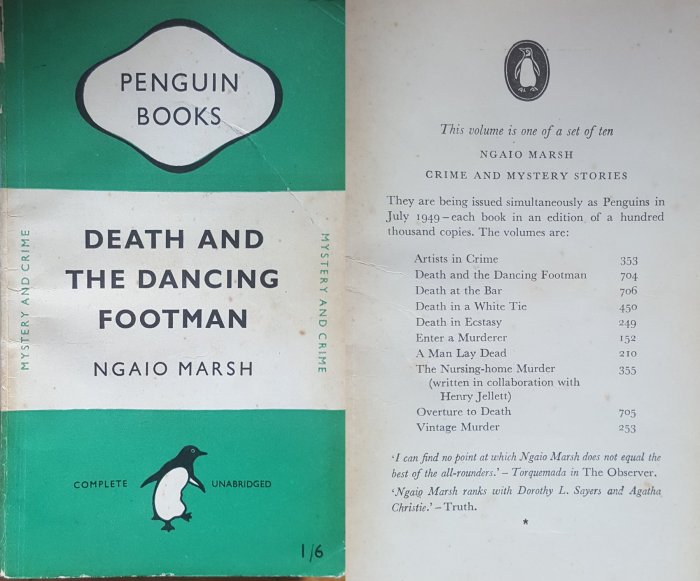
This time Penguin have made it easy for me and given the respective numbers in the Penguin catalogue in the listing. As you can see only three titles were new to Penguin (numbers 704 to 706 published July 1949) with the others going back as far as Enter a Murderer (152 – August 1938). This is where the financial advantage of collecting the ‘millions’ editions comes into its own as Death in a White Tie would sell for well over £500 and possibly getting on for £1000 as the March 1945 Penguin first edition whilst the reprint for the ‘million’ is only a few pounds. This reprint is also a Penguin oddity as the floor plan of the house where the murder took place is missing from this edition and was incorrectly included in 704 Death and the Dancing Footman. Both books are therefore somewhat confusing for readers, one for the lack of the diagram which makes placing the action more tricky, and the other for an included plan of a house that bears no relation to the plot.

The next million was in March 1950 and we leave the world of crime in favour of a somewhat more challenging read, D.H. Lawrence to mark the twentieth anniversary of his death.

As can be seen five of the books chosen were ‘double volumes’ marked with an asterisk in the list above, i.e. books of significant length and were therefore more expensive than the standard paperback at the time, which retailed at one shilling and sixpence (7½ pence), these longer books were two shillings and sixpence (12½ pence). Kangaroo for example is 594 pages. All of the books were first printings by Penguin nine of which are 751 to 759. The original plan was for 760 The White Peacock to be included in the ten books but production issues meant that this wasn’t ready for publication until August 1950 so the collection of poems (D11) was issued instead, which, along with the separate volumes of letters and essays, I think gives a wider overview of D.H. Lawrence’s work as part of this collection.

After the erudite literature of Lawrence it was back to crime for the next Penguin million. This time Margery Allingham in June 1950.
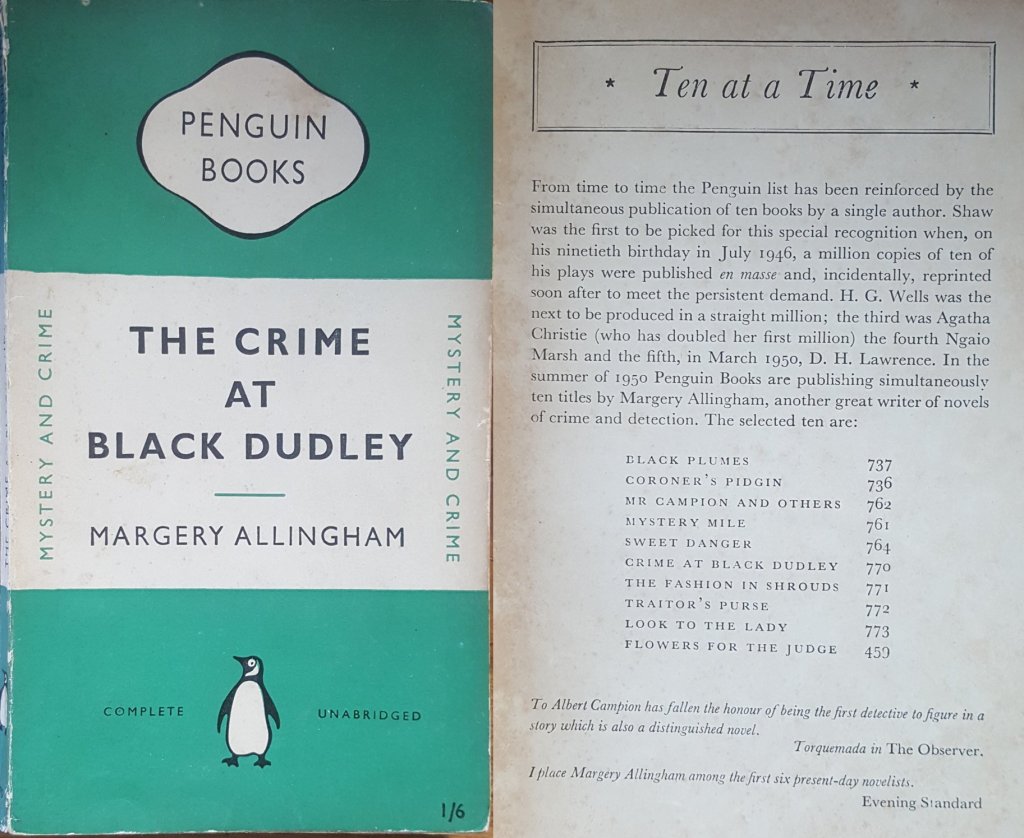
The only reprint is another wartime crime rarity 459 Flowers for the Judge (originally June 1944) all the others, despite the apparently random numbers, all first appeared as a UK Penguin in June 1950. The one oddity is 737 Black Plumes which had first been printed by Penguin USA Inc as number 534 in December 1943 and is another difficult to find wartime first Penguin printing, especially on this side of the Atlantic.

Next comes Evelyn Waugh whose ‘million’ came out in May 1951.

This time there are five titles new to Penguin (821 to 825) with five reprints Decline and Fall (January 1937), Vile Bodies (April 1938), Black Mischief (November 1938), Put out More Flags (October 1943) and Scoop (March 1944). There’s a nice potted bibliography along with the list of books in the listing. I’ve always quite liked Evelyn Waugh although he does seem to be a lot less well known nowadays. I also like the fact that his first wife, although only for one year as she had another relationship with John Heygate at the time, was also called Evelyn, just imagine the confusion when guests called.

We then start a run of three crime novelists before the ‘millions’ peter out and next comes Carter Dickson in June 1951.

Again we have ten new titles, consecutively numbered 811 to 820 and all by Carter Dickson, who also wrote under his real name John Dickson Carr as well as Carr Dickson and as a real wildcard once as Roger Fairbairn. Fortunately his ingenuity with plots is far better than his imagination with pseudonyms and the missing photograph on the back cover with it’s accompanying blurb regard anonymity fooled nobody. However regarding the use of the back cover here, I have had to do this as, due to a compilation error, all ten of the books actually have the Evelyn Waugh ‘millions’ description inside them instead of one for Carter Dickson. Almost all the books he wrote under the name Carter Dickson feature the elderly amateur detective and barrister Sir Henry Merrivale and that is certainly the case with the ten books in this collection. I personally prefer the Dr Gideon Fell stories he wrote under his actual name although that possibly because I came across him first. Each of these detectives have around a couple of dozen books dedicated to them and the Merrivale books certainly have much to recommend them.

The next million goes to Belgian George Simenon and his legendary detective Maigret and these were published in January 1952.

Simenon is invariably though of as French like his most famous creation Jules Maigret, as Penguin do so in the introduction above, and he did live for a lot of his life in France along with a decade or so in America after WWII. There are seventy five Maigret novels and numerous short stories but even the novels are quite short so Penguin tended to publish two per book. The collection came out as two blocks of numbers 826 to 830 and 855 to 858 which count for the nine new to UK Penguin Simenon titles in the ‘million’ there was also a reprint 739 A Battle of Nerves & At the ‘Gai-Moulin’ (originally January 1950). Yet again we have a book that was first printed in America as a Penguin Inc publication, Maigret Travels South which first appeared under the Penguin logo in New York as 564 (September 1945). The works of Simenon have a very chequered history with Penguin with many volumes being announced but never actually being published.

Where do you go after the classic Maigret novels well there can only be one choice and the only author to have multiple ‘millions’ it’s Agatha Christie again, this time in May 1953.

This time Agatha Christie chose the ten titles herself and oddly one of them had already appeared in the first Christie million so we have nine books (924 to 932) printed by arrangement with Collins which are first appearing in Penguin along with The Murder of Roger Ackroyd which had first been printed by Penguin as 684 in the first Christie million in August 1948. Technically all ten of these books are a first edition as each includes a new introduction written by Agatha Christie for this printing.

And that was it for the printing of ‘millions’ but there was one final addendum and that was for Arnold Bennett

This time there were only six books issued at the same time and no suggestion that a hundred thousand copies of each were being printed. Two were reprints Anna of the Five Towns (33, March 1936) and The Grand Babylon Hotel (176, November 1938) along with four that were new to Penguin (996 to 999) and as can be seen there were various issues with copyrights in Canada and the USA.

So where does that selection of eleven sets of publications within the first thousand bring us, well there are 106 (105 if you don’t want Roger Ackroyd twice) books to search for, eleven largely readable authors, both Bennett and Shaw I have to be in the mood for, and a pretty decent fiction library from the end of the 19th century through the first half of the 20th. Plenty of easy reading crime and other novels with some more taxing works but none that should put off a dedicated reader. It is also a manageable task to accumulate all of these without the bank account straining issues that can face a collector of a complete numeric run. I have been collecting Penguin for over thirty years, although I only really started taking the main series seriously in the last dozen or so as I mainly concentrated on the more obscure aspects of their output. But I’m still missing fourteen books out of the first six hundred even after twelve years and I’m only very very slowly filling in the gaps.

There are many more blocks of books by one author after number 1000, but as I don’t collect them I cannot pull them off the shelves to check to see if any of these are designated as ‘millions’. Examples include six books by Aldous Huxley numbered 1047 to 1052 published in April 1955, eight books by C.S. Forester numbered 1112 to 1119 published in January 1956 (1111 is also by Forester but came out two months earlier), and nine books by John Buchan numbered 1130 to 1138 which were published in May 1956. Maybe collecting the ‘millions’ is the way ahead.

The First Penguin Handbooks

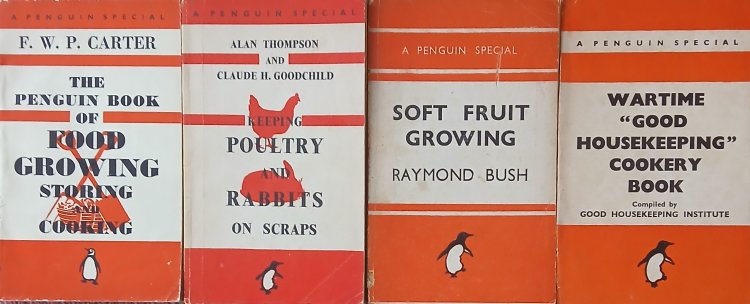
Last week saw the fiftieth anniversary of the end of the Vietnam War and this week sees the eightieth anniversary of VE Day, the end of the Second World War in Europe, as this post goes live on the 6th May 2025 two days before VE Day itself. Whilst last week I read Felix Greene’s excellent summary of the first half of the Vietnam War, this week I’m looking at eight books produced as part of the Penguin Specials series which were designed to help the population feed themselves during a time of food shortages and rationing. Penguin Specials were intended to be books dealing with issues of the day and they had rapidly multiplied during WWII with such titles as ‘Aircraft Recognition’, ‘Nazis in Norway’, ‘How Russia Prepared’, ‘Signalling for the Home Guard’ etc. The books were produced far quicker than titles in the other Penguin Series so that they were relevant to the issues of the day, but before the designation of some of them as handbooks there had also been some concerned with making best use of the food supplies however these were in the more usual red covers for Specials. These included ‘S90 The Penguin Book of Food Growing, Storing and Cooking’ (May 1941), ‘S101 Keeping Poultry and Rabbits on Scraps’ (January 1942), ‘S119 Soft Fruit Growing’ (December 1942) and ‘S127 Wartime Good Housekeeping Cookery Book’ (February 1943).

The dates shown below for most of these handbooks may seem quite late in the war for those of us born after the end of shortages and rationing, but it should be noted that general rationing in the UK continued until July 1954 although some items such as bread (1948) did come off rationing before then.

S132 Tree Fruit Growing – Apples – December 1943

Raymond Bush had already written one book for Penguin, as can be seen above, but the two handbooks detailing tree fruit growing took us to his main speciality which he had adopted following a bad accident in 1914 and being advised that an outdoor life would be better for his health than the poster design his company had been doing prior to the First World War. He was a commercial grower from 1915 up until 1935 when he started advisory work on the subject for various scientific committees. The book is a wide ranging guide to growing apple trees with notes where similar methods are appropriate for other fruits such as pears and almost a third of the book is dedicated to pests and how to get rid of them, but it is based on Bush’s determination that the wartime population should not be derived of wholesome fruit. As he says in his introduction “Well my amateur friends, once again you must sit back and watch the Ministry of Food collect most of the fruit to make jam go several times as far as it has any rights to go by the judicious addition of apple pulp, swedes, mangolds and what not. That is unless you grow your own fruit and make your own jam.”

S137 Preserves for all Occasions – April 1944

This book admits that it will soon become out of date as ingredients become more available after the war ut nevertheless it provide a lot of useful information on the varying ways of preserving food. Not just the expected jams and chutneys but syrups, bottling means of drying fruit, vegetables and herbs and how to store fresh produce for the longest time. Unlike other books on preserving that I own it doesn’t include recipes but instead concentrates on good techniques and means of avoiding common mistakes.

S138 Tree Fruit Growing – Pears, Quinces and Stone Fruits – December 1943

Volume 2 of Tree Fruit Growing concentrates much more on the individual varieties of a wider range of crops than I was expecting. I hadn’t realised that almonds were not true nuts but were in fact relative of the plum and peach where we eat the seed and discard the rest as a direct opposite to the two fruits. Bush admits to not having grown them himself and struggled to find any information but put together what he could. There is also a section on laying out an orchard and a substantial chapter on bees at the end along with the inevitable chapter on spraying for pests, a subject clearly on Bush’s mind a lot.

S140 Rabbit Farming – June 1944

Inspired by the success of ‘S101 Keeping Poultry and Rabbits on Scraps’ which as Goodchild explains in the introduction to this book was “giving all the practical hints I knew on rabbit keeping under wartime conditions in order that many newcomers could make a success of rabbit meat production”. This book on rabbit farming is however a very different work as it is aimed at a larger scale operation and includes use of the fur in coats and other clothes necessary to make a living from the business. Goodchild himself came from a long line of farmers and along with his partner ran the largest rabbit farm in England producing not just meat but from it’s manufacturing division coats, gloves and other assorted fur products. The photographs, presumably taken at his site near Crawley in south east England, show an extensive operation which must have been very useful to wartime food and clothing supplies.

S144 Poultry Farming – May 1945

The second of the books split off from ‘S101 Keeping Poultry and Rabbits on Scraps’ took almost a year longer to write than the first. Alan Thompson was amongst other things the editor of the monthly magazine ‘The Poultry Farmer’ which had started in 1874 as ‘The Fanciers Gazette’ and was eventually bought by the publishers of ‘Poultry World’ in 1968, so he was ideally suited to write the book. The book is not aimed at people wanting to keep a handful of chickens in their garden or allotment which was the point of S101 but instead those planning to run a commercial operation and early on mentions a figure of £2,000 (£73,500 in today’s money) for initial outlay if you want to have a hope of making a success of such a venture. The book goes into considerable detail not only on housing and selecting your chickens but also the finances of such an operation with several pages of photographs along with many line drawings to illustrate various points. My copy has clearly been well used.

S145 Trees, Shrubs and How to Grow Them – January 1945

Uniquely in this collection of eight books we have a title not covering food preparation or production and it is also, for me anyway, the least interesting of the titles. It goes into considerable detail about the various trees and shrubs in the UK, with guides as to what to plant and where, such as hedgerows and because Rowe is trying to impart so much information in a book just short of two hundred pages it is not particularly readable. That’s not to say it isn’t useful but just not for the general reader.

S146 The Vegetable Growers Handbook – Volume 1 – May 1945

All the other handbooks were commissioned by Penguin especially for this series and my copies are therefore true first editions whilst S146 and S147 are first editions in Penguin. The Vegetable Growers Handbook by civil servant Arthur J Simons however had first appeared in 1941 published by Bakers Nurseries Ltd of Codsall, Wolverhampton. Simons had written it during a period of quarantine he had undergone after contracting “a succession of childish but contagious diseases during the air raids”. In it you learn the basics of preparing the ground, improving the soil, using manure, compost and chemical fertilisers and this takes up the first third of the book. You then progress on what to grow, how to sow the seeds and raise the plants successfully initially in open ground and then a short section on using greenhouses and frames before a final chapter on pests and diseases and what to do about them. All in all a pretty comprehensive guide and I’m sure customers of Bakers Nurseries found it very useful.

S147 The Vegetable Growers Handbook – Volume 2 – May 1945

The second volume doesn’t have a first published date, but it doesn’t appear to be a Penguin original so I’m guessing this also first appeared from Bakers Nurseries. This volume deals specifically with the various crops you can grow, when to sow them and how to ensure a long cropping season with various vegetables ripening throughout many months. Like the first volume there are suggested plans for gardens or allotments to make maximum use of the space without wastage from gluts in certain weeks. Simons refers to letters he received after the first volume with suggestions which prompted this second book and despite the focus on wartime household needs these two books would even now be useful for a keen vegetable grower.

After the war it was decided to create a series of its own called Penguin Handbooks, the first new title of which was The Penguin Handyman which came out in November 1945 and was assigned the number PH9 with the obvious intention to move the existing eight books into this new series, however it all became more complicated than that, as it often does with Penguin Books. In fact PH1 is a 1945 reprint of ‘S119 Soft Fruit Growing’ but in the green cover of Penguin Handbooks rather than its original red. PH2 was assigned to the reprinted ‘S132 Tree Fruit Growing – Apples’ and PH3 became the reprint of ‘S138 Tree Fruit Growing – Pears, Quinces and Stone Fruits’, both of which are covered above and these would ultimately be combined into a single volume ‘PH83 Tree Fruit Growing’ in September 1962.

Despite the assumed plan of simply renumbering the existing handbooks into the gap left at the beginning of the new series we already have one book which hadn’t previously been issued as a handbook and just two of the originals occupying the first three numbers and this gets worse as numbers PH4 and PH5 were not in the end used and neither was PH8. This leaves just two numbers PH6 which became a reprint of ‘S145 Trees and Shrubs and How to Grow Them’ in 1951 and PH7 which combined S146 and S147 as the ‘Vegetable Grower’s Handbook’ in 1948.

Oddly ‘S137 Preserves for all Occasions’ did get reprinted as a ‘proper’ handbook as PH12 in July 1946, why they didn’t use one of the abandoned numbers I have no idea. ‘S140 Rabbit Farming’ and ‘S144 Poultry Farming’ were both discontinued in favour of their original base work ‘S101 Keeping Poultry and Rabbits on Scraps’ which came out as handbook PH14 in June 1949 making these two some of the most difficult to find Penguin Handbooks.

Collection du Vieux Chamois

I have recently managed to complete my collection of these sixteen children’s books, most of which were printed in 1947 in cooperation between Penguin Books in England and Fernand Nathan in France. The last two titles VC15 and VC16 are translations of books that originally came out in England in December 1947 and August 1948 respectively so presumably the French versions were later. After the war Penguin were keen to restart their international publications and came up with the plan of altering the text for a small number of Puffin Picture Books into French and printing them in England to avoid having to ship the lithographic plates abroad. This would still require a considerable amount of work to blank out the existing English text and replace it with a translation as the whole page is printed as one unit. This would therefore have been difficult enough but there were also some illustrations altered, some of which were done for obvious reasons others are more obscure.

The books were printed in editions of 20,000 copies per book and none appear to have been reprinted. In the intervening, almost eighty, years this relatively small production number along with the fragility of books consisting of eight folded sheets stapled down the centre making a thirty two page book meant that few have survived to the present day. Although they are a reasonably practical series of children’s books to collect and it has only taken me around five or six years to accumulate them all mainly from French second hand book dealers online. Interestingly none of the books mention who did the translation, presumably somebody at Fernand Nathan, or who made the alterations to the pictures, possibly the original artists. It is also somewhat ironic that the French translations were created, as one of the original inspirations for the Puffin Picture Book series was the French series ‘Albums du Pere Castor’.

I am indebted to the Penguin Collectors Society for their invaluable Checklist of Puffin Picture Books which includes a full listing of these books so that I could check each one as I obtained it, and the checklist is the source of a lot of the information in this blog. Whilst this book lists most of the differences between the English and French illustrations it doesn’t show the variations, so below I will do so as I think it is interesting to see just what cultural differences were picked up in the changes. Firstly let’s list the seven books where it is simply a text translation difference and as you will quickly spot there are several obvious title changes:

  • VC2 – Les Animaux de notre hémisphère – originally PP7 Animals of the Countryside
  • VC5 – Vacances a la Campagne – originally PP33 Country Holiday
  • VC7 – Les Abres de mon pays – originally PP31 Trees in Britain
  • VC9 – Merveilles de la Vie Animale – originally PP44 Wonders of Animal Life
  • VC10 – Comment Vivent les Plantes – originally PP58 The Story of Plant Life
  • VC13 – Les Chiens – originally PP56 Dogs
  • VC16 – La Péche et les Poissons – originally PP53 Fish and Fishing

Now let’s look at the ones with illustration changes which will also give you a chance to see how lovely this series of books are, either in the original 119 titles in English or these 16 in French:

VC1 – Les Oiseaux du village – originally PP20 Birds of the Village

This one is a mistake rather than a deliberate change, but page eight has a number of birds each identified in the adjacent text by a number. However in the French version the numbers within the illustration have been removed which makes the text meaningless. The alteration is omitted from the checklist which regards this book as a translation only.

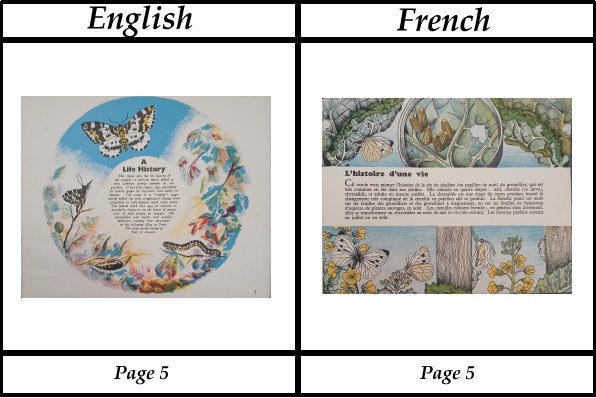
VC3 – Les Insectes – originally PP5 A Book of Insects

Two pages within this book are completely changed with totally new designs. The first one makes sense to change as the French text appears to be significantly longer than the English and therefore difficult to fit into the circular gap. The second one is less obvious why it was altered to a much more scientific form.

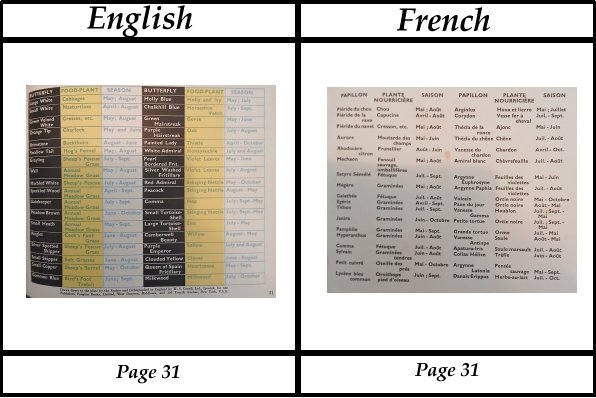
VC4 – Jolis Papillons – originally PP29 Butterflies in Britain

The change for this book is perfectly understandable as it is simply the table on the last page and changing all the text and replicating the original format is probably unnecessary. The deformation of the left hand side of the English text is simply because I didn’t want to force the page flat and possibly loosen the staples. This lack of formatting is not mentioned in the checklist which again regards this book as a translation only.

VC6 – A la Ferme – originally PP4 On the Farm

The biggest difference before the two versions is on the first page where the British farmer is replaced by a man more obviously at work.

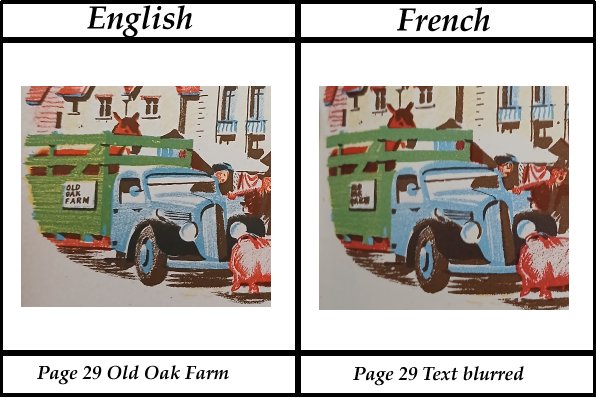
The other change is not included in the checklist and it is the amendment to the sign on the side of the lorry on the page dealing with going to the market, where the English text has simply been blurred out.

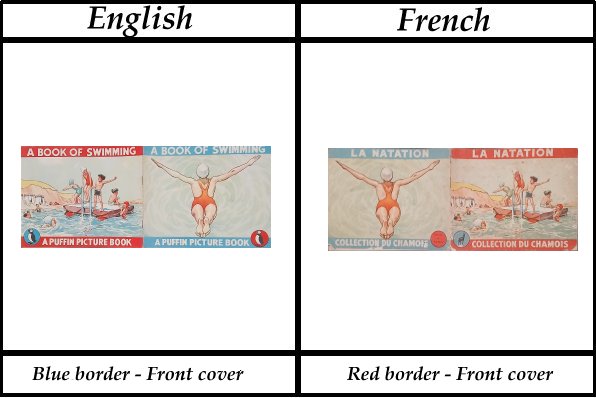
VC8 – La Natation – originally PP48 A Book of Swimming

Strangely this change isn’t in the checklist either although it is a pretty significant alteration, with the front and rear covers being transposed.

VC11 – L’Auto et son Moteur – originally PP38 About a Motor Car

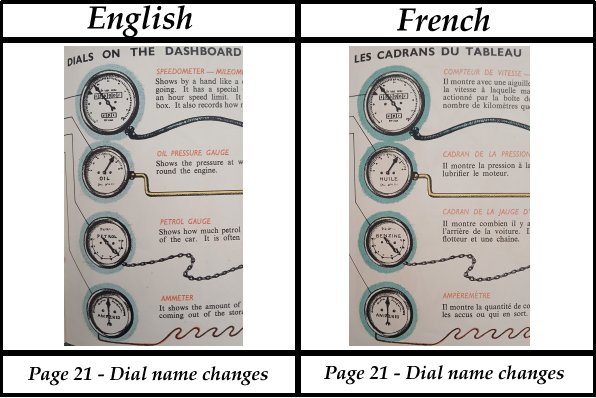
The two small changes to this book are so small that they were ignored by the checklist, the first one is quite amusing and is a text alteration on the middle page spread where in the English version after the word chassis it points out that this is a French word, quite rightly the French edition doesn’t bother with this explanation. The other change is shown below and is an amendment to the text on the gauges.

VC12 – Les Bateaux – originally PP11 A Book of Ships

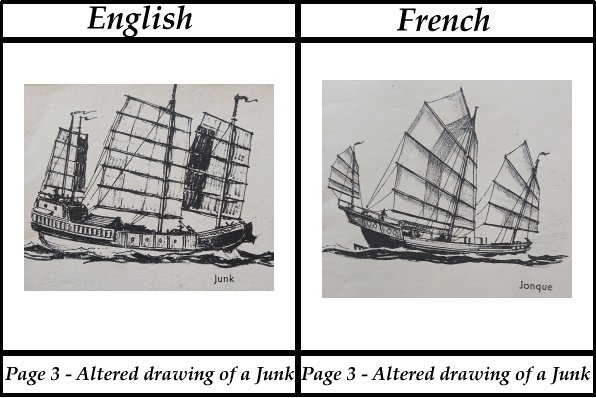
Now we get to the book with the most changes between the two versions, all of which are included in the checklist and we start on page three with a new drawing of a Chinese Junk.

The very next page has the British naval flag, the Red Ensign, altered to be unrecognisable in the French version. This also occurs on page 24 but I’ve just included the one example here.

Next comes a change of headgear between two sailors

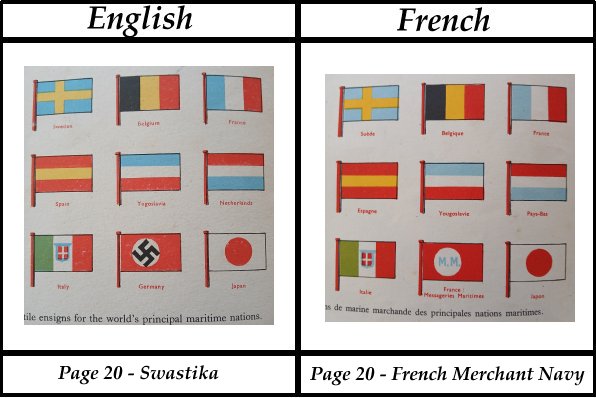
We then get a change that needed to be made from the original British edition, which was printed in June 1942, when the German flag would logically appear, to 1947 when it wouldn’t, or at least not in that form. The British book would be completely redesigned when it was reprinted in 1952 and no swastikas appear in that either.

Finally we come to page 27 where the illustration at the top of the page is reversed and indeed looks like it was completely redrawn.

VC14 – Les Merveilles du Charbon – originally PP49 The Magic of Coal

With this book only the front cover is amended to change both the helmet, the French version is more rounded and doesn’t have a lamp, and also the miner’s tattoo on his chest. This goes from St George and the dragon on the British miner to the symbol of France, the Gallic Rooster, in the French version. Whilst compiling this list I also realised for the first time that this book is slightly, but noticeably, larger than most of the other Puffin Picture Books or indeed the Vieux Chamois.

VC15 – Le Théatre – originally PP75 The Theatre at Work

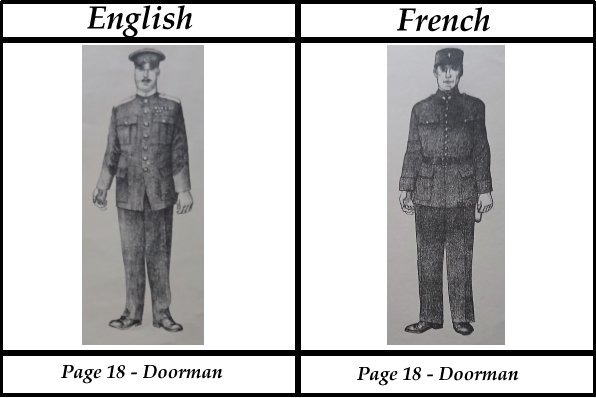
The final set of changes involve a couple of uniforms at the theatre both of which are in the checklist, firstly the doorman.

and finally the fireman who looks more prepared for disaster in the French version

That brings us to an end of this overview of the Vieux Chamois series, I’d love to know why they were called Old Chamois but I doubt that I’ll ever find out.

Penguin Marvel Classics collection

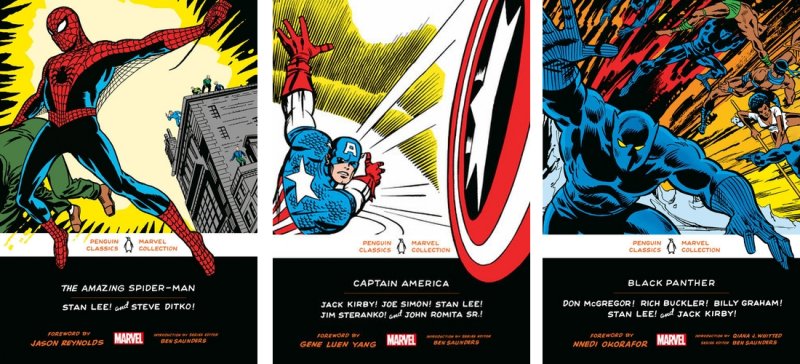
On the 14th June 2022 Penguin Books embarked on a new series of titles with three books each simultaneously printed in hardback and paperback. The paperbacks, as can be seen above, were designed to look like the current iteration of Penguin Classics but noticeably larger at 252mm tall and 180mm wide as opposed to the ‘normal’ size of Penguin Classics which are 198mm tall and 129mm wide. This larger size makes the reproduced comic books in each volume far more legible. The hardbacks are larger still at 272mm tall by 198mm wide, their covers are very different and have gold page edges on all three sides. The hardback covers are illustrated below as each book is discussed in this blog. It isn’t the size of the books that strikes the reader as different when you pick them up though, it’s the weight. At getting on for a kilo each for the paperbacks and even closer to two kilos for the hardbacks, this is due to the high quality paper used in order to do justice to the full colour pages throughout the almost four hundred pages making up each book, these are clearly not books for reading in bed.

All the books have the same introduction to the new collection as shown below:

It’s an interesting idea to class early Marvel comics as Penguin Classics, after all that series concept began in 1946 and 1947 with translations of Homer’s Odyssey, Guy de Maupassant’s short stories, Sophocles’ The Theban plays and Voltaire’s Candide in the first two years, quite what E V Rieu (the original series editor) would have made of these comic books appearing in Penguin Classics can only be surmised but it probably wouldn’t have been positive. Having said that, the introductory essays do indeed set the comic art in it’s historical and cultural context so at least some attempt to hold to Rieu’s principles for the series has been made.

The Amazing Spider-man

I was interested to see how these editions differed from the Folio Society curated volumes currently being produced, see their Spider-Man launch video here. Penguin have gone for a very different approach to their selection of comics to the Folio Society as with Penguin you get an almost contiguous run of early comics rather than a selection over the years by former Marvel editor Roy Thomas which is Folio’s take on the subject. So in this volume you get Spider-Man’s first appearance in Amazing Fantasy number 15 (August 1962) followed by the first four comics from The Amazing Spider-Man (March to September 1963). There then follows an essay about the characters development which also discusses comics five to eight and then the reproductions of the full comics continues with The Amazing Spider-Man comics nine and ten before another essay replacing issues then more reproductions and so on until the last comic included which is number nineteen from December 1964 by which time there have been twelve full reproductions. I actually really liked this way of doing it because at least you can follow story development rather than the more bitty Folio treatment and the three appendixes dealing with further aspects were really interesting as was the volume introduction by Ben Saunders. What you miss with the Penguin version rather than the Folio edition is a feel for where the character is going over the subsequent years however these are Penguin Classics after all so we should be looking at the early version of the character and even the hardbacks, at £40 are less than half the £95 of the Folio Society version.

Captain America

Captain America takes a similar way of selecting comics but with one major difference to the Spider-Man volume as although we get a reproduction of Captain America number one (March 1941) the rest of his largely propaganda driven World War II comic book stories are skipped. Because we get number one though we do at least get the famous cover illustration of Captain America punching Adolf Hitler. Instead we leap to Tales of Suspense number fifty nine (November 1964) and take the Captain from his relaunch including Tales of Suspense number sixty three (March 1965) which tells the origin story of Captain America. This had to be done as an entire generation had grown up without the character so who was this guy in the stars and stripes outfit? There are in total twenty two partial or complete reproductions of the comics, all but the first being Tales of Suspense which tended to have two, or more, separate stories in each edition and only the Captain America parts are reproduced here and he also didn’t appear in every edition so the last one included is number 113 (May 1969). Again unlike the Folio Society version we are focusing on one period of the characters existence rather than a more rounded overview and we also get essays that cover comics not included and provide more developmental background.

Black Panther

Unlike the other two, Black Panther originally appeared in another series entirely and has The Fantastic Four visiting Wakanda, home of The Black Panther, at his invitation only for him to launch an unexpected attack on them. This takes place in Fantastic Four numbers fifty two and fifty three (July and August 1966 respectively) both of which are in this volume. Despite the initially unfriendly approach, Black Panther and the Fantastic Four end up joining forces to attack an enemy of Wakanda and them ultimately encouraging him to continue fighting for good as Black Panther. We then leap to his next appearance, which is Jungle Action number six (September 1973) and have an uninterrupted series of comics from there to Jungle Action number twenty one (May 1976) this time with no explanatory essays replacing the comics. The appendices are very different as well, this time we get the essay written by Don McGregor as his introduction to Marvel Masterworks: Black Panther volume one and the typewritten plot synopsis originally created for Jungle Action number seven also by McGregor. This is a very interesting document as it shows how stories were developed before any artwork had been started.

The first three volumes of the Penguin Marvel Classics collection are excellent and anyone interested in comic books or the booming graphic novel market should seek them out.

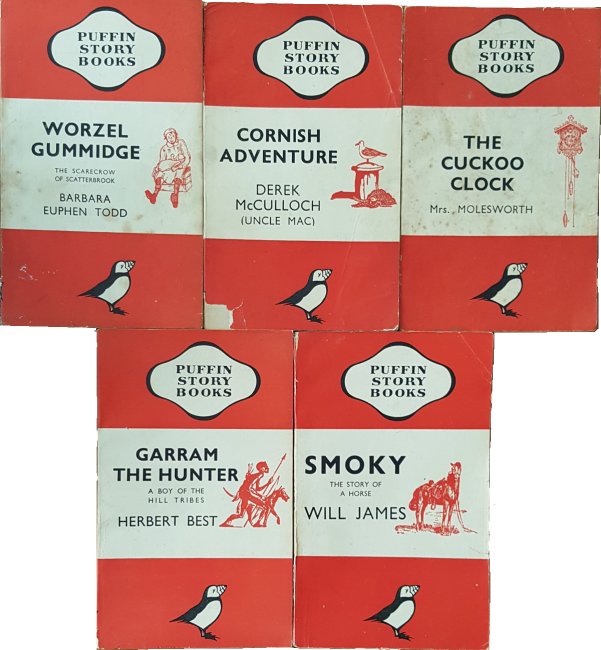
Puffin Story Books – the beginning

I somehow missed the eightieth anniversary of the start of Puffin Books last month as they launched in December 1941 but let’s somewhat belatedly look at how this massively important children’s imprint from Penguin Books started with five books, Worzel Gummidge, Cornish Adventure, The Cuckoo Clock, Garram the Hunter and Smoky and I have to say that the only one of these to have stood the test of time is Worzel Gummidge by Barbara Euphan Todd. I do have first editions of the Puffin books for all five so let’s take them in turn, starting each description with a quote from the title page where there is a brief introduction to the book.

Worzel Gummidge – Barbara Euphan Todd

This clever, fantastic story of the mysterious scarecrow who – when the mood took him – came to life and engaged in the funniest, and most alarming adventures, has become universally popular since the B.B.C. gave it to a wide and enthusiastic public.

The reference to the B.B.C. adaptation was a serialisation of the radio during Children’s Hour before the start of WWII and this was to just be the first of many adaptations that the book and its sequels have had over the years. I clearly remember the television version from 1979 to 1981 starring Jon Pertwee on ITV and there is a new TV adaptation running on the B.B.C. which started in 2019 starring Mackenzie Crook, which although I haven’t seen is introducing the character to a whole new generation. In the book two children, John and Susan, come to stay at the farm where Worzel is one of the scarecrows and start getting into all sorts of trouble as they are the only ones who see him move around and do things so they keep getting blamed for what he does. It’s a good story and you can see why Barbara Euphan Todd wrote nine sequels as Worzel Gummidge grew into a much loved character.

The book was first printed in 1936 and the Puffin edition is the first paperback, it is illustrated by Elizabeth Alldridge

Cornish Adventure – Derek McCulloch (Uncle Mac)

The setting, of small village, rocky cove and smuggler’s cave, is ideal for the plot that develops. The mystery breaks into the peaceful picture as the boy sails home on August morning with his fisherman friends

Derek McCulloch was best known as Uncle Mac on BBC radio where he presented Children’s Hour for seventeen years from 1933 but was also head of children’s broadcasting for the corporation throughout that time so would have been extremely familiar to his readers. It’s a classic children’s adventure yarn along the lines of Enid Blyton’s Secret Seven or Famous Five stories although these appeared much later than Cornish Adventure. ‘The boy’ referred to in the introduction is Clem and he is fifteen and has been coming to Cornwall through the summer holidays for the last five years and has got to know the local people over that time. He was out with a couple of fishermen collecting the crab pots when he spotted a dinghy going into a cave in the cliffs where they had never seen anyone before, what were the people doing there? Clem is determined to find out especially after swimming into the cave and finding it went back quite a way in the dark but he didn’t see the dinghy or the men.

The book is illustrated with drawings based on McCulloch’s own photographs but the artist who turned them into simple line drawings is not identified, it was first published in 1937.

The Cuckoo Clock – Mrs Molesworth

Griselda was only a little girl when her mother died, and she went to live in a big house with two great-aunts… She might have been lonely but for the cuckoo in the clock.

First published in 1877 and to my surprise still in print although no longer with Puffin, this book is definitely aimed at the younger reader; Griselda’s age isn’t given in the book but I’d guess at six or seven and Phil, the boy she meets near the end, is even younger and it is reasonable to assume that the target audience is around the same age as the protagonist in this case. Despite that it was a fun read with Griselda making friends with the cuckoo in the clock in scenes that could be interpreted as dreams except for the small invasions into real life afterwards such as finding the shoe from the land of the nodding mandarins in her bed (a large oriental cabinet in the room by the cuckoo clock turns out to be a gateway to where the carved figure live) or getting a message to Phil that she won’t be able to meet him the next day. The book is illustrated with several charming drawings by C E Brock.

Garram the Hunter – Herbert Best

Garram the boy is a fine vigorous character, cool-headed, bold and resolute, a skilful hunter, calculating his chances well and leaping swiftly into action. His adventures are lively and sometimes terrifying.

I probably enjoyed this book the most of the five I have read this week so it’s a disappointment to find that unlike the others it is long out of print with the Puffin version being the last I can find. Garram is the son of the chief of his tribe and is falsely accused of stealing and selling goats from one of the village elders by a rival for his fathers position. He manages to prove that the goats were in fact taken by a huge leopard but although this saves him at the time his enemy Sura continues to plot against both his father and him. Ultimately he is persuaded by The Rainmaker of the tribe to leave in order to protect his father as Sura would then fear his return as an adult to avenge any attack and so begins his adventures in lands beyond his tribes domain heading for the famous walled town of Yelwa, which is a real place, and where Garram would make his career before returning to his tribe and defeating his fathers rivals years later.

Despite being an American Herbert Best worked as an administrative officer for the British Civil Service in Nigeria and published several children’s books. First published in 1930, Garram the Hunter was shortlisted for the Newbery prize in 1931, the Puffin edition is illustrated with lino-cuts by Erick Berry which were ‘made on the spot’ so presumably in Nigeria and are the same as those in the hardback first edition rather than new illustrations for the Puffin book.

Smoky – Will James

Smoky is the story of a wild horse, told with exceptional vividness. It is also a real hot cowboy yarn, a grand adventure story told by a man who had lived in the saddle almost since infancy.

Well with an introduction like that who could fail to be intrigued? It is at many times a sad and yet ultimately fulfilling tale as Clint, who first trains Smoky after capturing him as a wild horse loses him to a horse thief. Smoky however, whilst perfectly obedient to Clint, will not allow the thief to ride him and is beaten repeatedly until eventually he lashes out and kills the thief. So begins his next life as an un-rideable bronco horse under the name of Cougar which eventually leads to career ending injuries. Sold off, this time as Cloudy he end up with yet another abusive owner who neglects and starves him before being spotted and recognised by Clint who eventually gets him back and nurses him back to health and a quiet retirement. Yeesh it was a hard read for a lot of the time.

Smoky is illustrated by the author although he isn’t credited in the book and it is easily the longest of the books in this set of five at 192 pages. Smoky won the Newbery medal for American children’s literature in 1927, a year after the book was first published, much to the surprise of Will James who considered it a book for adults, probably assuming the hard life Smoky has to be too upsetting for a younger readership.

Eleanor Graham was the series editor for Puffin Books from 1941, when they started, through to 1961 when she retired and was replaced by Kaye Webb. She did a remarkable job, especially dealing with paper rationing during the war and then building the imprint once paper started to become more available in the early 1950’s and adding titles such as Heidi, The Borrowers stories by Mary Norton and the first Moomin book. Webb inherited a series which by then ran to 150 titles which she was to vastly expand during her time in control including creating the Puffin Club and its associated annuals.

Folio Society Poetry Miniatures

20200915 Folio Miniature Poetry

Starting in 1991 the Folio Society introduced a short series of miniature books of poetry. This was back in the day when the society operated as membership scheme and to retain your membership you had to buy four books a year, you would also receive a free book each year you renewed your membership which was that years presentation volume. As an extra incentive to buy all your books in one go at the start of the membership year they would sometimes have an extra gift which was often available to buy in the annual collection and would only be on offer for free for a month or so; these books were that extra offer in the 1990’s. Obviously it made sense to get as much income as possible early on as the costs of publishing had been incurred and for cash flow reasons you need to offset that cost as quickly as possible as soon as a collection was announced so these books were an extra incentive to get that order in early. The books are bound in moire silk on boards and illustrated with wood engravings by various artists, they are roughly the same size although they vary slightly and they also all have gold coloured card slipcases.

1991 The Lady of Shalott – Alfred Lord Tennyson

20200915 Folio Miniature Poetry 1

This edition simply consists of one of Tennyson’s best known poems beautifully printed with five wood engravings by Howard Phipps.The poem is a retelling of one of the Arthurian legends about the Lady of Shalott who whilst imprisoned in a tower up river from Camelot is cursed never to look out of the window. Unfortunately she sees Sir Lancelot in the reflection of a mirror and is drawn to the window to see him better. Leaving the tower the curse befalls her and she dies in a boat heading to Camelot. The version used is the 1842 revision which makes it less clear than the original 1833 version that she knew she would die if she left the tower and therefore was effectively committing suicide by doing so as this was very much against Victorian morality.

The book was reprinted in 1993, with this volume being the only one to have a second edition apart from the final book in the series.

Printed by The Bath Press and bound by Hunter and Foulis – Size 116 x 83 x 8mm, typeface 9 point Monotype Ehrhardt

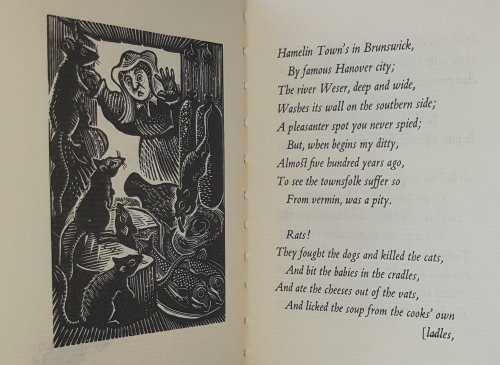
1992 The Pied Piper of Hamelin – Robert Browning

20200915 Folio Miniature Poetry 2

I must admit that until I owned this book I hadn’t realised that Browning wrote a version of the Pied Piper story, it had completely passed me by, in common with the rest of the series of books it is illustrated with lovely wood engravings, this time six of them by John Lawrence. For the most part the poem covers the most common version of the story although here the piper leads the children away immediately after he is cheated out of his payment for removing the rats and the townspeople are magically immobile so cannot prevent him doing so rather than returning later as I had read in an alternate telling. It also has a ending where instead of the children being led into the magical cave and never being seen again they do reappear but in Transylvania rather than Germany.

Printed by The Bath Press and bound by Hunter and Foulis – Size 116 x 85 x 7mm, typeface 9 point Monotype Blado

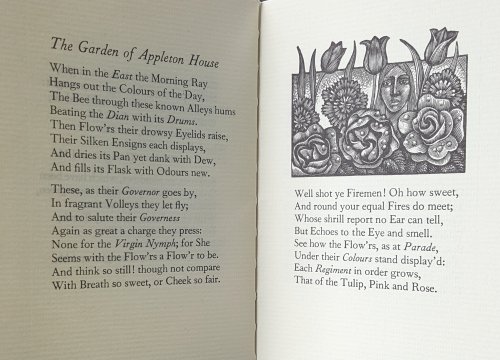
1993 The Garden & Other Poems – Andrew Marvell

20200915 Folio Miniature Poetry 3

Andrew Marvell is the earliest of the featured poets in these little books as he was writing from the mid 1630’s onward and was a friend of John Milton. Along with ‘The Garden’ there are seven other poems, ‘The Picture of little T.C. in a Prospect of Flowers’, ‘The Mower Against Gardens’, ‘Damon the Mower’, ‘The Mower to the Glow-worms’, ‘The Mower’s Song’, ‘The Garden of Appleton House’ and probably his most famous work ‘To His Coy Mistress’, these are accompanied by nine wood engravings by Harry Brockway. The four Mower poems comprise a set covering the four seasons in a meadow and the man who works it, the first is dismissive of gardens planted by man in imitation of nature when all around him in his meadows there is beauty. ‘To His Coy Mistress’ doesn’t really fit in with the other works but due to its fame I can see why it was included at the end.

Printed by The Bath Press and bound by Hunter and Foulis – Size 115 x 85 x 7mm, typeface 9 point Monotype Fourmer

1994 Sir Patrick Spens & Other Ballads

20200915 Folio Miniature Poetry 4

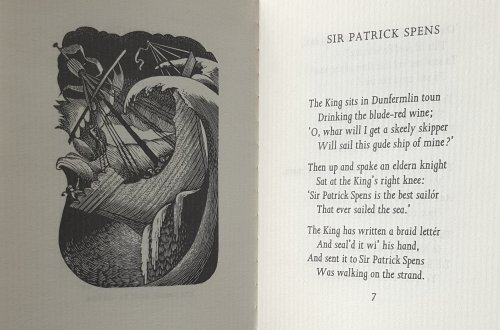
We are going back even further than Marvell in this collection of four old Scottish ballads illustrated with five wood engravings by Jane Lydbury but in this case no authors are known and there are multiple variants known of each of them. The versions chosen appear to be from the anthology by Francis James Child first published in 1860 but this isn’t confirmed in the book as no source is given for any of them. Apart from ‘Sir Patrick Spens’, there is ‘The Battle of Otterbourne’, ‘The Demon Lover’ and ‘Waly, Waly’, the final page consists of a useful glossary of the Scots dialect words used. As befits ballads these are best appreciated spoken out loud and I found myself doing just that whilst reading the book. If it wasn’t for the 1995 offering this would probably be my favourite book in the series.

Printed and bound by Mandarin Offset – Size 117 x 86 x 8mm, typeface 9 point Monotype Joanna

1995 The Raven – Edgar Allan Poe

20200915 Folio Miniature Poetry 5

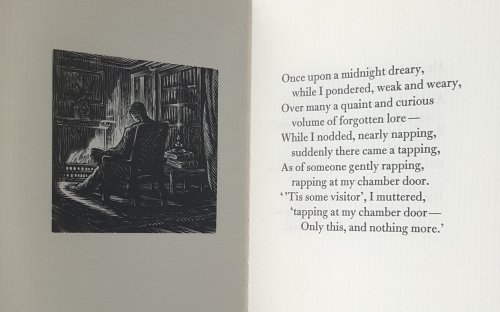
My personal favourite of these short works is this one and it is of course bound in black to honour The Raven and contains seven wood engravings by George Tute. I fell in love with this poem many decades ago, the rhythm of the words as you read them, again like the book of ballads this is best done out loud, drew me in at an early age and I visited the one surviving home of his in Philadelphia in the mid 1980’s when it was basically just an empty property. It still has no furniture in it but from the website it appears to have more going on there than thirty five years ago. The place being empty made me think of The Raven for some reason as you could imagine a man alone in the rooms at midnight being visited by that dark and terrible bird with it’s single word vocabulary that struck terror into the night.

Quoth the Raven, ‘Nevermore’

Printed and bound by Mandarin Offset – Size 117 x 85 x 7mm, typeface 10 point Monotype Bulmer

1996 Fifty Folio Epigrams – edited by Sue Bradbury

20200915 Folio Miniature Poetry 6

A distinct oddity in a series of poetry books, quite a few of the epigrams are taken from larger works but some, like the example by Max Beerbohm shown above are simply pithy quotes, the number of illustrations has also shot up from the earlier books and there are now eighteen wood engravings by Peter Forster. The collection is edited by Sue Bradbury who was Editorial Director at The Folio Society for many years and varies from Confucius to Dorothy Parker via Sophocles and W.C. Fields amongst many others. The Shakespeare quote by the way is from Richard II, Act 4, Scene 1.

Printed by BAS Printers and bound by Hunter and Foulis – Size 117 x 86 x 7mm, typeface 10 point Monotype Baskerville

1997 Fifty Folio Love Poems – edited by Sue Bradbury

20200915 Folio Miniature Poetry 7

This collection is also edited by Sue Bradbury and none of the selections are longer than a page, along with them are thirty two wood engravings by Simon Brett, one of which is repeated. The selection must have been popular because it became the only the second of these little volumes to be reprinted, in this case in 1997. Shakespeare and The Bible are of course included along with that particularly prolific author Anon. I was particularly pleased to find in Budapest a statute to Anonymous in recognition of his or her massive contribution to literature. Some are deep and passionate but there are also funny ones to offset the seriousness.

Printed by The Burlington Press and bound by Hunter and Foulis – Size 116 x 84 x 8mm, typeface 11 point Monotype Van Dijck italic

The bibliographic details at the end of each entry above are taken from Folio 60 which is the most recent of the bibliography volumes produced by the Folio Society and which was printed in 2007.

Penguin Science Survey

I recently completed my collection of this interesting series, some of which are surprisingly difficult to find, so I thought it was time to review the fifteen books that make the set and the history of how they came to exist. Although they were all published in the 1960’s their genesis was back in the 1940’s with two ‘quarterly’ periodicals also published by Penguin; Science News which ran to fifty four volumes from June 1946 to March 1960 and New Biology which had thirty one volumes from July 1945 to January 1960. As you can see from the date ranges, although these were theoretically quarterly, in practice only Science News managed anything like a volume every three months, in fact there was a gap of nineteen months between New Biology 1 and volume 2. These books each contained various articles covering a wide range of scientific advances written by scientists at a level where the interested layman wouldn’t feel intimidated but detailed enough to be of interest to the scientific community. By 1960 though Penguin Books were getting out of the periodicals business, however there was still seen to be a need for something like Science News and New Biology so Penguin Science Survey was born the following year.

20191217 Penguin Science Survey 1

1961 The Specials

Science News and New Biology had their own series codes within Penguin Books but as those had come to an end a new home was needed. The logical place was within the Pelican imprint which was well established as the main factual part of Penguin Books output and the 1961 volumes were therefore planned to go there. Both books have the Pelican logo internally and volume 1 even has a number in the Pelican range A526 (which was re-assigned to The Living Brain by W. Grey Walter published August 1961) but for some reason very late in the day it was decided they should be Penguin Specials and came out as S193 and S194 in June 1961 in what looks like a hasty rebinding with laminated thin card covers unlike anything else from Penguin at the time.

Volume 1 replaced Science News and covers such diverse subjects as elementary particles, The US space plan, geophysics, the development of nuclear weapons and several other topics. Each article is around twenty pages long and there are a dozen in total along with a preface by the editor Arthur Garrett and a section on units and constants. Volume 2 is the equivalent of New Biology and has fifteen articles ranging from smoking and cancer of the lung (an article well ahead of its time), world food production, the life of viruses, the cockroach, the brain of the octopus, etc. again these are normally around twenty pages long each and there is also a preface by the joint editors S.A. Barnett and Anne McLaren. Both volumes also have numerous line drawings within the text and a section of black and white photographic plates in the middle of the book. Having created this template in these volumes it was largely stuck to for the following years.

20191217 Penguin Science Survey 4

1963 A new home

There were no editions in 1962 and when they re-appeared in February 1963 they were oddly assigned to be part of the ‘main series’ with catalogue numbers 1924 and 1925 where they shared space with novels, travelogues, biographies and plays, they had also become A and B rather than 1 and 2 although A continued to be the equivalent of Science News with B covering New Biology with the same editors as in 1961. Volume A has amongst its eleven main essays a good article on optical astronomy by Patrick Moore and a fascinating piece on computers subtitled a progress review where the author describes an amazing IBM machine that could store a massive 100 million characters; which is several orders of magnitude less than an average mobile phone today. Roughly half of volume B is taken up with a series of articles linked under the heading ‘Matters of Life and Death’ which cover chromosomes, contraception, malformations and family planning. Also included in the rest of the book is a piece on tissue transplantation which was still in its early days, along with eight other essays.

20191217 Penguin Science Survey 5

1964 and 1965 A short period of stability

These two years continued the pattern of 1963 with the same editors and a wide spread of subjects covered. The books are still in the ‘main series’, which is where they would remain, and are assigned the following catalogue numbers 2043 and 2044 (April 1964) along with 2225 and 2226 (April 1965).

In 1964 subjects included elementary particles, Soviet space research, adhesion and a quirky short article entitled ‘How discoveries are made: a plea for intuition’ all in volume A, whilst volume B has life on other planets, the origin of man, learning a birds language, communication in bees amongst many other essays. In 1965 part A is split into three sections: Physical Research including superconductivity (still very relevant today), the physics of the brain, and automated spacecraft of the US. The second section is entitled Industrial Applications of Science and has diverse subjects such as Diamonds in industry, rubber, and supersonic aircraft. The final part is entitled Communications and has just two articles, the communication of information, and science on radio. Part B bounces all over the place from mental images, athletic physique, homosexuality, tranquillisers, and the yeasts of wine to other subjects equally intriguing.

20191217 Penguin Science Survey 6

1966 A missing book and a new title

Any collector looking for Penguin Science Survey A from 1966 will search in vain because it was never published. B did come out in March as number 2467 and it was joined, the same month, by Penguin Technology Survey 1966 (number 2439) which covered some of the same ground as Survey A would have been expected to do, it is also edited by the regular Survey A editor Arthur Garrett. This book is probably the one that interests me most with essays on the impact of electrical engineering, new methods of printing, computer aided design (remember this is 1966 so really surprising to see what feels like a new technology in use over fifty years ago) and a look forward to nuclear fusion reactors (which is still the case) along with other subjects. Science Survey B has a new editor, Anthony Allison, but apart from that little has changed. Like Technology Survey the subjects feel up to date including the challenge of insecticide resistance, two articles on fighting virus infections by differing means, and several more on the effects of temperature in biology and medicine.

20191217 Penguin Science Survey 7

1967 And then there was three

Any thoughts that the 1966 Penguin Technology Survey was a re-branding of Survey A which wasn’t done very well and left Survey B stranded was dispelled this year by the existence of three titles 2640 Penguin Technology Survey 1967 (April), 2687 Penguin Science Survey 1967 Biology (July) and 2688 Penguin Science Survey 1967 Physical Sciences (also July). The renaming of the surveys was presumably to make it more obvious what they covered rather than A or B and the same editors continued from the previous year along with Nicholas Valéry who took over what used to be Survey A and was now Physical Sciences.

Technology Survey has a good article on technological advances in Japan, something we would all become familiar with over the following decades and there are also a couple of excellent essays on technology in medicine but my favourite has to be the last one which deals with the problems of naming things as technology advances and is entitled “Let’s make up the words as we go along”. The Biology Survey is subtitled The Biology of Sex and all fifteen essays are concerned with some aspect of this subject including four on sex in the insect world, a couple on mammals in general and others including anthropology, and the x-chromosome. With technology now in its own volume what was Survey A is more restricted in its subject matter but this means it can look deeper into specific areas, instead of one article on space science which was the most you got up until now there are three, this better reflects the 1960’s Space Age fascination. There are also pieces on solar energy, detecting underground nuclear explosions (also a hot topic at the time) and high energy physics.

20191217 Penguin Science Survey 8

1968 The last hurrah

Technology Survey only lasted for two volumes and was gone after 1967. 1968 would be the final year of the Penguin Science Survey. 2840 Penguin Science Survey 1968 Biology and 2841 Penguin Science Survey 1968 Physical Sciences finally hit the bookshelves in November and had the same editors as in 1967. As with the previous year the Biology volume took one overarching subject, in this case photobiology, and the twelve papers look at all aspects of the effect of light in biology. From photochemisty, through photosynthesis, to the impact of light in controlling flowers, and on to bioluminescence with plants and animals producing their own light there is lots to get into in this book. Finally comes Physical Sciences, there are ten articles in this volume and several of these are still major paths of investigation today such as the worlds weather, superconductors, controlled nuclear fusion, and life in the universe.

20191217 Penguin Science Survey 9

The other Surveys

Somebody at Penguin obviously thought that the Science Surveys were a good idea and decided to expand the concept because in April 1965 there appeared 2336 Penguin Survey of Business and Industry 1965 alongside 2337 Penguin Survey of the Social Sciences 1965. For the purposes of this article we can ignore the business book, as it doesn’t include the word Science in the title, other than to note that three more volumes were produced. Number 2528 in June 1966 was for 1966, number 2746 in July 1967 was for 1967 and oddly number 2882 in October 1968 was apparently for 1967-8. With four volumes the business series was considerably more successful than its fellow which proudly proclaimed on its back cover that it is “The first in a new series of annual surveys” but the Social Science ‘series’ in the end only had two volumes with the next, and final, edition being 2823 Penguin Social Sciences Survey 1968 coming out in October 1968 just in time for the whole Survey concept to be killed off.

Now I would be the first to say that I know little about the social sciences but some of the articles do look to be potentially quite interesting. In 1965 the book starts with ‘In Defence of Sociology’ which I feel is John Gould’s (the editor of both books) attempt to get his response as to why the book was produced in before anyone asked the question. But Trends and problems in Soviet studies sounds like a paper that could be written now and How small-scale societies change turns out to be quite a good study in social anthropology. I must admit however that Prolegomena to the study of British kinship had me reaching for a dictionary, it apparently means a preface so why not say so? Reading the article, or at least starting it,  confirms my initial opinion that the author was simply trying to show off, as the word choices are often unreasonably complex and make it virtually unreadable. The 1968 book does also have several very good papers, on the power of politics, armed forces and the political process, and the study of organisations being three that particularly drew my attention.

Conclusion

All properly written articles on science should finish with a summary of what we have learned and in this case I just want to stress how good these books are. As you can see from the selection of article titles I have picked out they are to some extent still relevant today and provide an interesting background to the development of modern science and technology. Apart from the 1963 volumes and 1965’s Social Sciences (by Josef Albers) the covers were all designed by F.H.K. Henrion which gives a pleasing consistency to the series, no designer is credited for the 1963 effort or 1967’s Technology Survey but that one at least also looks like his work.

The price more than doubled over the eight years from six shillings (30p) in 1961 to twelve shillings and sixpence (62½p) in 1968 and they were always considerably more expensive than other Penguin books at the time which probably helped with their demise. In 1968 a novel the same length as one of the surveys would have cost five shillings (25p) so less than half the price, the reason is probably down to the lower print runs for specialised titles so fewer being sold but equally the price must have put off a significant number of potential readers therefore contributing to the downward spiral of purchasers.

Search them out, they are worth looking for and when you do find them still only cost a few pounds.

Sherlock Holmes – Arthur Conan Doyle – 4

The final stage of my August reading marathon of the complete Sherlock Holmes stories by Sir Arthur Conan Doyle in an edition published by The Folio Society. The set consists of five volumes of short stories issued in 1993 and four volumes of novels which came out the following year. The series has a very attractive binding of an offset wrap around design on each book which makes the spines also display the image and appropriately the books are printed using the Baskerville font.

20190806 Sherlock Holmes 1

Two novels and fifty six short stories down, just two novels to go to complete the exercise

20190827 Sherlock Holmes 1

The Hound of the Baskervilles

As mentioned in last week’s blog “The Hound of the Baskervilles”  appeared in Strand magazine in August 1901 was serialised over the following eight months. Doyle did not intend this to be a reboot of the series and it is deliberately set before the ‘death’ of Holmes in “The Final Problem”. It appeared in book form in 1902 and the next year Doyle gave in to public pressure and ‘resurrected’ his most famous creation. The first two novels had disappointed me but this was an excellent adventure well told. In the many years, if not decades, since I last read it I had managed to completely forget the plot other than a vague memory of a luminous dog chasing people to their death so the solution was still a revelation to me.

It all starts with the arrival at Baker Street of Dr Mortimer, a country physician from Devon with the strange tale of a curse on the Baskerville family from the time of the English Civil War when Hugo Baskerville had kidnapped the beautiful daughter of a neighbour intending to force her to marry him. The maiden escapes and he sets off to hunt her across the moor having first offered his body and soul to the Devil if he could catch her. Catch her he did but with a tragic end as found by three of his friends who followed him.

The moon was shining bright upon the clearing, and there in the centre lay the unhappy maid where she had fallen, dead of fear and of fatigue. But it was not the sight of her body, nor yet was it that of the body of Hugo Baskerville lying near her, which raised the hair upon the heads of these three dare-devil roisterers, but it was that, standing over Hugo, and plucking at his throat, there stood a foul thing, a great, black beast, shaped like a hound, yet larger than any hound that ever mortal eye has rested upon. And even as they looked the thing tore the throat out of Hugo Baskerville, on which, as it turned its blazing eyes and dripping jaws upon them, the three shrieked with fear and rode for dear life, still screaming, across the moor. One, it is said, died that very night of what he had seen, and the other twain were but broken men for the rest of their days.
“Such is the tale, my sons, of the coming of the hound which is said to have plagued the family so sorely ever since.

Holmes is not interested in superstitious “fairy tales” and says so but Dr Mortimer does catch his attention when he says that the the most recent owner of Baskerville Hall had died of heart failure in the grounds and near the body was “the footprints of a gigantic hound!” There is but one remaining Baskerville to inherit the estate and he is to arrive in London from Canada that very day and Mortimer wants to know what to do. Hugo Baskerville duly arrives at Baker Street and the fact that he is clearly being followed by somebody and even more peculiarly has had two of his boots stolen on separate nights convinces Holmes that there is more to this case than superstition but apparently he is too busy in London to look into it in person so Watson will have to go.

All this happens in the first five chapters and for the next six (90 out of the 211 pages in my edition) the case is solely pursued by Watson and we get his reports back to Holmes along with extracts from his diary as the narrative. I really enjoyed the way Doyle wrote this, it was good to see Watson at work rather than just following Holmes and reporting on his actions. The addition of an escaped prisoner from the high security prison on the moor further complicates the tale and leads Watson down other tracks other than those immediately involved in the case in hand. The reappearance of Holmes in the story with just 59 pages to go is the signal for the various strands of the case that have been apparently heading off in various directions to be drawn together, even that of the convict is significant right until the end. It’s a great story, far better than the first two Holmes novels and makes me look forward all the more to the final book in this reading marathon.

20190827 Sherlock Holmes 2

The Valley of Fear

First serialised in The Strand Magazine between September 1914 and May 1915 “The Valley of Fear” was published in book form in February 1915 in America by George H Doran and in June that year the UK edition came out published by Smith, Elder and Co. this was the only time that the American edition preceded the UK one for any of the nine books.

OK at halfway through this book I felt a deep sense of disillusionment, here we are back to the worst aspects of the first two novels, lots of back story with no Holmes and Watson, in this case far worse than those books as over half the book is back story. But I persevered and I’m glad I did so because whilst it doesn’t involve our heroes it actually reads like a separate novella which includes a couple of the characters from the Sherlock novella making up the first half. The first part (99 pages in my edition) is an excellent Holmes and Watson tale which is complete in itself, there is no real need for the American adventure in part two other than to pad the story out to novel size. When read in the original serial I’m sure readers felt they were being short changed as the 107 pages (again my edition) that has no Holmes, but instead is a Pinkerton Detective Agency mystery, would have made up probably five months of the magazine.

The Holmes story is probably the closest Doyle gets to the classic ‘locked room mystery’ there is no obvious way for the culprit to escape as each possible solution is shot down by the ridiculousness of the events needed to affect such an escape. And there is also The Case of the Missing Dumbbell to solve! The mystery is maintained until the last few pages and it is an excellent place to finish my Holmes and Watson marathon; but it isn’t where it ends. There are still the 107 pages of Pinkerton and 3 pages of epilogue to go. Now I said at the start of this review that I wasn’t happy with the way the novel was split but unlike the first two novels, where it really did feel like padding, the non-Holmes story was actually very good and written (and consequently could be read) as a complete separate work. It also has to be said that I worked out who Jack McMurdo was, not just in his alias in this part of the book relating to the first, but also his real profession within a few pages so there was absolutely no surprise at the end. Neither was the epilogue unexpected as Professor Moriarty had been mentioned at the start so I was fully prepared for him to act at the end but I did really enjoy this story after I got past my initial disappointment.

This marathon reading of the Holmes and Watson books by Sir Arthur Conan Doyle has been great fun, some I have read within the last few years, others (like the two here) it has been decades since I last tackled them but I’m very glad I gave them all a go this month and I recommend anyone to dip into the stories and enjoy the evolution of one of the greatest fictional detectives.

Sherlock Holmes – Arthur Conan Doyle – 3

Part three of the reading marathon of the complete Sherlock Holmes stories by Sir Arthur Conan Doyle in an edition published by The Folio Society. The set consists of five volumes of short stories issued in 1993 and four volumes of novels which came out the following year. The series has a very attractive binding of an offset wrap around design on each book which makes the spines also display the image and appropriately the books are printed using the Baskerville font.

20190806 Sherlock Holmes 1

So far I have read the first two novels and the first two sets of short stories, this takes us up to the disappearance of Holmes in “The Final Problem” where Sherlock apparently fell to his death from the Reichenbach Falls whilst combating Professor Moriarty.  This had been printed in December 1893 and there the stories appeared to end. In August 1901 however a new Sherlock Holmes story appeared, although set before the events in “The Final Problem”; “The Hound of the Baskervilles” was serialised over the following eight months in the Strand magazine and by the end the clamour for more Holmes stories was irresistible regardless of how much Doyle claimed he didn’t want to write any more he had opened the floodgates and was swept along. Again there are minor spoilers below as it is difficult to review the stories without having them but no plot resolutions are included.

20190820 Sherlock Holmes 1

The Return of Sherlock Holmes

This consists of thirteen short stories originally printed in The Strand magazine between 1903 and 1904, the collection was first published in book form 1905 and the stories are as follows:

  • The Adventure of the Empty House
  • The Adventure of the Norwood Builder
  • The Adventure of the Dancing Men
  • The Adventure of the Solitary Cyclist
  • The Adventure of the Priory School
  • The Adventure of Black Peter
  • The Adventure of Charles Augustus Milverton
  • The Adventure of the Six Napoleons
  • The Adventure of the Three Students
  • The Adventure of the Golden Pince-Nez
  • The Adventure of the Missing Three-Quarter
  • The Adventure of the Abbey Grange
  • The Adventure of the Second Stain

Although Holmes had been away from print for eight years Dr. Watson makes it quite clear in “The Adventure of the Empty House” that he had actually vanished for just three years as this story is set in 1894. In this tale he explains his absence as he needed to be in hiding from members of Moriarty’s gang who wanted to avenge their leaders death, for indeed he had died in the incident at the falls at the end of the last book. To this end Holmes had been travelling the world, including a significant amount of time in Tibet in the guise of a Norwegian called Sigurdson. By the time he introduces himself to Watson again only one danger remains at large and he seeks assistance in dealing Colonel Moran who will probably try to assassinate him that very evening. The capture of Moran, in a more dramatic manner than Holmes intended, does indeed occur that night and the two men return to Baker Street to renew their friendship.

Also in the first tale we learn that Mary has died and Watson is again alone. At the start of “The Adventure of the Norwood Builder” Watson has been persuaded by Holmes to sell his medical practice and move back in to 221b Baker Street. So Doyle has got rid of the awkward plot narratives of the second set of short stories where one of them needed to go to fetch, or visit, the other before things could happen. All the stories where a date is identifiable are set after Holmes return and Watson comments that they represent a tiny fraction of the cases handled in the ten years since 1894. But again Doyle is clearly planning to stop writing about our favourite detectives as he has Watson explain at the start of “The Adventure of the Second Stain”.

I had intended “The Adventure of the Abbey Grange” to be the last of those exploits of my friend, Mr. Sherlock Holmes, which I should ever communicate to the public. This resolution of mine was not due to any lack of material, since I have notes of many hundreds of cases to which I have never alluded, nor was it caused by any waning interest on the part of my readers in the singular personality and unique methods of this remarkable man. The real reason lay in the reluctance which Mr. Holmes has shown to the continued publication of his experiences. So long as he was in actual professional practice the records of his successes were of some practical value to him; but since he has definitely retired from London and betaken himself to study and bee-farming on the Sussex Downs, notoriety has become hateful to him, and he has peremptorily requested that his wishes in this matter should be strictly observed.

It was only because the last tale had apparently been promised earlier that Holmes allows it to be told. The stories in this collection are nearly all good reads, only one as far as I am concerned, “The Adventure of the Missing Three-Quarter”, fails in this regard and as it is one of the shortest examples it doesn’t really let down the book as a whole. Speaking of length I should really have checked how many pages I have to read this week to maintain the schedule, this book is 311 pages, next comes 195 pages and then 241 making a total of 747 and I also have to write around 3000 words, this is tight.

Two of the stories, “The Norwood Builder” and “The Golden Pince-Nez” rely on very similar solutions to the big reveal although they are handled differently and both are excellent tales.  “The Norwood Builder” also has a reference to the uniqueness of fingerprints which Holmes states that he has heard of. This story is set in 1894 so this was very new at the time as it was only in 1892 that the first book on the possible use of fingerprints for criminal detection was published. “The Dancing Men” is another example of Holmes defeating an American gangland member in this case by breaking what is actually quite a simple cypher. We also have several tales that revolve around the English nobility, two of which “Charles Augustus Milverton” and “The Second Stain” are blackmail cases where a lady’s indiscreet letters from before her marriage are to be sent to her husband or else. These very much rely on the strict Victorian morals to make much sense nowadays as a basis for murder. “Black Peter” has an interesting misdirection in the clues presented to us whilst “The Three Students” has, as the title suggests, just three possible malefactors, in this case which of the three students took an opportunity to cheat by copying the paper for an exam they were about to sit.

All in all this was an excellent collection of stories but there will now be another, although shorter, break in Doyle writing any more Holmes and Watson tales as yet again he tries to bring the series to an end.

20190820 Sherlock Holmes 2

His Last Bow

Six of the stories included in this volume were originally printed in The Strand magazine between 1908 and 1913, one other from 1892 (the Cardboard Box) had appeared in the first edition of “The Memoirs of Sherlock Holmes” but was dropped from some further editions and the title story was first published by Collier’s in 1917; the complete collection was published in 1917 and with just eight tales it is the shortest of the anthologies:

  • The Adventure of Wisteria Lodge
  • The Adventure of the Cardboard Box
  • The Adventure of the Red Circle
  • The Adventure of the Bruce-Partington Plans
  • The Adventure of the Dying Detective
  • The Disappearance of Lady Frances Carfax
  • The Adventure of the Devil’s Foot
  • His Last Bow: The War Service of Sherlock Holmes

The book starts with a preface by Dr. Watson which reinforces his comments at the start of the previous volume.

The friends of Mr. Sherlock Holmes will be glad to learn that he is still alive and well, though somewhat crippled by occasional attacks of rheumatism. He has, for many years, lived in a small farm upon the Downs five miles from Eastbourne, where his time is divided between philosophy and agriculture. During this period of rest he has refused the most princely offers to take up various cases, having determined that his retirement was a permanent one. The approach of the German war caused him, however, to lay his remarkable combination of intellectual and practical activity at the disposal of the Government, with historical results which are recounted in His Last Bow. Several previous experiences which have lain long in my portfolio have been added to His Last Bow so as to complete the volume.

John H. Watson, M.D

These asides to the reader are great fun and add to the realism of the two characters. The self awareness of the two men, with Holmes regularly complaining in the stories about the ‘sensationalism’ in Watson’s writing up of his cases, is one of the things that make the Sherlock Holmes stories so different from anything else and make them far more engaging personalities. I’ve been looking forward to getting to this collection as ‘the Bruce-Partington Plans’ is one of my favourites of the tales.

The oddest part of this sequential reading is something I hadn’t noticed before and that is just how much the first few pages of ‘The Adventure of the Cardboard Box’ are almost identical to that of ‘The Resident Patient’ in the edition that I have. It appears that Doyle was rather fond of ‘the mind reading experiment’ that Holmes performs on Watson in that section and when the Cardboard Box was not included in subsequent editions of ‘The Memoirs’ collection he simply rewrote the start and tacked it onto the other story.  Whilst reading this volume just a few days later however it was immediately clear that I had read those four pages before, if with slight changes. Editions exist with both stories in the same book and when that is the case ‘the mind reading’ only happens in The Cardboard Box, this was confirmed by my Catalan friend Mixa as her copy does indeed have both tales. However on with the review of the stories as told in this volume.

The first story along with ‘The Red Circle’ feature Inspector Gregson of Scotland Yard whom we have only previously heard of at that rank in ‘The Greek Interpreter’ from ‘The Memoirs’, although he also is a main character in the first Holmes novel ‘A Study in Scarlet’. In that work he was really just a foil to Holmes’ brilliance as he is regularly being shown to be wrong in his deductions. In ‘The Greek Interpreter’ he was very much a bit part but now he has come on in leaps and bounds. In ‘Wisteria Lodge’ he follows his own enquiries, which in previous Holmes novels would result in whichever official detective is involved being shown the error of their ways before long, but in this case he works out the solution just as Holmes does. In ‘The Red Circle’ he is actually working on the same case but from a completely different angle and the two men only become aware of the others involvement at the denouement. Having a Scotland Yard detective proving to be just as good as Holmes at following the clues is a pleasant change so both stories have a lot to recommend them even before they prove to be excellent mysteries. The Cardboard Box is the weakest story in the collection which is probably why Doyle felt safe in extracting its start as he probably assumed it wouldn’t end up being reprinted. he had no expectation of writing more stories about Holmes when the book was published and it would be a shame to waste the best bit of the tale.

Next comes ‘the Bruce-Partington Plans’, I like this because there are two mysteries in one which have to be solved, who stole the plans and what did they do with them? along with how did the body of the main suspect, Arthur Cadogan West, come to be where it was found? The answer to the first proves to be rather simpler than the second but is also the last to be revealed. The structure of the short story draws the reader along in a very satisfying way. In ‘the Dying Detective’ Holmes already knows the solution to the case from the start and we instead follow his trap for the murderer and his explanation at the end is the first we get to know about what he has been working on. A very nice twist to the narrative structure which shows Doyle’s mastery of his craft at this stage of his career.

Another variant is seen in ‘The Disappearance of Lady Frances Carfax’ this time instead of Holmes being the detective he sends Watson off on a chase around Europe looking for the missing lady only to eventually become exasperated by his failure to catch up with her and have to get involved after all. They jointly rescue her, but with only minutes to go. ‘The Devil’s Foot’ is one of those tales which I thought we had seen the last of as it is based around a narcotic with unusual properties that Doyle has invented. This means that the reader can have no real feel for the story as the solution is hidden in a fantasy product.

Finally we come to the title story, written much later than the other works, it has Holmes pulled out of retirement a couple of years before the First World War by the urging of the Prime Minister to crack a German spy network before they can obtain military secrets which would assist them greatly in the expected conflict. This he duly does although only just in time as it takes him a lot of that time to infiltrate the organisation. It has a very different feel to any previous Holmes and Watson story and definitely gave the impression that Holmes will at last be allowed to disappear into retirement this time for good, although of course the existence of another volume on my shelf means that this wasn’t to happen.

20190820 Sherlock Holmes 3

The Case-Book of Sherlock Holmes

This consists of twelve short stories originally printed in various magazines between 1921 and 1927, the collection was first published in book form 1927 and the stories are as follows:

  • The Adventure of the Illustrious Client
  • The Adventure of the Blanched Soldier
  • The Adventure of the Mazarin Stone
  • The Adventure of the Three Gables
  • The Adventure of the Sussex Vampire
  • The Adventure of the Three Garridebs
  • The Problem of Thor Bridge
  • The Adventure of the Creeping Man
  • The Adventure of the Lion’s Mane
  • The Adventure of the Veiled Lodger
  • The Adventure of Shoscombe Old Place
  • The Adventure of the Retired Colourman

Doyle by this time has stopped having Watson saying this will be the last collection and instead wrote an introduction under his own name where he acknowledges the significance of the story arc and finally recognises that it hasn’t really detracted from what he sees as his more ‘serious’ work but there will be no more and this time he means it. Let us however start with what must be the worst of the Holmes stories in any collection ‘The Adventure of the Creeping Man’ just to get it out of the way. I have no compunction in revealing that this case is based on the nonsensical concept that the taking of extracts of monkey glands to ‘enhance an older man’s prowess with a much younger lady’ would either work or even more ridiculously lead to him acting like an ape and able to scale sheer walls with the aid of guttering and window ledges just like one and then running round on all fours dragging his knuckles on the ground. Doyle was clearly following one of his madder moments when he wrote this, much like his belief in spiritualism or fairies at the bottom of the garden.

That said the remaining eleven tales are very good. ‘The Adventure of the Three Garridebs’ takes back to familiar territory first trodden with the ‘Red Headed League’ where it is necessary to lure somebody out of their home in order to achieve a nefarious act but with again a twist to make the story interesting although as 33 years separate the writing of the stories it is only when reading them one after another that this becomes so obvious. Two of the tales are written by Holmes rather than Watson, the first ‘The Blanched Soldier’ is apparently because after criticising the good doctor’s style for many years and being told to “Try it yourself, Holmes!” he feels he really ought to have a go. The second, ‘The Lion’s Mane’ is because it occurs well after Holmes’ retirement to the South Coast and Watson is simply not around. Both cases are interesting, although ‘The Lion’s Mane’ has quite an obvious solution right at the beginning and the switching of the narrative style works surprisingly well although Holmes does complain that it makes the writing more difficult.

And here it is that I miss my Watson. By cunning questions and ejaculations of wonder he would elevate my simple art, which is but systematised common sense, into a prodigy. When I tell my own story I have no such aid.

The other eight cases presented in this final volume are all equally strong and mark a fitting end to the Holmes saga. I particularly enjoyed ‘Thor’s Bridge’ for its ingenious solution and ‘The Sussex Vampire’ also has much to recommend it. The final story was actually ‘Shoscombe Old Place’, printed in April 1927, forty years after the publication of ‘A Study in Scarlet’ and three years before the death of Sir Arthur Conan Doyle. He would write another novel and several stories and articles for The Strand magazine in the intervening years including an obituary of the cricketer W.G. Grace, but nothing more about his great detective.

Next week I will read the final two novels written well before this final set of stories but it seemed logical that once I had started on the short stories I would carry through to the end and Holmes is nothing but logical.


Sherlock Holmes – Arthur Conan Doyle – 2

Continuing reading the complete Sherlock Holmes stories by Sir Arthur Conan Doyle in an edition published by The Folio Society. The set consists of five volumes of short stories issued in 1993 and four volumes of novels which came out the following year. The series has a very attractive binding of an offset wrap around design on each book which makes the spines also display the image and appropriately the books are printed using the Baskerville font.

20190806 Sherlock Holmes 1

Last week I read the first two novels as these preceded the appearance of Holmes in short story format however it is now time to tackle the first twenty three short stories in volumes one and two of the set I have.  The first group of short stories is collectively titled…

20190813 Sherlock Holmes 1

The Adventures of Sherlock Holmes

This consists of twelve short stories and in this edition it also has a short introduction by Peter Cushing who played the part of Holmes many times both in film and on television. Originally printed in The Strand magazine between 1891 and 1892, the collection was first published in book form in 1892 and the twelve stories are as follows:

  • The Adventure of a Scandal in Bohemia
  • The Adventure of the Red Headed League
  • The Adventure of a Case of Identity
  • The Adventure of the Boscombe Valley Mystery
  • The Adventure of the Five Orange Pips
  • The Adventure of the Man with the Twisted Lip
  • The Adventure of the Blue Carbuncle
  • The Adventure of the Speckled Band
  • The Adventure of the Engineer’s Thumb
  • The Adventure of the Noble Bachelor
  • The Adventure of the Beryl Coronet
  • The Adventure of the Copper Beeches

I do not propose to review each story as that would make this blog excessively long and I am also concerned about revealing too much about the plots, but let’s look briefly at each, there may be small spoilers ahead but nothing that gives away solutions. However I do need to answer a question posed at the end of last weeks review, where is Watson? Straight away on the first page of Scandal in Bohemia we find

I had seen little of Holmes lately. My marriage had drifted us away from each other.

Watson had indeed moved out and Holmes was now living alone in Baker Street and for the most part the stories in this volume deal with cases after that separation. But the Speckled Band specifically mentions that it occurred before Watson’s marriage to Mary, but only now can Watson reveal it to the world as the lady concerned in the case had passed away. This story also includes the information that some seventy cases had been documented by Watson over the first eight years of his friendship with Holmes so Doyle was clearly already allowing for a significant number of stories to be eventually written even if he didn’t increase the time line any further. The last three tales also relate to the time before Watson’s marriage, The Noble Bachelor specifically states that it occurs a few weeks before he moves out whilst the other two are clearly set whilst the two men are sharing the apartment.

Going back to Scandal in Bohemia, this is the only time that Holmes would be defeated by a woman,  although later on in this book he also admits to three failures against male opponents.  Irene Adler not only bamboozles Holmes but has the nerve to speak to him whilst in disguise outside his own home. so he greatly admires her, keeping a picture of her in 221b Baker Street. The next three tales are a bit of a let down as it is obvious what is going on and who the respective culprits are well before the end however the Five Orange Pips, which is the first ‘old’ tale i.e. before Watson’s marriage and has interest as it is effectively Holmes versus The Ku Klux Klan or at least the remnants of its first incarnation. When Doyle wrote this story the KKK was a thing of the past having effectively died out in the mid 1870’s and it wouldn’t be revived until 1915.

The next three stories, along with the Copper Beeches are my favourites from this set with enough detail given to make it possible to reason along with Holmes as he solves the cases but with enough of a twist to make them interesting. The Engineers Thumb is another where Holmes fails to capture the perpetrators but you do still get a satisfactory resolution to the case however the solution to The Noble Bachelor revolves around the price of a hotel room being high, but it is just given as eight shillings, which a reader from over a century later simply has no idea if that is high, low or a median for London prices at the time. This leaves The Beryl Coronet which frankly has a ridiculous plot device that a banker is worried about a famous treasure being stolen from the safe in his bank so takes it home and locks it in a bureau which has such a poor lock that pretty well any key will spring the drawer, and having first shown it to everyone in the house.

On to the second volume of short stories.

20190813 Sherlock Holmes 2

The Memoirs of Sherlock Holmes

Again all the stories were originally printed in The Strand magazine, this time between 1892 and 1893; the collection was first published as a book in 1894 and there are eleven stories included as follows:

  • Silver Blaze
  • The Yellow Face
  • The Stockbroker’s Clerk
  • The Gloria Scott
  • The Musgrave Ritual
  • The Reigate Squires
  • The Crooked Man
  • The Resident Patient
  • The Greek Interpreter
  • The Naval Treaty
  • The Final Problem

I enjoyed this selection rather more than the first, it gets off to a great start with Silver Blaze which is a really good story about a murder and a missing racehorse although the denouement would certainly not be allowed in modern times and I doubt it would have been possible back in the 1890’s either. One of the joys of this collection is that unlike the first there is no obviously weak story, Doyle appears to have gained mastery of the difficult genre of mystery short stories. Considering that the entire tale from setting out the original position, through investigation and then to the conclusion has to be done in such a condensed manner, the eleven cases here average just over 8,100 words each, this is quite a challenge and that all of them work well says a lot about his improved abilities as a writer in this style over the first collection.

There are really just ten cases in this collection as The Final Problem is supposedly written by way of an obituary and description of how Holmes met his death at the Reichenbach Falls whilst fighting Professor Moriarty, but published two years after it happened.  Doyle must have realised that separating his two compatriots was not really a good idea so only three stories are set after Watson married Mary, these are The Stockbrokers Clerk, The Crooked Man and The Naval Treaty. There are also a couple of tales set before Holmes and Watson met (The Gloria Scott and The Musgrave Ritual) where Holmes is telling Watson about the cases which alters the narrative structure. The Gloria Scott is apparently the first ever case that Holmes was consulted on and he clearly enjoys telling the tale. The Musgrave Ritual is his third and is more of a treasure hunt rather than one of his more usual endeavours. I like this structure of the two men just discussing a case in their apartment and I hope there will be more like this in the further books. The other five tales are set during the time whilst the two men are sharing 221b Baker Street.

The Greek Interpreter marks the first appearance of Mycroft Holmes, Sherlock’s older and even more astute brother, and is technically another of his few failures as although he saves his client the protagonists get away. The Resident Patient also has the wanted men escape but at least we get to understand what and why they do what they do. Probably the weakest story included is The Stockbrokers Clerk and that would have been fine apart from the fact that the plot is quite similar to The Red Headed League, although the ultimate reason is different.

It is difficult to pick out a favourite, The Yellow Face has an interesting twist at the end and for a change Holmes is not dealing with a crime, just a mysterious circumstance. I also liked the Naval Treaty particularly as it is one of the few examples of Holmes showing a sense of humour along with an urge to be dramatic in his final reveal. I think these have to be joint favourites and as I said at the start of the review of The Memoirs the writing is definitely better than the first collection.

And there this reading marathon of the tales of Sherlock Holmes and Dr. Watson should have ended. Doyle made it quite clear in 1893 that he had no intention of writing any further stories about the duo which is why he killed off his hero in his Final Problem as he wanted his other works to be appreciated more.

However after a break of eight years Holmes would be back…

It remains for me to provide a link to my Catalan friend Mixa’s, reviews of my second weeks books which we read simultaneously. The Google created English translations are readable if not very good English but at least you get the feel for what she wrote.

The Adventures of Sherlock Holmes

Original Catalan

Translation to English via Google

The Memoirs of Sherlock Holmes

Original Catalan

Translation to English via Google