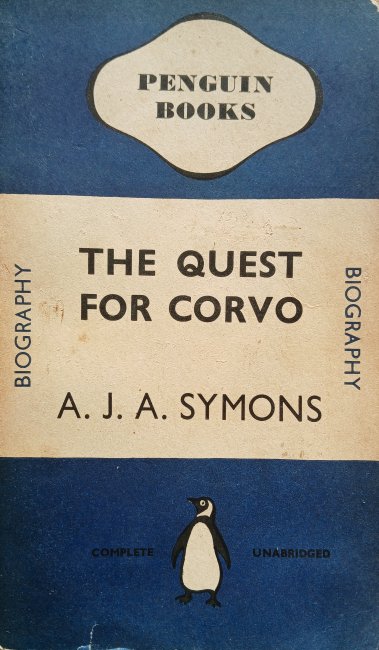
The Quest for Corvo – A.J.A. Symons

Following on from last weeks Christmas book of a hundred letters from the somewhat mysterious Frederick Rolfe, who styled himself as Baron Corvo, to publisher John Lane, this book tries to get to understand the man as much as is possible. Symons had developed his interest in Corvo following a visit to Christopher Millard in 1925 when Millard asked him if he had read ‘Hadrian the Seventh’, a book that Symons had never heard of by an equally unknown author Fr. Rolfe. Unusually Millard lent him his copy, he rarely let his books out of his home, and Symons read the novel and then in astonishment read it again. How could such an extraordinary book have escaped his attention and why had he never heard of the author, presumably a Catholic priest by his name, writing about a poor Englishman who unexpectedly rises to the papacy after the cardinals are unable to agree on a candidate amongst them at the conclave. This is theoretically possible as there is nothing in the rules around the selection of a Pope that says he has to be one of the cardinals tasked with making the choice. I haven’t yet read ‘Hadrian the Seventh’ myself but Symons’ enthusiasm for it suggests that I will hunt down a copy and read it before long, just checked and it is available as a Penguin Classic with the author given as Frederick Baron Corvo (Fr. Rolfe) and here we get to one of the problems with Symons study of the author, his regular changing of the name he is known as depending on circumstance. For consistency I’m going to normally refer to him as Corvo as that is how I first came across him and it is the name he is nowadays best known as.

It soon became clear to Symons that Corvo was dead but not long ago and many of his correspondents and also his brother were still alive and this is where Symons starts. The biography is unusual in that for the first two fifths of the narrative it is told as almost a detective story with Symons following leads and describing how he progressed from one to another rather than a finished biography where we would get a fully researched story from the beginning. I rather enjoyed this style and missed it when it was abandoned around the time Corvo first met John Lane, but as Symons explains it was getting rather too complex by then with more sources becoming available and a fuller picture appearing of the strange Baron Corvo a man who seemingly cultivated enemies everywhere, usually from the very people who were trying to help him and indeed had helped him until he took umbrage at some perceived slight or other. The following passage gives some idea of the man Symons was starting to reveal.
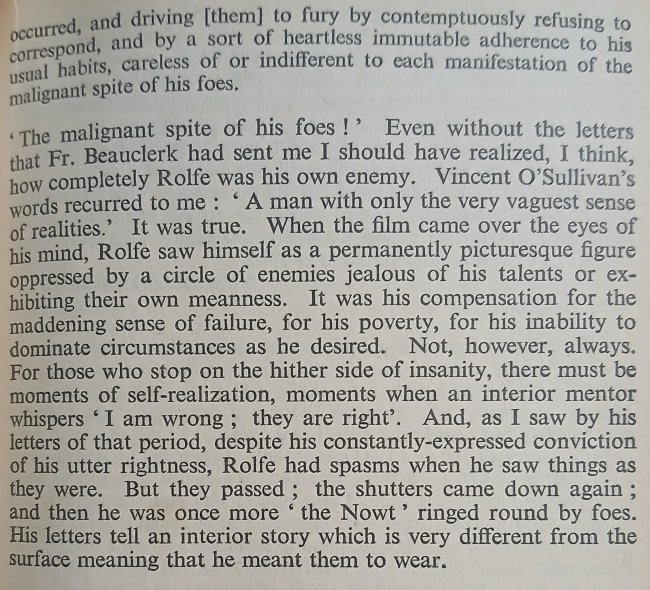
The picture you get from the numerous letters included in this book is a man probably suffering from an un-diagnosed persecution mania, nothing that happens is ever his fault it is entirely caused by malignant outside influences and his ever growing list of enemies who are determined to keep him down. He also has a gross overestimation of his own works worth, for example whilst living rent free in Wales he starts work on a series of paintings and banners for the local catholic church, originally as payment for his free lodging but gradually he ‘forgets’ the charity he is living off and demands payment for his work and what’s more the sum required is far above the value of what he has done at £1,000 (well over £100,000 today) when he is offered far less, the still generous £50 (£5,300) he refuses and starts spreading malicious stories regarding his then benefactor in the local press. The sum of £1,000 occurs several times in this book regarding Corvo’s valuation of his works and sometimes he manages to convince others and uses this figure as surety against loans which he has no means of paying back. To know Corvo even for a short time would often prove expensive and end up at the receiving end of vitriolic usually libellous letters.

This paints the man in a negative way, and he regularly deserves it, but by all accounts before the inevitable break down of a friendship he would be a fascinating companion with much apparent erudition whilst not able to understand the limits of his own learning. For instance he once agreed to work on a Greek translation whilst having little knowledge of the language and intended to drag the work through textbooks and piece together what he understood to be the meaning. The Rubaiyat mentioned in the previous blog entry apparently did actually appear but sold badly as it was a poor translation, unsurprisingly as Corvo knew absolutely no Persian and yet still undertook the translation.

Corvo died in Venice in 1913, where he was living on credit and piling up even more debts, a lot of which were settled by his brother when he came out to oversee his burial. He was without doubt a fascinating character which I would have loved to have met, whilst remembering to never lend him money, and this book by Symons does its best to be fair to the man showing his positive aspects whilst not shying away from his self destructive negative features.

Jonathan Wild – Henry Fielding

Born in 1707 Fielding was a barrister from 1740 and later as Chief Magistrate in London where he helped found The Bow Street Runners, the first British police force in 1749. Despite his legal career he was never good with money and had lived largely off his earnings as first a playwright, since 1728 and then as one of the first novelists in English. His first two published novels, ‘An Apology for the Life of Mrs. Shamela Andrews’ (published 1741) usually known just as ‘Shamela’ and ‘The History of the Adventures of Joseph Andrews and of his Friend Mr. Abraham Adams’ (published 1742) were both parodies of fellow early novelist Samuel Richardson’s ‘Pamela’ and also show his weakness for overlong titles, indeed this, his third novel is more properly entitled ‘The Life and Death of the Late Jonathan Wild, the Great’ and was first published in 1743. His most famous work is ‘The History of Tom Jones, a foundling’ (published 1749), which I also have but thought I would start with this earlier, and shorter, work as writers from this period can often be somewhat hard work.

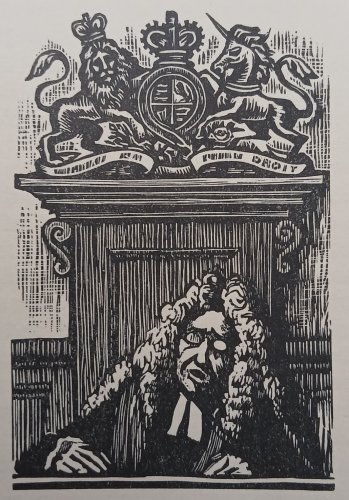
Jonathan Wild was a real person and was officially paid as a ‘thief taker’ or someone who found and handed over criminals and their illicit gains to the authorities in return for a substantial reward. But in reality he was a criminal mastermind himself who would simply hand over those who had got on his wrong side or who didn’t pay a big enough bribe. The majority of the returned goods were from thefts Wild had himself either taken part in or had organised using his large gang, as it was simpler to get the reward than dispose of the goods any other way. Wild was eventually exposed and hung in 1725 and was almost immediately satirically fictionalised by writers such as Daniel Defoe and John Gay in his ‘The Beggars Opera’, the target of the satire was not Wild but the Prime Minister Robert Walpole with Wild taking his place in the various works and this was widely understood by the public. This is also the case in Fielding’s novel with Wild taking the title of The Great Prig (slang for thief) which would be immediately understood as Walpole as he was sometimes known as the Great Whig (the political party he was part of) and particularly desired the epithet ‘the Great’ to be applied to his name. The image below is of the judge sentencing Jonathan Wild to his execution.

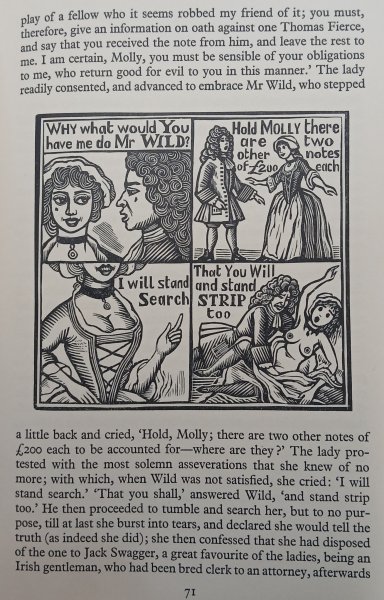
As explained above, the book is a satire of Robert Walpole but frankly after 275 years the allusions are lost on the modern reader, I for one have no idea as to what Walpole was getting up to that so upset so many writers at the time. It therefore is worth pointing out that after a slow start the plot fairly rattles along and you don’t need to know the intricacies of mid eighteenth century politics to enjoy the book. The version of Wild depicted in the book is a thoroughly unpleasant character to all that encounter him whilst appearing law abiding and pleasant to their face, as indeed was the real person, but Fielding did make the point that he invented a lot of the interactions to suit the plot. I have included one of the illustrated pages below to give you an idea of the story.

My copy is the 1966 Folio Society edition, which as it is a book with a slipcase rather than a dust wrapper, has attractive but somewhat nondescript covers, which is why I have used the frontispiece as the initial image. The wood engravings by Frank Martin have the feel of eighteenth century illustrations and fit beautifully with the book and with the bawdiness of the period. If you want to read the book for free in various different versions such as HTML online, as a Kindle file or as a PDF it can be found on Project Gutenburg here.

Romeo and Juliet – William Shakespeare

The local sixteen year old’s are sitting their English Literature exams this month and the set text play at least some of them are covering is Romeo and Juliet so I thought I would also give it a go although in a somewhat finer edition than they are using. I even found an appropriate quote by Romeo from Act 2, scene 2.

Love goes toward love as schoolboys from their books;
But love from love, towards school with heavy looks.

This is going to be a different sort of blog to normal as reviewing Shakespeare feels strange, the Bard rarely puts a foot wrong, it’s quite possible to review a performance but the plays themselves are genuinely some of the finest literature in English. So instead I’m going to treat it a a school exercise and for the first section summarise the play picking up on significant points, before moving on to describe the very special edition I am reading.

Shakespeare sets up the emnity between the two families of Capulet’s and Montague’s right from the first scene where servants from the two houses confront one another in the street, draw weapons and come to blows before being stopped by Benvolio who is part of the Montague family and happens to be passing. However Tybalt (Capulet) then arrives and seeing Benvolio with his sword drawn assumes he is part of the fight and likewise draws his sword to attack Benvolio, various citizens then arrive with clubs and it is only the arrival of Escalus, Prince of Verona, who orders all weapons to be dropped and the fighters disperse that finally brings peace to the streets. So the position of the rival families is well established within the first half dozen pages, a Montague and a Capulet, and even their servants, can barely be allowed in close proximity without trouble starting. Yet by the end of the first act Romeo, son of the head of the Montague family had entered the Capulet household at a masked ball, which means he is initially not recognised, and this leads to the fateful meeting between him and Juliet, daughter of the head of the Capulet family, which will bring such tragedy upon them both.

Act two begins with Romeo deciding to dump his current girlfriend, Rosalind, and giving his friends, Benvolio and Mercutio, the slip to enter the garden of the Capulet home where he spies Juliet high up in the house and this leads to the famous balcony scene, of which more later. During their conversation Juliet agrees to consider marrying Romeo the next day, a headstrong decision partly due to impetuous youth, for she is still two weeks short of her fourteenth birthday and also partly following on from her mothers conversation with her earlier that day encouraging her to look for a husband, although she was thinking of Count Paris, who has already indicated his interest in Juliet to her father. This act concludes with Romeo talking to a friend who is also a friar who agrees to perform a secret ceremony so that they may present their status as a married couple as a fait accompli to the two families and possibly through this heal the rift between them.

Amazingly for a Shakespeare tragedy we are now roughly half way through the text and nobody has died yet, most unusual, but all that is about to change. Everyone knows that “the star-cross’d lovers” (yes this is where that phrase comes from) don’t make it to the end of the play but the body count starts in act three of the five. Romeo and Juliet are now married, but nobody knows yet, and Tybalt is hunting for Romeo to avenge the dishonour of him appearing at the Capulet masked ball. When he finds him in the company of Benvolio and Mercutio he challenges him, but Romeo will not fight a man who has within the hour become his cousin, even if he isn’t aware of the relationship. Mercutio draws on Romeo’s behalf and is mortally wounded by Tybalt who then runs away but soon returns whereupon Romeo kills him in revenge. So before the end of scene one of the third act we have two dead and Romeo exiled from Verona by the Prince for the death of Tybalt. Delaying his exit from Verona Romeo manages to spend the night with Juliet and consummate the marriage but in the morning leaves quickly before her father arrives and tells Juliet that she is to marry Paris in this very week, she refuses but does not dare explain why however her father is insistent and says he will drag her to the church if necessary. The act ends with Juliet going to Friar Laurence to consult him on the way forward.

Act four sees Juliet coming home and as agreed with Friar Laurence submits to her father and declares she will go go through with tomorrow’s marriage, however he has also provided her with a drug that will simulate death for forty two hours which she is to take when she goes to bed. This she duly does and is discovered the next day apparently a corpse which is believed by all. We have amazingly for Shakespeare got through another act without anyone actually dying but that is all going to change in act five, the final part of the play.

Act five is where all the action occurs however it starts in Mantua with Romeo seeing the arrival of his manservant and asking him news of Verona. Balthazar tells Romeo that Juliet is dead and distraught Romeo decides to buy poison so that he can also die. Meanwhile Friar Laurence receives his messenger who should have given Romeo a letter explaining what was really going on but has failed to deliver it. Friar Laurence decides to head for the vault where Juliet is lying to see what is going on. Romeo has meanwhile arrived at the vault and is seen by Paris who has also gone there to lay flowers by Juliet, thinking Romeo means to disturb the corpse he attacks him and is in turn killed by Romeo. Romeo breaks into the vault and takes Paris’s body in there, seeing Juliet apparently lifeless he drinks the poison to join her in death. Friar Laurence then arrives and finds the two men dead but Juliet coming round, she then sees the bodies and before Laurence can take her out of the vault grabs Romeo’s dagger and stabs herself. Making a total of five dead in the play, but no when the lords Montague and Capulet arrive Montague reveals that his wife had died that night of a broken heart due to Romeo’s banishment. Friar Laurence reveals to all that Rome and Juliet were actually married and the two families resolve to end their rivalry in memory of those they have lost. The play ends:

Prince. A glooming peace this morning with it brings.
    The sun for sorrow will not show his head.
    Go hence, to have more talk of these sad things;
    Some shall be pardon’d, and some punished;
    For never was a story of more woe
    Than this of Juliet and her Romeo.

Now let’s compare the two copies of the play provided in the box, The smaller version bound in buckram with the paper label is actually a good size (8¾˝ x 5¾˝) hardback edition of the relevant volume of The Oxford Shakespeare series of all the plays bound to complement the much larger Folio edition. This is the copy you turn to if you want the academic learning around the play. It is 450 pages long of which the first 134 pages are the introduction. The play itself is broken up with a huge number of notes explaining the text and reading it feels very much like being at school and analysing a play to within an inch of its life. I studied ‘To Kill a Mockingbird’ like this at school and whilst I’m sure it’s an excellent read I’ve never been able to bring myself to pick up a copy since. See below where you can see that Juliet barely gets going before being interrupted by half a page of double column notes.

In complete contrast the much larger Folio limited edition is in a very clear large font (16-point Baskerville with Caslon display) letterpress printed on over-size pages (14˝ x 10¾˝) on beautiful paper and with a complete absence of notes, which to quote The Folio Society at the time “Allows to text room to breathe”. This makes reading the play much more pleasurable, as not only looking gorgeous the book feels fantastic as well with the fine leather and hand marbled paper binding. Removing all the notes and introduction takes this edition down to 113 pages. Here is the same section in this version, it is of course part of the famous ‘balcony scene’.

I have sixteen of the plays in this format, the tragedies are bound in red, the comedies in green and the history plays are blue. I was tempted to get more but at £295 per play it was turning into a major investment so I just got a selection of my favourite works by Shakespeare. Even so with each box measuring 15˝ x 11˝ x 2¾˝ (38cm x 28cm x 7cm) the sixteen buckram bound boxes take up a lot of shelf space. If you are interested in the production process used to print this book have a look at these Folio Society videos on the production of the Letterpress Shakespeare firstly the printing process itself and this one on how the marbled papers were made.

Voices of Akenfield – Ronald Blythe

I recently watched the 1974 film Akenfield directed by Peter Hall which is based on Ronald Blythe’s best seller ‘Akenfield, Portrait of an English Village’, a book that has remained in print ever sine it was first published in 1969. The film covers three generations of people from the fictitious village of Akenfield in Suffolk including its most famous bucolic scenes of farming life that has long since disappeared and the horrors of losing so many men to the World Wars. It is particularly unusual in that there are no professional actors and no script just an eighteen page synopsis by Blythe with the people in the film making their own lines up as appropriate for the scene. The film was made at the weekends so as not to impinge on the actual working week of the people taking part and Blythe himself appears in it, playing the part of the vicar of Akenfeld, you can see the trailer here.

I loved the film and was sure that somewhere on the shelves was the book which was memorably reviewed by Jan Morris for the New York Times:

“Ronald Blythe lovingly draws apart the curtains of legend and landscape, revealing the inner, almost clandestine, spirit of the village behind. His book consists of a series of direct-speech monologues, delivered by forty-nine Suffolk residents, and interpretatively linked by the author. The effect is one of astonishing immediacy: it is as if those country people have looked up for a moment from their plow, lawnmower or kitchen sink, and are talking directly (and disturbingly frankly) to the reader. This is a brilliant and extraordinary book which raises disquieting second thoughts when the poetry has faded—as Mr. Blythe says, it is like a ‘strange journey through a familiar land.”

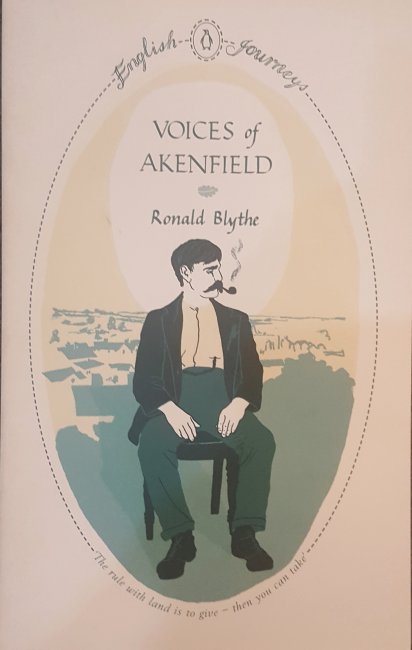
Sadly I couldn’t find it but I did locate the next best thing, a 126 page shortened version of the original 288 page Penguin Modern Classic from the set English Journeys which came out in 2009. This only has twenty one of the original forty nine interviews and the linking passages are largely missing but in the absence of the complete work it is an excellent substitute. The variety of people interviewed by Blythe is a cross-section of village life from a thatcher, blacksmiths and a wheelwright, a nurse, a couple of orchard workers and even one of the gardeners from the big house who describes the problems of working for the old couple that owned it and the professional pride that he got from a job well done. In fact there was a lot of pride in what people were doing right up until the younger generation and a tractor driver who no longer cared about straight furrows just how much land he could cover in a day, in total contrast to the horse ploughman who wanted everything just so.

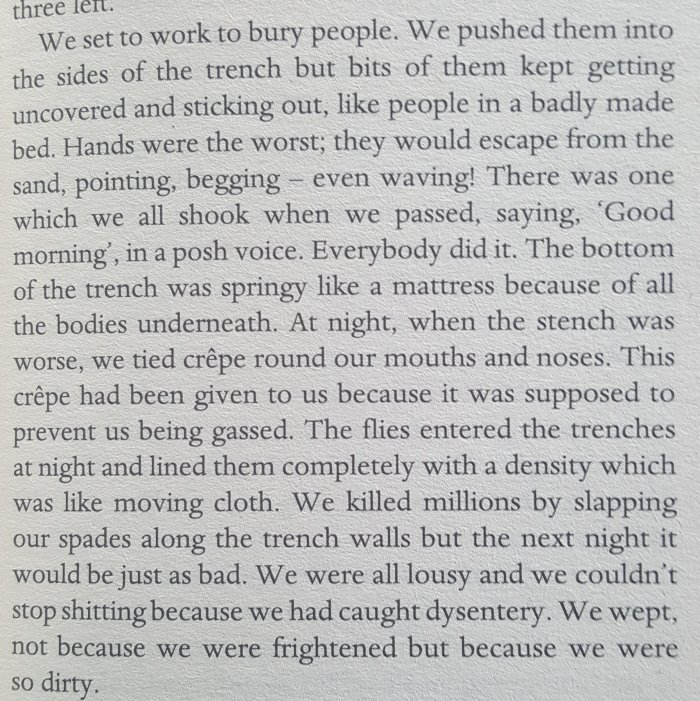
The saddest, and most difficult to read, interview was the first one in the book, Leonard Thompson age seventy one and listed as a farm worker but most of his narrative covers being called up in the First World War and having to go to The Dardanelles to fight the Turks before ending up on the Somme in the thick of the fighting. He describes first arriving in Turkey and asking about friends from the village who had gone before only to be told that they had all died in combat and then moving on to a trench which was full of corpses and stinking from the decomposition.

One of the more interesting interviews was with a saddler who admits “Our harness lasted forever, as you might say. It was our downfall, wasn’t it! We made these things so well that after a while they did us out of a living.” But even the wheelwright says that there were wagons around the village that were over a century old they were made that well that they never needed replacing. So different from modern products which have built in obsolescence, it was only the coming of tractors that would gradually drive those fine wooden wagons off the farm and into the history books. The retired district nurse describes arriving in Akenfield in 1925 and being the first medical professional that would actually turn out at a house as the local doctors weren’t interested in house calls, you had to go to them and be ready to pay or they wouldn’t see you at all. She saw it all from births to sitting up by a death bed as the person in it took their final breaths and had to work hard to gain the confidence of the people. She eventually covered nine villages and because of this was one of the few people with a car so she could get round but she was very struck by the poverty of the general population with large families in tiny properties so there would be five or six children sharing one bedroom with the latest baby in the other room with the parents.

The final person is appropriately William Russ, aged sixty one and the gravedigger. He started digging graves when he was just twelve years old, “People would look down into the hole and see a child”. One of the problems with his job was one I had never thought about and that was the high water table in Suffolk which meant that the graves would start filling up with water almost as soon a they were dug and coffins had to be held down with poles to stop them floating away until enough heavy soil was on top of them to force them down to the bottom of the grave.

All in all it’s a fascinating document of social history and I just need to keep hunting the shelves to find the full work although I have a feeling that I lent it to someone and never got it back. But I recommend either edition of Akenfield, or even the film, if you want a glimpse of a rural life that wasn’t that long ago but has now completely vanished.

The H-Bomb Girl – Stephen Baxter

First up, the quote by Paul Cornell on the cover gives away a lot of the plot, immediately you are on the look out for a time travel angle in a book ostensibly about a fourteen year old girl moving to Liverpool after the collapse of her parent’s marriage and having to start again making new friends at a time of international tension, for it is October 1962 and Russia is moving nuclear missiles to Cuba in order to be able to have a shorter strike time against the USA and match the American missiles based in Turkey. Therefore when the somewhat creepy Miss Wells at Laura’s new school appears to know more than she should and also has a resemblance to what an older Laura might look like and Agatha at the cafe the school friends go to also looks similar and furthermore has what appears to be a tattier version of Laura’s diary in one pocket the reader is considerably less surprised than they probably should have been.

Laura is given the nickname of The H-Bomb Girl after the very unusual item she has hanging round her neck is spotted by her school friends. Not many teenage girls walk round with the priming key for a Vulcan bomber hanging on a chain. Her father is a senior RAF officer in charge of the UK nuclear warheads, and in a slightly convoluted plot line has decided that a good way to keep his daughter safe in the event of a nuclear war is to give her the key and get her to memorise a phone number to ring and the arming codes so that if things go badly, which he suspects may well be the case, she can call and be whisked away to a safe place. I’m more inclined to believe that both father and daughter would be more likely to be taken to prison than to a place of safety but a certain amount of leeway has to be given here as the plot has more holes than a colander and the more you think about it the less believable it becomes. After all Miss Wells and Agatha must have been hanging around for some time waiting for Laura to move to Liverpool as Miss Wells at least appears to have a senior role in the school and is not mentioned as a new arrival.

It’s a pity that Baxter didn’t do more research into the period, if he had then the three anachronisms that I spotted immediately, there may well be others, wouldn’t have appeared. The first is minor in that in the introduction by way of explaining pre-decimal currency to modern readers he mentions the farthing which had ceased to be legal currency in January 1961 almost two years before the book is set. The second is more significant as during one of the versions of the post missile crisis where the world descends into nuclear war he refers to the first strike on Liverpool which led to the melting of the glass crown on Paddy’s Wigwam aka the Catholic Metropolitan Cathedral of Liverpool. Unfortunately this building only started construction in October 1962, the same month as the crisis occurred, it wasn’t completed until 1967 and gained it’s nickname soon afterwards, so it wasn’t there to be destroyed in October 1962. If you don’t know why it got the nickname see here. Finally in a book about time travel which also has a character mention Doctor Who starting soon he got the year wrong as it was the 23rd November 1963 when the show was first broadcast, nobody would have known about the show in 1962 as the BBC didn’t even start referring to Doctor Who internally until the summer of 1963. Finally as somebody who studied nuclear engineering the positioning of the open nuclear pool in the main control room hall, whilst needed for the plot, is simply ridiculous. These obvious errors, especially to someone born in 1962, as I was, were mildly annoying but apart from them and the dubious plot holes the story was a fun read.

The Motorcycle Diaries – Che Guevara

The book tells the story of a journey made almost on a whim by Ernesto Guevara and Alberto Granado almost the full length of South America initially using Guevara’s 500cc Norton motorcycle which is what gives the book its title. However from when they leave Buenos Aires on 4th January 1952 to arriving in Caracas on 17th July almost all the trip is done via hitch-hiking on lorries as the bike broke completely between Lautaro and Los Angeles in southern Chile on the 21st February. At the time Guevara was a student doctor and Granado was a qualified biochemist and taking what was intended to be a year long break to explore South America was seen as madness but neither man could be persuaded to delay the trip. Ernesto would return to medical school and qualify as a doctor before becoming known the world over as Che Guevara the revolutionary who helped Fidel Castro overthrow Fulgencio Batista the then dictator in Cuba before going on to assist in various revolutionary movements across South America and even in Africa. Che simply means pal or mate in Argentinian Spanish but it was the name he would have as his own for most of his adult life and is still how he is best known today.

But this book precedes his fame, he was only 23 when they set out, Granado was 29, and this review is published on my blog on what would have been Ernesto Guevara’s 94th birthday (14th June) if he hadn’t been executed by Bolivian forces on the 9th October 1967 when he was just 39. It wasn’t Guevara’s first journey by motorbike, he had already done at least one very long trip but that was by himself, taking Granado as well just on the one bike was somewhat overloading its capacity and it really didn’t take long for the poor roads and the extra weight to take its toll. At first they just used wire to hold the bike together but then they started to get repeated punctures which proved tricky to fix especially when splits started happening due to multiple holes near one another and the bike finally broke its steering column which consigned it to the scrap heap. This was not a luxury trip, they were largely impoverished on the journey living from hand to mouth, cadging beds and food as well as they could and using a largely fake fame as famous Argentinian leprosy specialists to ingratiate themselves with anyone they could. To be fair Granado did know a lot about leprosy and Guevara was considering making it his speciality when he graduated and they did visit several leper colonies on the trip so they probably knew more than anyone else apart from the specialist doctors at the colonies. But even this appeal to peoples charity didn’t work very well so they were often cold and hungry.

Amongst other ‘cons’ they used to get looked after was to stare dreamily into space after asking what the date was and saying ‘Oh we have been on the road for a year as of today’ and people would help them celebrate by buying food and drink. Guevara was particularly good at when being offered a drink he would just sip at it and when asked why he would explain that Argentinians don’t just drink they would always have food with alcohol and it felt strange to just have a drink. This would invariably get some food on the table for them. The full journey was to head south from Buenos Aires into Chile, go north through that country and then onto Peru, where they visited Lake Titicaca and the Inca ruins of Machu Picchu. They continued from Peru into Colombia and Venezuela where Guevara and Granado split up so that Guevera could get back to university by plane. This final stage however didn’t go to plan, as so much of the entire journey hadn’t, as to get a cheap flight he agreed to help ship racehorses to Miami with the plane due to fly back to Caracas and then onto Buenos Aires the next day. Instead the plane broke down in Miami and he was stuck there for a month waiting for it to be fixed.

The book was first published in 1993, with the translation into English by Ann Wright published in 1995 by Verso, so well after Guevara’s death, and was put together from his manuscript notes written during the journey. There is also a preface and an epilogue, both written by Guevara’s father, the epilogue details the fraught long unwanted stay in America. I have to say that this particular copy of the book, the thirteenth impression by Fourth Estate, is very badly printed with considerable over inking on random pages making it quite difficult to read in places but it was well worth the effort to get a glimpse into the development of a future revolutionary. You can see in his writing a change as he glimpses the extreme poverty that a lot of the continent is stuck in and the largely despotic rulers that control the lives of the population. Definitely a recommended read.

The Graveyard Book – Neil Gaiman

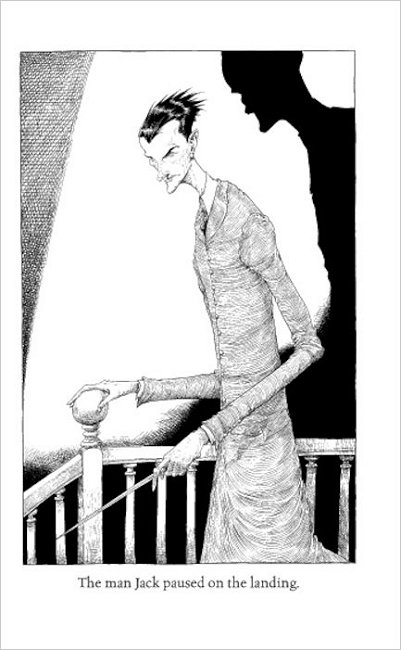
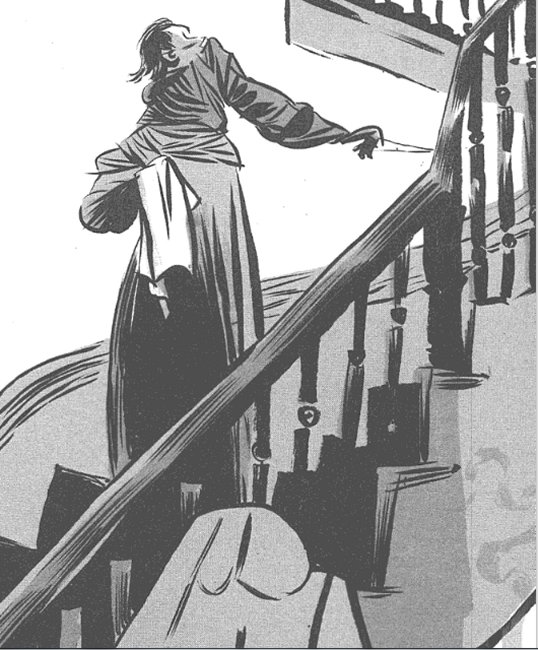
Master story teller of dark tales Neil Gaiman produced another brilliant book for young adults back in 2008 and my Bloomsbury edition is beautifully illustrated by Chris Riddell. Gaiman is probably best known for his books Coraline and Stardust both of which were turned into wonderfully strange films, along with the comic novel masterpiece that is Sandman and his collaboration with Terry Pratchett in writing Good Omens. The American edition, also released in 2008 was illustrated by Dave McKean who also did all the covers for the Sandman graphic novels and this version contains far more illustrations than the UK edition but I really like the sparseness of the Riddell pictures, see the two examples below. The darkness of the novel starts right from page one where before we get to the bottom of the page our hero’s entire family, mother, father and elder sister have been murdered by the man Jack and he is going up the stairs to kill him who is just eighteen months old. First is the picture by Chris Riddell and then comes part of the image of the same scene by Dave McKean.

Fortunately for the, as yet unnamed, toddler he had heard something and climbed out of his cot using his teddy bear as a stepladder and had worked his way down the stairs whilst the man Jack had been killing his family. Finding the front door open he had gone outside as stairs going up were far more difficult than bouncing down on your bottom so the choices were limited and tottered up the road outside until he reached what looked like a park. The man Jack followed him by scent, for there is a lot more to the man Jack than just a common assassin as we will find out as the book progresses, but as for the toddler he is now at an old graveyard, one that is no longer used for burials and is now, at least during the daytime, a nature park, but it is currently nighttime and the gates are locked but the child could squeeze through the railings. Eventually the man Jack tracks down the child and gets into the graveyard only to be confronted with the ghosts who ‘live’ there along with Silas (more of him later) and after a brief appearance of the ghosts of his family the inhabitants of the graveyard decide to look after the child as best they can.

Silas convinces the man Jack to leave using one of his powers which is to be extremely convincing even to such as Jack and is appointed the child’s guardian by the rest of the ghosts because Silas can leave the graveyard and exist in the world of the living as he is neither dead nor alive. It is never made clear in the book who, or indeed what, Silas is but he is clearly from the realm of the undead. All of this takes place in the first five pages of what is a 289 page book so as you can see Gaiman packs a lot of story into this work which was written piecemeal as he came up with ideas.

My son Michael inspired this book. He was only two years old, riding his little tricycle between gravestones in the summer, and I had a book in my head. Then it just took me twenty-something years to write it.

When I started writing the book (I started with Chapter Four) only my daughter Maddy’s request to know what happened next kept me writing beyond the first couple of pages

From the Acknowledgements at the rear of the book

Chapter four was originally published as a short story entitled ‘The Witch’s Headstone’ in a couple of anthologies and each of the chapters from two to seven make up complete short stories set a couple of years apart as Bod, as he becomes known, grows up in the graveyard with Silas able to bring food and clothes from the town of the living to keep him alive and the ghosts teaching him what they can. Bod, short for Nobody, makes a friend for a short while and Scarlett features in a couple of the chapters, Bod even manages to go to school for a while but that doesn’t end well and the man Jack reappears to try to finish what he started all those years ago but this time Bod is a teenager and on his own territory and knows just how to deal with the man Jack and his four accomplices. The book has funny parts as well as sections of considerable menace and appeals to adults both young and old. I loved it. There was even talk of making a film but despite a few abortive attempts nothing has yet come of that. But for me the most fun way to enjoy the book is with Neil Gaiman himself reading it which can be found here. This is the American edition so some of the words have been changed, a nappy becomes a diaper for example but even so enjoy…

Good Morning Nantwich – Phill Jupitus

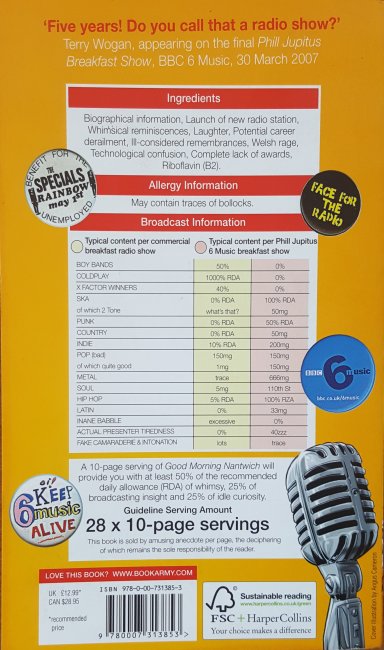
OK, I picked this book up because it had Nantwich in the title and that is the town in Cheshire that I was born in. I was also intrigued by a book by Phill Jupitus whom I was familiar with from the TV shows ‘Never Mind the Buzzcocks’, where he was a team captain for pretty well every show, and his occasional appearances on ‘QI’ and ‘Have I Got News For You’ along with the BBC Radio 4 stalwarts ‘The News Quiz’ and ‘I’m Sorry I Haven’t a Clue’ but I had no idea he had even done any radio presenting never mind being a breakfast show DJ for five years. On the first point of attraction Nantwich is never mentioned by Phill in the entire book and its sole appearance is the last line of the foreword by fellow DJ Lauren Laverne.

I also hope that this book gives you an insight into the man behind the mic, some tales that make you laugh and an insight into the way a man’s love of broadcasting might drive him to madness and beyond. Possibly to Nantwich.

My lack of knowledge of his radio broadcasting career is explained by the fact that in the 1990’s, when he started as an occasional broadcaster it was for a London based station that I couldn’t pick up and by the time that he appeared on national radio in 2002 it was for a newly launched digital only station ‘6 Music’ and at the time like almost everybody else in the country I didn’t own a digital radio as they were almost impossible to source. This partly explains the dire listening figures for his show but as Phill admits the style of the show probably put off quite a few potential listeners as it was very much a take it or leave it approach to what listeners could expect and if you didn’t like it well you could go elsewhere, he was doing it his way or not at all.

The book is actually fascinating as he not only covers his career on radio and especially his time on ‘6 Music’ but also looks at the history of breakfast shows, and compares the various styles that have been employed over the years including one very funny chapter where he makes himself to listen to a four hour show on an unnamed channel and truly hates the entire experience as it was so forced and formulaic. The humour is all the greater as I found myself hearing him reading the chapter in my mind and just getting more and more irate as he documents the show, down to the adverts and each record played along with the inane and several times genuinely offensive banter between the two presenters. Compare and contrast with the gentle style of that master of breakfast radio Terry Wogan who for twenty seven years held together a dedicated group of listeners in their millions and somebody that Jupitus genuinely admired although he had no intention of remotely copying on his own show, he was looking for something more like the shows done by the great late night broadcaster John Peel although not quite as eclectic in musical choice as he simply wouldn’t have been allowed to get away with it.

The more Jupitus mentions his musical and broadcasting heroes the more he and I agreed and we certainly had the similar exposure to music growing up as I am just fourteen days older than him and whilst he had far more opportunity to hear new things as he grew up in Greater London, a shared addiction to John Peel’s show meant that we certainly heard a lot of the weird and wonderful at the same time. Each chapter of the book concludes with a list of ten songs that has a sort of link to the chapter although at times this could be a little tenuous but it does give an idea as to the wide spread of his musical tastes. His final breakfast show broadcast was done from his own home which had the advantage that he could sleep in for an extra hour and three quarters and was also a nod to John Peel who had broadcast regularly from home where he had access to one of the largest private record collections in the world. Whilst Jupitus’s collection wasn’t in the same league he also played a lot of his own records in his final three hours as a breakfast DJ.

It’s a good book and a lot more interesting than I expected, after all reading about a radio career that you didn’t even know existed for 296 pages is a bit of a stretch, but in fact the book flew by and it just took two days to read and another one to write up. All in all I forgive the author for the Nantwich tag without which I would probably never have picked the book up. As for Jupitus in the ten years since he wrote this book he has never done a regular radio show and has no plans to do so.