
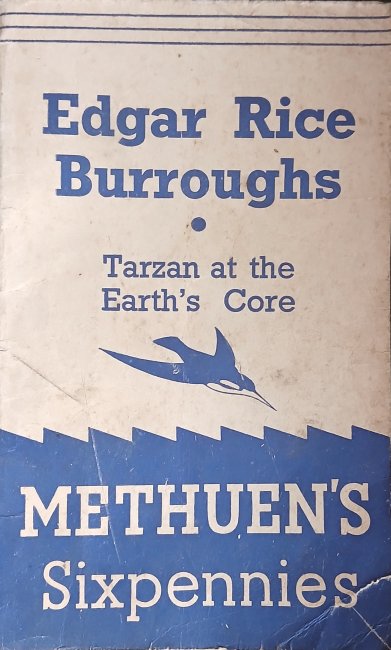
Tarzan at the Earth’s Core – Edgar Rice Burroughs

Inspired by last week’s book and author Michael Moorcock’s evident liking in that volume of the work of Edgar Rice Burroughs, along with my recent purchase of my first book by that author the intriguingly titled Tarzan at the Earth’s Core I just had to take it off the shelf and give it a go. I’ll come to why I bought the book at the end of this blog, it wan’t because of any particular interest in Burroughs or indeed Tarzan though.

I knew Burroughs had created Tarzan along with the science fiction works featuring John Carter of Mars but that was as far as my knowledge of him went. It turns out Burroughs was rather more prolific than I had imagined and amongst his vast output there were twenty six Tarzan titles of which this is the thirteenth and he also wrote seven books about Pellucidar, his name for a land hidden inside a hollow Earth and this crossover book is the fourth of those. Unlike Jules Verne’s ‘Journey to the Centre of the Earth’ or Bruce Carter’s ‘The Perilous Descent’ Burroughs has his Earth interior concave on an interior surface of the Earth five hundred miles below the surface we know with a central sun so it is always noon regardless of where you are. He does however have it populated by dinosaurs and primitive man like Verne does.

It was odd starting with Tarzan thirteen as the character is nothing like the one I remember watching as a child in films on television played by Johnny Weissmuller forever swinging through the trees and having little to do with civilisation. The Tarzan in this book is just as happy back in England as Lord Greystoke as he is in the jungle he grew up in, indeed when he sets off on the adventure he is sharply dressed in a suit and tie. The book however starts with Tarzan in the jungle coming across an expedition which was actually designed to find him and try to persuade him to join the plan to rescue the Emperor of Pellucidar from the hands of the Korsars, first though he has to have Pellucidar explained to him which is useful for those of us reading about this series of books for the first time. Needless to say he does go and brings along ten of the native warriors who regard him as chief and these along with numerous engineers and other staff set off on a huge experimental airship nine hundred feet (275 metres) long to fly to the north pole and find the entrance to Pellucidar. The hole is so large that they fly the airship down to Pellucidar and land to reconnoitre and the next morning Tarzan is seen leaving the ship dressed as he would normally be in the jungle and heading for the nearest trees.

This is of course where the whole plan starts to go wrong. Tarzan feels at home in the trees, so much so that he isn’t paying full attention to his surroundings, steps into a trap and is captured by a group of gorilla people. After a couple of days the crew of the airship are concerned that he hasn’t returned and a search party is organised consisting of officers from the ship and the native people Tarzan brought with him, these however get caught up in a ambush by sabre tooth tigers on the various prey species in the jungle. After the massacre has finished all the crew and native people appear to be OK but are now no longer together and they cannot find their way back to the ship due to the un-moving sun which ruins their sense of direction. Eventually those left at the ship, after a period of several more days decide to use the light aircraft they brought with them to search for the others but this ends up crashing so stranding yet another member of the party. The book tells the stories of the various groups as they survive and search for each other and the airship with the help and hindrance of various Pellucidar inhabitants and is a great adventure story if you allow for the errors regarding the prehistoric animals they meet. Unfortunately this searching for each other takes up so much of the book that the final denouement of the rescue of the Emperor is a bit of a rushed let down. That said I enjoyed the book, not enough to search out any more Tarzan or Pellucidar books, but it was a pretty good if rather dated read.

So why did I buy the book? Well it is all the fault of Jules Burt and an Instagram post of his where he talked about the difficult to find Methuen Sixpence’s, a very short lived attempt at being a competitor to Penguin Books, and that he had bought a complete run of the thirty seven titles from the Eric Gadd collection. This meant he had some spares which I then bought off him as I only had one example in my collection. Now I have enough to justify trying to complete the set myself even though I know they are rare due to poor quality wartime paper, they were published between 1939 and 1941, and not many of each title being printed in the first place. This explains the somewhat tatty condition of this example but frankly getting them in any condition is tricky.

Worrals of the W.A.A.F. – Capt. W E Johns

William Earl Johns is best known as the creator of James Bigglesworth, better known as Biggles, who featured in ninety eight books of adventure stories. Joan Worralson, aka Worrals, on the other hand appeared in just eleven books and the first three were finally republished in 2013 by Indiebooks after a long period out of print. Whilst it’s good to see these stories back in print I think it’s a pity that the cover illustrations are so childish with Worrals and Frecks depicted as apparently far younger than their actual age in the book which is eighteen and seventeen respectively. With that in mind I think I prefer the original dust wrapper from the first edition in 1941, although in that picture Worrals looks more in her early twenties.

W E Johns adopted the title Captain for his writing career although he never achieved that rank during actual service as a fighter pilot and later a flying instructor during WWI. Remaining in the R.A.F. after the war he was promoted to Flying Officer in 1920 whilst working as a recruiting officer, ultimately transferring to the reserves in 1927 before finally relinquishing his commission in 1931. The following year he wrote his first Biggles book ‘The Camels are Coming’, the title referring to the Sopwith Camel biplane rather than the bad tempered quadruped. His long career in the air force obviously informed his detailed descriptions of flying and the aircraft used, and you can be pretty sure that if Johns says a plane handles a specific way then it really did. The Women’s Auxiliary Air Force which had both Worrals and Betty Lovell, aka Frecks due to her freckled face, as members was founded in 1939 and during WWII it’s members performed various support roles to the R.A.F. including transferring aircraft between airfields and repair sites although this was a relatively uncommon function, most were employed in far more mundane duties. Worrels is therefore highly unusual in performing this task as this was actually a job for the Air Transport Auxiliary which eventually did employ around 100 women, but as a recruiting agent she apparently worked well.

The story begins with Worrals receiving a dressing down by the Squadron Leader for having gone out on a short training flight in a Reliant in contravention of standing orders which did not permit females to fly combat aircraft and she is to be punished along with the Flying Officer who flew with her by loss of leave and in his case a transfer to a forward airfield. Shortly afterwards the Squadron Leader rather shamefacedly asked her to fly the same plane as it needed moving and apparently with the transfer of Bill he had nobody left who had previously flown that make. All rather unlikely but it is really just a device to get Worrals, and Frecks as a passenger up in the air where they spotted a mysterious aircraft and received a general all planes message on the radio that it needed stopping. As the only plane in the vicinity Worrals engaged the other plane and luckily shot it down but not before seeing it swoop low over what appeared to be a golf course. If flying a combat aircraft without specific authorisation wasn’t bad enough before, then actually partaking in combat was very much forbidden, however Worrals managed to talk herself out of further punishment by pointing out that she was flying the only combat plane that had seen the mystery aircraft and otherwise it might have escaped. Worrals not only avoids further censure but gets her weekend leave reinstated.

Worrals decides to use her leave to do some unofficial investigation as she doesn’t think she was taken seriously over the activity at the golf course so taking Frecks with her they head off to the property only to be captured by German spies and the plot unfolds as they slowly work out what is happening during bouts of freedom as they alternatively escape and get recaptured a few times. The plot is well thought out and Johns certainly provides plenty of tension as the two women engage in a battle of wits with the Germans and although a few escapades somewhat stretch the readers credulity I had to remember that I was not the target readership which was largely teenage girls and young women during the war. Having said that I nevertheless enjoyed my first experience of Worrals, but I doubt I’ll read another. I read a lot of Biggles at around the age of ten and I can’t see me rereading any of those either. It was fun though and if you like what is now called Young Adult adventure stories then W E Johns has a lot to recommend him. Please be aware though that the books are very much of their time and although Worrals is largely UK based in all her books, Biggles travelled the world and often had a very 1930’s/40’s attitude to the people he found there.

With thanks to The Ironbridge Bookshop for the loan of the book so that I could try a Worrals rather than reading my extremely delicate and worryingly rare Penguin edition of Biggles Flies Again