I Hate and I Love – Catullus

A collection of forty three poems by Gāius Valerius Catullus, a Roman poet born in 84 BCE and who died in 54 BCE, but in his short life he wrote a number of poems, 116 of which have survived to the present day. Penguin published a complete volume translated by Peter Whigham which I don’t possess however this selection from that larger volume is part of the Penguin Little Black Classics all of which I purchased when they came out. Catullus’s poetry is normally categorised nowadays into three main subject types, those dealing with his friends, those about a woman he loves but refers to only as Lesbia rather than her real name which was probably Clodia Metelli and the rest are largely described as invective or works attacking other people, which was quite a popular style at the time. This volume is mainly poems in the ‘friends’ or ‘Lesbia’ categories with just seven of the ‘invective’ style represented although over fifty of the surviving works are categorised as ‘invective’. An example of the invective style is poem 43 which attacks the girlfriend of Formianus.

Apologies but photographing the poems without breaking the spine of the book has led to the distortions in the images. The next poem that I want to select to illustrate the tone of Catullus is one which describes his desire to travel now that the warmer weather is here. I have deliberately selected three of the shorter works although few are what we would regard as long, but the descriptions of personal experiences and desires is what marks Catullus as one of the writers known collectively as poetae nov or ‘new poets’ as poetry moved away from the epic heroic style favoured before then. The works of Catullus were almost lost to us completely as a single manuscript was found in the Chapter Library of Verona around seven hundred years ago. This document was copied twice before it was again mislaid and one of the copies was in its turn copied twice before being lost. So the 116 poems have come down the centuries due to these three surviving precious documents.
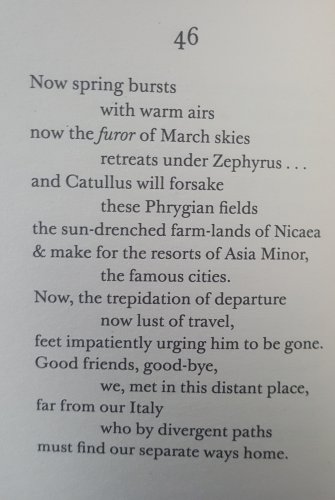
That one feels very modern with Catullus looking forward to a holiday in Turkey and hoping to meet up with friends there. For my third example it has to be one of the famous Lesbia poems although not the best known, which is poem 5, as that extends over a page in this edition so is difficult to include here. But poem 51 expresses his desire for Lesbia and how he feels when in her company although it is worth pointing out that poem 85 refers to her husband so Catullus was probably one of several men she had affairs with, including Rufus the subject of invective poem number 77 written after Catullus found out about their relationship.

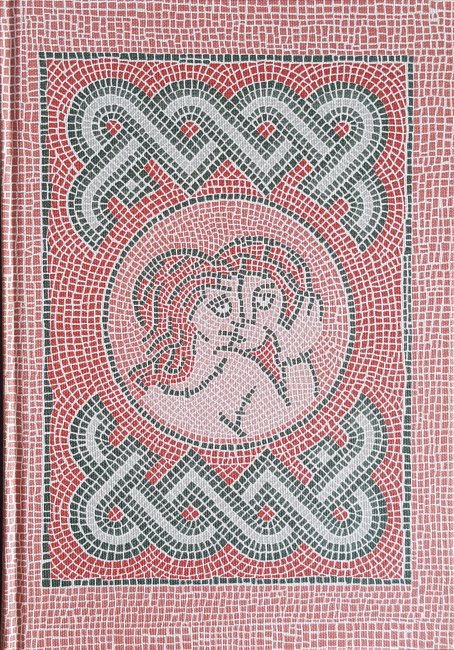
A few others are quite ribald so I don’t feel I can put them on this blog. Although I have certainly enjoyed reading the collection it does nowadays probably need to come with a warning regarding adult themes, The title by the way is from the opening line of the very short poem 85, which is just two lines long:

I hate and I love. And if you ask me how.
I do not know. I only feel it, and I’m torn in two
Catallus 85 translated by Peter Whigham

The Secret History – Procopius

Procopius was born around 500AD and died sometime after 565AD, a period during which the Roman empire was in serious decline. For many years he worked for the celebrated military commander General Belisarius during which time he wrote the work he became known for in the time of the empire ‘History of the Wars’. This series of eight books is a standard document of the campaigns of Belisarius who seemed to be leading his armies, and even the navy at some point, everywhere. It is clear from the level of detail that Procopius was on the scene for most of the battles he describes even though his official role, at least initially, was as legal advisor to the general. Less well known is his work ‘The Buildings’ which is largely a hagiography of Emperor Justinian (527AD to 565AD) as it describes the major construction works undertaken during his reign and exclaims the greatness of Justinian due to these churches and other civil engineering projects. His third work however is the one that I have read this week and it is very different to the rest, not least because it wasn’t available during his lifetime and indeed was only discovered in the Vatican library centuries after his death and finally published in 1623. So why wasn’t it available in the preceding thousand years, well Procopius gives us the explanation in his foreword.

This book is basically a scandal sheet denigrating Justinian as a genocidal leader interested only in the money he could confiscate or swindle out of everyone else and slaughtering tens of thousands of people on a whim whilst losing vast chunks of what was left of the empire. His wife is portrayed as a scheming whore, free with her body from an outrageously young age, stripping off in public places and letting anyone have their way with her as they wished. His former boss Belisarius and his wife are similarly pilloried by Procopius as is the previous emperor Justin who is described as an idiot and little more than a jackass. It is quite clear why he decided not to publish in his lifetime or indeed whilst anyone mentioned in the book was still alive, the repercussions would have been swift and brutal.

One slightly irritating feature of the book is the constant references back to Procopius’s eight volume history, this is usually where he is giving a scandalous reason for something that he had previously written about but which he had glossed over the causes of in the earlier book. This becomes more annoying if, like me, you don’t own ‘History of the Wars’ so can’t refer back, the notes in this edition simply tell you which of the eight volumes the story was first told, it would have been nice if a short precis was available so that the reader can compare the two accounts but that would have made the book probably over long. All in all I quite enjoyed this book though, it is unusual by being a character assassination of a couple of Roman emperors written at the time of their reigns, the only work I can think of that I have read with a similarly blunt although not as brutal or scandalous assessment of the emperors is ‘The Twelve Caesars’ by Suetonius although all the rulers he wrote about were dead before he started work on that.

As can be seen from the foreword the writing style is fairly chatty, although the subject matter with it’s never ending tales of depravity can get a little wearing at times. The translator of this Folio Society edition is Geoffrey Williamson and it was originally published as a Penguin Classic (L182, first published August 1966). The Folio Society first printed it in 1990 and it has gone through several editions since then.

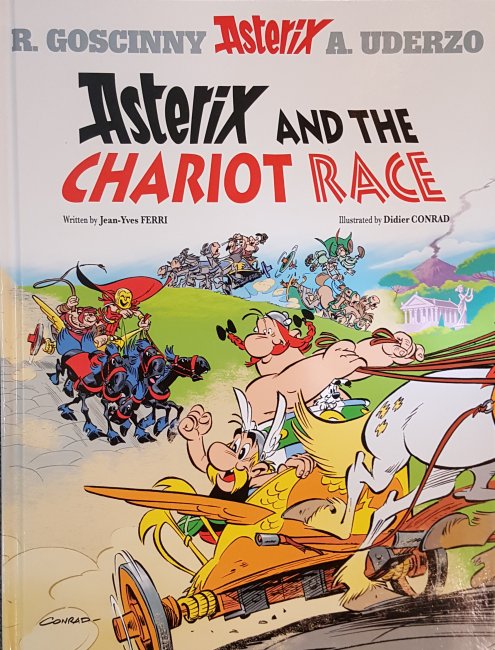
Asterix and the Chariot Race – Jean-Yves Ferri

This is not the book I was planning to post about this week as I am aiming to do a fuller story of the Asterix books later this year but I was doing a quick scan read to get my head round what I wanted to say and this book came up as extremely pertinent to the current world news, so I have added this short review.

20200317 Asterix and the Chariot Race 1

Now you may wonder why a book set during the time of Julius Caesar featuring a small tribe of Gauls would be so relevant to the present day and I will get to that but first a little bit about the series. The Asterix series of books started with ‘Asterix the Gaul’ written by René Goscinny and illustrated by Albert Uderzo in 1961 and now run to 38 volumes although now no longer by the originators. Goscinny  worked with Uderzo on the first two dozen titles until he died in 1977. Uderzo then wrote and illustrated a further ten books until 2009. In 2013 the first book written by Jean-Yves Ferri and illustrated by Didier Conrad appeared and this team have so far produced four titles of which this is their third (overall book 37) and was published in 2017. All comments below relate to the English translation of the text which was done by Adriana Hunter, this was her first time translating Asterix and overall I think she does a good job having taken over from Derek Hockridge and Anthea Bell, who between them translated the first 36 books.

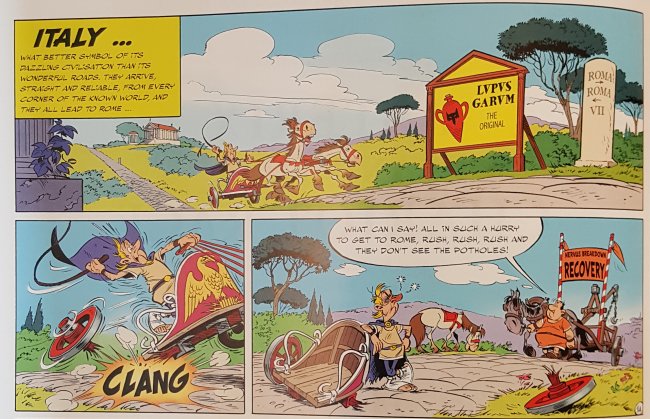
20200317 Asterix and the Chariot Race 2

The story starts with complaints about the state of the roads with potholes everywhere throughout the network in Italy. Consul Lactus Bifidus is challenged in the Roman Senate to do something about it as he is in charge of the roads but instead announces a chariot race to prove how good the roads are. The race is to be open to all comers and will start in the north of the country in what is now Lombardy and speed down to the south with a cup for the winner. Asterix and Obelix decide to enter even though neither of them are charioteers mainly because as the chief of their village, in the English translation he is Vitalstatistix, says

It might be fun bothering them on their home turf for once

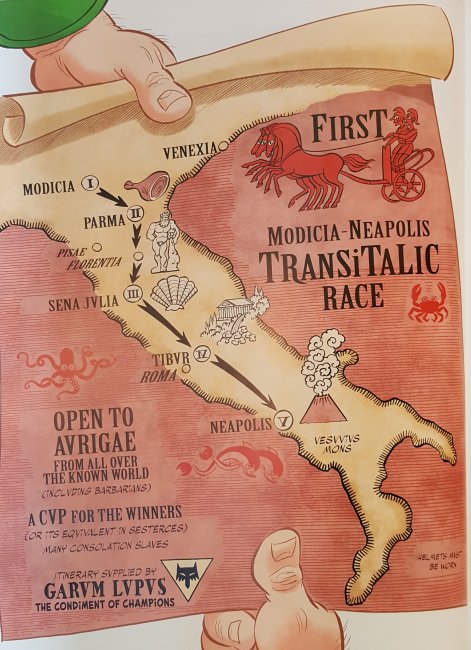
A lot of the names are changed in the English translations but I need to point out at this juncture that the significant one from this book is the same in the original French edition ‘Astérix et la Transitalique’. The route of the race can be seen on the flyer shown below.

20200317 Asterix and the Chariot Race 3

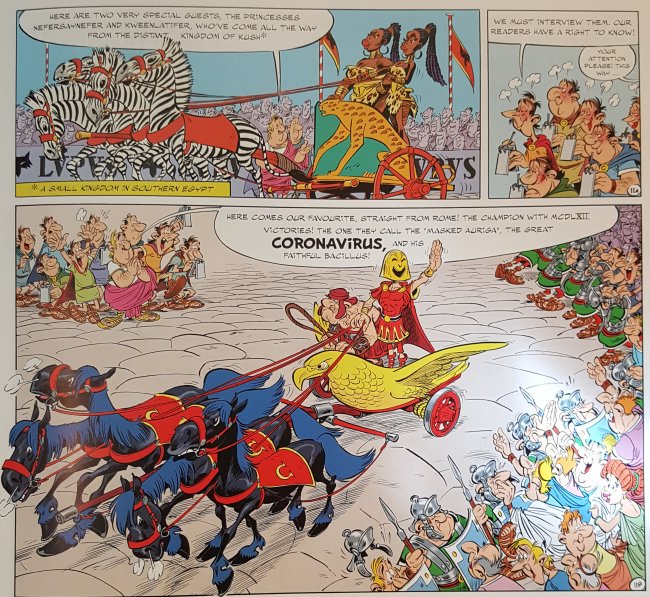
Lactus Bifidus is visited at home by the Emperor Julius Caesar and it is made quite clear to him that a Roman has to win or he will be personally fixing the roads in Libya which can definitely be seen as an incentive so he finds a great champion. Now this is where the book becomes a bit weird for those of us reading it in March 2020 as the name of the great charioteer is revealed and he is subsequently cheered on in very large text through the rest of the book.

20200317 Asterix and the Chariot Race 4

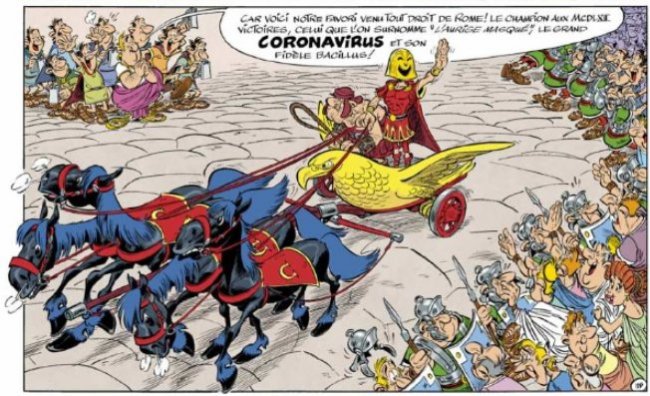
Yes you read that right, the person racing down Italy starting in Lombardy, for the honour of the Roman people, in a book published in 2017 is Coronavirus.  To prove that this is the original name and not one which Adriana Hunter came up with below is the original French panel.

20200317 Asterix and the Chariot Race 5

Stay safe everyone and let’s hope that things improve soon.