Tragically I was an Only Twin – The Complete Peter Cook

When I decided to review a book about Peter Cook this week I was faced with a dilemma, should it be ‘Something like Fire’ edited by his widow Lin Cook, or ‘Tragically I was an Only Twin’ edited by William Cook who is apparently not related to the great comic. Both books are wonderful tributes to Peter Cook who sadly died thirty years ago (9th January 1995) at the far too young age of just fifty seven. In the end I chose the second not because ‘Something Like Fire’ is the lesser book, it is a compendium of reminiscences and through that you learn a little more about what it was like to be with Peter Cook and it is of course extremely funny. But this book is a collection of his works, many transcribed from recordings as either there aren’t scripts existing anymore or in several cases there weren’t scripts in the first place, Peter’s genius lay in extemporisation. What this book definitely isn’t as a complete Peter Cook, that would be multiple volumes, but what is here is representative and whilst reading it I can hear Peter’s voice, especially in his guises of E L Whisty and Sir Arthur Streeb-Greebling or memorably with Dudley Moore as Pete and Dud.

The performances between Cook and Moore worked mainly because they rarely had a script or rather there was the basis of one which Dudley Moore would learn but Peter Cook wouldn’t despite having dictated it into his ever present tape recorder, relying instead on headlines to keep the performance going in the right direction. Cook would invent a lot during the double act which gave spontaneity to the shows and would often lead to Moore struggling to keep a straight face as some new brilliant line would strike Cook as a better alternative to what he should have been saying. That Dudley Moore could continue regardless is a mark of his acting abilities but it also left William Cook with a dilemma whilst compiling this book as there would be several different versions of a lot of the sketches so he had to choose which one should be included. There is a lot more to Peter Cook than his work on stage or on television and his writing for newspapers and the satirical magazine Private Eye, which he ran for many years, is also featured in this collection.

Sadly Cook did most of his best work in the 1960’s and 70’s only occasionally appearing after then and then only when he wanted to but when he did it was invariably superb. The one legged Tarzan sketch seen in the link is a classic and was originally performed in 1964 but this is a version from one of the Secret Policeman’s Balls in the 1980’s to raise money for Amnesty International. The real tragedy of this book is it highlights how much of the early material no longer exists, a lot of the 1960’s performances for the BBC were wiped when the BBC decided to re-use the master tapes so only records and tapes still exist and almost all of those are no longer available to purchase so this book is invaluable in preserving the work one of the great comic geniuses. Sadly I never heard his alter-ego Sven the Norwegian who would call in to a late night local radio show and would be so strange whilst talking about the Norwegian obsession for fish which had driven him from his home country without the radio host, at least at first, having any idea he was actually talking to Peter Cook. I did see the wonderful Clive Anderson interviews from December 1993, also included here, where Clive apparently interviewed four different, and distinctly odd, people in one show all played by Peter including a biscuit quality controller who had been abducted by aliens, a judge who shot a defendant in court, a football manager and an ageing rock star. Peter Cook’s performance in these was entirely unscripted and this was probably his last great appearance.

For those inspired to approach Cook’s work after reading this blog I feel I should warn about the language used in Peter Cook and Dudley Moore’s last collaboration, that of Derek and Clive. These sketches are deliberately littered with profanities and the two performers are often inebriated whilst coming out with this stream of consciousness. The coarseness of the language and the, at times, unpleasantness from Cook to Moore, who at the time (late 1970’s) was becoming successful in Hollywood just as Cook’s career was struggling sometimes makes these a difficult read but they are nevertheless very funny.

The Nutmeg Tree – Margery Sharp

If Margery Sharp is known at all nowadays it is of the creator of The Rescuers in a series of nine children’s books started in 1959, although a lot of people familiar with the two Disney animations of her stories about heroic mice may well not even know of the original books. The Nutmeg Tree precedes these by over twenty years, being first published in 1937 when Sharp was a well known author of novels for adults and this one is a romantic comedy. The story starts with the rather surreal position of Julia singing in her bath but without the usual reverberations, as it turns out that she is sharing the bathroom with most of her movable furniture, up to and including a grandfather clock, so she is somewhat disappointed with the acoustics. Now the reason she is in there with the furniture, and intends to be there for some time, is that bailiffs are in the living room, the other side of the door, and are looking for items to seize that could be sold to recover the money she owes as she is completely broke. Julia ultimately persuades the bailiffs to fetch the man running the pawnbrokers down the street and agrees to sell him the furniture in the bathroom sight unseen leaving her with a few pounds after clearing her debts. She needs the money as she has had a letter from her daughter, Susan, whom she hasn’t seen for years and is now living in France with her grandmother inviting her over in order to hopefully approve of her choice of husband.

Julia’s own first husband, and the father of Susan, had been killed during the first world war and after Susan was born they both lived with his parents for a while until the call of the stage and her old life drew Julia back to London and away from the frankly dull country life she was living. She left Susan with her grandparents as she would undoubtedly have a much better life with them as they were quite rich. They gave her the enormous sum of £7,000 in government stock (around £400,000 in today’s money) to set herself up as an independent woman and her first task on arriving in France is not to let on that she had frittered it away. Her various adventures in trying to hide the fact that she is now penniless and the interactions with Susan, Mrs Packett and Bryan (Susan’s intended) are where most of the comedic elements ensue as Julia recognises in Bryan a bit of herself and therefore is determined that he is not suitable for Susan. To add to the general confusion Julia had met a troupe of trapeze artists on the boat over to France and the senior brother had rather fallen for Julia and had asked her to marry him so was writing to her and then ultimately arriving at the house in France so she needed to explain him as well.

The book was adapted into a play in 1940 and then a film in 1948, which changed the title to Julia Misbehaves and altered the story quite a lot. The film starred Greer Garson as Julia and Walter Pidgeon as her now separated rather than dead husband and the young Elizabeth Taylor (aged 16) as Susan.

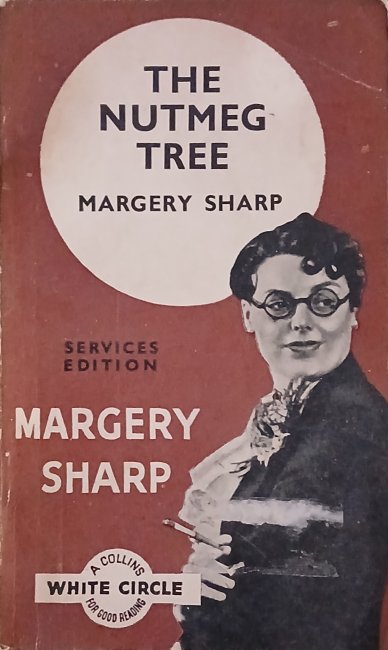
This edition was published by Collins in 1946 with a portrait of Margery Sharp on the cover as part of their short lived White Circle paperback range and is particularly notable as it is from the roughly 160 titles in this series also published as a Services Edition as explained on the rear cover, below. Most of the paperback printers during WWII printed Services Editions of books in their normal range, partly for patriotic reasons but also because doing so gave them access to more paper which was in short supply. None of them could be resold and should, in theory, be returned to the central book depot or passed on amongst the troops, as a consequence Services Editions are much sought after by collectors and when they are found are usually in fairly poor condition.

Carry On Jeeves – PG Wodehouse

There are times when only a PG Wodehouse will do. I’ve featured two of his books before on this blog, Summer Lightning back at the end of November 2019 and The Clicking of Cuthbert in September 2021, Summer Lightning is one of the Blandings Castle novels set in a stately home in Shropshire, whilst The Clicking of Cuthbert is a collection of short stories featuring golf. You can see from this description that there is a noticeable gap in my descriptions of the works of Wodehouse and that is the thirty five short stories and eleven novels that make up the Jeeves and Wooster canon. I do have all of these in three boxed sets from The Folio Society beautifully illustrated by Paul Cox, and I have chosen this book comprising of ten stories because it includes the appearance of the indomitable gentleman’s gentleman Jeeves into the life of wealthy dilettante Bertie Wooster. This story ‘Jeeves Takes Charge’, originally published in 1915, begins with Bertie very badly hungover when his new valet arrives from the agency:

I crawled off the sofa and opened the door. A kind of darkish sort of respectful Johnnie stood without.

‘I was sent by the agency, sir,’ he said. ‘I was given to understand that you required a valet.’

I’d have preferred an undertaker; but I told him to stagger in, and he floated noiselessly through the doorway like a healing zephyr. That impressed me from the start. Meadowes had had flat feet and used to clump. This fellow didn’t seem to have any feet at all. He just streamed in. He had a grave, sympathetic face, as if he, too, knew what it was to sup with the lads.

‘Excuse me, sir,’ he said gently.

Then he seemed to flicker, and wasn’t there any longer. I heard him moving about in the kitchen, and presently he came back with a glass on a tray.

‘If you would drink this, sir,’ he said, with a kind of bedside manner, rather like the royal doctor shooting the bracer into the sick prince. ‘It is a little preparation of my own invention. It is the Worcester Sauce that gives it its colour. The raw egg makes it nutritious. The red pepper gives it its bite. Gentlemen have told me they have found it extremely invigorating after a late evening.’

I would have clutched at anything that looked like a lifeline that morning. I swallowed the stuff. For a moment I felt as if somebody had touched off a bomb inside the old bean and was strolling down my throat with a lighted torch, and then everything seemed suddenly to get all right. The sun shone in through the window; birds twittered in the tree-tops; and, generally speaking, hope dawned once more.

‘You’re engaged!’ I said, as soon as I could say anything.

The hiring of Jeeves would prove to be the best thing Bertram Wooster would ever do and many a time Jeeves would get him out of terrible problems, often caused by Bertie’s friends although sometimes by Bertie himself. This book comprises of ten of the short stories an was first published in 1925 by Herbert Jenkins Ltd and as well as introducing us to Jeeves the stories are set around the first few novels. It isn’t necessary to have read the other stories before this collection although there are some spoilers regarding plots, most noticeably around Bertie’s interaction with the Glossop family which assumes that the reader is familiar with them. The odd thing is that although this collection includes the hiring of Jeeves, the collection of eighteen short stories (some of which were originally published in combination) in The Inimitable Jeeves was first published in 1923 and includes much of the appearances of Sir Roderick Glossop and his daughter Honoria whom Bertie gets engaged to twice only for Jeeves to successfully extricate him both times.

The other thing to bear in mind is that Wodehouse started writing about Jeeves and Wooster in 1915 and wrote his final novel about them, ‘Aunt’s Aren’t Gentlemen’, in 1974 so a spread of almost six decades but none of the characters age more than about five years over this period and the lifestyle of Bertie is firmly rooted in the 1910’s and 20’s. It also needs to be understood that the First World War doesn’t impinge on the books at all and it is easier to assume whilst reading them that almost the whole story line is set in the early 1920’s. The one obvious exception to this is the novel ‘Ring For Jeeves’ which is clearly set later and is the only Jeeves book which doesn’t feature Bertie Wooster.

Of the ten stories in ‘Carry On Jeeves’ four are set in New York where Bertie had taken refuge to avoid the wrath of his aunt Agatha and one in Paris where he is simply on holiday for a couple of weeks whilst the rest are in his native England. Wooster is sufficiently wealthy that he doesn’t have to work for a living so Wodehouse is free to place him wherever he fancies which includes hiring a house for an extended holiday by the coast. It is also clear that Bertie is not the brightest of chaps but then again neither are most of his friends, with the intellectual status being almost entirely given to Jeeves. Almost all the stories and novels are written from the perspective of Bertie but this collection includes the only one seen from Jeeves’s viewpoint ‘Bertie Changes His Mind’, where Jeeves is worried that he might be about to be let go by Bertie and is determined to make sure that this doesn’t happen. For Jeeves, despite his occasional disagreements with Bertie, largely over his sartorial choices, knows that his employer is one that is worth retaining especially compared to some of the others he has worked for.

I love the works of PG Wodehouse as his gentle comedies are invariably just the thing to brighten the day and they are beautifully written. You can read one of the various series such as Jeeves and Wooster, Blandings Castle or the Psmith stories or pick one of the numerous stand alone works that together comprise the around a hundred novels and collections of short stories along with over fifty plays and scripts that he wrote over more than seventy years, Indeed he was working on another Blandings novel when he died aged ninety three.

The Shakespeare Codex – Stephen Briggs

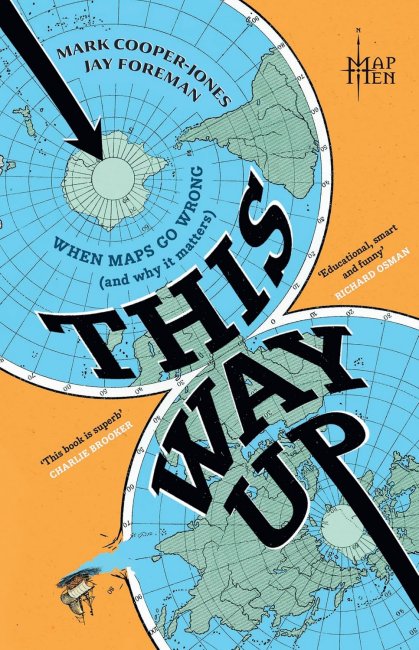
Based loosely on The Science of Discworld II: The Globe, Lords and Ladies and A Midsummer Night’s Dream, The Shakespeare Codex is a new Discworld stage adaptation written to commemorate Terry Pratchett’s life and works.

Pratchett and Shakespeare fans may also spot snippets from Maskerade, Wyrd Sisters, Richard II, Henry V, Hamlet and others as two worlds collide.

From the rear cover of the book

First published in 2021, but initially performed on 6th April 2016, this is Stephen Brigg’s first adaptation since Terry Pratchett’s death on 12th March 2015 and unusually takes as it’s base not one of Pratchett’s novels but the short novella written as part of the second Science of Discworld series which is used as the links between the science sections written by professors Ian Stewart and Jack Cohen. In the Science of Discworld series of four books the wizards of Unseen University accidentally create what they call Roundworld, but which is clearly our home planet of Earth, and then get involved in various adventures trying to keep it safe. In the case of book II this is to prevent Discworld elves taking over and involves Shakespeare as the man to write them eternally into fantasy and figures of fun and therefore no longer a danger, which he does in A Midsummer Night’s Dream. Briggs quotes extensively from Shakespeare’s plays with instructions to the actors taking the roles that these should be “played straight. Not hammy”.

As said in the quote from the rear cover Briggs has extended the source material beyond the Science of Discworld II and produced a play that works well even for non Discworld fans and which sold out through its first performances at the Unicorn Theatre in Abingdon, Oxfordshire where Briggs is part of an amateur dramatic company. He has been adapting Pratchett’s material since 1991 and these have been performed all over the world to apparently equally happy audiences. Despite this being the twentieth ‘Discworld’ play by him this is the first I have actually owned and read and it was very enjoyable with the mix of Shakespeare and Pratchett handled really well and plenty of the Bard’s own words to set it firmly in Elizabethan England.

The wizards are able to travel through time and ‘fix’ things that have gone wrong and which would prevent Shakespeare being born but they remain largely puzzled by this place where magic doesn’t work but despite which everybody there seems to believe it does work. They are also the only people able to see the elves as they spread their malevolent influence over the population although the Countess of Shrewsbury says to Queen Elizabeth at the end of the play that she could have sworn there was another Queen on the stage at some point so she clearly had seen, or at least sensed, the Queen of the Elves. Of course, all’s well that ends well, so to say and all does end well for the wizards and indeed for William Shakespeare whose new play making fun of the elves as silly fairies that try to interfere with mortal men but are ultimately defeated is a big hit with his audience.

As a final thought the Discworld librarian of the Unseen University is an orangutan (it’s complicated) and throughout the original book and this play is apparently successfully disguised as a Spaniard. I’m intrigued as to what nationality he is assigned in Spanish translations of the two books.

Porterhouse Blue – Tom Sharpe

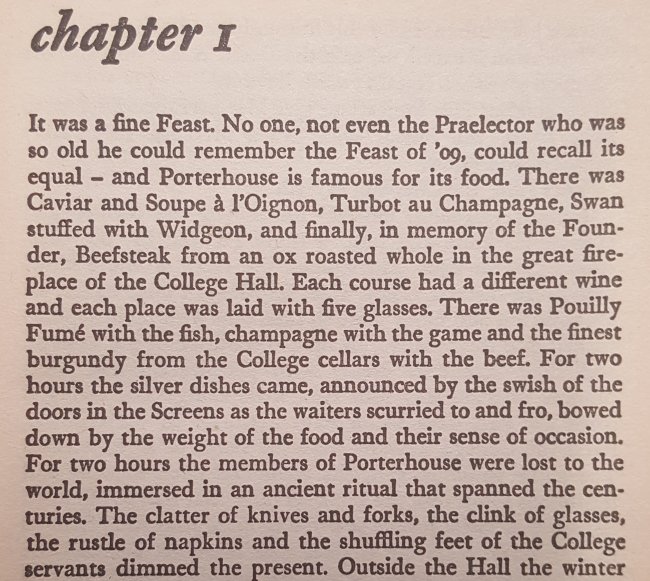
Porterhouse Blue was Tom Sharpe’s third novel and the first set in England after two mocking the apartheid regime in South Africa where he had lived from 1951 before being deported for sedition in 1961. Before going any further with the review however it is important to take note of the language used in a couple of early chapters and one later one, which can euphemistically be referred to as ‘of its time’ especially of the early 1970’s by a white person who had spent a decade in South Africa. It also probably goes some way to explaining why the book does not appear to have been in print for the best part of two decades in the UK. These three paragraphs aside the book is a fun read, with the conflicts, and other relations, between the characters driving forward the story. The opening paragraph sets the scene as the hidebound, male only, Porterhouse College with it’s tradition of big dinners, sporting prowess and low academic achievement has no idea what is about to hit it with the appointment of a new Master of College.

The new Master, Sir Godber Evans, has plans to shake up the old ways in this bastion of maleness; for a start he wants to be co-educational, start accepting students on the basis of academic qualifications rather than muscle for the rugby team and rowing crews, and horror of horrors turn the dining hall into a self service cafeteria run by outside caterers. More disastrous plans come to light, disastrous at least in the eyes of the senior faculty who quite like the big dinners, fine wines and a laissez-faire attitude to educational success that has characterised Porterhouse College for centuries. He must be stopped but how?

Another bastion of the traditions of the college is Skullion, the Head Porter, a role he has held for 45 years. It’s a job he is ideally suited for calling as it does for a total deference to ‘his betters’, i.e. the faculty, at least to their faces, a mindless application of the college rules especially where students are concerned and limited ambition. All these traits he gained in the lower ranks of the army along with fastidious attention to the shine on his shoes which he polishes daily as part of his fixed routine and which serves as a calming influence whenever he is upset. Being upset is going to be his standard position from the arrival of the new Master onwards and often with good reason. It is Skullion we follow more than any other character as the plot unfurls as he seeks to thwart the new masters plans with the help of former pupils known to himself as Skullions Scholars who he has helped pass their degrees by hiring capable students from other colleges to write essays or at the last resort sit the final exams for them.

There is another plot line, which barely touches on the main plot, and that is of Zipser, Porterhouse’s only research student, and the lustful feelings he has for Mrs Biggs his bedder, or servant who cleans and tidies his rooms in college. Mrs Biggs is a lady of mature years and large figure who not only realises Zipser’s desire but determines to reciprocate, Mr Biggs having passed away many years earlier. Zipser and Mrs Biggs storyline however reaches its climax just over halfway through the novel and only the aftermath is dealt with following that.

It’s worth pointing out the origins of the title. A Blue at Cambridge or Oxford is a person who has represented the university in a sporting event between the two universities and as Porterhouse is depicted as a sporting college then students from there would clearly be represented amongst the Cambridge Blues. But a Porterhouse Blue has another meaning as well and is down to the huge meals consumed there regularly and refers to the likely stroke that people with high blood pressure, cholesterol levels, obesity and probable diabetes brought on by such an unhealthy diet are likely to suffer from.

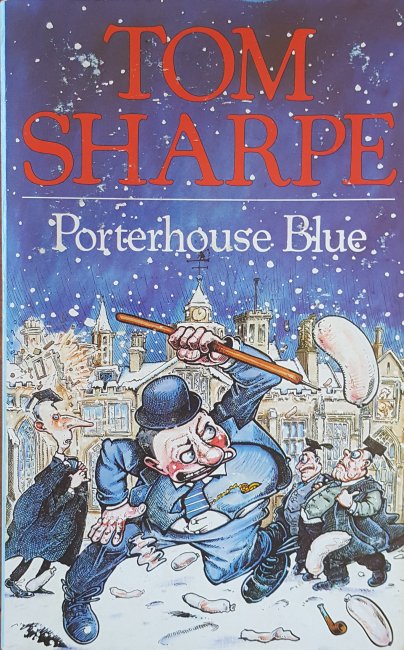
The book was adapted by Malcolm Bradbury as a four part TV series in 1986 starring David Jason as Skullion and Ian Richardson as Sir Godber Evans and that is how I first came across it. My copy is the 1976 first paperback edition with a cover illustration by Paul Sample which I bought second hand probably soon after the TV series was broadcast. The cover depicts one of the funniest scenes in the book as Skullion attempts to rid the college grounds of over 200 gas filled and highly slippery condoms in the middle of the night in a snowstorm. There is no way I’m explaining how they came to be there or the circumstances of their removal you’ll just have to read the book.

Clochemerle – Gabriel Chevallier

Just possibly the most fun book I have read this year, it is delightfully written with the author taking the role of narrator and introducing us to the small Beaujolais town of Clochmerle and it’s comical inhabitants in the way of a consummate storyteller. Every character and place is beautifully described, and at length, so that you can fully realise in your minds eye each and every one of them. It is the third in my August book theme of ‘translated from French’ and it has been an absolute joy to read even though it clocks in at 320 pages.

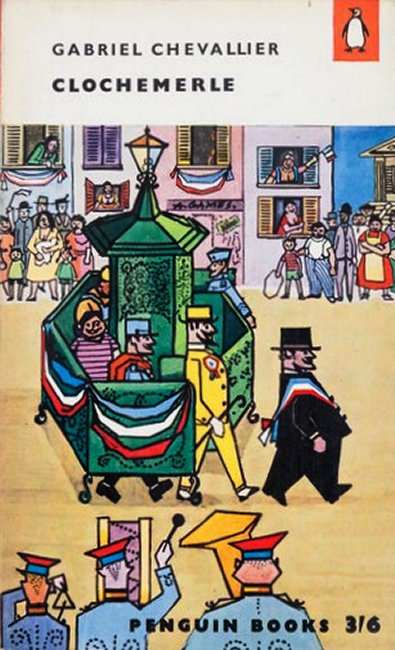
It all starts with the decision of the local mayor to bring progress to his sleepy town by building a public urinal and due to the odd geography of the place the best location is half way up the main street which places it firmly outside the church. Although not as indicated on the cover of this Penguin edition as it is placed not in the centre of a square but up against a wall adjacent to the Beaujolais Stores on an alley leading up to the church itself. To get a feel for the wonderful descriptions in the book let’s look at page one and the two men walking down the road from the square to where the urinal is to be situated.

One of these men, past fifty years of age, tall, far-haired, of sanguine complexion, could have been taken as a typical descendent of the Burgundians who formally inhabited the department of the Rhone. His face, the skin of which was dented by exposure to sun and wind, owed its expression almost entirely to his small, light grey eyes, which were surrounded by tiny wrinkles, and which he was perpetually blinking; this gave him an air of roguishness, harsh at times and at others friendly. His mouth which might have given indications of character that could not be read in his eyes, was entirely hidden by his drooping moustache, beneath which was thrust the stem of a short black pipe, smelling of a mixture of tobacco and of dried grape-skins, which he chewed at rather than smoked. Thin and gaunt, with long, straight legs, and a slight paunch which was more the outcome of lack of exercise than a genuine stoutness, the man gave the impression of a powerful physique. Although carelessly dressed from his comfortable, well-polished shoes, the good quality of the cloth of his coat, and the collar which he wore with natural ease on a week-day, you guessed that he was respected and well-to-do. His voice, and his sparing use of gesture were those of a man accustomed to rule.

And there we have a perfect pen-portrait of Barthélemy Piéchut, mayor of the town, a man of ambition to go far in the party and for which mayorality of a small provincial town was to be just a stepping stone. His fellow walker is Ernest Tafardel the schoolmaster and a far more devout republican than his friend although not destined to rise any higher than his current role. Against these two redoubtable men of the Third Republic there is the powerful Catholic Church although represented in Clochemerle by the Curé Ponosse a man who joined the priesthood for a quiet life and is definitely not the man for the crisis to come. However there is also the old maid, Mademoiselle Putet, full of religious fervour with nothing else to drive her forward now it had become quite clear she was destined to remain a Mademoiselle and untouched by the male sex rather than a married Madame. She it is that stirs up the trouble between the church and the state, initially over the urinal which as she lives by the church at the end of the alley where it is placed she sees as a personal affront to her dignity, but later as she interferes in the various goings on of the population.

The stage is set for a farcical ‘war’ between to two sides which is reflected in another conflict also in the location of the urinal between the two most attractive women in the town who run the Beaujolais Stores in the case of Judith and the bar of Torbayon in the case of Adéle which are directly opposite one another. Judith is well known for being free with her charms so to speak and Adéle flaunts hers rather than directly engaging in extra-marital affairs unlike Judith but this all changes when Judith’s particular favourite, who is staying at the Torbayon Inn, is taken ill and nursed by Adéle who takes advantage of his bed ridden state to discover exactly what she is missing in her own marriage. All this takes place in the long, hot summer of 1923 when tempers are getting frayed due to the heat and the annual fete is the cause of excessive drinking on all sides. The cast of minor characters is beautifully drawn and all have part to play in the ultimate fiasco and its resultant tragedy from the washerwomen of the lower town to the baroness in her chateau above the town, through the government officials more interested in cars and their private dealings and the military who can’t be bothered to intervene.

The book ends with an overview ten years after the calamities of 1923 by bringing us up to date with the happenings to most of the protagonists since then and all is well with most of them and the town now boasts three urinals, a great step forward indeed. There are apparently two sequels 1951’s Clochemerle Babylone and from 1963 Clochemerle-les-Bains both of which at least were available in Penguin so I can definitely see me hunting these out for future reading even if they are out of print which they appear to be.

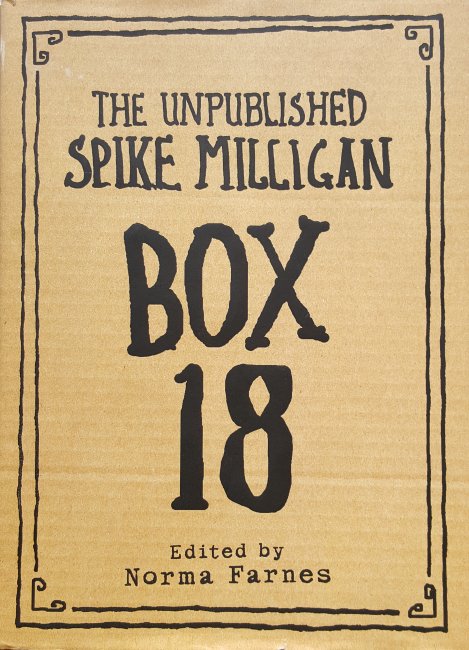
The Unpublished Spike Milligan Box 18 – Norma Farnes (Ed)

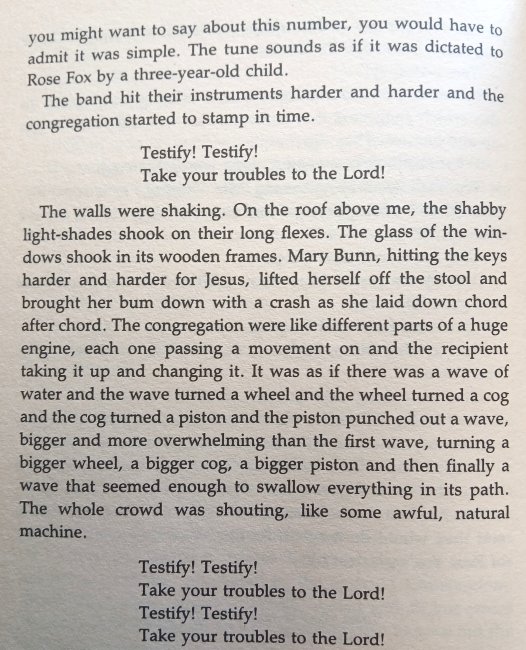
Norma was Spike’s agent, manager and friend for over thirty five years and as she explains in the introduction Spike had a comprehensive filing system based on numbered box files for work based items and lettered box files for personal things. Box 18 – IDEAS was a sort of dumping ground for things not finished or just ideas that would possibly be expanded later, every now and then he would go through it and pick out bits that he felt he could work on, sometimes they would go back in Box 18 untouched or partly modified others would make it through to completion, and some would just get discarded as unworkable. The problem with this book is that by definition anything in Box 18 was something that Spike didn’t regard as finished and frankly a large chunk of it shows why although there are definitely some gems hidden in here amongst the bits that really don’t work.

For those people reading this who aren’t familiar with the comic genius and deeply troubled man that was Spike Milligan he was born in 1918 and fought in Africa and then through Italy during WWII and was badly shell shocked during the conflict which would lead to frequent bouts of depression and more serious mental illness throughout the rest of his life. Despite this he was the leading light of 1950’s, 60’s and 70’s comedy in the UK as a founder and main script writer for the Goon Show and then his TV series Q which started in 1969. In fact in interviews included on the DVD’s of Q the Monty Python team recall seeing the first episodes and thinking that this was exactly what they had been planning, yet again Spike had got there first, The Pythons subsequently amended their format so that they didn’t appear to be copying Spike. He also wrote over eighty books including seven hilarious volumes of war diaries. Because of this pretty well everything that Spike thought should appear had done by the time of his death in 2002. I first came across his work whilst at primary school which a book of children’s poetry called a Dustbin of Milligan, I still have this rather battered due to being read almost to destruction paperback and have loved his writing ever since, still being able to quote the poems fifty years later.

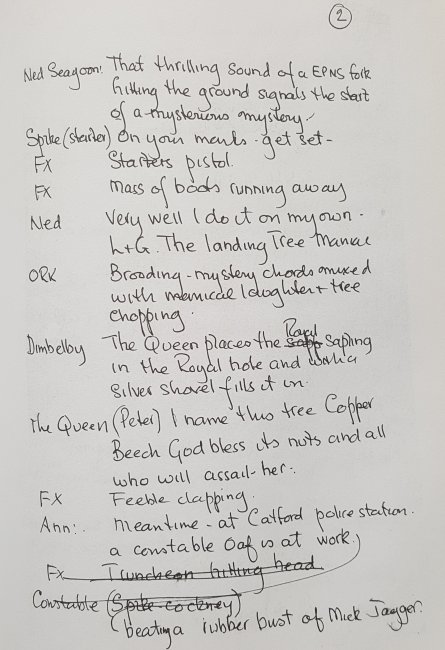
The photo above is of the Goons, Peter Sellars, Harry Secombe and Spike during what Norma believes is a rehearsal although clearly from the ages of the actors it was towards the end of their appearances together and one of the gems in this book is a script for a Goon show in Spike’s handwriting. You can see his mind at work with the crossings out and alterations, The Goons would be regarded as surreal even now, back in the 1950’s there was nothing like them anywhere but the pressure of not only appearing but also writing most of the material led to Spike having the fist of his manic depressive attacks which saw him frequently in mental hospitals from then onwards.

The final quarter of the book reproduces some of Spike’s letters and again you wonder why some were chosen although the spat with Harrods over a unpaid bill is somewhat amusing. This section, along with the first part which has pages of his diaries is also clearly not something that came from Box 18 in fact probably only about half of what is in the book could logically have come from the IDEAS box, the rest is abstracted from other files although a couple of diary pages are rather poignant as Spike is obviously going through a difficult time again

All in all this book is interesting for a Spike Milligan fan but there is so much more of his to explore for a newcomer to his work, definitely read the war diaries, or his numerous books of poetry but this is not the place to start. I must have over twenty of his books purchased over the years along with the DVD re-issue of the five series of Q and would recommend all of them ahead of this amalgamation of bits which has been sitting on my shelves for several years before I finally opened it this week, I think I need to pick up the diaries again to remind myself of what Spike’s writing properly finished to his own satisfaction could really be like.

Longhand – Andy Hamilton

Andy Hamilton is best known as a comedy script writer and actor for TV and radio and his shows have been a constant favourite of mine since he started in the 1970’s especially the BBC Radio 4 long running series Old Harry’s Game which he writes and stars in as Satan. Not a particularly obvious subject for humour but as always with Hamilton he finds a new way of looking at the character and that is what imbues him with comedy. In this book, his second novel, he takes another mythological character and brings him to life in a surprising way telling his story and allowing him to debunk a lot of the myth around him.

We first meet our hero, for hero he is even if he doesn’t like it and for reasons that swiftly become clear he shuns publicity as much as he can, frantically writing a very long letter to the woman he loves because he has to leave her and for the first time in thousands of years feels that he has to tell her why. As you can see below the joy of the book is that we get the letter, the whole book, all 349 pages of it, is handwritten, with crossings out and edits just as Malcolm would have written it.

The reader finds out almost immediately that Malcolm is actually Heracles and has lived for thousands of years always having to move on as firstly he never ages so starts to look odd to people who know him for a long time but secondly, and as it turns out more importantly, Zeus is determined he will never be happy and has tormented him throughout the millennia. The letter he writes to his darling Bess over a period of three days is funny yet also tragic; it is without doubt a love letter but also a confession and Hamilton handles the emotional roller coaster perfectly. I found myself reading late into the night as I simply didn’t want to stop finding out more about Malcolm and Bess and the ways that he tries to disguise his enormous strength and immortality from all those around them.

I have read many versions of the Greek myths so knew Heracles’s story but it isn’t necessary to know any of that before reading this book, Hamilton takes us right through the tales mainly so Malcolm can explain why they are so wrong and what really happened. It’s a brilliant idea and, to me at least, a completely original approach to mythological story telling, Malcolm is so ordinary because he has to be but his back story is one of wanton destruction and tragedy, he so despises that aspect of his early life and just wants to be ‘normal’. With Bess he has found that normality he craves but as the letter explains he is being forced to abandon the happiness he now has and at a truly awful point in time.

By the end of the book you are totally invested in the tragic love story of Malcolm and Bess, a tale that fit right in with the classical Greek mythology that Hamilton has mined for his characters’ source. We never hear from Bess in the whole book, other characters are reported verbatim but Bess is always heard through the medium of Malcolm’s letter as he explains what had just happened in the hope that she will forgive him. Fortunately we know right from the beginning that she does and that she still loves him as there is one other letter included right at the front and that is typewritten ostensibly from a firm of solicitors to the publisher. I read this first as that is where it is placed but rereading it after finishing Malcolm’s letter you understand it better.

The book is published by Unbound, a crowd funded publishing house, and I subscribed to it before Andy Hamilton even started to write, based partly on the pitch that he made on the site but also as a fan of his work over many decades I knew that he would produce something well worth reading and he has certainly delivered. As a subscriber I received a signed copy on publication and my name is in the list of around five hundred people who supported the work through to publication.