Tarzan at the Earth’s Core – Edgar Rice Burroughs

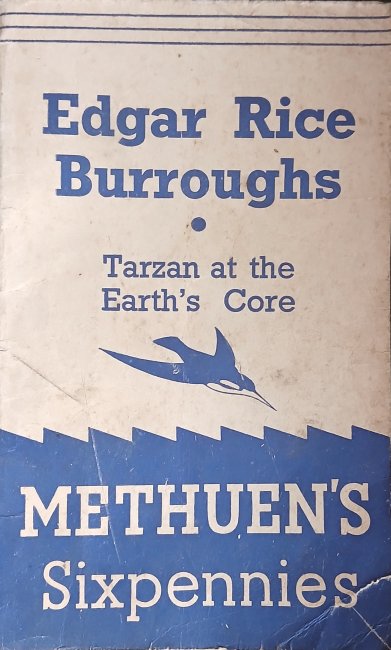
Inspired by last week’s book and author Michael Moorcock’s evident liking in that volume of the work of Edgar Rice Burroughs, along with my recent purchase of my first book by that author the intriguingly titled Tarzan at the Earth’s Core I just had to take it off the shelf and give it a go. I’ll come to why I bought the book at the end of this blog, it wan’t because of any particular interest in Burroughs or indeed Tarzan though.

I knew Burroughs had created Tarzan along with the science fiction works featuring John Carter of Mars but that was as far as my knowledge of him went. It turns out Burroughs was rather more prolific than I had imagined and amongst his vast output there were twenty six Tarzan titles of which this is the thirteenth and he also wrote seven books about Pellucidar, his name for a land hidden inside a hollow Earth and this crossover book is the fourth of those. Unlike Jules Verne’s ‘Journey to the Centre of the Earth’ or Bruce Carter’s ‘The Perilous Descent’ Burroughs has his Earth interior concave on an interior surface of the Earth five hundred miles below the surface we know with a central sun so it is always noon regardless of where you are. He does however have it populated by dinosaurs and primitive man like Verne does.

It was odd starting with Tarzan thirteen as the character is nothing like the one I remember watching as a child in films on television played by Johnny Weissmuller forever swinging through the trees and having little to do with civilisation. The Tarzan in this book is just as happy back in England as Lord Greystoke as he is in the jungle he grew up in, indeed when he sets off on the adventure he is sharply dressed in a suit and tie. The book however starts with Tarzan in the jungle coming across an expedition which was actually designed to find him and try to persuade him to join the plan to rescue the Emperor of Pellucidar from the hands of the Korsars, first though he has to have Pellucidar explained to him which is useful for those of us reading about this series of books for the first time. Needless to say he does go and brings along ten of the native warriors who regard him as chief and these along with numerous engineers and other staff set off on a huge experimental airship nine hundred feet (275 metres) long to fly to the north pole and find the entrance to Pellucidar. The hole is so large that they fly the airship down to Pellucidar and land to reconnoitre and the next morning Tarzan is seen leaving the ship dressed as he would normally be in the jungle and heading for the nearest trees.

This is of course where the whole plan starts to go wrong. Tarzan feels at home in the trees, so much so that he isn’t paying full attention to his surroundings, steps into a trap and is captured by a group of gorilla people. After a couple of days the crew of the airship are concerned that he hasn’t returned and a search party is organised consisting of officers from the ship and the native people Tarzan brought with him, these however get caught up in a ambush by sabre tooth tigers on the various prey species in the jungle. After the massacre has finished all the crew and native people appear to be OK but are now no longer together and they cannot find their way back to the ship due to the un-moving sun which ruins their sense of direction. Eventually those left at the ship, after a period of several more days decide to use the light aircraft they brought with them to search for the others but this ends up crashing so stranding yet another member of the party. The book tells the stories of the various groups as they survive and search for each other and the airship with the help and hindrance of various Pellucidar inhabitants and is a great adventure story if you allow for the errors regarding the prehistoric animals they meet. Unfortunately this searching for each other takes up so much of the book that the final denouement of the rescue of the Emperor is a bit of a rushed let down. That said I enjoyed the book, not enough to search out any more Tarzan or Pellucidar books, but it was a pretty good if rather dated read.

So why did I buy the book? Well it is all the fault of Jules Burt and an Instagram post of his where he talked about the difficult to find Methuen Sixpence’s, a very short lived attempt at being a competitor to Penguin Books, and that he had bought a complete run of the thirty seven titles from the Eric Gadd collection. This meant he had some spares which I then bought off him as I only had one example in my collection. Now I have enough to justify trying to complete the set myself even though I know they are rare due to poor quality wartime paper, they were published between 1939 and 1941, and not many of each title being printed in the first place. This explains the somewhat tatty condition of this example but frankly getting them in any condition is tricky.

Wizardry and Wild Romance – Michael Moorcock

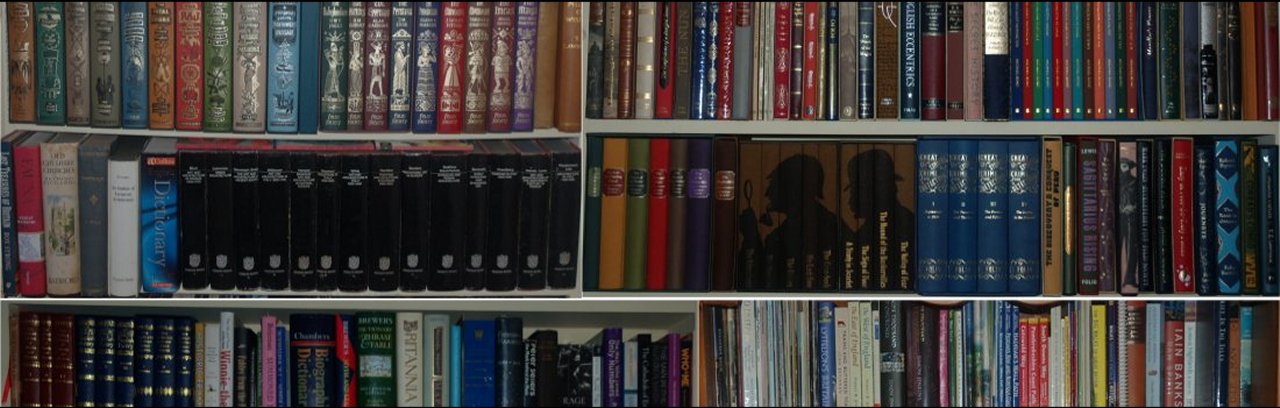
Michael Moorcock is a highly respected fantasy author, probably best known for his epic ‘Tales of the Eternal Champion’ which comprises 6,583 pages in the consolidated fourteen volume UK collection shown below from my own collection. Oddly due to copyright issues the UK set is missing two volumes which were only available in the USA whilst the fifteen volume USA set is missing one volume that was only available in the UK. As the design of the sets is very different I’ve elected not to seek out the two USA volumes and to stick with the UK set.

This book however is not part of one of his fantasy series but rather consists of six essays exploring the origins and development of epic fantasy, praising authors he likes and denigrating those that he doesn’t. A warning to fans of JRR Tolkien he doesn’t regard the Lord of the Rings as a serious piece of adult fantasy, the main clue is that the essay largely concentrating on this work is called Epic Pooh, but let’s get to that later on..

In the introduction Moorcock attempts to define his subject, tracing it’s sources back to Icelandic sagas, the Arthurian legends, Gilgamesh etc and the influences these had on the Romantic poets and Victorian novel writers such as Walter Scott and then leaping forward to HP Lovecraft. Personally I find both Scott and Lovecraft largely impenetrable, Moorcock also doesn’t rate Lovecraft describing him as “that somewhat inadequate describer of the indescribable”. The first essay is called Origins and as the title implies looks at the early days of epic fantasy. For me this was the least successful of the pieces in the book, largely because the authors and works he picks to illustrate his study are either ones I have never heard of let alone read, and from the descriptions they aren’t likely to be going on my reading list either. So whilst it added to my knowledge of the very early days of fantasy, we are talking the 1500’s to 1700’s here it largely felt as an exercise telling me what to avoid although the development of the Gothic novel was quite interesting.

However after this rather flat start the book improved dramatically as it started to deal with fantasy as I would more normally regard it. This is split into separate sections, looking first at fantasy landscapes and making the very reasonable point that if you don’t believe the lands that the characters inhabit you are far less likely to believe the stories they are involved in. Badly described geography can be a serious impediment to a readers enjoyment. Moorcock quotes extensively throughout the book picking good and bad examples of prose to illustrate his points. Having established the importance of somewhere for the heroes and villains to exist in he then moves onto character development looking at heroes and heroines in particular. The fourth essay deals with wit and humour, this is not just comedic fantasy or parodies but also introducing wit in the characters dialogue, an eternally dour character is probably going to be unlikable. It was at this point that I realised just how old this book is (1987) as he praises Terry Pratchett and says that Mort, the fourth Discworld novel had recently come out. This means that a lot of the ‘comic’ fantasy that has appeared in the last four decades are all after Moorcock wrote this work.

Now we get to ‘Epic Pooh’, Moorcock’s dissection not only of the works of Tolkien but also the Narnia books of CS Lewis and others of their ilk. I think I should start with a quote:

The sort of prose most often identified with “high” fantasy is the prose of the nursery-room. It is a lullaby, it is meant to soothe and console. It is mouth-music. It is frequently enjoyed not for its tensions but for its lack of tensions. It coddles, it makes friends with you; it tells you comforting lies. It is soft {here in the book is a quote from Winnie the Pooh} It is the predominant tone of The Lord of the Rings and Watership Down and it is the main reason why these books, like many similar ones in the past, are successful… The humour is often unconscious because, as with Tolkien, the authors take words seriously but without pleasure.

To be fair Moorcock does accept that at times Tolkien rises above his usual standard but quickly falls back in his failure to really explore the emotional background of his characters and almost completely ignores the character of Sauron seeing him simply as a force for evil with little explanation. But at least he is better then Lewis and here I have to totally agree with Moorcock. I find the Narnia books completely unreadable, and always have, mainly due to the ramming of the Christian message down the throats of its readers at every opportunity Lewis can find. It was only when I read this essay that I realised that I last read Lord of the Rings in my late teens so probably at the age that would most appreciate the work and before I read anything much better. I won’t go on, I do however suggest reading this book if you can find it as its been out of print for years.

A comprehensive, but witty survey… the perfect gift for any Tolkien fan you want to annoy

review in Time Out magazine

One fun bit to the book is the apparent source of the title, which is given at the start of the book as a line of poetry by a poet called Wheldrake in his poem The Elvish Rune from 1877.

And you love take my right hand,
Come from the faerie folks’ last dance:
And we’ll sleep and dream of Elfland,
Her wizardry and wild romance.

In fact Ernest Wheldrake was a creation of Moorcock’s and is regularly quoted by one of the characters in the novel ‘The End of all Songs’ which is the third part of ‘The Dancers at the Edge of Time’ the seventh compendium volume of The Eternal Champion series shown above. So the ‘inspiration’ for the title was a piece of poetry written for the book. This by the way is the only appearance of Moorcock’s own work in this volume, he deliberately avoids self reference.

Professor Branestawm’s Treasure Hunt – Norman Hunter

And now for some nostalgia, I first read this book along with the first book in the series ‘The Incredible Adventures of Professor Branestawm’ when I was in Primary school aged about seven or eight years old. I never actually owned a copy of either book, simply reading the ones in the school library, but the other day I came across this copy, dated 1966, which is the same as the version I first read all those years ago at the end of the sixties. I had to have it and see if childhood memories of loving the books were anywhere near as good as with Elleston Trevor’s ‘Where’s Wumpus’. Sadly the adult me found the book a bit of a curate’s egg (good in parts) and some parts have not dated very well, but when it was good it was great fun.

For those unfamiliar with the absent minded professor and inventor of crackpot inventions Branestawm would be partly great fun to meet but also a complete danger to anyone around him as his inventions not only invariably go wrong but also quite frequently do so in catastrophic ways, often explosively. His jacket is fastened by safety pins, having lost its buttons many years ago, and he wears five pairs of spectacles, one set is specifically for looking for the other four whenever he loses them, which is frequently. His housekeeper, Mrs Flittersnoop, is often to be found residing at her sister Aggie’s house when the professor’s home has been rendered uninhabitable by one disaster or another. In this book one of the stories concerns the house burning down, amazingly not caused by one of Branestawm’s inventions but not helped by him trying to put the fire out by trying to smother the fire with a rug, which promptly caught fire, adding to the conflagration, and then throwing alcohol on the flames which of course made everything worse. This leads to him trying to invent automatic fire alarms which prove to be so sensitive that even the mayor’s cigar sets them off and the professor ultimately having to move in with Mrs Flittersnoop’s sister as well because so little of the house is still standing. Other regular characters are Colonel Dedshott of the Catapult Cavaliers who is always to be found in full regimental dress uniform complete with jangling medals, Mr Chintzbitz the owner of the furniture shop and Doctor Mumpzanmeasle, these names giving a hint of Hunter’s love of word play, which can sometimes get in the way of readability as you try to work out just what you have actually read.

‘The Incredible Adventures of Professor Branestawm’ was first published in 1933, whilst ‘Professor Branestawm’s Treasure Hunt’ originally came out in 1937, there then was a long hiatus before book three was released in 1970, with a further eleven being written between 1972 and 1983. I suspect the reprinting of the first two books by Puffin in 1947 and 1966 respectively and especially the subsequent 1969 television adaption did a lot to revive the character and prompt Norman Hunter to write more. I’ve never read any more than the first two and indeed didn’t even know they existed until I came to research this blog. Norman Hunter was born in 1899 and died, aged 95 in 1995

Haroun and the Sea of Stories – Salman Rushdie

The start of the trial of Hadi Matar on the 10th February 2025 for the attempted murder of Salman Rushdie in August 2022 prompted me to go back to the shelf of Penguin Drop Caps volumes far earlier than I planned, as I knew that there I would find Haroun and the Sea of Stories. This novel for children was Rushdie’s first published work after ‘The Satanic Verses’, which had led to the fatwa declared against him by Ayatollah Khomeini of Iran for blasphemy and which almost certainly inspired Matar, a twenty seven year old American of Lebanese descent, to attack Rushdie almost killing him, stabbing him fifteen times, leaving him blind in his right eye, with a severely damaged hand and multiple other injuries. That the novel was published ten years before Matar was born and that Iran had said the fatwa would not be enforced also before he was born seems not to have affected Matar who admitted he had only read a few pages; and Rushdie had said that he was at last leading a relatively normal life without protection in an interview just two weeks before the attack. Still enough of the context as to why I picked the book up, let’s look at this wonderful fantastical story which I hadn’t read before.

Rushdie had me hooked from the opening lines of this novel:

There was once in the country of Alifbey, a sad city, the saddest of cities, a city so ruinously sad that it had forgotten its name. It stood by a mournful sea full of glumfish which were so miserable to eat that they made people belch with melancholy even though the skies were blue.
In the north of the city stood mighty factories in which (so I’m told) sadness was actually manufactured, packaged and sent all over the world, which never seemed to get enough of it. Black smoke poured out of the chimneys of the sadness factories and hung over the city like bad news.

It goes on to say that most places in Alifbey had just one letter as their name so there is the town of G and the nearby valley of K nestled in the mountains of M, this means that lots of places had the same name and therefore post was often delivered to the wrong place. In a helpful couple of pages at the back of the book Rushdie explains that the name Alifbey is based on the Hindustani for alphabet and that another destination on the journey of our heroes, for what sort of children’s book doesn’t have heroes even unlikely ones, is The Dull Lake “which doesn’t exist, gets its name from The Dal Lake in Kashmir, which does”. Rushdie was born in India and lived there until he was seventeen and takes a lot of inspiration in his writing from his youth. I have mentioned our heroes and they are Rashid Khalifa and his son Haroun, these are named after Haroun al-Rashid the legendary Caliph of Baghdad who appears in the Arabian Nights stories. Rashid is the happiest man in the very sad city and is renowned as a storyteller gaining the titles of The Ocean of Notions or the Shah of Blah because he could keep telling tales without repeating himself, weaving stories together without ever losing the intricate plots and therefore whenever he spoke he would draw huge crowds. This made his especially popular with politicians trying to get people to listen to them as elections approach as he could start the rally and pull people together from the surrounding area.

But one day disaster struck, the flow of stories just stopped, Rashid couldn’t string two words together and this was at the start of a tour arranged by politicians so it was vital that the reason was discovered. The second night of the trip saw Rashid and Haroun on a boat on The Dull Lake where Haroun encounters Iff the Water Genie who had come to disconnect the invisible tap that linked Rashid to the Sea of Stories, the source of all his tales. In vain Haroun argued that it was a mistake but finally he convinced Iff to take him to the Earth’s invisible second moon, Kahani, so that he could meet the leader of the Eggheads and appeal for Rashid’s tap to be reconnected. Travelling on a giant mechanical Hoopoe called Butt they arrive on Kahani and find the Ocean of Stories is heavily polluted with the stories dying off so Haroun then has to find out what is causing the pollution and stop it. Along the way he finds Rashid has also made his way to Kahani and has his own quest to undertake.

The book is a wonderful adventure story full of linguistic jokes, like the talking fish with lots of mouths which are called the Plentymaw fish in the Sea and the Pages, or soldiers, arranged into chapters and volumes instead of companies and battalions. It is split into twelve chapters, each no longer than fifteen pages so ideal to be read as to a child as a bedtime story over a couple of weeks. I loved the book and it was so different to the other book by Salman Rushdie I reviewed on this blog back in 2019, The Jaguar Smile. I also have his second novel, Midnight’s Children, which was his first best seller, hopefully I won’t wait another five and half years before reading that.

You can find more about the Penguin Drop Caps series in my overview here, which also includes links to the various books I have reviewed from this set of twenty six books.

The Stainless Steel Rat – Harry Harrison

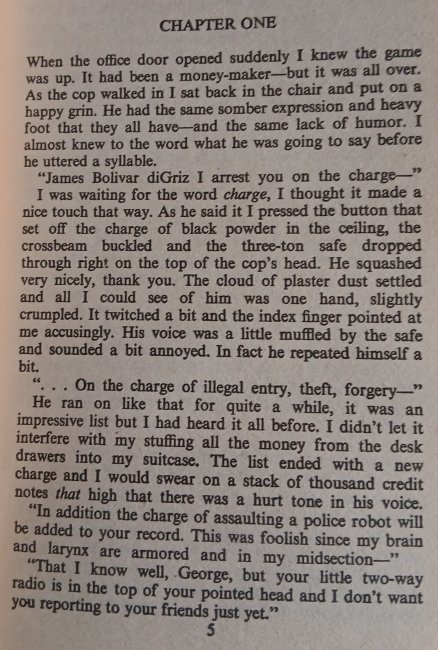
A few weeks back I featured a book written by Harry Harrison ghost writing as Leslie Charteris in the first ‘Saint’ book written by someone other than Charteris and that prompted me to look on the shelves for something where Harry Harrison was properly credited. That led me to a series of books I bought, and probably last read, back in the mid 1980’s and Harrison’s most famous creation The Stainless Steel Rat. There are a dozen books in the series and this was the first, it is based on a couple of short stories originally published in Astounding magazine in 1957 and 1960 which were linked and expanded to make the novel in 1961. The best way of introducing the character of Slippery Jim diGriz, alias The Stainless Steel Rat is to read the opening page of this book.

I like the way it is only revealed that the policeman is a robot after the safe is dropped on him, in fact The Stainless Steel Rat is proud of the fact that for all his criminal escapades he has never killed anyone. The stories are set in the distant future and on various planets far from our own, this is pure science fiction fantasy with a heavy dose of humour mixed in for good measure. As is stated in the page shown DiGriz is a career criminal, something of a rarity in this version of the future where children are scanned for any tendency to not be upright law abiding citizens and ‘corrected’ before adulthood. The crime he was committing at the beginning of the book was a simple one, rent a warehouse next to a government storage site, which is full of food but intended for emergencies so rarely visited, cut a hole in the wall and help himself to the goods, relabelling everything so it isn’t obvious it has come from the next door building. Using robots to do the work meant he could keep the money rolling in 24 hours a day without having to do any menial work himself.

Escaping from the police raid using a carefully planned route DiGriz soon starts another caper, this time the theft of an armoured car carrying the takings from a large department store, this is done in quite an ingenious way but this time someone was out thinking him every step of the way and he finds himself trapped. This is his first encounter with Special Corps, an interstellar police service headed by Harold Inskipp, who was a legendary criminal before DiGriz turned to crime and was assumed to be locked up somewhere as he hadn’t been heard of for years, instead he had been recruited to run Special Corps and now he wants DiGriz to add his special talents to the organisation.

I won’t go into too many details of the plot, it’s quite a short book, just over 150 pages, and can be read quite quickly, suffice to say that in the course of the novel DiGriz meets his future wife and mother of his twin sons although this won’t happen until the next book ‘The Stainless Steel Rat’s Revenge’, I have half of the Stainless Steel Rat books along with several other books by Harrison including one of his few books not to funny, Make Room! Make Room! which would be loosely adapted into the superb dystopian 1973 film Soylent Green, a very early warning on the dangers of the greenhouse effect and overpopulation. I have to admit that I prefer Harrison as a comedic writer with a strong streak of anti-authoritarianism thrown in.

Paint Your Dragon – Tom Holt

Chosen by way of a comedy interlude between two serious works, I actually have no memory of acquiring this book although I suspect it was part of a job lot of second hand fantasy novels I bought in the early 2000’s most of which have been read and passed on to other people who might be interested. This is the only book by Tom Holt I own, although he has written over seventy novels along with numerous novellas and short stories in his own name and that of K J Parker since giving up his original job as a solicitor in Somerset. As I have probably owned this book for a couple of decades it seems only right to finally read it especially when I read the back cover and it sounds intriguing…

To my surprise this retelling of the George and the dragon story is largely set in modern day Birmingham (England not USA). The local council has commissioned renowned sculptor Bianca Wilson to create a grand statue for the square outside the town hall and much to her amazement she finds herself selecting George and the dragon as the subject, very different to previous works of hers. It’s as though she is being led into the subject, and that’s because she probably is. One of the main premises of the book is that it is possible for the dead to inhabit a statue and effectively come alive again with the statue returning to flesh and blood when it is possessed. The first inkling that Bianca gets that something is amiss is when she and her friend Mike arrive in her studio one morning and on the plinth is just St George, several tonnes of Carrara marble in the shape of a dragon has vanished overnight with no trace of the mechanical equipment that would have been needed to cut it from the plinth or lift it onto presumably a flat bed lorry. Even more oddly the next day the dragon is back and George goes missing and there is a bit of toing and froing over the following days before both statues disappear. In the meantime we are introduced to some more protagonists, to wit five demons that got left behind in the Cotswolds region of England on their way on holiday from Hell to a country music event in Nashville.

I really enjoyed the interplay between the demons, one of which is female and is attracted to the effective leader of the stragglers much to his obvious concern and the situations they get into when they get recruited by St George to help him win the big rematch with the dragon, because who says the saint has to be the good guy after all? The other main characters include Chubby who makes his money selling time to people who need it along with his worryingly sentient computer and Kurt, a professional hit-man who may or may not be dead already. Holt manages to keep the various sub-plots moving at a rapid pace but not so that you lose track of who is doing what, where and why and I loved that the most likeable characters are the least obvious contenders for that position and that St George is clearly a nasty piece of work who apparently won the first contest with the dragon due to a fix with a gambling syndicate so you are rooting for the dragon almost from the start of the book.

I really enjoyed this book and am now surprised I haven’t any more works by Tom Holt. From the evidence of this book he seems to fall into much the same comic fantasy genre as Robert Rankin with unbelievable things happening in a fully believable modern setting.

Artemis Fowl – Eoin Colfer

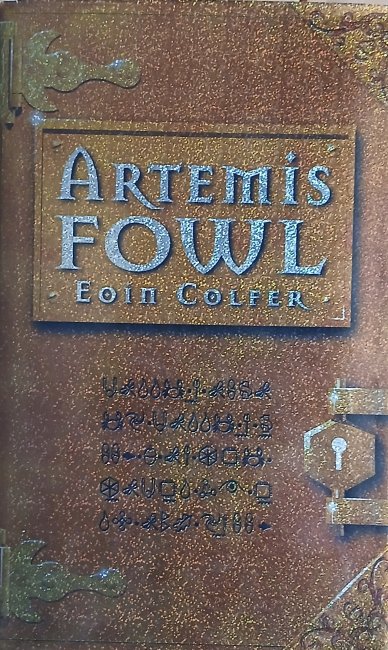
This is the first of an eleven book series written by Irish author Eoin Colfer, eight of which are about Artemis Fowl II and in the final three books, which are effectively a reboot, his twin younger brothers. My copy is a hardback from the first year of publication, 2001, and has a metallic, highly reflective dust jacket which made it very difficult to photograph. Later editions retain the gold colouring but are not metallic. At the start of this book is an introductory prologue which finishes as follows:

Artemis Fowl had devised a plan to restore his family’s fortune. A plan that could topple civilisations and plunge the planet into a cross-species war.
He was twelve years old at the time…

This last line, more than anything else in the prologue, establishes that we are in the literary genre known as young adult, which is not a area I have explored on this blog for a while so please be aware that this book is not aimed at me as a typical reader. Having said that I quite enjoyed this, and the next two books which I have also read, I have also discussed the series with other people who first read the books whilst they were within the target age range of roughly twelve to eighteen to obtain a more rounded viewpoint.

Artemis’s father is missing, presumed dead and his mother has become a barely functioning recluse in the attic triggered by her grief for her missing husband, this leaves Artemis without parental supervision in his parents large house in Ireland with only his mountainous bodyguard, deliberately confusingly called Butler and Butler’s younger sister Juliet. There are presumably servants but they don’t appear in the narrative. The family money was built upon criminal enterprises and Artemis is definitely a chip off the old block but he believes he has found a target for his genius beyond the jurisdiction of the Irish Gardaí or indeed any normal police force, his plan is to get money from the fairy world by obtaining their legendary supply of gold. And so we are entering the realm of fairies, elves, dwarfs, trolls and other magical creatures but not as imagined by Tolkein, Pratchett or others who have raided mythology for their characters modifying them to suit their plots. Here the changes are if anything more radical, dwarfs chew their way through the earth having first dislocated their jaws and expelling the residue via what can most delicately be called their opposite end having first dropped the flap in their trousers. That Butler at one point is in the way of a cataclysmic fart from Mulch Diggums. the kleptomaniac dwarf, is clearly there to appeal to the younger readers who by and large can never resist a fart joke. Elves are approximately a meter tall and one of the books major characters, Holly Short, is one of those, she is also part of LEPrecon, part of the police force for the fairy peoples who are now forced to live deep underground to avoid the Mud People as they refer to humans. Colfer explains that LEP stands for Lower Elements Police a somewhat tenuous forcing of the word Leprechaun into his plot line.

I’m not going to go into the plot of the book, suffice to say that Artemis has quite an ingenious plan to part the fairies from their gold which first involves deciphering their language, a sample of which is on the cover and which is also depicted on the base of each page of the novel, as far as I can tell differently on each page. The story moves on at quite a pace and I found myself at the end of the 280 pages far quicker than I expected. I mentioned at the beginning that I have read the first three Artemis Fowl books and talking to my friends who read them as teenagers I’m told I shouldn’t go much beyond about book five as they reckon that the plots get a bit similar as though Colfer was running out of stories to tell with these characters. One friend has read the first of the Artemis twins books but didn’t feel the urge to read the others, which I think says a lot, so by all means have a go at the early books as a bit of light reading between more weighty tomes but probably skip the later ones.

42 – edited by Kevin John Davies

Fifteen years was a long time to be stranded anywhere, particularly somewhere as mind-boggingly dull as Earth.

Douglas Adams – The Hitchhiker’s Guide to the Galaxy

OK, I haven’t spent fifteen years on this book as it only came out in 2023 but sometimes it felt like it, which is odd as Adams is one of the funniest writers I know of but this book seems to have things included just because it seemed a good idea at the time and the material was too hand. Things like his old school reports, although why on Earth Douglas still had those is beyond me, mine were binned years ago. Lots of the handwritten documents are transcribed, even if they are perfectly legible, but annoyingly the notes for Douglas’s first Doctor Who script, ‘The Pirate Planet, are not transcribed and I really struggled to read those so could have done with a typed version. The book looks great though with hundreds of documents from the life and career of Douglas Adams reproduced in pretty well chronological order so you can follow his development as a writer and also marvel at the mass of material represented here, the man doesn’t seem to have ever thrown anything away. From letters of apology to girlfriends to odd notes on ideas which may or may not have been used at some point to pages from scripts showing ideas being rejected or improved frankly it should have been more fascinating than I found it to be.

Douglas Adams was sadly taken from us at the age of just forty nine, dying of a heart attack whilst working out in gym so we never got to see what he would really have done with his unfinished work ‘The Salmon of Doubt’. It was intended to be the third Dirk Gently book but according to this volume it could have morphed into the sixth Hitch-Hikers novel. The problem with Adams was that he used to take an inordinate amount of time crafting each of his books or scripts and often would only actually complete something when absolutely forced to and as quoted in the posthumously published ‘The Salmon of Doubt’ which included what he had written so far along with various other articles by Adams and others.

I love deadlines. I love the whooshing noise they make as they go by.

Having said all I have earlier regarding the selection and sometimes presentation of what is included there is nevertheless much to enjoy in this book including a lot of not very well known material in the later sections detailing Adams’s work on the computer game Starship Titanic and his environmental endeavours with naturalist Mark Carwardine and also the charity Save the Rhino. Whilst I knew about and loved the radio programme, and book, he and Carwardine made called ‘Last Chance to See’, where they travelled the world looking for endangered animals I wasn’t aware before reading this of just how involved Adams had been with Save the Rhino. His involvement with rock band Pink Floyd was also a surprise and I would have loved to see the projected Millennium work outlined in this volume which I knew nothing about.

All in all this is probably a book for dipping into rather than reading from cover to cover and I’m sure I’ll enjoy reading sections again in the future but won’t attempt to read the whole thing again. It is also large (30cm x 21.7cm and 320 pages) and heavy (just over 1.8kg) so not a very comfortable book to hold, but it needs to be that big to reproduce the documents at mostly full size.

The editor certainly knows his stuff and worked on numerous projects with Adams over the years, from designing the Illustrated Hitch-Hikers Guide and directing for the BBC the documentary ‘The Making of the HItchhikers Guide along with a retrospective of the first thirty years of Doctor Who. The book is another crowd funded production by Unbound of which I have several examples now and will undoubtedly get more as they keep coming up with interesting production ideas.

A Stroke of the Pen – Terry Pratchett

The first of the books I received for Christmas to be reviewed is this collection of stories written by Terry Pratchett whilst he was still learning his trade as a writer and working as a journalist for the Bucks Free Prres in Beaconsfield. These stories however were mainly written for the Bristol based Western Daily Press so Pratchett wrote under the pseudonym of Patrick Kearns, Kearns being his mothers maiden name. The stories were rediscovered by Pat and Jan Harkin during a massive trawl through the British Library newspaper archive in search of a story they knew existed ‘The Quest for the Keys’ and in doings o they came across the other works by an unknown writer Patrick Kearns that sounded and felt familiar as they used places and characters from the tales written by Pratchett for the Bucks Free Press under the name of Uncle Jim which have now been collected in four volumes, the fourth coming out after I wrote my original review of those books. Apparently the fourth book is to be the last but ‘A Stroke of the Pen’ adds another twenty short stories by the young Terry Pratchett for us to enjoy and yes they do feel like the Uncle Jim stories and indeed one of them, ‘Mr Brown’s Holiday Accident’ did originally appear in the Bucks Free Press as by Uncle Jim.

The scale of the archive work done by the Harkin’s can only be appreciated when you know that despite being very short each of the stories were published in multiple parts with the longest, and the only one to be credited to Terry Pratchett in the Western Daily Press, being ‘The Quest for the Keys’ which appeared in thirty six individual sections from 30th July to the 13th October 1984. Also nobody knew about Patrick Kearns as a pseudonym so it was only the style and content that tipped them off that here was an until then unknown source of Terry Pratchett works. Also although ‘The Quest for the Keys’ was known to exist, because of the way it was clipped from the newspaper and saved the dates and indeed the newspaper which printed it were lost so they had to go through four possible newspapers archives from the earliest probable date (1972) up until 1984, when Terry’s first Discworld novel, ‘The Colour of Magic’, was printed, in their search. Fortunately they decided to work forwards rather than back or they would have found ‘The Quest of the Keys’ a lot quicker and probably not stumbled on the works of Patrick Kearns.

Enough of the history, what of the stories themselves? Well I love the Uncle Jim stories and these are more of the same, indeed there are a couple of reworked Uncle Jim tales under the name of Patrick Kearns which provides confirmation, if any was needed, that this is indeed the same author. The first story included is clearly inspired by Roy Lewis’s ‘The Evolution Man’ with its stone age man main character discovering major advances such as fire. My personal favourite of the ones in this book however is ‘The Fossil Beach’ in which the curator of Blackbury museum is taken to the beach by a local geology student where they find a fossilised deckchair, radio and a copy of today’s newspaper in the mouth of a small dinosaur. How these all got there is a mystery they are determined to solve. Pratchett is clearly already a very competent fantasy writer by the time he wrote as Patrick Kearns, not as good as he would become but definitely worth reading.

Sadly I cannot recommend this hardback book as it currently exists, as it has been announced that there is a story missing from it which Colin Smythe, who had commissioned the Harkin’s to undertake their quest, accidentally omitted when he sent the text to the printers which means that the paperback, due out in April this year will be the complete book and anyone who has the hardback first edition, like mine, will have to buy the paperback as well in order to read the missing tale.

Neverwhere – Neil Gaiman

The third of The Folio Society’s editions of Neil Gaiman’s greatest works, after American Gods and Anansi Boys, is the first one I have purchased as I already have very nice editions of the first two. However I had somehow not actually read Neverwhere, although I was familiar with it having listened to the 2013 radio play version several times. Whilst reading Neil’s ‘Introduction to this text’ I was surprised to discover that it had originally been a BBC TV series back in 1996 which I had completely missed and that Neil wrote the original novel partly so he could save the bits he liked that were either impossible to film within the constraints of the budget or were subsequently being cut from the show. He further expanded the book and removed some of the more obscure London references for a later international version and the version here is what is now known as the ‘Author’s Preferred Text’ where in 2006 he went back to both earlier iterations and merged them, bringing back the bits cut and also writing yet more new text to blend them seamlessly. The cast list for the radio adaptation, which was my first introduction to the book, is frankly amazing as can be seen in the Wikipedia entry for it and it was because of this when it was announced as a title for this years Autumn/Winter collection by The Folio Society I bought it immediately.

Neverwhere is a dark fantasy set in London Above and London Below, Richard Mayhew is an ordinary office worker but one evening on his way to restaurant for a meeting with his fiance and her boss finds an injured girl lying on the pavement. Ignoring his girlfriend’s insistence to just leave her as they are already late for the meal he instead decides to take her back to his home when she refuses medical assistance. Later his fiance calls to break off their engagement but by then Richard’s life has changed completely for the girl is a lady from one of the great houses of London Below and he is now irrevocably caught up in her escape from assassins sent to wipe out her family and her plans to avenge them.

London Below is a hidden place from almost all the inhabitants of London Above, partly on the tube lines, partly in the sewers, partly on the rooftops of London as we know it and partly in huge caverns invisible to those above. Door, for that is the girls name, needs help to escape from the murderous Mr Croup and Mr Vandemar and asks Richard to find the Marquis de Carabas with the assistance of the Rat Speakers. A lot of the character names seem very familiar to anyone who knows London, an aged man living on the rooftops is Old Bailey, Earls Court rides a tube train in a carriage that nobody seems to notice and which resembles a medieval court inside. There is also the scary Night’s Bridge where people disappear into the darkness and the realm of The Black Friars. One touch I particularly liked was The Floating Market, which moves around London Above completely invisible to the people there. Richard first encounters it in Harrod’s then later on it is on HMS Belfast, this is a place for the inhabitants of London Below to gather with a truce between all peoples.

This version of the book also includes the follow up short story ‘How The Marquis Got His Coat Back’, written in 2014, which introduces the very dangerous Shepherds of Shepherds Bush and the Elephant who controls Elephant and Castle. It has also been confirmed by Gaiman that he is writing a sequel novel called ‘The Seven Sisters’ which is paused whilst he is working on TV adaptations.

It’s only four chapters in, and waiting for me to stop showrunning and start writing.

Neil Gaiman’s twitter feed 24th January 2019

The book is, of course, beautiful with seven full page and two double page illustrations along with twenty one chapter headings all produced by Chris Malbon and the chosen font, Mentor with Tommaso as the chapter headings, is extremely clear making the 392 page book a delight to read and I devoured it in just two sittings getting completely immersed in the story. The picture above is of Richard and Door’s first encounter with The Angel Islington. The Folio Society also produced a short video on the release of this book on the 1st September 2022, which can be found here.

I loved the book, and the short story, and can’t work out why it took Folio Society to publish this version before I finally got round to owning a copy and reading it, roll on The Seven Sisters.