Count On Me – Ann Cavlovic

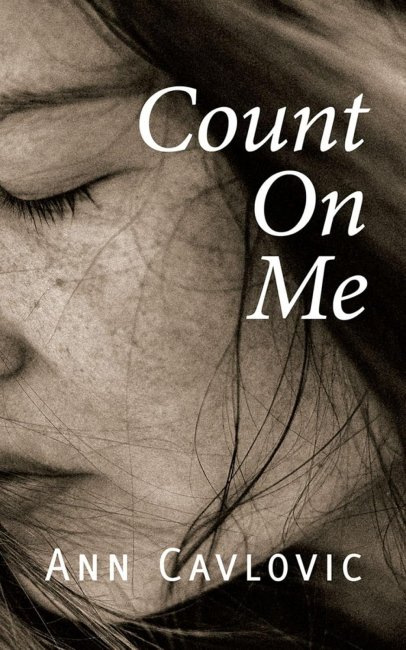
This, the first novel by Canadian author Ann Cavlovic, is something I’ve been reading as effectively a book proof although it doesn’t have any indication that it is a copy from before the official release date printed within it. The book was published on 1st October last year in its native Canada and I’ve had a copy since September, but most of us here in the UK have to wait until the 8th January 2026 to be able to get a copy. Originally I planned to write this blog before the book was released in Canada but as that would have been four months before its availability in the UK it has been delayed until now, a few days before its release here.

I initially struggled to get into the book, probably as the scenario is so far from my own experience but as the story developed I came to enjoy the book more and more. Without giving too much away we learn of brother and sister Tia and Tristan whose mother really needs to go into a care home and their father isn’t far off being incapable of looking after himself. Tia has problems of her own, recently divorced and with a one year old daughter she is struggling to look after her child and hold down her job and dealing with her parents problems as well just becomes too much. Tristan in the guise of caring for their parents is actually pushing their father out of the family home so that he and his partner can take over and is financially abusing the joint bank account which he has access to via power of attorney. He has also taken and/or sold various items from the family home along with his mothers jewellery which had been promised to Tia and taken out a $20,000 loan against their security. How Tia confronts him about this and starts to put things right whilst still managing to look after her daughter as a single mother and all the issues that position alone puts her into is the plot of the book. Reading that back it sounds like a dark nightmare but the book has enough lightness and humour to make the plot still enjoyable as you watch Tia struggle and ultimately get legal and personal assistance to counteract her brother’s attempt to grab everything including the house.

The book is written in the first person from Tia’s perspective as she tries to make sense of what is going on and protect their parents from Tristan and his girlfriend, who seem determined to gain as much a possible and get the parents out of the way into homes as soon as he can without regard for the best outcome for them, only the way that suits him the most. After initially having problems getting into the book I’m glad I persevered and by mid way I was cheering Tia on as she fought for the best resolution for her parents and to stop Tristan riding roughshod over not only their wishes but the rest of their lives as he tried to get them into the cheapest possible home regardless of the awful reviews the place had received and the general manipulation that he has imposed over them. It is Cavlovic’s first novel, although not by any means her first piece of fiction, you can find more about her at her website.

Many thanks to River Street Writing for supplying my review copy.

Keepers of the House – Lisa St Aubin de Terán

Lisa St Aubin de Terán gained her exotic sounding name from a mix of her mothers maiden name (St Aubin) and her first husband’s surname (Terán) of which more later. Born in London she was just twenty nine in 1982 when she wrote this, her first novel, but had already by then amassed life events enough for any aspiring writer to draw on. The novel tells the story of Londoner Lydia Sinclair who at the age of seventeen marries thirty five year old Venezuelan Don Diego Beltrán and goes to South America to live with him on his vast but declining estate. The book starts with a prologue which is set in the present day and tells how Lydia ended up in Venezuela before diving back over the two centuries of the rise and fall of the Beltrán family and estate until Don Diego is virtually the last of the family, and even he has a stroke several years into the marriage and is paralysed.

But the story of the early years of the Beltrán’s is of strong and powerful men rising to senior political and military ranks backed by the wealth from their estate. It is only after a horrific massacre of the family a century ago, men, women and children gunned down by soldiers goaded by members of a rival dynasty and a plague of locusts that destroyed all the crops in the valley leaving the villagers starving and almost as importantly the sugar cane that was the source of the money. The years of drought during Lydia’s time was the final straw, nothing is left, it is time to go. It sounds like a depressing read and in places it is but there is still some lightness to provide succour to the reader and it is certainly well worth reading. I also have her second novel ‘The Slow Train to Milan’ which is also based on her life with Jaime from after their marriage but before they finally moved to Venezuela and were instead travelling around Europe with increasingly bizarre experiences

Keepers of the House gets its title from a quote in the bible, specifically Ecclesiastes 12, and won the British literary prize The Somerset Maugham Award in 1983, which ironically is “to enable young writers to enrich their work by gaining experience of foreign countries.” whilst St Aubin de Terán had already had seven years of experiences in Venezuela, which was used as the basis of the novel, and was now safely back in England. I have written about one of her other autobiographical books in another blog back in 2020 ‘A Valley in Italy‘ and up until now have largely read her non-fiction works but have recently purchased a couple of her novels, this one included. I was struck particularly by the similarities between the stories of fictional Lydia and real life Lisa when comparing this book to ‘The Hacienda’, her memoir of her time in Venezuela published in 1997. If you thought that the plot of the novel was somewhat far fetched then the real story of Lisa is definitely worth reading as in ‘The Hacienda’ she tell of how she married at the age of sixteen to an exiled Venezuelan man more than twice her age who is wanted in his home country for bank robbery but who nevertheless takes her back to South America to live on his estate. She eventually comes back to England with her daughter Iseult to avoid the planned suicide pact intended by her husband Jaime as he realises that the marriage is falling apart.

The Picture of Dorian Gray – Oscar Wilde

Oscar Wilde’s only novel can famously be summarised as the story of a man who doesn’t appear to grow older, but rather the portrait of him ages on his behalf. But the copy I have is 256 pages long so it must be much more than the twenty word precis just given and indeed it is. I didn’t know what to expect when I pulled this book off the shelf as for some reason I have never read it before despite it being a famous work of literature and my owning this copy for at least fifteen years, but I definitely enjoyed it for it is beautifully written.

Yes the story of the painting ‘ageing’ rather than Dorian is there but that just scratches the surface, the picture shows all the corruption, not only of his increasing age, but also the collapse of his morality and does so in real time. So when he views the portrait, which he does regularly as time goes on even though he has it locked away in an attic so nobody else can see it, he can see the effects of his lifestyle boldly depicted on the canvas. Indeed when he kills a man blood starts to show on his hand in the portrait and appears to be dripping onto the floor within the painting from his fingers.

Dorian Gray is the only child from a very wealthy family so has no need to work instead he can just idle his way through life doing whatever he wants and because he can do this he does, dragging other people along with him. We see evidence of his moral dereliction many times through the book and his effect on his friends and lovers, one of his friends is depicted late in the book in an opium den hopelessly addicted and others commit suicide after being abandoned or blackmailed by him. Dorian however does not care about any of them even the social approbation that comes his way with people leaving rooms if he comes in or otherwise shunning his company means nothing to him for he has retained his youthful looks and that is all that he apparently needs. In his rejection of societal norms he is guided by the hedonistic dandy Lord Henry Wotton, whom he meets right at the beginning of the book at the studio of artist Basil Hallward whilst he is painting the titular full length picture. Henry becomes probably his only life long friend, apparently unconcerned about the depravity of Dorian’s life and loves and equally unfazed by Dorian’s never ending youthful looks or his occasional collecting manias. Due to his vast wealth Dorian can pursue any interest he wishes, collecting rare tapestries, perfumes, musical instruments or even jewels amongst other things, becoming an expert in this or that field before moving on and it is this money and knowledge that enabled him to stay accepted by at least part of London society.

Yes Dorian Gray is a repellent character, one that if he had really existed anyone would do well to avoid the company of, but Oscar Wilde’s writing is in contrast truly lovely. The pages just flew past whilst I was reading the book and as the story developed of Dorian’s spiral into vice the writing seemed to get better. It is. I suppose, part gothic horror and part social commentary upon the idle rich that Wilde spent so much time in the company of both in the city of his birth, Dublin, and London but I loved the book and can’t believe I have managed to not read it before. The final denouement, whilst the reader is expecting something of the sort, still had surprising details so Wilde kept me engrossed to the very last word and there are few books where that could be said.

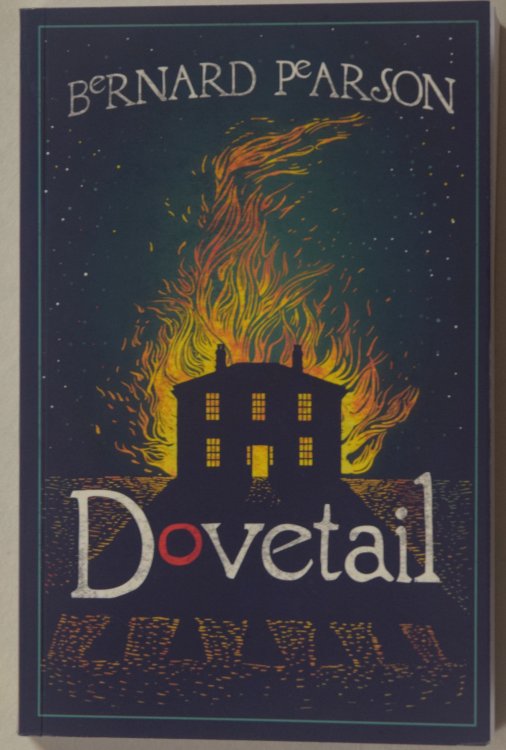
Dovetail – Bernard Pearson

He’s a craftsman, not just good with his hands, an artist, an artisan, the man you go to when you need something a bit special. Years of making wonderful objects have given him an eye for beauty and the skill to create it and if he can’t do it then he knows a man who can. But now he’s older and no longer hale and hearty and the body won’t let his hands do what they could do before. The old comfortable clothes and wreathes of pipe smoke still mark out the well known local character but a new chapter is beginning.

20180612 Dovetail 1

I could be writing about Bill Sawyer, the main character in Bernard Pearson’s first novel but in reality that was a shorthand portrait of Bernard himself. I’ve known him for over 20 years now and have handed over more money for things he’s made than I care to think about, beautiful finely detailed sculptures, unusual candles and interesting pottery figurines by him decorate my home and I wouldn’t have it any other way. Unfortunately he can’t sculpt any more, he can’t hold the tools long enough and steady enough for the work, but he can tell stories and what wonderful tales he tells, and has told over many years and many, many more pints of strong Somerset cider and so the new chapter begins…

Dovetail isn’t Bernard’s first foray into print, fourteen years ago he collaborated with Terry Pratchett to produce The Discworld Almanak, the first book to exist in our world that was specifically mentioned as an existing publication in Terry’s Discworld series of novels. Since then, with his wife Isobel, and the team at The Discworld Emporium in Wincanton there has been several other books and diaries set within Terry’s fantastical imaginary world. Towards the end of his life Terry told Bernard to try writing something of his own and this first novel is the result. It’s not high literature, it’ll never make the Man Booker short list, or even the long list for that matter but that isn’t what Bernard or indeed his readers are aiming for. What he has produced is a cracking good read with the eye to detail that distinguished his sculptures now turned to give depth to the characters and draw you along through the book as you get to know them and the twists and turns of the dodgy antique furniture trade.

As stated above, Bill Sawyer is a craftsman, one of the best, a man who can repair something old so that an expert wouldn’t know he had touched it or, if the need arises, can make something centuries old that didn’t exist last month. Known throughout the trade in the UK his fame, and skill, is about to get him into a lot of trouble and he wants to retire. He’s ill, just how ill is revealed as you read through the book, and it’s going to affect not only his work on this last unwanted project but his ability to protect those he cares for and he so desperately needs to be able to do that.

The book starts with a fire, one of many on the 5th of November, which is bonfire night here in the UK, a date redolent of history and violence, then jumps back three months as the remaining 345 pages tell the story of how and why the conflagration came about and you very quickly want to know the how, why and especially the who of that particular inferno. It’s a genuine page turner, I found it difficult to put down even when sleep was the obvious thing to do at that time of night.

20180612 Dovetail 2

Bernard used to be a policeman as a young man and knows about evidence and how untrustworthy it can be and how experts can be fooled especially when they don’t want to be (oh the stories). Actually he probably knows more about how to do all sorts of things you are not supposed to do at a police house without senior officers finding out than just about anyone alive but that really is another story. He’s a teller of tall tales, always has been, always will be and because they always contain a solid foundation of truth they are all the better for it. God knows what nugget from his memory was the foundation for this story, maybe I’ll find out one day over some cider, maybe I won’t, but I don’t mind as long as he writes some more.

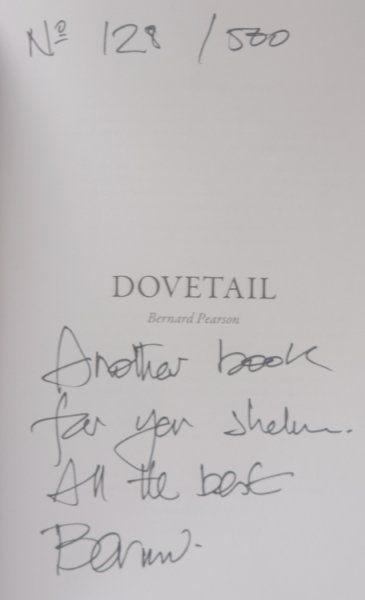
The book is self published and available from No 41 Publishers which is presumably Bernard himself (or more likely Isobel as easily the most organised of the two) as 41 High Street is the address of the Emporium. My copy is dedicated and numbered although this isn’t really a limited edition book. All my limited edition sculptures by Bernard (and there are quite a lot) are number 128 of however many were produced even when there was less than 128 made…

20180612 Dovetail 3

The photograph of Bernard is by Len Brook, another artist of my acquaintance and a photographer of considerable skill who also has a few tales he can tell.