Monty Python and The Holy Grail (Book)

This book is a lot of fun, especially if you know the film well as it contains the forty five page first draft, which was used for pitching for funds to make the film, along with the much longer final draft. The original version actually bears little relation to what was actually filmed and even in the final versions there are a lot of sections crossed out with pen amendments alongside so it was clearly a work in progress even whist being filmed. Alongside these two scripts are sketches of possible titles and posters, lots of stills from the film, a statement of accounts as to how much the film cost to make, a total of £229,575 for those of you who are interested and a letter from the producer to Michael Palin.

I feel this tells anyone who hasn’t seen the film quite a lot about it and it is very funny for those of us who have seen the film numerous times and can quote large sections.

It’s the ephemera and the pen amendments that for me make the book so interesting you can see the Python team improving the work as things are going on and they spot opportunities to tighten the humour, such as the section below. This is part of the fight between the three headed knight and Sir Robin which in the original final draft takes 3½ pages of typescript but is replaced with 1½ pages of handwritten alterations which got rid of a lot of the bickering between the heads and speeded up the arrival of the punchline “He’s buggered off” which isn’t even on this page of the script.

On his way to this fight, which as alluded to above Sir Robin ran away from, his minstrels had been singing songs of his bravery but written in such a way as to terrify the knight, which can be seen below. I have included this double page spread to give some idea as to how the book is formatted. On the left, which would have been blank in the original script are all sorts of interesting items such as the Daily Continuity Report seen here, but it could be snapshots from the set, notes on possible improvements, sketches by Terry Gilliam etc. In short anything at all that the editors of the book and Derek Birdsell, the designer, thought would be fun to include. It makes a wonderful mish mash of ideas about how the film is, or should, be progressing and adds a huge amount to what could have been a simple reproduction of the script.

I just had to include one of my favourite sections from the first part of the film where Arthur and his knights have arrived at the French castle, not riding horses but banging coconut shells together in the classic sound effect method to simulate horses hooves. This then leads to a side discussion as to where they had got the shells which comically keeps interrupting the main flow of the text. It is particularly fun as the swallow has become so iconic when attached to this section of the script to see that they originally intended a whole selection of different birds including a gannet, plover or a merlin which would have been a funny preshadowing of later in the book when they do encounter a parody of Merlin in the form of Tim the Enchanter.

The film ends on the shore of a lake where the knights are preparing to embark on their last great adventure but by this time the budget had largely run out and the Python’s decided to simply end the film there with a modern day police raid which stops filming. A truly surreal end to the film in a truly Monty Python way.

The rear cover has lots of suggested advertising slogans all in the form of obviously fake quotes including the then Prime Minister, Margaret Thatcher, her predecessor Edward Heath, and Richard Nixon who had resigned the American presidency following the Watergate scandal just four days after Mark Forstater’s letter the Michael Palin reproduced above. As can be seen I have the first edition of the book published by Eyre Metheun in 1977. Later editions drop the cut out folder format of the cover for a more ‘normal’ binding.

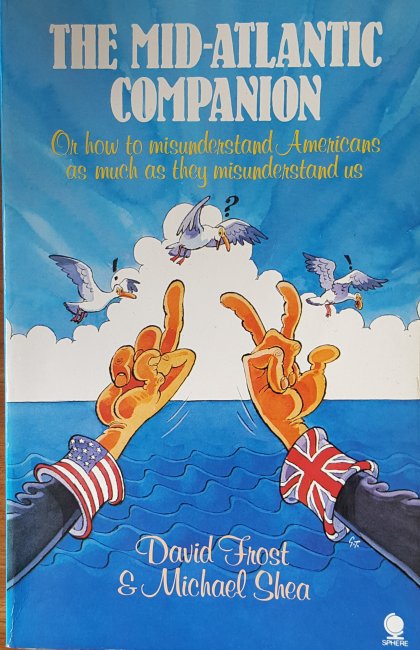
The Mid-Atlantic Companion – David Frost & Michael Shea

A friend is off to New York for the first time so it occurred to me to dig out this funny guide to the differences between America and the UK which originally came out in 1986. My copy is the first paperback edition from 1987, which is when I started regularly crossing the Atlantic to see my then girlfriend and found this full of handy hints. At the time David Frost was presenting TV programmes in both countries and commuted each week between London and New York, Michael Shea was a diplomat and Director of British Information Services in New York but when he wrote this book with Frost he was Press Secretary to Queen Elizabeth II. Both men therefore had extensive experience of the differences that you only appreciate really when you live in the country you are not native to.

The joy of this book is it’s not just the linguistic differences that they highlight but history, politics, food etc. are covered, if not comprehensively then at least enough to give a warning to the unwary. Back in 1887 Oscar Wilde said “We have really everything in common with America nowadays, except, of course, language.” and it is still very true today. I remember back in the early 1980’s Jane Fonda’s first workout video came out which included the surprising, to British female watchers at least, instruction to sit on the floor and bounce around on your fannies. Americans who don’t know what is wrong with that should know that a fanny moves from behind in America to the front and female only in the UK.

That passage gives some idea of the differences and fortunately the book is not as relentless as that all the way through, the book is equally fair, or unfair if you prefer, in dealing out warnings both for Brits going to America or Americans going to the UK so Brits are warned about the huge size of portions and the sweetness that pervades a lot of American food whilst Americans are equally warned about a lot of British food and heartily recommended to have breakfast three times a day. There are also specific chapters on London and, usefully for my friend, New York which includes a comment on street crime that “they even had a bank robber who got mugged on the way to the getaway car”. As for the cab drivers “Help wanted ads in NY papers claim you can get a cabby’s licence in three days. Most people are surprised they have been driving that long”.

Of course the book has dated, it is after all getting on for forty years old, however as both authors have been dead for a log time, Shea died in 2009 and Frost in 2013 there is no chance of an updated version. There are still enormous differences in language and culture between the UK and USA a lot of which are in this book and still relevant but there are new pitfalls for the unwary traveller to fall into and a new guide is probably called for.

A final thought from the politics section, which still seems relevant, at least in Donald Trump’s mind:

When the President does it, that means it’s not illegal

Richard Nixon

Surely You’re Joking, Mr Feynman! – Richard Feynman

Well this book was a complete surprise when I finally pulled it off the shelf where it has sat, largely undisturbed, for over ten years. The year before buying it I had read Six Easy Pieces and Six Not so Easy Pieces which were sections lifted from the Feynman Lectures on Physics and whilst I had enjoyed them I never felt in the mood to see which topics were included in this volume. In fact this isn’t a physics textbook but a stab at autobiography based on taped conversations between Feynman and Ralph Leighton largely done over a seven year period whilst they were drumming together, Feynman was a keen bongo player. The short pieces that make up the book are arranged in a rough chronological order from his childhood to getting his degree in physics at MIT in the first section, his time getting his PhD at Princeton University in the second. Part three covers his time at Los Alamos working on the Manhattan Project which developed the first atomic bomb during WWII whilst part four has him working as professor of physics at Caltech and Cornell universities and the final section has some fairly random stories in it. This potentially sounds rather dry but it is far from it, what we actually get is a total of forty anecdotes a lot of which have nothing to do with physics at all. As well as being one of the outstanding physicists of the twentieth century Feynman loved an anecdote and also stretching his brain doing things that had nothing to do with his career such as learning to do safe-cracking and taking it upon himself to translate Mayan pictographs relating to mathematical problems, both of which are covered in this book.

The stories are often humorous such as the first one concerning his Princeton years, which is also where the title of the book comes from. On arrival to start work on his doctorate he was invited to the rooms of the head of college for tea and being a young man from a Jewish background in New York he hadn’t come across this decidedly English concept which was popular amongst the academic elite at Princeton so didn’t really know what to expect. On being asked if he wanted lemon or milk in his tea he replied ‘both’ leading the lady pouring the tea to exclaim ‘Surely you’re joking, Mr Feynman!’ One of the funniest stories is his battle with the censors working at Los Alamos, now technically they weren’t allowed to censor mail within America but clearly they were going to because of the nature of the work on the Manhattan Project, However Feynman liked to keep his mind sharp so had already started having his correspondence with his father and his wife include codes without giving him a hint as to the key so that he had to crack the codes and the censors really didn’t like that aspect of his letters. Eventually they settled on having the letter writer include on a separate piece of paper how to crack the code and the censors would remove the solution before passing it onto Feynman. All I can say is he must have been a tricky person to work with and indeed his long time collaborator, Freeman Dyson, described him as ‘half genius, half buffoon’ which he later updated as ‘all genius, all buffoon’.

By its very nature the book is somewhat bitty, there are little, if any, links between the various stories included and you quite often want to know more and it leaves out large chunks of his life including his work on the report into the space shuttle Challenger disaster which helped bring him to wider public recognition outside of the world of physicists and academia. However the fact that it is forty largely self contained tales means it can be just dropped into wherever you feel making it ideal for reading when you just have short periods of time available and it is definitely worth reading, even if Feynman does come over as a pain in the ass at times. My copy was published by The Folio Society in 2012, twenty seven years after it first came out and is beautifully illustrated with numerous photographs along with drawings by Aude van Ryn.

Round Ireland with a Fridge – Tony Hawks

British comedian Tony Hawks was first in Ireland back in 1989 as the writer of a song entered for an ill fated attempt at an international song contest, but whilst he was there he saw something odd on his way to the contest; a man hitch-hiking with a fridge. What was even odder, at least to Tony was the complete way that this was regarded as normal by his Irish companions. Over the years this became a favourite tale for Tony to bring up at parties until late in the nineteen nineties he got particularly drunk at a friends house and…

Now both men knew in their heart of hearts that a bet made when neither of them could remember it being set because they were both too drunk does not have to be honoured, but this one niggled at Hawks for a while until he decided to go for it and I’m very glad he did because the trip and the subsequent book are very funny. I first read the book soon after it came out in 1999 and loved it then so it was with a little trepidation that I got it off the shelf for a reread, would I still think it as good as I did then? I needn’t have worried the tale is still as brilliantly daft as I remembered it to be.

Hawks arrived in Dublin having done minimal preparation other than badly packing a rucksack and arranging with a friend in Ireland to be met at the airport by a friend of this friend along with his travelling companion for the next month. It was whilst explaining to this person, that he had never before, what he was planning on doing that the economic idiocy of the adventure starts to come clear. As he pays him the £130 for the fridge it is obvious that even if he succeeds he is already £30 down not counting the flights, accommodation costs, food etc that he will have to pay for on his journey but he had not counted on the friendliness of the Irish. At a suggestion of his friend he drops a note round at RTE, the national broadcaster, for Gerry Ryan who is the host of the popular breakfast radio show on the basis that breakfast radio is a perfect place to talk about hitch-hiking round Ireland with a fridge as this sort of programme is always looking for offbeat stories to fill up some time. Instead of just a short chat with Ryan on his show it turns into a regular feature with the radio programme regularly calling to find out where he had got to since they last spoke and before he had even got half way round Hawks was mildly famous as ‘Fridge Man’ throughout Ireland and people were waiting to see him turn up in their town and he was being covered by local papers across the country.

The book is not just funny though, in his tale Hawks introduces people who helped and the stories of their lives that he briefly touches on, people start signing the fridge and by the time he gets back to Dublin there is no room left of the two foot cube that had made it all the way round. On the way, the pair of them did all sorts of things including going surfing, fortunately there is photographic evidence of this to prove it, the fridge also got christened and became a folk hero, they even spent a night in a dog kennel when there was no room anywhere else. The book is a joy to read and I’m so glad I picked it back up again after more than twenty years. Hawks has written several books since this one, often with a theme of travelling with a specific purpose such as ‘Playing the Moldovans at Tennis’ where he tries to persuade all eleven members of the national football team to play him at tennis. Or ‘One Hit Wonderland’ where he travels around the world trying to have a second hit record, he had his first, and only previous success back in 1988 with ‘Stutter Rap’ which made the British top ten back in 1988. If you like your travelogues with an eccentric edge Tony Hawks is the man for you.

Penguins Stopped Play – Harry Thompson

Harry Thompson was the original producer for the hit BBC TV show ‘Have I Got News For You’ and ran it for the first five series, he was also involved in several other TV programmes, there are a few short references to his TV career in the book, most notably when he managed to get people such as comic actor Hugh Dennis to turn out for his cricket team but this is not really an autobiography.It is instead a history of the cricket team he started and captained for over twenty five years. Now village cricket is not a high level sport and The Captain Scott XI, named after a person who famously came second, struggled to reach even this low bar. Initially this was deliberate on the part of several members of the team who simply wanted to lark about and had no intention of winning a game, gradually however this complete disregard for sporting etiquette meant that it became harder and harder for Thompson to find teams willing to play them. Gradually the team split into two camps and eventually into two separate teams one which continued to just lark about and the other, led by Thompson, determined to win a few games for a change.

The book starts however with a rapidly abandoned game on an Antarctic ice shelf which ironically doesn’t feature the Captain Scott XI at all but is instead an impromptu match thought up by passengers on an Antarctic cruise (including Thompson) who discover that due to excess ice they were going to be unable to get to Shackleton’s and Scott’s huts after all. Using oars from the ship as bats and a real cricket ball packed by a New Zealand passenger just in case it would be useful they start a game but presumably the echoes in the water underneath the ice shelf attracted the penguins which soon swarmed over the ‘pitch’ making play impossible leading to the oddest reason for stopping a game and the title of this book.

Before the original Captain Scott XI fell apart someone came up with the bright idea to go as a team to India to play a few matches in the hope that this would bring the increasingly fractious players together.

It sounded like a great idea; and also like a terrible mistake. It turned out to be both

The ‘tour’ started in Hong Kong as one of the ex members of the Captain Scott XI had been posted there by the bank he worked for and promised to arrange a couple of games, they would then fly back via India for a few more games before heading home a more united team. Almost none of this went to plan. As stated at the beginning English village cricket is just about as low level as you can get and still play, this standard doesn’t seem to be understood by any other country so they kept coming up against far better teams and losing spectacularly even without the sabotage several of the players indulged in. They did however play some games and get back without actually killing each other and this ‘success’ inspired Thompson to try again, this time heading for South Africa, the home country of a couple of the regular players for the team. Not only was the Captain Scott XI destined to be beaten again by much better teams who simply didn’t believe that another cricket team could be this bad but the travelling arrangements were almost impossible to make. This was the tour that finally split the team completely and ‘the layabouts’ as Thompson refers to them went off and formed a separate team.

Freed from the players that were ‘holding them back’ and flushed with the success of almost winning a couple of games Thompson came up with a clearly crazy plan, the Captain Scott XI would tour the world, and it is this trip that makes up the second half of the book. The cricket definitely gets better and they had managed another quick tour before then, just a week with only two matches in Malaysia because two of the team were half Malay which included them actually winning against the Malaysian national team, although a severely depleted version by playing on a week day when half the team would be working. Touring Barbados, Buenos Aires, Australia, Singapore and South Africa one after another on eleven round the world tickets when the British Airways system ‘gets confused’ if there is more than nine people in a group was an amazingly chaotic experience. Several times BA assured them that there were no flights from one destination to another leaving them flying thousands of miles in the wrong direction when they boarded next to a direct flight going exactly where they wanted to go, wasting time and adding to increasingly bad jet lag. Tickets kept getting refused, players arrested for having the wrong paperwork (normally whilst transiting America) and one thing they could almost always guarantee was torrential rain on arrival. It was to be the last international tour of the Captain Scott XI under Harry Thompson and the stories he tells are hilarious.

Sadly Thompson died from lung cancer aged just 45 despite never having smoked in his life, he had time to go over the final notes for this book in his last few days. This therefore becomes the third book I’ve read in as many months where the author didn’t live to see it come out after Barry Letts and Elisabeth Sladen. You don’t need to be a cricket fan, although I am, to enjoy this book, the often disastrous travel stories are what makes it a great read and you fume along with Harry at the magnificent incompetence of the British Airways flight booking service.

Mr Petre – Hilaire Belloc

I have five or six books by French author, but naturalised Englishman, Hilaire Belloc but apart from his book of humorous poetry ‘Selected Cautionary Verses’ I haven’t read any of them, reading this makes me want to pull the others off the shelves. My copy is the 1947 first Penguin edition, so 75 years old, and I can’t find any currently available editions which is a shame as it is a genuinely great read. Although written in 1925 it is set in the future of April 1953 and the basic conceit of being in the future, at least as far as the author is concerned, is that there was no longer the need for passports for British citizens entering the UK, although how you proved you were British and therefore didn’t need a passport is conveniently glossed over. It is vitally important for the plot however as the character we come to know as Mr John K Petre has no documentation on him with his name having arrived from America and losing his memory almost upon disembarking from the ship. He clutches at a barely remembered name ‘Petre’ as his own as he sinks into a nightmare of scratchily forming memories, but the name alone, whether it is his or not, proves his salvation, for it is a name of an eccentric multi-millionaire who thrives on being incognito.

There then follows a series of chancy investments, mainly by accident, but where the name of Petre works as a guarantee with no real financial backing, the first of which nets almost eighty thousand pounds and the second over a million but without our hero having any real knowledge as to what he is doing. The first is a simple boosting of the stock market which follows the knowledge that the great John K Petre has invested in a moribund stock which massively boosts the value, at least for a few days at which point the agent he had met at a dinner party cashed in for him and simply sent a cheque for his profit to the hotel he was staying in. This has some of the least likely plot lines in the novel and also some of the most dodgy mathematics as try as I can I cannot get a profit as stated in the narrative from the vague hints as to what the story says happened. The depositing of the cheque into a random bank account set up to receive it is also highly unlikely as no evidence is either requested or presented that the cheque has not been stolen or that the depositor is indeed John K Petre. The second transaction is however, oddly, far more believable despite netting over a million pounds when the character had nowhere near the required collateral for the property purchase involved but as he sold it straight away for far more than the agreed purchase price I can see this as quite possible, it is just a matter of timing payments.

I don’t want to give too much away, these two transactions occur in the first half of the book and Mr Petre has far more to go through before the end, but it is a brilliant novel which really draws the reader into the plot line both in feeling for our hero, who clearly has no idea what he is doing and is just led along by advisers, and also joy in the sheer blind luck he has in getting away with random investments much to his own surprise. What really surprises me however is that this 1947 paperback appears to be the last edition available, searching though abebooks and biblio, which represent the vast majority of online second hand book dealers, I cannot find a more recent copy apart from print on demand. I cannot understand why such a superb book has been effectively out of print for seventy five years, please if any publishers are reading this can we have a more recent edition? If anything due to the financial shenanigans so prevalent nowadays the book is more relevant then when it was first published almost a hundred years ago. If you can find a copy I suggest getting and reading it you won’t be disappointed.

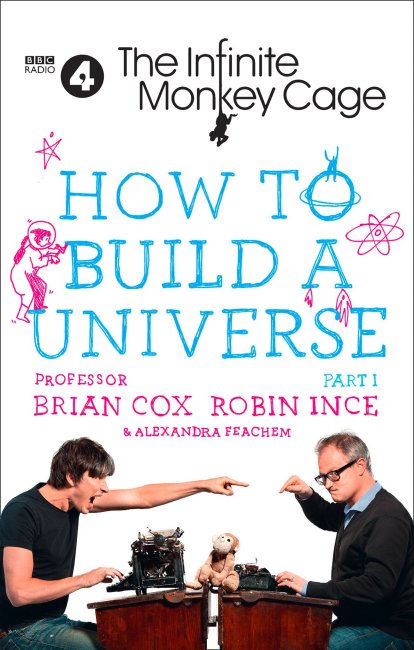
How to Build a Universe – Professor Brian Cox & Robin Ince

Based on the highly successful BBC Radio 4 series ‘The Infinite Monkey Cage’ this is science book like no other I have read. The radio show is also difficult to explain to people that haven’t listened to it, and you definitely should listen to it (link at the end of this blog) because it is co-hosted by on the one hand a Professor of Particle Physics at Manchester University and on the other a stand up comedian which is an extremely unlikely combination but works brilliantly. The look of the book matches the slightly anarchic structure of the radio show which in an early episode whilst discussing something completely different wandered onto the subject of “is a strawberry alive or dead?” They have come back to this subject on other occasions and I was pleased to see this being treated in the book as shown below:

The science for the most part is not overly challenging and the only really complex section is the largest, an eighty page chapter entitled ‘Recipe to Build a Universe’ which is almost entirely written by Brian Cox and as Robin writes:

This is the hard bit of the book. You may need a pencil to underline sections or just to occasionally jab into your leg or skull as you ask “but what does it all mean?” Don’t let this put you off

Page 80

In truth I have read so many books on this topic that it was relatively easy to follow and I largely sailed through this bit as it is so well written. Although a background of nuclear physics, coincidentally at Manchester University although six years before Brian went there to do his degree, possibly also helped. It also helped that the book is actually very funny especially during interplay between Cox and Ince, I laughed out loud at several sections and particularly a part written by Robin with increasingly irritated footnotes correcting him by Brian.

Other topics covered include the concept of infinity, space travel, the ultimate death of the universe and lots of things in between. In this way it is very similar to the radio show in that the main subject of a chapter, or indeed an episode, can be lost briefly if something interesting comes up as an aside. ‘Schrödinger’s strawberry’ (is it alive or is it dead) alluded to in the first chapter of this review is a prime case in point. You will learn a lot from this book but it won’t feel like it at the time unlike tackling something like Relativity by Albert Einstein or any of the four important science books I read one after another in August 2020. The style is easily approachable and the need for Brian to make sure that Robin is following the points as he makes them keeps the text grounded, although Robin Ince has now written his own science book ‘The Importance of Being Interested’ which I have a copy of so expect a review of that in a couple of months or so.

The radio show is just embarking on its twenty fourth series, some of the earlier ones only had four episodes but it now seems to have settled on six and all of them are available on the BBC website via this link. The shows on the site are usually the extended podcast versions rather than the original thirty (now forty five) minute broadcast. The usual format is that Brian Cox and Robin Ince are joined by two scientists who specialise in the subject selected for that episode and also another comedian who may have a science background but more often does not. A notable exception to this format, and an episode that is well worth listening to, was the astronaut special from series 22 where they were joined by astronauts Helen Sharman, Chris Hadfield, Nicole Stott and Apollo 9’s Rusty Schweickart. The book is great fun, the radio show even more so.

I is a Strange Loop – Marcus du Sautoy and Victoria Gould

A mathematical play, not a combination of words I ever expected to write and yet somehow it works. The authors are Professor of Mathematics at Oxford University Marcus du Sautoy and actress Victoria Gould who has a degree in physics and a masters degree in applicable mathematics. The play starts slowly with just one of the characters X on stage inside a large cube miming the drawing of two Platonic sequences, first the derivation of a regular hexagon using just a straight edge and a compass and secondly the proof of the irrationality of the square root of two using ever decreasing squares. Now this may not sound like riveting drama and frankly unless you know exactly what X is doing then it is very difficult to follow but X is about to have his whole world view changed by the arrival of the second character (or variable as they are referred to in the script) Y. Up until this point X has considered himself to be the only person and indeed the cube that he is in to be the only cube. Y however has travelled through millions of cubes and accumulated many things on her journey but is about to encounter her first ever other person, although she is surprised X is completely shocked by her appearance in his cube and through a couple of mathematical fallacies attempts to prove her non-existence.

OK this is probably sounding like a very niche production but believe me it is well worth sticking through the initial phases especially when we get to the second act which brilliantly turns the whole play on it’s head but more of that later. It also has to be the only play I have ever read that comes with a fourteen page guide to the maths in the play at the back of the book entitled A Mathematical Prompt Book. This is useful for the non-mathematician in explaining not only the maths but also some of the language used and functions very much like the glossary found at the back of some versions of Shakespeare’s plays. Would you get the joke about the Möbius script right at the end of the play if you don’t know what a Möbius strip is, probably not. But back to the first act. After Y demonstrates that there is a room, and in fact a series of rooms beyond the cube that X inhabits X then believes that the series must be infinite and tries (and fails) to prove this just as he also fails to physically prove other infinite series simply because, as Y points out, there are limits that prevent such physical proofs. All attempts to find an OUT, a place beyond the cube series also fail.

The second act is completely different and the humour of the piece grows, that’s not to say that the first act isn’t funny, the interactions between the purely mathematical X and the more practical Y are definitely amusing but the second act introduces reality is an very unexpected way. Right from the start of the second act Y believes the play is over and indeed no longer calls herself Y but instead uses her real name Victoria, X however is still very much in character. Victoria makes various attempts to disabuse X of his belief that the play continues including showing him that it is possible to leave the stage, go round the back and come back in from the opposite wing. She explains that the seemingly random noises heard during the play are the sounds of the underground trains near the theatre (there really was the sound of the underground where the play was first staged at The Barbican Pit Theatre in London) and she even produces a model of the set to show X that it is simply a stage. Nothing works and instead the play finishes almost back where it started. It really is very funny, both in the absurdity of the position that the characters find themselves in throughout the play and their changing relationships but also the increasing frustrating part of Victoria as the play is forcing itself back around her even as she believes she has finished.

The entire play can be seen here in a performance filmed at the Oxford Playhouse where the two parts are taken by the authors showing a surprisingly good acting ability from du Sautoy especially in what has to be described as experimental theatre. At one hour and fifteen minutes into the video the play is over and we go to a three quarters of an hour discussion about the play with Marcus du Sautoy, Victoria Gould interviewed by Simon McBurney, founder of Complicité, the theatre group responsible for the performance and which Gould is closely linked to. It’s definitely worth watching the play and it is considerably less intimidating knowing that the over two hour runtime of the video represents almost twice the length of the actual performance. Give it a go…

No Bed for Bacon – Caryl Brahms & S J Simon

Doris Abrahams and Simon Jacoblivitch Skidelsky, better known as Caryl Brahms and S J Simon respectively, collaborated on eleven comic novels and crime stories between 1937 and 1948 when S J Simon died suddenly at the age of just 44. No Bed for Bacon was their sixth book, first published in 1941, and is a comic retelling of Elizabethan England featuring William Shakespeare, Francis Bacon, Walter Raleigh, Queen Elizabeth herself and numerous other famous characters from the period. Caryl Brahms was best known as a theatre, especially ballet, critic and S J Simon was a journalist but much more famous in the world of contract bridge where he was European champion and also the author of books on the subject.

Well this was a fun romp round Elizabethan London with lots of running gags including the one that gives the book its title which is Sir Francis Bacon’s desperate attempt to get hold of a bed that Queen Elizabeth had slept in during one of her many progressions around England which was seen as a major status symbol in ones home. In this he is constantly thwarted partly at the hands of the Master of the Revels who controls all such progressions but also bu Elizabeth herself who knowing of his desire for such an item of furniture ensures that it never goes to him. Other running jokes include William Skakespeare constantly trying out spellings for his name, which definitely has a basis in fact because all the known remaining signatures by Shakespeare are spelt differently. Sir Walter Raleigh keeps getting a new and ever more flashy cloak only for it to be ruined within a couple of hours, from the, probably apocryphal, tale of him using his cloak to keep the Queens feet dry when her carriage stopped by a puddle and in contrast Lord Burghley keeps being dressed in more and more shabby attire. Shakespeare also keeps trying to start a new play called Loves Labours Wonne as a companion piece to Loves Labours Lost which famously has not survived to the present day even assuming that he ever finished it in reality and the regular sections in terrible Elizabethan spelling also add to the joy of reading the book.

The opening character remains anonymous through the work yet appears regularly always doing a different job as he makes a rapid rise, and even faster fall through the ranks of the proletariat from horse holder outside a theatre, to watchman, soldier, manservant, prisoner and back to watchman amongst many other jobs too numerous to list. He invariably starts any chapter actually set in London and you get used to seeing what he has managed to become this time. The other main fictional character, most of the people in the book really existed, is the young Lady Viola who disguises herself as a boy in order to join Shakespeare’s company as an actor as females were not allowed on the stage at the time and ultimately falls in love with him. If this sounds familiar than you have probably seen the 1998 film Shakespeare in Love where Gwyneth Paltrow plays Lady Viola who disguises herself as a man in order to join Shakespeare’s company as an actor as females were not allowed on the stage at the time and ultimately falls in love with him. Just a reminder that the book was written in 1941 and Tom Stoppard, who co-wrote the film is known to have had a copy of the book but claims to have not been influenced by it despite even using the same character name and no credits to Brahms or Simon are given in the film.

The book does play fast and loose with historical accuracy (as does the film which nicked the plot) but one of the most poignant sections and indeed the longest chapter of the novel takes place on a boat on the Thames with Queen Elizabeth progressing down the river in the company of her famous military and naval commanders whilst reliving the routing of the Spanish Armada. From what I remember of my Tudor history lessons this does appear to be mainly factually correct although it does contain Sir Francis Drake completing his game of bowls on Plymouth Hoe before heading out to meet the enemy which almost certainly didn’t happen. There are various sidelong comments regarding Drake being lucky with the wind which however was certainly correct.

Forsooth, tis a merrie romp Master Will and I definitely recommend the novel assuming you can lay your hands on a copy as it appears to have been out of print for a couple of decades but there are plenty of copies available on abebooks.

My copy is the first Penguin Books edition published in December 1948 five months after the death of S J Simon, Carly Brahms greatly outlived him and died just 3 days short of her 81st birthday in 1982.

Campaigns & Companions – Andi Ewington and Rhianna Pratchett

OK, this is an extremely short book, being more a series of jokes about why you should never let your pets take part in Role Playing Games such as Dungeons and Dragons, it is however also extremely funny and beautifully illustrated by Calum Alexander Watt. I purchased the signed edition which comes with four art cards each signed by one of the two authors, the illustrator and the editor and which have on the back a character profile in the style of RPG’s of the illustrated pets including special skills and dice rolling advantages and disadvantages. It has arrived in the post today and has immediately leapfrogged over all the other books in my to be read pile.

As it says on the back cover “What if your pets could play D&D? And what if they were… kind of Jerks?”

Anyone who has ever owned a cat will be all too familiar with that particular feline trait. There are forty five double page spreads like this with a scenario from a game on the left hand side and an illustration which mainly stays on the right but occasionally strays over to mix with the text, There is also a centre page double spread picture of the animals playing whilst seated at a table just as if they are human. One I particularly liked, because a friends dog is quite capable of doing this, is a dog with his staff in his mouth not able to understand why he can’t get through an archway. I’ve watched her dog try to get through a door to greet me whilst holding a branch in his mouth that is clearly too large to go through and getting more and more puzzled as to why he can’t get in.

Amazingly all the jokes work, there is a preponderance of cat and dog tales but that simply reflects the spread of pets, at least in the UK but there are also gerbils, a hamster, rats, a chameleon, a rabbit, a snake and even a spider amongst various others, but everything rings true to the habits of the animals.

As I said at the beginning of this review the four art cards, each signed by one of the people involved in the project, have a different format to the rest of the book and take four of the featured characters from the book and add more details on the back of the card that would be relevant if they were taking part in a Role Playing Game. The four cards are as follows:

I’ll just show the top half of the card for Rexar the Fighter and Poppy which was signed by Rhianna Pratchett, who by the way in her dedication in the book says “To Pinky and Perky. My wonderful girls. Thank you for all the bleps, plurps and snuggles”, I just hope they were guinea pigs and that is why she chose to sign this one. The other three contributors also dedicated the book to their pets

This shows the sort of extra detail, and jokes, that are only available to owners of the signed edition and as this cost the same price I don’t see why anyone wouldn’t get this variant at least while stocks last, it is only available from Forbidden Planet whilst the standard edition is widely distributed. The book is published by Rebellion who I hadn’t heard of before but I suspect it will be worth checking out their catalogue. As Ian Livingstone (co-founder of Games Workshop and the Fighting Fantasy series of books) says in his blurb for the book

Dangerously funny – I had to make a saving throw vs side-splitting. Pet adventurers – you have been warned.