Siné – Massacre

As this post goes up onto the blog I will be on my way to Hay on Wye to give a talk on the Gentle Art of Penguin Book Collecting as part of the Hay Independence celebrations for 2018, as part of the talk I’m going to cover the strange story of Siné’s Massacre in it’s only Penguin edition.

20180403 sine1

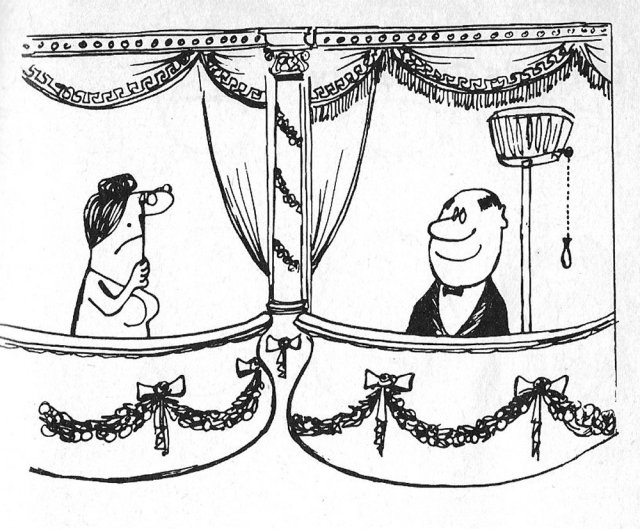
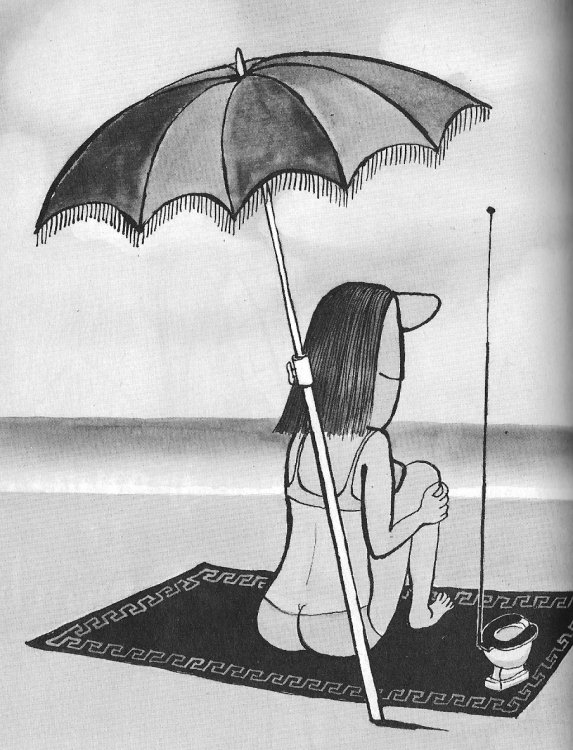
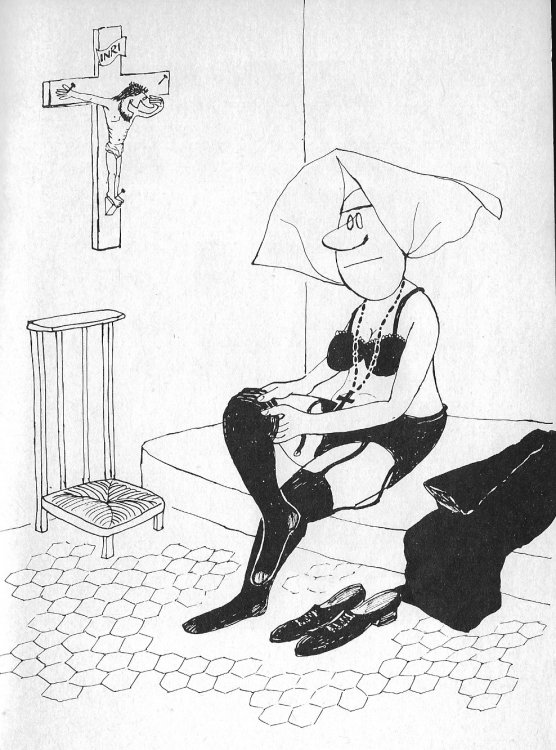
The title of the cartoon on the cover is a sort of pun in French, dessin morbide means morbid drawing but mord translates as belly so the vampire biting the belly of his victim covers both meanings. The fact that this was chosen as the cover and therefore amongst the least controversial of the cartoons included says a lot about the content of the book. Through the rest of this blog I will include other cartoons from the book although I have been careful not to include the most offensive examples, Siné had a fascination with toilets, hangings, amputation, sex and the catholic church sometimes all in one cartoon and I don’t feel many of the cartoons are suitable even now.

20180403 sine6

Given this controversial nature, why was he considered for a Penguin book dedicated to him? Well Penguin had a long history of publishing books of cartoons featuring selections of a particular artist, anything from Thelwell and his little girls at their pony club, through Osbert Lancaster, Peter Arno, Charles Addams (and his famous family) and Gerald Hoffnung with his musical fantasies to name just a few. On 5th October 1966 therefore a Penguin Books board meeting was convened to discuss the advisability of including Siné, as he was regarded as a major French cartoonist and a range that had the gentle work of Thelwell at one end and Siné at the other would definitely appear to be inclusive of all styles. It is worth pointing out that this board meeting would appear to have been very very late in the process, as the books had already been printed and were in the warehouse, orders had been placed but they hadn’t yet been distributed to retailers. So technically the book had not yet been published, but it really was a technicality at this point.

20180403 sine4

Sir Allen Lane, the founder of the business back in 1935, was still chairman of the board at this time although he no longer had total autocratic control of the business as he once had. He had given way long ago to the consensus of the board of directors as he had had to due to the huge increase in the size of the company, which was way beyond the ability of one man to control; however he still thought of Penguin Books as his. Nevertheless the minutes of the meeting show that the overall position was to back Tony Godwin, then Chief Editor and therefore a board member, with some reservations expressed. Backing Godwin was particularly forcefully put by Charles Clark who felt that not doing so at such a late stage would put Godwin in an untenable position; Sir Allen was not happy but, at the meeting at least according to the minutes, backed the decision to publish.

20180403 sine3

A draft press release was prepared announcing the publication on the 1st November 1966 which included a statement that the board were not in full agreement with the publication, however after the internal legal advisor was consulted it was decided to remove references to the disagreement and all was set for 3 weeks time. So far just a tale of a controversial book being prepared for publication, there had been several before at Penguin and there didn’t seem anything to make this different but the story was about to become bizarre…

20180403 sine5

George Nicholls recalled in 1970 (after the death of Sir Allen Lane) the events of a night in October 1966 which is almost certainly unique in the annals of UK publishing. He was in bed, as it was around midnight, when the phone rang and he was summoned to the office. When he got there he found Sir Allen along with 3 other men and he wanted the warehouse unlocking, Nicholls had the keys so they set off. On the way the reason for the late night escapade became clear as Lane explained.

I’ve got Singleton round the back with the farm wagon, I’m going to pinch all those Siné’s … that bloody board outvoted me, but I’ll have my own back on them.

Nicholls was shocked but as he said Sir Allen was “the governor” so he did what he was told. After a while they managed to load all the palletised stock onto the trailer and then realised that there would be boxes ready for shipping in the distribution area so went and found all those as well and loaded them onto the truck. It took a few hours but eventually Nicholls locked up the warehouse again and Allan Lane set off with his cargo after saying to Nicholls that this would be their secret.  What happened next is largely speculation, various accounts say that when Lane got back to his farm near Reading he had a large bonfire, some say the books were buried, others that he composted the lot and eventually spread it on his fields, what is certain is that the printed books were never seen again and Penguin never did officially publish Siné’s Massacre. Allen Lane also briefly vanished from the scene heading off on an impromptu holiday to Spain whilst things quietened down.

20180403 sine2

The odd thing was that there was apparently no hue and cry about the missing books; it all seems to have been quietly ignored, the few orders that had come in were cancelled as the book was ‘out of stock’. I used to design warehouse systems so know that so much stock going astray would definitely be noticed very quickly especially with unfulfilled orders this close to the official publication date but nothing was said. The only copies that survived are the few examples that had been sent to people to get their opinions about publication and some trade samples that had made it to representatives on the road. It all adds up to this being one of the rarest, and consequently most valuable, paperbacks produced by Penguin in the last 60 years. Checking abebooks reveals only one copy available at the time of writing this, across all the dealers on there around the world, and that is priced at £145.

20180403 sine7

The Devil’s Dictionary

20180327 Devil's Dictionary

Although now recognised as an American classic The Devil’s Dictionary by Ambrose Bierce was never originally intended to even become a book and certainly not intended to be read like one. It is, as the title implies, a dictionary; but full of alternative definitions, normally humorous, often satirical and sometimes it has to be said just plain strange at least to modern readers. But before looking at the book itself it is a good idea to know something about Bierce himself and how it came to be written and that is not as simple a task as it sounds as implied by the first sentence of the book summary in my copy.

The life of Ambrose Bierce is a tissue of facts embroidered with legend.

Normally at least birth and death dates of a well known journalist and author such as Ambrose Bierce would at least be known but although we know that he was born in 1842 the best that can be done for his death is ‘probably 1914’ when he went to Mexico during the revolution and was never heard of again.

But lets backtrack over what is known. In 1861 he enlisted in the 9th Indiana Infantry and fought in the American Civil War apparently with distinction and it was thought that he would go to a military academy after the war and make that his career but he was already interested in writing. So in 1866 he apparently ‘tossed a coin to decide whether to stay in the army or become a journalist. Journalism won the toss.’ By this time his army career had brought him to San Francisco, and that is where he started to teach himself what he needed to know; and started writing pieces some of which made it to print. In 1868 he got his first regular journalistic job and in a roundabout way this was to lead to the book I have. The job wasn’t journalism as such in that it didn’t involve factual reporting of news, instead it was a page in the San Francisco News Letter entitled ‘Town Crier’ which was a humorous and satirical view of life in the city and Bierce was set on his path to fame. He would over much of the rest of his life continue to write satire for numerous publications and by 1869 he had included his first multiple definition entry of what would eventually be a book although at the time it was probably just a useful space filler for the Town Crier page.

Over the ensuing thirty plus years Bierce continued his definitions in his various columns in publications not just in America but also in England where he lived for 3½ years in the 1870’s. They became increasingly popular and also much copied with Bierce sometimes entitling them The Devil’s Dictionary or later on The Cynic’s Dictionary until the idea of combining them into a book came to him in 1903. By the time of publication however not only had his idea been stolen but even the title of his column had been used by a competitor to publish their own set of definitions so he was forced to use the title The Cynic’s Word Book when it came out in 1906. Oddly it only included 521 definitions for the letters A to L with an intention to have a second volume covering M to Z later on, however it didn’t sell well enough for this plan to be realised.

And so it stayed as an unfinished work until 1911 when Bierce was working on his collected works and volume 7 was entitled The Devil’s Dictionary, this time covering the entire alphabet and with 1000 definitions, some of which were specially written for the book especially at the end of the alphabet because over all of his columns Bierce had only reached the word shoddy.

Shoddy: n. (vulgus) A term that expresses the status of a large part of our society, and furnishes a weakly page of matter to many of our time-serving dailies.

*Weakly is as written and implies a certain disdain for many of his less talented rivals producing similar columns for other newspapers.

The collected works was also a financial failure but The Devils Dictionary was recognised as probably his finest work and after his death went on to be published as a standalone volume by several companies and establish itself as a major work of American humour.

We then leap forward to 1963 when Ernest Jerome Hopkins, after a long career as a journalist, became Professor Emeritus of Journalism at Arizona State University and after discovering that the title didn’t actually come with any specific work decided to have another look at The Devils Dictionary and some strange gaps in the words chosen. It rapidly became clear that by no means all of the definitions Bierce had written for his various columns had made it into the published book, almost certainly because at the time of compiling he had been living on the Eastern seaboard of America and a lot of the early material was 3000 miles away in California and no copies would have existed in reference libraries where he was. Over the next few years Hopkins unearthed a further 851 definitions left out of the 1911 book and in 1967 the Enlarged Dictionary was published. My copy is the Penguin Classics edition, first issued under this imprint in 1985 although Penguin printed their first edition in 1971 in their main series.

To conclude let’s have a few definitions taken at random from the book, I have literally just opened the book and picked a word for each of these so it should give a flavour of the work as a whole, some are funny, some are sharp and some are odd, I’ll let you decide which are which. In the case of long definitions I have just included the first part, some go on a lot longer than others.

Edible: adj. Good to eat and wholesome to digest, as a worm to a toad, a toad to a snake, a snake to a pig, a pig to a man, and a man to a worm.


Bald: adj. Destitute of hair from hereditary or accidental causes – never from age.


Riddle: n. Who elects our rulers?


Miss: n. A title with which we brand unmarried women to indicate that they are in the market.


Insurance: n. An ingenious modern game of chance in which the player is permitted to enjoy the comfortable conviction that he is beating the man who keeps the table.


Dice: n. Small polka-dotted cubes of ivory, constructed like a lawyer to lie on any side, but commonly on the wrong one.


Fauna: n. A general name for the various beasts infesting any locality exclusive of domestic animals, travelling menageries and Democratic politicians.


Road: n. A strip of land along which one may pass from where it is too tiresome to be to where it is futile to go.

Uncle Jim

20180227 Uncle Jim 1

Back in 1965 a teenage apprentice journalist started work at the Bucks Free Press, then as now, the local newspaper covering the Buckinghamshire area, places such as High Wycombe, Beaconsfield, Marlow, Gerrards Cross etc. The newspaper had started over 100 years earlier and there was nothing really to suggest that this new trainee was much different to the many that had gone before him except that 2 years earlier at the age of 15 he had had his first story printed in Science Fantasy magazine (volume 20, number 60), more of that particular magazine in a later blog because that is also on my shelves.

The Bucks Free Press had a section called Children’s Circle (the image at the top is scanned from a 1966 copy) which had stories and birthday wishes aimed at younger readers all of which were apparently written by Uncle Jim, the general nom de plume of whoever was tasked to write them and it seemed logical to give the job to the new starter who had already proved he liked to write stories. In the coming years he would write over 80 tales as Uncle Jim nearly all of which were split over several weeks to keep the kids coming back for more, whilst also working as a journalist covering all the things that a local paper needs to do, he saw his first dead body within a week of starting.

The name of this young chap – Terence David John Pratchett, later to become Sir Terence, knighted for services to literature in 2009, or just Terry for those of us lucky enough to have met or indeed spent time in bars late at night with him. Because Terry always had time for his fans and we loved him for it.

Dsc_0558

Now trying to find local newspapers from over 50 years ago is largely a fruitless task so the first time I saw some of these stories from Terry’s early days was on a website started by the Bucks Free Press in association with the Friends of High Wycombe Libraries in June 2010, which posted 2 of them and the first 4 parts of what would become Terry’s first novel The Carpet People. They indicated that they intended to make them all available before they were told to stop quite quickly after the site was started as Terry owned the copyright. The site never actually added any more work and was eventually taken down by the end of 2012. What they did have on the site though was a partially useful list that showed the first time Terry wrote as Uncle Jim was published on the 8th October 1965 and the last they listed was 20th December 1968, in total there were 167 parts listed making up 47 distinct stories. The earliest was a 12 part story that eventually led to The Carpet People, the next longest were 2 stories, one in 1966 and one in 1968 which needed 8 parts and there were 7 stories that were completed in just one part.

These figures are however known to be incomplete as even the article on the Bucks Free Press website announcing the launch of the site in 2010 states that his last appearance as Uncle Jim was in 1970 and there were some 250 episodes, however they do provide an insight into the first 3 years of Terry’s work on this column and the way the stories were split. In fact there were 247 parts written by Terry between 8th October 1965 and 17th July 1970 making up the 80+ stories but apart from going to Beaconsfield library and reading their newspaper archive that seemed to be the end of being able to access these stories far less being able to have Uncle Jim wish you a happy birthday.

20180227 Uncle Jim 2

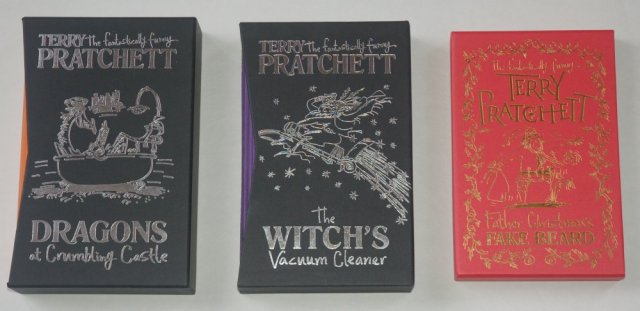
However as can be seen from the image of the books above there have now been 3 collected volumes and I have all 6 of them. Yes you read that right, each one has come out as a standard edition alongside a collectors version.

Dsc_0560

Dsc_0559

So lets make a comparison of the available volumes:

Dragons at Crumbling Castle – published 2014

  • Standard edition – Dust wrapper – 14 stories, two of which went to make up The Carpet People but are here presented as 2 separate works and an introduction.
  • Collectors edition – Slipcase – 16 stories, the two extras being ‘The Wergs Invasion of Earth’ and ‘Bason and the Hugonauts’. There is also a different, significantly longer, introduction; commentaries after each story written by Terry and a colour print tucked inside.

The Witch’s Vacuum Cleaner – published 2016

  • Standard edition – Dust wrapper – 14 stories and an introduction
  • Collectors edition – Slipcase – 16 stories, the two extras being ‘Johnno, the Talking Horse’ and ‘The Wild Knight’. Commentaries after the stories were written by Terry’s assistant Rob Wilkins as Terry had sadly passed away in March 2015 and there was also a postscript added by Rob by way of a eulogy to his boss and friend. Again a colour print was included as a loose insert.

Father Christmas’s Fake Beard – published 2017

  • Standard edition – Dust Wrapper – 11 stories, including one of the stories from The Dragons at Crumbling Castle, ‘Father Christmas goes to Work at the Zoo’.
  • Collectors edition – Slipcase – Identical text to the standard edition but on better paper and all the illustrations are in colour. No other extras

This means that 42 (or 41 if you regard the two parts of The Carpet People as 1 piece) have now been published which is roughly half of what appeared in the newspaper all those years ago.

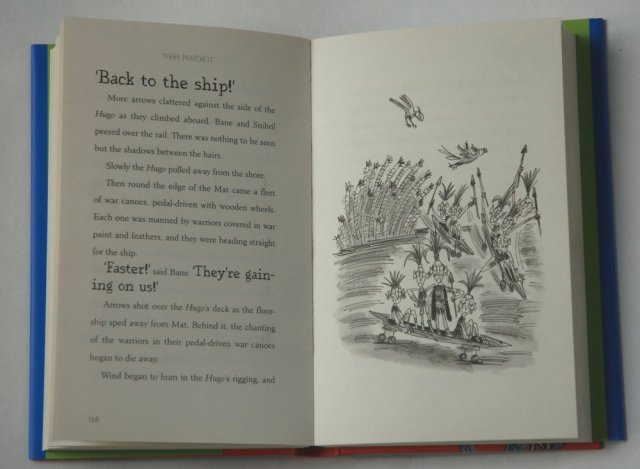
The books are great fun, the pages are covered in typographical games, at one point when the lights go out in a story the next two pages are white text on black, and there are numerous uses of other fonts and text sizes to emphasise the action.

Dsc_0562

The colour edition of Father Christmas’s Fake Beard is also a joy to own, the original looks great but the colour just looks fantastic.

Dsc_0564

During Terry’s tenure as Uncle Jim a lot of the stories are centred on the fictional county of Gritshire, its county town of Blackbury with surrounding towns like East Slate and Umbridge (on the river Um) and the notorious Even Moor where strange things happen in the wild places. The characters gradually develop over the stories so you really feel that there is such a community where odd events occur almost every day and almost feel sorry for the largely incompetent county councillors who just seem to invite disaster with their every plan for improvement. I suspect that this was Terry letting his main job. which included reporting on local government decisions. drift into his fantastical imagination.

I shall finish with the two prints from the collectors editions. The one on the right of Sir Terry as a knight in armour includes his actual coat of arms as ably described in this Wikipedia entry. Let’s hope to see more of these wonderful stories from Terry aka Uncle Jim being published in the future, after all there is still 50% of the work unavailable apart from in frustratingly difficult to obtain old newspapers.

Dsc_0565

The Diary of a Bookseller – Shaun Bythell

For my entry this week I’ve decided to review a book I was given at Christmas and thoroughly enjoyed, The Diary of a Bookseller by Shaun Bythell.

20170123 The Diary of a Bookseller

Shaun is the notoriously curmudgeonly owner of the largest second hand bookshop in the Scotland which goes by the wonderfully simple name of The Bookshop. Not The Wigtown Bookshop (which is where it is) or Bythells’ Books, no it’s just The Bookshop, direct and to the point just like its owner. His website name is similarly one to be envied by anyone in the trade www.the-bookshop.com. The book takes a very simple starting point “to write things down as they happened in the shop” and develops into an entertaining story of how a year passed for Shaun and his equally eccentric staff.  It starts randomly on Wednesday 5th February 2014 and finishes on Wednesday 4th February 2015 (this entry is as far as I can remember the only time the year is specified).

As the owner of a specialist retail business in a small town myself the interactions with customers, or at least people who wander into the shop, move stock around and then leave without buying anything, that Shaun documents are all to familiar.

Tuesday 8th April

At 10:15am a woman walked in and roared, I am in my element! Books! then continued to shout questions at me for an hour whilst she waddled about the shop like a ‘stately goose’ as Gogol describes Sobakevich’s wife in Dead Souls. Predictably she didn’t buy anything.

Few things are more guaranteed than when somebody you have never seen before in the shop and expresses huge enthusiasm on entering is that they won’t buy anything.

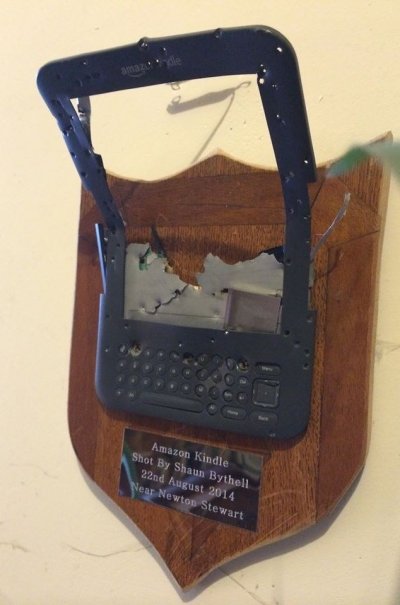
Shaun also has a dislike, no that’s the wrong word, hatred would be better, of Kindles and this is referred to several times in the book even to the point of shooting one and mounting the remains on the wall in his shop like a hunting trophy.

20170123 The Diary of a Bookseller 2

This is totally understandable for somebody who makes their living selling books (well maybe not the shooting part) you can’t after all trade the contents of a Kindle but as somebody who loves books I also dislike the impersonal nature of reading on a screen. I found the photo on pinterest so don’t know who originally took it so I apologise in advance for unacknowledged copyright.

However I don’t want to give the idea that the book is just full of Shaun complaining, sometimes he is having a great time, although usually this is whilst he isn’t actually in the shop. Wigtown is Scotlands’ book town, based on the idea by Richard Booth in Hay on Wye, gathering bookshops together to make the place a specific destination for book lovers all over the world and The Bookshop was the first of what is now 13 independent retailers in the town.  It is also home to a book festival at the end of September which is documented in the book.  The Bookshop hosts ‘The Writers Retreat’ a place where guest speakers at the festival can escape to good food and drink and to chat amongst themselves and this leads to more stories being told. There is clearly a lot of effort put into the festival and I really ought to go, but maybe not this year as I suspect a lot of readers of this book have had the same idea.

Tuesday 25th March

Shortly after Andrew had left an extremely rude old woman demanded a copy of Simon Sebag Montefiore’s biography of Stalin. We had one in the Russia section which she brought to the counter. It was an unusually pristine copy in a mint jacket, clearly unread – original price £25. She asked how much it was, I pointed to the sticker that says £6.50. She pushed it away from her and turned; walking out muttering, ‘Too expensive’. I’m pretty sure she’ll be back so I re-priced it at £8.50.

I loved the book and can’t recommend it more, you don’t have to be a bookseller or even a shopkeeper of any sort to get a lot of pleasure from it.

By the way I checked and yes you can get it on Kindle, Shaun is presumably furious…