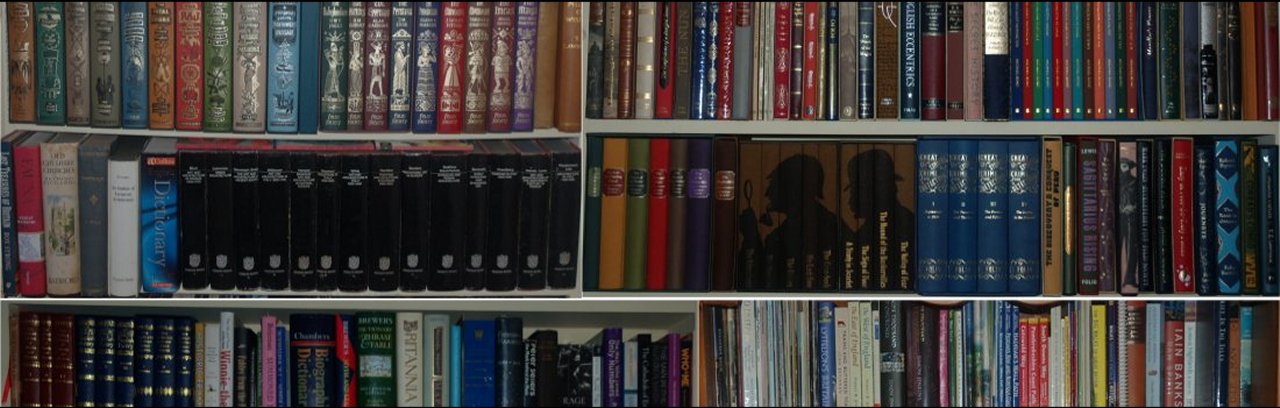
The Unadulterated Cat – Terry Pratchett

20190903 The unadulterated cat 1

One of Terry Pratchett’s least well known books, The Unadulterated Cat is an odd mix of cat lovers companion, a parody of the Campaign for Real Ale, and a heavy dose humour about the joys (or otherwise) of owning a cat. It is illustrated by Gray Jolliffe whose style completely fits in with the text and as discussed below is one of the reasons why I would recommend the later editions over the first. So what is it all about then? Well the opening lines give a pretty good guide.

Far too many people these days have grown used to boring mass-produced cats which may bounce with health and nourishing vitamins but aren’t a patch on the good old cats you used to get. The Campaign for Real Cats wants to change all that by helping people recognise Real Cats when they see one.

Hence this book.

The Campaign for Real Cats is against fizzy keg cats

That last line is a definite reference to CAMRA which as an organisation prefers ‘proper’ cask conditioned ales over anything in a pressurised keg. That used to a reasonable position but nowadays a lot of craft brewers are producing some wonderful keg beers. However on with the review, or at least Pratchett’s idea as to what a Real Cat is…

For example: real cats have ears that look like they’ve been trimmed with pinking shears; real cats never wear flea collars… or appear on Christmas cards… or chase anything with a bell in it; real cats do eat quiche. And giblets. And butter. And anything else left on the table, if they think they can get away with it. Real cats can hear a fridge door opening two rooms away…

Anyone who has ever owned a cat, or gained a cat they didn’t intend to, or indeed have been owned by a cat will recognise most, if not all, of the situations described in the book. Just a selection of chapter titles will give a feel for what is covered.

  • How to get a cat
  • Types of cat
  • Naming cats
  • Illnesses
  • Feeding cats
  • Training and disciplining the Real Cat
  • Games cats play
  • Schrodinger cats
  • The cat in history

etc.

That types of cat includes ‘Black cats with white paws’ and ‘Boot faced cats’ is a hint that this is not a book that regards pedigree highly. Training cats is also not something that can be done well apart from using a litter tray anyway as Pratchett points out

You think it’s the cat turning up obediently at the back door at ten o’clock obediently for its dinner. From the cats point, a blob on legs has been trained to take a tin out of the fridge every night.

If you have a sense of humour and own a cat, or frankly even if you don’t then read this book, it will definitely give you a laugh.
20190903 The unadulterated cat 2

Note of variations between editions

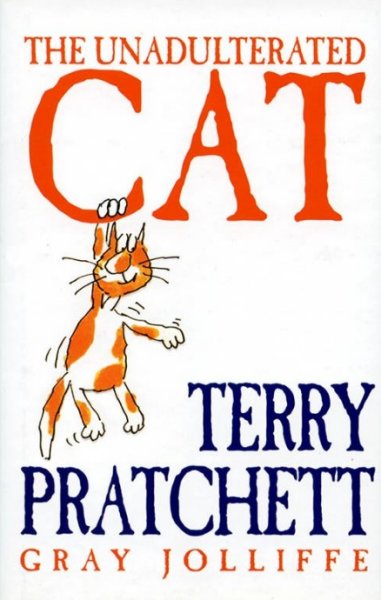
I have two distinct versions of this book. The original first edition was a paperback published by Victor Gollancz in 1989 and is shown at the top of this review. I also have the first hardback edition, also published by Victor Gollancz, but not until 2002, pictured above, and this, along with two intermediate paperback editions, Gollancz in 1992 and Vista in 1997 are all described as ‘revised editions’ so what is different?

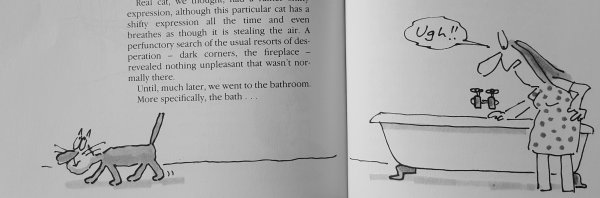
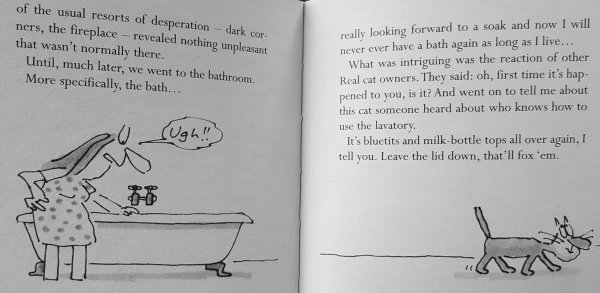
Well the initial obvious difference is the covers and the sizes of the two books I have, the first edition is 242mm tall by 172mm wide and the revised hardback is 185mm by 120mm. Partly due to this size differential the first edition is 96 pages as opposed to the 159 pages in the hardback. It appears the text is unchanged, unless there are minor corrections that I haven’t spotted, but the illustrations are significantly different between my two editions. There are a lot more of them in the later edition, which also adds to the page count, and those carried over from the original are sometimes in different places in relation to the text. There is one example of a mirrored version being used. Original version of what can happen if you accidentally leave your real cat in the house when you think it is outside is first.
20190903 The unadulterated cat 3

20190903 The unadulterated cat 4

Another where the text is amended, apparently to clarify a joke that I think was already quite clear, original to the left

And two illustrations are dropped altogether, along with the front cover of the original which didn’t make it into the revised edition. In the first case the mink coat cartoon was replaced

In the second example there is no illustration at this point in the text in the revised edition.

20190903 The unadulterated cat 9

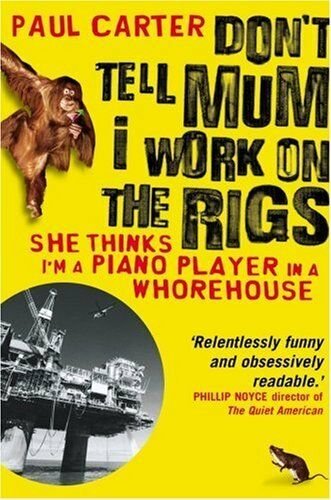
Don’t Tell Mum I Work on the Rigs – Paul Carter

Or to give the book its full title “Don’t Tell Mum I Work on the Rigs: She Thinks I’m a Piano Player in a Whorehouse”. A series of real life stories of life on oil rigs around the world in some of the most dangerous places you could ever hope not to go to.

20190709 Don't tell Mum I work on the Rigs

Carter has written a really funny summary of some of his exploits in fifteen years working on oil rigs around the world and the scrapes he has got into whilst doing it. The book has a prologue with an extract from chapter nine which has him in business class on a scheduled flight from Port Moresby in Papua New Guinea; unfortunately with Amoebic Dysentery which strikes just after take-off. Now there is definitely nothing inherently funny about an explosive attack of dysentery, especially in a crowded aeroplane, but the way he writes about it is so vivid that you cannot help laughing at the situation.

The first chapter relates to his childhood and initial links to oil, He had a rough time in his early years with a domineering father who was in the RAF, eventually his mother left him taking the two children with her. She moved the family to Aberdeen and got a job in the oil industry where she would meet her second husband and subsequently got posted to Australia which is where Carter spent his adolescence and eventually some dead end jobs but he wanted to work on rigs. Ironically after his father left the RAF he also started working on rigs and Carter would sometimes meet people who had worked with him. As he says the work is all over the world but the actual people doing the work form a surprisingly small community and there are regular characters that keep turning up no matter where he is working.

In amongst the stories about offshore and land rigs, crazy holding accommodation and the horror stories you also get to learn a little about the oil business and definitely a lot about why being involved may be lucrative but also extremely dangerous. Carter has worked on all sorts and after proving his abilities has been freelance for four years at the time he covers in the book. He is obviously good enough at what he does to be wanted by numerous companies no matter what type of rig is involved.

20190709 Don't tell Mum I work on the Rigs 2

We go on a bounce around the world starting in Australia with a land rig in the Western Australia goldfields back in the early 1990’s where he learnt the trade as a labourer, or roughneck, and worked his way up and then mainly in the Asian oilfields. Apart from the dysentery, and the local wildlife trying to kill you this was relatively safe until it got to time away from the rig when men who work in a dangerous and frequently deadly job chill out by doing dangerous and sometimes deadly ways of not being at work. The wilder the country the more dangerous it was, not just from the locality but also the often poorly maintained equipment such as ancient helicopters.

Every time I read Upstream, an oilfield newspaper, there’s an article like this

Bumfuck Nowhere: all nine passengers and crew died yesterday, when a twelve seater Sikorsky helicopter operated by Doom Air crashed in a really big ball of flames shortly after take off from Bumfuck Nowhere regional airport. Witnesses say the helicopter fell for, oh wow, ages before vaporising into the jungle at 1592 miles an hour.

He also worked the Gulf and South America but the stand out awful places were Russia which  was cold, so very cold and really primitive and worst of the worst Nigeria which was so dangerous to work in that getting out alive was regarded as a bonus. Nowhere in Nigeria was without armed guards when not on the rig especially on the trip to and from the airport, his two predecessors for the job he had there had both been killed by fake taxi drivers before they had even made it to the camp for the first time.

But it’s not just about the oilfields you also get the ups and downs of his personal life and the surprising sideline he ended up doing which was in advertising in Sydney in his downtime between jobs. This is probably what honed his way with words and makes the book such a pleasure to read.

This is not a book for the easily shocked or offended, but you probably guessed that from the prologue so at least you have been warned. I loved it and need to get his follow up “This is Not a Drill”

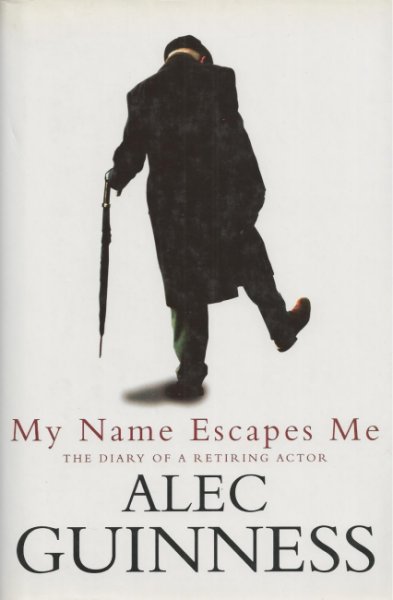
My Name Escapes Me – Alec Guinness

20190528 My Name Escapes Me

Subtitled “The diary of a retiring actor” this book takes us from the 1st January 1995 to the 6th June 1996. 1995 is treated rather episodically with large gaps in the diary but there are much more frequent entries for 1996 at least as far as that year goes. The book is quite a gentle read, ideal for a quiet afternoon where you just want something to entertain rather than educate. Guinness is in his eighties by the time he wrote this and effectively has retired although he does do a couple of very small parts for films and a short voice-over during the 18 months of the diary.

There are the expected reminiscences scattered through, not just of stage and screen but also of his conversion to Roman Catholicism forty years earlier. Through most of the book his wife Merula is having problems getting about leading to hip surgery and a long slow recovery and he clearly dotes on her, with various changes of plan wrapped around her current health. He is an inveterate name dropper and chides himself several times in the diary for long convoluted stories he tells at dinner parties probably boring everyone else in the process, a habit Merula sometimes curtails by commenting, with the punchline that he is slowly working up to, during the story. People expect actors, especially ones of his seniority, to be able to talk in public but Guinness is quite clear several times that having him give a speech is doomed to failure from the start, it always has been and age has not improved his ability.

One running commentary relates to the Star Wars films and the fan mail, usually with photographs they want signing that he gets all the time.  As in this entry from 16th December 1995 which gives a good flavour of the style of the book.

Today I have felt querulous. Behaviour has been spiky; largely due, I think, to our affable postman dutiful pushing piles of junk mail through the letterbox daily. It gets worse near Christmas. The rubbish, the charity appeals (often in duplicate) and worst of all, the photographs from Star Wars demanding autographs. They mostly come from America and as often as not enclose a stamped addressed envelope – the stamps being US stamps are useless her. The English usually make their demand without photograph, envelope, stamp or money. The nation has got acclimatized to asking something for nothing. Bills in the post are welcome in comparison. It’s mean and hard of me but from 1 January 1996 I am resolved to throw it all in the waste bin unopened (bills excepted, of course); I no longer have the energy to assist teenagers in their idiotic, albeit lucrative, hobby.

He makes a good point here, that a lot of the signed pictures are probably destined for Ebay or some such autograph trading site, where they would make a significant profit for the person who sent them and that is the reason for the contact in the first place. This is something that Sir Terry Pratchett was also somewhat wary of, threatening to sign any book where no dedication was requested “To Ebay purchaser”. Terry does actually make a slight appearance in the book in the 13th June 1995 entry where Guinness praises the Jungle Quest episode from the previous night which featured Terry and his PA Rob in Borneo with Orang Utans.

The diary ends on the 56th birthday of their son Matthew (also an actor) soon after a much needed holiday at Lake Como, not just to mark his birthday but also the anniversary of the Normandy invasion in 1945. Guinness was in the opposite side of Europe, in Italy, at the time having taken part in the attacks on Sicily and Italy several days before, designed not only to take that area but also to divert German military forces away from Dunkirk.

It’s a good read, if a little light, and has an excellent index which reveals that Alan Bennett is mentioned twelve times, The National Theatre four times whilst the National Lottery gets five. Shakespeare or his plays are name checked forty five times whilst the second highest is his wife Merula at twenty nine (although much longer entries) and third comes dogs at twenty one times. I think this says a lot for his priorities. Sir Alec Guinness died in August 2000 and Merula only lived another couple of months afterwards.

The Plagiarist in the Kitchen – Jonathan Meades

I first came across Jonathan Meades through his highly idiosyncratic TV documentaries where he was always dressed as shown on the cover of this volume, all in black with black sunglasses. He would talk direct to the camera whilst totally ignoring something going on behind him or alternatively somebody else would be talking to the camera and he would appear in the background apparently having little connection to what was being said. The films looked spontaneous precisely because they weren’t, everything was tightly scripted and performed with an artifice unique to Meades. The person on screen was not Meades as he really was it was Meades acting a character of himself and presenting the sort of intelligent TV that rarely gets made today. I later found out that The Times newspaper had employed him as a restaurant critic for fifteen years so seeing that in 2017 he had written a cookbook made searching that out imperative. How would the Jonathan Meades I knew and loved from his many programmes approach cooking. The answer, it turned out, was uniquely and also filled with his dry wit, in short exactly as I hoped.

20190521 The Plagiarist in the Kitchen 1

Meades explains the title by stating that all recipes are theft, they all come from somebody, even if you add to or alter them in some way, there is really only so many ways to cook something and they have all been done. This is more than a cookbook it is a cookery philosophy and also assumes that the reader has an understanding of cooking in that a lot of the recipes don’t actually have quantities to the ingredients. The only times that quantities are given is when it is essential to get the balance right such as avoiding a sloppy batter, or getting the right balance of flavours such as with gayettes (French style faggots). Other than that there may be hints, such as don’t use too much celery or carrot in a mirepoix because both can dominate. Some of the recipes can barely be called such.

20190521 The Plagiarist in the Kitchen 2

Simplicity is everything. But when he needs a more complex approach it can also be found here, cassoulet for instance takes four pages, most of which is actually involved with cooking the dish.  What you definitely do get is a healthy dose of advice, such as his instructions for making risotto.

What you do with the rice is more important than where it comes from
What you do is keep patient
What you do is stay put whilst it’s cooking
What you don’t do is slip outside for a gasper with the other snoutcasts
What you don’t do is include wine. It adds nothing

Do not get carried away stirring, cooking is not therapy

One of the joys of the book are Meades epigrams, which can be pearls of wisdom or just plain funny. Just a few from the section on oils will give a flavour of what to expect

  • Extra-virgin might be a desirable quality in nuns … but applied to olive oil it is close to meaningless
  • Various degrees of chastity have spread to other oils
  • Duck fat – Much cheaper than goose fat and virtually indistinguishable.
  • Toasted sesame – Asian dishes are for consuming, not for preparing. It is futile to steal what you can’t understand
  • Beef dripping – Delicious on toast … Good for chips and Yorkshire pudding and anything else that comes from north of the Trent

20190521 The Plagiarist in the Kitchen 3

The recipes are definitely practical and I will certainly be cooking a few with the exception of the fig and ham tart which ends

Leave to cool
Taste
Chuck in bin

This was Meades attempt a creating a dish and as he says the reasoning behind it appeared sound at the start but…

Only the doltishly insentient, the immemoriously recidivist, the sociopathic and the smug regret nothing. I no doubt belong, in this instance, to one of those unhappy categories by not regretting having invented this dish. I do not regret it because it was a warning. Never create when you can steal. Never enter a restaurant that advertises its ‘cuisine d’auteur’ or ‘creative cooking’.

But definitely do read this book.

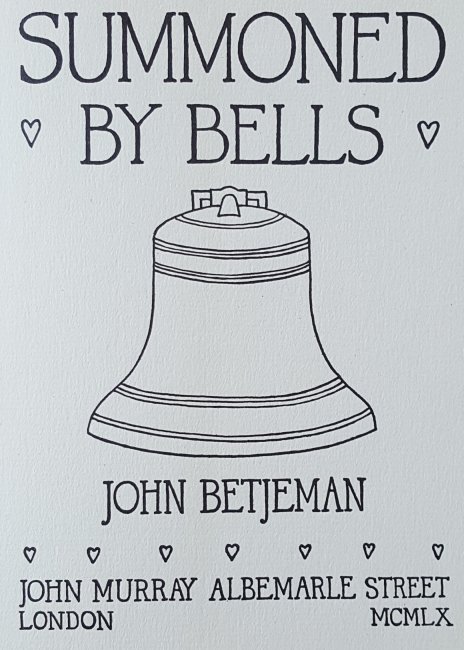
Summoned by Bells – John Betjeman

20190514 Summoned by Bells 1

This autobiography in verse covers Betjeman’s early life from his Edwardian childhood (he was born in 1906) to his university days at Magdalen College in Oxford where he was taught by C.S. Lewis. The book was first printed in 1960 just as Betjeman was getting serious recognition as a poet with a dozen volumes published before this and it is also the year he received The Queen’s Medal for Poetry and was made a CBE. The verse has his characteristic humour but also darker times like describing being bullied at school. It is uncharacteristic also in being, for the most part, blank verse, though he can’t stop himself at times, from adding in some parts in rhymes. The book is split into nine chapters as we follow him growing up.

We start in Highgate where the family had moved when he was three years old, they were clearly relatively well to do as they owned a four wheeled carriage and regularly holidayed in Cornwall. Apart from Maud, his overbearing nurse, who seemed to delight in punishing him for slight misdemeanors he appears to have had a happy childhood up until he went to school. Apart from one traumatic incident that clearly haunted him right up to his fifties when he wrote the lines on just the second page of Summoned by Bells.

Safe were those evenings of the pre-war world
When firelight shone on green linoleum;
I heard the church bells hollowing out the sky,
Deep beyond deep, like never ending stars,
And turned to Archibald, my safe old bear,
Whose woollen eyes looked sad or glad at me,
Whose ample forehead I could wet with tears,
Whose half-moon ears received my confidence,
Who made me laugh, who never let me down,
I used to wait for hours to see him move,
Convinced that he could breathe. One dreadful day
They hid him from me as a punishment:
Sometimes the desolation of that loss
Comes back to me and I must go upstairs
To see him in the sawdust, so to speak,
Safe and returned to his idolator.

His father was the third generation owner of a silversmith and cabinet making business and was very disappointed in John because he refused to carry on the firm and all this is covered in the second chapter of the book. In this edition each of the chapters has a small line drawing by Michael Tree and a brief summary of what will be covered. The description of the workshops for the business in this section and the hours that John spent clearly enjoying himself with the craftsmen employed there made it all the more galling for his father when he later expressed no interest in continuing it

To all my father’s hopes. In later years,
Now old and ill, he asked me once again
To carry on the firm, I still refused.
And now when I behold, fresh-published, new,
A further volume of my verse, I see
His kind grey eyes look woundedly at mine,
I see his workmen seeking other jobs,
And that red granite obelisk that marks
The family grave in Highgate cemetery
Points an accusing finger to the sky.

20190514 Summoned by Bells 3

Chapter three has him at school and being bullied at both his junior schools, he seems unclear why at the first one but at the second his apparently German surname in 1913/4, spelt then Betjemann, led to him being picked on by gangs and having to come up with various routes home to avoid them. Ironically the family was actually originally Dutch and the additional ‘n’ was added when they came to the UK over a century earlier but soon Britain was at war with the Netherlands, so they wanted to appear German. During WWI the second ‘n’ was quietly dropped again. Chapter four and the family is on holiday in Cornwall leading to the start of the young Betjeman’s love affair with railways and the English countryside.

20190514 Summoned by Bells 2

Chapters five and seven describe his private education, first at Dragon preparatory school in Oxfordshire and then Marlborough college in Wiltshire. His time at Dragon appears to have been pretty happy and exploring by bicycle leads him to churches and that other great love of his throughout his life, architecture. Marlborough however was a more difficult time, there are stories of beatings and the prefects birching the boys and terrorising them as a group known to the younger boys as “Big Fire” because of where they sat in the evenings. A boy who had transgressed would be called to “Big Fire” for a beating or sometimes worse. I skipped chapter six which covers being back in London during holidays exploring the London Underground and buying books, the family had moved to Chelsea and the bookshops abounded

Untidy bookshops gave me such delight,
It was the smell of books, the plates in them,
Tooled leather, marbled paper, gilded edge,
The armorial book-plate of some country squire

I’m with Betjeman all the way with those sentiments.

20190514 Summoned by Bells 4

The summary above of chapter eight pretty well covers it, his father is even more dominating than before but now John is big enough to escape and does so on long cycle rides round the area discovering yet more churches.

The final section deals with his years at Oxford, a place he freely admits to doing little or no work at and certainly not studying for his degree. Instead he builds a wide social network which become extremely useful to him in later years

No wonder, looking back, I never worked.
Too pleased with life, swept in the social round,
I soon left Old Marlburians behind.
(As one more solemn of our number said:
“Spiritually I was at Eton, John”)
I cut tutorials with wild excuse,
For life was luncheons, luncheons all the way-
And evening dining with the Georgeoisie

How much of this lack of drive towards his degree was down to the mutual dislike between himself and C S Lewis it is difficult to tell, it’s quite possible that even with a more sympathetic tutor who may have got more out of him he would still have left without a degree. In the poem he blames a failure of the compulsory divinity course but in reality he really put so little effort into his studies that he was never going to pass.

The book is a fun read and so unusual in the use of verse throughout. I first read it many years ago and had forgotten how much I enjoyed it.


Toad of Toad Hall – A A Milne

20190507 Toad of Toad Hall 2

What could be better than a play written by one of the English language’s best known children’s authors based on the book by one of the others. A A Milne whilst famous for his tales of Christopher Robin, Winnie the Pooh and all his friends in The Hundred Acre Wood was also a prolific playwright and in 1929 he adapted Kenneth Grahame’s famous 1908 tale The Wind in the Willows for the stage. This year marks ninety years since the first production and the copy I have is the first American edition also from 1929 printed by Charles Scribner’s Sons of New York. The introduction is particularly interesting as Milne deals with the problems of adapting a book, particularly one as well known as The Wind in the Willows.

There are two well-known ways in which to make a play out of a book. You may insist on being faithful to the author, which means that the scene in the aeroplane on page 673 must be got in somehow, however impossible dramatically, or, with somebody else’s idea in your pocket, you may insist on being faithful to yourself, which means that by the middle of act III everybody will realise how right the original author was to have made a book of it. There may be a third way, in which case I have tried to follow it. If, as is more likely, there isn’t, then I have not made a play of The Wind in the Willows. But I have, I hope, made some sort of entertainment, with enough of Kenneth Grahame in it to appease his many admirers, and enough of me in it to justify my name on the title page.

Milne’s solution to condensing the book is to focus on the parts that feature Mr Toad. this means that a consistent central cast is established although Toad is actually only in roughly half of the original book. He also gets round the problem of just how big is everyone, after all Toad drives cars and owns a horse drawn caravan but is definitely smaller than Badger whom we know lives under a tree in the Wild Wood so must be ‘normal sized’ at least most of the time. by having the start of the first act and also the epilogue make it clear that all the action is actually the dream of a young girl called Marigold sitting with her nursemaid on the banks of the river on a warm spring morning, neither of which are in the original story.

In reading the book, it is necessary to think of Mole, for instance, sometimes as an actual mole, sometimes as such a mole in human clothes, sometimes as a mole grown to human size, sometimes as walking on two legs, sometimes on four. He is a mole, he isn’t a mole. What is he? I don’t know. And, not being a matter of fact person, I don’t mind. At least I do know, and still I don’t mind

This quote, also from the introduction, gets to the heart of the ‘problem’ with The Wind in the Willows. But the reason why I put the word problem in quotes is because it isn’t a problem and never has been to readers of the book who are just swept up in the story. But put it on a stage, with humans playing the characters, and the stage director definitely has a potential problem. This is solved by the dream concept and allows the tale to unfold seamlessly with everyone being human sized yet still being Mole, Ratty, Badger, Toad et al.

For all of Milne’s protestations above the play is actually remarkably faithful to the parts of the book being dramatised and the humour is wonderful. Especially for my mind those lines given to Alfred, the sarcastic, and feeling much put upon, horse pulling Toad’s caravan. Anyone who loves Eeyore in the Winnie the Pooh stories will love Alfred, he was created by Milne as the horse isn’t named and is only a bit and indeed silent player in the book but here he really comes alive…

Enter a horse pulling a gaily painted wooden caravan

ALFRED Oh, there you are. I’ve been looking for you everywhere
TOAD (excitedly) Now isn’t this lucky? Just at the psycho – psycho – what’s the word?
ALFRED (hopefully) Encyclopaedia, That is, if you ask me
TOAD I didn’t ask you. Ratty you know the word–
ALFRED Introduce me to your friends, won’t you? I do get so frightfully left out of it
TOAD My friends Mr. Rat and Mr. Mole this is Alfred
ALFRED Pleased to meet you. If you are coming my way, you must let me take you. Only I do like a little conversation (To Toad) Encyclopaedia, that was the word you wanted
RAT (Sadly) So this is the latest?
TOAD (Eagerly) Absolutely the very latest. There isn’t a more beautiful one, a more compact one, a more – what’s the word?
ALFRED Heavy
TOAD A more up to date one, a more –
RAT So this is the latest craze! I understand. Boating is played out. He’s tired of it, and done with it
ALFRED Don’t blame me. I wasn’t consulted about this at all; but if I had been, I should have said boats. Stick to boats.
TOAD My dear old Ratty, you don’t understand. Boating – well – a pleasant amusement for the young. I say nothing against it. But there’s real life for you (he waves a paw at the van) – in that little cart. The open road, the dusty highway, the heath, the common, the hedgerows, the rolling downs!
ALFRED And the ups. However nobody consults me. Nobody minds what I think.

The play starts with Marigold on the phone (actually a daffodil) pretending to call Mr. Rat who she eventually gets through to and sets the basis of the play as her fantasy as regards the main characters. Suddenly we hear elfin music, the stage goes dark, Marigold and her nurse vanish and the magic of the story unfolds with Mole appearing out of his hole and meeting Ratty for the first time. We are soon afterwards introduced to Badger and then Toad and the tale continues with the arrival of Alfred so they can go on a caravanning trip. Sensibly Badger declines to be involved. Caravanning doesn’t last long however, they are forced off the road by a furiously driven car and the only thing Toad can think of after that is having one of those; “Poop Poop” is all they can get out of him for quite a while. And so ends the first act.

Act two is set entirely within the Wild Wood home of the dangerous Stoats and Weasels. Initially with Mole getting lost whilst exploring in the snow and scared of the woods inhabitants before being rescued by Ratty. Then the two of them stumble over Badger’s house and decide to take refuge from the bad weather and the ever present danger from attack when wandering at night in the wood. Inside Badgers home all is comfortable and settled as you would expect from the residence of an older gentleman content in his own company. The three friends start talking about Toad and his motoring exploits, apparently he has already owned (and crashed) seven cars, they are just discussing what they should do to save him from himself when Toad himself arrives. He has crashed car number eight… Badger decides to keep Toad at his house until this current craze has passed but after a few weeks Toad manages to trick Ratty into leaving him alone and the act closes with Toad running off singing about how clever he is.

Act three starts in a courthouse with Toad on trial for stealing a car and then calling a policeman fat-face. Sentenced to twenty years for these heinous crimes, especially the being cheeky to a policeman we then find him in a cell. He makes his escape with the help of the jailers daughter and her washerwoman aunt who they bribe to let him wear her clothes and after a series of adventures, including stealing a bargee’s horse he heads for the river.

The final act starts with Toad at Ratty’s home where he is informed that during the four weeks he was incarcerated the Stoats and Weasels have taken over Toad Hall and a daring plan is formed by Badger to take it back. The final scene of the battle and aftermath is actually the only time Toad Hall appears in the play despite being in the title. Finally the short epilogue as mentioned earlier has Marigold asleep amongst the daffodils as her nurse wakes her to go home.

As can be seen from the above précis the play follows the book pretty well, and it is sometimes difficult to spot which author is responsible for what. Indeed I will leave the last word to the summary on the dust wrapper of the first US edition and a photo of the front of the dust wrapper which is a paler version of the book cover shown at the top of the blog

we in turn, might ask ourselves after reading this play: “Is it Kenneth Grahame? Is it A. A. Milne?” We don’t know, but it doesn’t at all matter, for it is perfect

20190507 Toad of Toad Hall 1

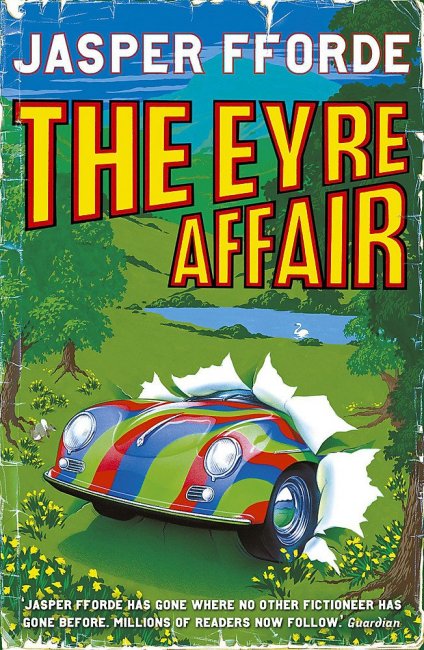
The Eyre Affair – Jasper Fforde

Jasper Fforde’s first novel also introduces his main protagonist, Thursday Next, an agent for LiteraTec Special Operations who has now appeared in seven books by Fforde. The books exists in an alternate history where, in the case of this book, the year is 1985 and the Crimean War is now into its 135th year, there are companies commercially genetically engineering extinct species so a popular pet is a dodo and Special Operations includes division 27 which looks after works of literature. In fact literature seems to dominate society with people changing their names to that of famous authors to such an extent that they are legally obliged to have a number tattooed on them to identify which John Milton you are talking to for example. There is also the Goliath Corporation a firm that has made billions in financing the Crimean War and seems to have various shadowy sidelines of it’s own which are strictly for the good of the corporation.

A running trope through this book is “Who wrote the plays attributed to Shakespeare?” sometimes there are short discussions regarding Bacon or Marlowe and in one tedious section which ruins the flow of the plot a whole series of pages are dedicated to this discussion for no good reason whatsoever.

20190423 The Eyre Affair 1

The book after all is theoretically about Jane Eyre, although in fact for almost half the story it is about Martin Chuzzlewit. The basic conceit of the book is that there is a master criminal who obtains a machine invented by Thursday’s uncle Mycroft which allows people to travel in and out of works of literature. Archeron Hades steals the original manuscript of Charles Dickens’ work, removes one of the minor characters and has him killed in the present day. This changes all copies of the book, even those already printed, and he threatens to do the same to Chuzzlewit himself unless a ransom is paid.

For various reasons the plot is foiled and the ransom not paid but Hades escapes to the fiercely independent Republic of Wales where he cannot be followed by English justice, only to try again by this time stealing the original manuscript of Jane Eyre and kidnapping Jane herself immediately before she rescues Mr Rochester from his flaming bed. All copies of the book are therefore much shorter and there is uproar. Thursday Next is sent to get Jane and the book back together.

As implied above there are numerous sub plots, in fact far too many sub plots, as the book is overly complicated by them. You get the feeling that Fford is trying to show off his literary erudition at the expense of just telling a good story and there is definitely a good story to be found in there if you work at it. I’m inclined to forgive him as this is his first published work and I will definitely read at least the next volume about Thursday Next entitled “Lost in a Good Book” which is set a few months after “The Eyre Affair”.

The book cover by the way is printed to look as though it is rather dog-eared, my copy is brand new.

Chapter 13

There is an ongoing joke in Fforde’s books regarding chapter thirteen or rather the lack of one. If there are numbered chapters then there is always one listed in the contents at the start but in fact chapter 14 always immediately follows chapter 12 and the page given for chapter 13 to start is either blank or part way through chapter 12. They do however have titles:

  • The Eyre Affair – The church at Capel-y-ffin
  • Lost in a Good Book – Mount Pleasant
  • The Well of Lost Plots – Reservoir near the church of St Stephen
  • Something Rotten – Milton
  • First Amongst Sequels – Cross Lewis’ number
  • One of Our Thursdays is Missing – 14th May 1931
  • The Woman Who Died a Lot – A Penguin
  • The Big Over Easy – First on the right
  • The Fourth Bear – 111110000

Note: assuming 111110000 is binary then the decimal equivalent is 496, it is anyone’s guess if this is significant or if there is any meaning to the choice of titles for the missing chapters; although the 14th May 1931 was a Thursday.

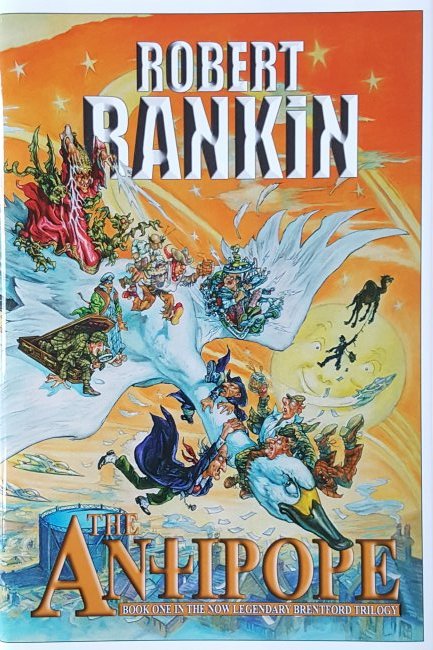
The Antipope – Robert Rankin

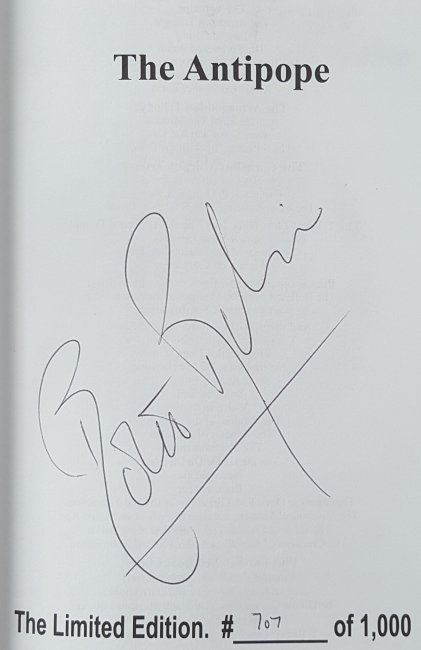
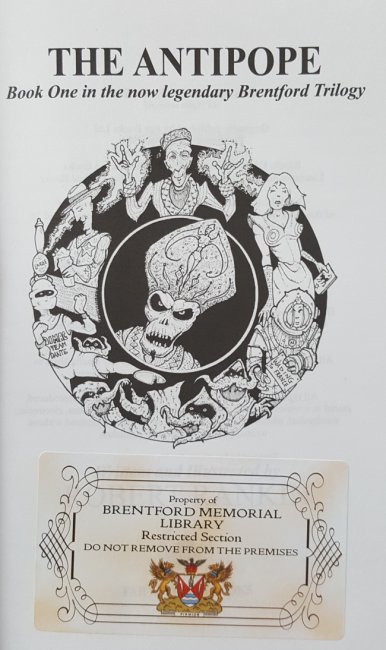
The first in the increasingly inaccurately titled Brentford Trilogy (currently eleven books with at least one more to come, which is claimed to be the last of the series) The Antipope also has the most straight forward title. Rankin has a passion for punning titles but as this was also his first ever book, originally published in 1981, maybe he felt something more mainstream was required. My copy is the 35th anniversary limited edition privately published by Rankin and signed by him, it is also the first time the book has appeared in hardback. Rankin himself describes his work as far fetched fiction, indeed his privately published volumes are by Far Fetched Books, at the time of writing the limited edition of The Antipope was still available and is illustrated internally by the author, the cover is by the brilliant Josh Kirby

20190402 The Antipope 1

The full list of Brentford Trilogy books so far is as follows; and from this you can see his love of wordplay with other book titles and songs:

  1. The Antipope (1981)
  2. The Brentford Triangle (1983)
  3. East of Ealing (1984)
  4. The Sprouts of Wrath (1988)
  5. The Brentford Chainsaw Massacre (1997)
  6. Sex and Drugs and Sausage Rolls (1999)
  7. Knees Up Mother Earth (2004)
  8. The Brightonomicon (2005)
  9. Retromancer (2009)
  10. The Lord of the Ring Roads (2017)
  11. The Chronicles of Banarnia (2018)

The Brightonomicon and Retromancer (2009) are included above although they aren’t in the list of Brentford Trilogy books at the front of this book which only has the first seven but equally on the dust wrapper it says:

The Antipope was the first book in the Brentford Trilogy which now includes at least nine books and will feature one more with the launch of The Lord of the Ring Roads – the first book in a new Brentford Trilogy – some time in the not too distant future.

The reason for the confusion in the number of books to be officially counted in the series is probably due to the appearance of several characters from the set appearing in other books by Rankin which means that those may, or may not, be part of the canon. The books also do not appear to have a specific reading order; things that happen in one book are ignored in later volumes, characters even reappear when they were apparently killed off or written out in earlier books and never with any explanation. Individual volumes are consistent within themselves however just don’t expect a sweeping narrative across them all.

20190402 The Antipope 2

Brentford itself is one of the least eventful places in the UK and certainly contests strongly for the top spot for this amongst towns within Greater London. Looking on the time line on the wikipedia page reveals that the only act worthy of mention in the last ninety years is the 1965 opening of the elevated section of the M4 motorway, an opportunity the express road took to bypass Brentford entirely. This makes the location all the funnier for the ‘far fetched fiction’ that Rankin has take place there and the cast of odd characters that populate the books. Chief amongst these are John Omally and Jim Pooley who are the reluctant, and frequently drunk, heroes of the book. They are never happier than when enjoying a pint of large in The Flying Swan served by Neville the part time barman at that establishment. It should be noted that Neville appears to be the only barman at the Flying Swan so he does seem to be full time although is always described as the part time barman. The other main characters for this tale are Professor Slocombe who understands more than most what is going on and guides the characters to the ultimate defeat of the Antipope; Norman Hartnell (always described as not to be confused with the other Norman Hartnell) who is a mad inventor and runs the newsagents; Soap Distant explorer of the inner Earth; Captain Carson from the Seaman’s Mission and Archroy who, at least at the start of the book, is working at the local rubber factory.

20190402 The Antipope 3

The plot starts with the arrival in the Flying Swan of

a beggar of dreadful aspect and sorry footwear

All those who encounter him feel compelled to cross themselves even if they are not Catholic and he slowly encounters most of the main protagonists most especially Captain Carson as he moves in and then takes over the Mission house. Quite what a seaman’s mission is doing in Brentford is also a mystery, the town is on the Thames but a long way from the sea. The plot gets odder and odder with each flight of fantasy by Rankin including ‘magic’ beans, vast underground chambers, an attempt to wade the English Channel and a cowboy night nobody will ever forget amongst other things.

Now I’m going to have to read the others in the series…

To conclude with Robert Rankin’s own explanation of Far Fetched Fiction from a 1999 interview in Dublin

 I’ve said this before, when I went into writing I wanted to create a new genre of fiction that wasn’t like anybody else’s. It was going to be called Far Fetched Fiction, I would have my own book shelf in Smiths, with just my books in them and it would be bliss. But it didn’t quite work out like that, I ended up in a general fiction section, and then they realised that I didn’t write general fiction and I ended up in science fiction, which I feel a bit of a fraud for being there. Because people who write science fiction don’t know what I write, and… I’ve forgotten what I was going to say, what was I going to say?

Sourcery (book proof) – Terry Pratchett

20190205sourcery1

The fifth Discworld novel by Terry Pratchett was published on 26th May 1988, before that however Gollanz released a sample for book reviewers and this was the only time that the book proof of one of Terry’s works was not the complete book. Instead what you got was just the first 61 pages and an essay from Terry explaining Discworld as it was still not well known. It is this short essay that makes this book so interesting as it has never been reprinted so you can only read it is you are one of the lucky few people that own a copy. It is not known exactly how many were printed but the proofs of books four and six in the series were both only of circa 100 copies produced so it is not unreasonable to assume that it is also the case for this example. The poor production value of what is basically a pamphlet with what looks like a bad black and white photocopy of the cover for an author who was not then famous would also suggest that not all of the printed editions were kept.

When Sourcery was printed for real the first edition (see below) ran to 7,600 copies, ten years later Carpe Jugulum (printed 5th November 1998) would have a first edition print run of 160,000 in the UK alone although the proof for that book was still only 148 examples. Pratchett UK book proof collecting takes a lot of looking to find copies and they are all rare.

20190205sourcery2

But back to the sample book proof, the essay inside describes how Terry saw the Discworld at the time, over the years this evolved and it is fascinating to read his views then, just four and a half years after the first book in a series that would eventually run to forty two novels, along with numerous other books, maps, plays etc. that added to the Discworld universe. The essay is headed

An Introduction to the series, composed by the Author, and included to make this special preview sample of Sourcery even more valuable as a collector’s item

In it he gives this description of why he invented Discworld in the first place

 It was created as an antidote to all those trilogies whose worthy heroes stagger across three volumes in order to do whatever it is that the fates have decreed that a hero must do. But fairy tales and folklore and all the feedstocks of fantasy have been dragged into it, and the humour gently teased out of them by the simple process of taking them seriously and staffing them with real people. This is very unfair on them, because it is like turning loose a large herd of cows in a small pottery.

This was indeed the case in the early Discworld books, the story is played for laughs and there is a strong sense of parody about the writing particularly in the ones up to and including Sourcery. The name of the novel by the way is also a joke and is deliberately spelled that way rather than Sorcery. The concept is that the eighth son of an eighth son is automatically a wizard of power but if he then goes on to have children each son would be as powerful as any existing wizard and if he has an eighth son then he would be a wizard squared and be all powerful with access to the source of all raw magic on the Disc hence a Sourcerer rather than a sorcerer. This duly happens and wizards start building towers to fight with one another, laying waste to the lands and peoples between; does this remind you of any three volume series by any chance? Pratchett specifically mentions Tolkien a little later.

Thus on the Discworld, wizards smoke. Nothing new about this Tolkien revealed to the world that wizards smoke. But on the Disc they really smoke, you can tell a wizard by his golden fingers, stained beard, tendency to cough when walking upstairs and, in the dark, by his little red glow.

The book goes on the amplify to the ridiculous numerous tropes of the fantasy novels up until then, barbarian heroes that are either like Cohen at 87 years old and sometimes needs to be carried off by the young maidens he has just rescued from sacrifice or patently unsuited for the role they have chosen such as Nijel who is far too polite for this sort of thing with his battle cry of “Erm, excuse me”. The book is very funny especially if you are well read in the sort of books that Pratchett is mercilessly parodying.

People keep asking for maps of the Disc, on the basis that all fantasy world have to have a map, but I retreat into my Somerset bunker and refuse on the ground that I may decide to move places around a bit if it makes a better joke.

As stated above there are now maps not just of the Disc itself but also specific regions but they weren’t created by Terry, instead Stephen Briggs eventually convinced him that it could be mapped, starting with the city of Ankh-Morpork and eventually the whole world and yes it did prove difficult because there wasn’t a map when the books were written and the lost continent of XXXX had to have a huge extension added just so that one of the books worked. The later books are also less parody of fantasy novels and more a humorous parody of life on Earth, back then Pratchett could never have seen where his work would take him and the millions of books he would sell, indeed he was somewhat bemused that it was as popular as it was even then.

the evolution of the books into a cult has rather perplexed me.

20190205sourcery3

At the time of writing there is a copy available on Abebooks should you be interested at a quite reasonable (considering its rarity) £225

The Best of Robert Service

THE SPELL OF THE YUKON

I wanted the gold, and I sought it;
   I scrabbled and mucked like a slave.
Was it famine or scurvy—I fought it;
   I hurled my youth into a grave.
I wanted the gold, and I got it—
   Came out with a fortune last fall,—
Yet somehow life’s not what I thought it,
   And somehow the gold isn’t all.

No! There’s the land. (Have you seen it?)
   It’s the cussedest land that I know,
From the big, dizzy mountains that screen it
   To the deep, deathlike valleys below.
Some say God was tired when He made it;
   Some say it’s a fine land to shun;
Maybe; but there’s some as would trade it
   For no land on earth—and I’m one.

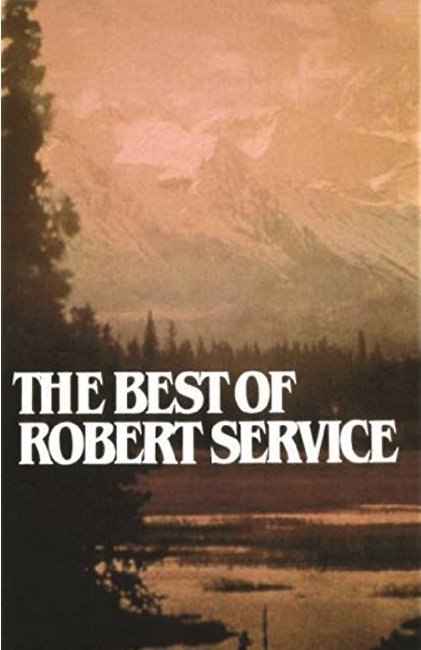
So begins the opening poem of this selection; I fell in love with Service’s verses and the land that inspired them at the same time over twenty years ago. Robert Service was an English born poet and novelist who emigrated to Canada at the age of twenty one and ended up in Whitehorse, Yukon nine years later in 1904 working as a bank clerk. Although he had been writing verse since before he left England it was the environs of Whitehorse and the gold prospectors that he would meet there that inspired him to write his most famous works and it was these that first introduced me to Service. Although “The Best of Robert Service” includes works from several of his books I want to concentrate on the ones that were taken from his first book “Songs of a Sourdough”, this is for two reasons, firstly I bought the book in Whitehorse before setting off to kayak down the Yukon river in 1995 following the trail of the gold prospectors from Service’s day and secondly I want to cover another of his books in a later blog as it has an interesting structure.

20181218 Robert Service 1

So why write about this book now? Well this is the 50th essay I have written for this blog so that brought the subject of gold to mind and frankly I’ve been meaning to write about it for some time. Songs of a Sourdough was an immediate hit, Service had intended it to be a small privately printed volume which he was going to give to friends and family but the printers that it was sent to loved it so much that they wanted to publish it properly and it went to numerous editions within the first year. He would eventually make over one hundred thousand dollars (more then two and a half million today) just from his first book and he became one of the richest authors of his day. Service can justifiably be compared to Rudyard Kipling, like him he was enormously popular but the critics of the day were rather sniffy about his work as they regarded his verse as little more than doggerel.  His most famous work is probably

The Cremation of Sam McGee

There are strange things done in the midnight sun
By the men who moil for gold;
The Arctic trails have their secret tales
That would make your blood run cold;
The Northern Lights have seen queer sights,
But the queerest they ever did see
Was that night on the marge of Lake Lebarge
I cremated Sam McGee.

Now Sam McGee was from Tennessee, where the cotton blooms and blows.
Why he left his home in the South to roam ’round the Pole, God only knows.
He was always cold, but the land of gold seemed to hold him like a spell;
Though he’d often say in his homely way that “he’d sooner live in hell.”

On a Christmas Day we were mushing our way over the Dawson trail.
Talk of your cold! through the parka’s fold it stabbed like a driven nail.
If our eyes we’d close, then the lashes froze till sometimes we couldn’t see;
It wasn’t much fun, but the only one to whimper was Sam McGee.

And that very night, as we lay packed tight in our robes beneath the snow,
And the dogs were fed, and the stars o’erhead were dancing heel and toe,
He turned to me, and “Cap,” says he, “I’ll cash in this trip, I guess;
And if I do, I’m asking that you won’t refuse my last request.”

Well, he seemed so low that I couldn’t say no; then he says with a sort of moan:
“It’s the cursèd cold, and it’s got right hold till I’m chilled clean through to the bone.
Yet ’tain’t being dead—it’s my awful dread of the icy grave that pains;
So I want you to swear that, foul or fair, you’ll cremate my last remains.”

A pal’s last need is a thing to heed, so I swore I would not fail;
And we started on at the streak of dawn; but God! he looked ghastly pale.
He crouched on the sleigh, and he raved all day of his home in Tennessee;
And before nightfall a corpse was all that was left of Sam McGee.

There wasn’t a breath in that land of death, and I hurried, horror-driven,
With a corpse half hid that I couldn’t get rid, because of a promise given;
It was lashed to the sleigh, and it seemed to say: “You may tax your brawn and brains,
But you promised true, and it’s up to you to cremate those last remains.”

Now a promise made is a debt unpaid, and the trail has its own stern code.
In the days to come, though my lips were dumb, in my heart how I cursed that load.
In the long, long night, by the lone firelight, while the huskies, round in a ring,
Howled out their woes to the homeless snows— O God! how I loathed the thing.

And every day that quiet clay seemed to heavy and heavier grow;
And on I went, though the dogs were spent and the grub was getting low;
The trail was bad, and I felt half mad, but I swore I would not give in;
And I’d often sing to the hateful thing, and it hearkened with a grin.

Till I came to the marge of Lake Lebarge, and a derelict there lay;
It was jammed in the ice, but I saw in a trice it was called the “Alice May.”
And I looked at it, and I thought a bit, and I looked at my frozen chum;
Then “Here,” said I, with a sudden cry, “is my cre-ma-tor-eum.”

Some planks I tore from the cabin floor, and I lit the boiler fire;
Some coal I found that was lying around, and I heaped the fuel higher;
The flames just soared, and the furnace roared—such a blaze you seldom see;
And I burrowed a hole in the glowing coal, and I stuffed in Sam McGee.

Then I made a hike, for I didn’t like to hear him sizzle so;
And the heavens scowled, and the huskies howled, and the wind began to blow.
It was icy cold, but the hot sweat rolled down my cheeks, and I don’t know why;
And the greasy smoke in an inky cloak went streaking down the sky.

I do not know how long in the snow I wrestled with grisly fear;
But the stars came out and they danced about ere again I ventured near;
I was sick with dread, but I bravely said: “I’ll just take a peep inside.
I guess he’s cooked, and it’s time I looked”; … then the door I opened wide.

And there sat Sam, looking cool and calm, in the heart of the furnace roar;
And he wore a smile you could see a mile, and he said: “Please close that door.
It’s fine in here, but I greatly fear you’ll let in the cold and storm—
Since I left Plumtree, down in Tennessee, it’s the first time I’ve been warm.”

There are strange things done in the midnight sun
By the men who moil for gold;
The Arctic trails have their secret tales
That would make your blood run cold;
The Northern Lights have seen queer sights,
But the queerest they ever did see
Was that night on the marge of Lake Lebarge
I cremated Sam McGee.

After three years in Whitehorse, he was transferred to the bigger branch in Dawson City which had been the centre of the gold rush, here he got to know more of the veteran prospectors and gained more tales to feed into his poetry. The Cremation of Sam McGee was based on a real incident that he heard about and apparently he composed the work that night. After a year the bank wanted him to move back to Whitehorse as manager of the branch but by now he was earning a good living as a poet so quit and became a full time writer from that point on. Service was not only a poet, he wrote several novels and lived most of his life in France after moving there as a journalist in 1913. After the war he enjoyed the high life as a wealthy author around Paris The book that features in this essay was published in Canada by McGraw-Hill Ryerson who sound like a character from one of his works and there are 101 poems featured giving a good overview of his output.

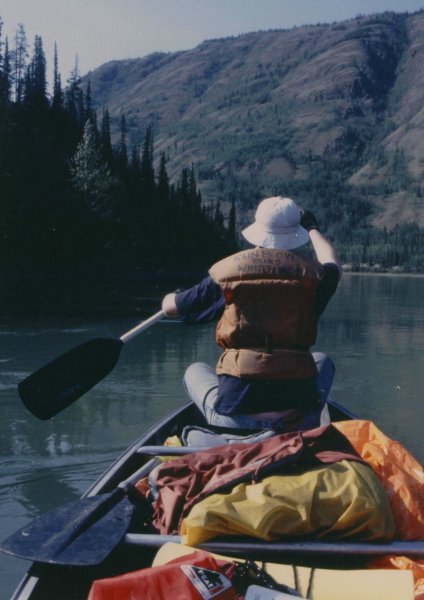
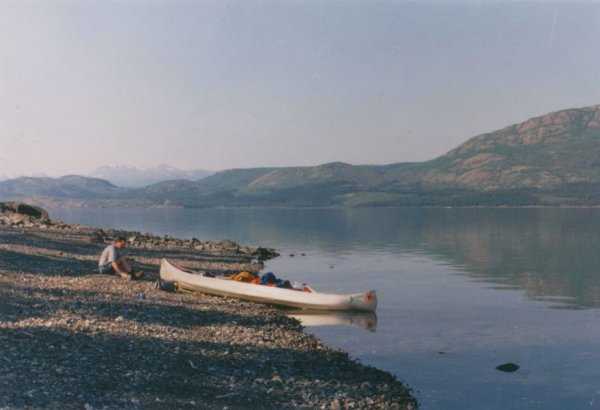
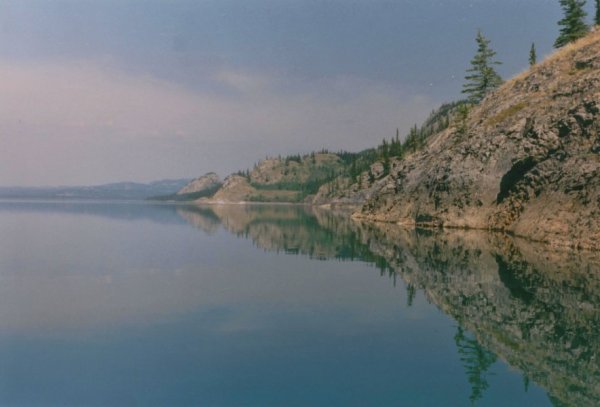
Sadly Robert Service seems to have slipped from the public conciousness nowadays, certainly I had never heard of him before picking the book up as something to read around the camp fire on the trip Dave and I made all those years ago, so just to give a feel of the beauty of the place where we went several days without seeing another human I’ll finish with some of the photos we took starting with me paddling at the front of the kayak. You can see why the place inspired Robert Service.

20181218 Robert Service 8

On the shore of Lake Labarge

20181218 Robert Service 3

More Lake Lebarge (it’s a very big lake)

20181218 Robert Service 4

Bald Eagle by the Thirty Mile River

20181218 Robert Service 5

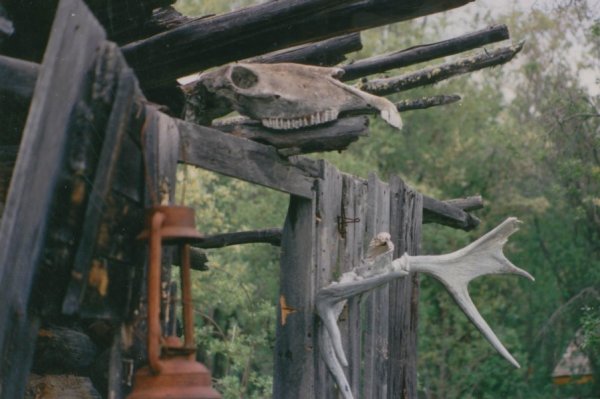
Trappers hut at Hootalinqua

20181218 Robert Service 6

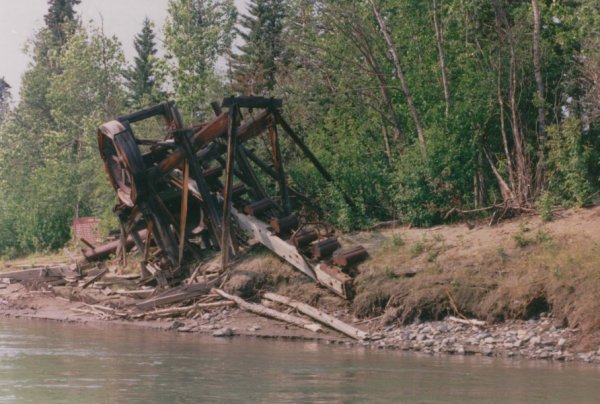
Cyr’s dredge, an abandoned gold dredging machine, when it broke it was just too expensive to fix or take back from the river so it has sat there for decades.

20181218 Robert Service 7