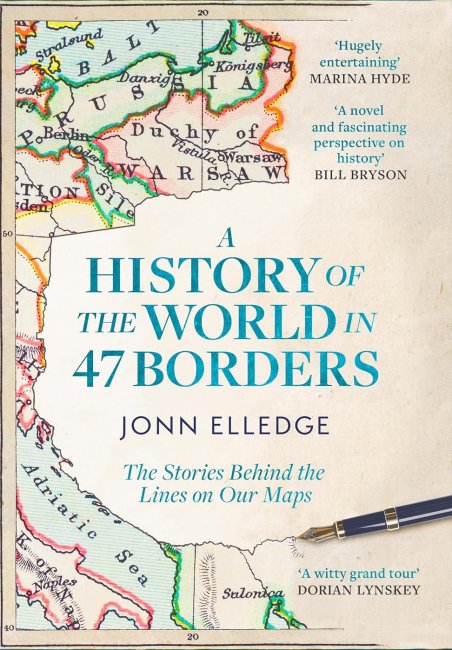
A History of the World in 47 Borders – John Elledge

I should admit up front that the very title of this book is misleading. It contains 47 chapters – but some are concerned with multiple borders

Elledge’s introduction does include the above admission, however that only applies to the hardback, this is the paperback which has 48 chapters as there is an extra bonus one concerning Poland in this version.That it should count chapters not borders is immediately clear as many of the chapters deal with multiple borders although usually in the same geographical vicinity. In fact the subtitle “The stories Behind the Lines on Our Maps” is probably better as I would argue that the chapters concerning The Prime Meridian, The International Date Line and time zones do not deal with national, state or even county borders, but do cover lines on maps which can be very different things. As somebody who loves history and geography I knew I was in for a treat with this book and I definitely wasn’t disappointed.

Each chapter is effectively a stand alone essay of around 2,500 to 3,000 words with twenty three maps where they are needed to clarify the points made,. This makes the book easier to read and digest than might be expected from a roughly 360 page factual volume (excluding index) as you can pick it up, read a couple of chapters, and then put it back down again having gained some insight into what caused a particular group of borders to coalesce where they currently are, or were when dealing with historical examples. The first twenty two chapters are grouped as ‘Histories’ and these cover such diverse subjects as the probable boundaries of Upper and Lower Egypt, The Roman Empire, Charlemagne’s short lived empire, how borders were created in Africa by white men who never went there, right up to the partition of Ireland and the Berlin wall in the twentieth century. Part two, entitled ‘ Legacies’ covers such oddities as the town of Baarle-Hertog and Baarle-Nassau which changes its name depending if you are in the Dutch or the Belgian parts or the Dutch bits in the Belgian bits in The Netherlands, yes it’s a mess, crossing the road can mean changing country and in some cases just walking across a room can do the same. One of my favourite youtubers The Tim Traveller has recently done a video covering the current state of the town but bear in mind it used to be far more confusing. Also in this section is included the far less amusing Israel/Palestine borders, China’s nautical nine-dash line, and bits of Switzerland that aren’t in Switzerland, which turns out to be a less complicated version of Baarle-Hertog and Baarle-Nassau but further south. The book continues with ‘Externalities’ where you will find the time zone and Prime Meridian chapters, but also how Antarctica is split up, how maritime and airborne boundaries are determined, Eurovision, and other oddities that didn’t really fit in the first two categories.

Elledge manages to inject a little humour in his writing where appropriate, it really isn’t when discussing Israel’s borders, or the partition of India, so he writes those in as deadpan factual a manner as possible, but the general lightness of touch especially when discussing downright odd accidents of history was much appreciated when reading the book and yes it is very readable. I was particularly amused reading about the multiple accidental invasions of Lichtenstein by its neighbour Switzerland as troops and more worryingly artillery crosses the border with surprising frequency. You can also make use of the further reading suggestions, which every chapter has and which usually includes the books cited in most chapters as source material, it really is very well researched and documented and if you want to know more then you are given suggestions as to where to look. As implied in the few examples I have given in this blog the breadth of issues covered is impressive but I’m equally certain there is more than enough material to produce a second volume is Elledge wanted to and I for one would be front of the queue to buy a copy.

Meanwhile I’m off to stake my claim to Bir Tawil, the bit of Africa nobody wants, see you next week.
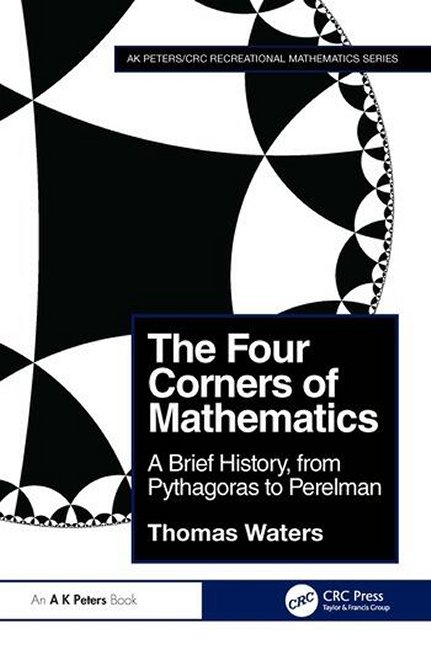
The Four Corners of Mathematics – Thomas Waters

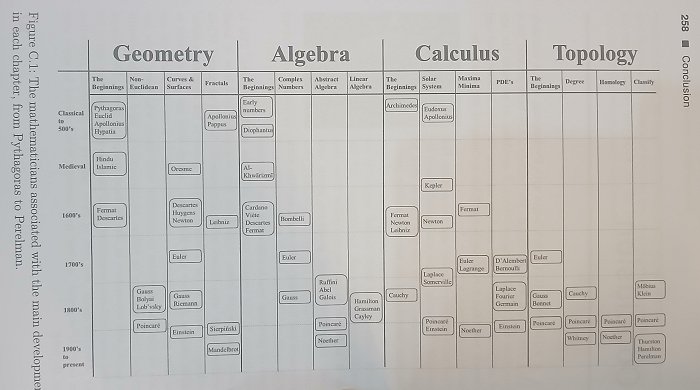
My second book from A K Peters recreational mathematics series is unlike any other maths book I’ve read as it attempts to explain mathematical development in a historical context. Now mathematics goes back over multiple millennia and is so diverse a topic that a comprehensive historical treatise would be impossible so Waters instead looks at four distinct topics and tries to show how they developed over the centuries, these four being Geometry, Algebra, Calculus and Topology. The examples used are considerably more advanced than the first book I read and reviewed from this series, Jun Mitani’s ‘Everyday Life is Full of Math‘, this time you need at the very least A-level standard maths and probably first year undergraduate to really follow what is being explained, now I did physics rather than maths at university and A-level maths, at least for me, was over forty years ago so I confess to struggling in places but it was a great mental workout as I tried desperately to remember basic calculus during the hot weeks of this summer. The way the book is split up into roughly sixty page sections on each of the four topics is neatly summarised by this chart at the end of the book.

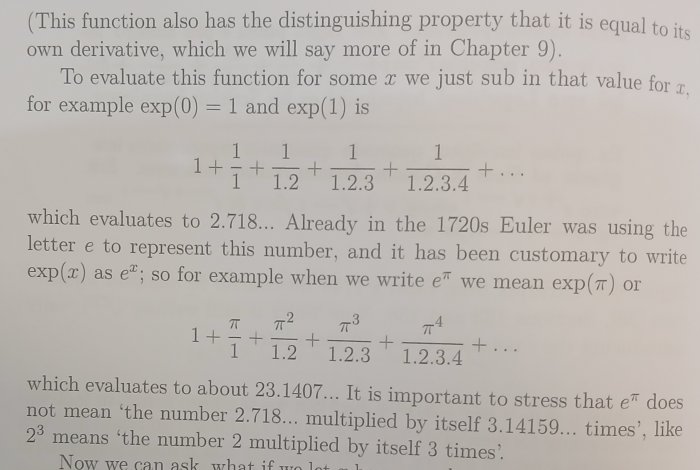
The great genius that is Swiss Leonhard Euler and French Polymath Henri Poincaré are the only people to be sufficiently significant and wide ranging in interests to appear in all four subjects and mentioning Euler here is an example of his work in the section on complex numbers, part of the chapters on algebra, although e isn’t a complex number it is logical to be here as part of the discussion on possibly the most famous and beautiful equation in mathematics which combines e, i, π, 0 and 1.

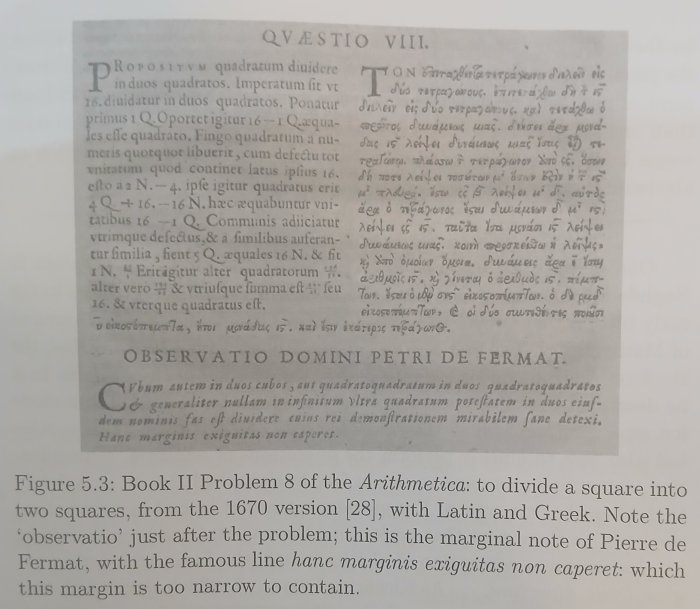
One of the features of the book which I particularly like is the inclusion of famous parts of mathematics in their original form, so we get an extract from Riemann’ Uber die Hypothesen in the original German and the opening page of Liebniz’s classic on calculus Nova Methodus from 1684 in Latin as almost all scientific papers were at the time, Along with possibly the most famous throwaway line in all of mathematics Fermat’s last theorem where Pierre de Fermat claimed to have found a proof that although there are lots of solutions where the sum of the squares of two whole numbers equals another whole number squared there are no examples where the power is greater than two and that he couldn’t write this proof down because the margin he was writing in was too small. Something that was not finally proved for several centuries and utilising mathematical techniques that were not available to Fermat so nobody to this day knows what proof he was referring to.

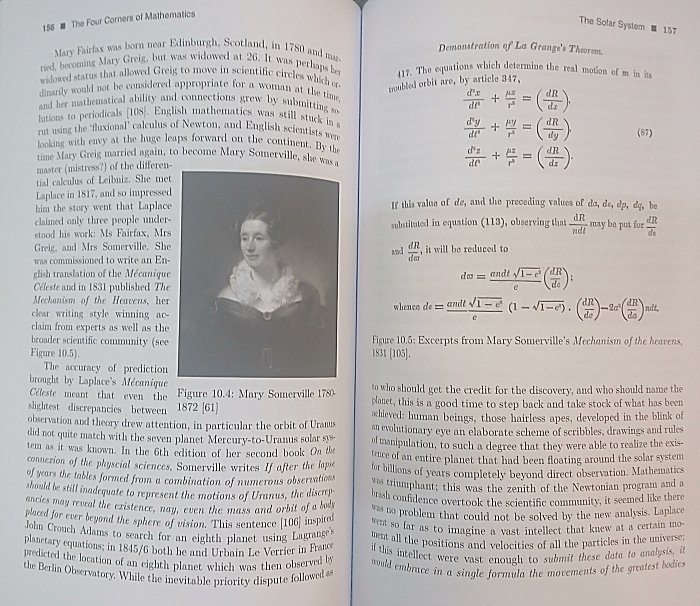
Interestingly the only mathematicians in the entire book to have their portraits included are female, in an attempt to at least partly redress millennia of male control over who could do research or publish papers and not be ‘pushed’ into the background or have their work misrepresented as somebody else’s (i.e. a male). A small number of female mathematicians have managed to be acknowledged in the past, and those are celebrated here along with several of the ones who didn’t get their due recognition at the time. Academia is fortunately not so male dominated nowadays but it is nowhere near 50/50 representation. One of the mathematicians so featured is Mary Somerville and specifically her work in translating the ‘The Mechanism of the Heavens’ by French mathematician Pierre-Simon Laplace in 1831.

Somerville did get recognition in her lifetime and posthumously gave her name to Somerville College, part of Oxford University, which was founded as a women’s college.

The book can be obtained from the Routledge website and is well worth reading, the historical development is fascinating and, for me at least, a novel way of approaching the subject. The maths, although tricky in places, especially after four decades of not doing some of it, is definitely understandable and frankly you need the examples given in order to follow the way the subject has evolved over the years. Thomas Waters is Associate Head in Mathematics in the School of Mathematics and Physics at the University of Portsmouth and this is his first book.

Carnival – Compton Mackenzie

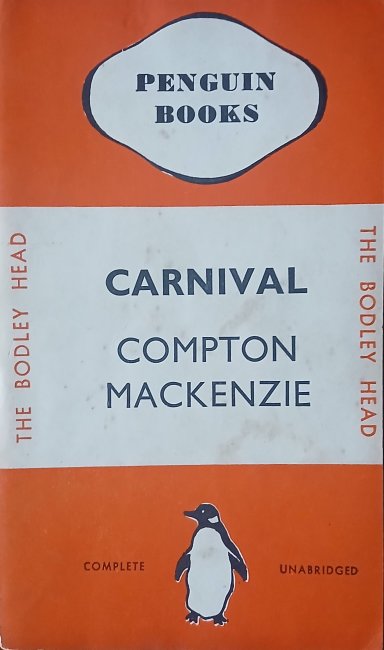
I finally reach the last of the ten books published by Penguin Books in July 1935 and we are back to authors I have heard of, although in this case have never read. Sir Edward Montague Compton Mackenzie to give him his full name is probably best known for ‘Whiskey Galore!’ a tale of a shipwreck in the Scottish islands but the ship is carrying fifty thousand cases of whiskey and the islanders are determined to hang onto as much of their surprise windfall as possible, the book was written in 1947 and turned into a film in 1948 and is great fun. He also wrote ‘The Monarch of the Glen’ which became the basis for a long running TV series between 2000 and 2005. Both of these, and indeed quite a lot of his output, are set in his beloved Scotland but this, his first stand-alone novel, written in 1912 is based mainly in London and tells the story of a rising ballet dancer who goes by the stage name of Jenny Pearl. Mackenzie was familiar with the stage as he came from a line of actors and theatre managers a lot of whom used the name Compton as their stage names.

Unusually the book starts with the birth of Jenny Pearl Raeburn in Islington and we follow her through childhood as she discovers a love of dance from around the age of two dancing by a barrel organ being operated at the end of her street. She continues to dance at every opportunity until one of the lodgers in her house, the family wasn’t well off by any means, suggested that she would benefit from formal training and knows just the school from his own days on the stage. So Jenny starts learning and we see her moving up through the various skill levels until, after a few years, she is deemed capable to go on tour with some older girls from the school and she has her first taste of independence from the family home.

I really enjoyed the ‘whole life’ telling of Jenny’s story, you get the highs and the lows, the tedium of the schooling and the first paid job, first boyfriend and the standoffish way she treats most of the men who hang around the stage door looking for pretty girls to take out. You really feel that you know her and the trials and tribulations she has with her family especially her parents as her father descends further into alcoholism and her mother gets more concerned regarding how Jenny presents herself in public. By part way through the book and as it is very well written, especially for a first novel you can get immersed in the story and the various friends she makes some of which turn out to be far less good for her than others. I’m not going to give away any part of the plot but simply say that this is a book that is well worth seeking out and 114 years after it first came out it’s still in print which is more than can be said for several others in this group of ten books

The book has been made into films three times, an American silent movie ‘The Ballet Girl’ from 1916, now believed lost as no archived copies appear to exist, then in 1931 came the first British adaptation ‘Dance Pretty Lady‘ starring Ann Casson and finally in 1946 came ‘Carnival‘ starring Sally Gray. This last one, despite retaining the novel’s original title, made several changes to the plot, especially the ending which is a lot happier than the one in the novel.

I’ve greatly enjoyed reading these first books from Penguin, with Susan Ertz and E.H. Young being delightful surprises as I’d never heard of either of these two ladies before tackling their books. As ninety year old paperbacks, and so never expected to still be around for more than a handful of years, these are all remarkable survivors and I’m definitely going to dip into more from the early days of Penguin. The reviews for all ten can be found here:

  1. Ariel – André Maurois
  2. A Farewell to Arms – Ernest Hemingway
  3. Poet’s Pub – Eric Linklater
  4. Madame Claire – Susan Ertz
  5. The Unpleasantness in The Bellona Club – Dorothy L Sayers
  6. The Mysterious Affair at Styles – Agatha Christie
  7. Twehty-Five – Beverley Nichols
  8. William E H Young
  9. Gone to Earth – Mary Webb
  10. Carnival – Compton MacKenzie

The Martian – Andy Weir

I’m stranded on Mars.
I have no way to communicate with Earth.
If the Oxygenator breaks down, I’ll suffocate.
If the Water Reclaimer breaks down, I’ll die of thirst.
If the Habitat breaches, I’ll just kind of explode.
If none of those things happen, I’ll eventually run out of food and starve to death.
I’m screwed

The above quote is from the rear cover of the book and it sets the premise of the story so well that I knew I was going to enjoy it. Yes I know the film starring Matt Damon came out in 2015, but I’ve never seen it. This is also my first time reading an Andy Weir book and with the release of smash hit film Project Hail Mary earlier this year he is difficult to avoid at the moment, so I thought I would go back to the beginning and his first novel. There are one or two scientific errors (see spoiler alert at the end of this blog) but it appears to be largely accurate, I’m not a space expert by any means so I could largely ignore the plot devices I knew wouldn’t work as the plot is so well told, and what I did know would work is properly explained. It is also very funny, which I wasn’t expecting.We start with Mark Watney realising he is alone on Mars as the rest of the crew of Earth’s third manned mission to Mars have taken off without him during an emergency evacuation of the planet as they believed he was dead in a sandstorm that had potential to destroy both their habitat and also the craft ready to take them back to orbit. They did attempt to find his body but couldn’t see anything due to the sand and had to give up as the lander was starting to lean to an degree that would have prevented take off. Watney however was injured by a flying radio antenna which pierced his spacesuit and took out his communication to the Mars Ascent Vehicle which was why they saw no vital signs from him.

The style of the novel is interesting as we don’t follow Watney in real time as he does things but in retrospect as he writes up his log, so when things go wrong the first clue is often a gap in the date at the start of the next log entry. My first impression whilst reading was that was going to be the entire structure because after all who else can he talk to, the habitat radio equipment was destroyed in the storm. But on page forty nine I finally got a chapter which wasn’t Watney’s monologue, entertaining as that was. and it was somebody on Earth realising that Watney was alive. Mindy Park had looked at satellite images of the Ares 3 landing site and spotted that the pop up tents were deployed and the rovers weren’t where they should be, that then lifted the story to two parallel tales, the day to day survival of Mark Watney and the NASA conversations as to what they could do to help, which frankly initially at least, looked like very little.

The story develops at Watney solves one problem after another, often whilst inadvertently causing another. He was originally picked as the mission botanist, but as that would have involved little work other than experiments in growing a small number of plants to see how they would cope he was also trained as the maintenance engineer, both skills that would be vital for his survival. He quickly realised that if he could wait it out until the next mission was due then he had insufficient calories to keep him going, so planting food would be essential. But Martian soil didn’t have the nutrients or bacteria needed to successfully grow anything so he needed to solve that, he also didn’t have enough water for crops as well as himself so that needed to be fixed somehow. Weir had obviously done a considerable amount of research around the various issues and how to get round them with the resources Watney would reasonably have to hand helped of course by the fact it was supposed to be a six person mission on the surface for a month and five of them had left after just six days leaving a lot of food and water to keep Watney going for months whilst he figured out how to create more starting with the handful of potatoes he had.

It’s really well written and an entertaining read and now I’m tempted to watch the film and definitely read more by Andy Weir.

Spoiler alert – do not read beyond here if you haven’t read the book or seen the film

.

.

.

.

.

  • The massive dust storm that forces the crew to abandon Mars leaving Watney behind could happen but wouldn’t have the life threatening implications given in the story, the Martian atmosphere is too rarefied to cause that sort of damage to equipment, especially something as heavy as the launch craft or the Habitat and wouldn’t blow an antenna across to Watney with so much force as to penetrate his spacesuit and almost kill him. But I know why it is written that way as Weir needed a plot device to plausibly abandon Watney. The sandstorm later on in the book, which causes him to make a massive diversion, is a far more accurate depiction in that several days after entering it he still hasn’t realised anything is wrong.
  • What would kill Watney however, and well before a rescue could get there, would be cosmic radiation, there is simply no way he would survive that long especially with the number of EVA’s he performs.

With those caveats, and I believe there are more issues with the film which aren’t in the book but which presumably were changed to make it more dramatic, in the book the science is pretty good especially the chemistry and the botanical solution for growing potatoes.