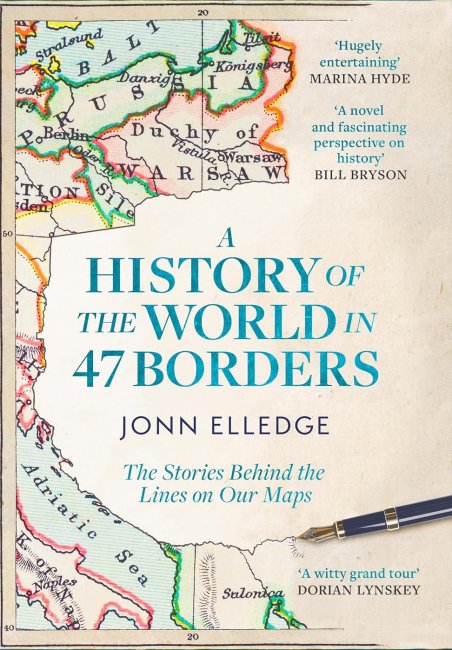
I should admit up front that the very title of this book is misleading. It contains 47 chapters – but some are concerned with multiple borders
Elledge’s introduction does include the above admission, however that only applies to the hardback, this is the paperback which has 48 chapters as there is an extra bonus one concerning Poland in this version.That it should count chapters not borders is immediately clear as many of the chapters deal with multiple borders although usually in the same geographical vicinity. In fact the subtitle “The stories Behind the Lines on Our Maps” is probably better as I would argue that the chapters concerning The Prime Meridian, The International Date Line and time zones do not deal with national, state or even county borders, but do cover lines on maps which can be very different things. As somebody who loves history and geography I knew I was in for a treat with this book and I definitely wasn’t disappointed.
Each chapter is effectively a stand alone essay of around 2,500 to 3,000 words with twenty three maps where they are needed to clarify the points made,. This makes the book easier to read and digest than might be expected from a roughly 360 page factual volume (excluding index) as you can pick it up, read a couple of chapters, and then put it back down again having gained some insight into what caused a particular group of borders to coalesce where they currently are, or were when dealing with historical examples. The first twenty two chapters are grouped as ‘Histories’ and these cover such diverse subjects as the probable boundaries of Upper and Lower Egypt, The Roman Empire, Charlemagne’s short lived empire, how borders were created in Africa by white men who never went there, right up to the partition of Ireland and the Berlin wall in the twentieth century. Part two, entitled ‘ Legacies’ covers such oddities as the town of Baarle-Hertog and Baarle-Nassau which changes its name depending if you are in the Dutch or the Belgian parts or the Dutch bits in the Belgian bits in The Netherlands, yes it’s a mess, crossing the road can mean changing country and in some cases just walking across a room can do the same. One of my favourite youtubers The Tim Traveller has recently done a video covering the current state of the town but bear in mind it used to be far more confusing. Also in this section is included the far less amusing Israel/Palestine borders, China’s nautical nine-dash line, and bits of Switzerland that aren’t in Switzerland, which turns out to be a less complicated version of Baarle-Hertog and Baarle-Nassau but further south. The book continues with ‘Externalities’ where you will find the time zone and Prime Meridian chapters, but also how Antarctica is split up, how maritime and airborne boundaries are determined, Eurovision, and other oddities that didn’t really fit in the first two categories.
Elledge manages to inject a little humour in his writing where appropriate, it really isn’t when discussing Israel’s borders, or the partition of India, so he writes those in as deadpan factual a manner as possible, but the general lightness of touch especially when discussing downright odd accidents of history was much appreciated when reading the book and yes it is very readable. I was particularly amused reading about the multiple accidental invasions of Lichtenstein by its neighbour Switzerland as troops and more worryingly artillery crosses the border with surprising frequency. You can also make use of the further reading suggestions, which every chapter has and which usually includes the books cited in most chapters as source material, it really is very well researched and documented and if you want to know more then you are given suggestions as to where to look. As implied in the few examples I have given in this blog the breadth of issues covered is impressive but I’m equally certain there is more than enough material to produce a second volume is Elledge wanted to and I for one would be front of the queue to buy a copy.
Meanwhile I’m off to stake my claim to Bir Tawil, the bit of Africa nobody wants, see you next week.


Thanks for your review – I was intrigued. I’ve just received my copy via Oxfam books online and it’s my next read after I finish Tomas Nevinson by Javier Marias. Immediately before that, it was a struggle to the finishing of Thomas Mann’s The Magic Mountain. I’m really looking forward to starting something I can dip in and out of!
LikeLike
Ah yes The Magic Mountain, I first read that about 20 years ago and keep looking at my copy to decide if I want to tackle it again for a review as I remember it being tough going but good. It might appear sometime next year.
LikeLiked by 1 person