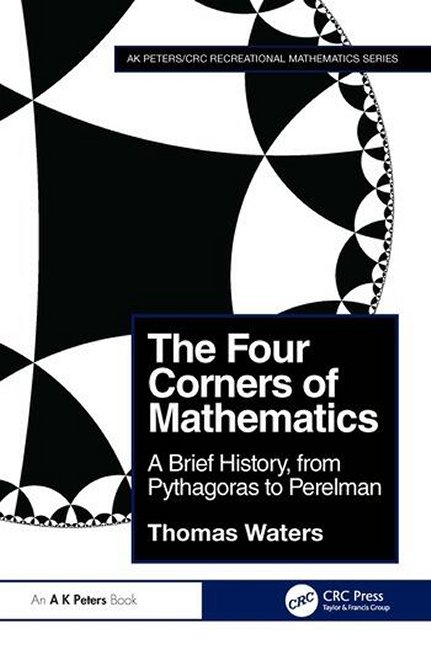
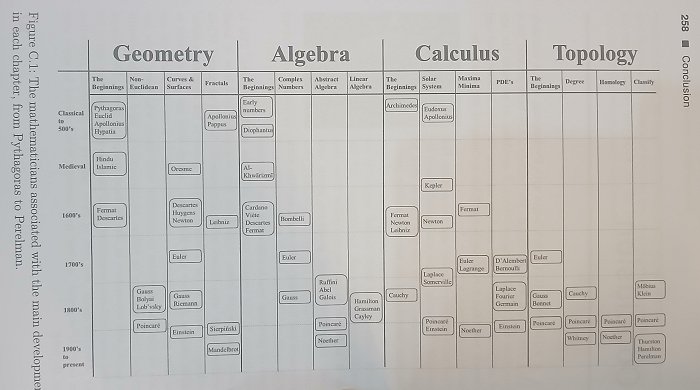
My second book from A K Peters recreational mathematics series is unlike any other maths book I’ve read as it attempts to explain mathematical development in a historical context. Now mathematics goes back over multiple millennia and is so diverse a topic that a comprehensive historical treatise would be impossible so Waters instead looks at four distinct topics and tries to show how they developed over the centuries, these four being Geometry, Algebra, Calculus and Topology. The examples used are considerably more advanced than the first book I read and reviewed from this series, Jun Mitani’s ‘Everyday Life is Full of Math‘, this time you need at the very least A-level standard maths and probably first year undergraduate to really follow what is being explained, now I did physics rather than maths at university and A-level maths, at least for me, was over forty years ago so I confess to struggling in places but it was a great mental workout as I tried desperately to remember basic calculus during the hot weeks of this summer. The way the book is split up into roughly sixty page sections on each of the four topics is neatly summarised by this chart at the end of the book.
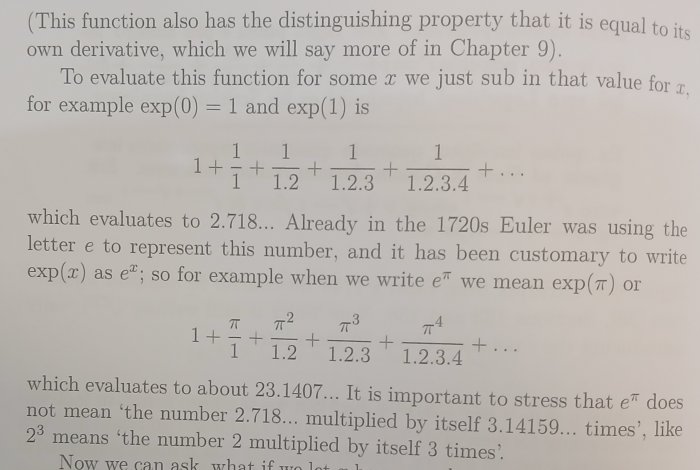
The great genius that is Swiss Leonhard Euler and French Polymath Henri Poincaré are the only people to be sufficiently significant and wide ranging in interests to appear in all four subjects and mentioning Euler here is an example of his work in the section on complex numbers, part of the chapters on algebra, although e isn’t a complex number it is logical to be here as part of the discussion on possibly the most famous and beautiful equation in mathematics which combines e, i, π, 0 and 1.
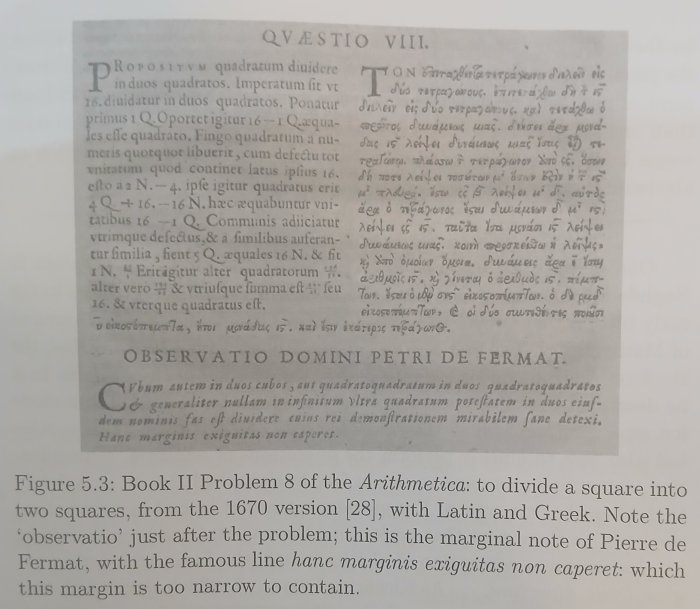
One of the features of the book which I particularly like is the inclusion of famous parts of mathematics in their original form, so we get an extract from Riemann’ Uber die Hypothesen in the original German and the opening page of Liebniz’s classic on calculus Nova Methodus from 1684 in Latin as almost all scientific papers were at the time, Along with possibly the most famous throwaway line in all of mathematics Fermat’s last theorem where Pierre de Fermat claimed to have found a proof that although there are lots of solutions where the sum of the squares of two whole numbers equals another whole number squared there are no examples where the power is greater than two and that he couldn’t write this proof down because the margin he was writing in was too small. Something that was not finally proved for several centuries and utilising mathematical techniques that were not available to Fermat so nobody to this day knows what proof he was referring to.
Interestingly the only mathematicians in the entire book to have their portraits included are female, in an attempt to at least partly redress millennia of male control over who could do research or publish papers and not be ‘pushed’ into the background or have their work misrepresented as somebody else’s (i.e. a male). A small number of female mathematicians have managed to be acknowledged in the past, and those are celebrated here along with several of the ones who didn’t get their due recognition at the time. Academia is fortunately not so male dominated nowadays but it is nowhere near 50/50 representation. One of the mathematicians so featured is Mary Somerville and specifically her work in translating the ‘The Mechanism of the Heavens’ by French mathematician Pierre-Simon Laplace in 1831.
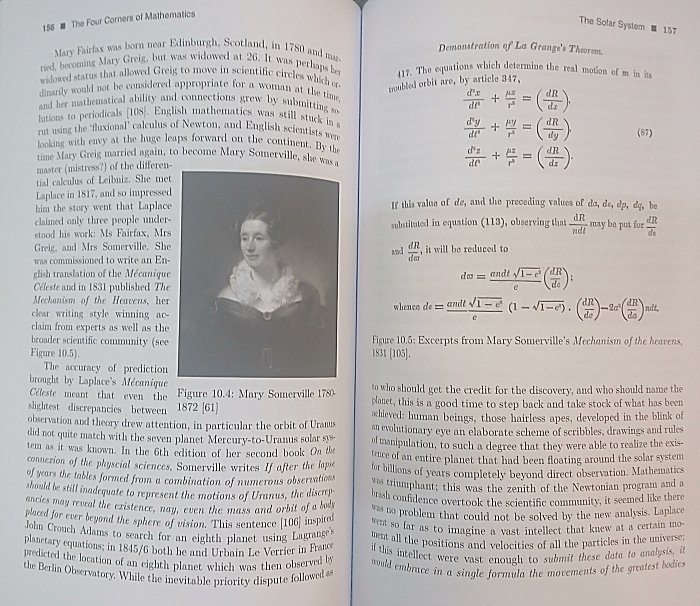
Somerville did get recognition in her lifetime and posthumously gave her name to Somerville College, part of Oxford University, which was founded as a women’s college.
The book can be obtained from the Routledge website and is well worth reading, the historical development is fascinating and, for me at least, a novel way of approaching the subject. The maths, although tricky in places, especially after four decades of not doing some of it, is definitely understandable and frankly you need the examples given in order to follow the way the subject has evolved over the years. Thomas Waters is Associate Head in Mathematics in the School of Mathematics and Physics at the University of Portsmouth and this is his first book.

