This book consists of a collection of letters from van Gogh, mainly to his brother Theo, although there are other correspondents. I was at once struck by how van Gogh writes as he paints, with descriptions of people and landscapes as though he was actively setting them down on paper or canvas. Take for example a letter from November 1885 written in Antwerp, where he had recently moved and he is trying to get a feel for the surroundings that are so different from the countryside he has just left.
… with the city behind one at the end of the landing stages where the Harwich and Havre steamers lie, there is nothing, absolutely nothing to be seen in front except for an infinite expanse of flat, half flooded pasture, immensely melancholy and wet, with undulating dry reeds and mud – the river with a single small black boat, water in the foreground grey, sky misty and cold grey – still as the desert.
As to the overall impression of the harbour, or of one of the docks – at one moment it is more tangled and fantastic that a thorn hedge, so chaotic that one finds no rest for the eye, grows giddy, and is forced by the papillot-ering colours and lines, to look first here, and there, unable to distinguish one thing from another – even after looking at the same point for a long time. but if one moves on to a certain spot with an undefined stretch of land in the foreground, then one again encounters the most beautiful, most peaceful lines and those effect which Mols, for instance, so often achieves.
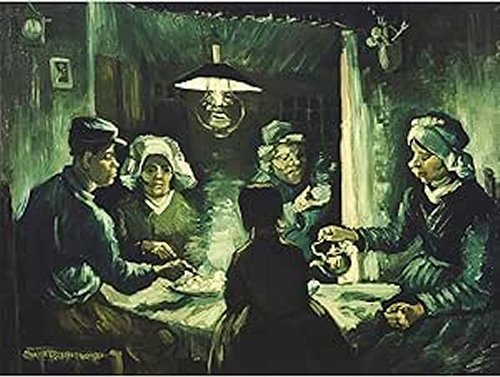
The artist Mols referred to above is either Florent or Robert Mols, probably Robert as his works seem to fit the description better. This extract is from the happier early times whilst van Gogh was still learning his trade and numerous letters describe studies he is making of the peasants around his countryside home and the only significant painting he describes working on is ‘The Potato Eaters’ shown below. Note the book doesn’t contain any images but I found it helpful to refer to his pictures when reading the letters that describe them.
I think the best way to review the book is to use van Gogh’s own words as I so enjoyed the letters that I’m amazed that I hadn’t come across them before. The book is an excellent replacement for the autobiography he never wrote, and would never have regarded himself as an appropriate subject for, as you get the see how he is thinking and reacting to his surroundings and ever present money troubles as paint and canvases are so expensive especially when he isn’t successfully selling any of his works. After the first section ‘Becoming an artist’ we move on to ‘The best days’ when he is at his most productive and he describes furnishing his home and hanging a series of paintings of sunflowers there, these were simply decoration to the house but now of course are some of his most valuable works. But the painting from this period I want to highlight is described below.
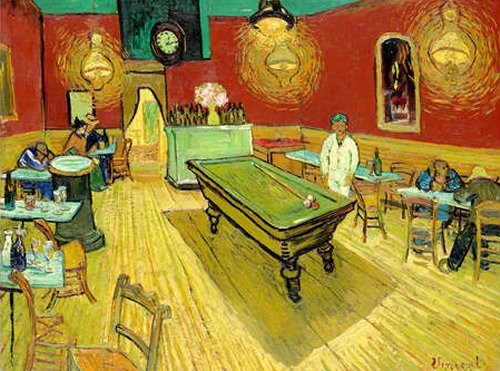
In my picture of The Night Cafe, I have tried to express the idea that the cafe is a place where one can destroy oneself, go mad or commit a crime. In short I have tried, by contrasting soft pink with blood-red and wine-red, soft Louis XV green and Veronese green with yellow-greens and harsh blue-greens all this in an atmosphere of an infernal furnace in pale sulphur, to express the powers of darkness in a common tavern. And yet under an outward show of Japanese gaiety and Tartarin’s good nature.
But what would Mr Tersteeg say about this picture, a man, who faced with a Sisley, Sisley mind you, the most unassuming and sensitive of the impressionists said “I can’t help thinking that the artist who painted this was a little tipsy”. Faced with my picture he’d say it was a raging case of delerium tremens.
The picture he is describing so wonderfully, I love that last line, is ‘Night Cafe in Arles’ and wow has he leapt forward with his use of colour. With ‘The Potato Eaters’ he describes that it should be hung with a gold background to lift the darkness of the image but here you would need a more subdued wall colour to get the best result. In contrast Alfred Sisley is positively restrained.
The final section of the book is entitled ‘Towards the end’ and begins after van Gogh had threatened his friend Gauguin with a razor and was found the next day having severed one of his own earlobes, clearly the mental issues that would result in his suicide are starting to make themselves apparent. Gauguin sensibly left van Gogh’s house in Arles soon afterwards but this left van Gogh on a downward spiral and considering either entering an asylum or joining the Foreign Legion. The former would cost him money, which he didn’t have, whilst at least he would earn something in the army, unfortunately whilst in hospital recovering from his injury his house and studio was ruined in a flood so he would have to move at the very least. It turns out that he did move but to an asylum at his brothers expense and here he starts to understand his mental condition through contact with the other inmates and he still paints as explained in this letter to Theo dated September 1889
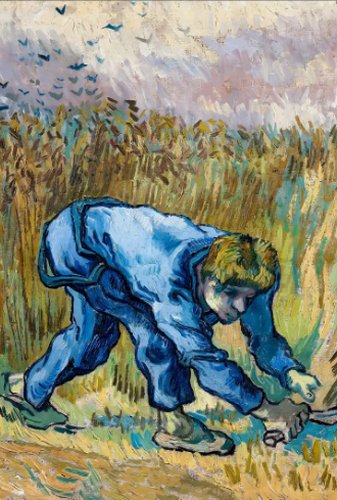
Aha! The Reaper is finished. I think it’ll be one of those you’ll keep at home – it’s an image of death as the great book of nature speaks of it – but the effect I’ve been looking for is – ‘on the point of smiling’. It’s all yellow except for a line of purple hills. A pale and golden yellow. I find it odd that I saw it like that through the iron bars of a cell.
The Reaper painted in the asylum in 1889, just ten months later he was dead


Your review was an interesting read – so much is revealed in his letters, and it’s fascinating to note his comments on colour and form. Many years ago I went to an exhibition of his paintings which also exhibited some of his original letters, particularly those to Theo which were very poignant. I’m glad you found the letters insightful too.
LikeLike