I’ve just returned from a week long holiday in Belgium and looking around on my shelves for something to read whilst there I decided on the most famous fictional Belgian of all, Hercule Poirot. Oddly despite loving detective fiction I’ve never read much Christie before starting this blog and this book is one that was new to me, but I chose it on the basis that a crime mystery is always good holiday reading and so it proved. The mystery concerns a flight from Le Bourget which at the time was the airport for Paris to Croydon which was its London equivalent, this being the days before Charles de Gaulle airport in Paris and Heathrow for London. Planes back in 1935 were also much smaller and slower but considerably more luxurious for all passengers than is the case today. Poirot (seat 9) is one of the passengers in the rear compartment, which was then the better section, this had eighteen passenger seats and on this flight only eleven were occupied one of which would be for the victim (seat 2) and one the murderer (seat ?, oh I’m not going to tell you that). The plot is carefully written with plenty of clues but not until Poirot unmasks the killer and their method from page 216 of 223 did I see who it was although it obviously had to be a passenger, or possibly one of the two stewards.
On the way to the solution Christie has a little fun with her profession as one of the passengers is Daniel Clancy, described as a well known mystery writer but she is clearly sending up the art of writing crime thrillers as Clancy is depicted just totally obsessed with his next novel that he fails to notice what is going on around him. He is also picked on by Inspector Japp as an obvious suspect although it is Poirot who arises the suspicion of the inquest jury as the murder weapon is found jammed down the back of his seat on the plane. So we not only have a mystery writer as a character but also the most famous of Christie’s detectives as prime suspects. The book was first published in 1935 so five years after Christie had married Max Mallowan, the noted archaeologist who specialised in the near East, and who should be occupying seats seats five and six but a father and son who are archaeologists whose primary interest were Persian artefacts. Christie also has fun with references to dull pottery fragments and digs in out of the way places and these two are also obsessed with their finds to a point of not noticing what is going on around them other than the son, Jean Dupont, killing a wasp that was flying around them which turns out to be significant.
The plot revolves around the victim, Madame Giselle, who has made a fortune lending money to wealthy but temporarily short of cash individuals and carefully holding information regarding them that would be damaging if released to ensure the repayments. More than one passenger has the potential to be one of Giselle’s clients and therefore has a motive and investigating this leads Poirot hopping between London and Paris working with both Scotland Yard and the Sûreté whilst following up leads. It was interesting to have Poirot dashing from one place to another rather than using his ‘little grey cells’ during quiet contemplation of the facts. It made a great read and needless to say it didn’t last the anticipated week as I needed to know what was going on so putting the book down became increasingly difficult.
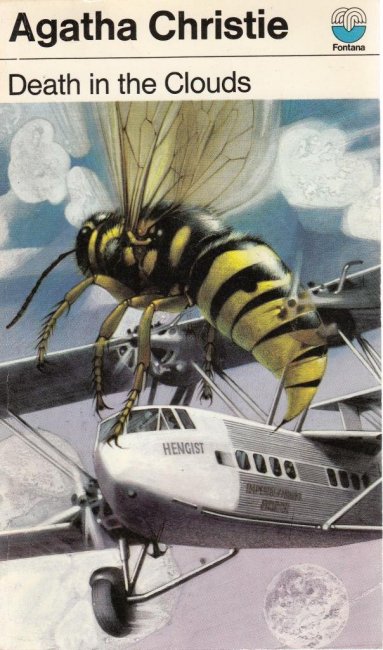
A little bit about this well known cover, by artist Tom Adams, which stayed on the Fontana edition here in the UK for many years from June 1969 and was instantly recognisable from its ubiquity on bookshop shelves. It was clearly the inspiration for the 2008 Doctor Who episode ‘The Unicorn and the Wasp’ where the Doctor meets Agatha Christie at a house party and the various guests are attacked by a giant wasp which is how it looks in the cover art. Because I hadn’t read the book before, although it’s been sitting on my shelves for many years, I hadn’t previously noticed the glaring error on the cover where the name painted on the fuselage of the plane is Hengist but the aircraft in the book is called Prometheus.


I do love it when she has fun with writers, like Ariadne Oliver! Lovely fact about Paris and Croydon, thank you!
LikeLike