Mr Mulliner stories – P G Wodehouse

Everyone has heard of the Jeeves and Wooster stories by PG Wodehouse and many know his tales set at Blandings Castle, less well known are the ones relating to Mr Mulliner’s numerous relatives as recounted by Mr Mulliner himself in the bar-parlour of The Anglers Rest. Altogether there are three books of short stories and whilst I was originally planning on just dealing with the first one ‘Meet Mr Mulliner’ once started I ended up reading all three one after another so it only feels right to deal with them all in one blog. Each story starts in the bar with various customers present all of whom, apart from Mr Mulliner, are unnamed and are simply referred to by what they are drinking, as for example this passage immediately before Mr Mulliner first interrupts the conversation from ‘The Reverent Wooing of Archibald’ which is the first story in ‘Mr Mulliner Speaking’

“I can remember the days,” said the Gin-and-Ginger-Ale, “when every other girl you met stood about six feet two in her dancing-shoes, and had as many curves as a Scenic Railway. Now they are all five foot nothing and you can’t see them sideways. Why is this?”
The Draught Stout shook his head.
“Nobody can say. It’s the same with dogs. One moment the world is full of pugs as far as the eye can reach; the next, not a pug in sight, only Pekes and Alsatians. Odd!”
The Small Bass and the Double-Whisky-and-Splash admitted that these things were very mysterious, and supposed we should never know the reason for them. Probably we were not meant to know.

This story is one of my favourites of the twenty seven featuring Mr Mulliner spread over the three volumes, Archibald is one of his nephews and he is in awe of a young woman called Aurelia Cammarleigh whom he is terrified to ask out, he is also far from bright in fact he is described in typical Wodebouseian dead pan prose as follows:

Even at the Drones Club, where the average intellect is not high, it was often said of Archibald that, had his brain been constructed of silk, he would have been hard put to it to find sufficient material to make a canary a pair of cami-knickers.
This inclusion of The Drones Club, which also includes Bertie Wooster as one of its members, beautifully ties this group of books to others from PG Wodehouse and adds some familiarity for the reader. The Wooster books started with ‘The Inimitable Jeeves’ in 1923 although there were some short stories before then, whilst Mr Mulliner first appeared in 1927 with the other two volumes being 1929 and 1933 respectively. Like most of Wodehouse’s books they are set in an indefinable period, one that had certainly vanished by the 1930’s, if indeed it had ever truly existed, with large houses hosting guests for weekends or even weeks at a time and young women whose main preoccupation appears to be the finding of a suitable, i.e. rich, husband, with the males trying for the most part to avoid them. Stories of that type certainly do appear in the Mulliner books, such as Archibald, but for the most part Mr Mulliner’s relatives do actually do some sort of work although they often have sufficient funds to exist without it.

Another great story concerns a property called Honeysuckle Cottage which is inherited, on the death of his aunt, by a distant cousin of Mr Mulliner, James. Now James is a writer of hard boiled detective stories and his aunt wrote what is described as ‘Squashily Sentimental’ tales so they never really got on. However he gained the house in her will and when he arrived he found that it was imbued with the spirit of the stories she wrote, so that things happened as if he was living in an unbearable romantic stor. It even threatened to disturb his books, with him introducing a girlfriend for his normally disinterested detective. The slow takeover of James by the aura of the house is hysterical as he is aware it is happening but powerless to resist until finally… Well that would be telling, Honeysuckle Cottage is the last story in ‘Meet Mr Mulliner’.
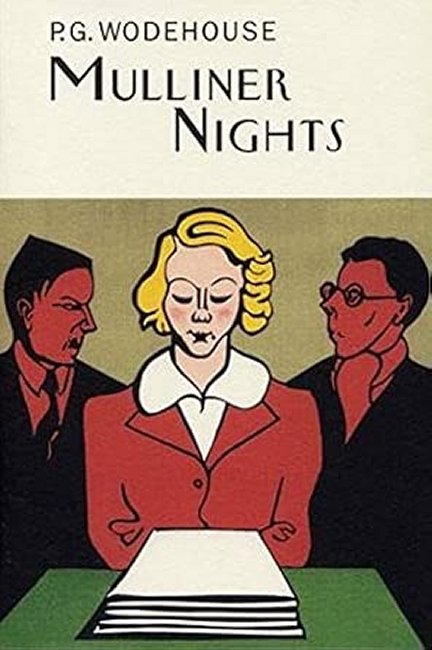
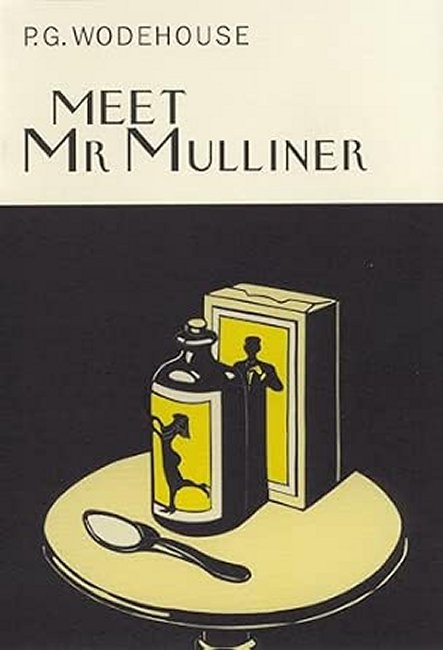
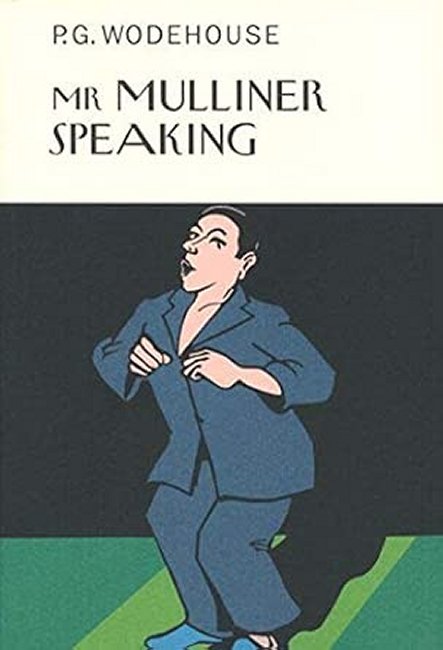
These three books are from the excellent Everyman’s Library series which collects for the first time all of Wodehouse’s novels and short stories in one uniform edition comprising of ninety nine beautifully presented volumes.I shall probably eventually get almost all of them, with the exception of the twenty one titles which I already have that were published by the Folio Society.

If you are intrigued as to what it is Mr Mulliner is drinking as he isn’t referred to by his drink of choice but by name. His favourite tipple is a hot scotch and lemon, a drink which I for one would go a long way to avoid unless as a cure for a cold, and that only on the basis that it may not cure the cold but it will help towards you forgetting about it. It’s been great fun exploring another set of stories by Wodehouse only one of which I had read before. It occurs to me that the setting of all the stories in the form of tales in a bar by the noted raconteur and regular Mr Mulliner possibly inspired Arthur C Clarke to write his ‘Tales from The White Hart’ in 1957 which I have touched on before in a blog from eight years ago ‘Fables From The Fountain‘.
Murder by the Book – Martin Edwards (ed)

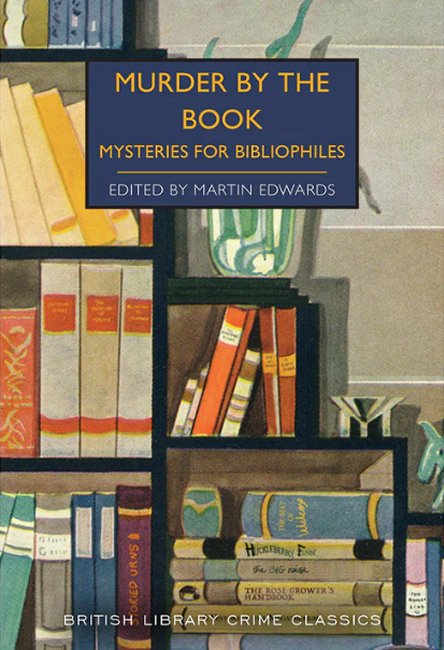
Part of the excellent British Library Crime Classics series, a collection of reprints of crime books originally published from the late Victorian era to the 1960’s but now long out of print. I love the way that this can introduce modern readers, who don’t have access to collections such as my Penguin library, to forgotten stories or even forgotten authors. The series editor is Martin Edwards and he usually provides a brief introduction to each book introducing the author and any unfamiliar context needed. This book is a great starting point, as it is one of the anthologies of short stories, in this case featuring sixteen authors, some still well known such as Ngaio Marsh, Nicholas Blake and even A A Milne but others probably only familiar to fellow bibliophiles (book collectors). I wrote about Milne’s only detective novel back in August 2018, and that blog also includes one of G D H and Margaret Cole’s crime novels, a husband and wife writing team who produced the first story in this collection, Milne’s own contribution here is interesting as it has a novelist talking with a police Chief Constable and saying that the jobs are similar in that they both have a series of items and need to create a story that includes them all:

I could contrive some sort of story out of any assortment of facts, a spot of candlegrease, a badly sharpened pencil, a canary that wouldn’t sing anymore and a man who went to bed one night in his wooden leg. Even as he said this Coleby began to wonder what the story would be. Better start with the canary…

Not all the stories are tales of murder, some like one of my favourites in this collection, the one by E C Bentley featuring his regular amateur detective Philip Trent is far more of a mystery but has an ingenious solution which is based around a mix of ornamental rock gardens and Lewis Carroll. Not a sentence I ever expected to type. One detective I was sort of expecting to find here but didn’t is Lord Peter Wimsey, but thinking about it he is famously a bibliophile but a book is rarely so significant to the plot as to make it into this collection, also Dorothy L Sayers is still a very well known author so is unlikely to feature in a series of books which by their nature are reprinting the more neglected writers. A A Milne of course isn’t neglected for his children’s works but sadly his excellent plays and brief forays into detective fiction are nowadays a lot more obscure. Another great read was ‘Malice Domestic’ by Philip MacDonald, I’ve got a few of his books but oddly haven’t featured him before in this blog, this short story is one of the few I can think of where the resolution doesn’t occur until almost the last sentence and it’s a brilliant twist. But on that subject I really have to mention ‘A Man and His Mother in Law’ where it really is the last line where the whole story turns.

This selection of sixteen stories are well worth reading, there were a couple which I didn’t think were as strong as others but that will be true with any group of stories. The British Library Crime Collection is a superb way to explore the less well known byways of crime fiction and I’m a subscriber so I get a new book every month along with a matching bookmark and a piece of ephemera related to the book especially created for subscribers. If you like murder mysteries then I heartily recommend this service.

Winnie-The-Pooh – A A Milne

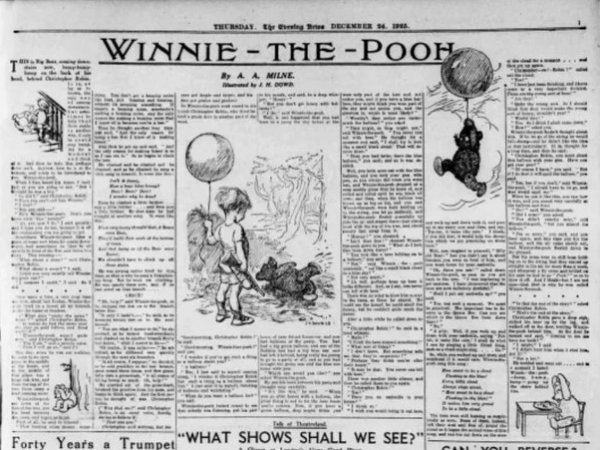
Happy one hundredth birthday Winnie-The-Pooh. The book where Pooh first appeared by name was first published on 14th October 1926 so technically this blog for his centenary is a day early, or it could be nearly ten months late or possibly almost two years late, the clue is in the careful way in which I started this sentence. I’ll explain, yes the book called Winnie-The-Pooh appeared on the date I’ve given but he first featured in the short story The Wrong Sort of Bees published in the newspaper London Evening News on 24 December 1925 and this story became the first chapter of the book when it was published so that is the possibility of this blog being ten months late.

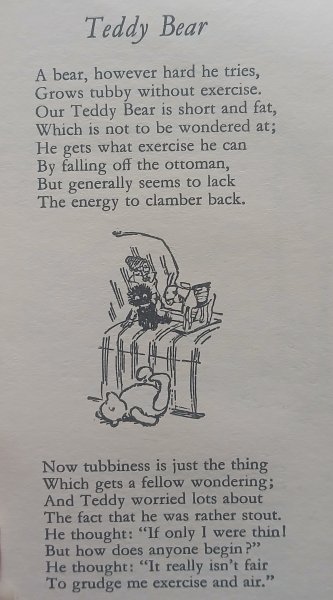
But what about that possible two years late well that is because Winnie-The-Pooh wasn’t A A Milne’s first children’s book, that was ‘When We Were Very Young’ first published on 6th November 1924 and in there (starting on page 85 to be precise) you will find a poem called ‘Teddy Bear’ where the titular character has the name Edward Bear but the illustrations by Ernest Shepard are definitely of the bear we know today as Winnie-The-Pooh. Which is only right as we know that Christopher Robin received his bear for his first birthday on 21st August 1921 and renamed him later. Edward can also be glimpsed at the top of the stairs behind Christoper Robin a few pages earlier in the illustration for ‘Halfway Down’ and indeed in the first sentence of ‘Winnie-The-Pooh’ he is still called Edward Bear.

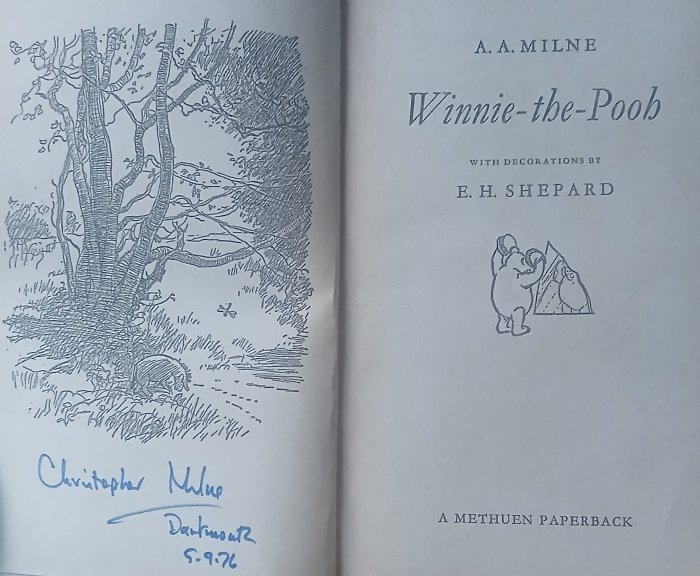
So is Pooh 100 or almost 101 or even almost 102, well the real bear is 105 and looks nothing like the Winnie-The-Pooh we know from the books and even less like the Pooh as portrayed by Disney, so I don’t think it matters very much. Indeed if you want to see what the real Winnie-The-Pooh looks like, four years ago I did a blog about the excellent book by Shirley Harrison which covers ‘The Life and Times of the Real Winnie-The-Pooh‘ and I have several editions of the four books including a set of paperbacks signed by Christopher Robin whilst he was running a bookshop in Dartmouth.

So I’ve settled down and to mark the centenary of the book’s publication and opened it again for the first time for many years only to find I’d forgotten what a great joy it is to read it, as it is written as though A A Milne is telling a story to his son with questions and suggestions coming the other way. The introduction and start of the first chapter explains, as far as is possible, how Christopher Robin came to rename his bear from Edward Bear to Winnie-The-Pooh, Pooh was after a swan that he had named that when he was very young and first going to the park. Winnie however is much more exciting as that was after a real bear called Winnipeg that Christopher Robin had met in London Zoo and regularly went to visit, even being allowed in the cage with her. The ‘The’ part is more difficult as told in the first chapter.

When I first heard his name, I said, just as you are going to say, “But I thought he was a boy?”
“So did I” said Christopher Robin
“Then you can’t call him Winnie?”
“I don’t”
“But you said—-“
“He’s Winnie-ther-Pooh. Don’t you know what ther means?”
“Ah yes, now I do” I said quickly; and I hope you do to, because it’s all the explanation you are going to get.

And so the stories begin and we are introduced to the other characters, beginning with Piglet, then Rabbit and Owl, Eeyore comes a little later and in the last three chapters we get Kanga and baby Roo. One part I had completely forgotten is that when Kanga first appears Rabbit decides to try to get rid of her by kidnapping Roo and making her leave in order to get Roo back. No I haven’t forgotten Tigger as he doesn’t appear in this book, only being introduced in ‘The House at Pooh Corner’ as Christoper Robin had by then been given a cuddly tiger toy and therefore he needed to be included.

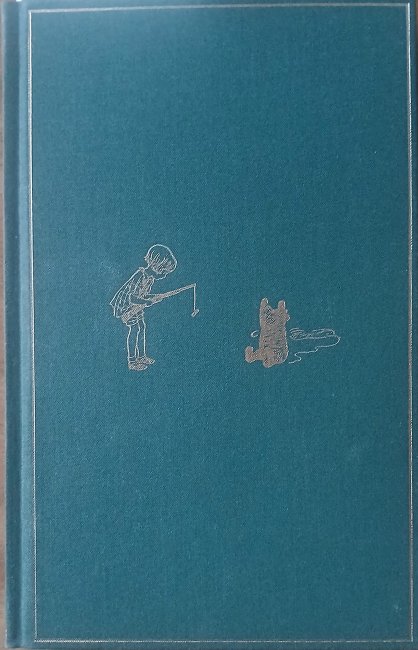
The copy of the book that I’ve read and was featured at the beginning of this blog is from a set of facsimile volumes published by Meuthen in 1999 and sold by The Folio Society. Pleasingly they were printed by Jarrolds, who printed the original first editions.

Colony – Rob Grant

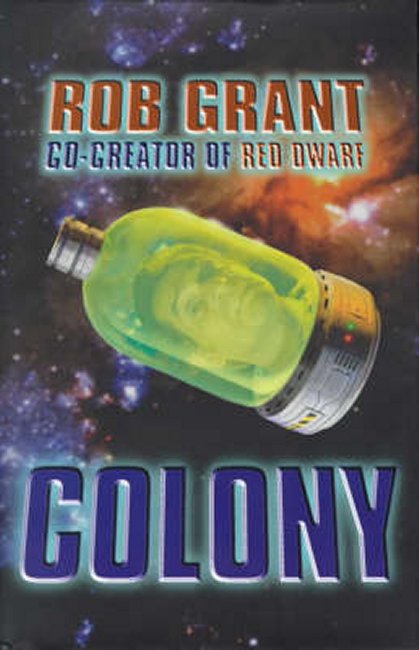
I’ve been going down a bit of a Red Dwarf rabbit hole for a while now, re-watching the various TV series along with various making-of documentaries and other random extras to be found on the DVD sets I have, so looking along the bookshelves to find the next thing to read my eye was caught by Colony. Rob Grant co-wrote the first six series of Red Dwarf with Doug Naylor however by the end of that in 1997 there was what can euphemistically best be described as creative differences between the two writers and their writing partnership was dissolved leaving Naylor to continue Red Dwarf on and off for the next five series and the TV film. Colony is not a Red Dwarf novel but it is set on a spaceship so here we go…

First the similarities to Red Dwarf, it’s set on a huge spaceship which is carrying the last survivors of the human race, OK in the TV series timelines are so messed up that that is one of the possibilities explored rather than as here in the novel it is a central premise. It is set far in the future, three million years in the case of Dwarf, ten generations in this novel and yes things have gone horribly wrong in both cases. So what’s different about the novel? Well lots. The spaceship Willflower is designed as a colony ship to take the best and brightest of the human race away from an Earth dying due to the ravages of climate change. If that sounds like eugenics in action then Grant makes that quite clear with the Nazi like plans for population control and the horror Eddie feels towards these plans as they are made clear to him by the ships’ priest Father Lewis. Each generation will inherit not only the possessions of their parents but also their jobs, ostensibly this is to ensure training from an early age in the job which may be highly complex, such as chief scientist or captain but it also means that those employed in menial roles can never see their descendants aspire to anything better. As Lewis points out the children of those on board working in the ‘Sexual Recreation Centre”i.e. prostitutes would be born into prostitution and Eddie is repelled by the thought.

But back to our hero, Eddie O’Hare, who is he? Well he’s not supposed to be on the ship for a start. He’s an accountant who saw millions of his bosses money just vanish in an inexplicable way on the computer system and was being hunted on Earth by hit men contracted to preferably get back the money but also to definitely kill him, so when he gets the chance to escape onto the ship by swapping places with someone he leaps at it. On board he is to be Charles Perry Gordon and when he gets there he discovers that Gordon is the architect of this abhorrent social system and he’s stuck with justifying it or be found to be an impostor which would lead to “the non-permanent suspension of life” which is the ultimate punishment and turns out to be removal of the brain and spinal column and storing this in suspension, yet another of Gordon’s bright ideas. All this occurs in the present and the book then shifts from Generation I to Generation X where descendants are badly running the ship as described in the precis on the dust wrapper.

The captain is an irresponsible adolescent with a penchant for naming planets after unpleasant bodily functions. The science officer is a religious zealot nutball, who responds to technical problems by singing hymns and whipping herself. And the ship is savagely damaged, out of control and on a deadly collision course with a grotesquely large planet.

It is this section of the book that I really became engrossed in the story, the first third is basically setup for this bit and whilst the early parts are necessary and a good read, Grant really gets into his dark comedy stride with Generation X. Like a good detective story you have been told, almost in an offhand manner, everything you need to know to work out what is really going on and the best bit is that you don’t realise that you need to pick up all this info as it doesn’t feel like a mystery until all of a sudden you get the resolution. I really enjoyed the book and am frankly amazed that the first edition has sat on a shelf here since it came out in 2000 and I’ve only now read it.

Rob Grant sadly died suddenly earlier this year just a week after announcing his next novel, a Red Dwarf prequel, having finally resolved the legal dispute over ownership of Red Dwarf, with Grant and Naylor agreeing to both be able to use the concept in 2023. The book was ultimately completed by Andrew Marshall.