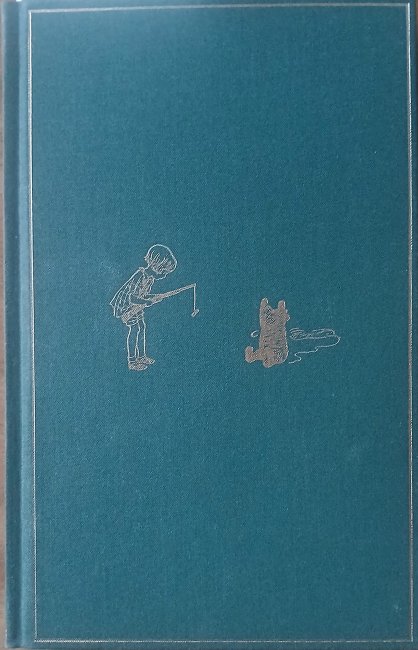
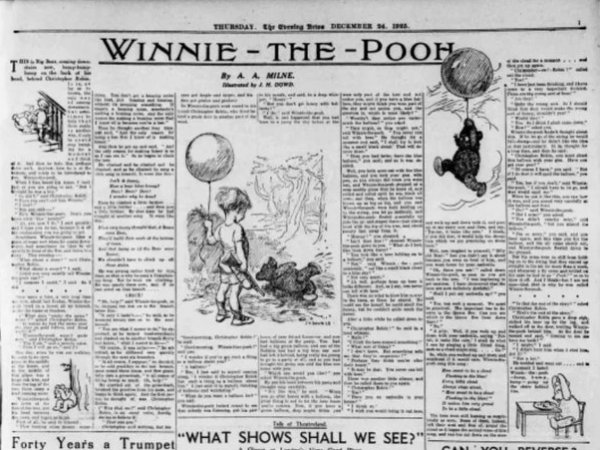
Happy one hundredth birthday Winnie-The-Pooh. The book where Pooh first appeared by name was first published on 14th October 1926 so technically this blog for his centenary is a day early, or it could be nearly ten months late or possibly almost two years late, the clue is in the careful way in which I started this sentence. I’ll explain, yes the book called Winnie-The-Pooh appeared on the date I’ve given but he first featured in the short story The Wrong Sort of Bees published in the newspaper London Evening News on 24 December 1925 and this story became the first chapter of the book when it was published so that is the possibility of this blog being ten months late.
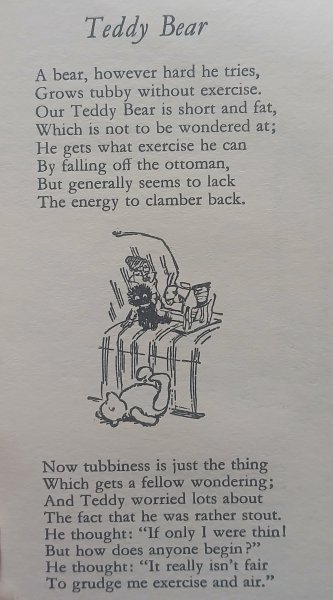
But what about that possible two years late well that is because Winnie-The-Pooh wasn’t A A Milne’s first children’s book, that was ‘When We Were Very Young’ first published on 6th November 1924 and in there (starting on page 85 to be precise) you will find a poem called ‘Teddy Bear’ where the titular character has the name Edward Bear but the illustrations by Ernest Shepard are definitely of the bear we know today as Winnie-The-Pooh. Which is only right as we know that Christopher Robin received his bear for his first birthday on 21st August 1921 and renamed him later. Edward can also be glimpsed at the top of the stairs behind Christoper Robin a few pages earlier in the illustration for ‘Halfway Down’ and indeed in the first sentence of ‘Winnie-The-Pooh’ he is still called Edward Bear.
So is Pooh 100 or almost 101 or even almost 102, well the real bear is 105 and looks nothing like the Winnie-The-Pooh we know from the books and even less like the Pooh as portrayed by Disney, so I don’t think it matters very much. Indeed if you want to see what the real Winnie-The-Pooh looks like, four years ago I did a blog about the excellent book by Shirley Harrison which covers ‘The Life and Times of the Real Winnie-The-Pooh‘ and I have several editions of the four books including a set of paperbacks signed by Christopher Robin whilst he was running a bookshop in Dartmouth.
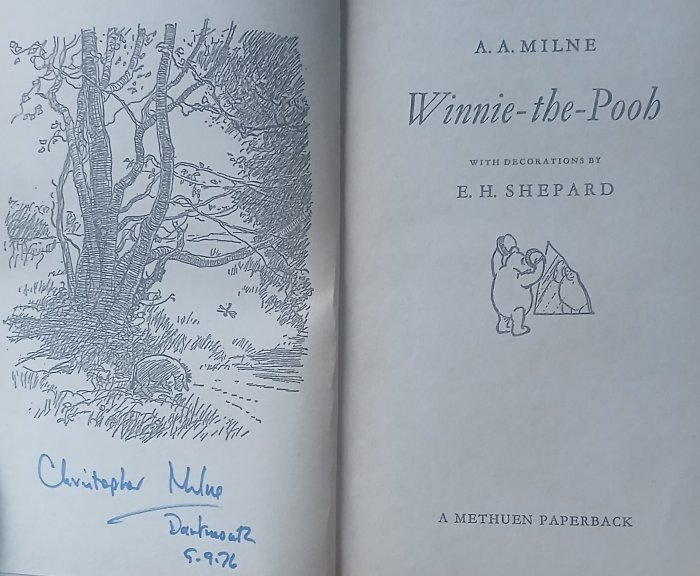
So I’ve settled down and to mark the centenary of the book’s publication and opened it again for the first time for many years only to find I’d forgotten what a great joy it is to read it, as it is written as though A A Milne is telling a story to his son with questions and suggestions coming the other way. The introduction and start of the first chapter explains, as far as is possible, how Christopher Robin came to rename his bear from Edward Bear to Winnie-The-Pooh, Pooh was after a swan that he had named that when he was very young and first going to the park. Winnie however is much more exciting as that was after a real bear called Winnipeg that Christopher Robin had met in London Zoo and regularly went to visit, even being allowed in the cage with her. The ‘The’ part is more difficult as told in the first chapter.
When I first heard his name, I said, just as you are going to say, “But I thought he was a boy?”
“So did I” said Christopher Robin
“Then you can’t call him Winnie?”
“I don’t”
“But you said—-“
“He’s Winnie-ther-Pooh. Don’t you know what ther means?”
“Ah yes, now I do” I said quickly; and I hope you do to, because it’s all the explanation you are going to get.
And so the stories begin and we are introduced to the other characters, beginning with Piglet, then Rabbit and Owl, Eeyore comes a little later and in the last three chapters we get Kanga and baby Roo. One part I had completely forgotten is that when Kanga first appears Rabbit decides to try to get rid of her by kidnapping Roo and making her leave in order to get Roo back. No I haven’t forgotten Tigger as he doesn’t appear in this book, only being introduced in ‘The House at Pooh Corner’ as Christoper Robin had by then been given a cuddly tiger toy and therefore he needed to be included.
The copy of the book that I’ve read and was featured at the beginning of this blog is from a set of facsimile volumes published by Meuthen in 1999 and sold by The Folio Society. Pleasingly they were printed by Jarrolds, who printed the original first editions.

