Winnie-The-Pooh – A A Milne

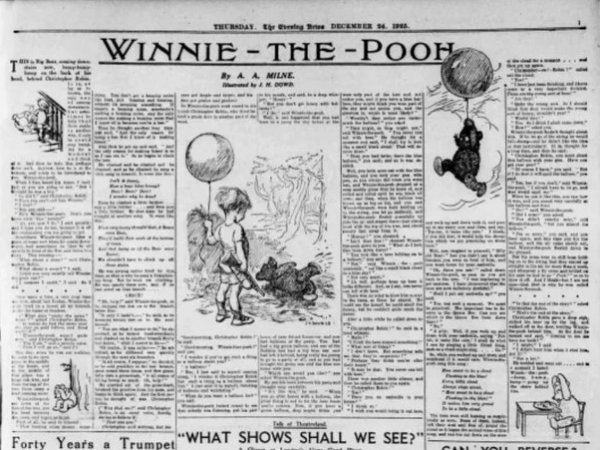
Happy one hundredth birthday Winnie-The-Pooh. The book where Pooh first appeared by name was first published on 14th October 1926 so technically this blog for his centenary is a day early, or it could be nearly ten months late or possibly almost two years late, the clue is in the careful way in which I started this sentence. I’ll explain, yes the book called Winnie-The-Pooh appeared on the date I’ve given but he first featured in the short story The Wrong Sort of Bees published in the newspaper London Evening News on 24 December 1925 and this story became the first chapter of the book when it was published so that is the possibility of this blog being ten months late.
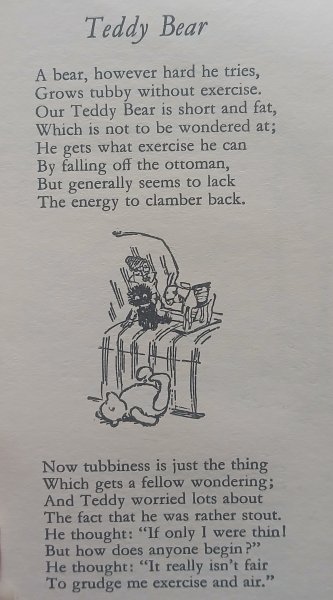
But what about that possible two years late well that is because Winnie-The-Pooh wasn’t A A Milne’s first children’s book, that was ‘When We Were Very Young’ first published on 6th November 1924 and in there (starting on page 85 to be precise) you will find a poem called ‘Teddy Bear’ where the titular character has the name Edward Bear but the illustrations by Ernest Shepard are definitely of the bear we know today as Winnie-The-Pooh. Which is only right as we know that Christopher Robin received his bear for his first birthday on 21st August 1921 and renamed him later. Edward can also be glimpsed at the top of the stairs behind Christoper Robin a few pages earlier in the illustration for ‘Halfway Down’ and indeed in the first sentence of ‘Winnie-The-Pooh’ he is still called Edward Bear.
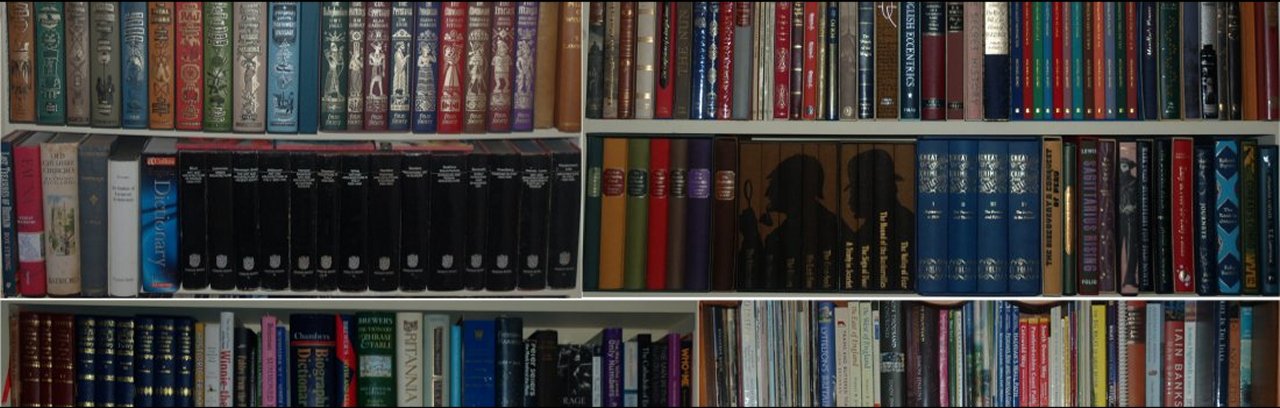
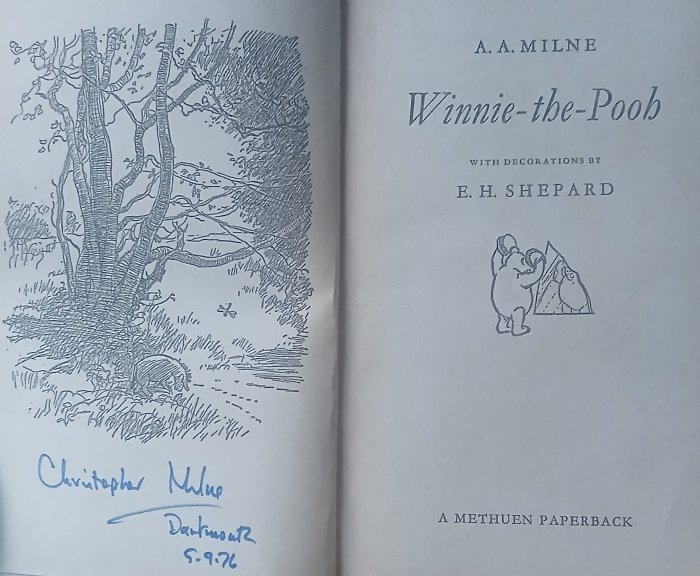
So is Pooh 100 or almost 101 or even almost 102, well the real bear is 105 and looks nothing like the Winnie-The-Pooh we know from the books and even less like the Pooh as portrayed by Disney, so I don’t think it matters very much. Indeed if you want to see what the real Winnie-The-Pooh looks like, four years ago I did a blog about the excellent book by Shirley Harrison which covers ‘The Life and Times of the Real Winnie-The-Pooh‘ and I have several editions of the four books including a set of paperbacks signed by Christopher Robin whilst he was running a bookshop in Dartmouth.
So I’ve settled down and to mark the centenary of the book’s publication and opened it again for the first time for many years only to find I’d forgotten what a great joy it is to read it, as it is written as though A A Milne is telling a story to his son with questions and suggestions coming the other way. The introduction and start of the first chapter explains, as far as is possible, how Christopher Robin came to rename his bear from Edward Bear to Winnie-The-Pooh, Pooh was after a swan that he had named that when he was very young and first going to the park. Winnie however is much more exciting as that was after a real bear called Winnipeg that Christopher Robin had met in London Zoo and regularly went to visit, even being allowed in the cage with her. The ‘The’ part is more difficult as told in the first chapter.

When I first heard his name, I said, just as you are going to say, “But I thought he was a boy?”
“So did I” said Christopher Robin
“Then you can’t call him Winnie?”
“I don’t”
“But you said—-“
“He’s Winnie-ther-Pooh. Don’t you know what ther means?”
“Ah yes, now I do” I said quickly; and I hope you do to, because it’s all the explanation you are going to get.

And so the stories begin and we are introduced to the other characters, beginning with Piglet, then Rabbit and Owl, Eeyore comes a little later and in the last three chapters we get Kanga and baby Roo. One part I had completely forgotten is that when Kanga first appears Rabbit decides to try to get rid of her by kidnapping Roo and making her leave in order to get Roo back. No I haven’t forgotten Tigger as he doesn’t appear in this book, only being introduced in ‘The House at Pooh Corner’ as Christoper Robin had by then been given a cuddly tiger toy and therefore he needed to be included.

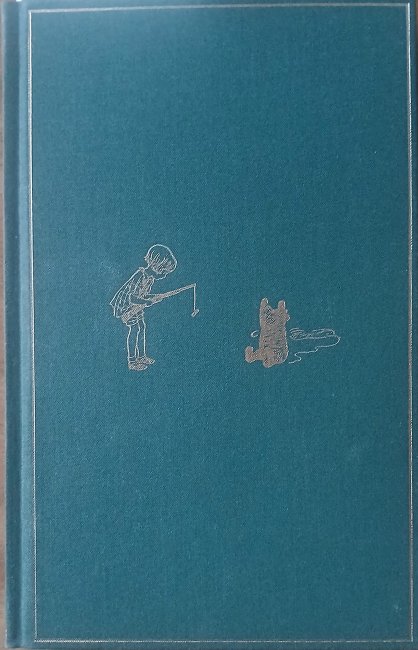
The copy of the book that I’ve read and was featured at the beginning of this blog is from a set of facsimile volumes published by Meuthen in 1999 and sold by The Folio Society. Pleasingly they were printed by Jarrolds, who printed the original first editions.
When I was Very Young – A.A. Milne

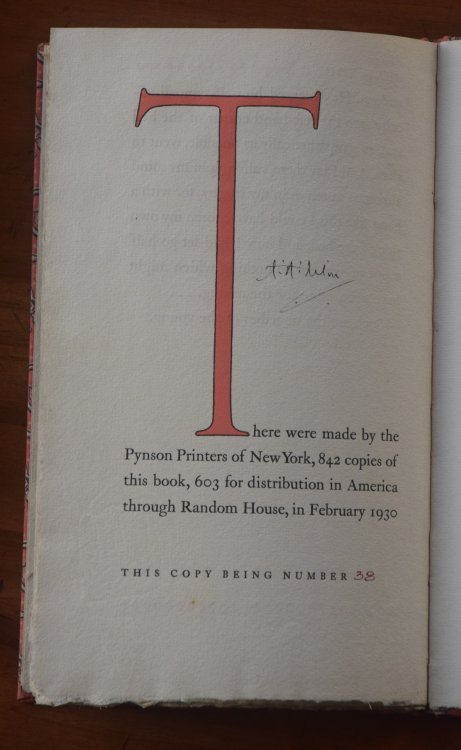
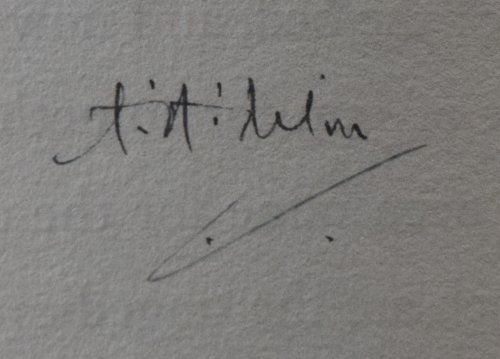
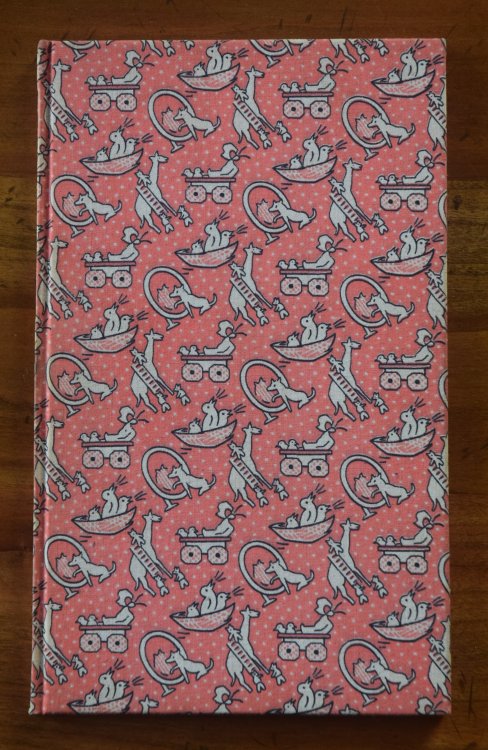
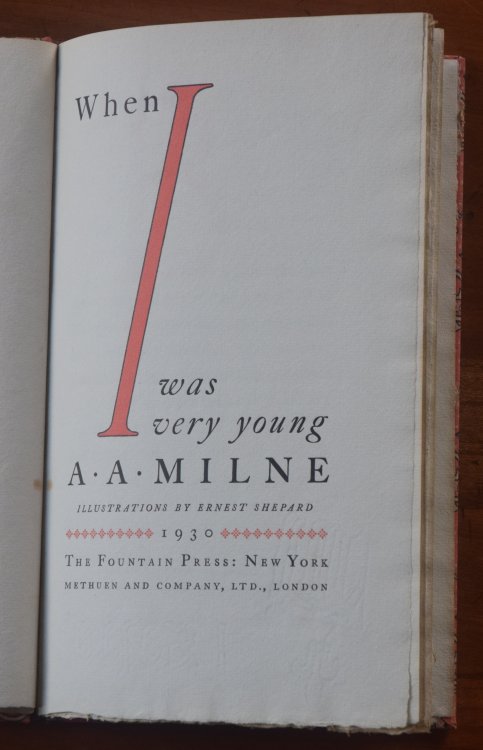
Although nowadays best known for his stories about his son Christopher Robin and his toys Winnie The Pooh and all the other characters in the Hundred Acre Wood, Alan Alexander Milne would rather be known for his other books and plays. He wrote a surprisingly good crime novel (The Red House Mystery) and over 3 dozen plays along with several books of non-fiction. When I was Very Young is one of his rarest works as the only publication of it is the limited edition from The Fountain Press printed in 1930. Just 842 copies were produced and all were signed by Milne on the limitation page at the back of the book, my copy is number 38. The book comes in a plain card slipcase rather than a dust wrapper although this easily damaged and is often missing from copies for sale

20180619 When I was Very Young 1

The book consists of five short biographical stories from Milne’s childhood which are written in the first person and probably true as the facts that it is possible to check are accurate, such as H.G. Wells being his science teacher at his first school, where his father was head-master. In the book his two older brothers are called David and John (in reality David Barrett Milne and Kenneth John Milne) and the age differences are correct along with the description of all three having blue eyes and golden hair. There are several illustrations by Ernest Shepard and the pages have the feel of handmade paper with rough edges. It’s short, here are only 23 pages of text along with 2 title pages, one page with the copyright information and the limitation page at the back so it definitely only takes a few minutes to read.

20180619 When I was Very Young 2

All of Milne’s Christopher Robin books were also printed as deluxe editions along with several of his plays and other works some of which were also released as signed limited editions. Milne, or at least his agent in America assuming he had one, also seemed to go in for special editions only sold in the USA so there are numerous varieties of some of his titles to collect especially limited editions and pre-signed signed copies. When I was Very Young was not even the first short book by Milne in being initially issued exclusively as such a volume, in 1929 The Fountain Press released The Secret and Other Stories in an edition of 742. The Secret has however since been printed in unlimited modern editions leaving When I was Very Young alone in not being available to a wider readership.

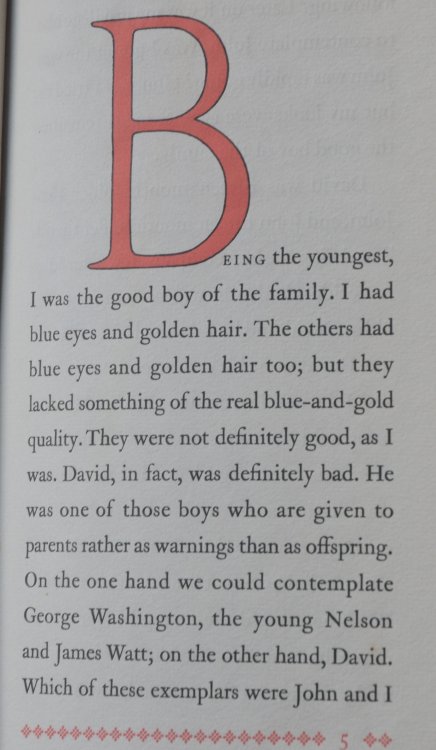
The first page sets the scene

20180619 When I was Very Young 3

After this introduction to the boys David isn’t mentioned in the first two tales, it is clear that Alan and John were close playmates though and the two boys shared a bed for many years but David, as the eldest, presumably had his own room. The first tale is a bit odd as it relates to an apparently shared dream of the two boys when they were about 5 years old for them to wake up one morning and find that everyone else in the world was dead.

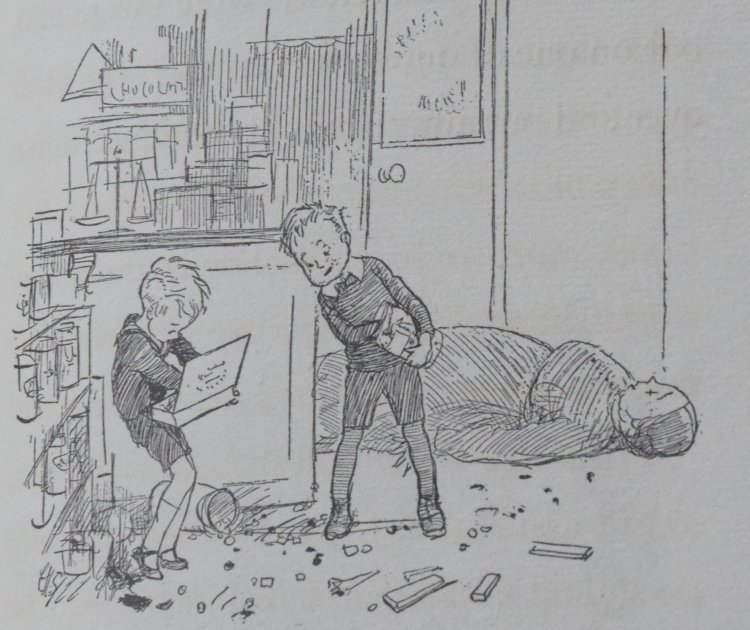
As soon as we woke up we should know that it had happened; the absence of the governess from our morning toilet, the discovery of her body in the passage between her room and ours – these would be the first signs. Having explored all over the house to make sure that the thing had been done properly, and that there really were no survivors to say “Don’t” we would then proceed to such-and-such, a sweetshop, step over the body of the proprietress and have our first proper breakfast.

There then follows a drawing by Shepard with the boys eating chocolates and sweets in the shop with the corpse in the background.

20180619 When I was Very Young 4

Not exactly the gentle Winnie the Pooh type tale you might expect! The second story is considerably less disturbing but none the less would be surprising to us nowadays. The two boys had collected various mineral samples and decided that they wanted to show them to somebody at the Geological Museum (then in Jermyn Street). By now it was 1890 and they were 8 and 9 years old and living in St Johns Wood, which is about 3½ miles (5½ km) from the museum. However their father seemed quite happy to let them go on their own as long as they ‘asked a policeman to help them cross Piccadilly Circus’, one of the most busy and therefore dangerous junctions in the city. They manage the trip, meet the curator who spends time with them looking at their small collection and also shows them round the museum and on their way back buy some matches to strike in their bedroom at night after the lights had gone out.

Two very short reminiscences follow, both featuring all three boys, in the first, inspired by a book called The Golden Key they put on an impromptu (and unscripted) play which turns out to be very short and in the second again after being inspired by a book they decide to be sailors and having lined up in front of their father David explains this to him. After consideration their father explains that “There will be examinations to pass”, at this David promptly gives up on the idea.

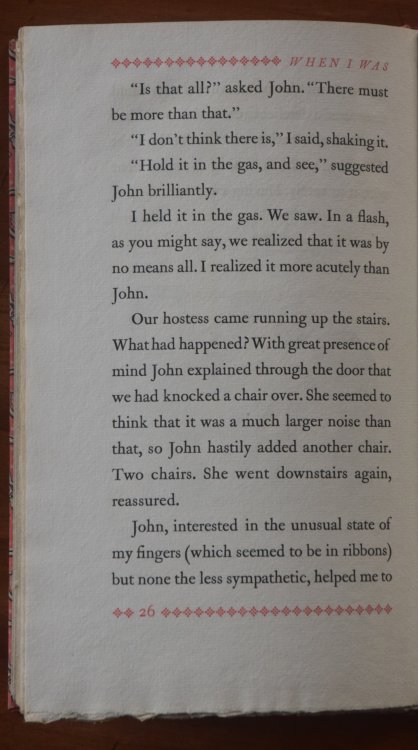
The final story moves us forward in time again to 1896 when ‘John’ and Alan were both at Westminster Public School and Alan was 14. Although they were boarding students they were allowed out at weekends providing they had somewhere to stay and this one weekend they were staying at the home of some elderly friends of their father. They had found a firework left over from the bonfire night celebrations and decided to extract the gunpowder from it. After a while a fairly disappointing quantity of powder was tipped out…

20180619 When I was Very Young 7

I don’t know why Milne always refers to his brother as John rather than Kenneth or Ken in this short volume, particularly as he always calls him Ken in his book It’s Too Late Now: The Autobiography of a Writer published in 1939 and dedicated as follows; 1880-1929 To the memory of KENNETH JOHN MILNE who bore the worst of me and made the best of me.

Oddly David is called Barry in the autobiography so Alan does like to confuse his readers.

20180619 When I was Very Young 5

The signed limitation page at the back of the book

20180619 When I was Very Young 6