For Art & For Life – Vincent van Gogh

This book consists of a collection of letters from van Gogh, mainly to his brother Theo, although there are other correspondents. I was at once struck by how van Gogh writes as he paints, with descriptions of people and landscapes as though he was actively setting them down on paper or canvas. Take for example a letter from November 1885 written in Antwerp, where he had recently moved and he is trying to get a feel for the surroundings that are so different from the countryside he has just left.

… with the city behind one at the end of the landing stages where the Harwich and Havre steamers lie, there is nothing, absolutely nothing to be seen in front except for an infinite expanse of flat, half flooded pasture, immensely melancholy and wet, with undulating dry reeds and mud – the river with a single small black boat, water in the foreground grey, sky misty and cold grey – still as the desert.
As to the overall impression of the harbour, or of one of the docks – at one moment it is more tangled and fantastic that a thorn hedge, so chaotic that one finds no rest for the eye, grows giddy, and is forced by the papillot-ering colours and lines, to look first here, and there, unable to distinguish one thing from another – even after looking at the same point for a long time. but if one moves on to a certain spot with an undefined stretch of land in the foreground, then one again encounters the most beautiful, most peaceful lines and those effect which Mols, for instance, so often achieves.

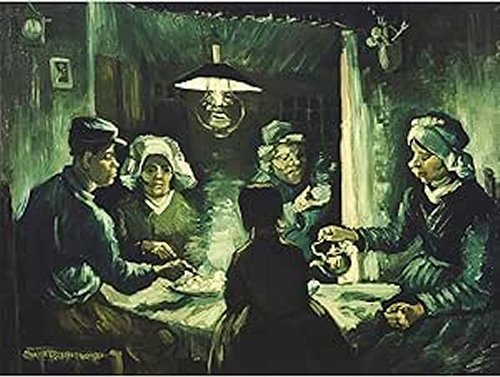
The artist Mols referred to above is either Florent or Robert Mols, probably Robert as his works seem to fit the description better. This extract is from the happier early times whilst van Gogh was still learning his trade and numerous letters describe studies he is making of the peasants around his countryside home and the only significant painting he describes working on is ‘The Potato Eaters’ shown below. Note the book doesn’t contain any images but I found it helpful to refer to his pictures when reading the letters that describe them.

I think the best way to review the book is to use van Gogh’s own words as I so enjoyed the letters that I’m amazed that I hadn’t come across them before. The book is an excellent replacement for the autobiography he never wrote, and would never have regarded himself as an appropriate subject for, as you get the see how he is thinking and reacting to his surroundings and ever present money troubles as paint and canvases are so expensive especially when he isn’t successfully selling any of his works. After the first section ‘Becoming an artist’ we move on to ‘The best days’ when he is at his most productive and he describes furnishing his home and hanging a series of paintings of sunflowers there, these were simply decoration to the house but now of course are some of his most valuable works. But the painting from this period I want to highlight is described below.

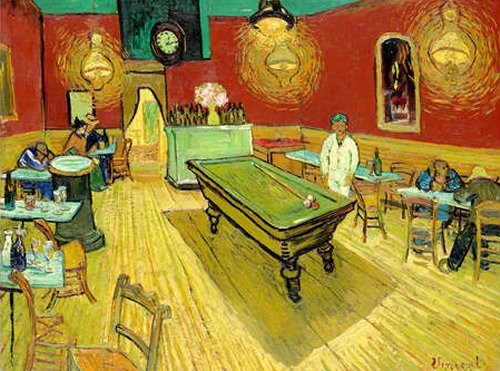
In my picture of The Night Cafe, I have tried to express the idea that the cafe is a place where one can destroy oneself, go mad or commit a crime. In short I have tried, by contrasting soft pink with blood-red and wine-red, soft Louis XV green and Veronese green with yellow-greens and harsh blue-greens all this in an atmosphere of an infernal furnace in pale sulphur, to express the powers of darkness in a common tavern. And yet under an outward show of Japanese gaiety and Tartarin’s good nature.
But what would Mr Tersteeg say about this picture, a man, who faced with a Sisley, Sisley mind you, the most unassuming and sensitive of the impressionists said “I can’t help thinking that the artist who painted this was a little tipsy”. Faced with my picture he’d say it was a raging case of delerium tremens.

The picture he is describing so wonderfully, I love that last line, is ‘Night Cafe in Arles’ and wow has he leapt forward with his use of colour. With ‘The Potato Eaters’ he describes that it should be hung with a gold background to lift the darkness of the image but here you would need a more subdued wall colour to get the best result. In contrast Alfred Sisley is positively restrained.

The final section of the book is entitled ‘Towards the end’ and begins after van Gogh had threatened his friend Gauguin with a razor and was found the next day having severed one of his own earlobes, clearly the mental issues that would result in his suicide are starting to make themselves apparent. Gauguin sensibly left van Gogh’s house in Arles soon afterwards but this left van Gogh on a downward spiral and considering either entering an asylum or joining the Foreign Legion. The former would cost him money, which he didn’t have, whilst at least he would earn something in the army, unfortunately whilst in hospital recovering from his injury his house and studio was ruined in a flood so he would have to move at the very least. It turns out that he did move but to an asylum at his brothers expense and here he starts to understand his mental condition through contact with the other inmates and he still paints as explained in this letter to Theo dated September 1889

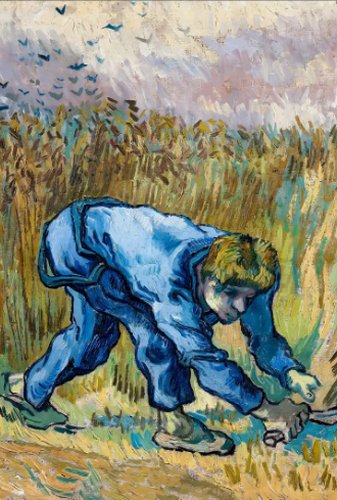
Aha! The Reaper is finished. I think it’ll be one of those you’ll keep at home – it’s an image of death as the great book of nature speaks of it – but the effect I’ve been looking for is – ‘on the point of smiling’. It’s all yellow except for a line of purple hills. A pale and golden yellow. I find it odd that I saw it like that through the iron bars of a cell.

The Reaper painted in the asylum in 1889, just ten months later he was dead

9th & 13th – Jonathan Coe

I needed something short this week, the last eight books have averaged 335 pages each, which is a lot to read and write about every week. This slim volume is the complete collection of short stories by British novelist Jonathan Coe and even then it is so short he still had to add a piece of journalism to get the book to much more than a pamphlet. There are three short stories and as Coe explains in the introduction this is mainly due to how difficult he finds writing “over a short distance” and finds that even if he starts out to write a short story he gets involved in the various possibilities and ends up with a novel instead. I’m glad he included the extra article especially as it is the first time it had appeared in English, it was written for the French film periodical ‘Cahiers du Cinéma‘ (Notebooks on cinema), as I really enjoyed it. Knowing that there wasn’t much material to work with Coe originally considered making the entire volume a collection of pieces of journalism from the seven or eight years he worked in that field before the novels took over, but rejected that idea:

it provided a perfect moment to rescue some lost journalistic gems from undeserved obscurity. Having trawled through my hard disk, however, I’ve reached the conclusion that obscurity is exactly what most of that writing does deserve.

Ivy and Her Nonsense

The first story is a fictionalised version of Coe’s memories of a childhood Christmas spent at his grandparents home in Shropshire when he was seven years old, he grew up in the south west corner of Birmingham so Shropshire was only just over the border. It is clearly a happy time and the book is dedicated to his grandfather in tribute even though he did advise Coe to give up writing and get a job in teaching, but that was before he started to become successful and sadly his grandfather didn’t live to see him published. The story is told from the young boy’s perspective, so not really understanding what is going on around him, his grandmother had been on the jury of a murder trial just a week or so earlier and the adults were trying not to discuss the case in front of Jonathan and his sister whilst the children were fascinated by anything they could glean.

9th & 13th

With story two we leap across the Atlantic to New York with a piano player telling the story of how he met a young woman, new into town and what might have happened if things had gone as he wishes they had. Wonderfully this story is available in a recording where the explanation of the chord described is played, which helped me a lot as I can’t play so was struggling with the imagery. You can hear the story here.

V.O.

The title stands for Voice-over and it only becomes clear why near the end of this quite poignant love story set at a horror and fantasy film festival which William is attending as part of the panel of judges, in his case specifically with regard to the soundtrack as he has made a career as a composer. The films however are rather mediocre and not to his taste, being rather more gore spattered than his normal viewing. Coe clearly had fun coming up with unpromising film ideas, my favourite being the “hilarious necrophiliac comedy called One Corpse at a Time, Please!”, although like William I’m quite sure I don’t want to see it. We start with William being interviewed by Pascale although the interview is soon forgotten and morphs into something more serious without either of them apparently realising where it is going, the denouement is beautifully written and perfectly ends the tale.

Diary of an Obsession

Finally we reach the piece of journalism and it explores a fascination that Coe developed from childhood with an obscure film by Billy Wilder called ‘The Private Life of Sherlock Holmes’. It follows his rising interest from first seeing a novelisation of the film for sale in a Cornish bookshop in 1972 whilst aged eleven during a family holiday, and frankly the cover design with Sherlock Holmes framing a half naked woman horrified him as he loved the Holmes stories and this clearly wasn’t an appropriate interpretation. Three years later the film was broadcast on the television and he watched it, somewhat confused by the story line which seemed to jump around rather a lot but drawn in by the music soundtrack by a composer he had never heard of. Eventually over the years Coe would grow up and marry but still was drawn back to the film much to the bemusement of his wife especially after he bought a copy of the book and whilst reading it discovered that a lot was missing from the film. It turned out that studio executives had made Wilder heavily chop the film he had made to the point that it barely made any sense to the viewer and Coe then became obsessed by finding out if any of the edited out parts still exist. He wrote the article that this part of the book features in 1998, but there is a postscript as in 2004 he sent the article to Wilder himself, now aged ninety four, and asked if he could do a follow up interview. Wilder was delighted that somebody was still interested in this largely bowdlerised work but declined the interview. The article is really well written as you follow Coe finding out more and more about the film and its music over the years so I would very much like to see more of his journalism rescued from obscurity.

William Blake: Dante’s Divine Comedy – Maria Antonietta Terzoli & Sebastian Schütze

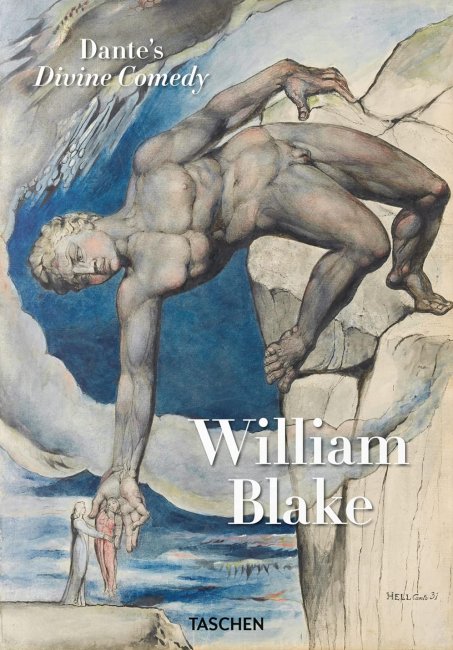
First things first, this isn’t a review of Dante’s Italian masterpiece The Divine Comedy, rather it is a book of a whole collection of works of art by the English artist and poet William Blake. I have the Folio Society edition of Inferno, the first book of Dante’s trilogy, illustrated by Blake and when I saw this profusely illustrated volume from Taschen of all 102 of the illustrations he produced for the three sections I had to have it. Blake died in 1827 before completing the series of works and some are little more than sketches but the ones that are completed give a feel for how the complete collection would have looked like. In total he produced seventy two works for part one of Dante’s great poem, Inferno, twenty for part two, Purgatorio, and just ten for the concluding section Paradiso.

This book is split into four main sections, the first is by the head of the department of Italian Studies at the University of Basel, Maria Antonietta Terzoli, and summarises the poem along with putting it in historical context. The second is by professor of early modern art history at Vienna University,Sebastian Schütze, and looks at earlier artists works influenced by Dante including famously Michelangelo and Gustave Dore and how these could have influenced Blake in his re imagining of the work. Both of these sections are profusely illustrated by works from other artists to give context and Schütze also looks at other works by Blake. The third section is also by Schütze and consists of all 102 plates each in a double page spread, where they are compete enough, or single page where just a sketch or even just a plan as to what would be there exists set against the quote from the poem that inspired the work and a brief analysis of what is depicted. The final section deals with the handful of works where Blake completed the line engravings that would have been used if the works had been completed and printed.

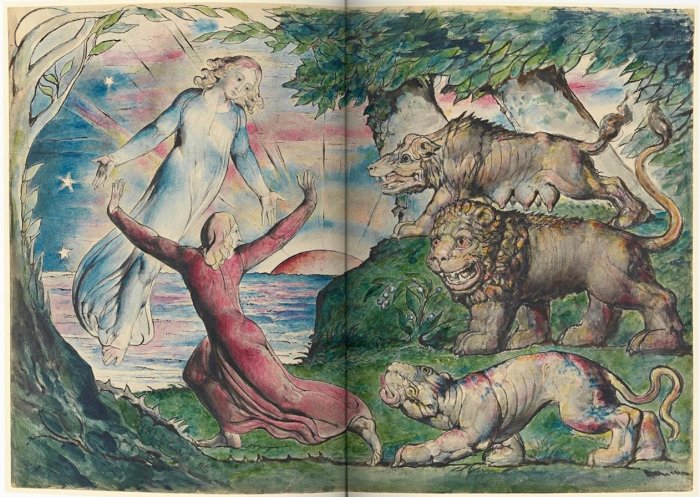
The poem starts with Dante, dressed in red, walking through a wood when he is pursued by three wild animals. He meets the ghost of the ancient Roman poet Virgil, dressed in blue, who explains that Dante has been chosen to explore Heaven and Hell and that Virgil will be his guide and protector. The image above is the first of the plates by Blake and represents this encounter with the leopard, lion and she-wolf with Virgil pointing out the route to safety even if it is on a hazardous journey. The originals of the art are in seven museums and galleries around the world, this one is in The National Gallery of Victoria in Melbourne, Australia, and what I like about this book is the fact that Taschen have obtained wonderful reproductions of all the works regardless of where they are now situated so the reader can fully appreciate the skill of the artist.

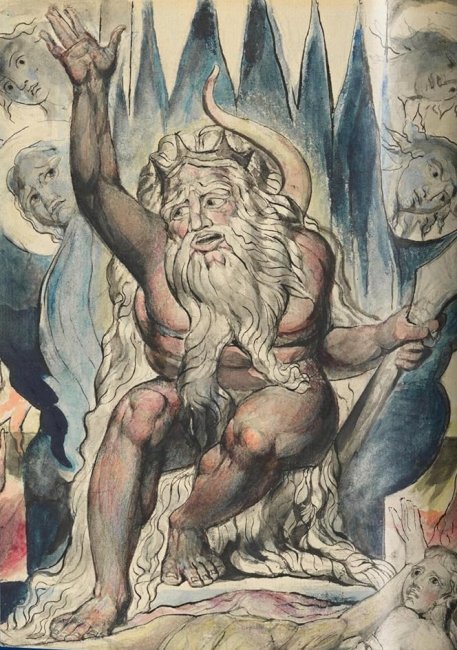
The next painting I have chosen to give a feel for the remarkable art produced by Blake for this project is of Minos the judge of Hell which Dante and Virgil encounter on entering the second of the nine circles of Hell in canto V of Inferno. Minos determines in which of the nine circles a sinner should be placed. This is only part of the full work by Blake, many of the works published in the book also have full page details of them included so you can greater appreciate the skill of the artistry. Dante and Virgil are climbing up to him through a pit of flames in the bottom left of the full image, the upraised fingers of Virgil’s hand can just be seen in the selection. This example is executed in pencil, pen and ink, chalk and watercolour, whatever medium or combination of mediums Blake thought would give the effect he required, again it is in the National Gallery of Victoria

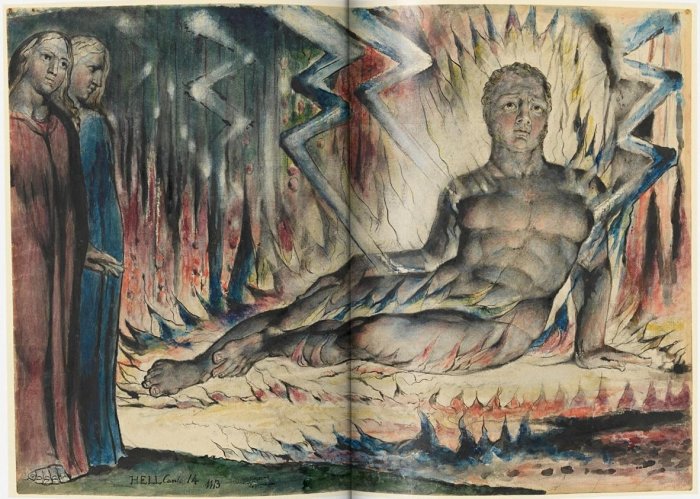
The next double page spread I have chosen is from canto 14 of Inferno by which time Dante and Virgil have reached the third ring of the seventh circle of Hell, this depicts Capaneus the Blasphemer who was killed by Jupiter for his pride that placed him above the gods. This is one of several examples in the poem where classical mythology intersects with the more basic telling of Christian belief of Hell ruled by Lucifer, who they also meet, and a heaven with Christ and angels. Virgil addresses him:

O, Capaneus, because your pride remains unquenched
you suffer greater punishment.
In your own anger lies your agony
a fitting torment for your rage.

Capaneus seems unmoved by the torment however at least in Blake’s interpretation. Yet again the original is in The National Gallery of Victoria.

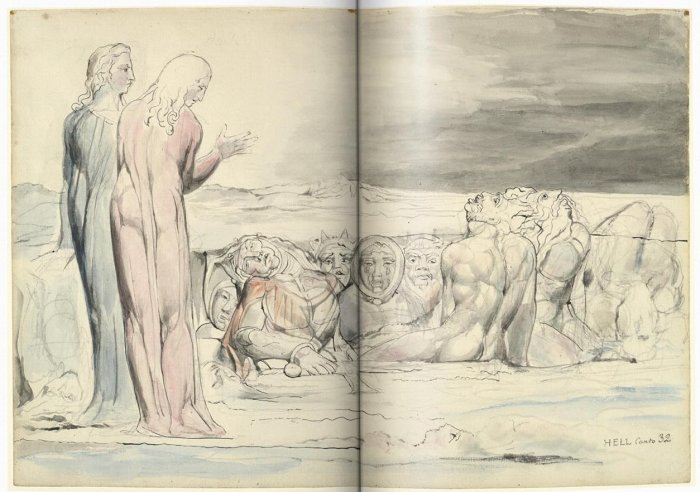
As an example of one of the pictures that is not finished, although others are considerably more sketch like than this, is a depiction of the final circle of Hell, the Circle of the Traitors where in the ultimate irony they are locked in ice. The extreme right shows two figures, their hair entwined, these are the Alberti brothers who killed each other in a dispute over their inheritance. Dante includes numerous people that would be familiar to his readers at the time, around 1320. This work is in the Fogg Art Museum, one of the Harvard University Art Museums.

I’d like to go back to the cover which depicts the giant Antaeus setting down Dante and Virgil in this final circle so that they could cross the cavern surrounding this circle of Hell. The book is wonderful and whether you are interested in Dante’s great work or the art of William Blake, or indeed both as I am, there is so much to get from this volume. The production is of the highest level as you would expect from Taschen and the whole book consists of 464 lavishly illustrated pages on fine quality art paper and as such is very heavy weighing 1.59kg.