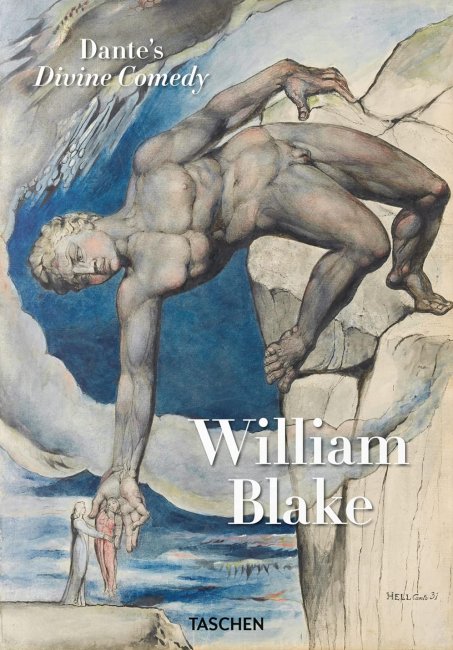
First things first, this isn’t a review of Dante’s Italian masterpiece The Divine Comedy, rather it is a book of a whole collection of works of art by the English artist and poet William Blake. I have the Folio Society edition of Inferno, the first book of Dante’s trilogy, illustrated by Blake and when I saw this profusely illustrated volume from Taschen of all 102 of the illustrations he produced for the three sections I had to have it. Blake died in 1827 before completing the series of works and some are little more than sketches but the ones that are completed give a feel for how the complete collection would have looked like. In total he produced seventy two works for part one of Dante’s great poem, Inferno, twenty for part two, Purgatorio, and just ten for the concluding section Paradiso.
This book is split into four main sections, the first is by the head of the department of Italian Studies at the University of Basel, Maria Antonietta Terzoli, and summarises the poem along with putting it in historical context. The second is by professor of early modern art history at Vienna University,Sebastian Schütze, and looks at earlier artists works influenced by Dante including famously Michelangelo and Gustave Dore and how these could have influenced Blake in his re imagining of the work. Both of these sections are profusely illustrated by works from other artists to give context and Schütze also looks at other works by Blake. The third section is also by Schütze and consists of all 102 plates each in a double page spread, where they are compete enough, or single page where just a sketch or even just a plan as to what would be there exists set against the quote from the poem that inspired the work and a brief analysis of what is depicted. The final section deals with the handful of works where Blake completed the line engravings that would have been used if the works had been completed and printed.
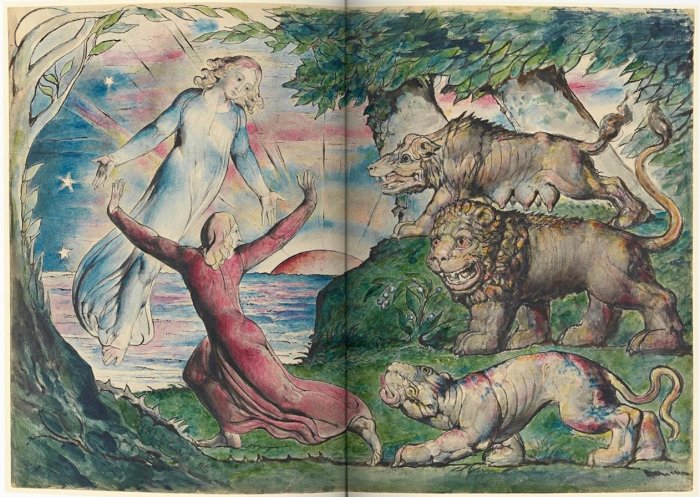
The poem starts with Dante, dressed in red, walking through a wood when he is pursued by three wild animals. He meets the ghost of the ancient Roman poet Virgil, dressed in blue, who explains that Dante has been chosen to explore Heaven and Hell and that Virgil will be his guide and protector. The image above is the first of the plates by Blake and represents this encounter with the leopard, lion and she-wolf with Virgil pointing out the route to safety even if it is on a hazardous journey. The originals of the art are in seven museums and galleries around the world, this one is in The National Gallery of Victoria in Melbourne, Australia, and what I like about this book is the fact that Taschen have obtained wonderful reproductions of all the works regardless of where they are now situated so the reader can fully appreciate the skill of the artist.
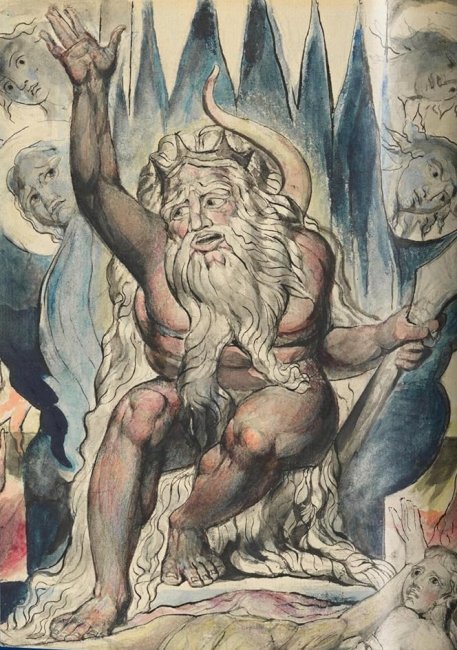
The next painting I have chosen to give a feel for the remarkable art produced by Blake for this project is of Minos the judge of Hell which Dante and Virgil encounter on entering the second of the nine circles of Hell in canto V of Inferno. Minos determines in which of the nine circles a sinner should be placed. This is only part of the full work by Blake, many of the works published in the book also have full page details of them included so you can greater appreciate the skill of the artistry. Dante and Virgil are climbing up to him through a pit of flames in the bottom left of the full image, the upraised fingers of Virgil’s hand can just be seen in the selection. This example is executed in pencil, pen and ink, chalk and watercolour, whatever medium or combination of mediums Blake thought would give the effect he required, again it is in the National Gallery of Victoria
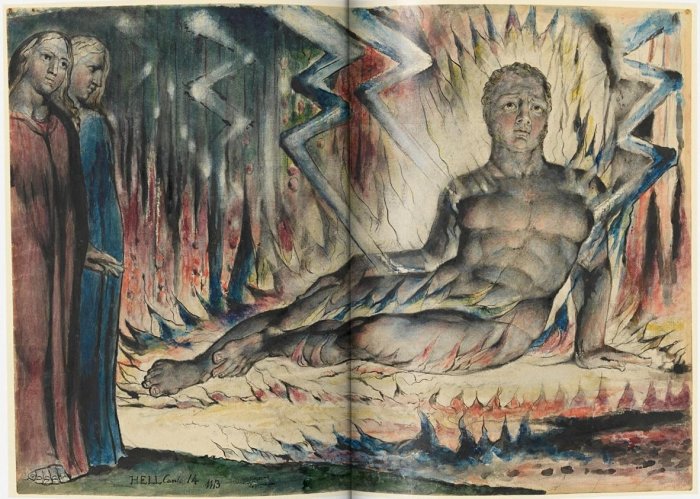
The next double page spread I have chosen is from canto 14 of Inferno by which time Dante and Virgil have reached the third ring of the seventh circle of Hell, this depicts Capaneus the Blasphemer who was killed by Jupiter for his pride that placed him above the gods. This is one of several examples in the poem where classical mythology intersects with the more basic telling of Christian belief of Hell ruled by Lucifer, who they also meet, and a heaven with Christ and angels. Virgil addresses him:
O, Capaneus, because your pride remains unquenched
you suffer greater punishment.
In your own anger lies your agony
a fitting torment for your rage.
Capaneus seems unmoved by the torment however at least in Blake’s interpretation. Yet again the original is in The National Gallery of Victoria.
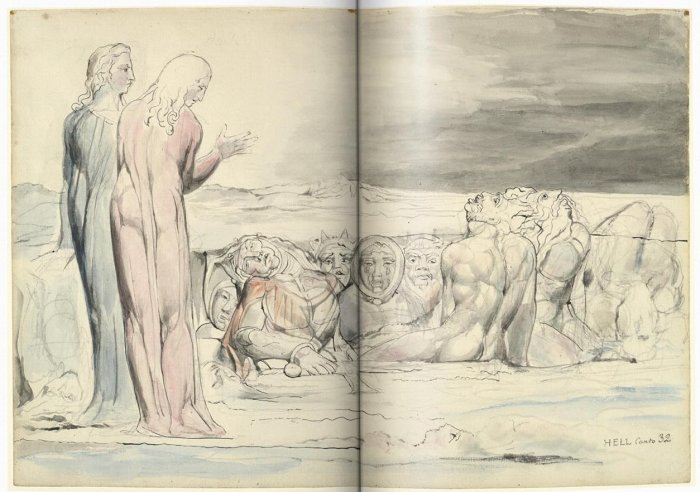
As an example of one of the pictures that is not finished, although others are considerably more sketch like than this, is a depiction of the final circle of Hell, the Circle of the Traitors where in the ultimate irony they are locked in ice. The extreme right shows two figures, their hair entwined, these are the Alberti brothers who killed each other in a dispute over their inheritance. Dante includes numerous people that would be familiar to his readers at the time, around 1320. This work is in the Fogg Art Museum, one of the Harvard University Art Museums.
I’d like to go back to the cover which depicts the giant Antaeus setting down Dante and Virgil in this final circle so that they could cross the cavern surrounding this circle of Hell. The book is wonderful and whether you are interested in Dante’s great work or the art of William Blake, or indeed both as I am, there is so much to get from this volume. The production is of the highest level as you would expect from Taschen and the whole book consists of 464 lavishly illustrated pages on fine quality art paper and as such is very heavy weighing 1.59kg.


Gosh what a beautiful book, thank you!
LikeLike