A series of essays inspired by books that I own, talking about their history, some reviews and also how they came to be on my shelves. With over 6,500 books here and several more arriving each week I doubt I'll ever be short of a topic.
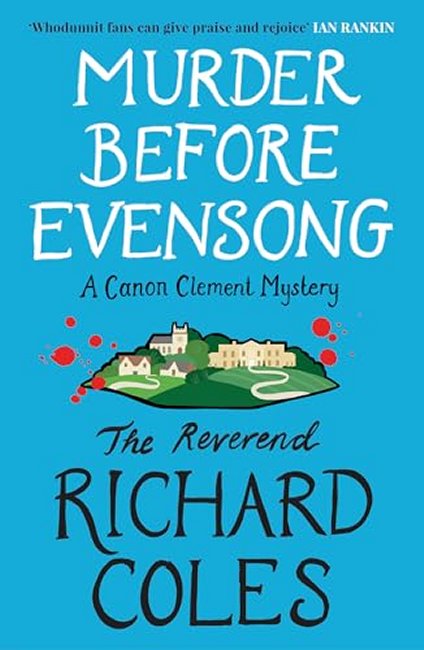
I do like a good murder mystery and I had previously greatly enjoyed Richard Coles’ biographical books ‘Fathomless Riches’ and ‘Bringing in the Sheaves’. The first of which tells of his early life and pop career with Bronski Beat and The Communards and the start of his religious career and the second dealing with life as a parish priest after his ordination. I therefore knew he could write so was really looking forward to this, his first murder mystery, although I am rather late to the party as it was published in 2022 and there are already five more books in the series featuring Canon Clement his priest-cum-detective. I have to say I was rather disappointed however.
Firstly it is rather slow to get going, and I have to say I got rather more enjoyment from the first hundred pages, which you have to get through before the first murder, in trying to work out when the book was set rather than the story being told. I was unsure as to whether it was the late eighties or the early nineties for quite a while but almost immediately after the murder there is a referred to event which clearly pinpoints the date of the death of Anthony Bowness to the evening of 23rd April 1988. You can tell that I wasn’t really gripped by the story so far as I stopped reading to look it up at the time. This was just before The Communards split up and Coles’ pop career effectively ended, which may or may not be significant in why he set it then. Once I knew a date I could keep checking items, for instance when Daniel Clement goes to the post office to buy stamps he is offered ones marking the 300th anniversary of the Welsh Bible as current commemoratives but those had already been superseded a month earlier by ones featuring sports. I still wasn’t completely drawn in by the plot, can you tell?
I think the main problem is that Canon Clement doesn’t actually do much in the way of sleuthing, he just has a bright idea near the end of the book, whilst preaching his sermon, which reveals the murderer to him. A sort of divine inspiration which frankly isn’t very satisfying. The reader is regularly reminded that Clement has a passion for pens and stationary, with him recognising valuable examples, but whilst proverbially the pen is mightier than the sword this proves to be of no consequence to the plot, so it fails to be the MacGuffin which is implied as a recurring motif.
As I said at the beginning, I know Coles can write and it is therefore highly possible that the later books are more engaging as he learns more about the structure of such novels, it is after all a perfectly competent first attempt at the genre. Am I going to read more to find out? Probably not, and I have already parted with my copy as I can’t see me ever reading it a second time.
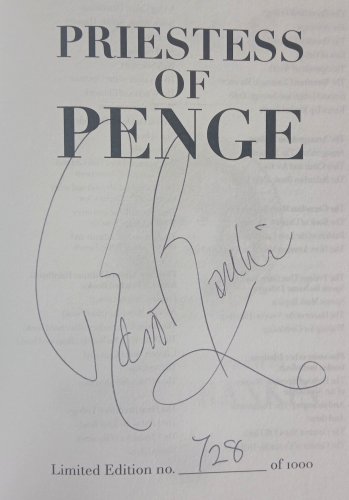
After the poetry of Billy Childish last week I needed some light relief and fortunately Robert Rankin’s latest book arrived in the post to provide it, there is nothing like the far fetched fantasy of Rankin to brighten the mood. The dust wrapper is unusual in that neither the title or the author are mentioned, indeed it is simply a wrap around of a lovely photograph of his wife out in the countryside with no text at all. That really wouldn’t work if he still had a contract with a major publishing house and sold books in bookshops, but those days are long gone and he nowadays self-publishes in limited editions of usually a thousand copies and that clearly works for him as this book sold out in about a week. I’ve been buying and reading his books since the 1980’s when he was published by Macmillan and later Doubleday and the obvious disadvantage of his self publishing is that he cannot easily attract new readers as only those people who already appreciate his fantastical style and follow him have a chance to buy the books or even come across him by chance as they don’t get reprinted after the original thousand are sold out. They do however eventually appear as Kindle editions but I for one don’t like reading a book on a screen.
So what of the plot of this newest tome? Well like a lot of Rankin’s books that is difficult to describe, most are set in the present day in fairly bland locations, there are twelve books in the Brentford trilogy for example which are as the name implies based in that otherwise nondescript suburb of West London. But this book moves location and time period, being set around Brighton on England’s south east coast and at the time of the Prince Regent, roughly 1820 as the Royal Pavilion is built and features heavily in the tale. The Rankin’s now live in Brighton so it’s an area he knows well although he does somewhat exaggerate the propensity for rain in that part of the country, it is repeatedly raining heavily in this novel.
The story concerns Edward, son of William, grandson of Robert and great grandson of the late lamented Lord Amesbury (he is regularly referred to by this whole genealogy) who at the start has just been thrown out of the family home by his father for selling most of the household library to cover his personal debts. Trudging along the road he meets Caradoc, a wizard, who tricks him into going on a quest to capture a knucker, or Sussex dragon, for the reward for doing so on behalf of the Prince Regent’s private zoo. In theory that is the plot, the finding and capture of a knucker but there is as usual for Rankin a huge amount going on around that bare concept including the mysterious Priestess of Penge seeking her Poly-Moo-Zuke, which I have no intention of trying to explain see later, and even the devil makes a significant appearance. Perhaps a quote will give you some idea of the ridiculous concepts so let’s have Edward meeting his companion on the quest, Rocinante.
Edward stared and stared again, for surely luck was truly on his side today. A hat lay unattended in the muddy thoroughfare. A tricorn hat, which would be just the thing for a ‘gentleman of the highway’. The fates were certainly smiling down upon him from their dry and golden palaces up high. Edward sloshed through the mud, took up the tricorn and prepared to set it upon his head, muddy though its bottom was, at an angle known as rakish. And then he saw what lay beneath the hat. For it was a head. And the face on the front of this head cried out to him saying “please would you help me out of this mud?” Edward glanced at the head, and once more at the hat. “Save my life”, called the mouth on the face of the head. “And you can keep the hat” A fine tricorn in return for a simple good deed.There was a balance to this and Edward liked the balance.He strained and struggled and tugged with a will and slowly a bedraggled figure was hauled from the murderous mire. “Thank you very very much” said the mud covered wreck of a man. “Now if you just be so kind as to assist me in pulling out the horse I was sitting on. I would be very grateful indeed.”
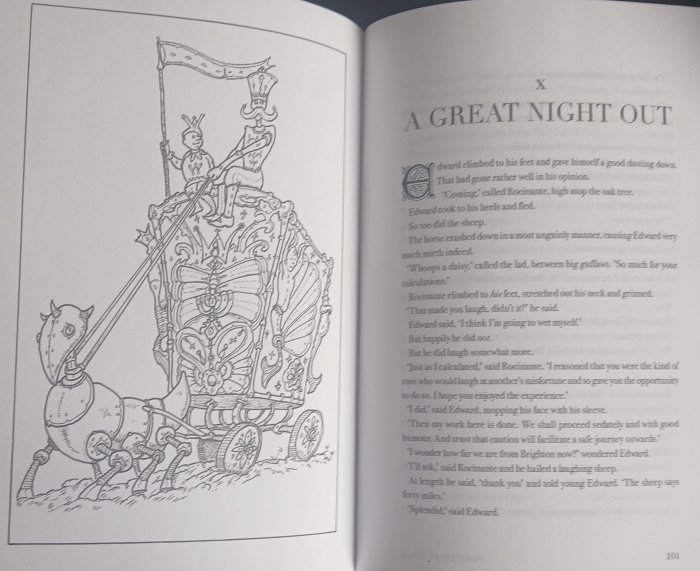
The book is illustrated as usual for Rankin’s self published works by his own distinctive drawings, in this case at the start of chapter ten the Poly-Moo-Zuke is seen pulling the caravan of The Wunderkind who is yet another outlandish character in a book full of outlandish characters but all somehow believable within their fantasy world. It was exactly what I needed to recover from the somewhat bleak poetry of Billy Childish.
Billy Chyldish, or Childish as it is spelt in my copy of his second novel from 1997 ‘Notebooks of a Naked Youth’, is ridiculously prolific with his Wikipedia page listing well over a hundred albums of music and almost a hundred books, including over seventy collections of poetry. He is also an artist win excess of a thousand works produced and a film maker, although he is not without controversy and this book does contain sexually explicit text which I’m not going to reprint here. The reason I’m reviewing it is not for its contents, although I have read it, but for the fascinating story of its existence. Chyldish or Childish was christened Steven John Hamper and has gone by various names including William Charlie Hamper, Bill Hamper, Bill Hamper-Childish, Guy Hamper, Jack Ketch, Gus Claudius and Danger Bill Henderson although I first came across him as the long time partner of British artist Tracy Emin in the 1980’s and his was the largest name (as Billy Childish) in her 1995 artwork ‘Everyone I Have Ever Slept With 1963-1995’.
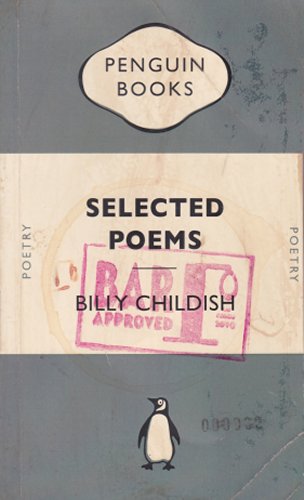
The book was originally published as Selected Poems (Billy Childish) in presumably tiny numbers, as a fine hand bound edition by Tangerine Press of Tooting in November 2009, they normally produce between fifty and seventy five copies. This was followed the next month by a B format soft back limited edition of five hundred by art gallery and dealers L-13 of Clerkenwell in what was described as ‘The Penguin Classic Art’ edition, presented as a homage to Selected Poems of D.H. Lawrence (released in March 1950 as Penguin Poets D11).
Penguin Books took considerable umbrage at this production and obtained a court order to require destruction of the print run.
L-13 unsurprisingly decided to turn this into a performance art event, for quite a while they were the main source for art by Bristol graffiti artist Banksy amongst others. and this was too good an opportunity to miss. Of the five hundred copies most were burnt by Billy Childish at what guests were told was a launch event on 21st January 2010, which was well covered by the press including New Musical Express who had a reporter there. With 113 copies surviving but heavily amended, ‘artistically altered’, to get round the restrictions of the court order. This surviving version of the first paperback edition is stamped in red ink inside “This book is NOT authorised by Penguin and is NOT for RESALE” and stamped in red ink on the front cover ‘BAR APPROVED’ (British Art Resistance) with an image of Childish’s gallows monogram dated 2010; it is further stamped at the bottom right of the front cover with an edition number out of 113 and a ‘L-13 editions’ stamp on the rear cover, again in red ink; the covers were further deliberately aged and defaced.These were presumably given away along with various A4 colour copies of photographs of the book burning. with a limited edition A3 poster, headed: Penguin Book Burning Dumb Insolence act 1 21-01-10 L-13
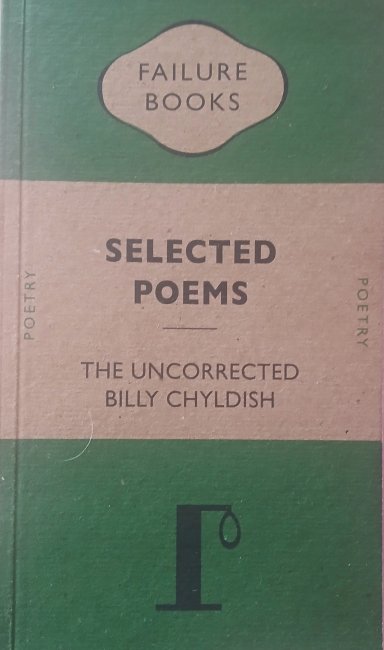
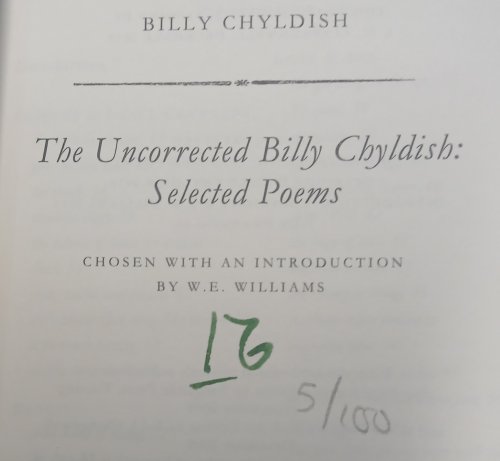
This brings us to the copy I have which is the third version and Childish continued his taunting of Penguin Books by basing the cover on a Penguin Crime cover with ‘Failure Books’ replacing ‘Penguin Books’ in the ogee at the top of the front and Childish’s gallows logo replacing the Penguin. This time just a hundred copies were printed and mine is number five making a grand total of about three hundred existing copies spread over three separate printings. As far as I know no other editions of this work exist.
It can be seen from the title page above that the poems are apparently chosen be W.E. Williams and he also ‘wrote’ the introduction. Sir William Emrys Williams was chief editor of Penguin Books from 1936 to 1965 and edited the Penguin Poetry series however he didn’t have any involvement with this book partly because he wouldn’t have wanted to have anything to do with it, but mainly because he had been dead for thirty three years by the time it came out.
Childish is dyslexic and the works included in the book are with uncorrected spellings, hence the subtitle. There are poems dealing with his violent father and the childhood sexual abuse he endured with a friend of his fathers along with various relationships over the years. But I’ll finish with a couple of examples of his work from this collection which don’t feature any of those themes which make his work so difficult to read, but somehow engaging, as he explores his life experiences both good and bad. So here is ‘with poems that sting like wasps’
i was in love with truth but not love with poems that sting like wasps and mad men in the sway of false gods
i have been stung so i too will sting and so i stung myself because truth without love is the worst type of lying
but all along secretly within this shell i always loved love and now i forgive all and see that even a wasp is nothing but a little winged tiger
Followed by ‘a big soft dog of a poet’
im no hard man im a big soft dog of a poet desperate for people to like me a damaged broken dog of a poet a half-man pierced by arrows
more sensitive than a sschoolgirl more prone to upsets alive with vengeneces more dangerous than a wounded wolf telling tails on self and others then whining for mercy
an angry chimp of a poet rageing thru the jungle hanging upside down thirsty for monkey brains
a living thieving rat of a poet who hates poetry who will not be a poet for you for your mother your lover or anyone
a lovable kitten of a poet tigerish and selfish whose verses are as harmless as milk
an ant of a poet acid-mouthed and creeping the type of charlatan who will deny hes wearing a hat whilst wearing a hat